

What do you think?

The Garden Party
Laura Sheridan finds her perspective of life altered when, following her family’s garden party, she visits the Sheridan’s neighbors to give her condolences on the passing of Mr. Scott. Katherine Mansfield’s “The Garden Party” captures the fleeting nature of youth and the unforeseen turns that life can take.
25 pages, Kindle Edition
Published April 29, 2014
About the author
Katherine Mansfield
1,063 books1,276 followersKathleen Mansfield Murry (née Beauchamp) was a prominent New Zealand modernist writer of short fiction who wrote under the pen name of Katherine Mansfield.
Katherine Mansfield is widely considered one of the best short story writers of her period. A number of her works, including "Miss Brill", "Prelude", "The Garden Party", "The Doll's House", and later works such as "The Fly", are frequently collected in short story anthologies. Mansfield also proved ahead of her time in her adoration of Russian playwright and short story writer Anton Chekhov, and incorporated some of his themes and techniques into her writing.
Katherine Mansfield was part of a "new dawn" in English literature with T.S. Eliot, James Joyce and Virginia Woolf. She was associated with the brilliant group of writers who made the London of the period the centre of the literary world.
Nevertheless, Mansfield was a New Zealand writer - she could not have written as she did had she not gone to live in England and France, but she could not have done her best work if she had not had firm roots in her native land. She used her memories in her writing from the beginning, people, the places, even the colloquial speech of the country form the fabric of much of her best work.
Mansfield's stories were the first of significance in English to be written without a conventional plot. Supplanting the strictly structured plots of her predecessors in the genre (Edgar Allan Poe, Rudyard Kipling, H. G. Wells), Mansfield concentrated on one moment, a crisis or a turning point, rather than on a sequence of events. The plot is secondary to mood and characters. The stories are innovative in many other ways. They feature simple things - a doll's house or a charwoman. Her imagery, frequently from nature, flowers, wind and colours, set the scene with which readers can identify easily.
Themes too are universal: human isolation, the questioning of traditional roles of men and women in society, the conflict between love and disillusionment, idealism and reality, beauty and ugliness, joy and suffering, and the inevitability of these paradoxes. Oblique narration (influenced by Chekhov but certainly developed by Mansfield) includes the use of symbolism - the doll's house lamp, the fly, the pear tree - hinting at the hidden layers of meaning. Suggestion and implication replace direct detail.
Katherine Mansfield is widely considered one of the best short story writers of her period. A number of her works, including "Miss Brill", "Prelude", "The Garden Party", "The Doll's House", and later works such as "The Fly", are frequently collected in short story anthologies. Mansfield also proved ahead of her time in her adoration of Russian playwright and short story writer Anton Chekhov, and incorporated some of his themes and techniques into her writing.
Katherine Mansfield was part of a "new dawn" in English literature with T.S. Eliot, James Joyce and Virginia Woolf. She was associated with the brilliant group of writers who made the London of the period the centre of the literary world.
Nevertheless, Mansfield was a New Zealand writer - she could not have written as she did had she not gone to live in England and France, but she could not have done her best work if she had not had firm roots in her native land. She used her memories in her writing from the beginning, people, the places, even the colloquial speech of the country form the fabric of much of her best work.
Mansfield's stories were the first of significance in English to be written without a conventional plot. Supplanting the strictly structured plots of her predecessors in the genre (Edgar Allan Poe, Rudyard Kipling, H. G. Wells), Mansfield concentrated on one moment, a crisis or a turning point, rather than on a sequence of events. The plot is secondary to mood and characters. The stories are innovative in many other ways. They feature simple things - a doll's house or a charwoman. Her imagery, frequently from nature, flowers, wind and colours, set the scene with which readers can identify easily.
Themes too are universal: human isolation, the questioning of traditional roles of men and women in society, the conflict between love and disillusionment, idealism and reality, beauty and ugliness, joy and suffering, and the inevitability of these paradoxes. Oblique narration (influenced by Chekhov but certainly developed by Mansfield) includes the use of symbolism - the doll's house lamp, the fly, the pear tree - hinting at the hidden layers of meaning. Suggestion and implication replace direct detail.
Ratings & Reviews
Friends & Following
Create a free account to discover what your friends think of this book!
Community Reviews
Displaying 1 - 30 of 484 reviews

May 18, 2024
Human life is perhaps not so simple and uncomplicated as it may appear to be, at the outset. We have come a long way from the initial steps, at the dawn of civilization, to modern complex life, however, the enigma of life still intrigues us. We define and devise our lives as per our own convictions, theories, and our upbringings, cultures, social status, class, and various other factors quintessential to humanity play vital roles in the same. We have been conditioning our minds over the years to parenthesize our lives into (myopic) compartments of binaries, and invariably we fail to look beyond our circle of influence and our seemingly (mis)understanding of life by ending up in just our pigeonholes.
The attitude of people belonging to the different spheres of life may be different towards it, depending upon the views they hold of it. However, there are certain virtues, peculiar to humanity, which make us connected to each other despite our obvious differences arising out of our faith systems, families, beliefs, dogmas, social strata, classes, races, ethnicities etc. Perhaps these attributes define who we are and make us feel connected at the species level. We have learned through acute study of humanity over the years that these virtues and merits could be altruistic in nature, to the highest degree of benevolence, such as sympathy, empathy, compassion, and love. The above-mentioned features define our social intelligence which underlines our ability to understand the relationship with other people. But, at times, could our differences, arising out of social distinctions, give rise to the utter indifference which may blind us to the virtues of connectedness often associated with humanity?
link: source
The puzzle raised in the previous paragraph poses an intriguing character study of humanity, which gives us opportunity through the deft and astute pen of Katherine Mansfield, to look at the humanity by rising above its noble virtues. The tale- The Garden Story makes us question our nonchalance towards the vagaries of humanity which is generally veneered under the grand and beautiful narratives of generosity and magnanimity. The sheer indifference of upper class towards the struggles, pains of the lower gives rise to distressing tensions among various classes which sets the tone of the story by making it appear to be central theme of the story, at the outset but with an author of the calibre of Mansfield you expect a deep and engaging experience, and seldom she disappoints. Nonetheless, the Sheridan family carries on the extravagant and grandiose preparations to organize what could be the best garden party ever, totally oblivious to the life shattering incident happens in the bleak and gloomy neighbourhood of Scott family.
We may say that one has every right to celebrate as one may desire, after all it is in one’s personal capacity to do as one may please. However, the tale makes us ponder upon the stark difference between the lives of upper and lower classes- the wasteful expenses of upper class for the garden party while those who belong to the lower-class struggle to earn the basic amenities of life. Moreover, it further questions the Sheridan family’s party which shows their elaborate and excessive life wherein they quibble about trivial issues like how exhausting it may be to organize the party while another the other hand the Scott family struggles to carry on life amidst the serious and consequential incident of misfortune happened to its only probable breadwinner. The turnout of these events perhaps points towards indifference, arrogance, insensitivity, hatred, antipathy, and various other such traits which probably contribute as significantly as the generally accepted virtues of humanity do, towards its development.
link: source
Laura, one of the members of Sheridan family rises from dungeons of oblivion and ignorance and positions her sensitive ears to the cries of human ignorance of Scott family, a dash of sympathy takes birth from her compassionate heart and forces her to question the veracity of such grandeur party amidst the news of misfortune from the neighbourhood. She finds it hard to digest that they can organize such a lavish celebration by turning their ears deaf and eyes blind to the plight of poor family from the neighbourhood but to her utter dismay, no one in the family echoes her sentiments, forcing her to come out of her idealistic illusion towards the reality, however strange it may sound. Since her empathetic arguments could not dislodge others to change their opinion so she continues with the arrangements of the garden party by carrying the subdued hopes of compassion in her heavy heart.
The wealthy family of Sheridan pay no regards to the emotions of Scott family, in fact, crushes their very existence under the feet of ignorance and egomaniac attitude. The Sheridan family behaves as if the people from the lower stratum do not exist as these humans and their beings cry from the hell of nothingness since they fail to draw the attention of people from the wealthy neighbourhood as if the humanity resides at a distance which, to them, is insurmountable to overcome. The Sheridan family tries to put things back to the normalcy by taking an ignominious consideration towards the destitute neighbours thinking that they could restore the status of their neighbours as human beings through this act which reflects their sheer arrogance, insensitivity, prejudice, and utter incomprehension of the bond we share as a species, in way that people don’t always long for materialistic things. Laura abandons her benevolent empathy towards Scott family, she feels in her pure heart, due to insistence of her family, only to realize that the symbols of seemingly harmony and commiseration imposed by her family, are actually that of prejudice, pomposity and inhumanity.
The Garden Party poses intriguing questions which forces us to contemplate upon the very subject of human existence as to what is to be human, through a language which appears to be simple with satirical undertones. The story goes beyond the normal tensions of detached coldness prevail among various social classes of man towards the question of life itself, to make us recognize how beautiful life could be, amidst the profound and eventual reality of death. The characteristic third-person narrative of Mansfield, with constrained space for the narrator for expressing her(him)self, by interspersing internal dialogues of the characters could also be felt in the story which has been told mainly from Laura’s perspective (however, the lack of male perspective is notable and significant), allowing readers access to the insides of her mind and perhaps in turn to that of author’s mind too.

link: source
The author writes with finesse of a painter of highest grade wherein each brush is stroked with delicate and sensitive understanding of humanity, and each shade has been painted with subtlety to capture various emotions of human beings. The prose of the tale is engrossing to the extent that it fully immerses the reader in it through the subtly infused elements of symbolisms. Reading Mansfield is like flowing with a stream of water, so pure that you could see all its colours and ingredients clearly, however, you always remain just on the surface by carefully traversing with the waves and ripples of the water so as not to impure it, by enjoying the ride from a sacred distance.
The genius of Mansfield lies in taking the short story beyond the themes of obvious elements to make one realize the relativity of human life, that life does not go on in binaries, such as brightness can’t exist without darkness, good exists with evil, pleasure with suffering so people from various classes, strata and other such differentiations exist with each other. The tale underlines the concept of humanitarianism by making its readers appreciate ‘death’ as an universal phenomenon which is inevitable in nature and perhaps that makes us accept the grace of death, as if it is perhaps the most beautiful and most sound sleep, which in turn helps us to rise up from the trivialities of life to comprehend and perceive its beauty, that life and death coexist and are inseparable, in other words happen all at once.
![Profile Image for s.penkevich [hiatus-will return-miss you all].](https://i.gr-assets.com/images/S/compressed.photo.goodreads.com/users/1735525095i/6431467._UX200_CR0,11,200,200_.jpg)
June 24, 2024
I often think of the best short stories as being perfectly fine tuned machines. Like in old cartoons where the watchmaker opens the back of some golden timepiece that counts the heartbeats of life with impeccable precision to reveal the intricate innards of gears that must be adjusted to nearly impossible standards, the best classic stories make every word count, every word ricochet off each other towards an amalgamated effect of themes and ideas that make the small collections of words resonate far beyond the sum of their parts. And, like a cartoon watch, accurately assess the heartbeats of life. Katherine Mansfield’s The Garden Party is such a story. Based on her own extravagant childhood home in Wellington, New Zealand, The Garden Party juxtaposes the frivolities and festivities of wealthy society with the harsh realism of death and destitution as symbolized in the poorer families living just outside the Sheridan’s garden gates. With a bold examination of class consciousness and a sharp critique of upper class snobbishness where their extravagant gates secure them from needing to feel empathy as much as securing their property, The Garden Party is an extraordinary piece that brilliantly balances the darkness and light of life into its tiny package of prose.
Having recently finished Ali Smith’s Spring in which Katherine Mansfield figures prominently, with Smith having also provided an introduction to her collected stories, I was eager to give Mansfield a read. I’d long been fascinated by her tumultuous friendship and rivalry with Virginia Woolf and while Woolf may have said Mansfield ‘stinks like a civet cat that had taken to street walking,’ she also admitted ‘I was jealous of her writing. The only writing I have ever been jealous of.’ As we plunge into the warm, idyllic days of summer, what better story to try than one which begins ‘And after all the weather was ideal.’
This is a powerhouse of a short story that lulls you into its depiction of warm, slow joy amidst the happy anticipation of a garden party before it abruptly bashes you into a wall of death and the cold insensitivity of the wealthy for the lower classes. The story places us alongside Laura as she navigates the day, from her empathy and idolization of the working class aiding in the set-up of the party to her confronting her own family about the crassness of holding a party so near a grieving family and later visiting the house containing the dead man to offer sweets and condolences. The latter section reminded me a bit of Louisa May Alcott's classic novel Little Women with the sisters sharing their Christmas meal with the impoverished family down the road, which is likely an inspiration for Mansfield as the other Sheridan siblings, Jose, Meg and Laurie, share names with Alcott’s characters.
‘If you're going to stop a band playing every time some one has an accident, you'll lead a very strenuous life.’
There is a sharp juxtaposition between classes present here, though Mansfield does well to remind us that distinctions are merely constructs enforced in order to oppress and depress those who do not hold power in order to retain control of it. While the happenings around the party are a celebration of beauty and life, we see how death is always creeping in and the two cannot be truly separated. Mr. Scott dies just outside the gate when thrown from a horse, but even the gate cannot keep the inevitably of death away, such as how, when singing a song to focus on how beautiful her voice is, Jose sings about death with lines like ‘this life is weary, hope comes to die’ which serve almost as foreshadowing. But best is the description of the wealthy cottages with the poorer homes, existing practically right on top of one another yet depicted as such opposites:
The descriptions have you looking down your nose at them, so couched in the perspective of the Sheridan’s and their contemporaries. The juxtaposition is in everything, from the lushness and light of the garden party to the poorer homes always described in terms of darkness. While the Sheridan house is a world with trees ‘lifting their leaves and fruits to the sun in a kind of silent splendour,’ amidst ideal weather ‘without a cloud,’ the people at the Scott household are ‘a dark knot of people’ curling into a ‘gloomy passage’ or crowding a ‘wretched little low kitchen, lighted by a smoky lamp.’ Laura’s journey from the glow of the garden to the darkness of the Scott household seems like a journey into the underworld to see death firsthand and bestows an epic sense not unlike the Greek myths into the narrative.
‘People like that don't expect sacrifices from us,’ Mrs. Sheridan scoffs at Laura’s insistence their festivities are vulgar in light of Mr. Scott’s death, ‘and it's not very sympathetic to spoil everybody's enjoyment as you're doing now.’ Which is really the crux of this story–the working class must sacrifice everything to uphold the world of the rich but the rich will not lift a finger for them. To them the lives of those outside their circle ‘seemed blurred, unreal, like a picture in the newspaper.’ Worse, they validate their inhospitality and insensitivity by assuming the worst, such as Jose insisting the Scott family are drunks and blaming drinking on the accident despite any evidence. For the Sheridan’s even the rose bushes ‘bowed down as though they had been visited by archangels’ which touches on the idea that wealth was a sign of god’s grace and divinely deserved while the poor suffer out of sin. But this cruelty only pushes Laura towards empathy and embarrassment and her hat, a symbol of frivolity is suddenly garish in the space of death. ‘Forgive my hat’ she says, meaning forgive my family, forgive my class, meaning Laura has had her eyes opened.
‘What did garden-parties and baskets and lace frocks matter to him? He was far from all those things.’
A quick story, but one full of power and crackling with social critiques and class consciousness. Written in 1922 as Mansfield was slowly succumbing to tuberculosis, The Garden Party continues to impress and is a marvelous little story.
5/5
Having recently finished Ali Smith’s Spring in which Katherine Mansfield figures prominently, with Smith having also provided an introduction to her collected stories, I was eager to give Mansfield a read. I’d long been fascinated by her tumultuous friendship and rivalry with Virginia Woolf and while Woolf may have said Mansfield ‘stinks like a civet cat that had taken to street walking,’ she also admitted ‘I was jealous of her writing. The only writing I have ever been jealous of.’ As we plunge into the warm, idyllic days of summer, what better story to try than one which begins ‘And after all the weather was ideal.’
This is a powerhouse of a short story that lulls you into its depiction of warm, slow joy amidst the happy anticipation of a garden party before it abruptly bashes you into a wall of death and the cold insensitivity of the wealthy for the lower classes. The story places us alongside Laura as she navigates the day, from her empathy and idolization of the working class aiding in the set-up of the party to her confronting her own family about the crassness of holding a party so near a grieving family and later visiting the house containing the dead man to offer sweets and condolences. The latter section reminded me a bit of Louisa May Alcott's classic novel Little Women with the sisters sharing their Christmas meal with the impoverished family down the road, which is likely an inspiration for Mansfield as the other Sheridan siblings, Jose, Meg and Laurie, share names with Alcott’s characters.
‘If you're going to stop a band playing every time some one has an accident, you'll lead a very strenuous life.’
There is a sharp juxtaposition between classes present here, though Mansfield does well to remind us that distinctions are merely constructs enforced in order to oppress and depress those who do not hold power in order to retain control of it. While the happenings around the party are a celebration of beauty and life, we see how death is always creeping in and the two cannot be truly separated. Mr. Scott dies just outside the gate when thrown from a horse, but even the gate cannot keep the inevitably of death away, such as how, when singing a song to focus on how beautiful her voice is, Jose sings about death with lines like ‘this life is weary, hope comes to die’ which serve almost as foreshadowing. But best is the description of the wealthy cottages with the poorer homes, existing practically right on top of one another yet depicted as such opposites:
‘True, they were far too near. They were the greatest possible eyesore, and they had no right to be in that neighbourhood at all. They were little mean dwellings painted a chocolate brown. In the garden patches there was nothing but cabbage stalks, sick hens and tomato cans. The very smoke coming out of their chimneys was poverty-stricken. Little rags and shreds of smoke, so unlike the great silvery plumes that uncurled from the Sheridans' chimneys. Washerwomen lived in the lane and sweeps and a cobbler, and a man whose house-front was studded all over with minute bird-cages. Children swarmed. When the Sheridans were little they were forbidden to set foot there because of the revolting language and of what they might catch. But since they were grown up, Laura and Laurie on their prowls sometimes walked through. It was disgusting and sordid. They came out with a shudder. But still one must go everywhere; one must see everything. So through they went.’
The descriptions have you looking down your nose at them, so couched in the perspective of the Sheridan’s and their contemporaries. The juxtaposition is in everything, from the lushness and light of the garden party to the poorer homes always described in terms of darkness. While the Sheridan house is a world with trees ‘lifting their leaves and fruits to the sun in a kind of silent splendour,’ amidst ideal weather ‘without a cloud,’ the people at the Scott household are ‘a dark knot of people’ curling into a ‘gloomy passage’ or crowding a ‘wretched little low kitchen, lighted by a smoky lamp.’ Laura’s journey from the glow of the garden to the darkness of the Scott household seems like a journey into the underworld to see death firsthand and bestows an epic sense not unlike the Greek myths into the narrative.
‘People like that don't expect sacrifices from us,’ Mrs. Sheridan scoffs at Laura’s insistence their festivities are vulgar in light of Mr. Scott’s death, ‘and it's not very sympathetic to spoil everybody's enjoyment as you're doing now.’ Which is really the crux of this story–the working class must sacrifice everything to uphold the world of the rich but the rich will not lift a finger for them. To them the lives of those outside their circle ‘seemed blurred, unreal, like a picture in the newspaper.’ Worse, they validate their inhospitality and insensitivity by assuming the worst, such as Jose insisting the Scott family are drunks and blaming drinking on the accident despite any evidence. For the Sheridan’s even the rose bushes ‘bowed down as though they had been visited by archangels’ which touches on the idea that wealth was a sign of god’s grace and divinely deserved while the poor suffer out of sin. But this cruelty only pushes Laura towards empathy and embarrassment and her hat, a symbol of frivolity is suddenly garish in the space of death. ‘Forgive my hat’ she says, meaning forgive my family, forgive my class, meaning Laura has had her eyes opened.
‘What did garden-parties and baskets and lace frocks matter to him? He was far from all those things.’
A quick story, but one full of power and crackling with social critiques and class consciousness. Written in 1922 as Mansfield was slowly succumbing to tuberculosis, The Garden Party continues to impress and is a marvelous little story.
5/5

December 9, 2022
I am lucky to have discovered yet another wonderful short story writer thanks to the Short Story Club. Katherine Mansfield is her name and her talent lies in making the reader care for the characters or to feel exactly the mood she wants to convey. She takes simple moments from people lives and turns them into something important, a social commentary or a statement about love, loss, cruelty etc.
In this another brilliant short story by Mansfield, two events are juxtaposed in order to lead to a social commentary about the inequality, superficiality and egotism. While a rich family is organising an elaborate Garden Party, a poor family is mourning the death of the man of the house. The man falls victim of an accident right after he helped with the organising of the big event. The only person who cares about the death is a young woman who decides to visit the bereaved family.
In this another brilliant short story by Mansfield, two events are juxtaposed in order to lead to a social commentary about the inequality, superficiality and egotism. While a rich family is organising an elaborate Garden Party, a poor family is mourning the death of the man of the house. The man falls victim of an accident right after he helped with the organising of the big event. The only person who cares about the death is a young woman who decides to visit the bereaved family.

June 5, 2019
“It's not your fault. Don't think that. It's just fate.”

I first read Katherine Mansfield's The Garden Party probably 25 years ago. As a complete short story that operates on a number of levels, it still works. What I remembered most was the depiction of the young heroine's mental state as she grapples with the world represented by the garden party as well as the nearby village where a death has occurred. What if anything does this death have to do with her world? What obligation do the rich have for the poor? How does one death touch the rest of us? While it does not throw class in the reader's face, The Garden Party is compelling. It approaches the subject with a degree of subtlety, focusing not on a simple plot but on the minds of the people affected.
“Why does one feel so different at night? Why is it so exciting to be awake when everybody else is asleep? Late—it is very late! And yet every moment you feel more and more wakeful, as though you were slowly, almost with every breath, waking up into a new, wonderful, far more thrilling and exciting world than the daylight one.”
I first read Katherine Mansfield's The Garden Party probably 25 years ago. As a complete short story that operates on a number of levels, it still works. What I remembered most was the depiction of the young heroine's mental state as she grapples with the world represented by the garden party as well as the nearby village where a death has occurred. What if anything does this death have to do with her world? What obligation do the rich have for the poor? How does one death touch the rest of us? While it does not throw class in the reader's face, The Garden Party is compelling. It approaches the subject with a degree of subtlety, focusing not on a simple plot but on the minds of the people affected.
“Why does one feel so different at night? Why is it so exciting to be awake when everybody else is asleep? Late—it is very late! And yet every moment you feel more and more wakeful, as though you were slowly, almost with every breath, waking up into a new, wonderful, far more thrilling and exciting world than the daylight one.”

March 19, 2021
The title story
The opening is idyllic, verging on the twee: the weather is perfect, the grass shines, and the rose bushes “bowed down as though they had been visited by archangels” - not just regular angels, but archangels!
As the lavish preparations unfold (a marquee, a band, an abundance of lilies, and fifteen sandwich fillings, including egg with olive, and cream-cheese with lemon-curd), it’s quickly clear that it’s going to be about class distinctions, and a young woman of the house wanting to assert her independence from the strictures of convention - including lusting after the hired hands.

Image: “Pots of pink lilies. No other kind. Nothing but lilies—canna lilies, big pink flowers, wide open, radiant, almost frighteningly alive on bright crimson stems.” (Source)
The saccharine of the opening becomes more astringent as minor glitches accumulate and the party is potentially overshadowed by external events:
“People like that don’t expect sacrifices from us.”
But the transformative power of a good hat is not to be underestimated and everything is, of course, divine.
“And the perfect afternoon slowly ripened, slowly faded, slowly its petals closed.”
However, rather than being the end, this is when the story takes flight into unexpectedly profound realms, with echoes of a particular parable. That elevates this from a routine 3* to and easy 4*.
“The little cottages were in a lane to themselves… They were the greatest possible eyesore, and they had no right to be in that neighbourhood at all. They were little mean dwellings painted a chocolate brown. In the garden patches there was nothing but cabbage stalks, sick hens and tomato cans. The very smoke coming out of their chimneys was poverty-stricken. Little rags and shreds of smoke, so unlike the great silvery plumes that uncurled from the Sheridans’ chimneys.”
Watch out, grammar mavens
Mansfield doesn’t just start sentences with conjunctions, she opens this story with one:
“And after all the weather was ideal. They could not have had a more perfect day for a garden-party if they had ordered it.”
And she ends it with an incomplete thought, “Isn’t life—”, which fortunately, Laurie understands.

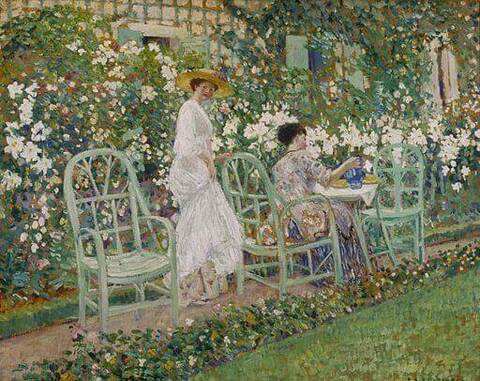
Image: “Garden in June”, Frederick Carl Frieseke (Source)
Context
Mansfield wrote this fifteen years after she left New Zealand and settled in England. It feels very English, although the house is based on her childhood home in NZ. It was published in 1922, only a year before she died of consumption (TB), aged 34.
I’ve reviewed The Daughters of the Late Colonel, from this collection, HERE. It also explores manners, class, and expectations, singed by death.
I’ve reviewed Miss Brill, from this collection, HERE. It’s a very short vignette of loneliness.
I’ve reviewed Bliss, from a different collection, HERE. Another case where the initial mood is very different from most of what follows.
Mansfield was a friend of DH Lawrence. Gudrun, in Women in Love (see my review, HERE), was partially based on her.
Short story club
I read this as one of the stories in The Art of the Short Story, by Dana Gioia, from which I'm aiming to read one story a week with The Short Story Club, starting 2 May 2022.
You can read this story here.
You can join the group here.
The opening is idyllic, verging on the twee: the weather is perfect, the grass shines, and the rose bushes “bowed down as though they had been visited by archangels” - not just regular angels, but archangels!
As the lavish preparations unfold (a marquee, a band, an abundance of lilies, and fifteen sandwich fillings, including egg with olive, and cream-cheese with lemon-curd), it’s quickly clear that it’s going to be about class distinctions, and a young woman of the house wanting to assert her independence from the strictures of convention - including lusting after the hired hands.
Image: “Pots of pink lilies. No other kind. Nothing but lilies—canna lilies, big pink flowers, wide open, radiant, almost frighteningly alive on bright crimson stems.” (Source)
The saccharine of the opening becomes more astringent as minor glitches accumulate and the party is potentially overshadowed by external events:
“People like that don’t expect sacrifices from us.”
But the transformative power of a good hat is not to be underestimated and everything is, of course, divine.
“And the perfect afternoon slowly ripened, slowly faded, slowly its petals closed.”
However, rather than being the end, this is when the story takes flight into unexpectedly profound realms, with echoes of a particular parable. That elevates this from a routine 3* to and easy 4*.
“The little cottages were in a lane to themselves… They were the greatest possible eyesore, and they had no right to be in that neighbourhood at all. They were little mean dwellings painted a chocolate brown. In the garden patches there was nothing but cabbage stalks, sick hens and tomato cans. The very smoke coming out of their chimneys was poverty-stricken. Little rags and shreds of smoke, so unlike the great silvery plumes that uncurled from the Sheridans’ chimneys.”
Watch out, grammar mavens
Mansfield doesn’t just start sentences with conjunctions, she opens this story with one:
“And after all the weather was ideal. They could not have had a more perfect day for a garden-party if they had ordered it.”
And she ends it with an incomplete thought, “Isn’t life—”, which fortunately, Laurie understands.
Image: “Garden in June”, Frederick Carl Frieseke (Source)
Context
Mansfield wrote this fifteen years after she left New Zealand and settled in England. It feels very English, although the house is based on her childhood home in NZ. It was published in 1922, only a year before she died of consumption (TB), aged 34.
I’ve reviewed The Daughters of the Late Colonel, from this collection, HERE. It also explores manners, class, and expectations, singed by death.
I’ve reviewed Miss Brill, from this collection, HERE. It’s a very short vignette of loneliness.
I’ve reviewed Bliss, from a different collection, HERE. Another case where the initial mood is very different from most of what follows.
Mansfield was a friend of DH Lawrence. Gudrun, in Women in Love (see my review, HERE), was partially based on her.
Short story club
I read this as one of the stories in The Art of the Short Story, by Dana Gioia, from which I'm aiming to read one story a week with The Short Story Club, starting 2 May 2022.
You can read this story here.
You can join the group here.

November 4, 2022
A really excellent short story that manages to pack quite a punch through its study of rich and poor, life and death, selflessness and egotism, and a good many other aspects of the human condition.

August 30, 2018
The Garden Party is a short story by the New Zealand writer Katherine Mansfield. It was first published in 1922 in the “Westminster Gazette” in three parts. Katherine Mansfield is known mostly for her short stories, many of which are quite astute. This one in particular poignantly reveals the vast social divide.
It begins with a deceptively charming and delightful air, focussing on the details and trivialities of life. A wealthy family called the Sheridans are preparing to host a party, in their perfectly maintained garden, ostensibly for their children. The central character is their younger daughter Laura, who is in excited anticipation of this garden party. Her job is to instruct the workmen on where to place the marquee.
Laura tries to hide the fact that she is scoffing bread and butter, and attempts to behave as her mother would. From this we realise straightaway how youthful and naive she must be, but she attempts to be haughty and detached, as she has observed is “correct”. However her true feelings of admiration for the workers soon emerge, and she wonders if she could be one herself. We are constantly privy to her innermost thoughts, and suspect that this story will be about Laura. It is, but it is perhaps not quite what we are to expect.
We watch the preparations for the party, and become aware of the beauty of the setting, and richness of all the foods, the finger sandwiches and cream puffs, on offer. We are thrust into the bounty and the happy optimism of the Sheridan residence, where everything is “perfect” and “delightful”; even Nature itself seems to respond to such a privileged, idealised state. The weather is perfect: blue skies “without a cloud”. The garden is “veiled with a haze of light gold … hundreds, yes literally hundreds, [of roses] have come out in a single night”. There is a vibrant atmosphere, despite the slightly discordant note struck by Laura’s mother, Mrs. Sheridan, and her elder sister Jose, both of whom seem only concerned with appearance and status, typically complacent and often intolerant members of the upper class to which they belong.
Throughout the day Laura is to grow increasingly conscious of her social position. For instance, we see that the moment that she goes back inside the house, Laura forgets all about her interest in erecting the marquee, and a fellow feeling for the workers, but becomes absorbed in a conversation about party dresses and the masses of pink canna lilies, which her mother has ordered.
Laura is constantly being steered by her family toward views which they consider proper for a young lady of her position. She is given an outfit which represents this, including a hat which initially Laura cannot imagine herself in. It seems overly grand and ornate to her, “trimmed with gold daisies, and a long black velvet ribbon”, but Mrs. Sheridan insists that the hat was “made for you”, so Laura’s doubts are quashed.
The story is mostly written in the third person, but slanted to allow us an in-depth understanding of Laura’s perspective, as well as a chance to observe her actions from the outside. On just a couple of occasions, we glimpse Mrs. Sheridan’s and Jose’s perspectives. We read Laura’s thoughts constantly, and the use of internal dialogue throughout the story, makes it easy to empathise with this young girl.
It seems quite modernist, and perhaps stream of consciousness, lacking a proper structure and unfolding in a few hours. It also has no real character descriptions or set beginning, allowing the context to bring each character and story to light as the story unfolds. Additionally, there are no male characters to speak of, and we have a female protagonist. The story seems concerned with domestic matters, yet an unexpected event is to turn this haven of bliss into a moral quandary for young Laura, who is about to discover the harsh reality of life.
The description of the nearby houses is in sharp contrast to the idealised luxury and upbeat feel of the Sheridans’ party. The sky here is not a perfect azure blue, but “pale”, the lane is “smoky and dark”, the cottages themselves, “mean” with just a “flicker of light”:
“the little cottages were in a lane to themselves at the very bottom of a steep rise that led up to the house. A broad road ran between. True, they were far too near. They were the greatest possible eyesore, and they had no right to be in that neighbourhood at all. They were little mean dwellings painted chocolate brown. In the garden patches there was nothing but cabbage stalks, sick hens and tomato cans. The very smoke coming out of their chimneys was poverty-stricken. Little rags and shreds of smoke, so unlike the great silvery plumes that uncurled from the Sheridan’s chimneys. Washerwomen lived in the lane and sweeps and a cobbler, and a man whose house was studded all over with minute bird-cages. Children swarmed. When the Sheridans were little they were forbidden to set foot there because of the revolting languages and of what they might catch. But since they were grown up, Laura and Laurie on their prowls sometimes walked through. It was disgusting and sordid. They came out with a shudder. But still one must go everywhere; one must see everything.”
As children, Laura, Jose, Meg, and Laurie were not allowed to go near the poor neighbours’ cottages, which are resented by the adults for spoiling their view. The contrast of these images is so great that it is hard to believe that they are part of the same world, never mind in close proximity. But they, and many others are, and we see that the author is deliberately describing how in the real world, these extremes of life are connected and dependent on each other. In life we have both beauty and ugliness, wealth and poverty, pleasure and suffering, joy and sorrow, childhood and adulthood, and life and death.
The final “Act” of the story, which I feel must have been the third installment, twists the knife even further. Laura’s mother has what she calls one of her “brilliant ideas”.
The ending of the story is ambiguous, probably deliberately so.
Interestingly The Garden Party is an almost autobiographical portrayal of Katherine Mansfield’s own experiences. Not only is the Sheridans’ residence based on her childhood home in Thorndon, Wellington, but she has written herself as Laura, the young girl from this wealthy, upper class family, who “seemed to be different from them all”. The Sheridans, who seem incapable of genuine sympathy toward the working classes, are caricatures of Katherine Mansfield’s own family. Laura is the only exception, who has strong misgivings about her family’s blasé attitude toward and their indifference to anyone they consider to be from a lower class.
The ending? I personally do not think any of the three possible interpretations here are more likely than any other. It could be that Laura accepts that the combination of all these conflicting things make life what it is, and she has learned to accept everything, even the things she does not want. She certainly has grown in a way, during the story. The hat is key.
Laura has been taught that in good society, one’s appearance should always take precedence. She is startled to see herself in the mirror, and realise that she has the appearance of beauty and maturity wearing the abominable hat. Yet when Laura find she cannot even say one sentence, such is her confusion. She just begins, “Isn’t life …” Laura is a young, impressionable girl, who is moved and baffled by what she has just seen and experienced, but her class values, and view of the world in general, is still developing, and remains fluid.
We may also view this story in a philosophical light. Which word would complete that sentence? “Good”? “Terrible?” “Complicated”? “Inconceivable”? “Wondrous”? “Beautiful”? Katherine Mansfield’s own philosophy of life was to attempt to experience life fully, but she believed that one had to accept everything it offers, whether good or bad. We will never know the end of Laura’s sentence, but it prompts us to wonder about the question of human existence.
It begins with a deceptively charming and delightful air, focussing on the details and trivialities of life. A wealthy family called the Sheridans are preparing to host a party, in their perfectly maintained garden, ostensibly for their children. The central character is their younger daughter Laura, who is in excited anticipation of this garden party. Her job is to instruct the workmen on where to place the marquee.
Laura tries to hide the fact that she is scoffing bread and butter, and attempts to behave as her mother would. From this we realise straightaway how youthful and naive she must be, but she attempts to be haughty and detached, as she has observed is “correct”. However her true feelings of admiration for the workers soon emerge, and she wonders if she could be one herself. We are constantly privy to her innermost thoughts, and suspect that this story will be about Laura. It is, but it is perhaps not quite what we are to expect.
We watch the preparations for the party, and become aware of the beauty of the setting, and richness of all the foods, the finger sandwiches and cream puffs, on offer. We are thrust into the bounty and the happy optimism of the Sheridan residence, where everything is “perfect” and “delightful”; even Nature itself seems to respond to such a privileged, idealised state. The weather is perfect: blue skies “without a cloud”. The garden is “veiled with a haze of light gold … hundreds, yes literally hundreds, [of roses] have come out in a single night”. There is a vibrant atmosphere, despite the slightly discordant note struck by Laura’s mother, Mrs. Sheridan, and her elder sister Jose, both of whom seem only concerned with appearance and status, typically complacent and often intolerant members of the upper class to which they belong.
Throughout the day Laura is to grow increasingly conscious of her social position. For instance, we see that the moment that she goes back inside the house, Laura forgets all about her interest in erecting the marquee, and a fellow feeling for the workers, but becomes absorbed in a conversation about party dresses and the masses of pink canna lilies, which her mother has ordered.
Laura is constantly being steered by her family toward views which they consider proper for a young lady of her position. She is given an outfit which represents this, including a hat which initially Laura cannot imagine herself in. It seems overly grand and ornate to her, “trimmed with gold daisies, and a long black velvet ribbon”, but Mrs. Sheridan insists that the hat was “made for you”, so Laura’s doubts are quashed.
The story is mostly written in the third person, but slanted to allow us an in-depth understanding of Laura’s perspective, as well as a chance to observe her actions from the outside. On just a couple of occasions, we glimpse Mrs. Sheridan’s and Jose’s perspectives. We read Laura’s thoughts constantly, and the use of internal dialogue throughout the story, makes it easy to empathise with this young girl.
It seems quite modernist, and perhaps stream of consciousness, lacking a proper structure and unfolding in a few hours. It also has no real character descriptions or set beginning, allowing the context to bring each character and story to light as the story unfolds. Additionally, there are no male characters to speak of, and we have a female protagonist. The story seems concerned with domestic matters, yet an unexpected event is to turn this haven of bliss into a moral quandary for young Laura, who is about to discover the harsh reality of life.
The description of the nearby houses is in sharp contrast to the idealised luxury and upbeat feel of the Sheridans’ party. The sky here is not a perfect azure blue, but “pale”, the lane is “smoky and dark”, the cottages themselves, “mean” with just a “flicker of light”:
“the little cottages were in a lane to themselves at the very bottom of a steep rise that led up to the house. A broad road ran between. True, they were far too near. They were the greatest possible eyesore, and they had no right to be in that neighbourhood at all. They were little mean dwellings painted chocolate brown. In the garden patches there was nothing but cabbage stalks, sick hens and tomato cans. The very smoke coming out of their chimneys was poverty-stricken. Little rags and shreds of smoke, so unlike the great silvery plumes that uncurled from the Sheridan’s chimneys. Washerwomen lived in the lane and sweeps and a cobbler, and a man whose house was studded all over with minute bird-cages. Children swarmed. When the Sheridans were little they were forbidden to set foot there because of the revolting languages and of what they might catch. But since they were grown up, Laura and Laurie on their prowls sometimes walked through. It was disgusting and sordid. They came out with a shudder. But still one must go everywhere; one must see everything.”
As children, Laura, Jose, Meg, and Laurie were not allowed to go near the poor neighbours’ cottages, which are resented by the adults for spoiling their view. The contrast of these images is so great that it is hard to believe that they are part of the same world, never mind in close proximity. But they, and many others are, and we see that the author is deliberately describing how in the real world, these extremes of life are connected and dependent on each other. In life we have both beauty and ugliness, wealth and poverty, pleasure and suffering, joy and sorrow, childhood and adulthood, and life and death.
The final “Act” of the story, which I feel must have been the third installment, twists the knife even further. Laura’s mother has what she calls one of her “brilliant ideas”.
The ending of the story is ambiguous, probably deliberately so.
Interestingly The Garden Party is an almost autobiographical portrayal of Katherine Mansfield’s own experiences. Not only is the Sheridans’ residence based on her childhood home in Thorndon, Wellington, but she has written herself as Laura, the young girl from this wealthy, upper class family, who “seemed to be different from them all”. The Sheridans, who seem incapable of genuine sympathy toward the working classes, are caricatures of Katherine Mansfield’s own family. Laura is the only exception, who has strong misgivings about her family’s blasé attitude toward and their indifference to anyone they consider to be from a lower class.
The ending? I personally do not think any of the three possible interpretations here are more likely than any other. It could be that Laura accepts that the combination of all these conflicting things make life what it is, and she has learned to accept everything, even the things she does not want. She certainly has grown in a way, during the story. The hat is key.
Laura has been taught that in good society, one’s appearance should always take precedence. She is startled to see herself in the mirror, and realise that she has the appearance of beauty and maturity wearing the abominable hat. Yet when Laura find she cannot even say one sentence, such is her confusion. She just begins, “Isn’t life …” Laura is a young, impressionable girl, who is moved and baffled by what she has just seen and experienced, but her class values, and view of the world in general, is still developing, and remains fluid.
We may also view this story in a philosophical light. Which word would complete that sentence? “Good”? “Terrible?” “Complicated”? “Inconceivable”? “Wondrous”? “Beautiful”? Katherine Mansfield’s own philosophy of life was to attempt to experience life fully, but she believed that one had to accept everything it offers, whether good or bad. We will never know the end of Laura’s sentence, but it prompts us to wonder about the question of human existence.

August 30, 2018
Katherine Mansfield died in 1923 at the age of 34, her life cut short by tuberculosis. But during her short writing career, she created a significant corpus of short fiction that has earned her a place ever since among the recognized great English-language practitioners of the format. This is one of only three of her stories (if I recall correctly) that I've read, but I've highly appreciated all three. I've read this one at least twice, most recently last night; so it's still fresh in my mind for reviewing. As a rule, I don't write reviews of individual short stories that I originally read in anthologies, but some of the discussion in a thread in one of my Goodreads groups (where some of us read/are reading the tale as a common read) convinced me to make an exception in this case.
This review benefited from the analysis portion of this unsigned Internet article: https://www.gradesaver.com/the-garden... , though I don't agree with it in every detail, and from reviews by some of my Goodreads friends, especially the one by Jean: https://www.goodreads.com/review/show... . My thoughts are my own, but the thoughts of others help to stimulate and clarify them!
Mansfield's style is Realist, and modernist, influenced particularly by Chekhov (at least in the judgment of critics who've read his short stories --I haven't-- and can compare the two writers); she was definitely a Chekhov fan. She writes with a sharp eye for character; her prose is clear and sharply honed, and the composition of her stories, including this one, well and carefully crafted. Some have labeled this story "stream-of-consciousness," and compared her writing here to Woolf, but I wouldn't go that far; Mansfield writes more coherently than Woolf did in some of her work. It's also not true that this story is "plotless;" it does focus, ultimately, on a particular meaningful incident, but there's a definite journey we follow to get to that point. Because Mansfield is usually classified (and I classify her myself) as a British writer, who wrote in England, most readers probably assume, as I originally did, that the not-explicitly-stated setting of the story is also British, possibly in London. But she was born and raised in New Zealand, and there are internal indications that the setting of the story is actually modeled on her family's home in Wellington, where she grew up. (Laura in the story, like Douglas Spaulding in Ray Bradbury's Green Town novels and stories, may well be the author's own alter ego.)
Like many short stories, this one is difficult to review without spoilers; and it's also difficult to assess thematically, partly because Mansfield's writing is intentionally ambiguous in places --she allows readers, at the end, to draw their own conclusions about the message. (But she doesn't leave us without clues.) The author's protest at the rancid class system of England and its colonies in that day (though it's not confined to that day, or to England) is obviously one message. But it's not, IMO, the only one; there are also themes of coming-of-age, of a young person's first actual encounter with death as a present reality (and grappling with what death means), and questions of what matters in life. Personally, I don't accept the very negative view of Laura and her perceptions at the end of the story that some reviewers espouse (the probability that Mansfield identified with her suggests that she's moving in a more positive direction), even while I don't quite take as positive a view of her learnings from this experience as the nameless author of the article linked to above does. She's a work in progress, with growing to do; but I think we should see the day depicted here as a genuine growing experience. (It would help if we knew Laura's age; but that's never stated, which would be my only real quibble with the author's craftsmanship here.)
As a final note, it's been suggested that the use of a female protagonist in short fiction is groundbreaking here. In American short fiction, writers of the preceding period like Jewett, Freeman, Kate Douglas Wiggin, etc. had used female protagonists extensively. But similar examples don't come to mind as readily for British short stories, so Mansfield may indeed have been breaking ground in that context.
This review benefited from the analysis portion of this unsigned Internet article: https://www.gradesaver.com/the-garden... , though I don't agree with it in every detail, and from reviews by some of my Goodreads friends, especially the one by Jean: https://www.goodreads.com/review/show... . My thoughts are my own, but the thoughts of others help to stimulate and clarify them!
Mansfield's style is Realist, and modernist, influenced particularly by Chekhov (at least in the judgment of critics who've read his short stories --I haven't-- and can compare the two writers); she was definitely a Chekhov fan. She writes with a sharp eye for character; her prose is clear and sharply honed, and the composition of her stories, including this one, well and carefully crafted. Some have labeled this story "stream-of-consciousness," and compared her writing here to Woolf, but I wouldn't go that far; Mansfield writes more coherently than Woolf did in some of her work. It's also not true that this story is "plotless;" it does focus, ultimately, on a particular meaningful incident, but there's a definite journey we follow to get to that point. Because Mansfield is usually classified (and I classify her myself) as a British writer, who wrote in England, most readers probably assume, as I originally did, that the not-explicitly-stated setting of the story is also British, possibly in London. But she was born and raised in New Zealand, and there are internal indications that the setting of the story is actually modeled on her family's home in Wellington, where she grew up. (Laura in the story, like Douglas Spaulding in Ray Bradbury's Green Town novels and stories, may well be the author's own alter ego.)
Like many short stories, this one is difficult to review without spoilers; and it's also difficult to assess thematically, partly because Mansfield's writing is intentionally ambiguous in places --she allows readers, at the end, to draw their own conclusions about the message. (But she doesn't leave us without clues.) The author's protest at the rancid class system of England and its colonies in that day (though it's not confined to that day, or to England) is obviously one message. But it's not, IMO, the only one; there are also themes of coming-of-age, of a young person's first actual encounter with death as a present reality (and grappling with what death means), and questions of what matters in life. Personally, I don't accept the very negative view of Laura and her perceptions at the end of the story that some reviewers espouse (the probability that Mansfield identified with her suggests that she's moving in a more positive direction), even while I don't quite take as positive a view of her learnings from this experience as the nameless author of the article linked to above does. She's a work in progress, with growing to do; but I think we should see the day depicted here as a genuine growing experience. (It would help if we knew Laura's age; but that's never stated, which would be my only real quibble with the author's craftsmanship here.)
As a final note, it's been suggested that the use of a female protagonist in short fiction is groundbreaking here. In American short fiction, writers of the preceding period like Jewett, Freeman, Kate Douglas Wiggin, etc. had used female protagonists extensively. But similar examples don't come to mind as readily for British short stories, so Mansfield may indeed have been breaking ground in that context.

November 23, 2022

Garden parties of extreme sophistication juxtaposed to a cruel accident that beheads a family. This could seem a brutal criticism of social differences.
But the ruthless portrayal is refined by Mansfield’s sublime writing, which makes the critique so much more discerning.
There is a difference, subtle, but determinant, between the canna lilies, that Mrs Sheridan in her extravagance orders from the florist, and the ready-to-pick arum lilies that abound in the garden and that working class people, with their simpler taste, will surely appreciate. People of that class are so impressed by arum lilies.
For this level of perception one needs to read Mansfield.


June 14, 2025
Esta fiesta en el jardín tiene la apariencia de cuento ligero, una familia de clase acomodada celebra una fiesta de verano. Las hijas un poco cursis, los padres un poco snobs. Justo antes del comienzo de la fiesta se produce un hecho que viene a alterar el ánimo, si no de toda la familia, sí que al menos del personaje central del cuento, Laura, una de las hijas.
Esta joven en unas pocas páginas de la narración hace un gran descubrimiento, más bien varios:
1) Por un lado, la doble moral que rige las reglas de su familia, y diría que de la mayoría de toda buena familia burguesa que se precie: hay que celebrar la fiesta a toda costa, aunque a unos metros de la casa estén los vecinos de luto. Nosotros hacemos nuestra fiesta en el jardín, con sus músicos y todo lo que conlleva, caiga quien caiga.
2) El descubrimiento de la muerte, de que la muerte acaba por alcanzarnos a todos, que creo es un hecho significativo para toda persona joven, al menos a mi me ocurrió. A unas personas les ocurre con 17 años, a otros con 15, a otros con 20…pero esa mortalidad es un hecho revelador siempre.
3) Descubrir lo pacífico y sencillo e igualador que es la muerte. Aquí se denota un aspecto que quise ver como existencialista:
“Ahí estaba un joven dormido, profundamente dormido, tan dormido que estaba lejos, muy lejos de las dos. ¡Oh, tan remoto, tan lleno de paz! Estaba soñando. No se despertaría jamás. Tenía la cabeza hundida en la almohada; los ojos cerrados estaban ciegos bajo los párpados cerrados. Estaba absorto en su sueño. ¿Qué le importaban las fiestas en los jardines, los cestos y los encajes? Ya estaba lejos de esas cosas. Era asombroso, bellísimo. Mientras ellos reían y la orquesta tocaba, había sucedido ese milagro en la callejuela. Feliz… feliz… Todo está bien, decía el rostro dormido. Es lo que debe ser. Estoy contento.”
Relato breve pero con muchas aristas y ciertamente interesante. Hay que dejarlo madurar un poco antes de emitir un juicio. Creo que más que leer el libro en términos literales, hay que interpretar la intención que busca K. Mansfield, que indudablemente existe.
Esta joven en unas pocas páginas de la narración hace un gran descubrimiento, más bien varios:
1) Por un lado, la doble moral que rige las reglas de su familia, y diría que de la mayoría de toda buena familia burguesa que se precie: hay que celebrar la fiesta a toda costa, aunque a unos metros de la casa estén los vecinos de luto. Nosotros hacemos nuestra fiesta en el jardín, con sus músicos y todo lo que conlleva, caiga quien caiga.
2) El descubrimiento de la muerte, de que la muerte acaba por alcanzarnos a todos, que creo es un hecho significativo para toda persona joven, al menos a mi me ocurrió. A unas personas les ocurre con 17 años, a otros con 15, a otros con 20…pero esa mortalidad es un hecho revelador siempre.
3) Descubrir lo pacífico y sencillo e igualador que es la muerte. Aquí se denota un aspecto que quise ver como existencialista:
“Ahí estaba un joven dormido, profundamente dormido, tan dormido que estaba lejos, muy lejos de las dos. ¡Oh, tan remoto, tan lleno de paz! Estaba soñando. No se despertaría jamás. Tenía la cabeza hundida en la almohada; los ojos cerrados estaban ciegos bajo los párpados cerrados. Estaba absorto en su sueño. ¿Qué le importaban las fiestas en los jardines, los cestos y los encajes? Ya estaba lejos de esas cosas. Era asombroso, bellísimo. Mientras ellos reían y la orquesta tocaba, había sucedido ese milagro en la callejuela. Feliz… feliz… Todo está bien, decía el rostro dormido. Es lo que debe ser. Estoy contento.”
Relato breve pero con muchas aristas y ciertamente interesante. Hay que dejarlo madurar un poco antes de emitir un juicio. Creo que más que leer el libro en términos literales, hay que interpretar la intención que busca K. Mansfield, que indudablemente existe.

August 26, 2018
4.5★
Run down just as you are. No, wait, take the arum lilies too. People of that class are so impressed by arum lilies."
Mansfield just doesn't miss a beat in her stinging portrayal of the wealthy family up the hill enjoying a festive, elegant garden party the day after the young father of a poor family at the bottom of the hill was killed in an accident.
Young Laura, who has enjoyed flirting with all the wonderfully natural tradesmen setting up the party, is disturbed when they hear the news and thinks it's wrong to go ahead. Mother has her own views.
"If someone had died there normally - and I can't understand how they keep alive in those poky little holes - we should still be having our party, shouldn't we?"
Later, when Laura's told to go "just as you are" with a basket of leftovers and calls in on the family down the hill, she feels embarrassed by her sparkling party frock and gorgeous big hat with ribbons, of which she'd been so proud.
The language, the dialogue, the attitudes are perfect. Laura is a mercurial flibbertigibbet whose thoughts jump from one position to another. When conflicting thoughts are uncomfortable, she's like Scarlett O'Hara with her "I'll think about it tomorrow" attitude. Her mother is more of a Marie Antoinette with "Let them eat cake".
Sister Laura and her dear brother Laurie talk before and after, and Laura's final conclusion of what it all means is certainly not what I expected. Of course, final and conclusion are the wrong words because her opinion is about as firm as skywriting.
It's nearly a hundred years old and still a good classic read, especially considering the widening divide between haves and have-nots.
I'm unsuccessfully biting my tongue to avoid saying that too many of today's politicians share Laura's flimsy hold on reality. (Let them eat cake in tents in the desert . . . if they don't drown at sea first, silly-billies. People of that class just love tents.)
It's available free online, with an introductory comment here by Chimamanda Ngozi Adichie. You will find some other stories, too. http://www.centerforfiction.org/forwr...
Run down just as you are. No, wait, take the arum lilies too. People of that class are so impressed by arum lilies."
Mansfield just doesn't miss a beat in her stinging portrayal of the wealthy family up the hill enjoying a festive, elegant garden party the day after the young father of a poor family at the bottom of the hill was killed in an accident.
Young Laura, who has enjoyed flirting with all the wonderfully natural tradesmen setting up the party, is disturbed when they hear the news and thinks it's wrong to go ahead. Mother has her own views.
"If someone had died there normally - and I can't understand how they keep alive in those poky little holes - we should still be having our party, shouldn't we?"
Later, when Laura's told to go "just as you are" with a basket of leftovers and calls in on the family down the hill, she feels embarrassed by her sparkling party frock and gorgeous big hat with ribbons, of which she'd been so proud.
The language, the dialogue, the attitudes are perfect. Laura is a mercurial flibbertigibbet whose thoughts jump from one position to another. When conflicting thoughts are uncomfortable, she's like Scarlett O'Hara with her "I'll think about it tomorrow" attitude. Her mother is more of a Marie Antoinette with "Let them eat cake".
Sister Laura and her dear brother Laurie talk before and after, and Laura's final conclusion of what it all means is certainly not what I expected. Of course, final and conclusion are the wrong words because her opinion is about as firm as skywriting.
It's nearly a hundred years old and still a good classic read, especially considering the widening divide between haves and have-nots.
I'm unsuccessfully biting my tongue to avoid saying that too many of today's politicians share Laura's flimsy hold on reality. (Let them eat cake in tents in the desert . . . if they don't drown at sea first, silly-billies. People of that class just love tents.)
It's available free online, with an introductory comment here by Chimamanda Ngozi Adichie. You will find some other stories, too. http://www.centerforfiction.org/forwr...

November 21, 2022
Ah, this story is so deceptive. Halfway in you’re thinking it’s all fluff, but read on.
The Sheridan family is expecting guests. It’s a garden party, and there is so much to do. We primarily follow the daughter Laura, as she helps her mother with the extravagant preparations, but we see other family members too, and their reactions before, during, and after.
We get insights from within the party:
“Jose and Laura were licking their fingers with that absorbed inner look that only comes from whipped cream.”
and without:
"The very smoke coming out of their chimneys was poverty-stricken. Little rags and shreds of smoke, so unlike the great silvery plumes that uncurled from the Sheridan’s chimneys."
If you were to look up the word “incisive” in the dictionary, you’d see a picture of Katherine Mansfield. She has a way of taking you somewhere and not just showing you something, but making you see, and somehow making you feel it’s what you would have seen had you been there.
Read it here: https://www.washoeschools.net/cms/lib...
The Sheridan family is expecting guests. It’s a garden party, and there is so much to do. We primarily follow the daughter Laura, as she helps her mother with the extravagant preparations, but we see other family members too, and their reactions before, during, and after.
We get insights from within the party:
“Jose and Laura were licking their fingers with that absorbed inner look that only comes from whipped cream.”
and without:
"The very smoke coming out of their chimneys was poverty-stricken. Little rags and shreds of smoke, so unlike the great silvery plumes that uncurled from the Sheridan’s chimneys."
If you were to look up the word “incisive” in the dictionary, you’d see a picture of Katherine Mansfield. She has a way of taking you somewhere and not just showing you something, but making you see, and somehow making you feel it’s what you would have seen had you been there.
Read it here: https://www.washoeschools.net/cms/lib...

January 29, 2018
مجموعه من مال نشر ماهی هه،
و گویا مفصل تر از مجموعه های قبلیه
۲۱۰ صفحه ست.با ترجمه خیلی خوب خانم انتخابی.
یه مجموعه داستان کوتاه فوق العاده ،شاید به جرات بگم همه داستاناشو دوست داشتم.
اگر داستان کوتاه های چخوف رو دوست دارین احتمالا این کارو هم دوست داشته باشین:)
و گویا مفصل تر از مجموعه های قبلیه
۲۱۰ صفحه ست.با ترجمه خیلی خوب خانم انتخابی.
یه مجموعه داستان کوتاه فوق العاده ،شاید به جرات بگم همه داستاناشو دوست داشتم.
اگر داستان کوتاه های چخوف رو دوست دارین احتمالا این کارو هم دوست داشته باشین:)

November 21, 2022
Cool story. It started slow but ended with a bang. Good tension. Good storytelling. Brilliant finish with a run of one and two line paragraphs. Recommended for all audiences.

September 30, 2016
The Sheridans, a wealthy family, are hosting a garden party on a perfect warm day with lavish flowers, a bounty of food, and a band. A delivery man tells them that a poor young man, who lived in a small cottage down the hill, was killed in an accident. This sets off a series of events which show the class division between the rich and the poor. Images are light and beautiful when the preparations for the Sheridan's party are described. In contrast, dark and dreary images describe the grieving people at the Scott's small brown cottage on a gloomy lane.
Daughter Laura Sheridan is a young woman who has some sensitivity regarding the situation, but this is her first encounter with death. Katherine Mansfield's writing is lovely in her wonderful collection The Garden Party and Other Stories. I enjoyed reading "The Garden Party" again with the Short Story Club.
Daughter Laura Sheridan is a young woman who has some sensitivity regarding the situation, but this is her first encounter with death. Katherine Mansfield's writing is lovely in her wonderful collection The Garden Party and Other Stories. I enjoyed reading "The Garden Party" again with the Short Story Club.

July 16, 2018
Here follows a free online link to the short story The Garden Party:
http://www.katherinemansfieldsociety....
Review:
In just a minimum of pages Katherine Mansfield (1888-1923) captures remarkably well the personality of a naïve, privileged adolescent girl. She is sweet, has a conscience and does like looking pretty. What girl doesn’t? We meet Laura Sheridon, her mother, her father, two older sisters, an older brother and a younger one. Servants fill the background, each doing their appointed tasks. A garden party is to be held that afternoon. The marquee must be set up, the flowers fashionably displayed, the sandwiches and the yummy cream puffs arranged on platters. It is a glorious, sunny day. We are there in the hubbub. We watch who does what, who sits back and orders others around and who really makes the decisions. We listen to what they say and think about what their words actually mean. The story is a character study.
Wait, more happens!
Word goes out that a fatal accident has occurred. No, nothing has happened to one of the family. Thank God! It is only one of the working families that live nearby, one of the “ordinary folk” who has died. I hope you hear my sarcasm.
Laura, young and naïve, not yet aware of the ways of the world, thinks the party must be stopped. Will it be stopped and what do each in the family think about stopping it? Laura’s mother says, ”People like that don’t expect sacrifices from us!”
The story is a commentary on social order and class. It is a commentary on human behavior. It is also about being young, growing up and “learning” from one’s elders. What if that we absorb in our youth from our parents and from other members of the class to which we belong is narrowminded and wrong? Is this why human behavior changes so little from generation to generation?
What makes the story good is that while it delivers its message it also lets you smile along the way. Watch how Laura, bread and butter in hand, goes out to instruct the workers putting up the tent. Even she realizes that it is pretty darn difficult to authoritatively give orders with bread and butter in one’s hand! There is nowhere she can throw it, and she may want a nibble later! C’mon, picture this. Draw it in your head. Doesn’t it make you smile? Her thoughts on the workers, one in particular, are amusing too.
Wait till you see what she has to do at the end. Mansfield captures her youth and naivety well.
Read the story. It is light. It is fun. It is good. It is short. You have no excuse, the link to it is right there up above!
http://www.katherinemansfieldsociety....
Review:
In just a minimum of pages Katherine Mansfield (1888-1923) captures remarkably well the personality of a naïve, privileged adolescent girl. She is sweet, has a conscience and does like looking pretty. What girl doesn’t? We meet Laura Sheridon, her mother, her father, two older sisters, an older brother and a younger one. Servants fill the background, each doing their appointed tasks. A garden party is to be held that afternoon. The marquee must be set up, the flowers fashionably displayed, the sandwiches and the yummy cream puffs arranged on platters. It is a glorious, sunny day. We are there in the hubbub. We watch who does what, who sits back and orders others around and who really makes the decisions. We listen to what they say and think about what their words actually mean. The story is a character study.
Wait, more happens!
Word goes out that a fatal accident has occurred. No, nothing has happened to one of the family. Thank God! It is only one of the working families that live nearby, one of the “ordinary folk” who has died. I hope you hear my sarcasm.
Laura, young and naïve, not yet aware of the ways of the world, thinks the party must be stopped. Will it be stopped and what do each in the family think about stopping it? Laura’s mother says, ”People like that don’t expect sacrifices from us!”
The story is a commentary on social order and class. It is a commentary on human behavior. It is also about being young, growing up and “learning” from one’s elders. What if that we absorb in our youth from our parents and from other members of the class to which we belong is narrowminded and wrong? Is this why human behavior changes so little from generation to generation?
What makes the story good is that while it delivers its message it also lets you smile along the way. Watch how Laura, bread and butter in hand, goes out to instruct the workers putting up the tent. Even she realizes that it is pretty darn difficult to authoritatively give orders with bread and butter in one’s hand! There is nowhere she can throw it, and she may want a nibble later! C’mon, picture this. Draw it in your head. Doesn’t it make you smile? Her thoughts on the workers, one in particular, are amusing too.
Wait till you see what she has to do at the end. Mansfield captures her youth and naivety well.
Read the story. It is light. It is fun. It is good. It is short. You have no excuse, the link to it is right there up above!

September 2, 2018
خیلی خوب بود.
چه چاپ قدیمی خوبی داشت.
یک داستان قوی، پرسرعت، و چفت و بستدار با پایانی خوب.
(خوب از لحاظ داستانی، نه هپی اندینگ؛ طبعا)
:)))
چه چاپ قدیمی خوبی داشت.
یک داستان قوی، پرسرعت، و چفت و بستدار با پایانی خوب.
(خوب از لحاظ داستانی، نه هپی اندینگ؛ طبعا)
:)))

August 2, 2024
Parece que hay bastante unanimidad en relación a que ‘La fiesta en el jardín’ es uno de los mejores relatos de la autora neozelandesa Katherine Mansfield. Por eso, llevaba bastante tiempo reservándomelo… leyendo y amando otros cuentos suyos pero, cuando vi está preciosa edición ilustrada ya no me pude contener más (una no es de piedra).
‘La fiesta en el jardín’ nos traslada a la mañana previa a un gran evento donde una familia de clase acomodada recibirá a un montón de invitados. La madre, aparentemente agotada, delega algunas tareas en sus hijos. Particularmente, Laura mientras realiza sus encargos entre la seriedad y el juego se enterará de algo que podría arruinar la fiesta.
Una historia aterradoramente atemporal que nos habla de cómo cerramos los ojos ante el sufrimiento ajeno, diferencia de clases, y cómo hay cosas que nos cambian para siempre (y menos mal).
En esta edición también viene otro relato “La señorita Brill”, sobre la soledad y la vejez, que con poquísimas páginas consiguió dejarme afectada toda una tarde. No pasa mucho, acompañamos a la anciana señorita Brill en una jornada por el parque, donde se encontrará con personas, irá a un concierto, pero… algo pasará que le hará no comprar ese día su pastel favorito.
Disculpad que no cuente más, pero son historias cortas y, aunque considero que no son “de spoilers” porque lo importante es cómo se nos cuentan, mejor saber poco y deleitarse descubriendo a cada personaje y sus desventuras.
No puedo terminar sin hacer mención a las preciosas ilustraciones de Carmen Bueno, elevan al nivel de joya este libro, ya de por si imprescindible.
‘La fiesta en el jardín’ nos traslada a la mañana previa a un gran evento donde una familia de clase acomodada recibirá a un montón de invitados. La madre, aparentemente agotada, delega algunas tareas en sus hijos. Particularmente, Laura mientras realiza sus encargos entre la seriedad y el juego se enterará de algo que podría arruinar la fiesta.
Una historia aterradoramente atemporal que nos habla de cómo cerramos los ojos ante el sufrimiento ajeno, diferencia de clases, y cómo hay cosas que nos cambian para siempre (y menos mal).
En esta edición también viene otro relato “La señorita Brill”, sobre la soledad y la vejez, que con poquísimas páginas consiguió dejarme afectada toda una tarde. No pasa mucho, acompañamos a la anciana señorita Brill en una jornada por el parque, donde se encontrará con personas, irá a un concierto, pero… algo pasará que le hará no comprar ese día su pastel favorito.
Disculpad que no cuente más, pero son historias cortas y, aunque considero que no son “de spoilers” porque lo importante es cómo se nos cuentan, mejor saber poco y deleitarse descubriendo a cada personaje y sus desventuras.
No puedo terminar sin hacer mención a las preciosas ilustraciones de Carmen Bueno, elevan al nivel de joya este libro, ya de por si imprescindible.

November 22, 2022
Oh, how extraordinarily nice workmen were, she thought. Why couldn't she have workmen for her friends rather than the silly boys she danced with and who came to Sunday night supper? She would get on much better with men like these.
Laura is quite drawn to these friendly workmen, and to the idea of workmen, and is very sympathetic . . . even to the point of being considered "extravagant." Her extravagance however has its limits.
Years ago I read Mansfield's most famous collection The Garden Party and Other Stories but did not recall the developments of the title story. My recent forays into the short stories of Katherine Mansfield have been most rewarding, and this story in particular (without a hint of exaggeration) has one of the best endings in the history of short fiction.
Laura is quite drawn to these friendly workmen, and to the idea of workmen, and is very sympathetic . . . even to the point of being considered "extravagant." Her extravagance however has its limits.
Years ago I read Mansfield's most famous collection The Garden Party and Other Stories but did not recall the developments of the title story. My recent forays into the short stories of Katherine Mansfield have been most rewarding, and this story in particular (without a hint of exaggeration) has one of the best endings in the history of short fiction.

January 9, 2021
In the space of one day a sensitive, wealthy girl is introduced to the dignity of those less fortunate than her, to the callousness of her social set toward them, and to how ready the affluent are to intellectualize away moral qualms for the sake of convenience and pleasure. Also Laura sees the terrible unfairness of economic disparity. In other words, she is awakened to her privilege.
Mansfield shames us here by personifying our reactions to the destitute. Upon encountering a homeless person, for example, we may feel Laura’s sensitivity, but still we walk on, oftentimes ignoring our qualms much like the adults in this story.
Mansfield shames us here by personifying our reactions to the destitute. Upon encountering a homeless person, for example, we may feel Laura’s sensitivity, but still we walk on, oftentimes ignoring our qualms much like the adults in this story.

October 4, 2017
Narrated by Mandy Glasson" 36 minutes
Young Laura and her family are throwing a garden party, but when a man dies in her community, she is alone in wanting it cancelled. What unfolds is a protagonist becoming more aware of the world around her and the class divisions that exist.
Goodreads review published 04/10/17
Young Laura and her family are throwing a garden party, but when a man dies in her community, she is alone in wanting it cancelled. What unfolds is a protagonist becoming more aware of the world around her and the class divisions that exist.
Goodreads review published 04/10/17

June 28, 2022
No había leído nada de esta autora modernista y me llamaba la atención. La verdad es que se entiende que esté considerada como una de las mayores expertas en relatos cortos de su época, porque en muy pocas páginas consigue construir una historia con la que experimentas emociones muy contrapuestas, pasando de lo plácido a lo sórdido en cuestión de párrafos. Y es que, con la excusa de describir la fiesta que organiza una familia pudiente en su jardín, la autora se mete de lleno en el conflicto entre clases sociales de la Inglaterra de principios del siglo XX, personas vecinas, que pese a compartir espacios públicos, apenas interaccionaban.
Es un tema recurrente y que hemos visto retratado en muchísimas obras, pero el principal valor de este relato diría que es desarrollarlo en muy poco tiempo y con una protagonista de la que esperarías una actitud mucho más pasiva de la que finalmente muestra. Hay cierto sabor a Virginia Woolf, que era su amiga, aunque la experimentación de Mansfield se limita a los temas tratados, y no al estilo con en el que escribe, que es mucho más sencillo. Un libro interesante y una edición ilustrada PRECIOSA.
RESEÑA COMPLETA: https://www.youtube.com/watch?v=ZVZe_...
Es un tema recurrente y que hemos visto retratado en muchísimas obras, pero el principal valor de este relato diría que es desarrollarlo en muy poco tiempo y con una protagonista de la que esperarías una actitud mucho más pasiva de la que finalmente muestra. Hay cierto sabor a Virginia Woolf, que era su amiga, aunque la experimentación de Mansfield se limita a los temas tratados, y no al estilo con en el que escribe, que es mucho más sencillo. Un libro interesante y una edición ilustrada PRECIOSA.
RESEÑA COMPLETA: https://www.youtube.com/watch?v=ZVZe_...

September 7, 2018
Thoughts soon.

November 28, 2016
GARDEN PARTY
By Katherine Mansfield
Summary
In "The Garden Party," Laura's mother throws a party. Hearing that their neighbor has died, Laura thinks the party should be cancelled so that the grieving family won't hear the music. At the end of the story, Laura brings the dead man's family leftovers.
• Laura watches hired men erect the tent for her mother's party. She's shy around them, but delights in the beautiful arrangements her mother has made.
• Upon hearing that their neighbor has died, Laura insists that they call off the party out of respect, but upon looking in the mirror and seeing her own gorgeous, gold embroidered hat, she agrees that the party should proceed as scheduled.
• At the end of the party, Laura takes a basketful of leftovers to the neighbors. She's taken to see the dead body and has a moment of epiphany in which she sees death as merely a peaceful sleep.
مهمانی باغ – در این داستان مادر لورا قصد گرفتن مهمانی در باغ خانه را دارد، اما زمانی که دخترش به خانه ی همسایه میرود، با جسد مرد همسایه رو به رو میشود و فکر میکند که مراسمشان کنسل خواهد شد تا صدای آن مزاحم افراد سوگوار خانه ی همسایه نشود.
در ابتدا مردانی را می بیند که چادری را برای مراسم مهمانی مادرش در حال برپا کردن هستن. سعی میکند تا رفتار و روش مادرش را در میان بزرگسالان تقلید کند، اما در میان بزرگسالان خجالت میکشد. هرچند خجالت میکشد اما بخاطر کارهایی که مادرش انجام داده است خوشحال است. زمانی که از مرگ همسایه آگاه میشود قصد میکند تا مهمانی را کنسل کند، اما زمانی که چهره زیبای خود را با کلاهی که مادرش به او هدیه داده تا سر کند در آینه می بیند، موافقت میکند که مهمانی در زمان مقرر شده برگزار شود.
در آخر لورا با سبدی از باقی مانده ی غذاهای مهمانی به خانه همسایه ی مرده میرود و هنگامی که دوباره جسد را می بیند، پس از حالتی از ظهور و تجلی عرفانی ، مرگ را تنها به صورتی خوابی عمیق تصور میکند.
Analysis
Two parts of the story represents 2 different worlds: 1. Rich world and 2. Poor society world.
In the first part we have the use of GOOD adjs and in the second part BAD adjectives.
*In media res: means that the story begins in the middle of the story.
*Bildungsroman: because the story is about learning and education we call it bildungsroman. The story is like a journey in which our protagonist learns Sth newfrom innocence to experience (knowledge).
Characters:
Laura name of a flower (laurel) which is a symbol of CROWN or victory.
Mrs and Mr Sheridan
Laurie
Jose
*Transition: Rite of passage (initiation): 1.one that happens in the context of family
2. When she goes to the house of the dead man and sees death.
She copies her mother behavior to pretend she is grown up. (because she feels she is shy.)
But this behaviour is affected (مصنوعی).
*preconception: قضاوت زودهنگام why do you want to sympathise? He was drunk!
مادرش میگه چرا میخوای برای اون مرد احساس دلسوزی کنی وقتی که مست بوده و از روی اسب افتاده که مرده. در صورتی که مشخص نیست آیا در حقیقت آن مرد مست بوده باشد. این قضاوت زودهنگام است.
*Different Ideas (harsh view about the world)
The mother gives her the hat hat is a kind of distraction shows that she is immature.
Hat a symbol of class distinction (she feels out of place with that hat)
IDIOM: Be pushing up daisies: to be dead
گل سر لورا از گل های دیزی یا جعفریه که اصطلاحی هست که آنرا برای مرگ به کار میبرند.. اصطلاح بالا.
Hat symbol of 1. Class division and class distinction
2. Coronation (تاج گذاری) and the heritage of snobbery (اشرافیت)
*Understanding the meaning of life and death درکی از معنای مرگ و زندگی در پایان داستان توسط دخترک که عده ای آن را نگاه سطحی نگر دختر از ابتدا تا انتهای داستان می دانند.
In The Garden Party by Katherine Mansfield we have the theme of connection, class, isolation, conflict and denial. Taken from her collection of the same name the story is narrated in the third person by an unnamed narrator and after reading the story the reader realises that Mansfield may be exploring the theme of isolation. Through the setting of the story (Sheridan’s house and gardens) there is a sense that the Sheridan’s are isolated (or disconnected) from the world around them. Mansfield situates the Sheridan’s house on a hill which could suggest that not only do the Sheridan’s live above others (which would play on the theme of class) but they also appear to be detached (or isolated) from those who live around them (the Scott’s and the poorer, working class neighbours). Similarly the garden itself may also be important as Mansfield may be suggesting that the Sheridan’s and the other guests at the party remain isolated (or protected) from the world around them while the party is taking place.
Despite the apparent isolation from others, Laura does appear to attempt to make some type of connection with those who would have been commonly perceived to have been beneath her class. This is noticeable by the fact that while Laura is talking to the workmen she wishes that she had friends who were workmen rather than the ‘silly boys she danced with and who came to Sunday night supper.’ It is also interesting that Laura, as the workmen are working ‘felt just like a work-girl.’ This line is significant as it suggests that Laura is connecting with the workmen and if anything she is disregarding the perceived differences between classes.
There is also some symbolism in the story which may be significant. Laura’s hat, which is given to her by her mother appears to symbolise Mrs Sheridan’s view on the world (and Laura’s apparent acceptance of this view). When Mrs Sheridan hands the hat to Laura she tells her daughter that ‘People (Scott’s) like that don’t expect sacrifices from us.’ This line is significant as it suggests that Mrs Sheridan is not connected (or in line) or is isolated from those neighbours who may be of a lesser class to the Sheridan’s. The fact that Laura, after she goes into her bedroom and looks at herself in the mirror, sees a ‘charming girl’, may also be significant as again it can suggest that (just like her mother) Laura is detached (or isolated) from the world around her (and the Scott’s tragedy). The fact that the hat is black, which would not be a warm or bright colour may also be important as by having the hat black Mansfield may be suggesting the lack of warmth or compassion being shown to the Scott’s by Mrs Sheridan. Mansfield may also be using the hat as symbolism to suggest the continued denial by Laura and Mrs Sheridan of what has happened (Mr Scott’s death).
The fact that Laura walks down the hill, towards the Scott’s house may also be symbolically important as it could suggest that Laura is overcoming the barriers that come with class and if anything she is connecting (as she did with the workmen) with those, who again, would have been perceived to have been beneath her class. It is also interesting that Mansfield, as Laura leaves the grounds of her house, describes Laura as crossing ‘the broad road.’ By describing the road as broad (or wide), Mansfield may be suggesting, at least symbolically, that a large gap exists between the Sheridan’s (upper class) and their neighbours (Scott’s, working class).
Mansfield also appears to be exploring the theme of conflict (internal) in the story. It is through Laura’s thoughts that the reader senses how uncomfortable (or conflicted) Laura is over Mr Scott’s death. She is the only member of the Sheridan family who feels any sympathy for the Scott family. Laura is torn between wanting to cancel the garden party (as a mark of respect to the Scott family) and participating in the party. However it is interesting that Laura, regardless of how she feels, does actually participate in the party. It is possible that Mansfield may be suggesting that Laura, by participating in the party, continues to live in denial or remains distant (or isolated) from the outside (and real) world. It is also possible that Mansfield, by having Laura wait for Laurie’s opinion (as to whether she should participate in the party), is suggesting that Laura does not have the maturity to make up her own mind and is reliant on others to make the decision for her.
The ending of the story is also interesting as Laura appears to have an epiphany (or moment of realisation). As she is looking at Mr Scott’s body lying on the bed, she apologises for her hat. This may be important as symbolically (as mentioned previously) the hat represents denial and by apologising for wearing the hat, Laura may realise that she has been disconnected (or isolated) from the world outside. The fact that Laura tells Laurie ‘Isn’t life’ and doesn’t finish her sentence may also be important as it could suggest that Laura has also come to realise that everyone, regardless of class, shares a common humanity. If anything everyone is connected in some way.
By Katherine Mansfield
Summary
In "The Garden Party," Laura's mother throws a party. Hearing that their neighbor has died, Laura thinks the party should be cancelled so that the grieving family won't hear the music. At the end of the story, Laura brings the dead man's family leftovers.
• Laura watches hired men erect the tent for her mother's party. She's shy around them, but delights in the beautiful arrangements her mother has made.
• Upon hearing that their neighbor has died, Laura insists that they call off the party out of respect, but upon looking in the mirror and seeing her own gorgeous, gold embroidered hat, she agrees that the party should proceed as scheduled.
• At the end of the party, Laura takes a basketful of leftovers to the neighbors. She's taken to see the dead body and has a moment of epiphany in which she sees death as merely a peaceful sleep.
مهمانی باغ – در این داستان مادر لورا قصد گرفتن مهمانی در باغ خانه را دارد، اما زمانی که دخترش به خانه ی همسایه میرود، با جسد مرد همسایه رو به رو میشود و فکر میکند که مراسمشان کنسل خواهد شد تا صدای آن مزاحم افراد سوگوار خانه ی همسایه نشود.
در ابتدا مردانی را می بیند که چادری را برای مراسم مهمانی مادرش در حال برپا کردن هستن. سعی میکند تا رفتار و روش مادرش را در میان بزرگسالان تقلید کند، اما در میان بزرگسالان خجالت میکشد. هرچند خجالت میکشد اما بخاطر کارهایی که مادرش انجام داده است خوشحال است. زمانی که از مرگ همسایه آگاه میشود قصد میکند تا مهمانی را کنسل کند، اما زمانی که چهره زیبای خود را با کلاهی که مادرش به او هدیه داده تا سر کند در آینه می بیند، موافقت میکند که مهمانی در زمان مقرر شده برگزار شود.
در آخر لورا با سبدی از باقی مانده ی غذاهای مهمانی به خانه همسایه ی مرده میرود و هنگامی که دوباره جسد را می بیند، پس از حالتی از ظهور و تجلی عرفانی ، مرگ را تنها به صورتی خوابی عمیق تصور میکند.
Analysis
Two parts of the story represents 2 different worlds: 1. Rich world and 2. Poor society world.
In the first part we have the use of GOOD adjs and in the second part BAD adjectives.
*In media res: means that the story begins in the middle of the story.
*Bildungsroman: because the story is about learning and education we call it bildungsroman. The story is like a journey in which our protagonist learns Sth newfrom innocence to experience (knowledge).
Characters:
Laura name of a flower (laurel) which is a symbol of CROWN or victory.
Mrs and Mr Sheridan
Laurie
Jose
*Transition: Rite of passage (initiation): 1.one that happens in the context of family
2. When she goes to the house of the dead man and sees death.
She copies her mother behavior to pretend she is grown up. (because she feels she is shy.)
But this behaviour is affected (مصنوعی).
*preconception: قضاوت زودهنگام why do you want to sympathise? He was drunk!
مادرش میگه چرا میخوای برای اون مرد احساس دلسوزی کنی وقتی که مست بوده و از روی اسب افتاده که مرده. در صورتی که مشخص نیست آیا در حقیقت آن مرد مست بوده باشد. این قضاوت زودهنگام است.
*Different Ideas (harsh view about the world)
The mother gives her the hat hat is a kind of distraction shows that she is immature.
Hat a symbol of class distinction (she feels out of place with that hat)
IDIOM: Be pushing up daisies: to be dead
گل سر لورا از گل های دیزی یا جعفریه که اصطلاحی هست که آنرا برای مرگ به کار میبرند.. اصطلاح بالا.
Hat symbol of 1. Class division and class distinction
2. Coronation (تاج گذاری) and the heritage of snobbery (اشرافیت)
*Understanding the meaning of life and death درکی از معنای مرگ و زندگی در پایان داستان توسط دخترک که عده ای آن را نگاه سطحی نگر دختر از ابتدا تا انتهای داستان می دانند.
In The Garden Party by Katherine Mansfield we have the theme of connection, class, isolation, conflict and denial. Taken from her collection of the same name the story is narrated in the third person by an unnamed narrator and after reading the story the reader realises that Mansfield may be exploring the theme of isolation. Through the setting of the story (Sheridan’s house and gardens) there is a sense that the Sheridan’s are isolated (or disconnected) from the world around them. Mansfield situates the Sheridan’s house on a hill which could suggest that not only do the Sheridan’s live above others (which would play on the theme of class) but they also appear to be detached (or isolated) from those who live around them (the Scott’s and the poorer, working class neighbours). Similarly the garden itself may also be important as Mansfield may be suggesting that the Sheridan’s and the other guests at the party remain isolated (or protected) from the world around them while the party is taking place.
Despite the apparent isolation from others, Laura does appear to attempt to make some type of connection with those who would have been commonly perceived to have been beneath her class. This is noticeable by the fact that while Laura is talking to the workmen she wishes that she had friends who were workmen rather than the ‘silly boys she danced with and who came to Sunday night supper.’ It is also interesting that Laura, as the workmen are working ‘felt just like a work-girl.’ This line is significant as it suggests that Laura is connecting with the workmen and if anything she is disregarding the perceived differences between classes.
There is also some symbolism in the story which may be significant. Laura’s hat, which is given to her by her mother appears to symbolise Mrs Sheridan’s view on the world (and Laura’s apparent acceptance of this view). When Mrs Sheridan hands the hat to Laura she tells her daughter that ‘People (Scott’s) like that don’t expect sacrifices from us.’ This line is significant as it suggests that Mrs Sheridan is not connected (or in line) or is isolated from those neighbours who may be of a lesser class to the Sheridan’s. The fact that Laura, after she goes into her bedroom and looks at herself in the mirror, sees a ‘charming girl’, may also be significant as again it can suggest that (just like her mother) Laura is detached (or isolated) from the world around her (and the Scott’s tragedy). The fact that the hat is black, which would not be a warm or bright colour may also be important as by having the hat black Mansfield may be suggesting the lack of warmth or compassion being shown to the Scott’s by Mrs Sheridan. Mansfield may also be using the hat as symbolism to suggest the continued denial by Laura and Mrs Sheridan of what has happened (Mr Scott’s death).
The fact that Laura walks down the hill, towards the Scott’s house may also be symbolically important as it could suggest that Laura is overcoming the barriers that come with class and if anything she is connecting (as she did with the workmen) with those, who again, would have been perceived to have been beneath her class. It is also interesting that Mansfield, as Laura leaves the grounds of her house, describes Laura as crossing ‘the broad road.’ By describing the road as broad (or wide), Mansfield may be suggesting, at least symbolically, that a large gap exists between the Sheridan’s (upper class) and their neighbours (Scott’s, working class).
Mansfield also appears to be exploring the theme of conflict (internal) in the story. It is through Laura’s thoughts that the reader senses how uncomfortable (or conflicted) Laura is over Mr Scott’s death. She is the only member of the Sheridan family who feels any sympathy for the Scott family. Laura is torn between wanting to cancel the garden party (as a mark of respect to the Scott family) and participating in the party. However it is interesting that Laura, regardless of how she feels, does actually participate in the party. It is possible that Mansfield may be suggesting that Laura, by participating in the party, continues to live in denial or remains distant (or isolated) from the outside (and real) world. It is also possible that Mansfield, by having Laura wait for Laurie’s opinion (as to whether she should participate in the party), is suggesting that Laura does not have the maturity to make up her own mind and is reliant on others to make the decision for her.
The ending of the story is also interesting as Laura appears to have an epiphany (or moment of realisation). As she is looking at Mr Scott’s body lying on the bed, she apologises for her hat. This may be important as symbolically (as mentioned previously) the hat represents denial and by apologising for wearing the hat, Laura may realise that she has been disconnected (or isolated) from the world outside. The fact that Laura tells Laurie ‘Isn’t life’ and doesn’t finish her sentence may also be important as it could suggest that Laura has also come to realise that everyone, regardless of class, shares a common humanity. If anything everyone is connected in some way.

November 21, 2022
This is the second short story I have read by Katherine Mansfield, and it was every bit as enjoyable as the first.
She seems to take ordinary events, albeit this was a lavish garden party thrown by a upper class family of privilege (but still I’d imagine it is an ordinary event to them), and describes them as in such a way that challenges the morality of the characters.
However, in doing so, she leaves room for you to interpret their activities, voices, actions, and even the outcome with varying purpose and intent.
In this particular story young Laura is left in charge of planning the party, and seems to mature before our eyes. Yet she struggles with her position of privilege and a more generous, approachable and accommodating demeanor of perhaps a member of the more common society.
Upon hearing of the accidental death of a neighbor she questions the party at all, which of course a member of the privileged society wouldn’t think twice of changing. She questions much of what her family believes. And, the entire thought of life and death is all new to her as well, and weighs heavily as she proceeds with the festivities, and the aftermath.
All of this making for great study and discussion, always open to interpretation.
She seems to take ordinary events, albeit this was a lavish garden party thrown by a upper class family of privilege (but still I’d imagine it is an ordinary event to them), and describes them as in such a way that challenges the morality of the characters.
However, in doing so, she leaves room for you to interpret their activities, voices, actions, and even the outcome with varying purpose and intent.
In this particular story young Laura is left in charge of planning the party, and seems to mature before our eyes. Yet she struggles with her position of privilege and a more generous, approachable and accommodating demeanor of perhaps a member of the more common society.
Upon hearing of the accidental death of a neighbor she questions the party at all, which of course a member of the privileged society wouldn’t think twice of changing. She questions much of what her family believes. And, the entire thought of life and death is all new to her as well, and weighs heavily as she proceeds with the festivities, and the aftermath.
All of this making for great study and discussion, always open to interpretation.

March 12, 2020
This short story is not particularly ground breaking, but it does have some merit to it. It does a good job of showing class division, and unfolding slowly and steadily. We have a nice enough main character who is awakening to her own ignorance, but is unsteady as to what she should do with this knew knowledge. I found that to be realistic of her situation. The ending was bittersweet but the short story overall hasn't left a last impression on me.

June 15, 2024
3.5 ⭐️
Um dia em Crescent Bay 3*
O Garden Party 3*
As Filhas do Falecido Coronel 3*
A Vida da Senhora Parker 4*
Marriage à La Mode 3*
Miss Brill 3*
O Primeiro Baile 4*
Uma Família Ideal 3*
A Criada de Servir 3.5*
Um dia em Crescent Bay 3*
O Garden Party 3*
As Filhas do Falecido Coronel 3*
A Vida da Senhora Parker 4*
Marriage à La Mode 3*
Miss Brill 3*
O Primeiro Baile 4*
Uma Família Ideal 3*
A Criada de Servir 3.5*

July 12, 2022
صورتش قرمز تر از همیشه شده بود ، اما نگاهی جدی به دختر انداخت و با لحنی بفهمی نفهمی عصبانی گفت : ببخشید مادموزل، این از دستتان افتاد.
و یک تخم مرغ داد دست دختر.
this is the cutest shit i've ever read.
و یک تخم مرغ داد دست دختر.
this is the cutest shit i've ever read.

December 2, 2012
Leer a Mansfield siempre es una experiencia agradable y a veces hasta resulta sorprendente, sobre todo cuando uno cree que ya conoce sus formas y resoluciones en los cuentos. Eso me pasó con este relato, que empieza mostrando una escena particular para terminar con un toque de amargura.
Fiesta en el jardín cuenta precisamente eso: una familia, los Sheridan, está organizando una reunión en el jardín, con invitados y orquesta en vivo. Las hijas van y vienen ordenando y cuidando los detalles, sobre todo Laura, quien es la más laboriosa del grupo.
Me abstengo de reponer mucho argumento por la brevedad del cuento. La gracia está en ver cómo aquello que parece ser una simple descripción de las tareas previas a una celebración se convierte en un espacio para la reflexión. En un momento creí que todo quedaría así, en la superficialidad (como lo temía en La señora Dalloway, de Virginia Woolf), pero después la narración nos invita a otra experiencia, a otra clase de acontecimiento. Y es ahí donde se puede apreciar la sutileza de Mansfield para introducir matices en los relatos y hasta para darles una vuelta más a los personajes, que tienen muy poco tiempo (hago una equiparación con la extensión del cuento) para desarrollarse y están atrapados por las convenciones.
Lo único que no me gustó es el final, y con “final” me refiero a las últimas líneas. Condensan todo muy bien, pero esperaba un poco más. Por lo general, los finales de Mansfield suelen ser así, pero en cierto punto me causan desesperación porque me generan expectativa. Y tal vez otro de mis problemas tenga relación con la pasividad de ciertos personajes. A pesar de todo esto, Fiesta en el jardín fue una linda lectura, rápida y sin complicaciones, ya que la narración es clara. Mi recomendación es absolutamente subjetiva porque me gusta mucho esta autora, así que están avisados.
Fiesta en el jardín cuenta precisamente eso: una familia, los Sheridan, está organizando una reunión en el jardín, con invitados y orquesta en vivo. Las hijas van y vienen ordenando y cuidando los detalles, sobre todo Laura, quien es la más laboriosa del grupo.
Me abstengo de reponer mucho argumento por la brevedad del cuento. La gracia está en ver cómo aquello que parece ser una simple descripción de las tareas previas a una celebración se convierte en un espacio para la reflexión. En un momento creí que todo quedaría así, en la superficialidad (como lo temía en La señora Dalloway, de Virginia Woolf), pero después la narración nos invita a otra experiencia, a otra clase de acontecimiento. Y es ahí donde se puede apreciar la sutileza de Mansfield para introducir matices en los relatos y hasta para darles una vuelta más a los personajes, que tienen muy poco tiempo (hago una equiparación con la extensión del cuento) para desarrollarse y están atrapados por las convenciones.
Lo único que no me gustó es el final, y con “final” me refiero a las últimas líneas. Condensan todo muy bien, pero esperaba un poco más. Por lo general, los finales de Mansfield suelen ser así, pero en cierto punto me causan desesperación porque me generan expectativa. Y tal vez otro de mis problemas tenga relación con la pasividad de ciertos personajes. A pesar de todo esto, Fiesta en el jardín fue una linda lectura, rápida y sin complicaciones, ya que la narración es clara. Mi recomendación es absolutamente subjetiva porque me gusta mucho esta autora, así que están avisados.

March 29, 2009
This will not be a terribly thoughtful review, just an expression of excitement. I don’t know how I got this far in my life without anybody telling me what a wonderful writer Katherine Mansfield was. She was a master of the modern short story. When I consider most of the 20C short story collections I’ve read, I think that Mansfield got there first, and did it better. And there was a terrible moment when I saw why Virginia Woolf felt so threatened by her, because, if I’d read the book with no cover or front matter, I’d have thought, Wow, Virginia’s in really good form here! I’d only have been puzzled by the references to New Zealand. Some more thoughts here:
http://alisonkinney.com/category/mans...
Thanks!
http://alisonkinney.com/category/mans...
Thanks!
Displaying 1 - 30 of 484 reviews