

What do you think?

Europa in Sepia
In Europa in sepia dwaalt Dubravka Ugrešić van de Amerikaanse Midwest tot Zuccotti Park, en van de Ierse Aran-eilanden tot Jeruzalems Mea Shearim, van de tristesse van de Nederlandse Vinex-wijken tot de rellen in Zuid-Londen. Ondertussen stipt ze tal van kwesties aan, van de lusteloosheid in Centraal-Europa tot de verveling in de Lage Landen. Met een vinger aan de pols van een uitgeput Europa en een andere aan die van postindustrieel Amerika, onderzoekt Ugrešić de fall-out van politiek falen en de vuilnisbelt van de populaire cultuur.
Met compassie en vol melancholische twijfel schrijft ze in deze essaybundel over de verdwijning van de toekomst, de zorg over het feit dat er geen nieuwe utopieën zijn verschenen na de ineenstorting van het communisme, en hoe onze tijd er een is van ongebreidelde nostalgie en zucht naar het verleden. Getemperd door Ugrešić’ lichte toon en haar instinct voor het absurde, is Europa is sepia een bundel vol betoverende wanhoop.
Met compassie en vol melancholische twijfel schrijft ze in deze essaybundel over de verdwijning van de toekomst, de zorg over het feit dat er geen nieuwe utopieën zijn verschenen na de ineenstorting van het communisme, en hoe onze tijd er een is van ongebreidelde nostalgie en zucht naar het verleden. Getemperd door Ugrešić’ lichte toon en haar instinct voor het absurde, is Europa is sepia een bundel vol betoverende wanhoop.
375 pages, Paperback
First published January 1, 2013
About the author
Dubravka Ugrešić
53 books681 followersDubravka Ugrešić was a Yugoslav, Croatian and Dutch writer. She left Croatia in 1993 and was based in Amsterdam since 1996. She described herself as "post-Yugoslav, transnational, or, even more precisely, postnational writer".
Dubravka Ugrešić earned her degrees in Comparative Literature, Russian Language and Literature at the University of Zagreb, and worked for twenty years at the Institute for Theory of Literature at Zagreb University, successfully pursuing parallel careers as a writer and a literary scholar.
She started writing professionally with screenplays for children’s television programs, as an undergraduate. In 1971 she published her first book for children Mali plamen, which was awarded a prestigious Croatian literary prize for children’s literature. Ugresic published two more books (Filip i Srecica, 1976; Kucni duhovi, 1988), and then gave up writing for children.
As a literary scholar Dubravka Ugrešić was particularly interested in Russian avant-garde culture. She was a co-editor of the international scholarly project Pojmovnik ruske avangarde, (A Glossary of the Russian Avangarde) for many years. She rediscovered forgotten Russian writers such as Konstantin Vaginov and Leonid Dobychin, and published a book on Russian contemporary fiction (Nova ruska proza, 1980). She translated fiction into Croatian from Russian (Boris Pilnyak, Gola godina; Daniil Kharms, Nule i nistice), and edited anthologies of both Russian contemporary and avant-garde writing (Pljuska u ruci, 1989).
Dubravka Ugrešić was best known in the former Yugoslavia for her fiction, novels and short stories: Poza za prozu, 1978; Stefica Cvek u raljama zivota, 1981; Zivot je bajka, 1983; Forsiranje romana reke, 1988.
Her novel Forsiranje romana reke was given the coveted NIN-award for the best novel of the year: Ugrešić was the first woman to receive this honor.
Croatian film director Rajko Grlic made a film U raljama zivota (1984) based on Ugrešić’s short novel Stefica Cvek u raljama zivota. Ugrešić co-authored the screenplay, as she did with screenplays for two other movies and a TV drama.
In 1991, when the war broke out in the former Yugoslavia, Ugrešić took a firm anti-nationalistic stand and consequently an anti-war stand. She started to write critically about nationalism (both Croatian and Serbian), the stupidity and criminality of war, and soon became a target of the nationalistically charged media, officials, politicians, fellow writers and anonymous citizens. She was proclaimed a “traitor”, a “public enemy” and a “witch” in Croatia, ostracized and exposed to harsh and persistent media harassment. She left her country of origin in 1993.
Dubravka Ugrešić continued writing since she began living abroad. She published novels (Muzej bezuvjetne predaje, Ministarstvo boli) and books of essays (Americki fikcionar, Kultura lazi, Zabranjeno citanje, Nikog nema doma).
Her books have been translated into more then twenty languages. Dubravka Ugrešić has received several major European literary awards. In 2016, Ugrešić won the Neustadt International Prize for Literature.
On March 17th of 2023, one of Europe's most distinctive essayists, Dubravka Ugrešić, died in Amsterdam at the age of 73.
Dubravka Ugrešić earned her degrees in Comparative Literature, Russian Language and Literature at the University of Zagreb, and worked for twenty years at the Institute for Theory of Literature at Zagreb University, successfully pursuing parallel careers as a writer and a literary scholar.
She started writing professionally with screenplays for children’s television programs, as an undergraduate. In 1971 she published her first book for children Mali plamen, which was awarded a prestigious Croatian literary prize for children’s literature. Ugresic published two more books (Filip i Srecica, 1976; Kucni duhovi, 1988), and then gave up writing for children.
As a literary scholar Dubravka Ugrešić was particularly interested in Russian avant-garde culture. She was a co-editor of the international scholarly project Pojmovnik ruske avangarde, (A Glossary of the Russian Avangarde) for many years. She rediscovered forgotten Russian writers such as Konstantin Vaginov and Leonid Dobychin, and published a book on Russian contemporary fiction (Nova ruska proza, 1980). She translated fiction into Croatian from Russian (Boris Pilnyak, Gola godina; Daniil Kharms, Nule i nistice), and edited anthologies of both Russian contemporary and avant-garde writing (Pljuska u ruci, 1989).
Dubravka Ugrešić was best known in the former Yugoslavia for her fiction, novels and short stories: Poza za prozu, 1978; Stefica Cvek u raljama zivota, 1981; Zivot je bajka, 1983; Forsiranje romana reke, 1988.
Her novel Forsiranje romana reke was given the coveted NIN-award for the best novel of the year: Ugrešić was the first woman to receive this honor.
Croatian film director Rajko Grlic made a film U raljama zivota (1984) based on Ugrešić’s short novel Stefica Cvek u raljama zivota. Ugrešić co-authored the screenplay, as she did with screenplays for two other movies and a TV drama.
In 1991, when the war broke out in the former Yugoslavia, Ugrešić took a firm anti-nationalistic stand and consequently an anti-war stand. She started to write critically about nationalism (both Croatian and Serbian), the stupidity and criminality of war, and soon became a target of the nationalistically charged media, officials, politicians, fellow writers and anonymous citizens. She was proclaimed a “traitor”, a “public enemy” and a “witch” in Croatia, ostracized and exposed to harsh and persistent media harassment. She left her country of origin in 1993.
Dubravka Ugrešić continued writing since she began living abroad. She published novels (Muzej bezuvjetne predaje, Ministarstvo boli) and books of essays (Americki fikcionar, Kultura lazi, Zabranjeno citanje, Nikog nema doma).
Her books have been translated into more then twenty languages. Dubravka Ugrešić has received several major European literary awards. In 2016, Ugrešić won the Neustadt International Prize for Literature.
On March 17th of 2023, one of Europe's most distinctive essayists, Dubravka Ugrešić, died in Amsterdam at the age of 73.
Ratings & Reviews
Friends & Following
Create a free account to discover what your friends think of this book!
Community Reviews
Displaying 1 - 30 of 42 reviews

August 13, 2015
There is no essayist in existence from whom I take more pleasure than Dubravka U. Her cynical, unflinching and mordantly funny takes on the dark absurdity of life, from the commercialisation of Yugonostalgia, to the craziness of her Croatian homeland, to the crass categorisation of women’s fictions, to the stuff an author is made of, each of her pieces are singularly brilliant. Her essays boomerang from anecdotal to factual to analytical to caustic commentary within the same paragraph and should be savoured by every reader as the angry, impassioned, despairing, and world-weary slices of genius they so clearly are, and as a discerning reader who loves literature, you should be reading Dubravka posthaste, and you know you should, and yet you still aren’t reading her at the end of this sentence. Amend this please.

October 7, 2020
Елегантно и тъжно мрънкане.
Всяко есе/ разказ от сборника е просто непоносимо отчаяно, просмукано с носталгия по изгубеното (разпаднала се Югославия, истински човешки контакт, никога несъстоялото се благоденствие, равенството на полове и нации...) и от безнадеждност към предстоящото.
Темите за мен си останаха неотличими една от друга - сменяха се, но всичко се сливаше в общо тъжно, отчуждено и повличащо в нищото петно.
Напомни ми за анекдота, където психиатърът изслушал пациента, избърсал сълзите си и заключил: “Той животът не е за всеки.”
Всяко есе/ разказ от сборника е просто непоносимо отчаяно, просмукано с носталгия по изгубеното (разпаднала се Югославия, истински човешки контакт, никога несъстоялото се благоденствие, равенството на полове и нации...) и от безнадеждност към предстоящото.
Темите за мен си останаха неотличими една от друга - сменяха се, но всичко се сливаше в общо тъжно, отчуждено и повличащо в нищото петно.
Напомни ми за анекдота, където психиатърът изслушал пациента, избърсал сълзите си и заключил: “Той животът не е за всеки.”

June 13, 2015
I'd like to like Dubravka Ugrešić's writing, but neither this nor Karaoke Culture lived up to my expectations. I shouldn't, probably won't, read another of her essay collections, yet I'm sort of curious to see what happens next in her narrative of her life, and some of her novels still look intriguing. On the other hand, it would be mean to give the same author yet another ≤ 3 star review.
Several of the themes and ideas from Karaoke Culture recur in Europe in Sepia. There's Yugonostalgia; the cult aesthetic of vintage Communist-era items and imagery is present across Eastern Europe, but is even more complicated in its former-Yugoslav incarnation, with the backdrop of the 1990s' civil war, subsequent territorial changes and remaining ethnic tension. Ugrešić again rails at the way high culture has been corroded by the noise of the internet - though at least there are European subsidies to keep a little of it going. (I'd have liked to see a little more ambivalence about accepting subsidised junkets, ringfenced though they may be, at a time when - as she elsewhere points out - the recession was increasing poverty.) Then there is Ugrešić's personal sense of exile and bitterness, but there's more here about life in the Netherlands; it's like she got some of the worst of the past off her chest in KC and can now live a little more in the present.
And as when I read KC, I'm harbouring some frustrated ideal or archetype of what an essay should be. A few weeks ago I also read a collection by another Slavic expat: Switerland-based Russian Mikhail Shishkin's Calligraphy Lesson. Several of the essays there were satisfying, focused and polished, and I had no qualms whatsoever about their structure. Plenty of readers and critics like Ugrešić's style, including the essays split into sections of varying lengths, with ramblings and digressions giving the pieces a sense of uneven weight distribution; and there are juxtapositions of cultural phenomena without much [overt?] analysis or synthesis. Whilst I can see how intentionally publishing these is innovative and/or postmodern, to me they still feel like notes, drafts, or hastily written blog posts. (I might think this stuff was pretty great if it was a blog by some non-famous person. And I'm not saying I could necessarily do better myself.) The style may be a structural representation of "the language of trauma", a phrase used of at least one of Ugrešić's novels. (As during KC, I started wondering how the essays might change if Ugrešić did a load of therapy to slough off some more of that trauma, creating more space for incisive thought amongst intrusive feelings. But there is a little change here compared with a few years earlier; one could see her in Rogerian terms as being 'in process'. Which to one extent or another almost everyone is.) The style and structure could also be called wired - representative of the contemporary internet world, where we are inundated with so much information, sparking so many instantaneous responses of thought and feeling, that it's difficult to process and organise it all quickly enough.
Factual inaccuracies might be associated with information overload, but shouldn't be part of style, especially not when you're an internationally-known academic and commentator. To take one lengthy example, Ugrešić refers to the Erasmus Prize, for some reason not by name, saying that the only female winner in "sixty years" was Marguerite Yourcenar, who shared it in her winning year with two men, and that it had also been awarded in another year to a husband and wife team, and she then gives a ratio of "59-1" for male to female winners. When was she writing? The same essay, 'What is an Author Made of?', also refers to obituaries for Christopher Hitchens (d. December 2011) as appearing in the past; Europe in Sepia, a collection of previously-published press columns was first released some time in 2013. The 2016 Erasmus prize was announced on 17th January, awarded to A.S. Byatt (hooray - I have always liked her as a commentator & reviewer, although I've only read one of her novels; her old remarks about the Orange Prize and about Terry Pratchett have long been favourites of mine to wheel out in discussions). So Ugrešić was probably writing at a point in 2012 when there had been 70 winners, awarded in 50 different years since 1958, seven of which winners were large organisations or collectives, not individuals. Mary Robinson's solo 1999 win was missed, as were joint wins by Margareta Niculescu and Hilla Becher. Now, these facts clearly don't make the Erasmus Prize a long-standing bastion of feminism - although the last four awards went to one man, one organisation and two women, suggesting it's now interested in making up for lost time in that respect, if not with regards to ethnicity. But it undermines one's authority to make errors like this in a published book, creating doubts over assertions less easily checked by the curious reader. If, in 2012, one excluded the organisational winners, that made 58 wins by men and 5 by women, with, at that point, no significant recent increase in women. The evidence wouldn't have undermined Ugrešić's argument in the least.
Only four or five years old, these essays already feel "of their time" and conjure a sort of nostalgia via media ephemera from 2011-12. (This is Europe in sepia, after all, an alluring title for the nostalgist.) Novelty foods. A new and newsworthy method of cremation. The popularity of aquaria among oligarchs. Androgynous model Andrej (now Andreja) Pejic. [At first I thought Ugrešić overstated the significance of Pejic, who, on the other hand, could be seen as a vanguard of the recent increased visibility of transpeople and multiple genders.] The 2011 UK riots. [Discussing the rioters' lack of interest in looting bookshops due to poor literacy, and expressing affinity with their outsider status felt like weak points; but there's also been plenty of solid writing about the riots elsewhere]. When she says how Europe in its entirety is irreparably tribal, how practiced it is in the art of world wars, and how this makes a new one a constant possibility - antagonism between East and West, she meant. But by late 2015, the spectre of uniting against a common - migrant - enemy, or at least problem, loomed instead. I found myself recalling, strangely starry-eyed, the adrenaline rush of the early days of recession, how it was like watching a disaster movie from the inside, before everything simply became a worse daily grind than the old one. Old news can seem less complicated, because we know what happens next.
It was great that several of the essays discussed Western European hostility to East and Southern European workers:
Young Spaniards abandoning their homeland en masse; young Greeks seeking out relatives long dispersed to far corners of the earth; trying to extract themselves from the ever-widening quicksand, young Croats recently snapped up three hundred Canadian working visas in a record forty minutes. The Spanish coast is flooded with refugees from Africa, most of whom live crammed into refugee camps. There’s no place to go anymore. The Albanians have given up on Italy—there’s no room since the Chinese hordes invaded. Highly-qualified Bulgarian women work in Turkey as cleaners. The few remaining Austrian elderly who can afford it hire highly-skilled caregivers from Slovakia.
Geert Wilders’ party, the PVV, or Partij voor de Vrijheid, launches a website cordially inviting Dutch citizens to have their say on burning questions (Do you have problems with recent arrivals from Central and Eastern Europe? Have you lost your job because of a Pole, Bulgarian, Romanian, or some other East European?). The website is visited by tens of thousands of people giving vent to their resentment at the legal presence of Central, East, and Southern European immigrants. Poles, especially the Poles. [“Poles” (a collective term for all East Europeans, of whom Poles are simply the most numerous).] Because it’s the Poles who are taking their jobs. Poles steal, get drunk, they’re loud and liable to criminal behavior. Poles are “human trash.” ... If the trains aren’t running, it’s because the Poles have ripped out the copper cables. If there’s a power loss, it’s because the Poles have pilfered the copper cables from a few windmills, the pride of the Dutch national landscape. If a remnant from the First World War explodes in the Ypres region, it’s because the Poles (ah, those moles!) have been burrowing the fields in search of copper... In almost every country the greatest thefts are perpetrated by natives—in Holland, the Dutch; in Croatia, the Croats; in Poland, the Poles—snugly protected by myths of great theft and devastation being the work of others, chiefly foreigners. Sometimes that other is a Gypsy, sometimes a Jew, other times it’s a Pole, Romanian, Serb, or Albanian. There’s no voice of reason that might prevent an embittered Dutchman from accusing a Pole of thieving cabbages from his garden. That’s just how things are for the moment.
It was a relief to hear someone saying this as the literary internet - even many UK sites - takes cues from U.S. notions of race and discrimination entirely based on skin colour. This sort of thing - it's generally Romanians on the receiving end of the worst attitudes in the UK - is weirdly invisible in book discussion, which feels like it takes place in a parallel universe where none of this happens/ matters. (If ideas of "diverse reading" had originated with left-wing West Europeans, rather than Americans, would writers from Eastern Europe, as the international representatives of discriminated and frequently criticised immigrant populations, be as much a part of those schemas as authors from the Indian subcontinent and African countries? Why is one not encouraged to consider what diversity and discrimination mean locally rather than in the American view?)
But Ugrešić is just mentioning events. There's not enough analysis, or when it's present - as it is more often in the essays about literature - it's often unoriginal.
There's that enticing quote about Ugrešić, "the fantasy cultural studies professor you never had". If some readers didn't think she lived up to it, Europe in Sepia wouldn't have a 4.06 average rating at time of writing. I thought she was closest in a couple of paragraphs about the beyond-ubiquitous Fifty Shades of Gray
as exemplary of corporate culture—financial power as the only currency; the commutibility of the surrounding class of “oppressed” chauffeurs, secretaries and cooks who serve Christian and Anastasia; sado-masochism as the organizing principle of interpersonal relations in all domains, including sex; brutality, vulgarity, violence, materialism; people being either masters or slaves—there’s no chance of us missing a particular detail. At one point Christian gives Anastasia an “independent” (naturally!) publishing house as a little present. And thus, in this symbolic setting, my literary fate (and the fates of many of my brothers and sisters of the pen) depends entirely on the symbolic pairing of Anastasia and Christian. In this kind of setting, indentured by the principle of publish or perish, I belong to the servant class and can only count on employment as Anastasia and Christian’s shoe-shine girl.
So far so Žižek, but at least she's saying something slightly different from the mainstream discussion of E.L. James: it doesn't focus on the gender issue of male dom/female sub. (Which, as I've said elsewhere, doesn't have to be a problem in itself, but it's disappointing that it's drowned out other alternatives from the mainstream media, leaving little space for teenagers in particular to be imprinted with other possibilities. I saw yet more anecdotal evidence the weekend I read this book: in several Tumblrs devoted to "reader confessions" - anonymous fantasies - about Mads Mikkelsen or the Hannibal TV series, the majority seemed to be from teen/twentysomething girls imagining him as their dom.)
Again on topics of women and books, I was puzzled by the assertion that there isn't a "women's canon". (I liked the way this was introduced, though, by a story about a young Croatian woman artist who'd filmed herself surreptitiously having an orgasm on a train, not realising this was nothing new; I've been old enough for a while to get deja vu about supposedly radical art, and such repetitiousness is mentioned less these days than when broadsheet critics dominated the conversation.) Does Ugrešić mean there isn't a women's canon in Croatian? It may indeed be so. I couldn't possibly comment. But there's sure as hell an Anglo one. FFS I was making myself read (not always finish) bits of it, from the 1990s onwards; I wasn't always that interested in the books, but ploughing them was just part of the endeavour to be reasonably well-read: Greer, Woolf and Wolf, Winterson, Wollestonecraft, Alice Walker, Plath, Atwood, Erica Jong, the Brontes, Jean Rhys, Angela Carter, Toni Morrison and many others.
An assertion I'm more often used to seeing is of writing as boys'/ men's work. I get really tired of the way no-one in print or lit journals compares national perspectives on this. I can well believe Ugrešić's account of a mediocre and male-dominated Serbo-Croat national literature, much of it not worth translating. That's the culture she started in, that's why she sees it that way. But as with the U.S. dominated conversation on women in literature, the sense of literature as female which I, and other Brits, grew up with - thanks in part to the preponderance of women authors among C19th British classics and Golden Age mystery writers - seems near-invisible. Americans going around assuming the universality of their perspective again. A few casual remarks by older British writers back me up, said as if it was so obvious it required no explanation, including by Susan Hill, in Howard's End is on the Landing, and drunken raconteur Jeffrey Bernard. I do, however, like Ugrešić's take on an essay by Meg Wolitzer, who thinks of literature as an exclusively Anglo-American domain. It’s as if she’s forgotten the power relations involved; that the names of “neglected” American women writers appear in the window displays of every bookstore on earth; that it’s probably all the same to a Korean woman writer whether she is discriminated against by her male colleagues at home, their Anglo-American buddies, or Anglo-American women. Meanwhile, many Continental Europeans are primed to understand English-language names and culture by TV, films and translated novels, a traffic which is far quieter in the other direction.
There were some essays here that were mostly good - just, IMO, skewed by some digression or off use of headings - and a few moments that sparkled. Satisfaction in having half-thought questions answered. What did the title 'Liquid Times' remind me of? Maybe nothing; at the end she mentions Zygmunt Bauman. I'd fallen asleep at one point wondering "would I choose to wake up as Ugrešić if I could?", trading the best part of three decades, and therefore some looks, for better health, travel, respect and a platform and so on: hell yes. Then there was an essay "soul for rent", not quite the same, but near enough to be a little weird.
In mentioning contradictory social attitudes to contemporary writers, who are both squeezed out (you may as well learn to write whilst doing a dead-end job, because you won't be able to live off your writing) and valued (by the media and by the rich wanting to buy some culture), she never really goes beyond the juxtapositions to analyse why these coexist, except very vaguely with allusion to corporate writers in residence. This gave me an idea for a story I haven't worked out how to execute - it also seems like MJ's type of thing - in which next week's new corporate writer in residence is also, for example, this week's temp - perhaps they aren't allowed to leave early from the temp post when they try to say they have another work assignment - or they also work silver service at a large function. It's something postmodern about the person having to be in two roles of completely different status simultaneously, in the same building/ room.
I think Ugrešić is worth reading at least once for her insider/outsider view on former Yugoslav society, and some of these individual essays on other topics were enlightening. (And read singly rather than in succession, the overly jaunty end punchlines wouldn't pall.) It may be I have near-impossible standards for essay collections, but I just keep wishing she'd be more original and systematic.
Several of the themes and ideas from Karaoke Culture recur in Europe in Sepia. There's Yugonostalgia; the cult aesthetic of vintage Communist-era items and imagery is present across Eastern Europe, but is even more complicated in its former-Yugoslav incarnation, with the backdrop of the 1990s' civil war, subsequent territorial changes and remaining ethnic tension. Ugrešić again rails at the way high culture has been corroded by the noise of the internet - though at least there are European subsidies to keep a little of it going. (I'd have liked to see a little more ambivalence about accepting subsidised junkets, ringfenced though they may be, at a time when - as she elsewhere points out - the recession was increasing poverty.) Then there is Ugrešić's personal sense of exile and bitterness, but there's more here about life in the Netherlands; it's like she got some of the worst of the past off her chest in KC and can now live a little more in the present.
And as when I read KC, I'm harbouring some frustrated ideal or archetype of what an essay should be. A few weeks ago I also read a collection by another Slavic expat: Switerland-based Russian Mikhail Shishkin's Calligraphy Lesson. Several of the essays there were satisfying, focused and polished, and I had no qualms whatsoever about their structure. Plenty of readers and critics like Ugrešić's style, including the essays split into sections of varying lengths, with ramblings and digressions giving the pieces a sense of uneven weight distribution; and there are juxtapositions of cultural phenomena without much [overt?] analysis or synthesis. Whilst I can see how intentionally publishing these is innovative and/or postmodern, to me they still feel like notes, drafts, or hastily written blog posts. (I might think this stuff was pretty great if it was a blog by some non-famous person. And I'm not saying I could necessarily do better myself.) The style may be a structural representation of "the language of trauma", a phrase used of at least one of Ugrešić's novels. (As during KC, I started wondering how the essays might change if Ugrešić did a load of therapy to slough off some more of that trauma, creating more space for incisive thought amongst intrusive feelings. But there is a little change here compared with a few years earlier; one could see her in Rogerian terms as being 'in process'. Which to one extent or another almost everyone is.) The style and structure could also be called wired - representative of the contemporary internet world, where we are inundated with so much information, sparking so many instantaneous responses of thought and feeling, that it's difficult to process and organise it all quickly enough.
Factual inaccuracies might be associated with information overload, but shouldn't be part of style, especially not when you're an internationally-known academic and commentator. To take one lengthy example, Ugrešić refers to the Erasmus Prize, for some reason not by name, saying that the only female winner in "sixty years" was Marguerite Yourcenar, who shared it in her winning year with two men, and that it had also been awarded in another year to a husband and wife team, and she then gives a ratio of "59-1" for male to female winners. When was she writing? The same essay, 'What is an Author Made of?', also refers to obituaries for Christopher Hitchens (d. December 2011) as appearing in the past; Europe in Sepia, a collection of previously-published press columns was first released some time in 2013. The 2016 Erasmus prize was announced on 17th January, awarded to A.S. Byatt (hooray - I have always liked her as a commentator & reviewer, although I've only read one of her novels; her old remarks about the Orange Prize and about Terry Pratchett have long been favourites of mine to wheel out in discussions). So Ugrešić was probably writing at a point in 2012 when there had been 70 winners, awarded in 50 different years since 1958, seven of which winners were large organisations or collectives, not individuals. Mary Robinson's solo 1999 win was missed, as were joint wins by Margareta Niculescu and Hilla Becher. Now, these facts clearly don't make the Erasmus Prize a long-standing bastion of feminism - although the last four awards went to one man, one organisation and two women, suggesting it's now interested in making up for lost time in that respect, if not with regards to ethnicity. But it undermines one's authority to make errors like this in a published book, creating doubts over assertions less easily checked by the curious reader. If, in 2012, one excluded the organisational winners, that made 58 wins by men and 5 by women, with, at that point, no significant recent increase in women. The evidence wouldn't have undermined Ugrešić's argument in the least.
Only four or five years old, these essays already feel "of their time" and conjure a sort of nostalgia via media ephemera from 2011-12. (This is Europe in sepia, after all, an alluring title for the nostalgist.) Novelty foods. A new and newsworthy method of cremation. The popularity of aquaria among oligarchs. Androgynous model Andrej (now Andreja) Pejic. [At first I thought Ugrešić overstated the significance of Pejic, who, on the other hand, could be seen as a vanguard of the recent increased visibility of transpeople and multiple genders.] The 2011 UK riots. [Discussing the rioters' lack of interest in looting bookshops due to poor literacy, and expressing affinity with their outsider status felt like weak points; but there's also been plenty of solid writing about the riots elsewhere]. When she says how Europe in its entirety is irreparably tribal, how practiced it is in the art of world wars, and how this makes a new one a constant possibility - antagonism between East and West, she meant. But by late 2015, the spectre of uniting against a common - migrant - enemy, or at least problem, loomed instead. I found myself recalling, strangely starry-eyed, the adrenaline rush of the early days of recession, how it was like watching a disaster movie from the inside, before everything simply became a worse daily grind than the old one. Old news can seem less complicated, because we know what happens next.
It was great that several of the essays discussed Western European hostility to East and Southern European workers:
Young Spaniards abandoning their homeland en masse; young Greeks seeking out relatives long dispersed to far corners of the earth; trying to extract themselves from the ever-widening quicksand, young Croats recently snapped up three hundred Canadian working visas in a record forty minutes. The Spanish coast is flooded with refugees from Africa, most of whom live crammed into refugee camps. There’s no place to go anymore. The Albanians have given up on Italy—there’s no room since the Chinese hordes invaded. Highly-qualified Bulgarian women work in Turkey as cleaners. The few remaining Austrian elderly who can afford it hire highly-skilled caregivers from Slovakia.
Geert Wilders’ party, the PVV, or Partij voor de Vrijheid, launches a website cordially inviting Dutch citizens to have their say on burning questions (Do you have problems with recent arrivals from Central and Eastern Europe? Have you lost your job because of a Pole, Bulgarian, Romanian, or some other East European?). The website is visited by tens of thousands of people giving vent to their resentment at the legal presence of Central, East, and Southern European immigrants. Poles, especially the Poles. [“Poles” (a collective term for all East Europeans, of whom Poles are simply the most numerous).] Because it’s the Poles who are taking their jobs. Poles steal, get drunk, they’re loud and liable to criminal behavior. Poles are “human trash.” ... If the trains aren’t running, it’s because the Poles have ripped out the copper cables. If there’s a power loss, it’s because the Poles have pilfered the copper cables from a few windmills, the pride of the Dutch national landscape. If a remnant from the First World War explodes in the Ypres region, it’s because the Poles (ah, those moles!) have been burrowing the fields in search of copper... In almost every country the greatest thefts are perpetrated by natives—in Holland, the Dutch; in Croatia, the Croats; in Poland, the Poles—snugly protected by myths of great theft and devastation being the work of others, chiefly foreigners. Sometimes that other is a Gypsy, sometimes a Jew, other times it’s a Pole, Romanian, Serb, or Albanian. There’s no voice of reason that might prevent an embittered Dutchman from accusing a Pole of thieving cabbages from his garden. That’s just how things are for the moment.
It was a relief to hear someone saying this as the literary internet - even many UK sites - takes cues from U.S. notions of race and discrimination entirely based on skin colour. This sort of thing - it's generally Romanians on the receiving end of the worst attitudes in the UK - is weirdly invisible in book discussion, which feels like it takes place in a parallel universe where none of this happens/ matters. (If ideas of "diverse reading" had originated with left-wing West Europeans, rather than Americans, would writers from Eastern Europe, as the international representatives of discriminated and frequently criticised immigrant populations, be as much a part of those schemas as authors from the Indian subcontinent and African countries? Why is one not encouraged to consider what diversity and discrimination mean locally rather than in the American view?)
But Ugrešić is just mentioning events. There's not enough analysis, or when it's present - as it is more often in the essays about literature - it's often unoriginal.
There's that enticing quote about Ugrešić, "the fantasy cultural studies professor you never had". If some readers didn't think she lived up to it, Europe in Sepia wouldn't have a 4.06 average rating at time of writing. I thought she was closest in a couple of paragraphs about the beyond-ubiquitous Fifty Shades of Gray
as exemplary of corporate culture—financial power as the only currency; the commutibility of the surrounding class of “oppressed” chauffeurs, secretaries and cooks who serve Christian and Anastasia; sado-masochism as the organizing principle of interpersonal relations in all domains, including sex; brutality, vulgarity, violence, materialism; people being either masters or slaves—there’s no chance of us missing a particular detail. At one point Christian gives Anastasia an “independent” (naturally!) publishing house as a little present. And thus, in this symbolic setting, my literary fate (and the fates of many of my brothers and sisters of the pen) depends entirely on the symbolic pairing of Anastasia and Christian. In this kind of setting, indentured by the principle of publish or perish, I belong to the servant class and can only count on employment as Anastasia and Christian’s shoe-shine girl.
So far so Žižek, but at least she's saying something slightly different from the mainstream discussion of E.L. James: it doesn't focus on the gender issue of male dom/female sub. (Which, as I've said elsewhere, doesn't have to be a problem in itself, but it's disappointing that it's drowned out other alternatives from the mainstream media, leaving little space for teenagers in particular to be imprinted with other possibilities. I saw yet more anecdotal evidence the weekend I read this book: in several Tumblrs devoted to "reader confessions" - anonymous fantasies - about Mads Mikkelsen or the Hannibal TV series, the majority seemed to be from teen/twentysomething girls imagining him as their dom.)
Again on topics of women and books, I was puzzled by the assertion that there isn't a "women's canon". (I liked the way this was introduced, though, by a story about a young Croatian woman artist who'd filmed herself surreptitiously having an orgasm on a train, not realising this was nothing new; I've been old enough for a while to get deja vu about supposedly radical art, and such repetitiousness is mentioned less these days than when broadsheet critics dominated the conversation.) Does Ugrešić mean there isn't a women's canon in Croatian? It may indeed be so. I couldn't possibly comment. But there's sure as hell an Anglo one. FFS I was making myself read (not always finish) bits of it, from the 1990s onwards; I wasn't always that interested in the books, but ploughing them was just part of the endeavour to be reasonably well-read: Greer, Woolf and Wolf, Winterson, Wollestonecraft, Alice Walker, Plath, Atwood, Erica Jong, the Brontes, Jean Rhys, Angela Carter, Toni Morrison and many others.
An assertion I'm more often used to seeing is of writing as boys'/ men's work. I get really tired of the way no-one in print or lit journals compares national perspectives on this. I can well believe Ugrešić's account of a mediocre and male-dominated Serbo-Croat national literature, much of it not worth translating. That's the culture she started in, that's why she sees it that way. But as with the U.S. dominated conversation on women in literature, the sense of literature as female which I, and other Brits, grew up with - thanks in part to the preponderance of women authors among C19th British classics and Golden Age mystery writers - seems near-invisible. Americans going around assuming the universality of their perspective again. A few casual remarks by older British writers back me up, said as if it was so obvious it required no explanation, including by Susan Hill, in Howard's End is on the Landing, and drunken raconteur Jeffrey Bernard. I do, however, like Ugrešić's take on an essay by Meg Wolitzer, who thinks of literature as an exclusively Anglo-American domain. It’s as if she’s forgotten the power relations involved; that the names of “neglected” American women writers appear in the window displays of every bookstore on earth; that it’s probably all the same to a Korean woman writer whether she is discriminated against by her male colleagues at home, their Anglo-American buddies, or Anglo-American women. Meanwhile, many Continental Europeans are primed to understand English-language names and culture by TV, films and translated novels, a traffic which is far quieter in the other direction.
There were some essays here that were mostly good - just, IMO, skewed by some digression or off use of headings - and a few moments that sparkled. Satisfaction in having half-thought questions answered. What did the title 'Liquid Times' remind me of? Maybe nothing; at the end she mentions Zygmunt Bauman. I'd fallen asleep at one point wondering "would I choose to wake up as Ugrešić if I could?", trading the best part of three decades, and therefore some looks, for better health, travel, respect and a platform and so on: hell yes. Then there was an essay "soul for rent", not quite the same, but near enough to be a little weird.
In mentioning contradictory social attitudes to contemporary writers, who are both squeezed out (you may as well learn to write whilst doing a dead-end job, because you won't be able to live off your writing) and valued (by the media and by the rich wanting to buy some culture), she never really goes beyond the juxtapositions to analyse why these coexist, except very vaguely with allusion to corporate writers in residence. This gave me an idea for a story I haven't worked out how to execute - it also seems like MJ's type of thing - in which next week's new corporate writer in residence is also, for example, this week's temp - perhaps they aren't allowed to leave early from the temp post when they try to say they have another work assignment - or they also work silver service at a large function. It's something postmodern about the person having to be in two roles of completely different status simultaneously, in the same building/ room.
I think Ugrešić is worth reading at least once for her insider/outsider view on former Yugoslav society, and some of these individual essays on other topics were enlightening. (And read singly rather than in succession, the overly jaunty end punchlines wouldn't pall.) It may be I have near-impossible standards for essay collections, but I just keep wishing she'd be more original and systematic.

January 16, 2025
Малко е неловко да станеш свидетел на авторовите комплекси, винаги ти се иска да напуснеш стаята без коментар. И да бе, песимизмът е част от литературния канон на бившите соц държави, ама тук малко ми дойде в повече. Независимо какво твърди Дубравка Угрешич в есетата си, светът е пълен с неща, пред които стои знак плюс, не всичко е банално тъпо, зло и престорено, гарантирам го!
November 11, 2021
Dubravka Ugrešić nel pantheon della saggistica più ironica, tagliente e acuta che ci sia.

September 22, 2024
Kniha esejí chorvátskej spisovateľky Dubravky Ugrešič je rozdelená na ti samostatné celky. 1. Európa. 2. Moja malá misia a 3. Ohrozená vrstva.
Obsahom Ugrešičovej esejí je fokus na povojnovú situáciu v jej rodnej krajine, ktorá bola dlhé roky súčasťou Juhoslávie a o istej jugonostalgii, ktorú vnímajú podobne ako u nás ľudia, ktorí si prešli hrôzami občianskej vojny v 90- tych rokoch, ktorá prerástla v genocídu, ktorá definitívne zmenila na niekoľko generácií vnímanie vzájomných vzťahov obyvateľov tejto postkomunistickej krajiny.
Autorka citlivo, otvorene a kriticky vníma kultúrny nielen európsky priestor a do jej hľadáčika sa dostala vďaka pozvaniu na Stredoeurópske fórum aj Bratislava.
Dubravka Ugrešič nie je úslužná z dôvodu pozvaní na rôzne literárne festivaly, prednášky či stretnutia. Vníma svoje publikum, jeho zloženie a schopnosť príjmať aj iné názory a pohľady. Protiví sa jej možnosť, že sa od niekoľkominútovej čítačky, až po hodinové stretnutie s čitateľmi, celé podujatie skončí iba možnosťou podpásať pár programov a fotografií. O tomto literatúra nie je a nemá byť.
Mne sa najviac páčila a najviac som súznela s treťou časťou esejí, kde autorka hovorí o literatúre, univerzálnosťou či prázdnotou autorkou alebo autoriek, ktorých vykladáme na piedestál predajnosti a čítanosti pretože do svojich kníh pridávajú to správne "korenie" , ktoré je dôležité pre prijatie ich diela po skoro celom svete, aby bolo možné ho dodať vo veľa prekladoch všade kde bude záujem. Dubrava Ugrešič je feministka a citlivo vníma neprítomnosť žien najmä v kanonizovanej literatúre, na miestach, kde sa rozdávajú literárne ceny a vytvára sa tak zoznam tých "pravých", umeleckyo vysoko hodnotených mužov- autorov, ktorí zväčša knihy svojich kolegýň nečítajú, nepoznajú. Feminizmus a postkolonializmus sú dnes aj v akademickom prostredí nielen výstrednosťou, ako tomu bolo ešte pred niekoľkými rokmi, ale nevyhnutnosťou. Aj z tohto dôvodu niektoré ženské africké či ázijské autorky dosahujú počty predaných a čítaných kníh na úrovni ich mužských kolegov. Toto vyrovnanie sa mužom nielen v literatúre, ale aj v hudbe, filme či výtvarnom umení je ale podmienené akýmsi spojením vnímania konkrétnej umelkyne ako "mučeníčky", ktorá sa musí pre svoju umeleckú kariéru vzdať a vysporiadať sa z mnohými obmedzeniami, obvineniami a zneužitím. Toto ženy prezentujú viac ako svoju invenciu, nadanie a tvorivosť a často a rady o tejto skutočnosti hovoria, čím vytvárajú akými príbeh o príbehu, svoj vlastný naratív idúci ruka v ruke s dielom, ktoré ich charakterizuje.
Eseje sú širokým zdrojom diskusií na rôzne témy. S autorkou môžeme aj nemusíme súhlasiť, môže sa nám zdať príliš radikálna, otvorená a kritická, ale tento jej postoj vyplýva z rôznych asociácií s jej životom aj za hranicami rodnej krajiny, kultúrnymi zmenami v Európe a formatívnou literatúrou ktorá ju silno ovplyvnila.
Obsahom Ugrešičovej esejí je fokus na povojnovú situáciu v jej rodnej krajine, ktorá bola dlhé roky súčasťou Juhoslávie a o istej jugonostalgii, ktorú vnímajú podobne ako u nás ľudia, ktorí si prešli hrôzami občianskej vojny v 90- tych rokoch, ktorá prerástla v genocídu, ktorá definitívne zmenila na niekoľko generácií vnímanie vzájomných vzťahov obyvateľov tejto postkomunistickej krajiny.
Autorka citlivo, otvorene a kriticky vníma kultúrny nielen európsky priestor a do jej hľadáčika sa dostala vďaka pozvaniu na Stredoeurópske fórum aj Bratislava.
Dubravka Ugrešič nie je úslužná z dôvodu pozvaní na rôzne literárne festivaly, prednášky či stretnutia. Vníma svoje publikum, jeho zloženie a schopnosť príjmať aj iné názory a pohľady. Protiví sa jej možnosť, že sa od niekoľkominútovej čítačky, až po hodinové stretnutie s čitateľmi, celé podujatie skončí iba možnosťou podpásať pár programov a fotografií. O tomto literatúra nie je a nemá byť.
Mne sa najviac páčila a najviac som súznela s treťou časťou esejí, kde autorka hovorí o literatúre, univerzálnosťou či prázdnotou autorkou alebo autoriek, ktorých vykladáme na piedestál predajnosti a čítanosti pretože do svojich kníh pridávajú to správne "korenie" , ktoré je dôležité pre prijatie ich diela po skoro celom svete, aby bolo možné ho dodať vo veľa prekladoch všade kde bude záujem. Dubrava Ugrešič je feministka a citlivo vníma neprítomnosť žien najmä v kanonizovanej literatúre, na miestach, kde sa rozdávajú literárne ceny a vytvára sa tak zoznam tých "pravých", umeleckyo vysoko hodnotených mužov- autorov, ktorí zväčša knihy svojich kolegýň nečítajú, nepoznajú. Feminizmus a postkolonializmus sú dnes aj v akademickom prostredí nielen výstrednosťou, ako tomu bolo ešte pred niekoľkými rokmi, ale nevyhnutnosťou. Aj z tohto dôvodu niektoré ženské africké či ázijské autorky dosahujú počty predaných a čítaných kníh na úrovni ich mužských kolegov. Toto vyrovnanie sa mužom nielen v literatúre, ale aj v hudbe, filme či výtvarnom umení je ale podmienené akýmsi spojením vnímania konkrétnej umelkyne ako "mučeníčky", ktorá sa musí pre svoju umeleckú kariéru vzdať a vysporiadať sa z mnohými obmedzeniami, obvineniami a zneužitím. Toto ženy prezentujú viac ako svoju invenciu, nadanie a tvorivosť a často a rady o tejto skutočnosti hovoria, čím vytvárajú akými príbeh o príbehu, svoj vlastný naratív idúci ruka v ruke s dielom, ktoré ich charakterizuje.
Eseje sú širokým zdrojom diskusií na rôzne témy. S autorkou môžeme aj nemusíme súhlasiť, môže sa nám zdať príliš radikálna, otvorená a kritická, ale tento jej postoj vyplýva z rôznych asociácií s jej životom aj za hranicami rodnej krajiny, kultúrnymi zmenami v Európe a formatívnou literatúrou ktorá ju silno ovplyvnila.

June 6, 2013
DISCLAIMER: I am the publisher of the book and thus spent approximately two years reading and editing and working on it. So take my review with a grain of salt, or the understanding that I am deeply invested in this text and know it quite well. Also, I would really appreciate it if you would purchase this book, since it would benefit Open Letter directly.
This is a really brilliant follow-up to the NBCC Award Finalist, Karaoke Culture. It's Dubravka at her fiercest, lambasting many aspects of modern life, while pointing out a lot of the power inequalities that exist, especially in terms of the literary world. It's maybe not as funny as some of her earlier books, but this is offset by how timely and urgent it feels.
We'll have galleys in the not too distant future . . . Really excited to be able to share this with the rest of you . . .
This is a really brilliant follow-up to the NBCC Award Finalist, Karaoke Culture. It's Dubravka at her fiercest, lambasting many aspects of modern life, while pointing out a lot of the power inequalities that exist, especially in terms of the literary world. It's maybe not as funny as some of her earlier books, but this is offset by how timely and urgent it feels.
We'll have galleys in the not too distant future . . . Really excited to be able to share this with the rest of you . . .

September 27, 2022
5/5. Verjetno najbolj direktna oz. kot bi Dubravka sama dejala "bez hvatanja krivin" esejistična premišljevanja o drugem desetletju postsocialistične tranzicije srednje in bolj vzhodno-zahodnih držav, ki so razpete med trženjem nostalgije, mcdonaldizacijo literature in večno epilepsijo nacionalizmov. Spretna opazovalka družbenih povzpetnikov, hinavščine poindustiralizirane književnosti, kameleonskih politikov ostaja sprijaznjena z dejstvom, da bo ostala večna tujka v večih domovinah.

March 4, 2014
This kind of journalism just isn’t a style that appeals to me. But beyond that, it isn’t even good writing in the style she aspires to. Her journalism is so informal as to be little more than notebook jottings. This is casual writing in the extreme; it seems very lazy to me. There is no style and little information here, page for page.
I persisted almost to the end, thinking something would emerge to explain the high ratings from other readers, but her (literal) ‘isn’t this awful' question marks kept accumulating with very little in the way of answers or even nuanced attempts to shape the question into something more meaningful. Her review of an interesting book was 90% quotes--no analysis.
What finally did me in was the following (on Ugresic looking around a European banquet room and noticing--epiphany!--that all the historical portratits are of men):
'Hasn’t gender discrimination become invisible precisely because it is so obvious and so pervasive? Why are Western European and North American women scandalized (if indeed they really are) by the discrimination endured by their ‘sisters’ in Asia or Africa, yet simultaneously fail to see they live in a gender-discriminating world? Do none of them see it, or have they all simply capitulated and beaten their retreat?'
That’s a typical ratio of question marks to analysis, and a typical breaking-news, really profound 'insight’. Also a pretty shallow understanding of feminism in the United States.
I persisted almost to the end, thinking something would emerge to explain the high ratings from other readers, but her (literal) ‘isn’t this awful' question marks kept accumulating with very little in the way of answers or even nuanced attempts to shape the question into something more meaningful. Her review of an interesting book was 90% quotes--no analysis.
What finally did me in was the following (on Ugresic looking around a European banquet room and noticing--epiphany!--that all the historical portratits are of men):
'Hasn’t gender discrimination become invisible precisely because it is so obvious and so pervasive? Why are Western European and North American women scandalized (if indeed they really are) by the discrimination endured by their ‘sisters’ in Asia or Africa, yet simultaneously fail to see they live in a gender-discriminating world? Do none of them see it, or have they all simply capitulated and beaten their retreat?'
That’s a typical ratio of question marks to analysis, and a typical breaking-news, really profound 'insight’. Also a pretty shallow understanding of feminism in the United States.

December 1, 2021
3.5 stars
July 29, 2026
Volim cinične, prgave Hrvatice

December 1, 2024
Doskonałe eseje, taki raport o stanie Europy. Gorycz refleksji Ugrešić i jej postawa intelektualistki niezłomnej nie zawsze do mnie trafiają. Ale nie zmienia to wielkiej przyjemności płynącej z lektury.

April 1, 2023
"Европа в сепия" е моето последно сбогом с изключително голямата и любима Дубравка Угрешич. Със сигурност съзнанието ни чете по различен начин произведенията на писатели, към чието творчество сме привързани, в дните след тяхната смърт. Не мога да скрия, че искрено ме натъжи факта за смъртта на Дубравка Угрешич (17 март, 2023 г.) и още на другия ден си купих единствената ѝ книга на български език, която не бях чел: сборникът с есета "Европа в сепия".
С творчеството на Дубравка Угрешич се запознах през 2019-а г., когато преди пандемията, в София имаше криво-ляво някакъв културно-литературен живот и що годе редовно ни гостуваха чужди автори. Издателство "Колибри" преиздаде за кратък срок в ново оформление едни от най-популярните книги на Дубравка Угрешич и още с първия роман, който прочетох, "Баба Яга снесла яйце", станах върл фен на писателката. Тогава, спомням си, твърдях, а и все още го твърдя, че първата част на "Баба Яга снесла яйце" е така бленуваната добра съвременна българска проза, на световно ниво, която всички искаме някой българин да е написал, и макар майката на Дубравка да е българка, след всичко прочетено на Угрешич - не мога да я нарека българка!, - тя си има хърватско-западноевропейски почерк в писането и нейната литература не може да бъде причислена към българската, за съжаление.
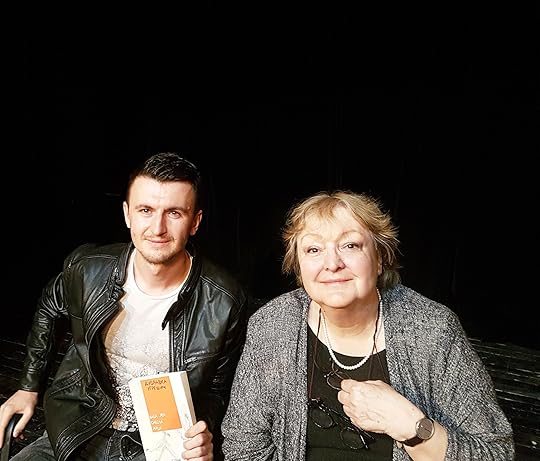
Не помня в кой столичен театър беше, но от изд. Колибри организираха литературна среща с Дубравка Угрешич и отидох с моя приятелка от вестника, в който тогава работех. Вечерта премина блестящо, абсолютен кеф! Това бе една от най-хубавите премиери, на които съм присъствал, Дубравка е изключително интелигентен, приказлив, умен и красив събеседник, който можеш да слушаш с часове. Изминали са 4 години, но още помня някои истории, които разказваше, ведрото ѝ настроение и аплодисментите в залата. След представянето на книгата ѝ успях да си взема подпис, да разменим 2-3 приказки, споделих ѝ с какво се занимавам и какво ме интересува, дори се снимахме заедно. Към днешна дата, години по-късно, оценявам още повече както автографа ѝ, така и снимката ми с нея: и ми се ще тя да можеше да разбере значението им за мен, защото в сборника си с есета "Европа в сепия" е посветила десетки редове на незначителността на писателя, безцелното даване на автографи върху флаери и книги, снимките с посетители на литературни фестивали и събития, които по-скоро тя нихилизира в своя ироничен стил.
„Всички дейности на литературните фестивали са ориентирани към посетителите, към евентуалната читателска публика. Към вас се приближават някакви мрачни типове с вашата снимка, свалена от интернет, и искат да им дадете автограф, макар, между другото, едва да се познавате на нея, защото без разрешение са ви фотографирали някакви други мрачни типове и са качили снимката в интернет. Питате се каква връзка има това с литературата и за какво им е всичко, отначало отказвате, но още в следващата секунда упреквате себе си в арогантност и покорно се подписвате. Към вас се приближават странни типове с хартийки, бележници или с програмата на фестивала, на която е отпечатано вашето име, и искат автограф, да, тук, моля, до вашето име, може и под него. Има и такива, които идват с екземпляр от вашата книга в ръце, към тях сте по-любезни, като учителка към отличниците, за да откриете в следващата минута, че са ви объркали с някой друг.”
След прочита на "Баба Яга снесла яйце" прочетох още: "Лисица", "Американски речник", "Форсиране на романа река", "Щефица Цвек в челюстите на живота" и "Епоха на кожата". (предвид натоварения ми график през последните години около пандемията нямах никакво време за редовно участие в goodreads и тепърва имам да наваксвам с много текстове и отзиви)
Прочетох "Европа в сепия" 10 години след издаването на книгата. Уж писани в периода 2009-2012 година есетата в сборника са пророчески, правдиви, остри, забавни и все по-актуални: какъв е всъщност балканският мъж, а може ли да пише балканската жена, в кои прослойки национализмът е гордост, да се плашим ли от джендърите и педерасите? Живот и здраве с удоволствие ще прочета текстовете и след десетина години, но съм сигурен, че и тогава ще говоря на един език с Угрешич и ще съм съгласен с нея по всяка тема. "Разбрах, че национализмът е въпрос на печалба, а не на чувства. Разбунтувах се срещу войната, вместо да приема тезата, че войната е просто икономика."
Обемисто ще е да правя разборка есе по есе, тъй като и без това всяко едно ме впечатли по свой собствен начин, но в общи линии в книгата силно са застъпени темите за безсмисления и смехотворен национализъм, принадлежността към обществото и света, инаквостта и еднаквостта, съдбата на писателя в модерния свят, посредствеността, връзката между литературата и парите (и по какъв начин банкнотите изкривиха занаята на талантливите и го превърнаха в професия на успешните маркетолози), свръхконсуматорството и последствията от него.
Феминистка в най-чиста и адекватна форма, Писателка, креативна, иронична, прозорлива, можеща, скромна, безпощадна в критиката си към глупака, космополитен и красив ум! Смятам, че за всеки четящ и любопитен към света човек срещата с "Европа в сепия" на Дубравка Угрешич би била едно приятно преживяване - като разговор със събеседник, който чете мислите ви и подрежда думите в изречения по-добре от вас. Наистина много голяма!
„А къде са моите читатели? Кой ще подкрепи мен и моето малко независимо ръкоделие? В неолибералния свят – а литературата е част от този свят – аз съм осъдена на затваряне на дюкяна. Какво става тогава с моето право да защитя своите текстове от ограничените политически, национални, етнически и други идеологически прочити, които споменах в началото? Моята свобода е изядена от демокрацията – бихме моли и така да поставим нещата. Имам колкото ми сърце иска паркове, където мога да държа речи на птиците. За каква следователно свобода говоря в момент, когато вестниците, бавно изчезват, защото, както се твърди, не са в състояние да осигуряват печалба; когато много литературни катедри се затварят, защото, както се твърди, няма студенти, които да проявят интерес (няма печалба!); когато издателите абсолютно безцеремонно се освобождават от своите недоходоносни писатели, дори те да са носители на значими литературни награди.
Запитах се какво в живота ми – този безразборен багаж, в който се смесват израстването ми при социализма, разпадът на Югославия, гражданската война, новите паспорти и разпадналите се идентичности, предателствата, изгнанието, новият живот в западноевропейска страна – та какво в живота ми се е сбъднало от онова, което ми обещаваха комунистическите идеолози и холивудските филми, идеолозите на консуматорството и местните националистически идеолози, идеолозите на европейското обединение и различните други учители и гурута? Въпросът ме прободе като отровен трън, сърцето ми заби по-бързо, а после ме заля страх, внезапен страх от теснотата, от празния екран, от недостига на въображение за бъдещето.
За какво ни е въображение, достатъчно утешително е, че в близко бъдеще ще живеем много по-дълго (Кой в такъв свят би искал да живее по-дълго?!); и сигурно ще живеем по-добре (Наистина вече никой не ни обещава това!); ако не по-добре, то във всеки случай по-свободно (Пфу!), в свят без граници (Моля?!), в свят на солидарност и справедливост (Стига!), в свят на солидарност и справедливост ще живеем като роби, ка-то ро-би…
С творчеството на Дубравка Угрешич се запознах през 2019-а г., когато преди пандемията, в София имаше криво-ляво някакъв културно-литературен живот и що годе редовно ни гостуваха чужди автори. Издателство "Колибри" преиздаде за кратък срок в ново оформление едни от най-популярните книги на Дубравка Угрешич и още с първия роман, който прочетох, "Баба Яга снесла яйце", станах върл фен на писателката. Тогава, спомням си, твърдях, а и все още го твърдя, че първата част на "Баба Яга снесла яйце" е така бленуваната добра съвременна българска проза, на световно ниво, която всички искаме някой българин да е написал, и макар майката на Дубравка да е българка, след всичко прочетено на Угрешич - не мога да я нарека българка!, - тя си има хърватско-западноевропейски почерк в писането и нейната литература не може да бъде причислена към българската, за съжаление.
Не помня в кой столичен театър беше, но от изд. Колибри организираха литературна среща с Дубравка Угрешич и отидох с моя приятелка от вестника, в който тогава работех. Вечерта премина блестящо, абсолютен кеф! Това бе една от най-хубавите премиери, на които съм присъствал, Дубравка е изключително интелигентен, приказлив, умен и красив събеседник, който можеш да слушаш с часове. Изминали са 4 години, но още помня някои истории, които разказваше, ведрото ѝ настроение и аплодисментите в залата. След представянето на книгата ѝ успях да си взема подпис, да разменим 2-3 приказки, споделих ѝ с какво се занимавам и какво ме интересува, дори се снимахме заедно. Към днешна дата, години по-късно, оценявам още повече както автографа ѝ, така и снимката ми с нея: и ми се ще тя да можеше да разбере значението им за мен, защото в сборника си с есета "Европа в сепия" е посветила десетки редове на незначителността на писателя, безцелното даване на автографи върху флаери и книги, снимките с посетители на литературни фестивали и събития, които по-скоро тя нихилизира в своя ироничен стил.
„Всички дейности на литературните фестивали са ориентирани към посетителите, към евентуалната читателска публика. Към вас се приближават някакви мрачни типове с вашата снимка, свалена от интернет, и искат да им дадете автограф, макар, между другото, едва да се познавате на нея, защото без разрешение са ви фотографирали някакви други мрачни типове и са качили снимката в интернет. Питате се каква връзка има това с литературата и за какво им е всичко, отначало отказвате, но още в следващата секунда упреквате себе си в арогантност и покорно се подписвате. Към вас се приближават странни типове с хартийки, бележници или с програмата на фестивала, на която е отпечатано вашето име, и искат автограф, да, тук, моля, до вашето име, може и под него. Има и такива, които идват с екземпляр от вашата книга в ръце, към тях сте по-любезни, като учителка към отличниците, за да откриете в следващата минута, че са ви объркали с някой друг.”
След прочита на "Баба Яга снесла яйце" прочетох още: "Лисица", "Американски речник", "Форсиране на романа река", "Щефица Цвек в челюстите на живота" и "Епоха на кожата". (предвид натоварения ми график през последните години около пандемията нямах никакво време за редовно участие в goodreads и тепърва имам да наваксвам с много текстове и отзиви)
Прочетох "Европа в сепия" 10 години след издаването на книгата. Уж писани в периода 2009-2012 година есетата в сборника са пророчески, правдиви, остри, забавни и все по-актуални: какъв е всъщност балканският мъж, а може ли да пише балканската жена, в кои прослойки национализмът е гордост, да се плашим ли от джендърите и педерасите? Живот и здраве с удоволствие ще прочета текстовете и след десетина години, но съм сигурен, че и тогава ще говоря на един език с Угрешич и ще съм съгласен с нея по всяка тема. "Разбрах, че национализмът е въпрос на печалба, а не на чувства. Разбунтувах се срещу войната, вместо да приема тезата, че войната е просто икономика."
Обемисто ще е да правя разборка есе по есе, тъй като и без това всяко едно ме впечатли по свой собствен начин, но в общи линии в книгата силно са застъпени темите за безсмисления и смехотворен национализъм, принадлежността към обществото и света, инаквостта и еднаквостта, съдбата на писателя в модерния свят, посредствеността, връзката между литературата и парите (и по какъв начин банкнотите изкривиха занаята на талантливите и го превърнаха в професия на успешните маркетолози), свръхконсуматорството и последствията от него.
Феминистка в най-чиста и адекватна форма, Писателка, креативна, иронична, прозорлива, можеща, скромна, безпощадна в критиката си към глупака, космополитен и красив ум! Смятам, че за всеки четящ и любопитен към света човек срещата с "Европа в сепия" на Дубравка Угрешич би била едно приятно преживяване - като разговор със събеседник, който чете мислите ви и подрежда думите в изречения по-добре от вас. Наистина много голяма!
„А къде са моите читатели? Кой ще подкрепи мен и моето малко независимо ръкоделие? В неолибералния свят – а литературата е част от този свят – аз съм осъдена на затваряне на дюкяна. Какво става тогава с моето право да защитя своите текстове от ограничените политически, национални, етнически и други идеологически прочити, които споменах в началото? Моята свобода е изядена от демокрацията – бихме моли и така да поставим нещата. Имам колкото ми сърце иска паркове, където мога да държа речи на птиците. За каква следователно свобода говоря в момент, когато вестниците, бавно изчезват, защото, както се твърди, не са в състояние да осигуряват печалба; когато много литературни катедри се затварят, защото, както се твърди, няма студенти, които да проявят интерес (няма печалба!); когато издателите абсолютно безцеремонно се освобождават от своите недоходоносни писатели, дори те да са носители на значими литературни награди.
Запитах се какво в живота ми – този безразборен багаж, в който се смесват израстването ми при социализма, разпадът на Югославия, гражданската война, новите паспорти и разпадналите се идентичности, предателствата, изгнанието, новият живот в западноевропейска страна – та какво в живота ми се е сбъднало от онова, което ми обещаваха комунистическите идеолози и холивудските филми, идеолозите на консуматорството и местните националистически идеолози, идеолозите на европейското обединение и различните други учители и гурута? Въпросът ме прободе като отровен трън, сърцето ми заби по-бързо, а после ме заля страх, внезапен страх от теснотата, от празния екран, от недостига на въображение за бъдещето.
За какво ни е въображение, достатъчно утешително е, че в близко бъдеще ще живеем много по-дълго (Кой в такъв свят би искал да живее по-дълго?!); и сигурно ще живеем по-добре (Наистина вече никой не ни обещава това!); ако не по-добре, то във всеки случай по-свободно (Пфу!), в свят без граници (Моля?!), в свят на солидарност и справедливост (Стига!), в свят на солидарност и справедливост ще живеем като роби, ка-то ро-би…

May 12, 2024
"Nije li Zagreb ipak Zagrob, zagrobno mjesto, a ne tek puko mjesto za pukim brijegom, ili pukom grabom?"
"Veliki romani su kao bugačice, oni upijaju temeljne dileme svoga doba, i naslijepo anticipiraju buduće vrijeme." (o Olešinom romanu Zavist)
"Moja ideja je možda ekskluzivna, ali na sreću nije originalna. Originalnost, kažu tržišni stručnjaci, samo povećava rizik od bankrota. Sve u svemu, odlučila sam iznajmljivati vlastitu dušu. (...) Moja je duša fleksibilna i pokazuje jaka regenerativna svojstva. Njezina apsorpcijska svojstva su zavidna, kao u starinske bugačice."
"Za razliku od većine žena, većina muškaraca osjeća se u književnosti komotno. Književnost je muški teritorij, književnici su u književnosti "doma", tu je njihova fotelja, njihove papuče, njihova lula. Povijest književnosti to su pjesnici, prozaici, dramatičari, esejisti, mislioci i filozofi; to su prijatelji i drugari, sugovornici i suigrači, idoli i inspiratori. Književnost je brojna muška porodica."
"Sve su to priče koje su ispisale tvoje sestre. I svašta tu piše, žene kao žene, utkivale su i uplitale u ćilime mnoge stvari: djevojke svoje ljubavne snove, bračne snove, udane mlade žene svoje nezadovoljstvo (...) Ćilimi su ženski dnevnici, samo ih treba znati čitati. A ti si mi na ovome polju, vidim, nepismena. Kažeš da si književnica, a ne znaš slova."
"Veliki romani su kao bugačice, oni upijaju temeljne dileme svoga doba, i naslijepo anticipiraju buduće vrijeme." (o Olešinom romanu Zavist)
"Moja ideja je možda ekskluzivna, ali na sreću nije originalna. Originalnost, kažu tržišni stručnjaci, samo povećava rizik od bankrota. Sve u svemu, odlučila sam iznajmljivati vlastitu dušu. (...) Moja je duša fleksibilna i pokazuje jaka regenerativna svojstva. Njezina apsorpcijska svojstva su zavidna, kao u starinske bugačice."
"Za razliku od većine žena, većina muškaraca osjeća se u književnosti komotno. Književnost je muški teritorij, književnici su u književnosti "doma", tu je njihova fotelja, njihove papuče, njihova lula. Povijest književnosti to su pjesnici, prozaici, dramatičari, esejisti, mislioci i filozofi; to su prijatelji i drugari, sugovornici i suigrači, idoli i inspiratori. Književnost je brojna muška porodica."
"Sve su to priče koje su ispisale tvoje sestre. I svašta tu piše, žene kao žene, utkivale su i uplitale u ćilime mnoge stvari: djevojke svoje ljubavne snove, bračne snove, udane mlade žene svoje nezadovoljstvo (...) Ćilimi su ženski dnevnici, samo ih treba znati čitati. A ti si mi na ovome polju, vidim, nepismena. Kažeš da si književnica, a ne znaš slova."

January 27, 2014
I'm a big fan of Dubravka Ugrešić, and this collection is brilliant and timely. My review appears in Music and Literature: http://www.musicandliterature.org/rev...

March 3, 2016
While the word "angry" kept going through my mind while I was reading the book, "pljuni istini u oci" is the best description of the book for me. I'm sure Boldozer won't mind. If this is sepia, I will dread picking up Dubravka's future book which would be titled Europa u crnom.

November 24, 2017
I was tempted to give this book four stars for the forcefulness and intelligence of Ugresic's prose, which cannot be denied, but her tone often suffers from a loosely reined anger that becomes too bitter for my tastes.

February 2, 2018
This is a collection of literary essays from Dubravka Ugrešić, a post-Yugoslav Croatian author living in exile in the Netherlands due to her opposition to the ethnic nationalism that tore the Balkans apart in the early '90s. Since then, she wryly observes that she's been suspended in a kind of national and literary no-man's land, defying as she does the easy categorization preferred by both. "Because literature - as an exemplar of a nation's 'spiritual wealth,' as a 'bridge between peoples' (alongside the many of the characteristics attributed to it) - is also a form of ethno-business. Unfortunately" (from "What is an Author Made Of?"). Ugrešić perceives herself as a shanty lost in a sea of skyscrapers, her critical acclaim no bolster to her limited appeal in a reading culture used to corporate hype of the Next Big Thing That You'll Like if You Liked This Other Similar Thing ("ON-Zone").
Exile, loss and drift, cultural exhaustion, and political resignation are the topics explored the twenty-three essays of Europe in Sepia. The collapse of Ugrešić's homeland Yugoslavia signaled the end of one era's dreams and vision, with nothing to replace it beyond a kind of stagnant capitalism and grasping consumerism. "We dreamed a lot in communism, and that was the best part about it . . . This best part will never find a place in any museum of communism for the simple reason that it's intangible: It crouches hiding in literature, in film, in painting, in the architecture of an epoch that believed it was creating a new world" (from "The Museum of Tomorrow"). Today, our resistance is feeble, Ugrešić says, we know we are easily bought, and our bitterness only lingers and ferments. "Our ability to imagine a new society has expired, and so we stand, like a blind man waiting expectantly for an explosion" (from "Manifesto").
Honestly, in reading such passages my initial reaction to Ugrešić was that she just really likes to complain, and I'm generally a pretty sardonic person myself. But, as I read on, I felt my perspective shift with the weight of her life and her isolation as a fundamentally stateless, artistically marginalized individual. "What sane person would want a literary marriage with an evidently traumatized literary personality like me?" Ugrešić asks dryly ("ON-Zone"). That's a tough question with no reassuring answer and she knows it.
Exile, loss and drift, cultural exhaustion, and political resignation are the topics explored the twenty-three essays of Europe in Sepia. The collapse of Ugrešić's homeland Yugoslavia signaled the end of one era's dreams and vision, with nothing to replace it beyond a kind of stagnant capitalism and grasping consumerism. "We dreamed a lot in communism, and that was the best part about it . . . This best part will never find a place in any museum of communism for the simple reason that it's intangible: It crouches hiding in literature, in film, in painting, in the architecture of an epoch that believed it was creating a new world" (from "The Museum of Tomorrow"). Today, our resistance is feeble, Ugrešić says, we know we are easily bought, and our bitterness only lingers and ferments. "Our ability to imagine a new society has expired, and so we stand, like a blind man waiting expectantly for an explosion" (from "Manifesto").
Honestly, in reading such passages my initial reaction to Ugrešić was that she just really likes to complain, and I'm generally a pretty sardonic person myself. But, as I read on, I felt my perspective shift with the weight of her life and her isolation as a fundamentally stateless, artistically marginalized individual. "What sane person would want a literary marriage with an evidently traumatized literary personality like me?" Ugrešić asks dryly ("ON-Zone"). That's a tough question with no reassuring answer and she knows it.
October 30, 2022
Ugresic is a compelling critic of nostalgia because she appreciates its allure. Scattered throughout the essays in this volume are observations about the dizzying dance of nostalgia and migration within Europe, and the new flavors added to the old flavors of social tension and prejudice in our new century where history hasn't ended, we just usually don't get how it sneaks up on us.
I had encountered Yuri Olesha only once before -- mentioned in an essay about the daily habits of writers (he had a rule to write at least one sentence or one line of poetry a day). After reading Ugresic's essay about him, I must hunt down his Envy.
I had encountered Yuri Olesha only once before -- mentioned in an essay about the daily habits of writers (he had a rule to write at least one sentence or one line of poetry a day). After reading Ugresic's essay about him, I must hunt down his Envy.

August 22, 2015
ik hou nogal van de romans, verhalen en essays van Dubravka Ugresic. Haar voorlaatste essaybundel had ik weliswaar overgeslagen omdat ik vreesde dat ze zich ging herhalen, maar haar nieuwe bundel las ik dan wel weer. En met veel plezier.
De essays in "Europa in sepia" gaan -zoals steeds bij Ugresic- over veel verschillende onderwerpen, landen en vreemde fenomenen. Maar een aantal kwesties keren vanuit steeds andere belichtingen steeds terug, en ook die kwesties kennen we uit eerdere essaybundels van Ugresic: de treurniswekkende cultuur van leugens in Ugresics geboorteland Kroatië; de depressief makende repressie, armoede, geborneerde terreur en andere ongein die haar noopten om uit Kroatië te vertrekken; de totale verplatting van de Westerse cultuur waardoor kunst en literatuur totaal naar de kloten gaan; de rap uitzaaiende invloeden van internet, Facebook en andere moderne media die tot totale conformistische eenvormigheid leiden en tot verplatting van de cultuur; de totale leegte die gaapt onder alle exhibitionistische selfexposure die op Facebook en Twitter hoogtij viert. De essays hebben dus vaak een waarschuwende, kritische of zelfs ronduit felle en boze toon, en hebben soms een behoorlijk zware en confronterende inhoud. Ze leggen bijvoorbeeld allerlei misstanden in het voormalig Joegoslavië bloot die ik nog helemaal niet kende, en wekken ook een behoorlijke onrust op over hoe het moderne Westen steeds leger, platter en cultuurarmer wordt. Ik vind deze essays daarom ook waardevol: misschien gaat Ugresic in haar cultuurpessimisme soms wat ver, maar ik vind het zonder meer heel goed dat Ugresic consequent blijft hameren op allerlei naargeestige cultuurfenomenen in Oost-Europa en West- Europa.
Nog flink wat waardevoller vind ik echter de manier waarop ze dat doet. De zware en deprimerende zaken die zij aanroert worden namelijk steeds in een opmerkelijk vederlichte, speelse, fantasievolle en lenige stijl beschreven. Daardoor herhaalt ze zich toch niet, want ze schrijft vaak wel over dezelfde soort onderwerpen maar wel steeds op een nieuwe en vernieuwende manier en vanuit steeds verrassende invalshoeken. Bovendien is haar lichtheid van stijl in mijn beleving een waardevol statement: die stijl zie ik namelijk als een protest en tegenwicht tegen de deprimerende zwaarte en conformistische eenvormigheid van de wereld.
Zo schrijft ze een lang essay over de "karaoke-cultuur": Ugresics eigenzinnige benaming van de steeds toenemende mate van imitatie, namaak en onechtheid in onze hedendaagse cultuur. Die benaming alleen al roept bij mij een grijns op, en die grijns wordt nog breder door alle onverwachte associatieve verbanden en invalshoeken die Ugresic construeert en door haar trefzekere formuleringen. Zo beschrijft ze de wijze waarop Bill Murray in "Lost in translation" een karaoke-lied zingt bijzonder raak als "fatalistisch geduld". Een stuk over de Occupy-beweging vliegt ineens associatief alle kanten op, en wordt daardoor van stijl en vorm ineens net zo anarchistisch en ongrijpbaar als de tegen alles en iedereen protesterende Occupy-beweging. Een behoorlijk navrante beschrijving van de heksenjacht die in Kroatië is en wordt gevoerd tegen Ugresic eindigt ineens met de speelse fantasie dat Ugresic op een bezemsteel springt en licht als een veertje door de lucht wegzweeft. Ongrijpbaar ontsnappend aan de zwaarte van de wereld. Een associatief betoog over zwaarwichtige zaken in Oost- en West-Europa wordt ineens doorsneden met een uiterst aanstekelijk pleidooi voor de vergeten schrijver Joeri Oljesja, wiens roman "Afgunst" ongrijpbaar was voor het Stalinistische regime, en wiens vederlichte stijl ons ook nu nog diverse non-conformistische en vernieuwende perspectieven aanreikt. Bovendien is " Agunst" een roman die - geheel tegen de toenmalige tijdgeest in- uitademt dat absolute waarheden niet bestaan. Op ontroerende wijze verklaart Ugresic zich vervolgens solidair met al die luiaards, fantasten, verliezers, non-conformisten en anti-maatschappelijke outcasts die Oljesja in zijn meesterwerk "Afgunst" beschrijft. En na allerlei deprimerende (hoewel met grappen doordesemde) beschouwingen over de teloorgang van de literatuur en het daardoor nakende einde van haar schrijverschap, komt Ugresic toch met de volgende m.i. wonderschone en vederlichte fantasie: "Want wie weet: misschien zullen zich morgen al, elke keer als ik in gedachten met mijn ogen knipper, in de lucht voor me doorzichtige boeken openen waarin de lettertjes als planktondeeltjes fonkelen; vloeibare boeken waarin ik als in een warme zee kan wegzinken en waaruit ik teksten kan laten stromen vol leven en met de zilveren schittering van een school sardines. Misschien zullen er morgen al boeken voor me verschijnen waarvan de lettertjes als vliegjes door de lucht zwermen om zich op een wenk van mij tot zinvolle woorden en zinnen samen te voegen. Niet slecht, denk ik, en ik zie voor me hoe vanuit het dieptepunt van mijn verslagenheid een nieuwe tekst wordt geboren".
Zeker, de essays van Ugresic zijn doordrenkt van verslagenheid en zwaarte. Maar door hun vederlichte stijl en hun anarchistische en ongrijpbare fantasie zijn ze ook heel stimulerend en hoopvol. Elk essay ontsnapt aan het eenvormige conformisme dat beschreven wordt, elke alinea beschrijft zwaarte maar bedrijft lichtheid. Dat vind ik erg stimulerend. Ik ben kortom blij dat ik "Europa in sepia" gelezen heb, en zal ook die ene essaybundel van Ugresic die ik overgeslagen heb alsnog gaan lezen. Maar eerst "Afgunst" van Joeri Oljesja!
De essays in "Europa in sepia" gaan -zoals steeds bij Ugresic- over veel verschillende onderwerpen, landen en vreemde fenomenen. Maar een aantal kwesties keren vanuit steeds andere belichtingen steeds terug, en ook die kwesties kennen we uit eerdere essaybundels van Ugresic: de treurniswekkende cultuur van leugens in Ugresics geboorteland Kroatië; de depressief makende repressie, armoede, geborneerde terreur en andere ongein die haar noopten om uit Kroatië te vertrekken; de totale verplatting van de Westerse cultuur waardoor kunst en literatuur totaal naar de kloten gaan; de rap uitzaaiende invloeden van internet, Facebook en andere moderne media die tot totale conformistische eenvormigheid leiden en tot verplatting van de cultuur; de totale leegte die gaapt onder alle exhibitionistische selfexposure die op Facebook en Twitter hoogtij viert. De essays hebben dus vaak een waarschuwende, kritische of zelfs ronduit felle en boze toon, en hebben soms een behoorlijk zware en confronterende inhoud. Ze leggen bijvoorbeeld allerlei misstanden in het voormalig Joegoslavië bloot die ik nog helemaal niet kende, en wekken ook een behoorlijke onrust op over hoe het moderne Westen steeds leger, platter en cultuurarmer wordt. Ik vind deze essays daarom ook waardevol: misschien gaat Ugresic in haar cultuurpessimisme soms wat ver, maar ik vind het zonder meer heel goed dat Ugresic consequent blijft hameren op allerlei naargeestige cultuurfenomenen in Oost-Europa en West- Europa.
Nog flink wat waardevoller vind ik echter de manier waarop ze dat doet. De zware en deprimerende zaken die zij aanroert worden namelijk steeds in een opmerkelijk vederlichte, speelse, fantasievolle en lenige stijl beschreven. Daardoor herhaalt ze zich toch niet, want ze schrijft vaak wel over dezelfde soort onderwerpen maar wel steeds op een nieuwe en vernieuwende manier en vanuit steeds verrassende invalshoeken. Bovendien is haar lichtheid van stijl in mijn beleving een waardevol statement: die stijl zie ik namelijk als een protest en tegenwicht tegen de deprimerende zwaarte en conformistische eenvormigheid van de wereld.
Zo schrijft ze een lang essay over de "karaoke-cultuur": Ugresics eigenzinnige benaming van de steeds toenemende mate van imitatie, namaak en onechtheid in onze hedendaagse cultuur. Die benaming alleen al roept bij mij een grijns op, en die grijns wordt nog breder door alle onverwachte associatieve verbanden en invalshoeken die Ugresic construeert en door haar trefzekere formuleringen. Zo beschrijft ze de wijze waarop Bill Murray in "Lost in translation" een karaoke-lied zingt bijzonder raak als "fatalistisch geduld". Een stuk over de Occupy-beweging vliegt ineens associatief alle kanten op, en wordt daardoor van stijl en vorm ineens net zo anarchistisch en ongrijpbaar als de tegen alles en iedereen protesterende Occupy-beweging. Een behoorlijk navrante beschrijving van de heksenjacht die in Kroatië is en wordt gevoerd tegen Ugresic eindigt ineens met de speelse fantasie dat Ugresic op een bezemsteel springt en licht als een veertje door de lucht wegzweeft. Ongrijpbaar ontsnappend aan de zwaarte van de wereld. Een associatief betoog over zwaarwichtige zaken in Oost- en West-Europa wordt ineens doorsneden met een uiterst aanstekelijk pleidooi voor de vergeten schrijver Joeri Oljesja, wiens roman "Afgunst" ongrijpbaar was voor het Stalinistische regime, en wiens vederlichte stijl ons ook nu nog diverse non-conformistische en vernieuwende perspectieven aanreikt. Bovendien is " Agunst" een roman die - geheel tegen de toenmalige tijdgeest in- uitademt dat absolute waarheden niet bestaan. Op ontroerende wijze verklaart Ugresic zich vervolgens solidair met al die luiaards, fantasten, verliezers, non-conformisten en anti-maatschappelijke outcasts die Oljesja in zijn meesterwerk "Afgunst" beschrijft. En na allerlei deprimerende (hoewel met grappen doordesemde) beschouwingen over de teloorgang van de literatuur en het daardoor nakende einde van haar schrijverschap, komt Ugresic toch met de volgende m.i. wonderschone en vederlichte fantasie: "Want wie weet: misschien zullen zich morgen al, elke keer als ik in gedachten met mijn ogen knipper, in de lucht voor me doorzichtige boeken openen waarin de lettertjes als planktondeeltjes fonkelen; vloeibare boeken waarin ik als in een warme zee kan wegzinken en waaruit ik teksten kan laten stromen vol leven en met de zilveren schittering van een school sardines. Misschien zullen er morgen al boeken voor me verschijnen waarvan de lettertjes als vliegjes door de lucht zwermen om zich op een wenk van mij tot zinvolle woorden en zinnen samen te voegen. Niet slecht, denk ik, en ik zie voor me hoe vanuit het dieptepunt van mijn verslagenheid een nieuwe tekst wordt geboren".
Zeker, de essays van Ugresic zijn doordrenkt van verslagenheid en zwaarte. Maar door hun vederlichte stijl en hun anarchistische en ongrijpbare fantasie zijn ze ook heel stimulerend en hoopvol. Elk essay ontsnapt aan het eenvormige conformisme dat beschreven wordt, elke alinea beschrijft zwaarte maar bedrijft lichtheid. Dat vind ik erg stimulerend. Ik ben kortom blij dat ik "Europa in sepia" gelezen heb, en zal ook die ene essaybundel van Ugresic die ik overgeslagen heb alsnog gaan lezen. Maar eerst "Afgunst" van Joeri Oljesja!

June 19, 2026
Smart collection of essays from this post/trans-national author of Croatian/Yugoslav descent. There is a slight bitterness and melancholy in her writing which is certainly unfortunate because she seems to have been under the impression she had failed in some way as an author, or at least that she didn't get the recognition she deserved and was certainly not indifferent to it. Otherwise, very interesting musings on many different topics including her perennial favorites: nationalism, migration, literature, sexism, capitalism.
January 11, 2026
Zbirka eseja iz 2010-2012. Nisam odusevljena, stovise na trenutke mi je knjiga bila malo naporna jer se vrte sve vec dobro prokuhane teme o tome kako su muski pisci cijenjeniji nego zene, kako su ljudi izgubljeni kad se odsele iz maticne drzave, kako nitko vise ne cita i sve je jeftino/umjetno i kapitalizam je sranje. Mozda je do toga sto su eseji napisani prije 15 godina pa su izgubili aktualnost i samo se cine neoriginalni.
Ali bilo je svakako dobrih trenutaka, pogotovo na pocetku.
Ali bilo je svakako dobrih trenutaka, pogotovo na pocetku.

January 7, 2024
Questi scritti raccontano di nostalgie storiche, di femminismo, di marginalizzazione, di scrittura e di letteratura in maniera divertente, senza mezzi termini. Molti passaggi sono quasi dolorosi: la letteratura è morta? Anche fosse, Ugrešić continua a scrivere. La sua è un’alta forma di resistenza.

August 28, 2026
idk how in debt the information in this book was, but i enjoyed reading it on my trip through the balkans, it gave me a lot of interesting context!! although i felt the author was a little bitter sometimes xdd

March 27, 2019
Despite its structure I found it chaotic. The author expresses some very drastic and controversial opinions at times but it was also interesting and enlightening in other places.
October 7, 2023
Авторката ми се струва интересна, но не мога да чета превода на български. Пример: “същият, който платил милион фунта на Ейми Уайнхаус” (стр. 224)

December 29, 2023
So cynical but so smart and entertaining at the same time
January 9, 2024
So sharp and precise about Europe today. I loved every word of if. Not easy to writte about so many difficult topics in such a clear way and still be lovable.

Displaying 1 - 30 of 42 reviews