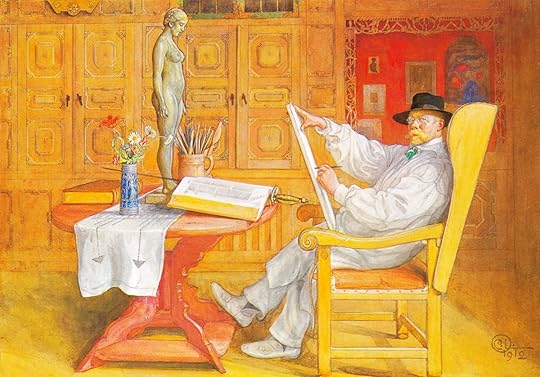
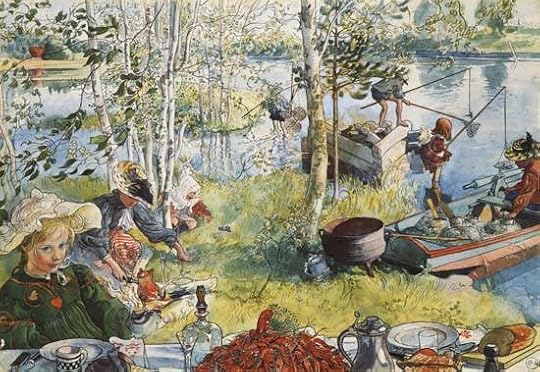
Carl Larssons självbiografi Frispråkigt och ärligt berättar Carl Larsson i sin självbiografi om den hårda barndomen i Stockholms fattigaste delar, åren i Paris livliga konstnärskvarter och livet i det hus i dalarna som för alltid skulle komma att påverka synen på det svenska hemmet.
Carl Larsson was a Swedish painter and illustrator, particularly known for his pen and watercolours of family life. He married Karin Larsson, née Bergöö, who was an artist and designer.
It is hard to imagine an artist more geniunely connected to Sweden's cultural heritage than Carl Larsson.
Reading his autobiography confirms that and adds several layers to the understanding of his life, both in its struggles and in its happiness. He wrote most of the text in July 1918, a few months before he died, and I read it in July 2018, in conjunction with a visit to his home in Dalarna, Sundborn. His voice hasn't lost any of its immediacy over the century that has passed since that hot summer when he looked at his life from a retrospective point of view, repeatedly apologising for mentioning his brutal father and poverty-stricken difficult childhood in Stockholm's poorest quarters. He felt guilty - having achieved so much family happiness, why complain about the past?
And yet, it is the account of his origins that makes the person Carl Larsson stand out as an extraordinary man. Breaking the vicious circle of alcohol, violence and abandonment, he created a home and a life for seven children together with his wife. You can see the emerging modernity exemplified in their collaborative creativity.
Honestly, and humorously, he describes his fights, his successes, and his fears, and how he learned to cope by keeping a positive, smiling attitude even when he felt fear towards the dangerous, hypnotising snake that was life lived in full.
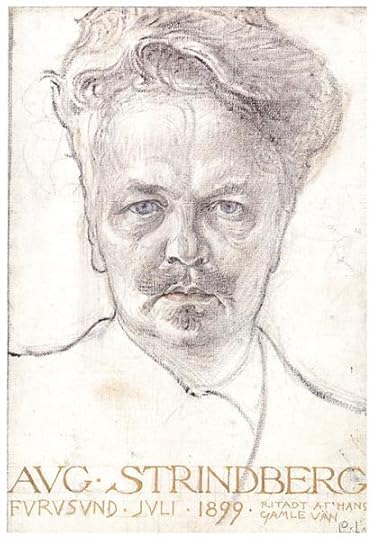
He befriended the artistic and cultural elite in Sweden of his times, and once called August Strindberg his best friend. It is a sad anecdote within the mass of notes when Carl Larsson describes the moment Strindberg turned his inevitable jealousy and hatred towards the former friend, and hit him where it hurt most - in a misogynist rant against Karin Larsson. Larsson from then on hated Strindberg, but was still noble enough to give a fair account of Sweden's national madman. His portrait of Strindberg is among the most intense witness accounts of both men's characters. "A masterpiece, may not be touched", Strindberg said about it when it was finished.
Regarding Larsson's autobiography, I would retort: "A masterpiece, you will be touched!"
Min sommar har bland annat spenderats i Dalarna, med ett besök i Sundborn, i Carl Larssons hem. En guidad visning fick upp mitt intresse för Carl Larssons självbiografi, och ett köp kändes givet där och då.
Boken är en mängd minnesanteckningar som blandas hej vilt, trots återupprepade försök av Larsson att hålla en röd tråd. Han beskriver det själv på följande sätt:
”Jag hade tänkt mig detta hela flytande jämnt och stilla som en bred flod, dessa hågkomster, som de nog i verkligheten var menade, men jag märker att jag därtill saknar förmåga; det blir hackmat, det blir ett kåseri till en grad som inte tillfredställer mig själv - eller så er…”
Jag håller med.
Större delen av boken handlar om folk han mött i sin karriär, och människor han såg upp till. Vilket inte intresserar mig nämnvärt. Däremot glimmar det till när han pratar om sina förälskelser, barnen och hemmet han byggde tillsammans med sin Karin. Det var fint.
Carl Larssons självbiografi. Jag köpte den när jag besökte Sundborn, eftersom att vi hade en så härlig guide, som berättade så inlevelsefullt om Carl Larsson.
Boken är betydligt rörigare än guiden på Sundborn.
Carl hoppar fram och tillbaka i tiden och rabblar namn, som jag inte alltid känner igen.
Det är roligt att ha fått en lite tydligare bild av den store konstnärens liv och konstnärskap, samt att få ta del av hans egna tankar och funderingar, men Carl Larsson var bättre på att måla än att skriva.
En stark självbiografi som Carl Larsson ville skulle släppas först efter hans och hustrun Karins död. Och så blev det också. Det osar om språket och man får en väldigt spännande inblick i hur det var att bo i Stockholm i slutet av 1800-talet. Carl Larsson gick från djup fattigdom till att bli en idol för det svenska folket. Hans vänskap och senare fiendskap med Strindberg hör till det mest brännande i boken.