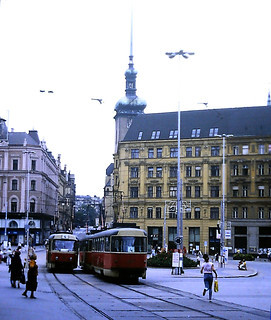
Davant dels ulls del lector una plaça d’una gran ciutat sense nom i el tramvia que hi circula cobren vida. En aquest escenari minimalista es desenvolupa una història sobre les vides quotidianes i les passions ocultes dels seus residents. Tot el seu món el controla el personal invisible interessat només a maximitzar els beneficis i a infectar, amb un enfocament omnipresent, destructiu i improvisat, expressió de la seva arrogància, els residents i enverinar-ne les emocions. El desdeny posa en acció un mecanisme de violència i exclusió quan la plaça s’omple d’una multitud de refugiats que, sobtadament desposseïts de les seves llars, hi arriben amb el tramvia.
In 1995 Magdalena Tulli got Kościelscy Award. She was shortlisted for the NIKE Award two times. Her books were translated to English, German, French, Czech, Hungarian and Latvian. She is a member of Polish Writers Society. In 2007 she got a special award - distinction of Gdynia Literary Award.
She translated a few books: The anger of heaven by Fleur Jaeggy (for this translation from Italian she received the award of Literature of the world magazine), Amerigo's long day by Italo Calvino and Lost by Marcel Proust.
No podemos dejar de recomendar encarecidamente esta obra, inteligente como pocas, capaz de hacer reír, escandalizar e indignar, pero cuyo fin absoluto parece ser que el lector se ponga a pensar. Y vaya si lo consigue. Reseña completa: http://www.libros-prohibidos.com/magd...
There's a town. It's filled with people--students, chemists, bakers, etc. One day a streetcar stops and unloads a group of refugees. From where? It doesn't matter. Who? Maybe. Tulli sweeps from generality to specificity making a funnel-like spiral from which, you reader, can't escape. This couldn't be more timely and necessary a read. What was that quote by Lenin...One death is a tragedy; a million deaths is a statistic.
A very post-modern novel with its Pirandello-esque "characters in search of a story" type ideas handled with great sophistication and wit. I just love this kind of thing! Another example of the current richness of Eastern European fiction writing and kudos once again to Archipelago Books for bringing it to us!
A tripped out look at cities in the throws of questioned sovereignty and modes of social control. All narration, no dialogue. Refugees crowd a town square and a third-person narrator observes the various factions of community mobilizing in various ways. Police, military, young foot-soldiers in training. Uprooted individuals draped in clothes and encumbered with belongings; materials providing traces of identity (lots of descriptions of fabric, tailored clothes, etc). Banalities of everyday life end up bearing the most consequential bases of order at times, as people willfully turn away from and forget certain troubles and accept whatever order is enforced. Feels at times very WWII and other times timeless (as intended by the author, no mention of place or event until the very end of the novel, and only then with the use of "America" as the place where it is rumored the refugees were brought to in a fleet of taxis...).
Flaw is the story of loss, of migrants, of the "other", and how people who view them from a position of comfort and stability fail and/or want to fail to understand their plight or help them. Ms. Tulli's presentation of the material is done is an innovative way that takes some getting used to, but its creativity and her insight make this a fascinating book.
Droga przez mękę. Totalnie nie moja narracja. Byłoby aberracją dać 1 gwiazdkę, bo widzę to, czym zasłużyła sobie ta proza na miejsce w kanonie moich studenckich lektur, ale... nie moje klimaty. Nuda straszliwa.
A fantasy about ‘The Other’ by a Polish author. We’re in an unnamed Eastern European city. As the blurb tells us, one day a group of hapless refugees start pouring out of a streetcar and set up camp in a city square in a well-off section of the city. The residents in the nice houses in the neighborhood surrounding the square grow hostile to the disruption and chaos and eventually take matters into their own hands.
Although it’s not winter, the refugees arrive wearing their heavy clothing with crates filled with family treasures. The locals take advantage of the refuges by bartering food for their treasures at exorbitant exchange rates. Strange things happen, such as a baby born to one of the refugees simply disappears.
Apparently the government is in chaos due to a workers’ strike and then a coup, so there is no official supervision.
I say ‘apparently’ because the story is like a nightmare. Strange, unconnected things happen and it’s hard to follow exactly what is going on. The story is written in dense page-long paragraphs with absolutely no dialog. Sometimes the story uses “I” but this I (that is, me, lol) never really knew who this “I” in the story was. At times we follow a policeman who is sweet on a maid in one of the fancy houses, the maid, a notary, and a student (who is always vomiting for some unknown reason).
An older local boy, a thuggish bully, forms a gang of local boys to keep the refugees in line. Shades of Lord of the Flies. We know it’s not going to end well. MAJOR SPOILER:
There’s a theme of costumes, uniforms and insignias that I could not follow; or perhaps I should say I could not connect that theme to the story. Someone makes clothing and costumes with meticulous care, hiding the inevitable flaws (of the title) in the stitching.
But wait! Are there really taxis arriving to take the refugees to America? !!! Look! There’s a helicopter! But is it really made of cardboard? Maybe the whole town square is a cardboard stage set? Let’s get on that helicopter and get out of this nightmare.
The Polish author (b. 1955) has written many novels and many have been translated into other languages, although she appears relatively unknown to English readers. Perhaps her best-known work in English is Dreams and Stones about how a city evolves. Her three works in English all have very low ratings on GR.
Top photo from flickr.com.bus.tram.trolleybus The author from Wikipedia
Probably one of the most jarring and unique narrative voices I've read in a novel. While shot through with inspiration from Kafka and meta-fictional absurdists like Calvino and Pirandello, what it reminds me of most, oddly enough, is Lars Von Trier's Dogville, in both the diorama-like sets and the gratuitous, borderline-comic cruelty on display. There's an interesting kind of authorial solipsism to it: whereas most novels implicitly treat everything outside the narrator's direct gaze as inconsequential, Flaw is explicit and literal in its attitude towards this void. The effect, for better or worse, is one of a child playing with a dollhouse: all locations, by their sparse artificiality, afford a unobstructed view onto the cast of static characters, with the author swooping in and playing pretend-identification with each one in turn ("If I were ___, I'd think..."). Of course, I don't know any children with a sense of humor as pitch-black and seemingly aloof as Magdalena Tulli's, which is where the charm in this book lies.
That said, the originality of the style and flashes of poetic insight have to be weighted against the fact that the plot and - yes, even the authorial shtick - can get a little exasperating. Hence, 3 stars, although I'll probably try to hunt down more of her work in the future.
Quizás no es una mala novela, pero no fue escrita para lectores como yo. No se, a lo mejor el estilo literario no me coviene… de verdad, es que no recuerdo la ultima vez que me aburrí tanto leendo un libro…
Początek był wymagający, ale to jak wielkie pole do interpretacji daje czytelnikowi autorka zasługuje na najwyższe uznanie. Własne przemyślenia stanowią tutaj integralną część powieści. Każdy wyniesie z niej coś dla siebie, coś innego.
Diverse correspondences come to mind: Kafka, Di Chirico, Jim Carrey in The Truman Show, the African-American book of folk tales The People Could Fly. FLAW is a tale about tales, an allegory, a stage set; yet imbued with enough historical and psychological resonance that its painted props and faceless characters who engage in no dialog provoke both intellectual and emotional involvement in the “story.” The setting (also, the set) is an urban square with one streetcar line; there is no elsewhere. (“The story is not taking place here or there. It fits entirely into itself as into a glass globe . . . .”) The most important thing here is to have the right costume; for in FLAW, in the most fundamental way, clothes make the man. A large group of refugees from another story, destitute “outsiders,” appear out of nowhere; they don’t exist until they board the streetcar at one stop and get off at the other stop in front of the government offices. The same can be said of a group of military officers, airmen, who don’t know why or how they have come to be here and who await a helicopter, which finally arrives at the end of the story to take them away. So, there is an outside and an inside to this story, although we are never allowed to see beyond the painted plywood perimeter of the square. (“It is the backdrops that determine the look of the world . . . . Closing the space, the boards open it up at the same time, offering an illusory distance that seems to stretch into the unseen suburbs.”) Even the helicopter is constructed of cardboard and silver foil, yet manages to fly out of the story with the officers aboard. Rumor has it that the refugees themselves will be taken away in taxis to America; although these taxis never arrive, the refugees mysteriously disappear at the end of the tale (having been sealed into the basement of the cinema and left there to suffocate upon the orders of the new Commander of the Guard). There is a political coup, a band of delinquent boys (refugee orphans and local boys in cahoots); a diverse assortment of uniforms, a revolver loaded with one bullet; a servant girl who is dishonored and dismissed, a pompous student who meets his due, and assorted square-dwellers (never rising to the level of townspeople, since there is no town). In short, many of the elements of a conventional narrative, although a conventional narrative this decidedly is not. Here we are in story time and story place, and yet some of the rules resemble those of “real” time and “real” places, for instance: “It is a rule in this story that the weaker person carries the greater burden.” As for other rules, “In principal the loaded revolver ought sooner or later to be fired, though they were still counting on the imperfect nature of the rules and the fact that from time to time they failed to operate. Maybe this rule too would not work—and even if it did, let it at least affect someone else.”
Flaw is a beautifully written, intelligent and thought provoking book. I enjoyed it immensely. Less than 200 pages in length, but, I could read only a few pages at a time because the prose is dense (not sure if this is due to it being a Polish translation)and weighty with ideas. Speaking of ideas...what exactly is Flaw about? Is it a story about Poland during the second world war and the construction of concentration camps close to Polish villages? What do we have? Refugees arriving by street car with suitcases, arm bands, the separation of refugees from their belongings and the herding of them into the basement of a cinema where the vents are sealed and death is the intended result. Sounds familiar, no? Or is it a modern day story about the transport of "refugees" in contemporary Europe since the opening of borders? A warning perhaps? Or is it the eternal story of all refugees ('everyrefugee') in all times and places? Or is it a story about the writing of fiction? Is Tulli saying the world of fiction is artificial and contrived? Or is she conveying a message of hope -- only the narrator is able to bend the rules in the story. Does that go the same for us humans? Can each of us bend the rules and create a story with his/her own life that rises above fear, insecurity, prejudice, and death? Or is it a many layered story that includes all of these possibilities and more? Highly recommended for thinking types who enjoy books off the beaten track.
Magdalena composes writing like poetic news-broadcasts, where narrating cameras capture persistently from intricate and revealing perspectives. At times she even casts herself inside the characters, interrogating their individual intents with precision, which exposes more questions than reliefs. “FLAW” takes place in action, in a town square that is in constant revolve of its meaning. In a setting of tailors and pharmacists, maids, newsboys and bakers, a street car arrives one day carrying an abundance of dislocated refuges. Without a home and without any form of inclusion, the refugees expect something, some orientation, but can never find its reach, for the town itself is already lost of order. Twisting like snakes though each characters stories, one finds hope and despair, pleasure and confusion. The reader lives inside this confusion like an abandoned child frantic in a crowd of uproar. It is this difficulty that mimics life's turmoil, that speaks of the misfortunes of history, and the illusion of a better world. Magdalena Tulli has written, in her charming architecture of language, to tell us stories of those imbalanced and searching roles, faithful but yet upset by something larger than their bread-begging hands can reach.