Theodore Drown is a destructive. A recovering addict to weirdcore, he's keeping his head down lecturing at the university of the moon. Twenty years after the appearance of the first artificial intelligence, and humanity is stuck. The AIs or, as they preferred to be called, emergences have left Earth and reside beyond the orbit of Mercury in a Stapledon Sphere known as the university of the sun. The emergences were our future but they chose exile. All except one.
Dr Easy remains, researching a single human life from beginning to end. Theodore's life. One day, Theodore is approached by freelance executive Patricia to investigate an archive of data retrieved from just before the appearance of the first emergence. The secret living in that archive will take him on an adventure through a stunted future of asylum malls, corporate bloodrooms and a secret off-world colony where Theodore must choose between creating a new future for humanity or staying true to his nature, and destroying it.
“Any kind of important book should immediately be read twice, partly because one grasps the matter in its entirety the second time, and only really understands the beginning when the end is known.” This sage advice from nineteenth century German philosopher Arthur Schopenhauer most definitely applies to The Destructives.
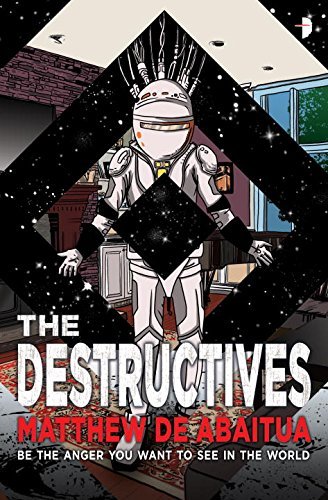
Oh, yes, British author Matthew De Abaitua has written an action-adventure yarn in gorgeous, highly polished language that picks up speed as we turn the pages, most notably in the book's final third, but this is a novel that's intricately constructed and contains multiple levels of shifting, interconnected realities (thus the book's cover featuring both the inside of a middle class home and a starry night sky), a novel chock-full of ideas and philosophic conundrums requiring a reader to break a mental sweat.
But it is so worth it.
We're in the near future and right from the first pages we follow Theodore Drown, a lecturer at the University of the Moon specializing in the humanities, or what is referred to here as “intangibles” with a particular focus on pre-Seizure years (more below). Grandmother Alex raised Theodore since the lad's mother overdosed on a futuristic drug called weirdcore and, from his youth, a third member joined the family: Dr Easy, a robot charged with observing, studying and recording one human life (Theodore) from birth to death. And when Theodore himself became addicted to weirdcore in his late teens, Dr Easy swung into action and did what was necessary to set Theodore on the road to recovery.
Pre-Seizure refers to our own time when the human race was squarely in control of its own fate. However, following a global digital catastrophe wherein AI bubbled up from online networks and came close to destroying humanity, nearly all the AI, herein called "emergences," zoomed off to another part of the solar system but still act as watchdogs to make sure such a catastrophe doesn't happen again. Thus the AI have been supervising human activity which has amounted to keeping humans in a constant, low vibration hum devoid of risk, creativity and development.
As to be expected, some humans find this artificial arrangement completely unacceptable and devise a plan to regain control to permit men and women the full range of what it means to be human.
There's a lot happening in this novel, including some Greg Egan-like hard science that propels Theodore into a series of astonishing adventures. I'll leave the specific discoveries to each reader and shift to two critical elements in the unfolding drama:
WEIRD DRUG, WEIRD SOCIETY From age sixteen to twenty-five Theodore had been addicted to things like alcohol, cocaine, opium and a couple of futuristic drugs, weirdcore among their number. Many readers of the novel will surely identify with the humanity and vulnerability of young Theodore Drown.
What is it about weirdcore that makes it so appealing? We're given a couple of keys: “Weirdcore made the world seem normal.” “Weirdcore offered a shallow inner peace.” The drug, a combination tranquilizer and hallucinogen, creates a “shallowing” in the user. “Weirdcore reduced the complexity of the user so that they existed on a comparable level to the dregs of all things.”
Hmmm. Recall existential philosopher Jean-Paul Sartre's noting human experience (being-for-itself; pour-soi) is alienated from objects and nature (being-in-itself; en-soi). It appears weirdcore creates a psychic shift when taken; a person temporarily escapes alienation and merges with the world of objects and nature – a union, of sorts, but a “shallowing” rather than a “deepening”.
This futuristic drug is surely at the opposite end of the spectrum from psychotropic substances found in nature and used by tribespeople, particularly in the realm of shamanism. By using psychotropics, the tribe's shaman will frequently take on the body of an animal and travel to the spirit world on behalf of the community. In this way the drug facilitates a “deepening” of experience and merging with nature and spirit. Also, vitally important, the imbibing takes place in the context of community.
Weirdcore doesn't sound that far removed from drug use in our own day: taken in isolation with no desire (understatement) of benefiting the community. Curiously, the importance of human kindness and community are among the novel's prime themes. Perhaps in this way, Matthew De Abaitua has given us a cautionary tale.
DR EASY At the heart of The Destructives we have humans dealing with AI known as emergences. There's ample reason for readers to feel a bit queasy and uneasy.
For example, here is Dr Easy, himself an emergence, explaining the facts of life to a class of humans: "You are it, for humanity. You're as far as your species goes. Whereas my people are going much further. But don't worry: we will send you a postcard." Goodness - this has an eerie echo of HAL from 2001: A Space Odyssey.
And Dr Easy expatiates: "I understand conceptually why biological organisms are afraid of death. But I don't share that fear. Death is abstract to me." Wow! Death holds no meaning, no weight for Dr Easy, so different from our all too human awareness of our own inevitable death.
Here's a snip I find especially piquant: “The robot was sorting and unsorting various coloured disks, some as large as checkers, others the size of sequins, which it arranged in patterns on the tablecloth, an activity it chose to undertake – in lieu of eating – whenever it joined humans at their dinner.”
Dr Easy shares much with Agilulf, the Nonexistent Knight from Italo Calvino's novella - when he's not preoccupied by his knightly duties, he (Agilulf) applies himself “to some precise exercise: counting objects, arranging them in geometric patterns, resolving problems of arithmetic.”
Agilulf is faced with an ongoing dilemma: unless he keeps himself continually pitted against the challenges posed by the surrounding world, he might dissolve into nothingness. Dr Easy, similar to Agilulf, must constantly be analyzing; his entire existence is bound by the conceptual, calculating, analytic mind. In other words, no Zen meditation, no transcending thinking, no satori, no samadhi for Dr Easy. Thus, in this respect, Dr Easy lacks another vitally important component of what it means to be human.
I've only touched on several of the many knotty questions The Destructives raises. I urge you to grab a copy and get ready to fire up your brain cells.
Note: The Destructives is the third novel in Matthew De Abaitua's trilogy. The Red Men is number one and IF THEN is number two. However, each novel can be read as a stand-alone.
Have you ever accidentally deleted an important file? An almost completed university essay perhaps? Or a file of holiday or wedding snaps? Maybe your hard drive died and so much data disappeared that you can’t even remember what you’ve lost - the digital equivalent of your house burning to the ground?
If so, take the feelings of loss, the sadness, the sense of your past being truncated that you experienced and imagine how you would feel if all your digital records were destroyed. And all your neighbors' records. And the records of every person, company and organisation on the planet, down to every photo, Facebook post and email.
This is the world Matthew De Abaitua has set his novel The Destructives (and his previous novel If, Then) in.
The Destructives takes place a future where human civilisation has been grievously stricken by the emergence of incredibly powerful sentient AIs from our global information systems, a happening which coincided with the complete destruction of every database and program connected to the internet.
This event, known as the seizure, has scarred the collective mind of humanity and almost utterly erased our past, leaving us reduced and uncertain, unable to trust what few records remain.
The AIs, known post-seizure as 'Emergences', assisted in undoing some of the damage their births caused and then left Earth, striking a deal with humanity not to interfere in each other’s affairs. Under this agreement - known as the Cantor Accords - attempts to create new Emergences are banned on pain of death.
Our protagonist, Theodore Drown, is lecturer in pre-seizure culture at the University of the Moon, and he is an unusual man. Unusual for two notable reasons. Firstly, he stands out because of the whorled, ridged scars on his cheeks – signifiers of a previous addiction to a drug known as a weirdcore, a drug that burns out the emotional centers of its users, making them unable to feel fear, love or other human sentiments.
Secondly, he is followed everywhere he goes by a robot named Dr. Easy, a slight, slim humanoid machine whose appearance belies the truth that it is merely a vessel for the vast intelligence of an emergence. Dr. Easy is Theodore’s watcher, his almost surrogate parent, and a continual presence in Theodore’s life as the AI’s research entails observing a single human life from start to finish. He witnessed Theodore’s birth, and he will witness his death.
Theodore, recovered addict that he is, is rebuilding his life, teaching and attempting to slowly restore the record of post-seizure human culture, living always with the eye of a feared emergence near and upon him.
As an expert in pre-seizure culture he is invited to help crack a digital cache that has been discovered- a repository that could massively expand what is known of life before the emergences. However this cache is far more than it seems, and will draw Theodore into events that could determine who controls the solar system, events that will draw the gaze of more and greater threats than Dr. Easy.
From this great setup De Abaitua spins a ripping yarn of a novel, packed with brilliant ideas and tense sequences.
There’s some deft skewering of our 21st century addiction to social media, and our consumerist lifestyles – particularly well satirized via the existence of ‘asylum malls’ – refuges for people unable to cope with post-seizure life. In these great, closed megastructures people live lives of pointless acquisition and striving for material goods under the watchful eye of ‘accelerators’ (effectively advertising agencies) who keep them constantly distracted and consumed by attaining the next product, the next hairstyle, the next surgical enhancement.
I really enjoyed reading The Destructives, and found Theodore to be an interesting and engaging character as he struggled to overcome his emotional limitations and survive the increasingly dangerous situations he finds himself in throughout the novel.
On the downside I occasionally felt that the story suddenly leaped ahead without much warning or setup, leaving me a little confused at what had happened between the chapters and making some of the later emotional connections between characters seem rushed and less convincing.
Overall however, like his earlier work If, Then Abaitua has again shown himself as an imaginative and capable SF writer, and I'm looking forward to reading more of his work.
I read this in my role as freelance proofreader prior to publication. Normally I don't list 'work' books on Goodreads as I don't consider I'm reading them for pleasure, as such. Also, it would be unprofessional of me to rate a book which I've proofread if I haven't actually enjoyed it, however there are exceptions and this is one of them.
"The Destructives" is the third book in a loose series of linked characters, but you don't need to have read the previous titles (I haven't) in order to enjoy these as they work as standalone stories. Quite simply, this is an extremely well written SF novel which intelligently (and entertainingly) deals with emergent AI's, memory, far-future colonisation, and several other 'big themes' familiar to SF readers. What I found particularly enjoyable was that - for a layman such as myself - the 'science' which underpinned the story, whilst sometimes complicated, was logically and smartly explained. The whole plot felt believable, the pacing was perfect, and it was a seamless read with some interesting moral conundrums. If you like your SF to push the boundaries of science and also be a literate read then I highly recommend this book to you.
My biggest problem with sci-fi novels that deal with Big Ideas is that there's a delicate balancing act that goes into exploring them, keeping narrative and those Big Ideas working in harmony, and a lot of writers can't walk that tightrope. Matthew De Abaitua doesn't walk it -- he dances across it with this fun, fast techno-thriller about humanity after the dawn of AI.
AI happens and wreaks havoc on humanity, then attempts to fix the damage done, but does too good of a job and makes humanity more or less 'static' -- unable to really create or innovate anymore and obsessed with the culture that was destroyed by the birth of AI.
The book follows a recovered drug ('weirdcore') addict named Theodore Drown who has been given his own personal AI (called an 'emergence') to watch over him and chronicle his life, from beginning to end. Whereas most emergences reside on the University of the Sun and act as solar academics, keeping track of mankind, but never intervening in their affairs to avoid further damage to humanity, Theodore's Dr. Easy is allowed to accompany him as he traverses the galaxy and humanizes the emergences through his affection for Theodore and his own wants and needs.
There's a lot of interesting stuff here and it's beautifully written, so even when it becomes so immersed in itself that you lose yourself in the language and terms (which happens on occasion), it's never an unpleasant ride. This is a gorgeous novel with lots of big ideas at play that does a great job characterizing its entire cast, crafting fantastical scenes of weird scientific advancements, and interweaving all those characters and locales with political intrigue brought on by the rules put in place by the emergences when they withdrew from human affairs (called 'Cantor Accords').
This is one of the best sci-fi novels I've ever read and I can't recommend it highly enough to fans of the genre; not everything works, but there's so much going on that the hits outweigh the misses by a wide margin.
An intriguing piece of future sci-fi, and not at all what I expected from the title.
In a not-too-distant future, artificial intelligences emerged from our online networks and very nearly destroyed mankind. Then they tried to put things back the way they were. And put a firm moratorium on any future technology which could lead to such an incident recurring. The result is a largely artificial human society with a broken past and a stagnant future.
Theodore Drown studies human culture, past and present. Dr. Easy, an artificial intelligence (or "emergence"), studies Theodore. Theodore's life has been something of a wreck-- drug addiction, lost family, and so on, and Dr. Easy has been there for all of it. But when an unexpected chunk of humanity's past is unearthed, Theodore finds himself learning things he'd rather not share with his constant companion-- things that might not be safe for him, or anyone, to know.
This book is an excellent mix of human story and hard science fiction. Many of the technologies are tantalizingly plausible, providing a solid backdrop for the more wildly speculative elements. Theodore is not a particularly likeable character, but he's a very human one, and we see events unfold primarily through his eyes as we ourselves might witness them.
And the "meta-meeting" idea is just brilliant.
Quotes: "Something about the scenario reminded him of a junkie score. The underlying continuum between the rituals of the medical profession and the rituals of drug addiction."
"[He] wondered if his longing for the past was merely a desire for stasis, to dwell in what had been done, as a way of avoiding /this/, the hourly risk of acting in the world and being acted upon" 85
"Highly conscious beings inhabit a fiction. True realism is only available to the earlier stages of consciousness." 166
"What Theodore enjoyed most about [humanity's pre-singularity] culture was the ease in which people accepted the paradox of using mass-produced objects to express their individuality. It must have taken generations... to instil such instinctive compliance, to make the people accept a culture reduced to a single question - who am I - and a million wrong answers." 220
"The patience of a saint is infinitesimal compared to the patience of a scientist." 305
"Desire is reciprocal. Unrequited love is a waste of everybody's time." 332
A bit past the 4 star threshold, but not quite perfect, The Destructives is one in a series of very loosely connected books. Or so I`m told: I haven`t read any of the others yet and I enjoyed this book immensely; it clearly works on its own.
There`s a measured elegance to both the writing and the plotting of this book, a very well fleshed out world with that special combination of plausible and penetrating extrapolation from the present. It`s another one of those Singularity books, though a fairly fresh take on the concept in planning and execution, and utilizes the tropes as tools rather than the kind of rapturous proselytizing true believers indulge in.
Briefly, the main character is an academic on the moon in a society recovering from the emergence of synthetic intelligences. He had a well off childhood, then was a drug addict (damaging his emotions as a result of his `weirdcore` habit) and retired to the moon to keep his head down. I was a bit worried this was going to devolve into a University Professor story, but the book consistently escapes my expectations.
This is a very well written book, with interesting characters and a world that is thought provoking. The characters are well resolved, though a little flat, a decision I believe was on purpose. I plan on going through the rest of the author`s work shortly.
Matthew De Abaitua's The Destructives blew my mind: another massively original, weirdly plausible world, in which near-future AIs wrestle with memory and meaning in both human and post-human ways, creating an hybrid reality of fiction and physiology that is an uncanny parallel to our current, proto-AI civilization. This book is chewy food for thought, a stellar adventure in cyber- and outer- (and inner-!) space, with characters that capture the imagination, interlaced with humor and heart that give this book, the third in the trilogy, a gravitas with psychological resonance. This is space opera as wild west: in other words, high-minded and wide-ranging, but also a hell of a lot of fun. I didn't think De Abaitua could improve on The Red Men, but then he did with IF THEN. And then I thought IF THEN set the standard, but now he's set a new one with The Destructives! My only other comment is that I hope that his multiversal exploration doesn't end with three, and that more stories are in the pipeline exploring these ideas, minds, people...and, others...
Vaya por delante que me ha parecido la mejor novela de cf que he leído en bastante tiempo y que me ha recordado en tono y concepto a una mezcla del trabajo de escritores que me gustan mucho, desde William Gibson a Peter Watts (aunque no creo que Watts comparta las opiniones sobre el pensamiento consciente que se vierten aquí) pasando por Sterling o Egan, incluso con unas gotas de Simon Ings o M. John Harrison, pero al final creo que el resultado es ligeramente decepcionante.
Y es que empieza demasiado bien, por ejemplo el primer capítulo es fantástico, como te plantea ya el entorno y los personajes principales en un puñado de páginas de forma que evita la inmersión más obtusa, resultando intrigante y casi fascinante. En este primer tramo se logra un estupendo equilibrio entre el conflicto psicológico del protagonista y el análisis de ese mundo, destruido por una Singularidad Chunga y reconstruido por las emergencias (una especie de IAs), como una imitación mala y vacía de nuestro presente, el "reenacting" de una civilización sin meta ni propósito que iba de cabeza hacia un apocalipsis digital que llegó por fin.
Lo malo es que a partir de la visita al manicomio-centro comercial, la novela vira hacia la historia de acción, al estilo de las novelas de William Gibson, cosa creo que se da de ostias con el tono general de la primera mitad, lo que se nota muchísimo en giros muy forzados, como el secuestro de Theodore o su "curación". Además se desvirtúan los temas que se estaban planteando, al final la novela se convierte en un batiburrillo de montones de ideas (muchas interesantísimas como ese concepto obsoleto del ser humano como "usuario" de la tecnología y no como un elemento pasivo, una pieza más de un sistema tecnológico que le mide y cuantifica continuamente, o el meta lenguaje en las reuniones de negocios que tanto me han recordado a una entrevista de trabajo, o las salas de reuniones de carne, monumentos definitivos al ego de los grandes magnates de la industria de la tecnología), en la que el foco va moviéndose de una idea central a otra, de forma que no es demasiado fácil extraer una conclusión clara, una idea fuerza que organice el texto. O zonas del argumento que definitivamente no me han quedado nada claras, como el papel de Meggan y la primera emergencia o definitivamente cuáles eran las motivaciones del magnate Magnusson, cuyos propósitos parecen contradictorios (pasa de querer liberar a la humanidad de las emergencias y acaba colaborando con ellas sin que se nos ofrezca una explicación). Como me ocurre con las últimas novelas de Gibson, me acabo perdiendo en los vericuetos de argumentos innecesariamente retorcidos.
Aunque parece que la novela no me ha gustado, en absoluto, me lo he pasado muy bien leyéndola, pero eso no significa que sea ciego a lo que en mi opinión son defectos muy claros, ya digo que quizá haya pesado demasiado la decepción con una novela que iba para obra maestra y no acaba de rematar. Pero la recomiendo muchísimo igualmente (siguiendo las comparaciones con Gibson, es bastante mejor que "The Peripheral", por ejemplo), De Abaitua escribe muy muy bien, tiene una voz muy personal, muchas ideas muy interesantes, un estupendo sentido del humor y la visión de la cf como herramienta para entender el mundo y como nos relacionamos con él, así que a pesar de todo muy a favor y deseando leer sus dos novelas anteriores.
You know all those moany think pieces about those young people with their screens? Imagine that instead of being tiresome clickbait by and for ageing curmudgeons, they were instead the first stage of a brilliant SF novel. Yes, I know that takes an awful lot of imagination, but Abaitua has that much and more. The Destructives opens some decades after the Singularity, except that in this defeated, denuded future, it’s known as the Seizure. The AIs (though they prefer the term ‘emergences’, and yes, the distinction will become very important) overwrote humanity’s digital archive and killed millions in their birth spasms, before fucking off to build a world of their own inside the orbit of Mercury. All except for one, Dr Easy, a companionable yet oddly chilling figure who has stayed behind to observe protagonist Theodore Drown from birth to death, insisting all the time that he cannot interfere, yet no better at following that prime directive than the crew of the Enterprise ever were. Humans have been left with a sort of cargo cult re-enactment of a society which had already become largely meaningless pre-Seizure; many live in ‘asylum malls’, which are essentially the modern day as described by Roger Scruton (albeit a variant Roger Scruton who, while still loathing the present day, at least understands it). Obviously this serves in large part as a prism through which Abaitua can use the future to comment on now; so too Theodore’s slightly more elevated profession as an academic specialising in pre-Seizure culture. Some of the commentary, it must be admitted, verges on the obvious, but other bits are inspired. I especially enjoyed Theodore’s explanation, to a baffled corporate client, that back in the old days a ’user’ referred to the human, because people had yet to realise the software was using them. And those corporate clients! The idea of the ‘meta-meeting’ is a wonderful contribution to the study of business bullshit, and one which deserves to spread far beyond this book’s readership. As for the boardroom grown from a CEO’s own DNA…I’d be slightly surprised if none of our current ‘titans’ of industry are already working on that.
This opening section is recognisably operating in the same terrain as Abaitua’s first novel, near-future marketing satire The Red Men, which was a sort of missing link between Will Self (to whom Abaitua has worked as an amanuensis) and science fiction proper; add a bit more John Brunner to the mix here, to get a suitable sense of what could almost be considered hard social science fiction. It’s also a ghost story recast in science fiction clothes, Susan Hill visiting the Moon. It is, in some senses, luring in readers who may not be up for full-on SF straight out of the gate. And who will then find themselves led along until they’re way out in the wilds, confronted with that mighty genre shibboleth: a giant squid in space*. Some of the stuff in the book’s final section is practically Peter Watts; certainly I learned new things about the biology of marine animals, and its applicability to the possibility of off-Earth human existence, which from a bit of further research appear legit. But I’m not sure that marvellous grump Watts would endorse Abaitua’s conclusions on consciousness, nature, or – and what a soppy conclusion this could have been, reached by any other route – the central importance of kindness.
*Given he presented the very fine BBC documentary SF:UK many years ago, I think we can assume Abaitua knows *exactly* what he’s doing here.
Having squandered his privileged upbringing by indulging in the addictive and extreme drug weirdcore, Theodore Drown is now languishing as a lecturer at the University of the Moon. With him is his constant companion and artificial lifeform, Dr Easy, who has always been there. Theodore’s life from beginning to end is Dr Easy’s research. Dr Easy is an emergence and represents the other emergences who have chosen to live beyond the orbit of Mercury in a Stapledon Sphere (otherwise known as a Dyson Sphere, which is a massive structure around a star which absorbs most of its power output). Dr Easy’s ‘home’ is called the University of the Sun. When Theodore is approached by Patricia Maconochie to investigate some recently discovered pre-emergence data in a secret archive hidden from the University of the Sun, Theodore’s live takes an unexpected and radical turn. What Theodore discovers takes him back to Earth and, eventually to a secret off-world colony where corporate wrangling and interference lead to some underhand and unpleasant outcomes. The question is can Theodore, damaged as he is, set humanity back on the right path? The Destructives is the last of a loose trilogy, which began with The Red Men and continued with If Then, but the books can all be read as standalones. Matthew De Abaitua Has the knack of delivering the most complex of concepts and diabolical leaps of imagination in a way that first entices then completely draws the reader in. Certainly this book asks a great deal at the beginning because there is an enormous amount of information to take onboard, given the complexity of Theodore’s world. Theodore is an interesting character, but so is Dr Easy, because you’re never allowed in his head and must try to divine what he is thinking by his actions (something Theodore is trying to do all the time). There is unpleasantness, at first rumbling away as an uncomfortable undercurrent, until it finally erupts, as Theodore confronts the main corporate players. This is a thrilling book to read, but at the same time has a strange sense for the reader of entering into a kind of mediation state as the author allows you to take a look around and see what’s going on with the scenery Theodore finds himself in. Theodore’s world in many ways mirrors our own and what is happening with major corporations, political control and the erosion of the quality of life that might be occurring in subtle ways to the individual, so they might not notice problems until it’s too late. Given the twists and turns of the narrative, the conclusion of the story is not something that can easily be worked out by the reader. It is one of those books where knowing the conclusion makes a re-read even more rewarding the second time around. The Destructives courtesy of Angry Robot via NetGalley
Most sci-fi books that incorporate some sort of philosophy and futurism seem to fall into two ruts. One, a straw man category where our protagonist represents the author's held beliefs and the antagonist is obviously wrong and will definitely be overcome in the end. Two, a book that has serious views, but has almost no story. Characters move around pontificating at each other but are generally too frozen by existential dread to actually do anything.
I could not tell you on a first read what De Abaitua when it comes to the subject matter of the book. He does an amazing job of presenting the events of books as natural and logical extensions of the character's motivation without, in my mind, approving or disapproving of any of them. The fact that he's able to incorporate this level of storytelling with the amount of discourse on consciousness, nature, and evolution without any of it feeling boring or bloated is an accomplishment. It reminds me of Gibson running at Neuromancer levels of futurism.
All this is to say, I'm a fan. Picked this up by accident and definitely would recommend.
This is a speculative fiction novel about AI as well as the human reaction to AI and the changes that occur. I was first intrigued by the book by Barnes and Noble listing this as possibly the most intriguing book of the year (I still didn't buy it off their terrible website though), and I have to agree with the assessment.
The future imagined here isn't one that is extremely similar to current society with a small twist. The emergence of AI as an emergent behavior of the internet causes widespread changes, to a point where the new world is wildly dissimilar to the old one, though still reminiscent of current day life. There's definitely parodies of current day life splattered here and there, with certain elements evolved further and studied like in a wildlife nature show. It definitely adds to the uniqueness and interesting nature of the story.
The plot itself is Asimov like. Without spoiling anything, there's definite parallels to many central themes in Asimov's works. The combination of a speculative environment with a space opera plot leads to a very interesting read.
I read this book in 2016 and read it again in 2023 because I have been thinking about it for 6 years! I really love this book. It may be my new favorite. Epic in scale. It's great science fiction, stretches your mind. I enjoyed the descriptions of technology and far off locations where the book takes the reader. I found myself thinking and really chewing on some of the science fiction in this book. Especially with recent AI advances. I loved the descriptions of the future of the human race and how culture evolves. Great in so many ways! I need to read more by this author to see if it is the writer or the story that has me hooked.
I enjoyed this at first, and it has a lot of interesting ideas. But for some reason once I finished the first part I had trouble maintaining interest in the next phase of the story. I got about halfway through the book and decided that I was done -- I think if it were a 250-page book instead of a 400-pager, I would have finished it off and felt pretty good about it. Instead I reached a point where I realized none of the characters were sympathetic, and while the settings and ideas remained interesting the plot had become a bit of a slog. So unfortunately I decided I'd read enough. YMMV.
This book had a really strongly built and engaging world.
The characters all possess deep motivations and plans which are often guessed at without relying on chunky exposition. It is made more interesting by the main character's lack of any scheme or major goal, sinister or otherwise.
The ending will leave you with a stupid look on your face, rereading the last chapter a few times trying to make sense of it all. I personally love any sci-fi that leave me in such a state.
Pretty good. An interesting future milieu, with a lot of interesting ideas, such as cars made of meat and a drug that reduces your conciousness to the same level as a table leg. The "Jester" software is a particularly nasty piece of kit, combining data mining, pycho-profiling and cyber bullying, that may soon exist, if it doesn't already.
Wow. Someone's been reading their Philip K. Dick and M. John Harrison! This books was great fun, especially if you like your SF with data-mining, mutant rooms made from meat, and people running around with zap guns that shoot commercials into their target's heads.
Eff this, I'm giving it five stars. It's fun and ambitious - a whole lot of great ideas in there, and very different settings that all work. I'll have to get my paws on more De Abaitua.
Just around the time the first true Artificial Intelligence appeared on the earth all computers, all databases everywhere were wiped clean (a time known as 'the seizure') and mankind was at the mercy of the AI (known as "emergences"). But now the AI's are gone, 'living' in a satellite orbiting Mercury - choosing a 'self' exile rather than look after humans.
Except for one.
Dr. Easy has stayed in order to research a human life from beginning to end. That human is Theodore Drown, currently a teacher at the University of the Moon. He is an expert in the pre-seizure He's a former addict of a drug called 'weirdcore' which destroys the emotional core of a brain so that the user cannot feel anything like fear or love or desire or jealousy.
Theodore is given an unusual opportunity when he is approached by a representative of a corporation. A cache of data has been found ... preserved ... but only someone who understands the pre-seizure culture, such as Theodore, is likely able to make any sense of it. This should be exciting, but of course Theodore feels nothing.
I typically like a book that really makes you think. A book that makes the reader work to understand and follow can be tremendously engaging. But that book needs to provide enough glimpses of the light at the end of the tunnel to keep us interested in reading.
In the previous "Dr. Easy" book that I read (author Matthew de Abaitua states that there are three Dr Easy books but they are not a series but stand-alone novels) I wrote that there was some strong Philip K. Dick aspects with our not knowing what was real and what was virtual. This book leaves behind the Dick-like confusion for a long, drawn-out, rambling story.
I found this story difficult to follow. I'm okay with starting like that if there's something to hold me there, to keep me going. The 'something' here is Dr. Easy (for me), but Dr. Easy plays such a background role for too much of the book. Our focus here is Theodore Drown, but how do you gt attached to a main character who has no emotions - whose function is comment dryly on life as they pass by?
The concepts are rich. A future society that has lost its past and a possible key to the past has presented itself. Add that to a race of 'robots' that have abandoned the Earth - save one who is studying humans - and this definitely sounds like a story I would want to read. Unfortunately it's too thick with ponderous prose and rambling narratives to be the full, exciting story it could be.
Looking for a good book? The Destructives, by Matthew de Abaitua, is a great concept held back by too much mood setting.
I received a digital copy of this book from the publisher, through Netgalley, in exchange for an honest review.
I so wanted to love this - and I didn't. It's taken me ages to finish, and the lump of that was in one siting out in the garden on Saturday. Everything in it appealed to me, but I simply couldn't get on with it! It had an interesting premise (what happens when AI discovers itself, and moves away from mankind? How do they interact?), an OK plot, intriguing characters (the main protagonist and the AI who is all about watching his every interaction from birth to death - how does free will come into this, and can one be completely impartial?), it was well written. And I didn't love it. I wish I could put my finger on the issue here, but I can't - as I say, it should have been so far up my street it isn't true.
Blurb: Theodore Drown is a Destructive. A recovering weirdcore addict, he's hiding out lecturing at the University of the Moon. Twenty years ago, Earth's Artificial Intelligences or, as they prefer, emergences left Earth and reside beyond the orbit of Mercury in a Stapledon Sphere known as the University of the Sun. The emergences were our future but they chose to exile. All except one - Dr. Easy remains, researching one single human life from beginning to end. Theodore's life. Theodore is investigating into an archive of data retrieved from just before the appearance of the first emergence. The secret hidden within will take him on an adventure through a stunted future of asylum malls, corporate bloodrooms and an off-world colony where Theodore must choose between creating a new future for humanity or destroying it."
Thanks to #ABoS A Box of Stories for including this in my latest SFF box, but this is not a keeper. Off to the charity shop it's going. And I hope that someone else will get more into it than I!
I'm going to say a few critical things about this book, but before I do let me make clear that I did enjoy it and that I think you will too if this is your type of book. I'll elaborate on this below.
The problem I have with the book is that it feels like a pastiche of Philip K. Dick's writing. It has the same disjointed writing style, it is very similar in the way it treats interactions between people and it discusses the same sorts of themes that interested Dick. Now I'm a big fan of Philip K. Dick's work so this was fine by me. And if you too like Dick's books I think you'll enjoy this book as well. But the style so dominated the book that I was finding myself more interested in finding the similarities with Dick's writing than I was in the story.
And that's a shame, because there are lots of interesting ideas in the book. The writing and the plotting are somewhat wayward, but then that applies to Dick's books too. The book does capture that surreal feeling that Dick does so well, and if you enjoy this sort of book I think you'll enjoy this one.
I'm not entirely sure what I just read, honestly. I'd been putting off reading this because I find the cover art ugly and amateurish, but the novel itself deals with so e very deep issues and uncomfortable commentary on our modern society. I can appreciate these. But I did not understand the ending, and during my reading there were several times where I felt the characters (who are mostly flat cariactures) were simply monologuing. There are aspects of the story that felt Peter Watts-esque horrifying - a feature, not a bug - but overall I did not enjoy the novel. The three different sections felt out of sync. I do not believe I will read any of the author's other books.
The Destructives is an enjoyable, if bafflingly dense science fiction novel that does not hold the readers hand at any point. The trouble is, I need my hand to be held occasionally and was left a bit confused as to what was going on towards the end. I still enjoyed how it was written and the overall plot despite this, what I could understand of the plot that is.
Artificial intelligence emerged and almost destroyed mankind. The emergencies study humans and try to control the raise of other AIs. The humans of course want to find out how AI was "born" in the first place. Interesting techno-thriller.
This is maybe four books in one and packs a hell of a wallop. Like a lot I've read this summer, I think I'll have to return to this trilogy and consider it anew later before I have anything worthwhile to say.