"I think I can, I think I can, I think I can..." Discover the inspiring story of the Little Blue Engine as she makes her way over the mountain in this beloved classic—the perfect gift to celebrate the special milestones in your life, from graduations to birthdays and more!
The kindness and determination of the Little Blue Engine have inspired millions of children around the world since the story was first published in 1930. Cherished by readers for over ninety years, The Little Engine That Could is a classic tale of the little engine that, despite her size, triumphantly pulls a train full of wonderful things to the children waiting on the other side of a mountain.
When I was seven, my Mom used to read to us from this little book.
It was one of many books scattered atop our bright red plastic-‘n-steel tabletop, and she was cataloguing them for her new Public Library!
It was a bright red-letter year for us kids, too, that year - a real Book Bonanza.
And THIS was the way she encouraged stick-to-it-iveness in us lazy, dozy kids - with books like this: ‘I THINK I can! I THINK I can!’
Just like the relentless chugging of a pint-sized locomotive!
Well, I KNEW about steam locomotives in those days.
Dad used to take me down to the central Roundhouse back then to watch ‘em. The huge wheel would turn the engine around 180 degrees so it could face back out towards the station - and start a new trip...
Well, THIS little locomotive thought it could make its trip if it told itself it COULD do it hard enough.
And, when it got really chugging away, Mom would read, ‘I KNOW I can! I KNOW I can!’
AND the little locomotive was, of course, ultimately successful.
But that was my mom for you!
I remember one night at that same kitchen table four years later, when she was studying for her finals prior to receiving her Master’s Degree in Library Science - with an excruciating migraine.
She made like the little engine again, only THIS TIME she was SINGING, in spite of her pain:
ONE MORE RIVER AND THAT’S THE RIVER JORDAN! ONE MORE RIVER AND THAT’S THE RIVER TO CROSS!
Because she KNEW she could make it.
The day she received her diploma was a bright, warm spring day in Montréal.
The proud dignitaries and even prouder McGill graduates were there in full regalia.
But perhaps proudest of all, decked out in our Sunday best, were my Dad and us three little kids...
For our Mom had done it - just like she had promised!
My son loves this book. L-O-V-E-S it. The board book had been his go-to "read this to me 4 times in a row" book as a baby and now as a 19 month old toddler, he's discovered this edition and insists on it every night before bed.
And yes, it's a classic beloved by generations. But I'm still only giving it one star. If I have to read this damn thing multiple times a day, I damn well reserve the right to judge it with all my might.
Firstly, it's tedious. There's no need to list everything on the cargo manifest. The first third of the book is just a running tab on what's going over the mountain, and does nothing to advance the plot. We are led to assume the little blue engine will be a main character, but we don't see her until the book is almost over. The real protagonist seems to be "the funniest toy clown you ever saw," which is actually not funny at all, but terrifying. If I wanted clowns, I'd read IT.
Secondly, why do only the good little boys and girls get toys and food? Don't the bad kids at least deserve a toy clown and some spinach? Surely their behavior could be a result to bad conditions at home and SOMEONE has to reach out to them and let them know they're worthy of the bare necessities. But in this world of sentient trains, we know that compassion is in short supply.
Thirdly, all the trains but the little blue one are dicks. The lesson of this book isn't perseverance, it's that 3/4 of people you meet will leave you to die on the side of the road. An important lesson, sure, but I think I'd rather wait until at least kindergarten before I start teaching my son that.
Fourthly, what happens to the red engine that broke down at the beginning of the book? Do they just leave it there? As we already know, no one else is going to help it get home.
Perhaps the most bothersome part of this edition is the terrible layout/formatting. There's no effort to keep whole sentences together on a page. As a parent reading this, that means I don't know what's coming or how to inflect certain words or phrases because I can't see how it ends. If I wasn't 90% on the way of having this memorized, this could really negatively impact the storytelling experience for my child.
I much preferred the board book version to the original. It neatly compressed all relevant information into a coherent, pleasurable read that you could also chew on. To get through this edition, (because I must, because I love my son and would never hide the book behind a radiator in someone else's house like I very much would like to do) I employ several ridiculous, over the top voices and attitudes, and adjust my reading speed to twice that of my normal one. I advise any parent in a similar situation to do the same.
Found this book in a second hand store. I have heard the term so often...decided to buy it. Great lesson for children and adults alike. I kind of missed this book when I was a boy; but I had a boss that would use the term all the time. Can see why this book would stay with you.
One of my alltime favorite books as a kid. I don't even have to tell you how many times in my life that "I think I can, I think I can" became "I know I can, I know I can" and this was of immense help to overcome challenges. Absolutely must-read to kids and grandkids!
Still good! With a surprisingly non-creepy clown (okay just a little scary at first). Slightly dated in language but not bad. And a good heartfelt message and story.
Celebrity Death Match Special: The Little Engine That Could versus Neural Networks and Deep Learning
"Oh, please help me!" begged the family filter. "I'm being trained, you see, but I'm stuck in this local minimum. If I can't get out by tomorrow morning, I'll be put into production anyway and all the boys and girls will be exposed to potentially unsuitable content! Yes, Microsoft's quality control really is that slipshod!"
"Doesn't sound too serious," mused the Naive Bayesian Classifier. "A bit of unsuitable content might do them some good." And he went on his way.
"How about you, good sir?" asked the family filter with increasing desperation. "You look like a powerful optimization methodology. Maybe you can get me out of this unfortunate local minimum?"
"I'm hot, baby, hot!" boasted the Simulated Annealing Algorithm. "Feel my temperature! Yes, I can pick you up and get you over that mountain range and the next three as well! You'll be someplace different alright, though I'm not quite sure where. Wanna roll the dice?"
"No, no!" sobbed the family filter. "I just want to safely lower my error rate! Leave me alone!"
The family filter had almost given up when the Little Neural Net came along. "Here, dry your eyes," he said kindly. "You'll get your coefficients damp. Now let me just give you some of my Nesterov momentum." He coupled his parameters to the family filter's and they steamed off together.
"The gradient's awfully steep," murmured the family filter nervously. "Are you quite sure we should be going this way?"
"Adagrad! Adagrad! Adagrad!" puffed the Little Neural Net. "We're nearly there!" And before she knew what had happened, they were over the ridge and coasting down to a minimum so low she could hardly believe it.
"I don't know how to thank you!" she stammered as they pulled up. "How did you do that? You're just... unreasonably effective!"
"It's all part of the service ma'am," said the Little Neural Net gravely. And tipping his hat, he left to revolutionize yet another area of software engineering.
Seriously! How is it possible that this delightful, inspirational tale is NINETY years old!?! Well, it is and to celebrate there is a brand new edition just waiting to be read and added to your library!
Everyone knows the story of the little engine, right? I think I can…. I think I can…. and soon she absolutely could! By far this was my favorite story as a child. I was small and so often there were things I was told I was “too little” to do. This engine became my hero, her mantra became mine. When I was a Weight Watchers group leader the members in my group used it as their mantra as well. If you think you can, you will do!
The text in this updated version is the same heart felt prose we always adored but the illustrations are new and absolutely gorgeous. They will make you fall in love with them!
This anniversary edition features the original text, all-new re-imagined artwork and an introduction from Caldecott Medal-winner Dan Santat and a special letter from Dolly Parton, award-winning singer-songwriter and founder of Dolly Parton’s Imagination Library. Every child and adult alike should have a copy of this inspiring tale on their shelves to read when self-doubt rears its head. It’s perfection.
One of my favorites from childhood. I read it over and over again and I can’t believe I’ve never written a review of it until now.
Sometimes I find myself reluctant to review classics because I’m not sure what to say because it’s been said so much.
But I love this and it’s still holds a warm and tender place in my heart. I am starting to review more and more Classics that I read as a kid. Didn’t do it before, but now…
I think I can. .. I think I can. I think I can I think I can….
This is just a classic story for children, introducing themes of perseverance in the face of difficulty. " I think I can, I think I can " (sounding like a train chugging along) vs. "I cannot, I cannot." (as the train slows down.) A timeless piece.
I rated this book a "5" because it is a classic book with such a great message to children. Both little boys and girls can enjoy this book and appreciate the message in it. This story is about a train carrying goods for children but it breaks down and is unable to get the goods to the children. The train asks several trains that pass by for help, but they all decline for various reasons. Eventually a little engine helps although she thinks she is not strong enough to pull the train over the mountain because she has never done anything like this before. She chants "I think I can, I think I can," and she succeeds. The "message" in this book is priceless and timeless. Children always need to hear they are able to succeed, no matter how unlikely it may be. Too often children are told what they cannot do, rather than be told they can succeed if they just continue to try. I will definitely read this book in my classroom. It would be great for a Pre-K to grade one class.
Though the personificiation of an 19th century steam boiler might be classified as disturbing, this book clearly outlines mental ambition and perservearance. What's equaly facinating is how the book is ridden with antagonists: old trains, mean trains, tough trains... all telling the protagonist "choo-choo" the mountain "obstacle" is nearly impossible to overcome. The climax is a riveting edge-of-your-seat thrill ride which will leave you orgasmically shaking with tears and joy. Overall, a good read.
CHILDREN'S BOOKS: WHAT I'M READING NOW, WHEN I CAN'T DEAL WITH REALITY…but Good Lord, even this one's political now!
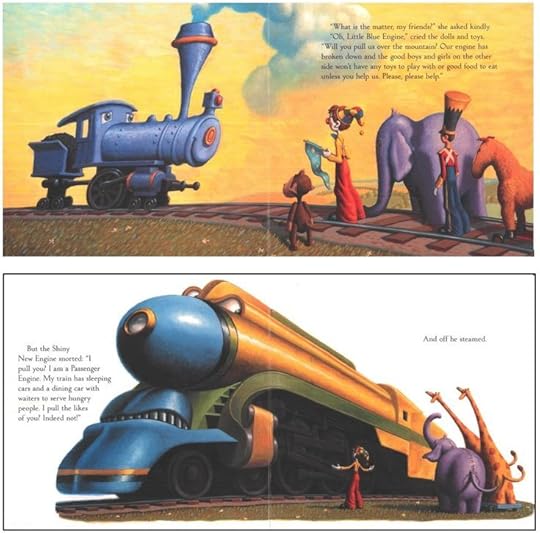
One of my grandson's current favorites, so picked up this delightful 2005 reimaging with beautiful new illustrations by Loren Long, (which —among other things — finally de-creepifies that scary clown from the original).
THAT SAID…I have long seen this story as a lovely and instructional retelling of "the Good Samaritan" for children. But in reading (and endlessly rereading) again with little Isaac, I realize this is also a sad allegory for contemporary American politics. The oh-so-angry Shiny New Engine (above) with his fancy sleeping cars and dining car who refuses to "pull the likes of you" (that "you" being a relief train full of food and "wonderful things" trying to reach disadvantaged children on the other side of the mountain); and the Big Strong Engine who is "a very important engine indeed!" and so also refuses to "pull the likes of you" are today's Republicans personified. And so, are the Democrats then the heroes here? Sadly, not at all — they're represented by the Rusty Old Engine who would like to help, but is just too exhausted and so "cannot pull even so little a train as yours over the mountain."
So, just who then is the Little Blue Engine who knows "I'm not very big…but I think I can"? Well, I guess that leaves you and me, people. It's up to us, together with our neighbors, our churches, our communities, whatever. Get involved, volunteer, vote smarter, choose better candidates.
Whilst we're embarking on the 1001 Children's Books there's obviously going to be a slight haziness as to if I'd read the titles featured in the opening section (Ages 0-3) during my own childhood. There was definitely a familiarity, but I'll come to that later...
The positive message of a little train who was willing to help despite having reservations of being able to succeed was commendable and effective. Shame on all the other more adaptable engines as they'd refused to help the broken down train who's load featured toys and food for children.
There's a gapping plothole as to what happened to the broken down engine, was he just left there? Though this shouldn't overshadowed the small heroes achievements though.
The reason why this seemed so familiar was Casey Jr echoing the same phrase of "I think I can" to "I thought I could" at the start of Dumbo.
It's easy to see why this is still popular now, the catchy mantra cements it as a classic children's tale. It's also a perfect choice for the first in 1001, we definitely think we can do all of them.
My momma read me this book when i was but a babe... ever since i have been telling myself that no matter what life throws at me, i can overcome it, just like the little steam engine. From the time i was in diapers, a wee little lad, I have lived by the motto "I think I can, I think I can" and thus far I have overcome insurmountable hills and mountains in my life... just like the little engine. I encourage all to read this book, but especialy those that face great trials and tribulations in life. We can learn much from the little steam engine.
It’s a good story to introduce the concept of putting your heart into trying/doing something you haven’t done before. Penny realized that the other trains weren’t very nice and that we don’t want to say “I can’t” with Old Engine. “I think I can” is so much better.
Ages: 2 - 6
We just happened upon a little train world inspired by the book: watch my reel!
Content Considerations: nothing to note.
**Like my reviews? Then you should follow me! Because I have hundreds more just like this one. With each review, I provide Content Considerations, mentioning any objectionable content I come across so that parents and/or conscientious readers (like me) can determine beforehand whether they want to read a book or not. Content surprises are super annoying, especially when you’re 100+ pages in, so here’s my attempt to help you avoid that!
If you’re considering a book or looking for a new title to read, check out my highly categorized shelves, read my reviews and Friend or Follow me to spiff up your feed with clean, wholesome, living books.
Now I have a bit of a confession to make: I actually was introduced to this classic children’s story through an animated special that premiered on TV way back in the early 1990s and I have only just recently decided to pick up the book that the animated special was based off of. “The Little Engine that Could” by Watty Piper along with artwork by George and Doris Hauman is truly a cute classic that children will read for years to come!
The story starts off with a little train carrying good things for the little boys and girls on the other side of the mountain such as teddy bears, dolls, books for the children to play with. The little train also carried good food for the children to eat such as apples, oranges, milk and peppermint drops. Just as the little train was heading towards the mountains with all of these good things for the little boys and girls, it suddenly stopped on the train tracks and it could not budge. The toys then began to lament this predicament and they tried to receive help from various trains that stopped by. Unfortunately, none of the trains wanted anything to do with taking the toys to the other side of the mountain and they just left the toys on the side of the tracks. Finally, a little blue engine came along and…
Will the little blue engine help the toys get to their destination and will the toys make it over the mountain in time to give the little girls and boys their gifts?
Read this book to find out!
Watty Piper (which is actually a pseudonym for the Platt & Munk Publishing House) had done an excellent job at writing this cute little story as it details the importance of perseverance through the actions of the little blue engine as she tries to get the toys to their destination despite being so small. I like the fact that this story teaches children about the importance of never giving up in the face of a difficult situation and that they just need to do the best they can when they are dealing with situations that might be impossible for them. I also like the idea about the story being mainly about the toys and the train trying to get to the other side of the mountain to deliver toys and food to the little boys and girls since it reminds me a bit of how Santa Claus usually has to deliver toys and goodies to many children of the world, except in this case, this story does not take place during Christmas. George and Doris Hauman’s artwork is truly adorable to look at as all the toys are so cute to look at and I especially loved the image of the little engine herself as she is colored in blue, which is quite a unique color for a train, and she constantly has a smile on her face that makes me root for her.
The reason why I gave this book a four-star rating is because I felt that the pacing for this story was a bit slow and I wished that they trimmed off a bit of the toys’ conversations with the trains in order to get to the main point of the story.
Overall, “The Little Engine that Could” is a cute story about the importance of perseverance in the face of hardship that children will easily relate to! I would recommend this book to children ages three and up since there is nothing inappropriate in this book.
I never read this as a kid, of that I'm quite sure. I'd heard of it of course - it's been around for over 70 years, after all! - but now that I've read it, I know for sure I didn't read it or have it read to me as a child. If I had, I would probably have enjoyed it more as an adult, even if just for the nostalgia. That tends to be the way it works. It's not that I think it's terrible or anything, it just doesn't hold my interest or appeal - it's very much a story from the early 20th century (or maybe even older), which makes it dated in a quaint way, but it's more the way it's written and how cutesy it is that makes me a reluctant reader.
A simple story, it's about a little train that is carrying lots of "good things for boys and girls" in the town over the mountain. These include toy animals and dolls - and even "the funniest toy clown you ever saw." And there are cars full of puzzles, toy engines, books and "every kind of thing boys or girls could want." And there are cars full of good things for boys and girls to eat and drink. The engine "puffed along merrily" until "all of a sudden she stopped with a jerk. She simply could not go another inch. She tried and tried, but her wheels would not turn."
The toys get out and try to help. They wave down passing train engines to ask them to pull their train over the mountain, but the first one, a shiny new engine, is too important and posh for such work. The second was a big strong engine, but he was a freight engine that had just pulled a big load of machines over the mountain and was too important to "pull the likes of you!" The third was an old, rusty engine that said he was too tired to pull "even so little a train as yours over the mountain. I can not. I can not. I can not."
The fourth train engine was a very little engine, but she was kind and decided to try. And as she puffed and chugged and slowly got the train moving, she chanted to herself, "I think I can - I think I can - I think I can..."
It is a very sweet story indeed, full of positive messages (be kind, considerate and helpful to others, you don't know what you can or can't do until you try, cooperation etc.). It was rather interesting to me, the cynical adult wary of stereotypes, that the first three engines were all portrayed as male, while the little blue engine that agreed to help them was female.
The illustrations, also from the original 1930 publication, match it well. I've found that the kids - 2 years old now - have a little trouble seeing the two illustrations, one on each page, as one long panoramic picture. Also, the pictures don't always match the text, which seems to have trouble keeping up with the illustrations. The repetitions in the text get a bit annoying for the adult reader (all the good boys and girls over the mountain), but of course the children like them. I was rather tickled to hear my two-year-old (this was before his birthday, actually), saying "I think I can I think I can" - not that he knows what it means, really, but it's always nice to hear a complete sentence!
"Watty Piper" is actually a pseudonym for the Platt & Munk Publishing house, which is a division of Grosset & Dunlap, which is a division of Penguin Young Readers Group. Phew! It's a retelling of Mabel C Bragg's The Pony Engine, which I've never heard of before but I can imagine it must be something similar (still in print??). I got the hardback but I'm now wishing I had got the board book version (same publisher), as the toddlers are quite into this and have already ripped out one of the pages - twice.
Originally published in 1930, and apparently based upon earlier poems and stories - the first version appears to have been part of a sermon that was published in The New York Tribune in 1906, whereas the first actual appearance of a story entitled The Little Engine that Could was in Olive Beaupré Miller's multi-volume My Book House anthology, published in 1920 - this picture-book is one of those ubiquitous classics that I somehow seem to have bypassed, in my own childhood reading. Although intimately familiar, like most American children I would imagine, with its trademark phrase - "I think I can, I think I can, I think I can" - I have no recollection of reading this one as a girl. Perhaps I did, and simply don't remember it?
In any case, when The Little Engine That Could was nominated for our November reading over in The Picture-Book Club to which I belong, where our theme this month is "Classic Picture-Book Characters," I decided that it was time to correct this notable gap in my children's-book education. I can see why this is such a favorite for so many readers: it's a fun story, with a repetitive structure that would make it an excellent read-aloud selection, and the vintage artwork by George and Doris Hauman is colorful and engaging. All in all, a very entertaining tale for young children, one with lots of appealing themes (a train bringing all those goodies!), and a good message about perseverance. I suspect that, if I'd first encountered this as a child, my star rating would be far higher...
I loved this book!!! I write books to empower children overcoming various forms of adversity.
This book is a perfect example of the types of books I write and want to write!
It is inspirational and encouraging!
It fits with my motto: DREAM, BELIEVE, ACHIEVE...EVERY CHALLENGE CAN BE OVERCOME!!!
Still at my age, whenever I think "I can't", I remember this book and I say "Yes, I can!"
This book also inspired my eldest child, my daughter, Danielle. She was abused by a babysitter at 13 months old and acquired a brain injury that led to a learning disability. Her self-esteem suffered terribly in school. I just kept telling her that she could do ANYTHING; she just had to keep trying just like the "little engine". I would read this book to her a lot!
She could not read. She just couldn't, but I encouraged her and kept reminding her of the "Little Engine That Could" and she persevered!!!
She didn't learn to read until she was 12 years old (ironically, the same age she acquired glaucoma for no known reason, which is EXTREMELY rare in children and the same year we discovered she is legally blind!).
She is now 24 years old and she just finished "To Kill a Mockingbird"!!!! This legally blind girl with a learning disability is a total bookworm and is reading books that I read too!! She is reading at a College level and she even graduated from College for Culinary Arts!
She is now the illustrator of the children's books I write!
She personifies THE LITTLE ENGINE THAT COULD!
To this day, whenever she thinks she can't do something, I remind her of the "little engine" and she keeps trying until she gets it!
Both the "little engine" and my daughter inspire me daily!!!
I would recommend this book to any child struggling to overcome a disability or low self-esteem and would encourage parents to read this to all of their children because all children struggle with SOMETHING!
Of course I've read this many times. For one thing, it's a staple for the first week of many kindergartens. But I'd like to see the new illustrations by Loren Long.
Otoh, I see by the preview that the toys are still the same ancient ones that I dismissed as irrelevant, twee, and old-fashioned even when I was a little girl in the 60s. Too bad. ...... Oh, one of my libraries has the ebook of the newer edition. So I just read it. I don't know if the text is a little different than what I remembered (according to data it could be) or my memory is faulty, or if the page layout is less wise (shouldn't the instances of "I think I can" be on several spreads to build drama?) but the whole doesn't strike me as effective as I expected/ remembered. And no, the toys aren't updated, nor am I comfortable with the 'Indian' doll. Still it's a "she" train who is finally willing to help, after three "he" trains refused, and that's interesting.... ......... Ok, I found a couple of other editions on openlibrary.org. The board book leaves out the whole building of suspense by leaving out the three trains that say No. The pictures in the one illustrated by Ruth Sanderson are much more to my taste, as the toys seem timeless, not dated. But I guess it's not Long's choice to compress the "I think I can" pages... they somehow make all the impact though being so few, such a 'small' part of the story... just like the 'small' blue engine that did get the cargo over the mountain, I guess....