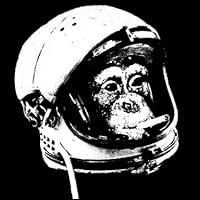
In the spring of 1970, artist Ralph Steadman went to America in search of work and found more than he bargained for. At the Kentucky Derby he met a former associate of the Hell's Angels, one Hunter S. Thompson. Their working relationship resulted in the now-legendary Gonzo Journalism. The Joke's Over tells of a remarkable collaboration that documented the turbulent years of the civil rights movement, the Nixon years, Watergate, and the many bizarre and great events that shaped the second half of the twentieth century. When Thompson committed suicide in 2005, it was the end of a unique friendship filled with both betrayal and understanding.
A rollicking, no-holds-barred memoir, The Joke's Over is the definitive inside story of the Gonzo years.
Ralph Steadman (born Wallasey, May 15, 1936) is a British cartoonist and caricaturist.
Born in Wallasey, Cheshire, and brought up in Towyn, North Wales, Steadman attended Ysgol Emrys Ap Iwan (high school), Abergele, East Ham Technical College and the London College of Printing and Graphic Arts during the 1960s, doing freelance work for Punch, Private Eye, the Daily Telegraph, The New York Times and Rolling Stone during this time.
Steadman is renowned for his political and social caricatures and cartoons and also for illustrating a number of picture books. Awards that he has won for his work include the Francis Williams Book Illustration Award for Alice in Wonderland, the American Society of Illustrators' Certificate of Merit, the W H Smith Illustration Award for I Leonardo, the Dutch Silver Paintbrush Award for Inspector Mouse, the Italian Critica in Erba Prize for That's My Dad, the BBC Design Award for postage stamps, the Black Humour Award in France, and several Designers and Art Directors Association Awards. He was voted Illustrator of the Year by the American Institute of Graphic Arts in 1979.
Steadman had a long partnership with the American journalist Hunter S. Thompson, drawing pictures for several of his articles and books. He accompanied Thompson to the Kentucky Derby for an article for the magazine Scanlan's, to the Honolulu Marathon for the magazine Running, and illustrated both Fear and Loathing in Las Vegas and Fear and Loathing on the Campaign Trail '72. Much of Steadman's artwork revolves around Raoul Duke-style caricatures of Thompson: bucket hats, cigarette holder and aviator sunglasses.
Steadman appears on the second disc of the Criterion Collection Fear and Loathing in Las Vegas DVD set, in a documentary called "Fear and Loathing in Gonzovision", which was made by the BBC in 1978, of Thompson planning the tower and cannon that his ashes were later blasted out of. The cannon was atop a 153-ft. tower of Thompson's fist gripping a peyote button; Thompson demands that Steadman gives the fist two thumbs, "Right now."
As well as writing and illustrating his own books and Thompson's, Steadman has worked with writers including Ted Hughes and Brian Patten, and also illustrated editions of Alice In Wonderland, Treasure Island, Animal Farm and most recently, Fahrenheit 451.
Among the British public, Steadman is well known for his illustrations for the catalogues of the off-licence chain Oddbins. He also designed the labels for Flying Dog beer and Cardinal 'Spiced' Zin', which was banned in Ohio for Steadman's "disturbing" interpretation of a Catholic cardinal on its label.
Steadman also illustrates Will Self's column in The Independent newspaper. Johnny Depp's anthology of songs, "Rogue's Gallery: Pirate Ballads, Sea Songs, and Chanteys" (2006) surprisingly contains two contributions from Steadman. He sings lead on "Little Boy Billee", and sings backing vocals on Eliza Carthy's song "Rolling Sea". Depp played Raoul Duke in the film adaptation of Fear and Loathing in Las Vegas.
Steadman currently lives with his wife in Kent, England.
Few people knew HST better (or put up with more of his shit) than Ralph Steadman. I can see why he waited until his passing to publish this, as I can only imagine the haranguing and abuse (not to mention lawsuits) that would've otherwise likely ensued, but ultimately this was little more than a factual, mostly tender look back at their thirty-five years of working, fighting, and just generally living it up together. If HST were still around to object, it would be in his finally having to admit that Ralph could indeed write after all, or at least write as well as he could draw.
Some of the stories were only tangentially related to HST, and one wonders why these were even included, but it is Ralph's book after all, and he did spend about half his life in the shadow of HST's own writing, so I guess it was just his time to shine. And shine here he does for the most part.
Required reading for anyone interested in learning more about HST and his friend, foil, and partner in crime.
I have never written a Goodreads review, and probably will not write many of them, but I felt some justification for my five-star rating was in order. Was this most well-written book I have ever read? By no means; but it had something that so many better-written, more focused books I have read lack: Integrity.
This book (to briefly summarize) is a portrait of the relationship shared between Hunter S. Thompson (former Hell's Angel and American author extraordinaire) and Ralph Steadman (one of the most unique and influential artists of our day). The book chronicles 35 years of (barely) working relationship between two men who are responsible for such gems as "Fear and Loathing in Las Vegas," "The Curse of Lono," and, ultimately, the fathers of the Gonzo movement. From their meeting in 1970 to Hunter's dramatic suicide in 2005, Steadman paints a vivid picture of the man HST was to himself and the people around him: impulsive, cruel, egocentric, ingenious, thoughtful, and driven by a madness inside which few outside his nearest and dearest hoped to understand.
Throughout the book, I was struck by how absolutely candid Steadman was about his relationship with Thompson; sharing with the reader his personal struggles in trying to write a memoir of a man who, at best, was complicated, and at worst nothing but the very darkest in each of us. Steadman made no effort to hide the often cruel and thoughtless manner in which HST treated those around him--accusing them of feeding off his fame like leeches, denouncing their roles in his successes and in general leaving a mess of drugs, alcohol and destruction in his wake. He likewise did not keep from view Hunter's moments of insight, compassion, and insecurity. Throughout the book, Steadman conveys a deep sense of unease with his own feelings toward Hunter: resentful of the offhand way Thompson treated their friendship and yet drawn to the camaraderie and closeness shared by friends who embark on a journey to bring the art of living to a new level.
Steadman's absolute candor is what made this book successful for me. The story had me laughing, cringing, and feeling tense and angry--all as Steadman felt, I am positive. The fast-pacedness of the book only contributed to the frenzy characteristic of the Gonzo movement. Ralph's uncensored examination of Hunter's behavior during each of their joint projects gave me keen insights into what this world of Gonzo was all about; more than the drugs, the alcohol, the guns, this time was about the examination of all expectations, beliefs, notions, easy-buys and easy-outs. Hunter challenged the world around him to break molds, push boundaries, not accept complacency, and never take yourself too seriously. His final act, a grisly suicide to which he invited his only son, was met with Steadman's reply, "It's about time. He's been threatening to long enough."
I think I keep trying to put into words a feeling I cannot convey, which is that Steadman succeeded in painting a true and honest portrait of a man he both loved and loathed for 35 years. I thoroughly enjoyed this book, cover to cover.
If you don’t already know and love HST’s work, this book isn’t for you. There’s not really much new ground covered. There are no deep insights to the man behind the myth (as if that were even possible, or anyone would want to read it if it was). Instead, we get a deja vu of Thompson’s greatest hits from Fear and Loathing at the Kentucky Derby onward, but this time from the slightly off kilter perspective of Steadman, HST’s long time wingman.
So this is a book to read when you’ve already read all the Thompson books that are worth reading (opinions vary as to how many that is) and find yourself wishing you could take one more ride with the madman. Steadman puts you in the passenger’s seat and lets you take that ride.
Perhaps the only new revelation in The Joke’s Over is that Steadman, who for thirty five years was Hunter Thompson’s close working associate, wingman, and one of his best friends, didn’t know him any better than the rest of us. Whatever HST there was behind the created persona he presented to the world was too deeply buried, too effectively hidden for anyone to discover. Perhaps that’s a good thing.
I was willing this book to be good. No commentary I've ever read on Hunter has EVER been good.
It is not wonderful. Ersatz Gonzo stylings from the illustrator who admits that Hunter HATED when he tried to write anything on the pictures so essential to his own success. There was much territorial pissing.
Of course, HST is a complete MONSTER. He maces Steadman in the face at their first meeting. I have to say I believe Ralph totally on that one. The wound of his eventual inevitable rejection by Hunter clearly still suppurates. Particularly when Steadman keeps picking at it...
Impressions of Steadman himself at present are not stellar. Raving, paranoiac Welshman prone to fits of sabotage and assassination by ink.
Best chapter so far has been on the HST piece that never saw the light of day - what they got up to in Kinshasa covering the Rumble in the Jungle.
In the end, Hunter comes off as the freak you'd expect (I'm wondering if I should go back to read what I once so admired, or if it might freeze the blood like recent re-watchings of Withnail and I) but Ralph even more so. Resentment, pettiness, open jealousy, bottled anger until explosion...all told in a thick argot of bluffness that makes the dialogue from McGoohan's The Prisoner seem positively straight forward.
There isn't much insight here. Only a short reference to the suicide, in Aspen, while Ralph was visiting. He seems bewildered by his friend, and blindsided.
This is such a fun and insightful account of many adventures with Hunter. If you love HST, either the author or the character, this is a MUST read to see the good, the bad, and the strange that was Hunter Stockton Thompson from one of his closest friends and collaborative partners.
An interesting insight, sometimes a bitter rake, but overall a worthwhile read. Who'd of thought the illustrator behind many of the works of Hunter S. Thompson had a life of his own? Written from the shadow of arguable greatness Steadman lends his insider's voice to the clamor of voices trying to understand and account for one of the 20th century’s most controversial men of letters. Do his stories make me like hunter less? No. Does it make me like Steadman? Not really. As much as I love hearing the stories around Thompson's insane career I never appreciate a whining tone and Steadman does on occasion take the opportunity to lash out against this man who clearly was a number one asshole. I'd love to read the book hunter could have written about Steadman.
From the early years, Hunter's prose was often married to Steadman's unique artwork until they just seemed to be one and the same. To his credit Steadman's art is the perfect accompaniment to Hunter's work. Though there are many representation of Steadman's art work in the book I wish they had been given more prominence.
Well. The jokes over, that cocksucker got us again. A book in hunters memory, a book full of reminders that steadman wasn't a friend of hunter, cause of course there really was no such thing, or not such a thing that's desirable. This is like fake beat, gonzo. Special, unimportant,different an excuse for shadowy behavior. Mace replaces handshakes and "god damnit Ralph you fuckhead" replaces hello. On the topic of words for words, "your a total peace of shit die" means I love you. This was not much of a book but a cloud made up of dust that refuses to settle in the wake of its shit pot stirrer. This took me a while to read. In the beginning stead man was a fangirl, an accessory, then a dirty rubber sole; but this story doesn't end with him out of a shoe, at most he might be the stitches that hold the leather together, pieces of a shoe nonetheless. This experience showed hunters vulnerability, although potentially fabricated, a hard to find perspective in the world of HST. Steadmans place here is difficult to pinpoint, im not sure know him any better. He speaks little of his artistic creative brain, although integral to their experience ,its importance did not come across to me in these texts. Nonetheless, an attainable accessory in a life like no other. We all could be stead man.(separate the man from the art). HST for the common man. The jokes over, it shot itself. Now will begin this novel explaining non of who I am, and zero of who HST is; but you will wince or maybe even cringe, at the normality of it all. Nothing special here captain, just a drunk and a visionary. plus a couple foreigners. Goodnight and goodbye, the jokes over today, but may it live on in every day of your life... like an arthritic reminder.
"Don't write, Ralph, you'll bring shame to your family" - Hunter S. Thompson.
That he did. A sad shame indeed. Above my desk is a beautiful print of one of Ralph Steadman's finest pieces. Thompson is pierced through the throat by the carriage lever of a typewriter. The keys of the typewriter spell out "Aaaarrgh," which I find quite moving. I am not an art expert, but I know enough about the men behind the image to know that "Aaaarrgh," was perhaps an understatement for the torture they put themselves through. Drinks, drugs and hard knocks settled these men for thirty-five years of knowing each other. Steadman’s book, The Jokes Over: Memories of Hunter S. Thompson feels like a memoir, biography of the eponymous writer, cathartic release for Steadman and an attempt at re-working the wit and words of the great 20th-century writer.
He captures the time they spent together with accuracy and detail, but they are mere rehashes of what we can learn from reading Thompson’s work. Where Steadman can enjoy himself is in the later moments, those pieces Thompson did not write about for he either did not care or did not have the energy to do so. Those fumbling's in the late 1990s and early 2000s are brief but interesting, for we have yet to hear them from the horse’s mouth. Steadman conveys these later moments well, but it feels remorseless and unmotivated. There are earlier parts in the book where Steadman tries to capture the Gonzo style. To his credit, he at least explains how it works, and what bad Gonzo looks like, by writing it.
Interactions with a theatre group, going overboard in times of great stress, Steadman is a poor copy of the manic energy and biting style Thompson was. It is lucky that The Jokes Over: Memories of Hunter S. Thompson only tries it a handful of times, but those handfuls are etched on the memory, seared forever as a man who drew Gonzo tries to write it. It is not a good mix, yet it should be. Perhaps that is the most frustrating part of Steadman’s effort here. He reveals that the book is a cathartic experience, knocking the old dog that bit him so many times in the past. At that point, the discussion of Thompson and Steadman’s relationship comes into play, and Steadman rights with honesty and inevitably reflective style.
There is nothing particularly engrossing, though. For all the detail that Steadman can provide on later projects that failed to see the light of day, reading them would be far more interesting than reading of them. Why not? The Curse of Lono is out there, somewhere. Steadman still banks off of the unreleased content, piecing together limited edition stylings of many works that have yet to see the light of day. Hopefully, they continue, because when Steadman tries to create these stories himself, the emptiness is clear to see. His memento to Hunter comes from a place of love, but the forced demand of the written Gonzo style is not Steadman’s strong suit.
If you liked this review, you can read more of my work on my website, Cult Following.
Essential, though not always pleasant, for the long-time HST fan, and, of course, the long-time Steadman fan, who has more than a large reputation outside his appearances with Thompson.
Surprisingly well written. A must for any fans of Gonzo and HST/RS collaborations. Reading the final chapter this morning, "Memo to the Sports Desk, 2006" was especially poignant, given the focus of the letter to HST in "heaven" and its focus on George W. Bush as a war criminal and idiot savant President. To his credit, George now looks incredibly sane compared to the MAGA nut job we just had in the White House for 4 years. We could really use HST about now...
Not a bad read, and would definitely like to read more of Steadman, like the Grapes of Ralph and his book on Freud. Some interesting facts in the book both political and historical. Ralph Steadman is an odd guy for sure! The book of course is written from his point of view on Hunter S. Thompson, which I can appreciate. I laughed out loud at moments like Ralph’s desire to spray paint “Fuck the Pope” on a yacht, and also the letters back and forth between Hunter and Steadman about their sons. I would say the letters between these two are my favorite part of the book. Steadman’s drawings on many of the pages enhance the reading experience for sure. Very good, but not excellent, 4 stars!
A great read, for the most part. The book opens with a great HST Gonzo quote about Steadman that is hilarious even if totally misguided, that I won't reveal here. Steadman is astonishingly intelligent, and surprisingly a top notch writer as well. He has full command of the Gonzo parlance, when he wants it, and a fresh and full-spectrum style the rest of the time. This memoir of his friendship with HST is filled with love, and with understandable loathing, for which he provides very ample support. Clearly, Mr. Thompson was not always a true and faithful friend, and he could be as savage in real life with the people he apparently loved as he could be with his pen. Still, their destinies were inextricably intertwined and RS understood the implications. I think he provides a very close and personal view of Thompson that I never sensed from the biographies I've read. Part of it was heartbreaking, such as the sequence where they could barely get HST up and to his son's wedding because he was in a foul hangover mood. There was savage ribbing, such as when RS was honestly worried about his son's vandalism, and HST provided a guns-blazing-Gonzo response. Did RS find it witty and reassuring, or cold and uncaring? There are very-interesting letters from HST, none of which I recall reading in either of HST's two tomes of personal letters. There is also a somewhat interesting description of the heartache and stress HST went through trying to complete their collaboration on Curse of Lono. This explains, in part, why, in my opinion, that book sucked.
Steadman understands Thompson's genius, but he isn't burdened with the hero-worship embedded in most other accounts of which I am aware. I thought that there was a slow period where the book drifted into esoterica about two-thirds in. And, surprisingly and sadly, the RS artwork is all black and white, and too small to appreciate any of the details, not even the handwriting in the drawings - and I read the hard cover version. There is a compelling account of of his meeting with William Burroughs, which is introduced with HST's dismissal and disinterest in the Beats. It seems that RS understands the connection even though HST was oblivious. The lat 20 pages soar with insight. His account of the American view of sports is dead on, and, as he says, has never been noticed by any American.
For what it's worth, I remember walking the streets of NYC and seeing a display of this book in a window. I'm not even sure it was a bookstore. I bought it, but it took me 9 years to get around to reading it- I think I was inspired by the recent documentary For No Good Reason, which displays his artistic talent far better than this book. In any event, I got much more than I expected. There are great first-hand accounts of the events surrounding their most famous collaborations, and there are more sober reflections on the friendship that lasted for 30 more years. I might even read some of his other books. If you are, like me, fascinated by HST, I highly recommend this book, because I don't think this perspective, with this level of insight, can be found anywhere else.
I have long been a fan of Hunter S. Thompson. In fact, I was a fan of his before I even realized that we co-inhabited the same region of this great state of Colorado. For me, this title was at first just another way of re-living stories already familiar to me from a slightly different angle.
Ralph's artwork has become synonymous with Hunter's writing, but this was NOT an automatic effect. Honestly, I loved Hunter's writing because it was Hunter's. I always felt more like Ralph's art managed to fit Hunter's words, and not the other way around. There is a part in this title where Ralph seems to claim the reverse. This felt incorrect to me as I listened.
Mind you, I learned many things about the way that Ralph was treated as a member of Hunter's coterie that I hadn't been aware of before. Perhaps Ralph's claim to having as much influence over Hunter's fans as Hunter himself is owed more to Ralph's pendulum swinging full in the other direction, after Hunter's swung free–and up and out the top of a canon, and into the ether where we have all been breathing him in for years since. Ralph will have the de facto last laugh, even if the joke really is over.
Thanks for making me laugh out loud as I drove around town making deliveries, and for causing me to ball like a little baby as the final chapter wound to a close (I'm doing it again now, god damn you Ralph!) and I relived all of the things I wanted to be, and can never now be, because my hero is no longer here on this planet with me. He is around us, but I'll never be able to shake his hand; won't be able tell him that I named my Son after him, because he was THAT important of a human being.
I didn't think I'd like this book as much as I did. I expected a 4, or maybe 4 1/2 star book. I was, happily, wrong about that.
I'm not a man who has a lot of heroes, or puts a lot of weight into elevating people to such positions. But if I did, then one of them would be the inscrutable maverick madcap journalist, and creator of Gonzo that was Hunter Thompson. It's with some trepidation that I would recommend this book to people similarly inclined. You see, while Thompson's many great works are filled with a seething and lusty rage against injustice, usury and the perceived excesses of those around him, there was always little in the way of that lens being turned inward. While we all know of the excesses of the man, and his adventures, they were usually from his perspective. Not so the case in The Joke's Over.
Ralph Steadman is not merely a great and revolutionary artist, he's a great raconteur, and his storytelling prowess, and witty eye for detail means that this book, is never dull, and always fascinating. It is however, a "string-warts" and all expose of his times with Hunter, and in the way only a true and loving friend can do, Steadman pulls no punches in detailing the pettiness, paranoia, and frequently the small-minded selfishness which beset his frequent collaborator.
If you want to walk away with a new perspective on the pair of them, and on the near 40 years they spent working and larking around together on and off, then this book is a marvel. But beware, you will walk away in no doubt that the Too Much Fun Club had closing hours, and its proprietor was just a man.
The book started a lot stronger for me than it finished. Probably because Steadman was more enamored with his early years with Hunter before he became more and more "Hunter."
Funny that in their first assignment Hunter was the one restraining Steadman, and there's a great story of Hunter just running through the airport with the Ivory tusks he brought back from "The Rumble in the Jungle" after they were confiscated by customs. He got away with it...sorta.
The book never quite really puts a finger on why Steadman (or anyone) would put up with Thompson's behavior, which was both outlandish and petty, though it tries at times, usually to just shrug and attribute it to the spirit of "Gonzo."
A muddled biography see-sawing back and forth from scathing criticism to sycophantic fawning of "my illustrations are not worthy of his words..." of a once solid writer who became a drug and booze-addled megalomaniacal parody of himself.
Ralph Steadman and Hunter Thompson were kindred spirits. A match made at the Kentucky Derby in 1970.
This is Steadman’s memoir — a running account, almost like a diary, of his relationship with Thompson, beginning when Steadman collaborated with Thompson on The Kentucky Derby is Decadent and Depraved. Steadman’s eccentric and dire artwork was the perfect complement to Thompson’s no-holds-barred writing style, and the two seemed to share similar attitudes toward the rich, decadent, and corrupt.
Steadman includes his own reflections on the assignments and other times the two got together for whatever reason or lack of reason, along with letters and faxes the two exchanged. Thompson seemed to be freely in his element around Steadman. The two of them together composed a combustible mobile carnival of weirdness.
Thompson also let Steadman have it with both barrels (not literally), and Steadman gave back as best he could. He understood Thompson like few people did. He took the barrage of insults, slights, and even degradations, and he saw where it was all coming from. He sees Thompson as an intense, pulsing mass of flawed, damaged goods wrapped around a sense of justice and a sense of outrage where it was warranted.
I don’t think it’s even possible to sugar-coat Thompson, and Steadman doesn’t try. Thompson treated him like crap much, maybe most of the time. He ridiculed him, he accused him of disloyalty, he competed for credit and money in their collaborations, . . . .
But Thompson treated most people like crap, especially himself. His writing though — no one could flow such an extreme life into prose that communicated, that called us all to outrage over a corrupt world. We miss that voice today.
One thing I hadn’t known was how bound Thompson’s suicide was to the Bush re-election. Steadman doesn’t come right out and say that Thompson ended his life because of it, but it’s pretty clear it was one of the last straws. The title of the book, The Joke’s Over, is something that Thompson took to saying as he saw the political world degrading into uncharted depths — it just wasn’t funny anymore, and if it wasn’t even funny, what was it?
This is a great chance, if you’re interested in Thompson, to get the perspective of someone with a unique understanding and experience of him. And it’s also a great chance to understand Steadman. I hadn’t really. Now I have a much better picture of where those drawings are coming from, why they are so dire and crazed — a reflection of the world he experienced with Thompson.
As writing goes, the book runs a little long and maybe in need of editing. But then “extreme” is the name of the game.
Steadman of course is still around and active as an artist. He and Thompson were kindred souls, but Thompson was playing a higher stakes game. No slight to Steadman — he was in it heart and soul. But it’s as if Steadman was playing a kind of hard core bumper cars to Thompson’s lifelong demolition derby.
Fantastic book looking at the collaboration between two definitive artists in their field: satire & the excoriation of the holy. Fuck the pope indeed.
I was lucky enough to talk to Steadman at the time of the book's launch. It was a brilliant phone call; he was gentlemanly, highly obliging & most circumspect. His influence is massively underrated, from Spitting Image to the gargoyle distortions so prevalent in today's cartoons, with our knackered world and the information age to inform us of exactly how screwed we are.
He cheerfully elaborated on the vexations on working with one of the most extreme personalities letters ever produced. What's amazing, and endearing, are the sweeter anecdotes, such as his disabled mother in Tennessee, in a prime nursing home (on her son's $), with a walker stocked with all her medication, ahem...pure HST.
His commitment to freely the wrongly imprisoned Lisl Auman, a touching insight into what people power, and the inspiration of spirited words, can do. She was freed shortly after the good Doctor ended his life. His life, his terms.
The fact that infirmity terrified him. He saw vistas of old ladies creeping up his helpless form to cradle his balls. Makes grandma crawling up your leg with a carving knife in her teeth seem pretty normal.
"When the going gets weird, the weird turn pro..." indeed.
A great insight into a great mind, and the only self help author worth reading.
In The Joke's Over, Ralph Steadman, the wild-hearted artist, gives us a backstage pass to the gonzo world, where he and Hunter S. Thompson, a writer with a penchant for chaos, created a symphony of the absurd.
Steadman, a Brit with a pen for the peculiar, lands in America in 1970, seeking work but finding a whirlwind. At the Kentucky Derby, fate throws him into the path of Thompson, a man as unpredictable as a roulette wheel. Together, they embark on a journey that would redefine journalism and etch their names into the annals of literary and artistic history.
Steadman's memoir isn't just a recount; it's a trip through the eye of a cultural hurricane. Steadman and Thompson were the odd couple at the centre of everything from the civil rights movement to the fall of Nixon, from Watergate to the wackiness of the 1970s and 80s. But don't expect a solemn history lesson – this tale is sprinkled with madness, mirth, and a touch of melancholy.
The Joke's Over is more than just memories; it's a tribute to a unique friendship that survived through betrayal, understanding, and a shared appetite for the extraordinary. Steadman's wit shines as he illustrates (both literally and figuratively) the bizarre, the fantastic, and the utterly gonzo. Buckle up if you're in for a ride through the outrageous, with stops at all the significant and trivial stations of recent history. Steadman's got the wheel, and in The Joke's Over, the road is anything but straight.
Steadman is the artist most associated with Gonzo journalist, Hunter S. Thompson, & his bizarre, & often disturbing, images have earned him fame in his own right. Although Thompson insisted that Steadman wasn't a writer - that was his job - this volume indicates that he was wrong. Their various collaborations are powerfully, & often amusingly, documented by the artist. The first third or so is absolutely riveting, as Ralph is drawn into Hunter's world & both realise that this is a match made in heaven. For better or worse. But I did get tired of Thompson's incessant antics. Not that I didn't know what was coming in that respect. I have read several of his books as well. At one point there is a long passage of Thompson's letters & faxes sent to Steadman & I skipped over it. If you've read one of his missives, you've read the lot. Over the final third I got a bit weary. Again, because of the frustratingly predictable Thompson behaviour. But a great insight into one of the most significant artistic partnerships of the 20th century.
Ralph Steadman is almost as much a hero to me as Hunter S. Thompson. They are both geniuses in their own right, and towering counter culture intellects. Thompson was most definitely an asshole; Steadman, not so much, it seems. I would probably choose to hang out with Steadman more often than Hunter, as much as that pains me to write.
Steadman caught some flack for this book, and why not? A lot of folks don't like to find out that their heroes have flaws, and Hunter assuredly had legions of them. But for all of Thompson's blubbering and machismo, Steadman paints him for what he was: a deeply troubled and flawed human being who hurt as much as he loved.
I will go to my grave a fan of these two iconoclasts. Their worldview and the niche they created together has had an indelible mark on me, and I admire and love them both. Warts and all.
Although I’m a lifelong Hunter S. Thompson’s fan, I was a bit surprised, to say the least, at the degree of darkness and pettiness that seemed to surround the dysfunctional / love-hate work relationship between the illustrator Ralph Steadman and the wordsmith HST.
At times, “The Joke’s Over” reads like a millennial “decoupling manifiesto” (it was published after Hunter’s suicide after all), showing the neglected and seldom-heard other side of the story, while shedding a bit more light on the life and career of one of the most important (in my opinion anyways) authors of our time.
I’m glad those two gentlemen (a la Elton John and Bernie Taupin) somehow made it all work. Maybe some day, Mr. Steadman would get the proper closure he truly needs and deserves.
In the spring of 1970, artist Ralph Steadman went to America in search of work and found more than he bargained for. At the Kentucky Derby he met a former associate of the Hell’s Angels, one Hunter S. Thompson. Their working relationship resulted in the now-legendary Gonzo Journalism. The Joke’s Over tells of a remarkable collaboration that documented the turbulent years of the civil rights movement, the Nixon years, Watergate, and the many bizarre and great events that shaped the second half of the twentieth century. When Thompson committed suicide in 2005, it was the end of a unique friendship filled with both betrayal and understanding.
A rollicking, no-holds-barred memoir, The Joke’s Over is the definitive inside story of the Gonzo years.
Very different than the typical sycophantic biographies you find of HST. He is uncompromisingly honest in his assessments of HST, and pulls no punches. He isn't afraid to include the good with the bad, and he is just as effusive with the praise for his talent and friendship as he is with his scorn and bitterness toward to the less-agreeable aspects of their friendship and working relationships. He makes it clear that he deeply valued their friendship and co-creative relationship, but it was always on Thompson's terms, and he could be quite savage to those closest to him.
A near 400-page eulogy from a friend who endured the best and the worst of times. Steadman's prose is a little off at times, but man does he make up for it with information, letters, tons of his drawings, and photographs that chronicle a 35 year friendship that saw the birth of Gonzo journalism to its untimely end in 2005. Steadman graciously gives us a run for our money in depicting Hunter S. Thompson as that bastard of his time. Not a good guy or a bad guy per se, but someone dancing to the beat of their own drum all day, every day. A worthy read.
The book opens with a quote from Thompson, telling Steadman that he shouldn't write because he'll bring shame on his family. Unfortunately it's true, Steadman's writing isn't great. The editing isn't so good either, the book would be better if it was less repetitive and 100 pages shorter. The book is still a cool insight into the love-hate relationship between two anti-establishment artists. It was fun to read about the Kentucky Derby from Steadman's point of view.
Other people have put it better in their comments, so I'll keep this short. Aside from a few good stories to start the book, I don't get why this was published. Steadman is a great artist but not the strongest writer and some of this book just seemed like he was publishing private letters and taking potshots at the recently deceased Hunter S. Thompson. It won't add much, but I would only read this if you want to 100% everything related to HST.