"Rodrigue, as-tu du coeur ? Tout autre que mon père l'éprouverait sur l'heure..." Qui de nous n'a pas été bercé par l'épopée du Cid ? Noble, vaillant, sans égal, sans rival. Amoureux de Chimène, aimé en retour, accablé par le sort, car pour sauver l'honneur de sa famille il lui faut perdre une maîtresse. L'affront est rude. Un soufflet ! Homme de coeur, Rodrigue ne peut que venger son père d'un tel outrage. A son tour, Chimène demande justice. "Tu t'es, en m'offensant, montré digne de moi, je me dois, par ta mort, montrer digne de toi." Cruel conflit entre devoir et passion qui pousse les deux amants à s'opposer. A tant de grandeur d'âme, le Ciel ne peut être insensible...
Pierre Corneille était l'un des trois grands dramaturges français du XVIIe siècle , avec Molière et Racine. Il a été appelé «le fondateur de la tragédie française» et était productive pendant près de quarante ans.
Pierre Corneille was one of the three great seventeenth-century French dramatists, along with Molière and Racine. He has been called "the founder of French tragedy" and produced plays for nearly forty years.
- يا لعظمة هذه الترجمة التي اتحفنا بها خليل مطران، قدرة لغوية من اعلى طراز وانتقاء بديع للمفردات...
- القصة تدور في زمن "اخلاق الفرسان"، حيث الشرف الرفيع لا يسلم الا بإراقة الدم! يصوّر لنا الكاتب الصراع المرير بين الشرف والحب، بين العقل والقلب، بين ما يمليه القلب وما يمليه الشرف.. وكل ذلك بصورة بديعة وحوارات راقية، متزنة.. ذهبت مع تلك العصور...
دوستانِ گرانقدر، این نمایشنامه و تراژدی در پنج پرده نوشته شده و مربوط به عشقِ میان دو جوان به نام «شی مِن» و «رودریگ» میباشد... این نمایشنامه نشان میدهد که در آن روزگار، هیچ چیزی بالاتر از حفظِ شرف و آبرویِ خاندان و خانواده نبوده است... حتی قدرتِ عشق نیز نمیتواند سببِ چشم پوشی از این موضوع گردد... در زیر چکیده ای از این نمایشنامه را برایتان مینویسم ------------------------------------------- جوانی جنگجو به نام «رودریگ»، خواستارِ بستنِ پیوندِ زناشویی با «شی من» است و پدرِ شی من یعنی «دوک گومس» نیز نسبت به این پیوند نگاه خوبی داشته و قرار است تا پدرِ رودریگ یعنی «دون دی یگ» که افتخارات زیادی در نبردهایِ گوناگون به دست آورده است، به صورتِ رسمی شی من را از پدرش خواستگاری کند... ولی از سویِ دیگرِ داستان، شاهدختی به نام «دونیا اوراک» که دخترِ پادشاه کاستیل است، دلباختۀ دون رودریگ بوده که آتشِ عشقِ این جوان، وجودش را هر لحظه میسوزاند... ولی او شاهدختِ پادشاه کاستیل است و باید با شاهزاده و یا پادشاهی برازنده ازدواج کرده و نمیتواند به واسطۀ عشق به یک دون، با آبرویِ خاندان و سلسلۀ نامدارِ خویش بازی کند... بنابراین برایِ آنکه از بندِ این عشق رهایی یابد، دون رودریگ و شی من را با یکدیگر آشنا کرده و سبب شده تا آن دو به یکدیگر دلبسته و عاشقِ یکدیگر شوند روزی که پدرِ رودریگ و پدرِ شی من با یکدیگر قرارِ گفتگو دارند، بر سر موضوعی مسخره با یکدیگر بحث و دعوا میکنند... گویا پدرِ رودریگ به مقامِ آموزگاری پسرِ پادشاه انتخاب شده است و این موضوع حسادتِ پدرِ شی من را برانگیخته است... پدرِ شی من که جوان تر است، سیلی به گوشِ پدرِ رودریگ زده و به او دشنام میدهد.. ولی پیرمرد نمیتواند از خویش دفاع کند... بنابراین به خانه آمده و از پسرش رودریگ درخواست میکند تا انتقامِ او را گرفته و این ننگ را از چهرۀ خاندانشان پاک کند... رودریگ نه تجربۀ جنگ دارد و نه حریفِ شمشیرزنی و جنگاوریِ پدرِ شی من میشود.. ولی پس از کلنجار رفتن با خود، به این نتیجه میرسد که عشق به شی من را قربانیِ کسبِ شرافتِ از دست رفتۀ پدر کند.. بنابراین شمشیرِ پدر را به کمر بسته و برایِ گرفتنِ انتقام به سویِ پدرِ شی من میرود... در سویِ دیگرِ داستان، شاهزاده خانم به این نتیجه میرسد که اگر رودریگ بتواند پدرِ شی من را که در جنگاوری و شمشیر زنی شهرۀ اسپانیا میباشد را شکست دهد، آنگاه او میتواند با سربلندی از پادشاه درخواست کند تا به او اجازه دهد که با رودریگ ازدواج کند.... خبر به پادشاه و شی من میرسد که رودریگ توانسته در نبرد، جانِ پدرِ شی من را بگیرد... زمانی که شی من با خبر میشود، قیدِ عشق و عاشقی را زده و به سویِ پادشاه رفته و از پادشاه درخواستِ مجازات و اعدامِ رودریگ را میکند... در این میان، مراکشی ها به سواحلِ اسپانیا هجوم می آورند... رودریگ با تنی چند از سربازانِ پدرش به سویِ آنها شتافته و مراکشی ها را شکست داده و دو پادشاه از مراکشی ها را به اسارت به دربار پادشاه می آورد... در این نبرد به اندازه ای از خویش دلاوری به نمایش میگذارد که مراکشی ها به او لقب «السید» میدهند... عزیزانم، بهتر است خودتان این نمایشنامه را خوانده و از سرانجامِ آن آگاه شوید.. آیا شی من میتواند انتقامِ خونِ پدر را از عشقِ خویش یعنی رودریگ بگیرد؟ --------------------------------------------- امیدوارم از خواندنِ این نمایشنامه لذت ببرید «پیروز باشید و ایرانی»
Это очень лицемерная история, которая вытекает из неверной посылки , что честь - превыше всего. Результатом становится фактическое убийство отца Химены на дуэли ее возлюбленным Родриго. Лицемерно ее согласие выйти замуж за того, кто убьет на дуэли Родриго, но все законы логики повергаются ради того, как сделать так, чтобы поженить Химену и Родриго.
And Rodrigo, oh, Rodrigo! Torn between love and the battlefield, his every sacrifice resonated with a painful realism.
Just a word of caution – this play might awaken a dormant poet within you. Don't be surprised if you find yourself scribbling verses of yearning and loss on napkins or bathroom walls.
چهارمین نمایشنامهی ترم چهارم/ السید نوشتهی پییر کورنی از اولین نویسندههای نئوکلاسیک که متاسفانه چاپش تموم شده و پیدا کردنش به طور فیزیکی و پی دی اف تقریبا غیرممکنه(ما برای کلاسمون نسخهی آفست-پرینتی گرفتیم)نمایشنامهای بس جذاب بود که اصلا زمین نذاشتمش و به نوعی به سلیقهی شخصیم نزدیک بود. حال و هوا و قهرمانهای شکسپیری داره و موضوع بر سر جدال و گرهایه که بین دو معشوق میفته بر سر اینکه عشق رو انتخاب کنن یا شرف رو. جواب خیلی واضحه و شیمن یکی از کرکترهای زن موردعلاقم در تراژدی شد.
The “Cid” may well be Corneille’s best-known work. It had been very successful and, for that reason, also drew violent critics to Corneille’s doorstep. The eighteenth century was not ready for certain moral aspects presented in the Cid. Quote from ‘Excuse à Ariste:
« Mon travail sans appui monte sur le Théâtre Chacun en liberté l’y blâme ou l’idolâtre, Là sans que mes amis prêchent leurs sentiments J’arrache quelquefois trop d’applaudissements, » …’Et mes vers en tous lieux sont mes seuls partisans ; Par leur seul beauté ma plume est estimée Je ne dois qu’a moi seul toute ma Renommée’…
Corneille’s work is a must-read for readers interested in theatre and history.
"Ir en busca de una muerte tan fatal a mi reputación! ¡Sufrir que España impute a mi memoria el no haber sido capaz de mantener el honor de mi estirpe! ¡Respetar un amor del que la turbación de mi alma ve la pérdida segura!" Recuerdo la primera vez cuando de niño luego de saber el argumento del "Mio Cid" me enteré que había una tragedia "El Cid" donde Rodrigo Díaz de Vivar joven afrontaba una gran calamidad con la también joven Jimena. Este clásico de Corneille, el más importante o conocido, lamentablemente tiene pocas traducciones al español y no es comercializado como debiera. En la historia existen dos triángulos amorosos: uno de Rodrigo, Jimena y la Infanta de Castilla y el otro de Rodrigo, Jimena y Sancho. La historia ocurre luego que el padre de Jimena le comete un atropello e injuria al padre de Rodrigo, Don Diego. Lo que hará que éste le pida a Rodrigo buscar venganza. Trata temas muy españoles como el honor y la familia. Es en realidad una tragedia de muchos nudos, por las indecisiones que tienen que atravesar todos los personajes (cada uno tiene su propia minitragedia) a lo largo de la obra. Me gusta lo complicado del argumento y los desenlaces bien elaborados, te sorprendes y desencantas varias veces como en pocas tragedias y además los valores están bien definidos. Me encantaron varios parlamentos de Jimena que no los puedo poner pues adelantan el argumento. Es uno de mis favoritos y espero poder seguir leyendo a Corneille.
This must be read in French in order to appreciate the text. Awesome book. I remember memorizing Don Diego's monologue for school, great memories!
ô rage ! ô désespoir ! ô vieillesse ennemie ! N'ai-je donc tant vécu que pour cette infamie ? Et ne suis-je blanchi dans les travaux guerriers Que pour voir en un jour flétrir tant de lauriers ? Mon bras qu'avec respect toute l'Espagne admire, Mon bras, qui tant de fois a sauvé cet empire, Tant de fois affermi le trône de son roi, Trahit donc ma querelle, et ne fait rien pour moi ? ô cruel souvenir de ma gloire passée ! Oeuvre de tant de jours en un jour effacée ! Nouvelle dignité fatale à mon bonheur ! Précipice élevé d'où tombe mon honneur ! Faut-il de votre éclat voir triompher le comte, Et mourir sans vengeance, ou vivre dans la honte ?
Tells the story of Rodrigo Díaz (El Cid) (see an account of his exploits in The Poem of the Cid), and Jimena (styled as Chimène in French). Virtually every character the play suffers from massive internal conflict which, I might have mentioned, is my personal jam.
First, we have the King’s daughter, in love with Rodrigo. Alas, her love is only a knight and unequal to her rank. So she sets him up with Chimène, hoping their union will free her of her passion. “My sweetest hope is to lose hope.”
Second, we have Rodrigo, who loves Chimène, but who must kill her father for insulting his own. “My love is engaged against my own honor. I must avenge a father and lose a mistress. The one stimulates my courage, the other restrains my arm.”
Finally, we have Chimène, who also loves Rodrigo, but is compelled to make him pay for her father’s death. Will her passion or her duty win out? “I feel that in spite of all my rage Rodrigo is still contending against my sire in my heart. He attacks it, he besieges it; it yields, it defends itself; at one time strong, at one time weak, at another triumphant.”
It’s set up well and initially I found myself greatly enjoying it. However, as the play went on, and the characters reiterated the same complaints again and again, I found myself enjoying it less, until finally every additional speech to the same effect became boring and tedious and I could not wait for it to end. Amazing how much pleasure is destroyed by repetition.
A very baroque piece of writing: fiery passion rules, expressed in excessive melodramatic developments. Corneille here presents the classic theme of fatalism: whichever way it goes, one always loses. The mental framework is clearly medieval (honor first), but the monarch has absolute power. Typical and new is the ambiguity in the feelings of the characters: certainly with Rodrigo and Jimena, but most pronounced with the Infante. Jimena is the actual main character; her turnaround in the end remains problematic to me.
Description: The story of the 11th century Spanish hero before his rise to fame. Rodrigo is a charming young courtier who plans to marry Ximene. But when her father, the chief general in the King's army, insults Rodrigo's father, he promptly finds himself challenged by Rodrigo to a duel. The young suitor, inexperienced in warfare, knows that if he loses he dies. But also that if he wins he loses Ximene. Pierre Corneille's famous play examines the complex moral and emotional dilemmas faced by the legendary champion-to-be, and his intended.
Translated and adapted by Ranjit Bolt
Don Rodrigo James Purefoy Ximena Indira Varma Elvira Eleanor Bron Dona Urraca Gina McKee Don Diego David Calder Don Gormas Ewan Bailey Don Fernando Stephen Thorne Don Sancho Chris Pavlo Leonora Amelia Lowdell Don Arias Gerard McDermott Page Gary Podmore
It's strongest point was it's writing. It had very beautiful passages that really felt alive at some points. But it was let down, by how sometimes it felt as if the author was just chewing up and spitting the plot down your mouth.
It shows that Corneille was struggling with the rules of the age, and that if not constrained it would've turned out much better. Trying to keep the three unities, the plot felt a little nonsensical and rushed.
Out of the characters Chimène was relatable though at times annoying and Rodrigo was a Mary Sue. The strongest character for me was the Infanta, for some reason she was the most poignantly written. Everyone else was unimportant and forgettable.
Pomislio bi čovjek (barem ja) kako će ovakva priča o dužnosti biti malo patetična. Naprotiv, iako sam je pročitala prije par godina ostala mi je u lijepom sjećanju i voljela bih pročitati "Le Cid" još jednom. Likovi su mi bili dostojanstveni, uvjerljivi i zanimljivi. Mislim da je francuska klasicistička književnost, barem onoliko koliko sam je čitala, uspješna u katarzi, doista izaziva to suosjećanje i vrlo je bliska tom grčkom idealu koju joj je bio uzor. Ponajbolje od francuske književnosti po mome mišljenju.
Radnja Cida započinje slično kao Romeo i Julia, dakle zaljubljeni mladi i sukobljene obitelji, a sama radnja temelji se na epu Pjesma o Cidu, tako da je možda mnogima i poznata, ili kroz film sa Sofijom Loren (ako se ne varam, mislim da je ona glumila, a ona baš ima upečatljivo lice). No, mislim da će drama biti zanimljiva i onima koji znaju radnju. Meni je svakako bila. Naravno preporučavam je i ljubiteljima antičke drame.
I read The Cid as a discourse of tyranny and law. While shimem is urging the king to treat Rodrigue as the law suggests, the king wants to act beyond the law. (As everyone else does. Rodrigue acts beyong the law himself when he decides to kill Shimen’s father to defend his family’s honor). It is quite obvious though that the end was changed, because again, in the final page we can see that law is fading away and kings order is gaining power.
This entire review has been hidden because of spoilers.
From BBC Radio 3 - Drama on 3: The story of the 11th century Spanish hero before his rise to fame. Rodrigo is a charming young courtier who plans to marry Ximene. But when her father, the chief general in the King's army, insults Rodrigo's father, he promptly finds himself challenged by Rodrigo to a duel. The young suitor, inexperienced in warfare, knows that if he loses he dies. But also that if he wins he loses Ximene. Pierre Corneille's famous play examines the complex moral and emotional dilemmas faced by the legendary champion-to-be, and his intended.
Translated and adapted by Ranjit Bolt
Directed by Peter Kavanagh
The star-studded cast included James Purefoy as the Cid, with Indira Varma as Ximene, Gina Mc Kee as the Princess, and featuring Eleanor Bron and David Calder.
Pierre Corneille was one of France's three outstanding Classical dramatists, alongside Racine and Moliere. The Cid is his most famous - but in Britain too little-performed - play.
The distinguished translator Ranjit Bolt's refashioning tells the story of the younger Cid, a self-indulgent, love-smitten courtier in 11th century Spain who when duty calls rises to the occasion to become Spain's greatest hero.
It is a tale of love, honour and might, but in the great tradition of Racine and their other contemporary writers of tragedy, Corneille focuses on romantic dilemma, to show how lovers act under intense duress, and what choices - and perhaps compromises - they then make.
Bolt's translation is at once daring and faithful. He has observed the conventions of 17th century French Drama (rules imposed on his select group of writers by the infamous Cardinal Richelieu, intent on restoring classical virtues). But Bolt in customary fashion has dynamised the language and style.
Featuring Spanish guitar music by, amongst others, Heitor Villa-Lobos.
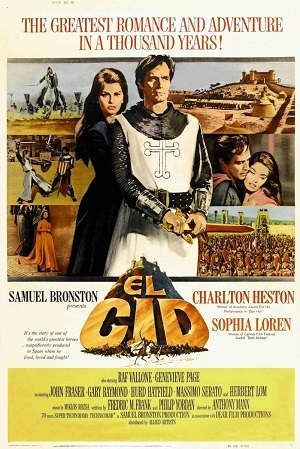
A movie was made based on this play: El Cid (1961), directed by Anthony Mann, with Charlton Heston, Sophia Loren, Raf Vallone.
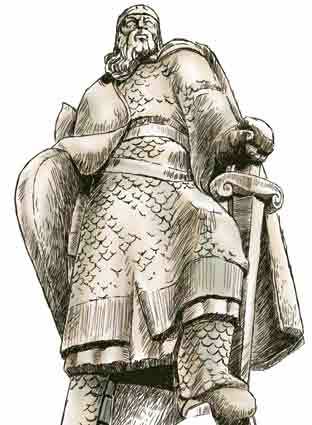
El Cid's statue may be found in the city of Burgos, in Spain:
The true story of Rodrigo Diaz is told in the epic poem "El cantar de mio Cid" (The Song of my Cid) composed sometime between 1140 and 1207. Date and authorship are still open to debate. More details about this magnificent medieval work (including Rodrigo's biography) as well as the original Spanish version may be found at Camino Del Cid.
In addition, there is The Route of El Cid which is a cultural and tourist route that crosses Spain from north-west to south-east, following in the steps of Rodrigo Díaz de Vivar, El Cid, the famous 11th-century mediaeval knight. This route is based on “El Cantar de mio Cid”, the great Hispanic mediaeval epic poem written at the end of the 12th or beginning of the 13th century.
A short note should be mentioned about "El Cofre de El Cid" located at Burgos Cathedral: On one wall of the Chapel of Corpus Christi Cathedral of Burgos you can see a bunker known as the Cofre del Cid. The story goes that corresponds to the ark with which Rodrigo Diaz de Vivar, El Cid, endorsed requesting money to pay three hundred knights who accompany him in exile decreed by King Alfonso VI, asking for "borrowed" the Jews Raquel and Vidas de Burgos. Arriving home lenders, he convinced them to accept his deal: money in exchange for a chest containing all his family jewels. The Jews thought they would get a lot more capital than left, so accepted. Rodrigo, after receiving the amount, left the city with his men leaving the Jews with the hood. After opening his surprise he was capitalized. There were no treasures, or jewels, only earth and stones, still too late to claim anything. Another version of the legend that tells how Rodrigo really delivered the chest full of jewels but to the greed of the Jews, they became stones, stones they would become jewelry when he returned to Burgos with enough money to pay their treatment . Whether or not real, the truth is that this story is found in the "Cantar de Mio Cid" as a sign of the trickery employed by Christians with Jews, while others think it was just a way to punish greed lenders.
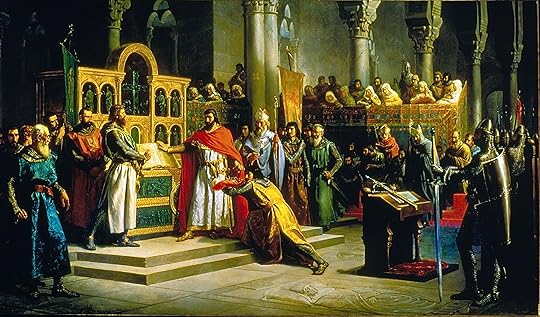
Some related paintings:
1864 Marcos Giráldez de Acosta's painting depicting the "Santa Gadea Oath". In the middle of the scene, Alfonso VI (with red cape) is swearing with his right hand on the Bible that he did not take part in the murder of his brother Sancho II, while El Cid stands as a witness in front of him.
Daughters of the Cid Ignacio Pinazo Diputación, Valencia, Spain Oil on canvas, 1879.
Now I'm really confused. I have to read this drama for a university lesson, and my professor told us to spend at least 4 or 5 hours reading this one, because it is a really hard read. I am really afraid I read this drama the wrong way for class or something, because I did not find it that difficult... moreover, I can actually say I loved it and that it became one of the best dramas I have ever read.
I was a bit afraid that it was going to be a sematic romantic costume drama with no message or hidden values at all, but I was pleasantly disappointed. I loved all the moral questions raised, and how they were put in really intelligently, in a not too obvious way. Seeing character development was nice, too.
I also loved how nothing was black and white, and how every single one of the characters were right in their own way. I love it when a playwright (or a writer, either) can make conflict without putting in a really evil, ruthless character. I also loved Dona Urraca's character - at last a female character who is in love with the main heroine's love interest, but does not try to sneakily break them up.
Après avoir lue la deuxième pièce de Corneille, je ne veux pas imaginer comment soit son œuvre tradui en autres langues. Ces œuvres sont d'une grandeur incroyable! Le Cid, dont la narration esagnole je n'ai pas lue, s'agit d'un chaine des evenements qui se passent après que un fils, pour restaurer l'honneur à son père, et donc à soi-même, et pour se montre digne de l'amour, ne doit que tuer le père de son amante. Comme tous les tragédies, le sort et le destin sont des pensées principaux, et les personaes doivent s'affronter avec les mécontentements et les misères qui sont parfois inévitable et parfois non! Ayant lu la version de Corneille je veux bien chercher la version epique espagnole de cette œuvre. Que je sache, Le Cid est la première tragédie non-aristotélicienne de Corneille où les règles souventes de tragédie ne sont pas suivies, et pour lequel il y a eu beaucoup de débat après sa publication malgré le succès qu'elle a eu.
I don’t know how to rate this. I absolutely loved this play until the last scene. But the last scene was so infuriating. I get why this was such a controversial play in the 17th century. Vrai but not vraisemblable.
“Mais d’un coeur magnanime éloigne ces faiblesses, Nous n’avons qu’un honneur, il est tant de maîtresses! L’amour n’est qu’un plaisir, l’honneur est un devoir.”
Bravery, valor, love…alas, not enough to make this reader enjoy it. But probably you will
The Cid plays to packed audiences.
It is acclaimed and appreciated by critics, professionals that know what they are talking about.
As opposed to this amateur reader, who did not enjoy this morning’s adaptation of the famous play.
It doesn’t mean much, and if you read this, you would be way better off by going to some authorized book, site or blog dealing with the subject, where you can find scholarly opinions.
I remember seeing the movie with Charlton Heston.
Heston is an intriguing character- an actor that has seen some glorious days and mega productions.
He played El Cid, Moses and Ben Hur.
After which, he played what I see as a weird, somewhat compromising role with the NRA, National Rifle Association or something like that.
Yes, in America they love the second amendment which gives citizens the right to bear arms.
But I see the organization that has an obsession with fire arms, even after well known massacres like Columbine, as an outfit for people with issues.
But that’s just me.
El Cid is a story about bravery, love honor and a number of other values.
It is worthy and there is a big chance that you will love it.
For some reason which is not worth digging into, I did not.
I am reading again through A Portrait of The Artist as A Young Man.
Now there’s a great book that I love, and which makes it pointless to insist with El Cid, famous and acclaimed as it may be.
I feel like I should write this review in French since I read this book in French, but my spelling is bad and my grammar is worse so I'll make do with English. The first time I read this book was for French literature class at university. I didn't keep a lot of the books from that class, but I kept this one because I remember thinking it was pretty interesting and funny at times. So I picked it up and wow, this was a ride. So much melodrama! I didn't remember the story, but Chimène is such a whimsical drama queen and poor Rodrigue (and the King) is just along for the ride. She's so obviously a teenager trying to be an adult and not really knowing how to go about it, so it's like she says and does things that she's seen and heard other adults do, but it's never really what she wants to do, only what she thinks others expect her to do... And it's a mess. The fact that these are actual conversations in the book is hilarious to me (and way more modern than I expected of a 17th century story): Rodrigue: Listen to me. (Écoute-moi.) Chimène: I'm dying. (Je me meurs.) Rodrigue: One moment. (Un moment.) Chimène: Go, let me die. (Va, laisse-moi mourir.) ~~~~~ Chimène: Go, I don't hate you. (Va, je ne te hais point.) Rodrigue: You should. (Tu le dois.) Chimène: I can't. (Je ne puis.) They're both such emotional drama queens. And I love it! Just kiss, already! But yeah, so this book was a lot more fun than I thought it would be from what I remembered. Definitely keeping this to read again.
Cid by mal byť jedným z najlepších diel 17. storočia. Či je to tak, neviem povedať, z tej doby som toho veľa neprečítal. Každopádne, určite to nie je zlá hra. V slovenskom preklade ju prebásnil Ján Smrek a už len preto sa oplatí prečítať. Hra otvára pre dnešnú dobu zrejme už nepochopiteľnú otázku - pomstiť otca a zachovať česť rodiny alebo ostať verný/á láske. Alebo inak, urobiť to, čo káže zvyk (alebo povinnosť) alebo poslúchnuť cit? A možno práve naopak v tom tkvie jej aktuálnosť. Je láska len otázkou citu? Existuje v dnešnej dobe niečo ak česť? Určite stojí za prečítanie a zamyslenie sa nad týmito otázkami. Bez nich je to dielo, popisujúce stredoveké "Španielsko" - Kastíliu, bojujúcu s Maormi, kde sa však do centra pozornosti dostáva vzťah Rodriga (Cida) a Ximeny, inak zrejme inšpirovaný historickými postavami, ktorí musia riešiť vyššie popísané otázky. Ako to dopadne? Hra sa tvári ako tragédia, ale predsa len to je tragédia 17. storočia, ktorá môže skrývať kadejaké prekvapenia. Dávam 3 a pol hviezdičky.





 http://www.bbc.co.uk/programmes/b06vp3c9