

What do you think?
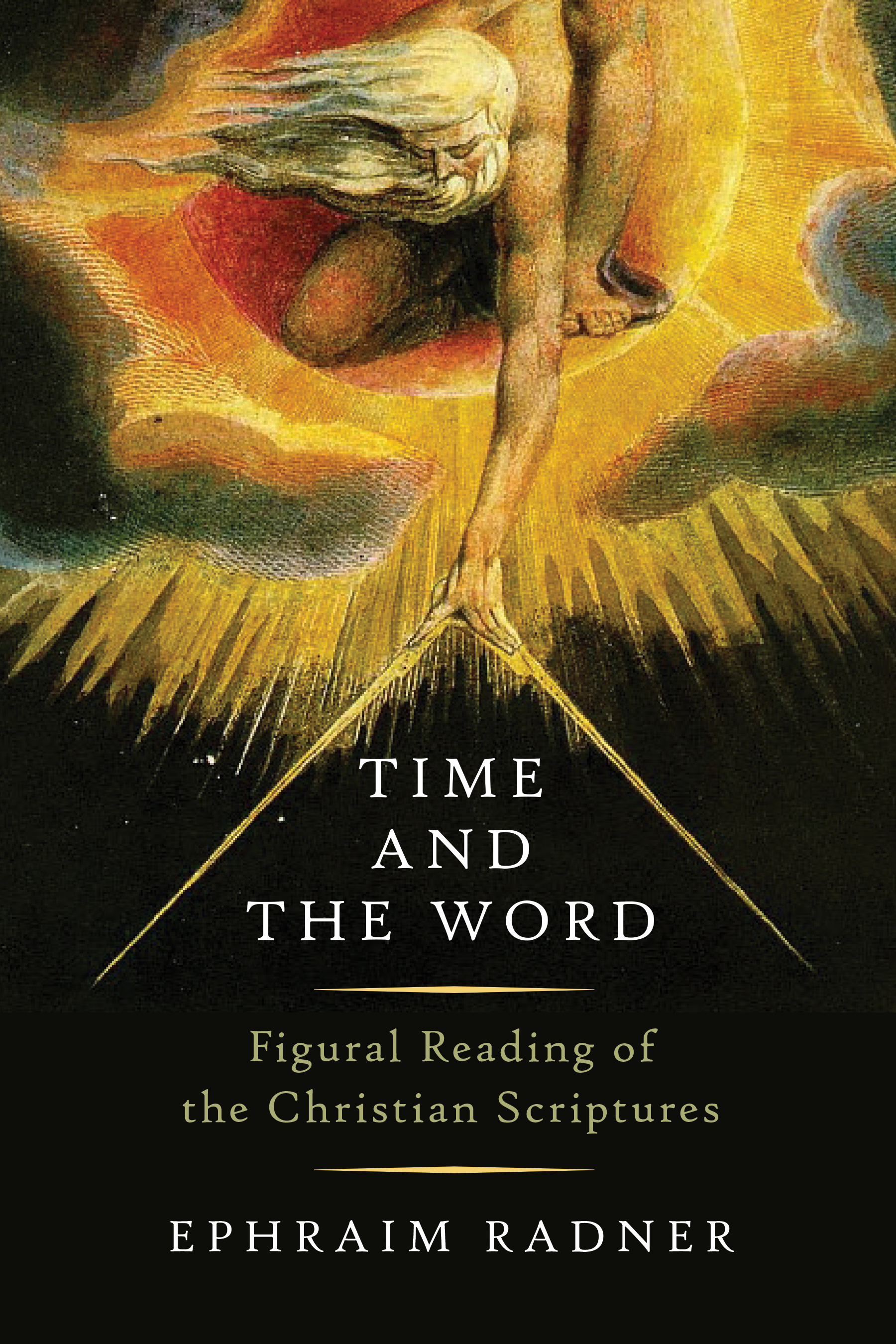
Time and the Word: Figural Reading of the Christian Scriptures
This book by Ephraim Radner constitutes the first significant theological account of the foundations and methods of the figural reading of Scripture. Radner's reintroduces contemporary scholars to a traditional approach to biblical interpretation that dates back to Jewish practice from before the time of Jesus. Figural interpretation continued in prominence through the early church, the Middle Ages, and into the early modern period before it was forcefully rejected with the rise of historical criticism.
Embracing "spiritual" and "allegorical" ways of understanding the Bible, figural reading once offered a broad approach to reading Scripture—an approach that Radner here engages through a foundational theological lens. Radner first uncovers the theological presuppositions of figural reading, historically and philosophically, focusing especially on the Christian understanding of time and the divine. He then moves from the theoretical to the concrete, looking at examples of how figural reading of the Bible gives rise to specific doctrinal claims about God and showing how it can still fruitfully inform Christian teaching and preaching today. The book concludes with four sample figural sermons from across the centuries.
Embracing "spiritual" and "allegorical" ways of understanding the Bible, figural reading once offered a broad approach to reading Scripture—an approach that Radner here engages through a foundational theological lens. Radner first uncovers the theological presuppositions of figural reading, historically and philosophically, focusing especially on the Christian understanding of time and the divine. He then moves from the theoretical to the concrete, looking at examples of how figural reading of the Bible gives rise to specific doctrinal claims about God and showing how it can still fruitfully inform Christian teaching and preaching today. The book concludes with four sample figural sermons from across the centuries.
326 pages, Hardcover
First published May 12, 2016
Ratings & Reviews
Friends & Following
Create a free account to discover what your friends think of this book!
Community Reviews
Displaying 1 - 13 of 13 reviews

October 6, 2026
Want to assure readers you didn’t use AI in your writing? Then write like Radner. Want to make sure most people can follow your writing? Then maybe don’t write like Radner.
But a brilliant book
But a brilliant book

November 20, 2020
Eight out of ten.
This is far and away the most difficult book I have read. (To think I once thought The American Jeremiad was a challenge!) But somewhere underneath the many layers of philosophical questioning and appeals to countless varyingly obscure Bible scholars from AD 200 to the present, there's a quite simple and quite radical theological commitment that works something like this:
The Bible is literally the Word of God, and as such, it cannot be approached and/or interpreted in the way other books can. Rather, it is the holistic Truth of Scripture that forms us as we interact with it.
Honestly, I don't follow some of Radner's arguments, most notably one that is quite central to his discussion: that the Word is causally prior to all aspects of the world. This seems unremarkable if the Word is designated as the second Person of the Godhead. But I don't specifically follow the equation of Scripture to Jesus Christ, nor do I understand the framework of my own creation through it.
Another somewhat related problem I have is due to the causal nature of the Word: all existing things, Radner says, exist only as spoken by the Word. But where am I, or Stalin, or my sister's father-in-law's dog, to be found in Scripture? Perhaps I'm just overthinking this one.
And yet the concepts that follow from Radner's arguments are fascinating. One consequence in particular that struck me is the power Christians are stewards of in their speaking of God. Our Christian speech is the Word of God going forth, and we should be aware that it will not return to Him void.
I'm not sure at this point that I can preach a figural sermon, mostly because I couldn't find an accessible definition of figural reading. But I agree with Radner that the traditional historical interpretation of the Bible is obviously lacking. I do feel, too, that the concept of Biblical figuration, especially of its necessarily Christological emphasis, is something the church today needs more of. It seems a strongly appropriate response to those who have the forms of godliness but deny its power.
On a somewhat personal note, I am more and more persuaded that the Bible should be read naïvely, that is, that historical and textual criticisms of it are misguided and largely futile. It seems to me that all that is needed in coming to the Word is, in Radner's words, "humility and receptivity before the creative act of God within the Scriptures themselves (256)."
Time and the Word is no walk in the park, but I do recommend it, with that caveat, to serious students of words and the Word of life.
This is far and away the most difficult book I have read. (To think I once thought The American Jeremiad was a challenge!) But somewhere underneath the many layers of philosophical questioning and appeals to countless varyingly obscure Bible scholars from AD 200 to the present, there's a quite simple and quite radical theological commitment that works something like this:
The Bible is literally the Word of God, and as such, it cannot be approached and/or interpreted in the way other books can. Rather, it is the holistic Truth of Scripture that forms us as we interact with it.
Honestly, I don't follow some of Radner's arguments, most notably one that is quite central to his discussion: that the Word is causally prior to all aspects of the world. This seems unremarkable if the Word is designated as the second Person of the Godhead. But I don't specifically follow the equation of Scripture to Jesus Christ, nor do I understand the framework of my own creation through it.
Another somewhat related problem I have is due to the causal nature of the Word: all existing things, Radner says, exist only as spoken by the Word. But where am I, or Stalin, or my sister's father-in-law's dog, to be found in Scripture? Perhaps I'm just overthinking this one.
And yet the concepts that follow from Radner's arguments are fascinating. One consequence in particular that struck me is the power Christians are stewards of in their speaking of God. Our Christian speech is the Word of God going forth, and we should be aware that it will not return to Him void.
I'm not sure at this point that I can preach a figural sermon, mostly because I couldn't find an accessible definition of figural reading. But I agree with Radner that the traditional historical interpretation of the Bible is obviously lacking. I do feel, too, that the concept of Biblical figuration, especially of its necessarily Christological emphasis, is something the church today needs more of. It seems a strongly appropriate response to those who have the forms of godliness but deny its power.
On a somewhat personal note, I am more and more persuaded that the Bible should be read naïvely, that is, that historical and textual criticisms of it are misguided and largely futile. It seems to me that all that is needed in coming to the Word is, in Radner's words, "humility and receptivity before the creative act of God within the Scriptures themselves (256)."
Time and the Word is no walk in the park, but I do recommend it, with that caveat, to serious students of words and the Word of life.

May 26, 2019
I am interested in approaches to scriptural interpretation that resist the hegemony of historical-critical method, so I was interested in this defense of figural reading. Except even I, who did a PhD in metaphysics, did not anticipate the overly dense metaphysical sections. Plus, there was much in these sections I did not concur with. I ultimately skimmed through huge portions of the book, and appreciated much more the final chapters with more practical application for the preacher.
Radner argues that the task of preaching is to lead the listeners into the text rather than establishing THE meaning. He writes, "Our figural goal is to lead and go with our people into a realm of meanings and trace out its parameters and interiors. It should be a realm in which, of course, we do not leave our listeners as disoriented wanderers, but as creatures taken by the scriptural forms themselves, so as to lead them further, or into a clearing, or back out again, in some posture of transformed wonder." I particularly like that "transformed wonder" idea.
Radner argues that the task of preaching is to lead the listeners into the text rather than establishing THE meaning. He writes, "Our figural goal is to lead and go with our people into a realm of meanings and trace out its parameters and interiors. It should be a realm in which, of course, we do not leave our listeners as disoriented wanderers, but as creatures taken by the scriptural forms themselves, so as to lead them further, or into a clearing, or back out again, in some posture of transformed wonder." I particularly like that "transformed wonder" idea.

July 29, 2018
Let me state upfront that Radner's prose is insane. It is as if he learned to write from Kant himself. His sentences are almost always needlessly confusing, and it can be dizzying to read large sections at a time. That being said, I find it impossible to deduct any stars from this work. Radner embarks on the ambitious project of providing a metaphysic of scriptural reading and, wonder of wonders, actually succeeds. This book helps makes Scripture thicker, and certainly helped to open my eyes to its intense power and beauty.

March 31, 2022
For those familiar with Radner's work, his figural reading of Scripture is a common phenomenon. Now, with this book, we have his attempt at explicating the validity of such an approach to Scripture. Rather than studying Scripture as an object 'out there,' he argues that we must be immersed in the world of the text.
Figural reading, for Radner, is Christological and he suggests that to engage in such a reading we must ask ourselves (to put it simply) what a given text says of God and what it says of ourselves. The examples given in the last chapter and the appendix give a sense of what he is aiming for, namely, something like what the apostles practices when they associated different Scriptures and grouped them together based on semantic connections. In my opinion, sound figural reading is essentially a form of biblical theology that is more intuitive and non-discursive (and thus, arguably less rigorous) than the latter. One of the examples he offers in the appendix is of a former slaved turned preacher who made a connection between the sun standing still in Joshua, the shadow being moved back with Gideon and the sign involving the sun with Hezekiah. Another, by John Donne, places together two apparently contradictory statements-Jesus is judge and Jesus does not judge the world (John 3:16-17)-to argue that Christ is gracious toward us as long as we are alive.
There is simply too much content to comment adequately on this book, even in summary fashion, but, suffice it to say, Radner case of a figural reading at the very least offers significant food for thought for the serious student of Scripture by making a compelling modern case for patristic and medieval readings of Scripture.
Figural reading, for Radner, is Christological and he suggests that to engage in such a reading we must ask ourselves (to put it simply) what a given text says of God and what it says of ourselves. The examples given in the last chapter and the appendix give a sense of what he is aiming for, namely, something like what the apostles practices when they associated different Scriptures and grouped them together based on semantic connections. In my opinion, sound figural reading is essentially a form of biblical theology that is more intuitive and non-discursive (and thus, arguably less rigorous) than the latter. One of the examples he offers in the appendix is of a former slaved turned preacher who made a connection between the sun standing still in Joshua, the shadow being moved back with Gideon and the sign involving the sun with Hezekiah. Another, by John Donne, places together two apparently contradictory statements-Jesus is judge and Jesus does not judge the world (John 3:16-17)-to argue that Christ is gracious toward us as long as we are alive.
There is simply too much content to comment adequately on this book, even in summary fashion, but, suffice it to say, Radner case of a figural reading at the very least offers significant food for thought for the serious student of Scripture by making a compelling modern case for patristic and medieval readings of Scripture.

April 18, 2024
Hard to rate/review because the ideas are stunning (and probably don’t completely work?) but the writing obscures them.
You waaaant to agree with him because it’s so cool, but he makes it difficult because 1) you can’t understand him, and 2) he takes things like 3 steps too far.
Prime Example: his main point is that Time IS the Scriptures. This is probably such a cool idea, but what on earth could it mean?? I genuinely dont think he even knows.
He gets 4 stars just for going for it
You waaaant to agree with him because it’s so cool, but he makes it difficult because 1) you can’t understand him, and 2) he takes things like 3 steps too far.
Prime Example: his main point is that Time IS the Scriptures. This is probably such a cool idea, but what on earth could it mean?? I genuinely dont think he even knows.
He gets 4 stars just for going for it
Read
July 8, 2021Not New, Not Easy, But Valuable and Spiritual
Radner is a difficult writer to comprehend. I have listened to this text on text-to-speech twice and read it once SLOWLY and think that I finally grasp his argument and how he supports it generally. For anyone new to the line of scholarship Radner comes from, this will be a difficult read. I would recommend, at least, the Cascade Companions book by Stephen Fowl on Theological Interpretation of Scripture. This little book may give a bit of perspective to help understand where Radner is coming from and where is is going. Also, George Lindbeck's "The Nature of Doctrine" and Hans Frei's "The Identity of Christ" are both helpful reads to have under the readers belt before approaching Radner here as well. Though, I hope that doesn't intimidate potential readers because I LOVE Radner's work here and recommend it to many, especially those in preaching ministries. I think it is highly valuable for cultivating spiritually sensitive churches whose focus is entering into the depths of God's wonderful and terrifying presence.
Radner's focus, it seems to me, is apologetic in nature. He is not focused on writing a methodological approach to Scripture which will necessarily derive the "right" meaning of the text. Instead his focus comes from his experience of God within Africa, his postliberal education at Yale and his deep engagement with church history. The church has always read Scripture figurally and this seems to be an inevitable facet of the Church's interaction with God, or rather, God's use of the Church as Radner likes to refer to this reality. For those looking for a methodology which will produce a kind of truth that eliminates the various tensions present in interacting with Scripture in a distinctly Christian way, this book will not deliver what you are looking for. However, that is how I approached this book and it has given me something better that I would like to describe a bit.
For me, the key chapters to get Radner's argument are the second, third and last. He has a particularly dense section in chapter three under the heading "proem" in which he lays out the contours of his approach. Reading this slowly and with somewhat painstaking effort is INCREDIBLY helpful for grasping what Radner is doing, but I will summarize it here in a more simplistic way. 1) God made us. 2) Since we are creatures and God is God, we experience time differently. 3) When God speaks to us, if it is actually God speaking to us, whatever was spoken transcends time. 4) The Scriptures thus transcend time, even though they come to us within history. 5) God orders our time providentially, in some way(s), so that the world and the word correspond, but the word has priority regarding it's communication of itself. 6) Because of this, the locus of meaning inherent in Scripture is formed around how Scripture is related with God, because God is a more primary reality than the created world. 7) Therefore, Scripture finds it's meaning within it's reference to God, who we know in Christ. 8) So all Scripture refers to Christ somehow and how this is teased out in life and interaction with God is what figural reading basically is.
All of this is something Radner works out in detail and in different words than what I wrote here. In fact, I left out some crucial nuances for simplicity's sake (and maybe laziness). But I think I've highlighted what was most attractive about his argument to me. Namely that God is doing work through Scripture and Scripture is forming me in accordance with God's will as a personal force driving me inevitably into the presence of God in Christ. The implications of this work are something I am still working through. But with that stated, I think what Radner is defending in this book has an immense appeal in that it is all about simply entering into God's presence through Scripture. Radner is consonant with the way the Church has read Scripture throughout the centuries. He makes his argument in a way that founds his metaphysical presuppositions on Scripture itself (so, creator/creature relationship rather than say, a figuralism derived from a Platonic source or something like that). He is intellectually rigorous and lastly he is spiritually deep. His final section in figural preaching and his appendix are a game changer for sermon construction and, I think, resembles what readers of patristic sermons love most about the ancient writers. That is, that they aren't all about resolving the tensions the texts bring us into, so much as they are about seeing Christ in the Scriptures and attempting not to lose sight of that reality and to respond to and participate in that reality faithfully and, more importantly, lovingly.
In short, I ABSOLUTELY LOVE THIS WORK! I think it is fantastic and has been a huge encouragement to read the Scriptures as about Christ, or, said differently, to read Scripture "spiritually." Thank you Dr. Radner for your work here, it has helped me and I hope it helps others as well.
Radner is a difficult writer to comprehend. I have listened to this text on text-to-speech twice and read it once SLOWLY and think that I finally grasp his argument and how he supports it generally. For anyone new to the line of scholarship Radner comes from, this will be a difficult read. I would recommend, at least, the Cascade Companions book by Stephen Fowl on Theological Interpretation of Scripture. This little book may give a bit of perspective to help understand where Radner is coming from and where is is going. Also, George Lindbeck's "The Nature of Doctrine" and Hans Frei's "The Identity of Christ" are both helpful reads to have under the readers belt before approaching Radner here as well. Though, I hope that doesn't intimidate potential readers because I LOVE Radner's work here and recommend it to many, especially those in preaching ministries. I think it is highly valuable for cultivating spiritually sensitive churches whose focus is entering into the depths of God's wonderful and terrifying presence.
Radner's focus, it seems to me, is apologetic in nature. He is not focused on writing a methodological approach to Scripture which will necessarily derive the "right" meaning of the text. Instead his focus comes from his experience of God within Africa, his postliberal education at Yale and his deep engagement with church history. The church has always read Scripture figurally and this seems to be an inevitable facet of the Church's interaction with God, or rather, God's use of the Church as Radner likes to refer to this reality. For those looking for a methodology which will produce a kind of truth that eliminates the various tensions present in interacting with Scripture in a distinctly Christian way, this book will not deliver what you are looking for. However, that is how I approached this book and it has given me something better that I would like to describe a bit.
For me, the key chapters to get Radner's argument are the second, third and last. He has a particularly dense section in chapter three under the heading "proem" in which he lays out the contours of his approach. Reading this slowly and with somewhat painstaking effort is INCREDIBLY helpful for grasping what Radner is doing, but I will summarize it here in a more simplistic way. 1) God made us. 2) Since we are creatures and God is God, we experience time differently. 3) When God speaks to us, if it is actually God speaking to us, whatever was spoken transcends time. 4) The Scriptures thus transcend time, even though they come to us within history. 5) God orders our time providentially, in some way(s), so that the world and the word correspond, but the word has priority regarding it's communication of itself. 6) Because of this, the locus of meaning inherent in Scripture is formed around how Scripture is related with God, because God is a more primary reality than the created world. 7) Therefore, Scripture finds it's meaning within it's reference to God, who we know in Christ. 8) So all Scripture refers to Christ somehow and how this is teased out in life and interaction with God is what figural reading basically is.
All of this is something Radner works out in detail and in different words than what I wrote here. In fact, I left out some crucial nuances for simplicity's sake (and maybe laziness). But I think I've highlighted what was most attractive about his argument to me. Namely that God is doing work through Scripture and Scripture is forming me in accordance with God's will as a personal force driving me inevitably into the presence of God in Christ. The implications of this work are something I am still working through. But with that stated, I think what Radner is defending in this book has an immense appeal in that it is all about simply entering into God's presence through Scripture. Radner is consonant with the way the Church has read Scripture throughout the centuries. He makes his argument in a way that founds his metaphysical presuppositions on Scripture itself (so, creator/creature relationship rather than say, a figuralism derived from a Platonic source or something like that). He is intellectually rigorous and lastly he is spiritually deep. His final section in figural preaching and his appendix are a game changer for sermon construction and, I think, resembles what readers of patristic sermons love most about the ancient writers. That is, that they aren't all about resolving the tensions the texts bring us into, so much as they are about seeing Christ in the Scriptures and attempting not to lose sight of that reality and to respond to and participate in that reality faithfully and, more importantly, lovingly.
In short, I ABSOLUTELY LOVE THIS WORK! I think it is fantastic and has been a huge encouragement to read the Scriptures as about Christ, or, said differently, to read Scripture "spiritually." Thank you Dr. Radner for your work here, it has helped me and I hope it helps others as well.

March 29, 2022
This is by no means an easy read. Indeed this turned out to be the first of, I suspect, many books in which I relied upon my son to read a chapter and then explain it to me in simple language. The metaphysics are tough, although the parts that I understood were enlightening. I loved the idea of Augustine's that because time existed in God's mind at the moment of creation all time is eternally intertwined and so every moment of time is therefore entangled with another. This idea of entanglement, although not made explicit by Radner, made me think of entanglement in the realm of quantum physics. There is rather a delicious thought that the "past", whatever that may be, is influenced by actions in the present and is therefore not simply one way. After Augustine things got trickier for me, and the lengthy discussion of William of Ockham left me struggling. I have at least (thanks to my son) got my head around surds and artefacts anyway.
The final section of the book thankfully led me to far more solid ground as metaphysics was applied to Scriptural interpretation and figural reading. The plea to preach from the lectionary in its fulness was one that I agree with, and has been my practice for the past few years. A more extensive lectionary (perhaps covering five rather than three years) would be helpful.
The final section of the book thankfully led me to far more solid ground as metaphysics was applied to Scriptural interpretation and figural reading. The plea to preach from the lectionary in its fulness was one that I agree with, and has been my practice for the past few years. A more extensive lectionary (perhaps covering five rather than three years) would be helpful.

August 22, 2024
An intense and thought-provoking read. Radner provides multiple streams of entry into the figural reading of Scripture, whether that is through a theological understanding of time and historical interpretation, a humble disposition and approach to Scripture itself and its meanings, the juxtaposition of passages to open meaning and figures that intersect with our own personal histories, the gathering up of all things in Christ, who is the Word, and more. As is the case with Radner in general, it can be difficult to fully understand what he means at times; the worst examples of this are when he makes a complex claim and then follows it with the same claim albeit reworded for the (presumed) sake of clarity, but the latter reworded explanation is just as opaque as the original claim. Helpfully, however, the second half of this book is devoted to the more practical side of figural interpretation and thus contains more concrete examples of it in practice. Overall, Radner provides a fascinating but tough read that deepens one’s understanding of what Scripture is and how we are to read it (or rather, how it [and He, that is, the Word] reads us!). It is a more advanced book on the subject, so those who are new to it should probably start elsewhere, such as with Don Collet’s book on figural reading to get some bearings, and then move to Radner.
April 6, 2025
Radner is a vibe. Those not familiar with Radner’s writing might be overwhelmed by his prose and arguments for figural reading, but it's worth some serious thought. The proposal might seem radical in contemporary grammatical-historical hermeneutical circles, but if you take into consideration the whole of church history, it's really not. Essentially, Radner's thesis is that Scripture, as a divine agent, is the subject into which we, as its recipients, are to be taken into the reality that it puts on display. Rather than being an object that is passive to human inquiry, Scripture is the divine revelation that we are to apply our lives to, rather than just applying its teaching to our lives. Though I have some quibbles with how Radner describes the divine reality of Scripture revealing itself in history, his work is provocative, learned, and insightful. I think Radner would say that this book is certainly not the final word on the subject of figural interpretation, but instead gives a taste of Scripture's power on the church throughout the course of history. Time and the Word does this well, giving the church a glimpse into the Word that brought her into existence.

December 16, 2024
A rich, thought-provoking work of immense learning and deep reflection — with challenging prose to match; though not because Radner is a poor writer (quite the opposite!) but rather because the metaphysical material he is covering so intensively resists simple description. I certainly didn't understand everything — I have not read enough of e.g. the literature on analogical predication to really understand his intervention in that particular debate — but what I did grasp is brilliantly worked.

July 17, 2018
Great book! Such a refreshing read in light of the hegemony that the historical-critical school has over our work. Add some theology to your interpretation life, and get this book.

April 16, 2021
Radner is an impressive scholar and thinker, and not easily dismissible. But, from my perspective, there are some significant problems with the project of figural reading as he describes it.
Displaying 1 - 13 of 13 reviews