With more than 300,000 copies already sold, Backyard Birdsongs is back by popular demand. The Cornell Lab of Ornithology is proud to rerelease this widely acclaimed bird audio field guide series, from award-winning ornithologist and author Donald Kroodsma.
Suitable for beginning bird watchers, Backyard Birdsongs is an interactive handbook of birds and their songs. With a touch-button electronic module that contains common vocalizations of seventy-five species from across eastern and central North America, this volume offers a truly sensory way to identify and get to know local birds. Crisply detailed, scientifically accurate illustrations accompany each entry, and up-to-date range maps provide clear geographical reference points. With an introduction that will inspire readers to look out their windows and venture into the field, this unique book gives people of all ages an exciting entryway into the subtle art of using birdsong to identify birds.
This second edition includes a much-requested new Sound Track Index (to help make watching and listening to birds easier), and access to a free download of the Cornell Lab's own MERLIN® Bird ID App (in iTunes and Android stores). As with all Cornell Lab Publishing Group books, a portion of the net proceeds from the sale of Backyard Birdsongs supports projects at the Cornell Lab, including children’s educational and community programs.
This was near the front desk at the library and caught my eye, because there was an associated bird song player built in! It reminded me of reading sound and picture stories as a little girl.
I have been interested in birdwatching since about five years ago, but haven't really made any strides towards learning more about birds. Of all the songs I hear in a day, I hardly even notice birds are singing, let alone which particular bird it might be. While learning that will take quite a bit more time, I expect, this book is very adequate for the newcomer to explore and learn more about some birds in Central and North America (so, birds that inhabit my immediate area).
I found the introduction helpful and encouraging - learning about birds is more than just memorizing a song and description to a "face," it's about discovering the interesting personalities of these critters.
I wrote down at least four pages of things I had learned from this book, and was happy to spot some familiar birds, like Cardinals and Jays, as well as finding new birds to seek out for their unique songs or their cute appearance (the Northern Bobwhite and the Purple Martin).
I would recommend this book to all people who are interested in getting to know more about birds.
Donald Kroodsma is the most patient person in the world. By sitting quietly and listening to birds sing for hours on end he has teased out amazing details about theirs songs and calls. This is truly a labor of love. The fun part of this book is the attached digital audio model enabling the reader to hear each birds as its picture is seen and the description is read. The hope is that combining audio and visual stimulus will lead to learning. We shall see. Beyond that, this is a lovely book with deep affection for the subjects.
Donald Kroodsma's boundless enthusiasm and knowledge of birdsong is amazing. I can think of no better comparison to his experience of listening and analyzing birdsong than the great naturalist Ernest Thompson Seton, specifically Seton's essay on the crow Silverspot. Kroodsma provides just such insights and details for each bird included in his selection. I can't recommend this collection of essays( with audio files) enough. It will take your enjoyment of birds to another level.
A nice book of some basic birdsongs. It's really nice to have the book and the player at hand and not have to pull out a CD player or app to listen to the songs. Each bird entry has an artist's image of the bird (I'll admit - I think photographs are vastly superior), a write up on the bird, and a reference number for the song or songs available for the bird. It's easy to work and the digital numbers are large and simple for reading but a bit dark for those with eyesight issues. There are some odd choices for backyard birds (how many people have a sora in their backyard?) and I think it's missing some obvious choices, such as a fish crow to go with the American crow. Overall, it does what it says on the packaging.
So engagingly written, this book is one of the best book purchases I've made; and it gets used a lot. The pages containing the bird descriptions and their habits are so interesting that you can just sit down and read for hours. The illustrations are exquisite. (I'm not sure, but I think they are the work of many artists.)
And the audio portion is amazing. The speaker does not sound tinny and fake at all. Playing the recorded birdcalls, it sounds like the actual bird is right there in the room. Too cool!
(We have yet to take it outside to use as a lure for the real birds. I'm afraid of harassing the birds by using it outside. We do use it outside to identify birds using the illustrations and descriptions, but not with the audio portion.)
Another use we've found for this marvelous book is when we read about birds in other books, especially picture books. As a read aloud mom, the only time I am stumped (well, besides encountering words in foreign languages with which I am unfamiliar) is when authors write the sounds birds make. I never know if I'm saying it properly. So, to get around that, I always pull down this book and play the actual sound. Even when they don't write the sound, it's still fun to use with stories featuring birds: it takes the experience of reading the book to another level, making it more real.
This book has a painting of each bird, a brief description of its habitat, and a brief description of its habitat, but the longest portion of the text is describing the songs and calls of each bird, and the behavior that surrounds the song. Kroodsma writes ecstatically about the glories of each bird. He is a man clearly in love. He wants you to know and love the birds as he does. And mostly he wants to teach you to listen.
There is so much to know. Dawn songs, courtship songs, aggressive calls. The vocabulary used to describe birdsongs here is as precise as the esoteric labels used for fine wines. Bird songs may be whistled, hissy, plaintive, tonal, nasal, buzzy, metallic, raspy, sweet, burry, throaty, mellow, slurred, choppy, husky, and shrill. Birds may whinny, grunt, trill, rattle, hiccup, coo, shriek, chatter, bubble, scream, gurgle, and much more.
And of course, the best part of this book is that if you push a button, you can hear all these songs. Even if you are not interested in birds, it's fun to play with the sound button. This book was handed to me by a librarian friend who said she used this book to entertain restless children in the library. She said they would settle right down and stop bothering their mothers.
As for me, I learned how much I don't know. I think I will pay more attention to the birds that wander into my backyard.
What a truly neat concept for a book. The text is the familiar-style field guide, but attached to it is an audio player featuring recorded songs of the various birds. This is a truly revolutionary idea; there’s no trying to discern mnemonically-written birdsongs in text field guides, or hauling around CD players for recorded versions. You get a large illustration of the species, a discussion of its habits, and a true-to-life playback of its calls—all in one.
Another thing I appreciated about this book is it is one of the first field guides I’ve encountered that truly revels in the birds for who they are—not for their “value” (or lack thereof) to human sport and industry, and not for the rather cold and detached methodology of scientific classification. Even frankly unpopular species such as house sparrows and starlings are given their due; the author encourages readers to look at—and listen to—these animals with a fresh and unbiased mind. This is a book that celebrates birds.
What a wonderful idea: a bird identification guide with actual, lifelike audio of the birds' calls. The way that bird calls are described in traditional guides has a level of fun all its own, adding to one's vocabulary phrases like "pretty pretty pretty" and "peent." We'll always have those. But now we have something new, something more: a way to annoy the living daylights out of our cat.
My daughter plays the mp3s over and over. She's beginning to be able to identify birds by their song. I am very excited that she is interested in bird watching thanks to this book. It can only help for her to learn to focus and listen closely.
I have been using this to identify birds in my area. I really like the sound feature. It not only gives you one typical sound of each bird, but gives you sounds dependent on the situation or gender. I have so many birds in my backyard that identifying them is a treat.
This book is THE book for any backyard nature lover...and birder, both new and experienced. This book has been very instrumental in forming a love of birds and bird songs with our two, young grandchildren. I highly recommend this book!
An excellent reference to bird songs. This book has helped me learn what birds are in the backyard by their call and, as an extra bonus, it keeps my 2 month old son incredibly entertained :)
Guided Audio-filled Audio Field Guide Remember those Speak & Says tykes play with to learn the sounds the animals make? The same concept is applied here for a field guide for all ages of birdwatchers. The most distinct and 1st noted aspect of this book is the audio device attached. It plays 132 different tracks of recorded bird calls & songs. And, it has a play all button that will play them all in sequence, if you just want to follow them through the guide, or test yourself on recognition blindly. I love everything about it! That alone is enough reason to be excited about this incredibly well-designed book. But, wait… like the info-mercials always say… that’s not all. I was surprised to find that the audio tracks are so good that birds respond to them. You want to use the sounds ethically outdoors.
Remember your favorite bird song mnemonics from childhood, where you recognized the woodpecker’s busy pounding on trees, the “quack-quack” of the female of the duck species, the “hoot-hoot” of the owl, and especially the “bob-bob-white” of the obvious bob white and the “whip-poor-will” song of the whippoorwill? But did you ever hear the barred owl who sings, “who-cooks-who-cooks-for you-all?” Or, his mate respond, “you-all!” Did you know that the bobwhite, who is easily recognized because he calls his name for all to hear, “O-bob-white” changes to a “holypoo” when he is separated from his mate and trying to find her? This guide tells you where he lives: in river bottoms, southern swamps, and forests, with a pictorial map of his habitat.
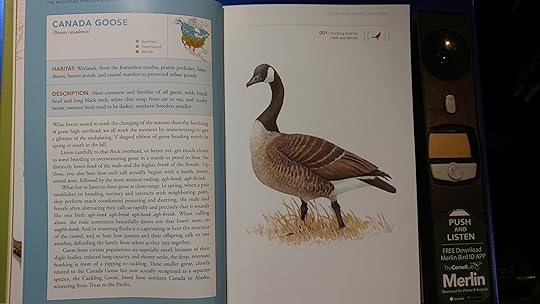
A Sample 2-page spread for the Canadian Goose with one soundtrack:
Each 2 page spread gives a particular species, with picture and audio clues. It explains some of the habits of the species, and also describes the song patterns in audio/musical terms that make it easier to identify and define what you are hearing in the birdsongs you are hearing in your own backyard. Each one gives 1 to 4 hi-quality audio track numbers with a sample of that bird’s song repertoire. And, where known, mnemonics are shown to help you learn the calls for easy recognition.
Making it easier to find your way through these 75 species of birds, the book is subdivided into two color-coded sections for the Non-Passerine and the Passerine birds. The Non-Passerine are the birds that do not learn their songs, but are instead born with an innate song from the nest. These are the owls and other such unusual birds. The Passerine is the larger section, and includes a handful of birds that migrated here from Central America and also do not learn their songs, only repeating the inborn song.
Most of the Passerine section is the ‘songbirds.’ These are the birds that have a more complex brain and highly developed voicebox for learning and maturing their own repertoire of songs as they grow up. These are often the most fun to identify at home by sound. That is the thing I liked most about this guide- the fact that you are not lost in the silence of the photos found in most picture field guides I’ve seen. The process is opened up to include the appearance and sounds of the birds. What is not here is a more detailed description of the bird’s habitat, behavior, or other scientific or trivial minutiae. This is strictly for beginning birders who want to learn to identify the most common birds seen in this region of their world.
Also included is info on a free downloadable app called Merlin from the Cornell Lab that lets you see and hear about 150 birds directly from your smart phone, but be aware that not all the sounds on the app are high quality recordings like the book. And, it doesn’t include the advantage of the mnemonics and sound information described in the book, while it has the advantage of IDing birds by color and by photo for you. So, the app works great beside the book. The book also gives info for downloading free visual software for your pc to record and visualize birdsongs to help learn the pattern of songs. There is much to be enjoyed for any bird hobbyist. I found this hardbound edition at Barnes & Noble in Rome, which is the best place to browse for new books with great photo & art quality. Who says picture books are just for kids?!