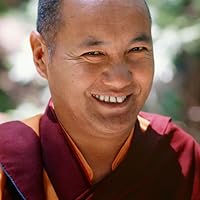
Lama Thubten Yeshe was born in Tibet in 1935. At the age of six, he entered the great Sera Monastic University, Lhasa, where he studied until 1959, when the Chinese invasion of Tibet forced him into exile in India. Lama Yeshe continued to study and meditate in India until 1967, when, with his chief disciple, Lama Thubten Zopa Rinpoche, he went to Nepal. Two years later he established Kopan Monastery, near Kathmandu, in order to teach Buddhism to Westerners. In 1974, the Lamas began making annual teaching tours to the West, and as a result of these travels a worldwide network of Buddhist teaching and meditation centers—the Foundation for the Preservation of the Mahayana Tradition (FPMT)—began to develop. "Meditation is not on the level of the object but on that of the subject - you are the business of your meditation. "Bodhicitta is very practical, I tell you. It's like medicine. The self-cherishing thought is like a nail or a sword in your heart; it always feels uncomfortable. With bodhicitta, from the moment you begin to open, you feel incredibly peaceful and you get tremendous pleasure and inexhaustible energy. Forget about enlightenment - as soon as you begin to open yourself to others, you gain tremendous pleasure and satisfaction. Working for others is very interesting; it's an infinite activity. Your life becomes continuously rich and interesting. "Historically, Shakyamuni Buddha taught the four noble truths. To whose culture do the four noble truths belong? The essence of religion has nothing to do with any one particular country's culture. Compassion, love, reality - to whose culture do they belong? The people of any country, any nation, can implement the three principal aspects of the path, the four noble truths or the eightfold path. There's no contradiction at all."
Lama Thubten Yeshe was a monastic teacher of Tibetan Buddhism most closely associated with the Gelug school of the Dalai Lamas. He established the Foundation for the Preservation of the Mahayana Tradition (FPMT), and was succeeded in leadership of that organization by his heart-disciple Lama Thubten Zopa in 1984.
Four teachings of Lama Yeshe are reunited in this little book. The first two detail the general particularities of tibetan buddhism; the next two are more advanced and mainly focused on the differentiation of Paramitayana from Vajrayana. Very interesting for people wishing to discover this "school" of Buddhism.
This is from live teaching and is difficult to follow . The speeches look confusing and the message got lost at least if you don’t know much about Buddhism and wanted an introduction.
BLUF: Book details the essence of bodichitta and Tantra. Good for someone wanting to learn about core pieces of Tibetan Buddhism for free through Google Play. Not enough to practice.
Not sure where to put this because it's not enough info to do much with unless you've read other books but if you read other books then this book just repeats two major concepts in a different way. As stated, It is helpful for those who want to get more information beyond a Wikipedia article but don't want to spend the money. It's free through the Google Play store.
The first part of this small book is the transcription of Lama Yeshe covering for an ill his holiness the Dalai Lama at a conference in France. It is exceptional in its clarity and humor.
The second part is a bit more complex but still very well written.
The folks at the Foundation for the Preservation of the Mahayana Tradition (FPMT) make this book available as part of the Lama Yeshe Wisdom Archive. This is quite wonderful: you can read for free online or if you prefer paper, you can obtain several of their books for free (paying only shipping) as part of your quest to understand more about the practice of Buddhism. This book is part of the Wisdom Archive's starter pack and imho is the way to go.
A wonderful teaching from Lama Yeshe on how we can become freed from the illusion of separatness in order to benefit other sentient beings. He gives an excellent discussion of the three basic aspects of the path and also a short introduction to tantra.
Lama Yeshe teaches simply the heart of meditation. I will give this to all my students. May all sentient beings be free from suffering and the root of suffering.