

What do you think?

Making India Awesome: New Essays and Columns
Love your country?Want to make it truly great?Tired of loud debates and complex arguments which lead to no solutions?Welcome to MAKING INDIA AWESOME
Following the phenomenal success of his first non-fiction book, What Young India Wants, Chetan Bhagat, the country’s biggest-selling writer, returns with another book of essays in which he analyses and provides inspired solutions to the country’s most intractable problems—poverty, unemployment, corruption, violence against women, communal violence, religious fundamentalism, illiteracy and more. Using simple language and concepts, this book will enable you to understand the most complex of problems facing the nation today and give practical solutions on how you can do your part to solve them.
Following the phenomenal success of his first non-fiction book, What Young India Wants, Chetan Bhagat, the country’s biggest-selling writer, returns with another book of essays in which he analyses and provides inspired solutions to the country’s most intractable problems—poverty, unemployment, corruption, violence against women, communal violence, religious fundamentalism, illiteracy and more. Using simple language and concepts, this book will enable you to understand the most complex of problems facing the nation today and give practical solutions on how you can do your part to solve them.
194 pages, Kindle Edition
First published August 19, 2015
About the author
Chetan Bhagat
40 books5,629 followersChetan Bhagat writes op-ed columns for English and Hindi newspapers, including Times of India and Dainik Bhaskar, focusing on youth and issues based on national development. Bhagat is also a motivational speaker and has given talks in leading MNCs and other institutions. He quit his international investment banking career in 2009, to devote his entire time to writing. In 2008, The New York Times called Bhagat "the biggest selling English language novelist in India’s history". Bhagat, a graduate of Indian Institute of Technology (IIT) Delhi and IIM Ahmedabad, is seen more as a youth icon than as an author.
Ratings & Reviews
Friends & Following
Create a free account to discover what your friends think of this book!
Community Reviews
Displaying 1 - 30 of 154 reviews

August 22, 2015
I must confess that I started reading this book with a preconceived notion about it being written by not a wise or a role-model author. I wasn't sure if my experience would be a good one but it turned out to be one of the best. For the first 50-60 pages, I could easily contradict his views but soon after he started talking about vote bank, politics, economy, minority and women issues, I realised that he actually is speaking his mind and all of it is not as bad as I thought. He said all the things that needed to be said but was not being said by anyone influential. I am glad someone did.

August 31, 2015
Reads more like a rant I feel than a non-fiction book. I went through a couple of chapters and then just couldn't take the idealistic thinking anymore.
For example, there was a chapter where he tells Modi some 17 points "To-Dos". There were points like "don't wear expensive clothes. A leader is not recognized by how expensive his clothes are". Hmmm... maybe, but that is still not a reason why he shouldn't wear expensive clothes. A leader is neither recognized by cheap clothes is he? A person can wear whatever he wants I don't care. As long as he's taking steps to make improvements it's all fine. Then he gives more such idealistic points about how he's wearing a muslim cap but the muslims don't need that.
All these feel more like complaints rather than well-thought-out conclusions. There are no discussions about whether X is better or Y is better. The author feels that X is the way to go and he rams it down your throat without any explanation. Then comes another surge of bashing up politics, how bad we indians are etc. True that we need to improve but isn't that too generalized? There are a 1000 things that we should be focusing on but we still focus on what? On whatever we want to do. So if the author really wants to change people then he needs to make them desire. You can complain all you want about how bad everything is around us and that it's our responsibility to improve things. But all those are just your opinions and they don't change my opinion. In the end I will decide my own responsibilities myself.
Lastly I would like to mention about idealistic thinking. If we live in the real world we need to manage our own expectations. Let me do this with an analogy. Suppose you are working in an office in a cut-throat environment and you're having some issues with your colleague's rude behavior. So what can you do to deal with this?
* You could take measures to rectify the issue. Like speaking to the colleague about his way of speaking
* Or distance yourself from him, making as miniumum number of interactions as possible. You could interact with him on IM or email instead as much as possible.
* You could vent it out to someone else. "oh that guy's stopping my work and causing disturbance for everyone around him"
* You could gather some evidence and speak to your boss or the HR
* You could fight back in different ways. Argue with him unnecessarily.
* You could speak to him in the same way he speaks to you, until he stops it.
What CB does in his book is not talk about the above points. He tells us:
* how bad that guy is and how bad we all are
* how it is important to have a proper behavior in office
* how one should be considerate and give space to others
You see the difference? You can think about idealism and stress yourself out, be angry and it won't help you. Instead focus on what you can do and just keep doing the next possible things. Idealism is a big goal and no one can pick it up in one shot.
Edit: Corrected some typos.
For example, there was a chapter where he tells Modi some 17 points "To-Dos". There were points like "don't wear expensive clothes. A leader is not recognized by how expensive his clothes are". Hmmm... maybe, but that is still not a reason why he shouldn't wear expensive clothes. A leader is neither recognized by cheap clothes is he? A person can wear whatever he wants I don't care. As long as he's taking steps to make improvements it's all fine. Then he gives more such idealistic points about how he's wearing a muslim cap but the muslims don't need that.
All these feel more like complaints rather than well-thought-out conclusions. There are no discussions about whether X is better or Y is better. The author feels that X is the way to go and he rams it down your throat without any explanation. Then comes another surge of bashing up politics, how bad we indians are etc. True that we need to improve but isn't that too generalized? There are a 1000 things that we should be focusing on but we still focus on what? On whatever we want to do. So if the author really wants to change people then he needs to make them desire. You can complain all you want about how bad everything is around us and that it's our responsibility to improve things. But all those are just your opinions and they don't change my opinion. In the end I will decide my own responsibilities myself.
Lastly I would like to mention about idealistic thinking. If we live in the real world we need to manage our own expectations. Let me do this with an analogy. Suppose you are working in an office in a cut-throat environment and you're having some issues with your colleague's rude behavior. So what can you do to deal with this?
* You could take measures to rectify the issue. Like speaking to the colleague about his way of speaking
* Or distance yourself from him, making as miniumum number of interactions as possible. You could interact with him on IM or email instead as much as possible.
* You could vent it out to someone else. "oh that guy's stopping my work and causing disturbance for everyone around him"
* You could gather some evidence and speak to your boss or the HR
* You could fight back in different ways. Argue with him unnecessarily.
* You could speak to him in the same way he speaks to you, until he stops it.
What CB does in his book is not talk about the above points. He tells us:
* how bad that guy is and how bad we all are
* how it is important to have a proper behavior in office
* how one should be considerate and give space to others
You see the difference? You can think about idealism and stress yourself out, be angry and it won't help you. Instead focus on what you can do and just keep doing the next possible things. Idealism is a big goal and no one can pick it up in one shot.
Edit: Corrected some typos.

November 2, 2015
The ideas are a lot of gyans. These will be nice to hear from a selfless man like kalam or E Sreedharan etc. But from you Mr Bhagat it just does not match up. Keep doing some good work for the nation besides judging a dance reality show.
You should be thankful I bought your book and read it
You should be thankful I bought your book and read it

January 5, 2026
I’m glad that Chetan Bhagat wrote this book. His opinions on society, governance, and events may often come across as simplistic, but those are mostly harmless and often motivating.
For many young readers, those opinions can even be inspiring. At the very least, he’s nudging his primary audience toward civic sense and moral duty—readers who, once in a while, pause their endless doomscrolling to engage with something more substantial.
What puzzles me is why serious readers approach this book with expectations of literary depth and then walk away disappointed. It feels like a mismatch of intent and audience. You don’t go into a Rohit Shetty film expecting the nuance of a Satyajit Ray masterpiece, do you? Bhagat isn’t trying to be a philosopher or a historian; he’s trying to spark thought in a demographic that might otherwise not engage with these ideas at all.
In that sense, the book succeeds in its own lane - an accessible entry point into conversations about society and responsibility. Literature doesn’t always have to be profound to be valuable; sometimes, its worth lies in simply getting people to think, even if only for a moment.
A shout out to the Audible narrator.
For many young readers, those opinions can even be inspiring. At the very least, he’s nudging his primary audience toward civic sense and moral duty—readers who, once in a while, pause their endless doomscrolling to engage with something more substantial.
What puzzles me is why serious readers approach this book with expectations of literary depth and then walk away disappointed. It feels like a mismatch of intent and audience. You don’t go into a Rohit Shetty film expecting the nuance of a Satyajit Ray masterpiece, do you? Bhagat isn’t trying to be a philosopher or a historian; he’s trying to spark thought in a demographic that might otherwise not engage with these ideas at all.
In that sense, the book succeeds in its own lane - an accessible entry point into conversations about society and responsibility. Literature doesn’t always have to be profound to be valuable; sometimes, its worth lies in simply getting people to think, even if only for a moment.
A shout out to the Audible narrator.

March 8, 2016
Reading relativity, energy conversion and christian theology in parallel can take a toll on most of us. On times like these one just need a simple book to relieve the stress and keep the GR challenge counter in motion. Thus I decided to try out this despite my unparalleled hate on the author's works of fiction. I also tried his previous non-fiction long back and found it quite boring and childish. So I didn't have much hope to start with but this amazing world of good reads keep on surprising me.
My previous experience with such a book was with the Target 3 Billion written by Dr. Kalam. Chetan Bhagat, as I see him, can never produce such compelling and well documented arguments and assuredly no one expects him to. He is 'The Man' that India look forward to when they want a light read and this time he used his skill for something much useful. He presents to us the case of 'practical patriotism'.
Would you use an Indian flag to wrap yourself when you are freezing? If you are feeling unwell when you hear the national anthem being played, would you remain seated? Would you appreciate a Pakistani sportsperson who showed amazing talent while hitting hard on your own team? Of course you should...
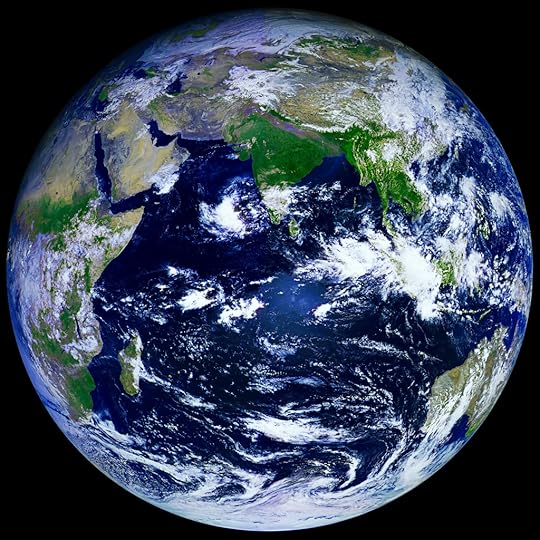
What do you see?? Never mind... What is it that you cannot see in this picture???
To me, what was strikingly absent were the boundaries...
I am citizen of earth and any symbolism that separates us mean very little to me. With that said, till the day that a global society is set up, I will uphold the concept of India above all else. It is the living proof that whatever that may separates us are nothing compared to what unites us. What is it that a north Indian have in common with a south Indian or a north-eastern Indian? Not language, not religion, for god's sake even the fucking food is totally alien to one another. We are as diverse as 3.3 million km squares can practically be and still we thrive under one banner. India is global society in a nut-shell and this concept is too precious that I am as patriot as any army men guarding our walls at Siachen (Yes, I dare say that). Do you think that I am contradicting myself? Take this book and at the very beginning see how Mr. Bhagat quite smartly classify us to selfish, aligned and objective Indians and understand how contradicting oneself is the first step towards sanity and objectivity.
And this is just what the book is all about. A clever classification of the problems that India faces and some opinions by the author as to how to solve them. Which is a great thing to do as what good comes with all the billion and more debates if there are no suggestions on how to proceed.
My previous experience with such a book was with the Target 3 Billion written by Dr. Kalam. Chetan Bhagat, as I see him, can never produce such compelling and well documented arguments and assuredly no one expects him to. He is 'The Man' that India look forward to when they want a light read and this time he used his skill for something much useful. He presents to us the case of 'practical patriotism'.
Would you use an Indian flag to wrap yourself when you are freezing? If you are feeling unwell when you hear the national anthem being played, would you remain seated? Would you appreciate a Pakistani sportsperson who showed amazing talent while hitting hard on your own team? Of course you should...
What do you see?? Never mind... What is it that you cannot see in this picture???
To me, what was strikingly absent were the boundaries...
I am citizen of earth and any symbolism that separates us mean very little to me. With that said, till the day that a global society is set up, I will uphold the concept of India above all else. It is the living proof that whatever that may separates us are nothing compared to what unites us. What is it that a north Indian have in common with a south Indian or a north-eastern Indian? Not language, not religion, for god's sake even the fucking food is totally alien to one another. We are as diverse as 3.3 million km squares can practically be and still we thrive under one banner. India is global society in a nut-shell and this concept is too precious that I am as patriot as any army men guarding our walls at Siachen (Yes, I dare say that). Do you think that I am contradicting myself? Take this book and at the very beginning see how Mr. Bhagat quite smartly classify us to selfish, aligned and objective Indians and understand how contradicting oneself is the first step towards sanity and objectivity.
And this is just what the book is all about. A clever classification of the problems that India faces and some opinions by the author as to how to solve them. Which is a great thing to do as what good comes with all the billion and more debates if there are no suggestions on how to proceed.

October 12, 2015
This is a collection of brief news updates that show up beside your news feed on facebook. Sometimes the author has so little to say that his opinions are based on movies. A couple of times he does make valid points. For example:
1. Roman Hindi. CB makes a case for using Roman script to write Hindi, instead of the usual Devnagari one. He talks about how languages have evolved with time, and similar changes have happened elsewhere. The argument is actually convincing, but then he takes a false step. He says that there are books that have started using Roman Hindi. I had almost fallen straight into the trap! He is talking about himself, and trying to pass off his novels as Roman Hindi. Well played, CB, well played.
2. Jaipur Literary Festival. CB is proud that the country has an event celebrating books. WTF CB, haven't you heard of the Kolkata Book Fair? It's only been happening for 40 years now, did you miss it? Oh I understand - you weren't invited there, so it's outside your field of view.
3. Gay Rights. He has a massive hard-on for gay rights, and believes that gay rights = justice. Unfortunately he doesn't realize that lawmakers and law enforcers are different groups in India. Quite often police don't care about laws; they just want to harass people for money. The courts are overburdened and common people often don't want the hassle. This reminded me of another CB quote from two years back "What?! Consensual gay sex ruled illegal in 2014? Shows you how badly India needs new young leaders with a modern outlook." Listen dumbfuck, Supreme Court ruled gay sex illegal, and you can't send elected leaders to the supreme court. The Union Cabinet and Parliament have almost no role to play in the appointment of judges to the Supreme Court or to any of India's twenty-four High Courts.
It's surprising how you can read a book and not learn anything new.
1. Roman Hindi. CB makes a case for using Roman script to write Hindi, instead of the usual Devnagari one. He talks about how languages have evolved with time, and similar changes have happened elsewhere. The argument is actually convincing, but then he takes a false step. He says that there are books that have started using Roman Hindi. I had almost fallen straight into the trap! He is talking about himself, and trying to pass off his novels as Roman Hindi. Well played, CB, well played.
2. Jaipur Literary Festival. CB is proud that the country has an event celebrating books. WTF CB, haven't you heard of the Kolkata Book Fair? It's only been happening for 40 years now, did you miss it? Oh I understand - you weren't invited there, so it's outside your field of view.
3. Gay Rights. He has a massive hard-on for gay rights, and believes that gay rights = justice. Unfortunately he doesn't realize that lawmakers and law enforcers are different groups in India. Quite often police don't care about laws; they just want to harass people for money. The courts are overburdened and common people often don't want the hassle. This reminded me of another CB quote from two years back "What?! Consensual gay sex ruled illegal in 2014? Shows you how badly India needs new young leaders with a modern outlook." Listen dumbfuck, Supreme Court ruled gay sex illegal, and you can't send elected leaders to the supreme court. The Union Cabinet and Parliament have almost no role to play in the appointment of judges to the Supreme Court or to any of India's twenty-four High Courts.
It's surprising how you can read a book and not learn anything new.

February 8, 2016
Too simplistic and self - important. can be recommended for Sixth grade kids.

October 21, 2015
I must confess that I couldn't go beyond a few pages of Chetan's book "One Night @ Call Centre" because I couldn't relate to what was written and the manner in which it was written. Subsequently he became a celebrity. I tried reading his subsequent book. Yet again I could not go beyond a few pages. Perhaps these books were for the youth of this country and I was not so young. I have indeed grown older now but I loved reading "Making India Awesome" because I could relate to it and because there are practical and "do-able" suggestions. One may not agree with all that has been written but the author makes one think. Think positively. The author exhorts the reader "The country needs you". He also comes up with seminal statements like "Society needs ethics as much as laws to function well". Though he is all for easing and even removing controls that have shackled the economy, he talks of "reining the MNCs for they seem to have little ethics".
A must read for all Indians.
A must read for all Indians.

February 9, 2016
if you care for your country, you should definitely read this book.

October 21, 2015
In short
80% of the book comprises of the problems what India is facing like corruption/poverty etc
20% comprises of what Mr Bhagat thinks the solution to those problems are.
I personally feel its the case of a misguided missile or rather misleading title (since 80% of the book screams about problems rather than about how to make India awesome!)
The only two good things I found about this book were:
- it was only 192 pages.
- it was way too simple to read. (to conclude within an evening!)
Rest all, about the issues or solutions mentioned in the book, appear to have been shown, discussed or debated across, in the press/media and hence repetitive! I learned nothing new!
I'm still wondering, why Mr Bhagat chose 2015 to write this book, when he could have written about it almost a decade back! Couple of things wouldn't have held relevance, but the problem he's written existed then too! Never mind.
Cheers,
80% of the book comprises of the problems what India is facing like corruption/poverty etc
20% comprises of what Mr Bhagat thinks the solution to those problems are.
I personally feel its the case of a misguided missile or rather misleading title (since 80% of the book screams about problems rather than about how to make India awesome!)
The only two good things I found about this book were:
- it was only 192 pages.
- it was way too simple to read. (to conclude within an evening!)
Rest all, about the issues or solutions mentioned in the book, appear to have been shown, discussed or debated across, in the press/media and hence repetitive! I learned nothing new!
I'm still wondering, why Mr Bhagat chose 2015 to write this book, when he could have written about it almost a decade back! Couple of things wouldn't have held relevance, but the problem he's written existed then too! Never mind.
Cheers,

September 7, 2015
Making India Awesome' is a book which has all rhetoric but no substance. Chetan does not seem to have any knowledge about the politics in India. He preaches everyone to change, which is easier said than done. You don't gain anything by reading the book nor will you lose any if you miss it.

August 22, 2015
Let 1000 better writers than Chetan Bhagat get released and published in India but whenever the book by the Superstar himself releases, the pre-booking breaks all the records. I can never resist buying his book as soon as the pre-order is opened for all the readers. Chetan Bhagat's 8th book overall and categorically, 2nd non-fictional book released 2 days back named "Making India Awesome". Chetan Bhagat never does a big launch and marketing tactics for his non-fictional books. He somewhere believes that people concerned with the growth of nation and having love for the country will definitely purchase a book based upon the idea of how to make it the Superpower. But without any fanfare too, the fans like me get to know about his book release.
"Making India Awesome" is Chetan Bhagat's attempt of sharing essays and columns he have written on nation time to time and explaining the complex issues in the easiest language possible. It is definitely in the lines of his first non-fictional book, "What Young India Wants?" but here, he is not that biased towards parties the way he was in the former. Still, his love for Narendra Modi and BJP was evident in few sentences. The intention of the book can be clearly understood right from the first chapter itself. Chetan wants the nation to improve and therefore, he discusses ideas on many issues about how they can be resolved with whatever more or less knowledge he had regarding the same.
He have divided the book in four different parts- Awesome Governance, Awesome Equality, Awesome Society and Awesome Resources. Accordingly, he have discussed points like politics, economy, societal values, women's right, gay rights, minority rights and the transformation youth can bring to the nation. This 176-pages book is a light-read and you will find an urge of having an opinion on all the issues after you will end up reading the book. You will want to have an angle in your life for the nation too rather than only blaming the government, ministers and the whole system.
But there's a big problem with the ideas and solutions Chetan Bhagat have provided. The most of them are meant for the government and Prime Minister. The book is mainly like an open letter to Narendra Modi than to the youths of India. The book has been projected as if it's written for us on how to bring glory to the nation at personal level but it's more about how government can improve various things. He have discussed points on how even we can bring the change but even those points aren't much effective except few which are literally possible. I wish if Chetan Bhagat could have been little more sensible in putting up the solutions as some of them are really very silly to even think. I would give this pure effort 3.5* out of 5. Go For It!
Thanks.
ABHILASH RUHELA - VEERU!!!

August 3, 2017
Two stars because, from a personal point of view, I hadn't a clue what I was reading. It felt like I had to be born and living in India to understand the politics
However, the author liked to talk about solutions to the problems, solutions that would create world peace but we know will never happen. In an ideal world maybe....but until corruption and leaders stop being so mean it's unthinkable.
At the beginning he said we're all guilty of corruption, how can we blame the leaders if we do things like forgetting to scan an item at the self-checkout and don't rectify it. It's the same thing but on a smaller scale.
Good point but not really comparable. Shame on you if you tea leaf knowingly though!
However, the author liked to talk about solutions to the problems, solutions that would create world peace but we know will never happen. In an ideal world maybe....but until corruption and leaders stop being so mean it's unthinkable.
At the beginning he said we're all guilty of corruption, how can we blame the leaders if we do things like forgetting to scan an item at the self-checkout and don't rectify it. It's the same thing but on a smaller scale.
Good point but not really comparable. Shame on you if you tea leaf knowingly though!

December 30, 2015
This is the first non fiction book written by Chetan Bhagat I have ever read. He has definitely done a better job than fiction writing. Keeping to his simple and straightforward style of writing, Bhagat tackles some socio-economic and political issues.
PLUSES:
-Light reading, though the volume of topics covered is huge.
-Owing to his style of writing and explanations through examples, it really is a " dumbed down"version of India's problems - so that anyone can understand.
-Some of the issues are explained in good old text book fashion, with flowcharts and relatable examples.
NEGATIVES:
-Mr. Bhagat says at the beginning of the book that when you talk about some problem you should have an alternative/solution. However, he seems to forget his ideals while exploring some topics. i.e just rants no solutions - it's fine in one sense, as of course nobody expects him to find the solution for all of India's problems.
- Cards on the table- Mr.Bhagat is no literary genius. This is exactly why most of the reviews will say it is just ranting. His usages of awesome, cool and such words to blend in to the youth of the nation, in such serious topics probably takes away the seriousness of the issue.
The subjects dealt in this book should have been an awakening call- but it doesn't,due to the oversimplification.
I can effectively summarize the entire content as' Ok society, you judge everyone. But it is actually you who should change. All of us should change. Then all these problems would be solved'
In a nutshell, it is good for some light reading on heavy topics- but it wont make you get up and say 'hell yeah, he's right. I'm going to do something about it.' - in other words it isn't inspirational. Neither do you learn much new, or get a radical change of perspective.
But I do appreciate his role in at least turning the Non caring Indians to at least bother to care..It's a start.
PLUSES:
-Light reading, though the volume of topics covered is huge.
-Owing to his style of writing and explanations through examples, it really is a " dumbed down"version of India's problems - so that anyone can understand.
-Some of the issues are explained in good old text book fashion, with flowcharts and relatable examples.
NEGATIVES:
-Mr. Bhagat says at the beginning of the book that when you talk about some problem you should have an alternative/solution. However, he seems to forget his ideals while exploring some topics. i.e just rants no solutions - it's fine in one sense, as of course nobody expects him to find the solution for all of India's problems.
- Cards on the table- Mr.Bhagat is no literary genius. This is exactly why most of the reviews will say it is just ranting. His usages of awesome, cool and such words to blend in to the youth of the nation, in such serious topics probably takes away the seriousness of the issue.
The subjects dealt in this book should have been an awakening call- but it doesn't,due to the oversimplification.
I can effectively summarize the entire content as' Ok society, you judge everyone. But it is actually you who should change. All of us should change. Then all these problems would be solved'
In a nutshell, it is good for some light reading on heavy topics- but it wont make you get up and say 'hell yeah, he's right. I'm going to do something about it.' - in other words it isn't inspirational. Neither do you learn much new, or get a radical change of perspective.
But I do appreciate his role in at least turning the Non caring Indians to at least bother to care..It's a start.

October 29, 2015
The first thing I said my friend when I bought this book was that now I had all of Chetan Bhagat's books in my shelf. The brand created by the author through his debut novel Five Point Someone holds strong even today and is the only reason why I decided to give it a try. Its a collection of essays, mostly on the various social, political and economical issues on what the author thinks is hindering India from becoming awesome. I did agree to some of his views while there were some others which I found hard to accept. Nevertheless, I feel the author needs to be appreciated for taking up his social responsibility being a celebrity author and speaker to pen down Making India Awesome even though he could have written another work of fiction which could have filled his pockets in a better way. This book for sure will not make it into the best seller's list and its not written for that purpose. If there is any reason to pick up this book and read, its simply the author. The language and style is as usual, simple - one of the author's trademarks. You won't feel that overwhelming feeling of being an Indian or determined to make a change, but this book gives you some issues to think about and discuss which can for sure make our tomorrows much much better.

January 20, 2017
The reasons why I like reading books by Chetan Bhagat are that they are short and simple. When it comes to fiction, those are not bad traits for a book to have. Not everyone needs a book with literary eloquence that makes you run for the dictionary. For that reason, I have enjoyed many of his books. They are all stories from India, that all of us can relate to at some level compared to the works of fiction from the foreign authors that we are used to.
But when it comes to a work of non-fiction content is of utmost importance.
The reason why this book disappointed me is its failure to deliver the promises that were made too eagerly.
The text on the back proclaims '...using simple language and concepts, this book will enable you to understand the most complex of problems facing the nation today and give you practical someone on how you can do your part to solve them'.
It does none of that. All it does is oversimplify some of the issues that we face and the solutions are ridiculous. At times,it felt like i was reading my 5th grade moral science text book. And then there are the weirder ones- what should bjp and Congress do etc which grossly oversimplifies everything.
It could be just that I'm not among the target audience.
But when it comes to a work of non-fiction content is of utmost importance.
The reason why this book disappointed me is its failure to deliver the promises that were made too eagerly.
The text on the back proclaims '...using simple language and concepts, this book will enable you to understand the most complex of problems facing the nation today and give you practical someone on how you can do your part to solve them'.
It does none of that. All it does is oversimplify some of the issues that we face and the solutions are ridiculous. At times,it felt like i was reading my 5th grade moral science text book. And then there are the weirder ones- what should bjp and Congress do etc which grossly oversimplifies everything.
It could be just that I'm not among the target audience.

May 24, 2016
This is the first chetan bhagat book I'm reading and I did like this book. But i gave it 3 stars cause i disagree on of his view points AND THEIR SOLUTIONS but i respect them nonetheless.Everything else in it would be rated 5 star, take its language, simplicity, usage of examples, he did hit the sweetspot he was hoping to hit the 80% 'self foccused indifferent indians' according to him of which i hope 90% are youngsters . He urges them to openup and does that in a very pleasing manner. I would be happy more than the author if 10% of those individuals do get some sense of responsibility and awareness reading this book. Its good to mention that he did handle a lot of sensitive topics with great care its visible in the writing.
And to conclude, book has nothing great or new for the frevent followers of news and day to day activities in india but what the author tried to do is add up all small things and appeal to the more and enormous section of people for content i would have given 1STAR but gave 3 so as to say he succeded what he intended to do .
And to conclude, book has nothing great or new for the frevent followers of news and day to day activities in india but what the author tried to do is add up all small things and appeal to the more and enormous section of people for content i would have given 1STAR but gave 3 so as to say he succeded what he intended to do .
March 29, 2016
Ugh…Chetan Bhagat has a good heart, but is so hopelessly naïve and uninformed that it distresses me that his inane writings can have so much influence. Yes, it’s good to argue for less corruption, better governance, more concern for the poor, more tolerance, etc. All of those are GOOD things. But Bhagat talks about these topics like edicts that should be obvious to anyone of his cultural/societal position rather than showing that they come from reasoned arguments he has actually has considered and understood. So whenever he delves into an issue where the benefits are more controversial (such as his unbridled support for unregulated capitalism and wealth creation as the solution to everything), he comes off as an ignorant shouter of pop wisdom.
It would be nice if more people took as strong an attitude towards seeking good governance, rule of law, community harmony, and better treatment for women/poor/minorities as Bhagat does. But I hope that when they do, they can find some more informed prophets to lead them in the nitty-gritty of how we get there.
It would be nice if more people took as strong an attitude towards seeking good governance, rule of law, community harmony, and better treatment for women/poor/minorities as Bhagat does. But I hope that when they do, they can find some more informed prophets to lead them in the nitty-gritty of how we get there.

September 1, 2015
Few writers stay in our lives with a Tag “whatever you say, feel and think but you can’t ignore me’. This line sets best on Chetan Bhagat Sir. He knows what to say how to say, just like some professional who knows his part in others life very well. Every time he announced his new book, we wait while we know there will be another love story, but we can’t read literature all the time, heart needs party time too.
“Don’t kill yourself in trying to have it all. Just be normal, admit you won’t be excellent at everything every day and smile through life.”
Frankly speaking, I love his non-fiction writing skills more than anything else. Author amazed me literally with his first non-fiction “What Young India Wants” (Must Read) collection of some speeches and columns about society and culture but I liked the way he narrate his part.
Read More :https://soundingwords.blogspot.com/20...
“Don’t kill yourself in trying to have it all. Just be normal, admit you won’t be excellent at everything every day and smile through life.”
Frankly speaking, I love his non-fiction writing skills more than anything else. Author amazed me literally with his first non-fiction “What Young India Wants” (Must Read) collection of some speeches and columns about society and culture but I liked the way he narrate his part.
Read More :https://soundingwords.blogspot.com/20...

September 24, 2015
Even though i don't support all of his views, Making India Awesome is a good read for Indian Youth. It covers almost all issues India facing these days without going to the details. As usual Chetan Bhagat's writing style makes this book more book more awesome.
I think Chetan Bhagat succeeded in presenting a skinny idea of everything India facing these days to our youth. He presented it in simple words so even a beginner can try this one. Also his attempt to point out attitude issues among Indians are appreciated.
I hope this book have the potential to make us think about issues already we know. Lets hope Making India Awesome could contribute to the change we are hoping to achieve under this new government with young ideas.
I think Chetan Bhagat succeeded in presenting a skinny idea of everything India facing these days to our youth. He presented it in simple words so even a beginner can try this one. Also his attempt to point out attitude issues among Indians are appreciated.
I hope this book have the potential to make us think about issues already we know. Lets hope Making India Awesome could contribute to the change we are hoping to achieve under this new government with young ideas.

April 2, 2016
Everyone's entitled to their own opinion and this book is full of them. And that's o.k. It's human nature to have an opinion.
While this book was written for the youth of India, I found it quite interesting as a traveler in India. Travelers see many issues in India, but most of the time we are unaware of the political, cultural and historical perspective of the coutry. Cheten gave me more of an insight than I would have got from talking to randoms on the street or other people I've meet.
I enjoyed his style of writing and sense of self awareness and authority. Not only did he give me an insight on India's situation, he also made me think about human nature as a whole.
The whole world is watching India and if more people thought about solutions like Cheten does, rather than just blank out societies problems or just complain, then the world would be a much better place.
While this book was written for the youth of India, I found it quite interesting as a traveler in India. Travelers see many issues in India, but most of the time we are unaware of the political, cultural and historical perspective of the coutry. Cheten gave me more of an insight than I would have got from talking to randoms on the street or other people I've meet.
I enjoyed his style of writing and sense of self awareness and authority. Not only did he give me an insight on India's situation, he also made me think about human nature as a whole.
The whole world is watching India and if more people thought about solutions like Cheten does, rather than just blank out societies problems or just complain, then the world would be a much better place.

October 22, 2015
For a person who has little clue about internal workings of India this was an interesting read.
The book is comprised of short essays discussing various problems/issues India faces today in a positive and solution-oriented manner. While I'm sure it is over-simplistic in some cases and the proposed solutions might not be feasible, it seems like a decent starting point for a wider discussion.
In general, most of the arguments are quite well aligned with liberal and rational thought and sometimes could even be considered common sense, although this might be seen differently by a more informed Indian reader.
The book is comprised of short essays discussing various problems/issues India faces today in a positive and solution-oriented manner. While I'm sure it is over-simplistic in some cases and the proposed solutions might not be feasible, it seems like a decent starting point for a wider discussion.
In general, most of the arguments are quite well aligned with liberal and rational thought and sometimes could even be considered common sense, although this might be seen differently by a more informed Indian reader.

December 13, 2016
Some of the ideas were preachy, yet others were quite good. Overall, I was impressed by Chetan Bhagat's knowledge on the varied topics that he talked about. It is a good book to pick up for a college kid who might want to get some information on the current affairs taking place in India and the pulse of the people regarding those topics.
The topic about women and DU cutoffs was especially good. I really felt he went to the heart of the matter.
The topic about women and DU cutoffs was especially good. I really felt he went to the heart of the matter.

June 24, 2017
Very Good points though I might not agree with completely. It makes a good argument on why citizens and voters are responsible for having a bad government. Recently I visited India. The most annoying aspect for me was that there was garbage thrown around and they were mostly breeding ground for mosquitos. People whom with I discussed this problem placed their blame on municipalities and governments.
I liked the 10-meter rule around you.
The responsibility lies on each one of the voters.
I liked the 10-meter rule around you.
The responsibility lies on each one of the voters.

September 4, 2015
A good read. He keeps his argument quiet simple. Though they may not appeal to be the most intellectual ways to solve the issue at hand; he nevertheless addresses the elephant in the room and creates a decent argument around them.

September 9, 2015
Good one but a little more solution oriented focus on economics , agriculture n employment issues might have made the book awesome, too much concentration on Rahul Gandhi n critical of the governments diluted it's purpose to some extent!

November 4, 2015
Generally i read some social-welfare books.
But this book is somewhat special.
Every book tries to identify the problems and questioning nature.
But this book gone to next step and tried to develop the solution capability or urge for solution in the reader.
May it is to me i find it.
Thank you.
But this book is somewhat special.
Every book tries to identify the problems and questioning nature.
But this book gone to next step and tried to develop the solution capability or urge for solution in the reader.
May it is to me i find it.
Thank you.

November 8, 2015
The usual dramatics and some horrible examples did exist but I should say Chethan Bhagath does make some good points the youth could use.He also turned out to be witty sometimes.Overall it's just a quick ramble of whatever we here everyday with slight improvements.

October 15, 2016
An utopian view of how the world needs to be. An interesting read for a citizen of Bangladesh as many of the issues faced in India are a replica of that in Bangladesh. Read this book with an open mind.

October 23, 2016
If you are a youth of India, this book is written for you…
If you want to understand concerns of youth of India, YOU MUST READ IT !
Check the full review on:
https://navigatingshelves.wordpress.c...
If you want to understand concerns of youth of India, YOU MUST READ IT !
Check the full review on:
https://navigatingshelves.wordpress.c...
Displaying 1 - 30 of 154 reviews