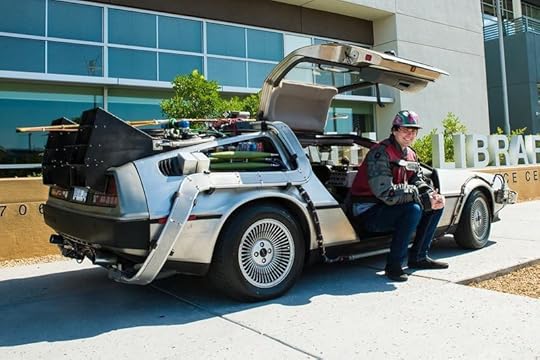
Long before Marty McFly and Doc Brown traveled through time in a flying DeLorean, director Robert Zemeckis and his friend and writing partner Bob Gale worked tirelessly to break into the industry with a hit. For the first time ever, the story of how these two young filmmakers struck lightning is being told by those who witnessed it.
We Don't Need Roads includes original interviews with Zemeckis, Gale, Christopher Lloyd, Lea Thompson, Huey Lewis, and over 50 others who contributed to one of the most popular and profitable film trilogies of all time. With a focus not only on the movies but also on the lasting impact of the franchise and its fandom, We Don't Need Roads is the ultimate audiobook for anyone who has ever wanted to ride a hoverboard, hang from the top of a clock tower, travel through the space-time continuum, or find out what really happened to Eric Stoltz after the first six weeks of filming.
I am fan of Back to the Future film trilogy, so it wasn’t hard (at all) to decide to read this book.
It’s a book describing all the behind-the-scenes process implied to present to audience the wonderful trilogy of Back to the Future since even before that the production got a green light to begin.
Caseen Gaines, the author, not only have read several research books about the topic, but also he was able to make direct interviews with many people involved in the film franchise.
Obviously since I am a geek, I knew a lot about the film trilogy but it was refreshing to find out several things that I didn’t know about, and also to “live” again the whole development of the trilogy, step-by-step, all the good and all the mess.
The author gives away both versions of the story when it’s about a polemic issue without taking a stand, he just presents both sides of each incident, and you are the one to decide who was right or wrong, even the chance that nobody is totally right or wrong, and the truth can be found, just in the middle of both versions of how the events happened.
The casting, the visual effects, the locations, the artwork, the music, the impact and the aftermath, you are a first line witness in an engaging narrative, making a true time-travelling trip to the history of one of the most beloved film franchises.
To be continued...
TIME FLIES WHEN...
I remember having read (several years ago) a 3-part article in a Spanish-translated edition of Starlog magazine, published in Spain, where the author of the article made an AMAZING job detailing all the paradoxes created in the trilogy and certainly I had the time of my life reading the 3-parter article. (and yes, I still have those magazines, somewhere in my boxes).
This book at hand isn’t about the implications and paradoxes on the script. This book is a detailed behind-the-scenes access to the whole long process that it was made to make possible the production of the iconic first film and its two sequels, making a timeless trilogy.
Also, you will read about the impact of each movie, how they were received by the audience inside of USA and around the world, in the same way the aftermath involving side-projects, fan clubs and marketing in all its spectrum.
Depending of how much you may know about what happened during the filmation of the trilogy, it’s likely that you will know many of the facts revealed here, but I trust that (like my own case), the book will be able to surprise here and there. Telling you some stuff that you hadn’t the slightest clue, or even if you were kind aware of some stuff, it’s quite possible that the deep exposition will be able to expand your own knowledge of certain incident and/or anecdote or giving you an unknown angle until now.
To be concluded...
NO TIME LIKE...
While I truly think that the book deserves its my personal rating of 5 stars, since I enjoyed each second of the reading experience, I believe that some stuff wasn’t exposed as it was detailed others.
There isn’t anything about the casting process for Christopher Lloyd, maybe the Bobs (Robert Zemeckis and Bob Gale) always wanted him for the role of “Doc Brown” but in the book it’s told cases like that (if there’s the case at all) for support characters, so it’s odd not having at least some paragraphs dedicated to the co-star of the trilogy.
During the narrative it’s clear that the author had access to many people, including key persons like Zemeckis, Gale, Lloyd, Lea Thompson, Thomas F. Wilson, etc… but my impression is that he wasn’t able to contact Michael J. Fox, since while the book have a lot about him and his life experience while filming the trilogy, when it’s about Michael it seemed to be something that he was told about by a third party and/or read somewhere, and while it’s my humble feeling about it (I can be wrong) it’s a pity not having first hand comments from the star of the film trilogy.
But don’t take me wrong. The book is a real treat to any fan of Back to the Future and I am sure that if you love the trilogy as much as I do, you’ll love to read this book too.
Honestly the book read very dryly. There's a lot of information about casting, and filming, and production of the movie - which is interesting - but it's put together haphazardly. There's little cohesiveness to how the story is told, with backstory being dropped in at random places, and jumping around within the singular storyline.
I ended up skimming quite a lot of it because I just couldn't read through page by page. Perhaps this is a case of 'it's me, not you,' but I can't say that I was happy to have read this book - even if I did only manage to get 25% of the way in.
I received this book through the LibraryThing Early Reviewers Program.
If you grew up on the Back to the Future trilogy, you must read this book. I'm usually pretty slow to read through nonfiction books, but I blazed through this in a couple days. It reads as fast as a novel and is absolutely fascinating.
Much of the book focuses on the first movie: the background of "the Bobs," Robert Zemeckis and Bob Gale, and the dilemma with the leading man. They wanted Michael J. Fox but he was engaged with Family Ties, so they went with Eric Stoltz. He was a fabulous actor but not suited for Marty; he was a method actor who insisted that he be called "Marty" on the set and played the role as stiff and serious. By the time they realized this and desperately sought out Fox, they were able to finagle things to cast him and history was made.
The book overflows with interviews with many of the cast members, including Lea Thompson and Christopher Lloyd. I was utterly fascinated by the truth behind the famed hoverboard scene in Part II: that a stuntwoman almost died. Sure enough, I watched that scene again last night, and you can see the reflection of a body falling thirty feet to the concrete.
I found it very appropriate that immediately after I finished this book, I went on Facebook and found that Christopher Lloyd reprized his role as Doc for a Lego commercial. Back to the Future has such huge cultural significance for my entire generation and for me personally. I truly enjoyed finding out more of the truth behind the trilogy.
Great Scott, this book featured tidbits about the best trilogy ever that even I didn’t know!
The book itself is pretty straight forward – I don’t think it would hold the attention of a casual fan as it runs down behind the scenes info in chronological order.
If you knew that Eric Stoltz filmed quite a bit of scenes as Marty McFly:
And that George McFly was killed off in BTTF 2 due to actor Crispin Glover's failed contract negotiations:
Then this is the book for you! (and if you guys aren't ready for that yet... your kids are gonna love it.)
Basically, as long as you’re not a butthead you’ll enjoy finding out the original plot for the second film, what the studio wanted to title the film and how an unfortunate on set accident changed the stunt world.
And for added measure, interviews with the actor who played Marvin Berry and the singer who provided Marty’s “Johnny B. Goode” voice were very charming.
WARNING! This book is not for tranks, lo-bos and zipheads.
A really interesting book that made me want to rewatch the trilogy again. I haven't been all that diligent in reading BTTF tidbits, so most of the information was new to me. One thing I did know was the original casting of Eric Stoltz; even then, though, I still learned a lot more about why they replaced him and how that impacted other aspects of the production.
I would have loved it if the book were even longer, and covered some other aspects of the movie. Although the soundtrack is mentioned, I would have loved to read more about Silvestri's score.
In case you're wondering, here are the major topics in the book as I remember them: -Early development of the movie -Casting Eric Stoltz v. Michael J. Fox -Crispin Glover not being in Parts II and III, and his replacement -The disastrous hoverboard stunt at City Hall in Part II -The music, mostly Huey Lewis, Marvin Berry, and Marty McFly's voice double -Making of Parts II and III--expectations and pressure -Reception of all three films, and their legacy to this day
And wow, it's now 2015 already! Too bad we don't have hoverboards yet.
A fun, if slight, look at everything to do with 'Back to the Future'. I love the films and have heard a lot of these stories before, so it is to Gaines' credit that I did learn a thing or two. As a story, though, this leaves something to be desired; there is a little too much emphasis placed on things like the merchandising and/or lawsuits arising from the film, which come at the expense of a larger narrative. There's no great insight into the people, system or culture that produced these films, and it's easy to see why - this has all the earmarks of being rushed out to coincide with the original film's 30th anniversary. Not getting Michael J. Fox's participation hurts, and Gaines is upfront that he only had a half hour with Bob Zemeckis. It's impressive what this book manages to accomplish, considering its limitations, but I'm still left wanting more. God, do I want to watch the movies though!
‘Back to the Future’ hit theaters in late summer of 1985 and was massive blockbuster hit that spawns two sequels while made fans for life to many children, teenagers, and adults. In “We Don’t Need Roads”, popular culture history author Caseen Gaines gives the backstory of the entire film trilogy with information for both super fans and those who just love watching the films.
Gaines jumps right into the biggest storm that ‘Back to the Future’ weathered as his jumping off point in the book. Gaines developed the backstory of how the film got into production before the issue of miscasting of Eric Stoltz as lead character Marty McFly and how director Robert Zemeckis and writer Bob Gale handled the situation to get Michael J. Fox. Instantly Gaines had hooked the reader by showing the challenges the production team faced in getting the film to screen.
Though interviews of numerous actors and crewmembers, Gaines gives a detailed account of how iconic scenes were created and how much people enjoyed the making the films. One of Gaines biggest hurdles in the book was giving a well-rounded account of why Crispin Glover did not sign on for the sequels and how producers filled his absence, resulting in one of many lawsuits that ‘Part II’ endured. Gaines also takes us behind the scenes of the famous hoverboard scenes, including the botched stunt that resulted in the second ‘Part II’ lawsuit.
Before wrapping his book, Gaines details how the ‘Back to the Future’ trilogy continued to live after it had left theaters through fan clubs and fan websites that connected thousands of fans across the world with one another. Gaines included this chapter to explain why ‘Back to the Future’ continues to be a part of pop culture, while so giving an unstated reason for why this book was in part written. The final chapter, which included how the ‘Back to the Future’ community at-large has rallied around Michael J. Fox’s fight to cure Parkinson’s Disease, shows how a production team of crew and actors got through so many challenges to create a pop phenomenon that endures until today. After reading this book, one’s appreciation of the original film, and its sequels, will only grow.
I received a Advance Uncorrected Proof edition of this book through LibraryThing Early Reviewers.
I really want to give this book three stars, but I give it four because of my love for BTTF.
It has nothing to do with the author, nor does it have nothing to do with the people interviewed. It all has to do with the people the author didn't get to interview (or chose not to be interviewed) and the films it didn't focus on (part II and part III).
The interviews he did get were great and it was nice getting a lot of clarification on how people felt when it came to the Eric Stoltz incident and the Crispin Glover incident. It was also nice and sad to find out what happened the day with the accident on the set of Pt II with the hoverboard.
The focus on the creation of the first film was perfect. When it started going into Part II and Part III territory, that's when it started to fall apart. Besides from the incident with the hoverboard stunt, and Cripsin Glover's replacement, that was all there really was for Part II. Part III only covered ZZ Top, stunts on train, and the destroying of the DeLorean. I can't believe that there was so little to tell from Part III. What about Michael J. Fox accidentally getting hung?
I will warn you that Michael J Fox, Tom Wilson, and Mary Steenburgen (obviously Crispin Glover, too) were not interviewed and things detailing to their character or incidents involving them was pulled from various sources over the year. :/
BUT. Do get this book. I sound like I'm marking it down for those two reasons, but it was really well done. I read it all in one sitting and I enjoyed it immensely. I just wish there was more, and maybe there could have been if the actors that weren't interviewed were.
This is a book about Bob Gale and Bob Zemeckis and their films, Back to the Future. The author interviewed them and several cast members. The majority of the book is about the first film, though the trilogy and aftermath (including the bttf 2015 party) are covered.
Incidents an anecdotes are the primary means to tell the story, and all of the major ones are covered here. I most enjoyed reading how the Huey Lewis songs came together and all the details about Marty Eric Stoltz.
I was looking forward to this book but came away mostly disappointed. I was thinking this was going to be akin to Rinzler's The Making of Star Wars books, full of details culled from production notes, script drafts, storyboards, and interviews, but while there's some of that, it's nowhere near as extensive. While Gaines managed to get most of the major behind-the-scenes players to talk with him, including Robert Zemeckis (though Gaines admits in his introduction he only got a half hour to interview him), the cast was less willing to talk, with Lea Thompson and Christopher Lloyd being the only major players sat down with him.
On most subjects you'll learn little more than you'd get from the audio commentaries and featurettes on the home video releases. The notable exceptions are the dirty laundry behind the production -- Eric Stoltz getting fired, the decision to replace Crispin Glover in the sequels and the subsequent lawsuit, and the accident that nearly killed a stunt woman -- which Universal understandably avoids in official material. That alone makes the book worth reading, even if you have to wade through material you're already familiar with. (This is a short, breezy book, so the rehashing isn't too bad.)
Still, if you're going to read one book on BTTF, I'd go with the hilarious B^F: The Novelization Of The Feature Film by Ryan North, which goes through George Gipes' long out-of-print novelization page by page. Because the novel was based upon the draft of the screenplay used for Eric Stoltz, there are lots of fascinating differences, from an alternate opening sequence where Marty acts like a John Hughes character, to Marty treating his family with utter contempt in the original 1985.
This takes a relatively thorough look at the behind-the-scenes of the Back To The Future Trilogy and proves to be an interesting read, if a little dry at times. Gaines interviews a lot of the key crew - from Robert Zemeckis, the director and Bob Gale (who co-wrote and co-produced the original, wrote and produced the rest and doesn’t appear to have done much since) down to special effects technicians - and there are some good insights into the process and personalities involved in the filming. Nicely, the book doesn’t shy away from contentious issues so we get the Eric Stoltz as Marty story in full, the odd/exciting (depending on which side of the camera you stood) activities of Crispin Glover (neither of whom were interviewed), the awful injuries Cheryl Wheeler suffered on II (which is dealt with in depth) and the occasional stroppiness of Zemeckis. As with other trilogy making-ofs (thinking specifically of Bouzereau’s Indiana Jones book), the first film takes up the lions share of the pages and gets the most detail (which, in this case, isn’t an issue because I think that’s the better film). But the second and (especially) third really feel short changed and there are plenty of places were Gaines could have dug a little deeper. The interviewees are interesting (especially Dean Cundey, the director of photography and Lea Thompson, who played Lorraine - apparently named because the studio head, Sid Sheinberg, wanted the character to share his wifes name) but some of those not interviewed (as mentioned above) are noticeable by their absence, chiefly Michael J. Fox, Mary Steenburgen and Tom Wilson. So it’s definitely interesting even if it’s not as thorough as it could have been and if you’re a fan of the series (as I am) then this is well worth a read and I’d recommend it.
I read this book in part to celebrate "Back to the Future Day," October 21, 2015--the date that Marty McFly and Doc Brown took the flying DeLorean time machine to the future to "do something about" Marty's future kids, as it was put at the end of the first "Back to the Future" movie. The first movie was never intended to be the start of a trilogy, but its phenomenal success made the sequels almost mandatory. I’m a long-time megafan of the movies, directed by Robert Zemeckis and written by Zemeckis and Bob Gale. The first screenplays are textbook examples of writing, and the movies were directed and performed to perfection. This book, a behind-the-scenes look at everything that the movies accomplished, the trials they overcame, and the impact that they have had on culture—not just in the United States, but worldwide for generations of fans. Caseen Gaines’ painstakingly researched and wonderfully written book gave me an even greater appreciation for the films. And while an unabashed celebration of the movies, the book doesn’t shy away from some of the controversies of the film series, such as the ouster of the miscast actor original chosen to portray Marty McFly, Eric Stoltz, and his replacement with Michael J. Fox, as well as the unhappy split with the talented Crispin Glover, who was Marty’s father, George McFly, in part 1. Gaines also details the unforgivable carelessness that led to the serious injuries of a female stunt double who was injured in a “hover board” scene in movie No. 2, and the callous treatment she received from Universal Studios. For any die-hard fan of the BTTF series, this should be a must-read. It’s available in print, Kindle and Audible format.
De Volta Para o Futuro é um dos meus filmes favoritos, senão O favorito entre todos. Sou muito fã da trilogia e já perdi as contas de quantas vezes assisti a todos os filmes. Fiquei muito contente de ganhar essa edição, que está linda do começo ao fim. São tantas fotos, tantas memórias, que dá vontade de ficar só admirando as páginas e não encerrar a leitura nunca. Esperava que a parte informativa fosse um pouco maior, mas mesmo assim, não me desagradou em nada. Para quem é fã, é um presente e tanto, pois traz muitas curiosidades dos bastidores e narra os acontecimentos desde o "nascimento" do roteiro. É claro que um dos maiores sucessos do cinema tem seus conflitos, fofocas e meias-verdades. Como algumas pessoas não toparam dar entrevistas para o autor, acho arriscado tomarmos como "100% realistas" as opiniões nele retratadas. Afinal, eu, como jornalista, sei da importância de se saber todas as versões de uma história. No entanto, o autor não teve culpa e isso não tirou o brilho de sua homenagem, pois assim como muitos de nós, Gaines também é um grande fã da trilogia. Foi a melhor forma de encerrar meu 2016 literário.
If you're an 80s child like me, you probably love the movie series BACK TO THE FUTURE (personally, my favorite is III, but I like them all), and this book will tickle all your nostalgic feels. I vaguely knew that Eric Stoltz had been cast as Marty because of scheduling conflicts with Michael J. Fox, but this book will tell you the whole story. And who knew BTTF was so big in Japan? If you like movie trivia and you didn't know that Mattel actually sold hoverboards (prop replica hoverboards that people still expected to work), you should check out this book.
Inside you'll find behind the scenes info on all three movies (I never knew the sequels weren't planned!) and tidbits on what's happened with the franchise in the 30 years since BTTF came out (geez, I'm older than the series). I'm really going to have a Back to the Future rewatch party--who wants to join? I can regale you with factoids about the series, or you can enjoy the book on your own.
Received as a free digital ARC via the First to Read program in exchange for an honest review.
Look, I'm not going to mince words here. This book was SO MUCH FUN that I regretted not being able to read it while sitting on the beach, burning to a crisp in the sun because I couldn't put it down. It's the literary equivalent of the Back to the Future movies: not necessarily deep or life-changing, but good old-fashioned summer movie fun, best served with a barrel of popcorn.
If you, like me, saw the first Back to the Future movie as a teenager and fell in love with its charming cast and story, this book is for you. It's an inside perspective on all three movies, and while the author is clearly a fellow fan, it's not fawning or obsequious. There are interviews with cast members (the only major player missing is Michael J. Fox, who comes across as genuinely likable even while absent) and crew, stories I'd never heard, and an overview of how fans have reacted to the movie over the last 30 years. I was never nuts about the 2nd movie, but who cares? I was seat-belted into the DeLorean and approaching 88 miles an hour and having a great time.
This was a road trip listen and a good one. About half of the book seemed to be about the making of the first film, and all of the ups and downs associated with that, and the second and third films followed. We heard more details about Eric Stoltz's aborted stint as Marty McFly and about Crispin Glover's antics and ensuing lawsuit. There were a lot of details I'd never known about (the stunt woman nearly dying in Part II, the reasons for the Jennifer recast, and the fact that Parts II and III were unofficially subtitled "Paradox") and I was surprised by how interesting it all was.
For someone who's both interested in filmmaking and a fan of Back to the Future this was gold!! A good structure, interesting facts etc! (I would recommend you to listen to the audiobook since the narrator is awesome!)
I do believe though that you have to have seen all three movies and know some names of the actors to fully appreciate this.
A short, but interesting, read. The glimpses into the early creations of the series are fascinating, but relatively little focus is given to the later two movies (Part 2 doesn't come up until more than halfway through the book).
I did a module on film and television history for my degree and once got into a standing-up argument with another student about what constitutes a good film. His argument was that Citizen Kane was the best film ever made. I argued that anyone who thought Citizen Kane or Das Boot or Battleship Potemkin was the best film ever made had clearly never watched Back To The Future.
I got shouted down by everyone in the class, but I stand by my argument. BTTF is the best film ever made.
This book was great in that there were loads of anecdotes and gossip from behind the scenes. The number of production people and actors Gaines got interviews with was impressive (sadly no Michael J Fox). It gets a bit dry in places and he was clearly struggling to find anything to say about the making of BTTF3, but it's well worth a read if you're a fan. Which you ought to be.
After watching The Offer, the exhilarating making of The Godfather series, We Don’t Need Roads, felt a little stiff and wordy in its execution. In reality, the book does a good job of chronicling the making of the BTTF trilogy including some enjoyable trivia and insights into the production process. The book’s detail-oriented approach will speak to true fans of the film trilogy.
I thoroughly enjoyed this read. I was about 10 when I saw "Back to the Future" for the first time and like many it has been a lifelong impact. I profess to not being quite obsessed about it to the point of knowing every detail about the film so it was with this that I pleasantly dived into the book to learn a few things, but wound up reading it cover to cover. Great Scott! I learned a lot not just about this franchise but the stars and crew behind it, and best of it all it has made me once again want to watch all the films in order. It's fun and light reading, but if you are a diehard this may not be new information to you (based on the other reviews I read) but I loved the book.
Much of it seems culled from movie trivia sites. (I have done the same, but this was a major publication, and not one of my independently published tomes.) Truly original content is minimum.
The reader gets a thorough recounting of the development and the original process of shooting with Eric Schultz. Back to the Future has the dubious distinction of being mostly reshot with a new actor. Why? The old one wasn't working out. The dedicated Schultz would also not perform a stage punch on Tom Wilson--rather resorting to real strikes--which was cruel and unprofessional. The replacement of Eric Schultz with Michael J. Fox most definitely saved the movie and turned it into the 1980s cinema touchstone that it is.
And there's the mystery of Crispin Glover. This drama ends up being the most interesting part of this book. That Glover was, at the time, the most successful actor on set was intriguing. Stories of his weirdness makes him one of the most well-sketched character in this book. His performance skills were unquestionable; his personal skills were controversial. This is followed by his replacement with struggling actor and Glover-replacement Jeffrey Weisman, who has the misfortune of becoming collateral damage in the fight between the rich and the very rich. The author tries to be fair and balanced, but he also clearly comes down on the Bobs' side: Glover asked for too much money, and he got cut.
The trilogy was life and career changing for all of the leads, for better and worse. It led to Glover being partially blacklisted and Wilson being typecast. There's an excellent recounting of all the things that the series got right about the future--which is now the past--and all the things that it got wrong. Wish they'd done more to warn us about 2015 Biff becoming our President, though.
Much attention is focused on hoverboards. The inspiration for hoverboards. The attempts to build hoverboards. Mattel's shameful knock-offs for hoverboard fans. The horrible injuries caused by hoverboards. I wish we had hoverboards in 2017, and not just two-wheeled douche machines that catch fire.
This might be a must-read for fans, but non-fans probably won't be interested.
Esse livro é um pacote completo para quem ama cinema e ama a trilogia. Tem várias histórias que eu nunca tinha ouvido falar e tem outras que eu já sabia "por cima" o que tinha acontecido, mas que é mais aprofundado nesse livro. Simplesmente amei <3
I somehow missed this when it was released a couple years ago, in time for the 30th anniversary of the release of BTTF. It was a quick, enjoyable read, and even though I knew a lot of minutiae around the trilogy the book still managed to cover some things that were new to me.
4.5 stars. Any fan of the movies will like this book, and there are new stories and tidbits throughout. My only qualm is the writing style, which can be a bit clunky or overdramatic at times.
Kolejna ciekawa publikacja dotycząca najlepszej trylogii filmowej wszech czasów - "Back to the Future", powstała na okoliczność trzydziestolecia powstania filmów. Ogromnym plusem tej publikacji jest to, że autorowi udało dotrzeć się do źródeł - bazuje między innymi na kilkuset (!) godzinach wywiadów z twórcami filmów i odtwórcami kluczowych ról - i mimo, że fan serii, za którego uważam się i ja, znajdzie tu wiele informacji, które z pewnością "obiły mu się o uszy" docierając z innych źródeł, to stosunek ciekawostek dobrze znanych, do tych, które są unikatowe w tej publikacji jest całkiem spory.
To zdecydowanie lepsze opracowanie niż czytana przeze mnie uprzednio "Back From the Future: A Celebration of the Greatest Time Travel Story Ever Told" Brada Gilmora - więc jeśli - nome-omen - czas Was ogranicza i wystarczy go na przeczytanie jednej z książek, która dostarczy masy szczegółowych i interesujących informacji o "Powrocie do przyszłości" to rekomenduję przede wszystkim "We Don't Need Roads..."
As the book aptly points out, Back to the Future was one of the first movies to combine comedy, sci-fi and social commentary into one great film.
There were plenty of great, fun anecdotes about how the film was made. For example, the producers had a partnership with Nike, and it was Nike that designed the self lacing shoes in the sequel. Also, the book details the somewhat painful process of firing the original actor who played Marty and ultimately hiring Michael J. Fox.
The most interesting parts of books like this are the parts that explore why the film had such an impact on society and make larger connections around our culture, and in the case of this book, what is so appealing and fascinating about time travel.
If you enjoy watching the actors or directors commentaries on DVDs, you will enjoy this book! some chapters drag on a little bit but overall it was an enjoyable read
This book on the Back To The Future movies is enjoyably comprehensive, running through much that will be familiar to fans but generally offering more information and context. The shooting of the first film comes through in great detail; the second, and more noticeably the third, are more just summarised around a few memorable incidents.
To the book’s credit it doesn’t shy away from the unpleasantness surrounding various well known firings and lawsuits, plus a horrific hoverboard accident in the second film. (Oddly it omits Michael J. Fox’s hanging accident in Part III.) The chapter on Jeffrey Weissman was downright uncomfortable, and some intriguing context is offered on the whole thing about Crispin Glover’s likeness.
I wish there was more said about the quietly fantastic Tom Wilson (as he’s not hugely interested in Future fandom, which is fair enough, he hasn’t been interviewed here) and there seems to be plenty about Parts II and III that could be explored more. (How did Flea end up in them?) But the Acknowledgements suggest it was a bit crunched, and there’s not too much of a downside with this ending up as a brief, highly readable race through three movies.
Great book. Lots of details on how the Back to the Future trilogy movies were developed and produced. He talks a lot about how many of the stunts and props were developed. Lots of info in how the actors and actresses worked together. Even accidents during stunts. How the fans of the movies keep coming, ever after 30 years! Lots of tidbits on all the other movies that were created while "Future" was being produced. I decided to order the 30th anniversary DVD set, just to enjoy them again since the last time I saw them on VHS :-) I still prefer having a local copy of media that I like, screw streaming :-) I still want a Mr Fusion, far better than a hoverboard!