

What do you think?

Hellblazer: New Editions
Hellblazer, Vol. 13: Haunted
In this collection, Constantine must investigate the horrific death of a former girlfriend, dig into an urban legend about the Devil’s child, exorcises a former torturer’s ghost, and help a Bosnian refugee family.
Collecting: Hellblazer #134-145, Winter's Edge #1-3, and Vertigo Resurrected #1.
Collecting: Hellblazer #134-145, Winter's Edge #1-3, and Vertigo Resurrected #1.
333 pages, Paperback
First published May 17, 2016
About the author
Warren Ellis
1,930 books5,776 followersWarren Ellis is the award-winning writer of graphic novels like TRANSMETROPOLITAN, FELL, MINISTRY OF SPACE and PLANETARY, and the author of the NYT-bestselling GUN MACHINE and the “underground classic” novel CROOKED LITTLE VEIN, as well as the digital short-story single DEAD PIG COLLECTOR. His newest book is the novella NORMAL, from FSG Originals, listed as one of Amazon’s Best 100 Books Of 2016.
The movie RED is based on his graphic novel of the same name, its sequel having been released in summer 2013. IRON MAN 3 is based on his Marvel Comics graphic novel IRON MAN: EXTREMIS. He is currently developing his graphic novel sequence with Jason Howard, TREES, for television, in concert with HardySonBaker and NBCU, and continues to work as a screenwriter and producer in film and television, represented by Angela Cheng Caplan and Cheng Caplan Company. He is the creator, writer and co-producer of the Netflix series CASTLEVANIA, recently renewed for its third season, and of the recently-announced Netflix series HEAVEN’S FOREST.
He’s written extensively for VICE, WIRED UK and Reuters on technological and cultural matters, and given keynote speeches and lectures at events like dConstruct, ThingsCon, Improving Reality, SxSW, How The Light Gets In, Haunted Machines and Cognitive Cities.
Warren Ellis has recently developed and curated the revival of the Wildstorm creative library for DC Entertainment with the series THE WILD STORM, and is currently working on the serialising of new graphic novel works TREES: THREE FATES and INJECTION at Image Comics, and the serialised graphic novel THE BATMAN’S GRAVE for DC Comics, while working as a Consulting Producer on another television series.
A documentary about his work, CAPTURED GHOSTS, was released in 2012.
Recognitions include the NUIG Literary and Debating Society’s President’s Medal for service to freedom of speech, the EAGLE AWARDS Roll Of Honour for lifetime achievement in the field of comics & graphic novels, the Grand Prix de l’Imaginaire 2010, the Sidewise Award for Alternate History and the International Horror Guild Award for illustrated narrative. He is a Patron of Humanists UK. He holds an honorary doctorate from the University of Essex.
Warren Ellis lives outside London, on the south-east coast of England, in case he needs to make a quick getaway.
The movie RED is based on his graphic novel of the same name, its sequel having been released in summer 2013. IRON MAN 3 is based on his Marvel Comics graphic novel IRON MAN: EXTREMIS. He is currently developing his graphic novel sequence with Jason Howard, TREES, for television, in concert with HardySonBaker and NBCU, and continues to work as a screenwriter and producer in film and television, represented by Angela Cheng Caplan and Cheng Caplan Company. He is the creator, writer and co-producer of the Netflix series CASTLEVANIA, recently renewed for its third season, and of the recently-announced Netflix series HEAVEN’S FOREST.
He’s written extensively for VICE, WIRED UK and Reuters on technological and cultural matters, and given keynote speeches and lectures at events like dConstruct, ThingsCon, Improving Reality, SxSW, How The Light Gets In, Haunted Machines and Cognitive Cities.
Warren Ellis has recently developed and curated the revival of the Wildstorm creative library for DC Entertainment with the series THE WILD STORM, and is currently working on the serialising of new graphic novel works TREES: THREE FATES and INJECTION at Image Comics, and the serialised graphic novel THE BATMAN’S GRAVE for DC Comics, while working as a Consulting Producer on another television series.
A documentary about his work, CAPTURED GHOSTS, was released in 2012.
Recognitions include the NUIG Literary and Debating Society’s President’s Medal for service to freedom of speech, the EAGLE AWARDS Roll Of Honour for lifetime achievement in the field of comics & graphic novels, the Grand Prix de l’Imaginaire 2010, the Sidewise Award for Alternate History and the International Horror Guild Award for illustrated narrative. He is a Patron of Humanists UK. He holds an honorary doctorate from the University of Essex.
Warren Ellis lives outside London, on the south-east coast of England, in case he needs to make a quick getaway.
Ratings & Reviews
Friends & Following
Create a free account to discover what your friends think of this book!
Community Reviews
Displaying 1 - 30 of 67 reviews

March 9, 2017
Ugh, be careful what you wish for, eh? I thought a Warren Ellis-scripted Hellblazer would be a chicken dinner but it proved to be much too bitter for my taste.
Ellis’ six-part story Haunted sees John Constantine looking for an Aleister Crowley wannabe who murdered his ex in a bloody ritual. John’s vengeful journey takes him through the dark underbelly of London. The story is meandering at best and gratuitously miserable and dark. The pages are full of sad people living in filth, doing needle drugs, violently hurting each other pointlessly – it’s too much. And the finale is just depressing as fuck. I’m usually fine with Ellis’ misanthropic writing/worldview but I absolutely hated this one and could barely stand it.
The rest of the book is made up of short stories, some by Ellis, some by other writers, and none are much better than Haunted. A lunatic in a bedsit murders people until he turns the room evil; an elderly dying Japanese doctor confesses to atrocities he committed in WW2 and desires a painful exit from this life in atonement; Eastern European mystics bring the dead back to life – what a horrible collection! So utterly morbid.
I enjoyed Ellis’ story Telling Tales where John puts the frighteners on a journalist by making up stories about the Royal Family being secretly reptiles and JFK being assassinated by aliens – it was imaginative, amusing and entertaining. Shoot, about a kid who shoots another kid in high school, was ok but I read it before in a collection of the same name. And, though Paul Jenkins’ Tell Me wasn’t that great, I liked Paul Pope’s art tell the story of a music critic’s love beyond the grave.
I like Warren Ellis, I sometimes like John Constantine, but Hellblazer: Haunted is a ghastly comic full of dark wretched unpleasantness for the sake of it. The unrelenting woe gets very boring long before the end and I was glad when it over – not recommended to anyone except edgelords!
Ellis’ six-part story Haunted sees John Constantine looking for an Aleister Crowley wannabe who murdered his ex in a bloody ritual. John’s vengeful journey takes him through the dark underbelly of London. The story is meandering at best and gratuitously miserable and dark. The pages are full of sad people living in filth, doing needle drugs, violently hurting each other pointlessly – it’s too much. And the finale is just depressing as fuck. I’m usually fine with Ellis’ misanthropic writing/worldview but I absolutely hated this one and could barely stand it.
The rest of the book is made up of short stories, some by Ellis, some by other writers, and none are much better than Haunted. A lunatic in a bedsit murders people until he turns the room evil; an elderly dying Japanese doctor confesses to atrocities he committed in WW2 and desires a painful exit from this life in atonement; Eastern European mystics bring the dead back to life – what a horrible collection! So utterly morbid.
I enjoyed Ellis’ story Telling Tales where John puts the frighteners on a journalist by making up stories about the Royal Family being secretly reptiles and JFK being assassinated by aliens – it was imaginative, amusing and entertaining. Shoot, about a kid who shoots another kid in high school, was ok but I read it before in a collection of the same name. And, though Paul Jenkins’ Tell Me wasn’t that great, I liked Paul Pope’s art tell the story of a music critic’s love beyond the grave.
I like Warren Ellis, I sometimes like John Constantine, but Hellblazer: Haunted is a ghastly comic full of dark wretched unpleasantness for the sake of it. The unrelenting woe gets very boring long before the end and I was glad when it over – not recommended to anyone except edgelords!

February 5, 2022
Well, this group of Warren Ellis stories didn't hold up nearly as well as I remember when I read this back when it came out in floppies. Ellis's world view is REALLY dark. Constantine has an old girlfriend who was talked into aborting her fetus and then pickling it. That's the level of foulness we are talking. While there are some interesting ideas here, these stories really did a number on me. I'm glad his time on Hellblazer was short.

November 25, 2020
[4.5] Brutal AF, but also bloody good writing.
Post-Delano Hellblazer has so far seemed to me like a trade-off: you only get decent writing if you accept very heavy themes, i.e. Garth Ennis sublimating an Irish atheist's anger at Catholicism into a harsh new cosmology for the series, or Warren Ellis, and to a lesser extent Brian Azzarello (who isn't quite as good a writer), turning it into graphic hardboiled crime fiction with a few supernatural elements. Paul Jenkins wrote folklore and counterculture influenced stories like many of my favourites in Delano's run, but was clumsy and mediocre. (At time of writing this review I've read up to vol. 14.)
The 90s, 'edginess', and bleakness
For several years I've had an idea for a hypothetical scale for graphic violence and grimness in prose fiction: the Dora Suarez Scale, after I Was Dora Suarez, British writer Derek Raymond's 1990 crime novel which infamously made the author's previous publisher throw up over his desk and reject the book. However, as I've not read Dora Suarez and am unlikely to, points on the scale remain vague at best. Hellblazer had previously been quite gory at times - it is a horror comic, after all - but it was only when I got to Ellis' run that I started thinking about the Dora Suarez Scale. It's grim, it's graphic. Verbal descriptions of murders (including of one of Constantine's exes by the sadistic dark magician who was her subsequent boyfriend) made me wonder how this sounded to people who, a couple of years earlier, had read detailed newspaper accounts of the torture and murders carried out by serial killers Fred and Rose West: not quite as horrific to read because briefer, more so, or similar. (In the 90s that was definitely the most graphic account of such stuff I'd ever read, and, still in my late teens, I hadn't realised national newspapers would print that sort of thing.) This stuff is not shown in detail in the illustrations, of course. Given the references to Raymond's Factory novels that had always floated about the darker end of British indie culture, so it perhaps wasn't surprising to read in Vertigo Secret Files and Origins (collected in vol.14) that Ellis cited them as an inspiration "there's a certain strain of British crime fiction that's not been seen in American comics, a kind of murder writing that's blacker and sadder than [James] Ellroy. Derek Raymond's 'Factory' novels are the obvious touchstone, brutal things without a chink of light in them."
Goodreads reviews of Hellblazer - especially, but not only, the Ellis and Azzarello runs - highlight, in more concentrated fashion than anything else I've seen, that current twentysomethings and teens associate the 90s with edginess, e.g "typical 90s edgelord" and so on. Whilst, as a fortysomething who feels defined by the 90s, I've a certain disappointment in this (like an 18th century relic disappointed in Victorian attitudes) I find this a wonderfully concrete set of examples of a cultural change that, when I've commented on it in the past, I suspected I might sound nebulous and vague. Here is actual evidence!
Comedy show The Mary Whitehouse Experience was hardly the edgiest product of the 90s, but the title, I think, juxtaposed with today's "2edgy4me" as a totally acceptable and kind of cool sentiment to express now, puts this change in a nutshell. Back then, the uncoolest, most mockable thing in 90s indie-orientated pop culture, was to be offended or shocked, and actually say so, and complain - like Mary Whitehouse, notorious British activist against lewd content on TV, whose work against porn and the sexualisation of children is now praised by some strands of contemporary feminism. (Yes, there were also the US campus culture wars bringing up similar questions to the 2010s social justice movement, but in the world of UK alternative pop culture, musicians like Louise Wener and Richey Edwards were actively critical of political correctness whilst also being left-wing; there was New Lad puckishly and then boorishly overturning the ideal of the New Man; there were writers like Will Self; and in the US you also had Chuck Pahlaniuk, gangsta rap was a dominant strand of hiphop, and there was Bill Hicks and a slew of imitators.) Maybe this mainstream acceptance of once taboo and lairy content, and the expected bravado of the audience - continuing or cresting for a few years into the 00s with the likes of Jackass, Girls Gone Wild and the trend for torture-porn horror movies - was such that things could only go in the other direction. It used to seem unthinkable to me that such a thing as the shift from the open playful licentiousness of 18th century culture to Victorian restraint (with a great deal of licentiousness still under the surface) could have happened; it was like hearing that water had flowed upwards. But that was because I was living at a point where increasing cultural liberalisation had been happening for decades since the 1960s, it had become synonymous with the idea of progress and the future - and I was too young (and my relatives not of the right age/lifestyle) to have known, or attached much importance to, what it felt like when the post-war 1950s Anglo-American culture buttoned things up after the freedoms and chaos of the war.
The 90s pop-culture taboo against complaining about something offensive, even if it went too far for you personally, is, I would argue, shown in Haunted by Constantine's conversations with Watford, the sexist, old-school police detective he works with when looking into the death of his ex Isabel. Watford is like an 18-certificate Gene Hunt (Life on Mars), commenting sexually on pictures of her naked mutilated corpse and repeatedly referring to the female victim Isabel as "it", yet the monster responsible is "he". Constantine's own attitude is a contrast to this: his actions and commentary shows that he obviously sees her as a person, human and dignified and who was been grossly demeaned by the murderer. You get the impression that he is the only person who sees and understands her as a whole, as someone who was a whole person *and* who was entitled to be interested in the occult world she had fallen into (she just ended up with a particularly dreadful person); and he is discreet and not someone who'd sell the story to the papers, who would go nuts for the sensationalist story of an educated white middle class girl (the 'right' kind of victim for the media) who had fallen into a life of sleaze and depravity (a 'blameworthy', unhinged or lurid kind of victim). (The family most probably see the whole thing as dreadful, like the world of heroin addiction which is occasionally glimpsed in 90s Hellblazer comics, was a frequent issue in the news, was also visible in pop culture due to addicted musicians, and books and films like Trainspotting.) How Constantine remembers and fights for her, when the vast majority of others would look down on her life and choices, is how you'd want someone to care about and remember you, frankly. (Very similar to the Constantine I first fell for in Sandman.) Yet despite this, Constantine's words never overtly criticise the officer for calling her "it", as would be expected by the readership now. (At least he'd have to criticise it in his narrative, even if he wasn't going to say it to his face in case the copper stopped giving him info.) 20-30 years ago, I absorbed the idea of not showing offence at such a thing as being part of what are now called "adulting" and "resilience" in their then-contemporary versions; now (at least outside the alt-right) I get the impression that, especially but not only if you're under 35, it's quite the opposite: it's mature and admirable to have the guts to say something when away from social media cheerleaders.
The "edginess" is easy to explain as a development from the 1960s, but what was it that made the 90s produce such bleak pop culture? I was there (though too much of it just reading music papers at home) and I still don't know. It just seemed normal to me. But there are stats like the decade had the highest youth suicide rate (up to the late 2010s), and the bleak thing has become part of its reputation. It wasn't all down to Kurt Cobain, and there have been plenty worse recessions before and after. Maybe one can playfully retcon a purpose that it was preparing Gen X-ers to be less fazed at bleak RL stuff happening when they were middle aged (now). But at the time?
Constantine & London
John Constantine has been associated with London since his beginnings in Alan Moore's Swamp Thing (vol.4), where Baron Winter called him "a jumped up London street thug". But his stories have never been imbued with London so much as in Warren Ellis's version. Earlier stories may have featured MPs and royals and Cockney gangsters, and other archetypes often found in movie London. And the crummier, cheaper parts of the city have always been a backdrop where John and his mates live and wander. But what Ellis gets is the city as a character itself, as other great London writers have. No-one else would have spent two pages on the differences between Brixton and Stockwell and the fuzzy physical and cultural boundary of the two areas; I don't think Constantine ever went to a chicken shop before; no other writer so earned the right to have the character say: "London: here I stay, haunted by London and London haunted by me", one of *the* classic Constantine lines used in memes and logos, and so iconic it's also referenced in the title of this volume.
It's so London, it even has a pisstake of Iain Sinclair. (As there isn't a huge crossover readership between DC comics and literary non-fiction on London psychogeography, many readers have assumed the character is simply 'a journalist'). Ellis has got Sinclair's feverish free-associative meanderings about esoteric London pitch-perfect and makes you see, that even a decade or so before most fans of Sinclair started to feel he was repeating himself, it was all kind of absurd. It's a brilliant idea to have Constantine and Sinclair meet; I mean, if Constantine was real, Sinclair would be a raving fanboy obsessed with trying to connect things to him (and JC would roll his eyes at Sinclair's literary convolutions and obsessiveness).
Ellis gets both the fascination and the terrible pressure of London; the pressure of the huge, dense built-up area and how you feel it physically, of how bloody good you have to be to make it there, and through the environment of the city, on top of its being the place in a country of 60 million where most of the people who are best at what they do have settled. (That's how I experienced and observed it in the second half of the 00s, whether you like it or not; there was a calibre that's merely routine there, whether in work or extra-curricular interests and general conversation, that is outstanding and rare if ever encountered in other big UK cities. Though perhaps it will not always be so rare if more people move away from London and its hinterland because of the prices.) Ellis shows this stress most overtly in #136 as Constantine narrates, looking out over the city from a hotel room: "Sometimes I can't face London. Seeing the things it does to people, feeling whatever it's doing to me … I can't look London in the eye sometimes. All I can do is hunch over London's pressure, stagger around like some fucking troglodyte with London night on my shoulders, looking for some kind of anesthetic." Exactly. I wonder if this is particularly characteristic of people who grew up elsewhere and moved to London. They can feel part of it, being 'a Londoner' certainly doesn't mean you were born there. But for those who have lived in London since they were little kids, its atmosphere is all they've ever known apart from short holidays, so I don't think it registers in quite the same way or has the same effects. So strange seeing Constantine saying that having taken temporary refuge in a luxury hotel at a time of acute stress, which I once did too for a few days, during a hideous breakup and not long before I left London. An extravagant foray into the world of the wealthy who experience the city more easily; they might have high-stress jobs, but money and services remove the stress of ugly, cramped, decaying spaces (London housing stock at the "cheaper" end of the market is horrible), the crush of public transport, the vast queues and crowds everywhere, and the way that obtaining the simplest things can be a battle. (Especially if the mail to your flat is also unreliable, what with constant changes of postmen who don't know the numbering or can't find places or who nick stuff, or lack of letterboxes, or insecure hallway doors that mean passers-by can easily get in and take post from the bottom of the stairs. Places like that, and having to pay more for them than you would for something much nicer in any other city, are part of Constantine's usual scuzzy London. Not overtly mentioned, but it's the accumulation of things like this that make London uniquely tiring if you don't already have a lot of energy an resilience, and one or two extra bad things can easily make it too much.)
Continued below in comment field. (Not just a couple of paragraphs' overflow, this is a fucking essay.)
(Read Nov 2020, reviewed Dec 2020)
Post-Delano Hellblazer has so far seemed to me like a trade-off: you only get decent writing if you accept very heavy themes, i.e. Garth Ennis sublimating an Irish atheist's anger at Catholicism into a harsh new cosmology for the series, or Warren Ellis, and to a lesser extent Brian Azzarello (who isn't quite as good a writer), turning it into graphic hardboiled crime fiction with a few supernatural elements. Paul Jenkins wrote folklore and counterculture influenced stories like many of my favourites in Delano's run, but was clumsy and mediocre. (At time of writing this review I've read up to vol. 14.)
The 90s, 'edginess', and bleakness
For several years I've had an idea for a hypothetical scale for graphic violence and grimness in prose fiction: the Dora Suarez Scale, after I Was Dora Suarez, British writer Derek Raymond's 1990 crime novel which infamously made the author's previous publisher throw up over his desk and reject the book. However, as I've not read Dora Suarez and am unlikely to, points on the scale remain vague at best. Hellblazer had previously been quite gory at times - it is a horror comic, after all - but it was only when I got to Ellis' run that I started thinking about the Dora Suarez Scale. It's grim, it's graphic. Verbal descriptions of murders (including of one of Constantine's exes by the sadistic dark magician who was her subsequent boyfriend) made me wonder how this sounded to people who, a couple of years earlier, had read detailed newspaper accounts of the torture and murders carried out by serial killers Fred and Rose West: not quite as horrific to read because briefer, more so, or similar. (In the 90s that was definitely the most graphic account of such stuff I'd ever read, and, still in my late teens, I hadn't realised national newspapers would print that sort of thing.) This stuff is not shown in detail in the illustrations, of course. Given the references to Raymond's Factory novels that had always floated about the darker end of British indie culture, so it perhaps wasn't surprising to read in Vertigo Secret Files and Origins (collected in vol.14) that Ellis cited them as an inspiration "there's a certain strain of British crime fiction that's not been seen in American comics, a kind of murder writing that's blacker and sadder than [James] Ellroy. Derek Raymond's 'Factory' novels are the obvious touchstone, brutal things without a chink of light in them."
Goodreads reviews of Hellblazer - especially, but not only, the Ellis and Azzarello runs - highlight, in more concentrated fashion than anything else I've seen, that current twentysomethings and teens associate the 90s with edginess, e.g "typical 90s edgelord" and so on. Whilst, as a fortysomething who feels defined by the 90s, I've a certain disappointment in this (like an 18th century relic disappointed in Victorian attitudes) I find this a wonderfully concrete set of examples of a cultural change that, when I've commented on it in the past, I suspected I might sound nebulous and vague. Here is actual evidence!
Comedy show The Mary Whitehouse Experience was hardly the edgiest product of the 90s, but the title, I think, juxtaposed with today's "2edgy4me" as a totally acceptable and kind of cool sentiment to express now, puts this change in a nutshell. Back then, the uncoolest, most mockable thing in 90s indie-orientated pop culture, was to be offended or shocked, and actually say so, and complain - like Mary Whitehouse, notorious British activist against lewd content on TV, whose work against porn and the sexualisation of children is now praised by some strands of contemporary feminism. (Yes, there were also the US campus culture wars bringing up similar questions to the 2010s social justice movement, but in the world of UK alternative pop culture, musicians like Louise Wener and Richey Edwards were actively critical of political correctness whilst also being left-wing; there was New Lad puckishly and then boorishly overturning the ideal of the New Man; there were writers like Will Self; and in the US you also had Chuck Pahlaniuk, gangsta rap was a dominant strand of hiphop, and there was Bill Hicks and a slew of imitators.) Maybe this mainstream acceptance of once taboo and lairy content, and the expected bravado of the audience - continuing or cresting for a few years into the 00s with the likes of Jackass, Girls Gone Wild and the trend for torture-porn horror movies - was such that things could only go in the other direction. It used to seem unthinkable to me that such a thing as the shift from the open playful licentiousness of 18th century culture to Victorian restraint (with a great deal of licentiousness still under the surface) could have happened; it was like hearing that water had flowed upwards. But that was because I was living at a point where increasing cultural liberalisation had been happening for decades since the 1960s, it had become synonymous with the idea of progress and the future - and I was too young (and my relatives not of the right age/lifestyle) to have known, or attached much importance to, what it felt like when the post-war 1950s Anglo-American culture buttoned things up after the freedoms and chaos of the war.
The 90s pop-culture taboo against complaining about something offensive, even if it went too far for you personally, is, I would argue, shown in Haunted by Constantine's conversations with Watford, the sexist, old-school police detective he works with when looking into the death of his ex Isabel. Watford is like an 18-certificate Gene Hunt (Life on Mars), commenting sexually on pictures of her naked mutilated corpse and repeatedly referring to the female victim Isabel as "it", yet the monster responsible is "he". Constantine's own attitude is a contrast to this: his actions and commentary shows that he obviously sees her as a person, human and dignified and who was been grossly demeaned by the murderer. You get the impression that he is the only person who sees and understands her as a whole, as someone who was a whole person *and* who was entitled to be interested in the occult world she had fallen into (she just ended up with a particularly dreadful person); and he is discreet and not someone who'd sell the story to the papers, who would go nuts for the sensationalist story of an educated white middle class girl (the 'right' kind of victim for the media) who had fallen into a life of sleaze and depravity (a 'blameworthy', unhinged or lurid kind of victim). (The family most probably see the whole thing as dreadful, like the world of heroin addiction which is occasionally glimpsed in 90s Hellblazer comics, was a frequent issue in the news, was also visible in pop culture due to addicted musicians, and books and films like Trainspotting.) How Constantine remembers and fights for her, when the vast majority of others would look down on her life and choices, is how you'd want someone to care about and remember you, frankly. (Very similar to the Constantine I first fell for in Sandman.) Yet despite this, Constantine's words never overtly criticise the officer for calling her "it", as would be expected by the readership now. (At least he'd have to criticise it in his narrative, even if he wasn't going to say it to his face in case the copper stopped giving him info.) 20-30 years ago, I absorbed the idea of not showing offence at such a thing as being part of what are now called "adulting" and "resilience" in their then-contemporary versions; now (at least outside the alt-right) I get the impression that, especially but not only if you're under 35, it's quite the opposite: it's mature and admirable to have the guts to say something when away from social media cheerleaders.
The "edginess" is easy to explain as a development from the 1960s, but what was it that made the 90s produce such bleak pop culture? I was there (though too much of it just reading music papers at home) and I still don't know. It just seemed normal to me. But there are stats like the decade had the highest youth suicide rate (up to the late 2010s), and the bleak thing has become part of its reputation. It wasn't all down to Kurt Cobain, and there have been plenty worse recessions before and after. Maybe one can playfully retcon a purpose that it was preparing Gen X-ers to be less fazed at bleak RL stuff happening when they were middle aged (now). But at the time?
Constantine & London
John Constantine has been associated with London since his beginnings in Alan Moore's Swamp Thing (vol.4), where Baron Winter called him "a jumped up London street thug". But his stories have never been imbued with London so much as in Warren Ellis's version. Earlier stories may have featured MPs and royals and Cockney gangsters, and other archetypes often found in movie London. And the crummier, cheaper parts of the city have always been a backdrop where John and his mates live and wander. But what Ellis gets is the city as a character itself, as other great London writers have. No-one else would have spent two pages on the differences between Brixton and Stockwell and the fuzzy physical and cultural boundary of the two areas; I don't think Constantine ever went to a chicken shop before; no other writer so earned the right to have the character say: "London: here I stay, haunted by London and London haunted by me", one of *the* classic Constantine lines used in memes and logos, and so iconic it's also referenced in the title of this volume.
It's so London, it even has a pisstake of Iain Sinclair. (As there isn't a huge crossover readership between DC comics and literary non-fiction on London psychogeography, many readers have assumed the character is simply 'a journalist'). Ellis has got Sinclair's feverish free-associative meanderings about esoteric London pitch-perfect and makes you see, that even a decade or so before most fans of Sinclair started to feel he was repeating himself, it was all kind of absurd. It's a brilliant idea to have Constantine and Sinclair meet; I mean, if Constantine was real, Sinclair would be a raving fanboy obsessed with trying to connect things to him (and JC would roll his eyes at Sinclair's literary convolutions and obsessiveness).
Ellis gets both the fascination and the terrible pressure of London; the pressure of the huge, dense built-up area and how you feel it physically, of how bloody good you have to be to make it there, and through the environment of the city, on top of its being the place in a country of 60 million where most of the people who are best at what they do have settled. (That's how I experienced and observed it in the second half of the 00s, whether you like it or not; there was a calibre that's merely routine there, whether in work or extra-curricular interests and general conversation, that is outstanding and rare if ever encountered in other big UK cities. Though perhaps it will not always be so rare if more people move away from London and its hinterland because of the prices.) Ellis shows this stress most overtly in #136 as Constantine narrates, looking out over the city from a hotel room: "Sometimes I can't face London. Seeing the things it does to people, feeling whatever it's doing to me … I can't look London in the eye sometimes. All I can do is hunch over London's pressure, stagger around like some fucking troglodyte with London night on my shoulders, looking for some kind of anesthetic." Exactly. I wonder if this is particularly characteristic of people who grew up elsewhere and moved to London. They can feel part of it, being 'a Londoner' certainly doesn't mean you were born there. But for those who have lived in London since they were little kids, its atmosphere is all they've ever known apart from short holidays, so I don't think it registers in quite the same way or has the same effects. So strange seeing Constantine saying that having taken temporary refuge in a luxury hotel at a time of acute stress, which I once did too for a few days, during a hideous breakup and not long before I left London. An extravagant foray into the world of the wealthy who experience the city more easily; they might have high-stress jobs, but money and services remove the stress of ugly, cramped, decaying spaces (London housing stock at the "cheaper" end of the market is horrible), the crush of public transport, the vast queues and crowds everywhere, and the way that obtaining the simplest things can be a battle. (Especially if the mail to your flat is also unreliable, what with constant changes of postmen who don't know the numbering or can't find places or who nick stuff, or lack of letterboxes, or insecure hallway doors that mean passers-by can easily get in and take post from the bottom of the stairs. Places like that, and having to pay more for them than you would for something much nicer in any other city, are part of Constantine's usual scuzzy London. Not overtly mentioned, but it's the accumulation of things like this that make London uniquely tiring if you don't already have a lot of energy an resilience, and one or two extra bad things can easily make it too much.)
Continued below in comment field. (Not just a couple of paragraphs' overflow, this is a fucking essay.)
(Read Nov 2020, reviewed Dec 2020)

October 16, 2020
The original "Hellblazer" run was amazing! It had some very talented writers working with the definite version of John Constantine. Volume 13, written by Warren Ellis is a great addition to this superb series.
"Haunted" is the main story arc and it is spread over 6 parts. An old girlfriend of JCs has been found horribly murdered. Constantine finds a rogue magacian trying to recreate Crowley-like rites. Constantine runs the gamut of threats and solves it in his own unique way. Great story! The art work is also quite good.
"Locked" was a very cool story about a room that is a murder scene but ever officer who has entered has gone crazy. JC shows up to figure it out. This was a nice Warren Ellis one shot story about a mad man in a room.
"The Crib" is a strange story about a writer who may have found the crib that contains the aborted fetus of the anti-christ. Don't ask, just read it. It was not great but not bad.
"Shoot" is a very interesting story about the youth of today and why they are killing themselves.
Finally "Ashes and Honey" is a interesting story about boots from the old world that can give gifts but at a terrible price. Well done story.
This series is a great collection of dark, twsited John Constantine tales. Please do your best to forget that terrible tv show (at least K. Reeve's movie at least tried to get the JC character down) and check out the true master mage and master asshole that is John Constantine.
"Haunted" is the main story arc and it is spread over 6 parts. An old girlfriend of JCs has been found horribly murdered. Constantine finds a rogue magacian trying to recreate Crowley-like rites. Constantine runs the gamut of threats and solves it in his own unique way. Great story! The art work is also quite good.
"Locked" was a very cool story about a room that is a murder scene but ever officer who has entered has gone crazy. JC shows up to figure it out. This was a nice Warren Ellis one shot story about a mad man in a room.
"The Crib" is a strange story about a writer who may have found the crib that contains the aborted fetus of the anti-christ. Don't ask, just read it. It was not great but not bad.
"Shoot" is a very interesting story about the youth of today and why they are killing themselves.
Finally "Ashes and Honey" is a interesting story about boots from the old world that can give gifts but at a terrible price. Well done story.
This series is a great collection of dark, twsited John Constantine tales. Please do your best to forget that terrible tv show (at least K. Reeve's movie at least tried to get the JC character down) and check out the true master mage and master asshole that is John Constantine.

August 23, 2018
I was hoping Ellis could like ...breathe some new life into this series which I feel has been stagnating for quite awhile but NOPE. Also he does this thing where he tries to like ...call out the series for fridging all of John's girlfriends in horrible ways AND YET there are literally no women in this except for said dead girlfriends and like maybe two other women who are there for one or two scenes each. You can't just mention it and not make any attempt to change it, that's not how it works.
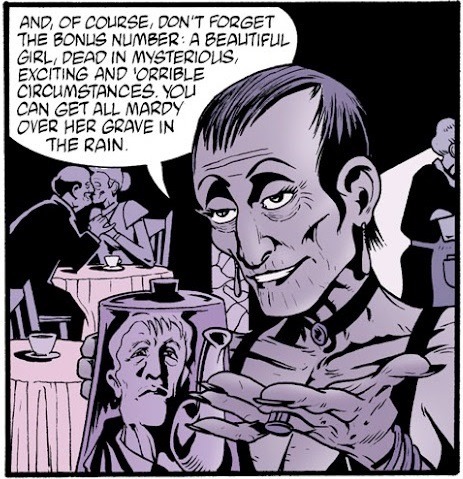
An excellent point, now ADD FEMALE CHARACTERS jfc
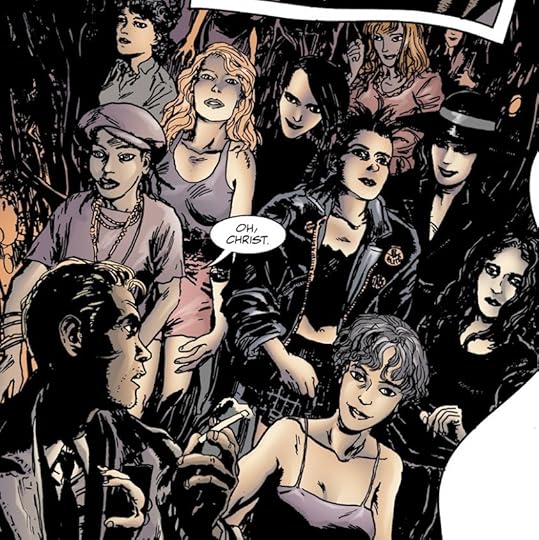
I guess I should have stipulated that they should be alive
An excellent point, now ADD FEMALE CHARACTERS jfc
I guess I should have stipulated that they should be alive

October 19, 2015
Overall rating: 3.5*
Haunted: 3*
Locked: 3.5*
The Crib: 2*
Setting Sun: 4.5*
One Last Song: 4*
Telling Tales: 3.5*
Ashes and Honey: 4*
A lot of people are not going to like this volume. I can't say why, it's just a gut feeling. Not that it's bad, I mean, it's Warren Ellis writing, but it's just a bit of a deviation from what we've come to expect of Constantine stories. First off, there's not that usual JC flair, no manipulation, and general nihilism. Warren's JC is very political, not in the sense that he's holding a placard and lamenting about the good ole Thatcher days, but most of the issues here, he has his feet firm in one belief or another. It's not the usual ambivalent self, the JC that can swing both ways, or no ways, just for the help of it.
Haunted, the main story was a tad too long, and a bit anticlimactic. The other one-shots were exciting for the most part, but lacked a certain cohesiveness that moat JC one shots had.
Haunted: 3*
Locked: 3.5*
The Crib: 2*
Setting Sun: 4.5*
One Last Song: 4*
Telling Tales: 3.5*
Ashes and Honey: 4*
A lot of people are not going to like this volume. I can't say why, it's just a gut feeling. Not that it's bad, I mean, it's Warren Ellis writing, but it's just a bit of a deviation from what we've come to expect of Constantine stories. First off, there's not that usual JC flair, no manipulation, and general nihilism. Warren's JC is very political, not in the sense that he's holding a placard and lamenting about the good ole Thatcher days, but most of the issues here, he has his feet firm in one belief or another. It's not the usual ambivalent self, the JC that can swing both ways, or no ways, just for the help of it.
Haunted, the main story was a tad too long, and a bit anticlimactic. The other one-shots were exciting for the most part, but lacked a certain cohesiveness that moat JC one shots had.

October 22, 2018
Good ol’ Constantine back at it. A few gems from Warren Ellis and company. The cheeky bastard never backs down.

January 19, 2020
The darker the better.

August 9, 2020
Hellblazer trade 13 has been one of the darkest, bleakest reads in recent memory. And its a pretty damn fine read, but first of all i like to adress the writer. I am well aware of the controversy surrounding Warren Ellis, and have been hearing all kinds of outcries to cancel his ass, and still i am here reading a comic of his. While i do think we need to talk and give attention to things like this, i dont know if not reading a writers work is the answer. I did decide to read this book because i am reading Hellblazer in order for the first time ever. And i have not just read 134 issues to just skip this one, i just cant. I also have already bought it way before all this stuff came to light. But still its shit to see creators who's work you love are being tarnished by stupid shit they do. But on to the story, these tales are dark. Very dark. Ranging from school shootings, tales about a japanese man who tortured people in World War ll a madman who has been killing people in his room for 20 years and the antichrist. Did i already say these stories were dark? The main story is John Constantine looking for the killer of one of his ex girl friends, who died horribly. Ellis his prose fits Hellblazer very well, but he and Vertigo split when Vertigo axed the school shooting story (the Columbine shooting just happened) and they replaced them with Darko Macan, who has a couple very lackluster stories. The artwork is very good with artists like John Higgins, Phil Jimenez, Paul Pope and Tim Bradsheet who's Punisher covers i have been enjoying since forever, i think this is actually the first real comic work i have seen from him. Hellblazer greats like Paul Jenkins and Garth Ennis have a story here aswell in this very mixed bag of great and mediocre, and the trade ends with a prose story of Dave Gibbons, making this collection a very weird but good mix indeed. I would give this trade 4 stars, but the Darko Macan stories are just a real snoozefest so 3.5 stars it is for me.

November 14, 2016
Most of the short stories in this volume are really boring or just plain bad. It tried hard to display gore but for no particular reasons other than to add visual flavour to the plot. I hated however story had a different artist with varied quality of drawing, however the stories are all equally bad.

February 8, 2019
This was probably the darkest volume so far, and totally not what I expected from Warren Ellis.
July 14, 2025
This collection contains Warren Ellis’s full run (134-143), including the infamous final issue, Shoot, which went unpublished for a few years.
Ellis’s run is worth the read. It’s short and it’s very dark, to many, unnecessarily so, but it did introduce some characters that would pop up again in later runs.
This also has two issues written by Darko Macan, which I struggled to follow, and some fun shorts by Paul Jenkins and Paul Pope, Garth Ennis, and Steve Dillon.
If this collection is still out of print, the two older and, at the time of writing, cheaper collections, Haunted and Setting Sun contain all of the essentials. This one is more so for the completionists.
Ellis’s run is worth the read. It’s short and it’s very dark, to many, unnecessarily so, but it did introduce some characters that would pop up again in later runs.
This also has two issues written by Darko Macan, which I struggled to follow, and some fun shorts by Paul Jenkins and Paul Pope, Garth Ennis, and Steve Dillon.
If this collection is still out of print, the two older and, at the time of writing, cheaper collections, Haunted and Setting Sun contain all of the essentials. This one is more so for the completionists.

July 8, 2018
British Dialogue Level: 1000%
Hellblazer Issues #134-145
AIGHT SO after reading Original Sins, The Devil You Know, and Dangerous Habits it only made sense of course to read volume 13! It really doesn't. But I had heard that Haunted was one of Hellblazer's best stories and that you get all of Warren Ellis' run in this one book. So $27 went *POOF!* and the book arrived. In terms of the namesake of this entire book. I really really liked it. It was a much more violent and meaner feeling Hellblazer book than the others I have read. It also perfectly examines how fucked up London is besides its politics. The rest of the book was questionable to me though and I will get into that.
Haunted is a very unique story with a simple plot. John wants revenge on his ex's killer. But the journey is a lot different than I would have thought. First of all, this story is extremely subtle and sometimes confusing. If you aren't soaking up all the little details you're kinda fucked because I was admittedly confused for a long ass time. But once I put everything together I appreciated it. The art in Haunted is a lot different from the styles of David Lloyd, William Simpson, and Steve Dillon. So it took me at least half the book to get used to it and appreciate it. It is great art. Very clean is the word I would use. Something I love about this story is how John is handling this situation. I love how he isn't moping and crying over his loss. He is just angry but likes the anger because all he wants to do is fuck up the person who murdered Isabel. There are so many little details about things that are happening in London that make it feel a lot richer. And by richer I mean substance. For example, there is one scene dedicated to a certain symbol on a cigarette lighter and what that symbol means. I was about to just brush past it but I took a second to appreciate that little thing because Warren Ellis actually made London feel real with that scene. I dunno maybe I'm just rambling but you'll understand when you read it. John also tells tales about the different parts of London and the history behind them. It's just like what Scott Snyder did in his New 52 Batman run for Gotham city. These stories while all gruesome as hell, are important because it also lets us the readers know John Constantine's place in London among everything else. The ending is also great but again confusing to me. There is a character named Watford. I don't really understand his part in the ending. I get what happened just not how. The whole story is John trying to find the murderer. Why didn't he just go to Watford first instead of a bunch of other people?
There is what I believe a twist that happens near the end of the book as well. I think. If it wasn't then I was just confused. It got me anyway. And I feel like this twist could only really happen in a book. I can't see this happening in a movie or video game unless the shots were really clever and dim lighted. The ending is satisfying and ends with a really great line. Oh and one more thing. There is an amazing scene with a train, Phenomenal. Letter Grade: (A-)
The rest of this book are the issues for Hellblazer that Ellis wrote before he stepped down. He had the shortest run on Hellblazer. And if I'm being completely honest I didn't love any of the stories after Haunted. The best of the bunch were Shoot and Ashes and Honey Parts 1 and 2. The reason I didn't exactly like these stories were because they all hit the same note for me. Except for those 3 issues I just mentioned. Somebody tells a really fucked up story and John gives his smart-ass opinion on them, or John tells a story to us the readers and other characters. This wasn't interesting because that's all they were to me. Fucked up story time with no other plot behind it. John never gets involved in an actual plot and has no barring on the issue. Shoot was good but when it finally hooked me fully the issue ended. And I still don't understand the whole meaning behind that issue. Ashes and Honey Parts 1 and 2 was a very odd story that dealt with John helping refugee family. These 2 issues were semi-competently written, even if I was confused for a LOT OF IT. I dunno. Am I just an idiot or what? In particular, there is a page where John is trying to get through a gate and eventually gets through. But I don't know how. I never saw the gate open. The story does switch back and forth between present and past. I got mixed up so much and at one point lost track of who was doing what. AHHHH!
In the end, I enjoyed the hell out of Haunted. The rest of the book just didn't do it for me. All the art is fantastic though. No complaints there. If you are looking for a very dark and toothy collection of Hellblazer stories, this is your gold. Especially if you like Warren Ellis.
Overall Letter Grade: (B+)
Hellblazer Issues #134-145
AIGHT SO after reading Original Sins, The Devil You Know, and Dangerous Habits it only made sense of course to read volume 13! It really doesn't. But I had heard that Haunted was one of Hellblazer's best stories and that you get all of Warren Ellis' run in this one book. So $27 went *POOF!* and the book arrived. In terms of the namesake of this entire book. I really really liked it. It was a much more violent and meaner feeling Hellblazer book than the others I have read. It also perfectly examines how fucked up London is besides its politics. The rest of the book was questionable to me though and I will get into that.
Haunted is a very unique story with a simple plot. John wants revenge on his ex's killer. But the journey is a lot different than I would have thought. First of all, this story is extremely subtle and sometimes confusing. If you aren't soaking up all the little details you're kinda fucked because I was admittedly confused for a long ass time. But once I put everything together I appreciated it. The art in Haunted is a lot different from the styles of David Lloyd, William Simpson, and Steve Dillon. So it took me at least half the book to get used to it and appreciate it. It is great art. Very clean is the word I would use. Something I love about this story is how John is handling this situation. I love how he isn't moping and crying over his loss. He is just angry but likes the anger because all he wants to do is fuck up the person who murdered Isabel. There are so many little details about things that are happening in London that make it feel a lot richer. And by richer I mean substance. For example, there is one scene dedicated to a certain symbol on a cigarette lighter and what that symbol means. I was about to just brush past it but I took a second to appreciate that little thing because Warren Ellis actually made London feel real with that scene. I dunno maybe I'm just rambling but you'll understand when you read it. John also tells tales about the different parts of London and the history behind them. It's just like what Scott Snyder did in his New 52 Batman run for Gotham city. These stories while all gruesome as hell, are important because it also lets us the readers know John Constantine's place in London among everything else. The ending is also great but again confusing to me. There is a character named Watford. I don't really understand his part in the ending. I get what happened just not how. The whole story is John trying to find the murderer. Why didn't he just go to Watford first instead of a bunch of other people?
There is what I believe a twist that happens near the end of the book as well. I think. If it wasn't then I was just confused. It got me anyway. And I feel like this twist could only really happen in a book. I can't see this happening in a movie or video game unless the shots were really clever and dim lighted. The ending is satisfying and ends with a really great line. Oh and one more thing. There is an amazing scene with a train, Phenomenal. Letter Grade: (A-)
The rest of this book are the issues for Hellblazer that Ellis wrote before he stepped down. He had the shortest run on Hellblazer. And if I'm being completely honest I didn't love any of the stories after Haunted. The best of the bunch were Shoot and Ashes and Honey Parts 1 and 2. The reason I didn't exactly like these stories were because they all hit the same note for me. Except for those 3 issues I just mentioned. Somebody tells a really fucked up story and John gives his smart-ass opinion on them, or John tells a story to us the readers and other characters. This wasn't interesting because that's all they were to me. Fucked up story time with no other plot behind it. John never gets involved in an actual plot and has no barring on the issue. Shoot was good but when it finally hooked me fully the issue ended. And I still don't understand the whole meaning behind that issue. Ashes and Honey Parts 1 and 2 was a very odd story that dealt with John helping refugee family. These 2 issues were semi-competently written, even if I was confused for a LOT OF IT. I dunno. Am I just an idiot or what? In particular, there is a page where John is trying to get through a gate and eventually gets through. But I don't know how. I never saw the gate open. The story does switch back and forth between present and past. I got mixed up so much and at one point lost track of who was doing what. AHHHH!
In the end, I enjoyed the hell out of Haunted. The rest of the book just didn't do it for me. All the art is fantastic though. No complaints there. If you are looking for a very dark and toothy collection of Hellblazer stories, this is your gold. Especially if you like Warren Ellis.
Overall Letter Grade: (B+)

May 13, 2016
Warning, not for the faint of heart.
Of course that applies to probably 80% of Hellblazer stories, but this volume especially so. With Warren Ellis at the head, there are some truly gruesome stories here, most grounded in the horribleness of humans as opposed to the usual demons and monsters John usually fights.
The 6 part Haunted story is essentially one long revenge fantasy as John deals with an upstart magician who killed an old girlfriend of his. It's grim, to say the least. But that's barely scratching the surface.
There's also a few one-shot stories like The Crib, which is a) gross and b) very clever, and Telling Tales is probably the lightest the stories in this volume get, and even then it's still pretty dark. It all culminates with the controversial Shoot story that was only published a few years back, but collected here since it was meant to originally be issue #141 of the series. This one isn't even that gross in terms of visuals, but the subject matter is extremely volatile, and the ending is a huge gut-punch. It was this story that ultimately caused Warren Ellis to leave Hellblazer, since his editors wouldn't let him run the story.
The back half of the book is a 2 issue fill-in by Darko Macan about some immigrants and resurrection, which is almost as dark in tone as the Ellis stories, and then three never-before-reprinted Christmas stories from Vertigo: Winter's Edge which are told by previous writers Paul Jenkins and Garth Ennis, and the esteemed Dave Gibbons whose prose story is a fun, lighthearted way to end probably the darkest volume of Hellblazer yet.
Of course that applies to probably 80% of Hellblazer stories, but this volume especially so. With Warren Ellis at the head, there are some truly gruesome stories here, most grounded in the horribleness of humans as opposed to the usual demons and monsters John usually fights.
The 6 part Haunted story is essentially one long revenge fantasy as John deals with an upstart magician who killed an old girlfriend of his. It's grim, to say the least. But that's barely scratching the surface.
There's also a few one-shot stories like The Crib, which is a) gross and b) very clever, and Telling Tales is probably the lightest the stories in this volume get, and even then it's still pretty dark. It all culminates with the controversial Shoot story that was only published a few years back, but collected here since it was meant to originally be issue #141 of the series. This one isn't even that gross in terms of visuals, but the subject matter is extremely volatile, and the ending is a huge gut-punch. It was this story that ultimately caused Warren Ellis to leave Hellblazer, since his editors wouldn't let him run the story.
The back half of the book is a 2 issue fill-in by Darko Macan about some immigrants and resurrection, which is almost as dark in tone as the Ellis stories, and then three never-before-reprinted Christmas stories from Vertigo: Winter's Edge which are told by previous writers Paul Jenkins and Garth Ennis, and the esteemed Dave Gibbons whose prose story is a fun, lighthearted way to end probably the darkest volume of Hellblazer yet.

May 20, 2020
Man, what a loss it is that we didn't get more Ellis writing Hellblazer. They are perfect for each other. For the first time since Jamie Delano, or, hell, maybe even Alan Moore's Swamp Thing run, John Constantine is dealing with genuine horror.
Yes, Ennis dealt a lot with demons and devils and the odd ghost. Paul Jenkins as well. But those stories were never really about horror. They were high-concept con artist stories, where Constantine and his cohorts never really feel frightened of anything going on, and therefore, neither do you, the reader. Ellis brought it back to its roots, though, and boy did he nail it.
Every story Ellis wrote for this title was a visceral, punch-you-in-the-gut story about a societal ill, framed solidly around a genuine horror story. It's the most prescient and readable Hellblazer I've come across yet, and a lot of that is down to Ellis's typical ability to let the art do more of the talking than the words. These stories about ghosts and serial killers and fear of the unknown and the inherent violence of humanity, and Ellis really lets them breathe on the page. I read this entire volume in about an hour because I was just so taken with everything Ellis had to say in it. I feel safe to say that, if given the opportunity, Ellis would've been the greatest Hellblazer writer of them all.
However, this wasn't to be. Around the time of Columbine, Ellis wrote the smart, affective story "Shoot," about school shootings in American and the unbelievable horror of children faced with living in a world that allows this kind of thing to happen. It is by no means exploitative, and is in fact one of the best stories in this collection. At the time, though, Vertigo got cold feet and pulled the issue before publication, fearing a public backlash (despite some early good reviews). This led to a fight with Ellis, who was trying to say something about the issue with this comic, and when they refused to publish, he quit the title altogether. That might seem kind of dramatic, but I can understand it. If you pour your heart and soul into trying to say something about a horrible thing beginning to rear its head in the world, and the publisher won't let you because they're scared, it really seems like being stabbed in the back.
So, with that, Hellblazer lost Ellis. He was replaced at first by Darko Macan, whose story in this volume is lackluster to say the least. Brian Azzarello came along next, whose run I'm getting into soon, but I think it's still a bummer to see just how great this series could've been with a writer like Ellis at the helm. Oh well. At least we got a ton of other great stuff out of the guy instead.
Yes, Ennis dealt a lot with demons and devils and the odd ghost. Paul Jenkins as well. But those stories were never really about horror. They were high-concept con artist stories, where Constantine and his cohorts never really feel frightened of anything going on, and therefore, neither do you, the reader. Ellis brought it back to its roots, though, and boy did he nail it.
Every story Ellis wrote for this title was a visceral, punch-you-in-the-gut story about a societal ill, framed solidly around a genuine horror story. It's the most prescient and readable Hellblazer I've come across yet, and a lot of that is down to Ellis's typical ability to let the art do more of the talking than the words. These stories about ghosts and serial killers and fear of the unknown and the inherent violence of humanity, and Ellis really lets them breathe on the page. I read this entire volume in about an hour because I was just so taken with everything Ellis had to say in it. I feel safe to say that, if given the opportunity, Ellis would've been the greatest Hellblazer writer of them all.
However, this wasn't to be. Around the time of Columbine, Ellis wrote the smart, affective story "Shoot," about school shootings in American and the unbelievable horror of children faced with living in a world that allows this kind of thing to happen. It is by no means exploitative, and is in fact one of the best stories in this collection. At the time, though, Vertigo got cold feet and pulled the issue before publication, fearing a public backlash (despite some early good reviews). This led to a fight with Ellis, who was trying to say something about the issue with this comic, and when they refused to publish, he quit the title altogether. That might seem kind of dramatic, but I can understand it. If you pour your heart and soul into trying to say something about a horrible thing beginning to rear its head in the world, and the publisher won't let you because they're scared, it really seems like being stabbed in the back.
So, with that, Hellblazer lost Ellis. He was replaced at first by Darko Macan, whose story in this volume is lackluster to say the least. Brian Azzarello came along next, whose run I'm getting into soon, but I think it's still a bummer to see just how great this series could've been with a writer like Ellis at the helm. Oh well. At least we got a ton of other great stuff out of the guy instead.

August 3, 2017
I've been working through an era of Hellblazer I hadn't explored before, starting with Mike Carey and then working backwards through Ennis' Son of Man and this volume, which collectively form the narrative foundation of Carey's run. More specifically, the main attraction here -- the 6-part "Haunted" -- provides much of the background cast that Carey pulls from, way down in Vol. 16. But because these are the overstuffed reprint editions, this new collection contains not only "Haunted," but a scattering of short stories from Ellis and other authors.
Ellis' stories are spiritually connected in that, while they do contain magic, they are mostly about very real terrible people whose "magic" is usually second fiddle to their loathesomeness as human beings. In this, Ellis' run is air-suckingly bleak. He uses Constantine as a mouthpiece for his own bitterness, and London is basically Spider Jerusalem's City with more specific geography. These stories might as well be cast-off Transmetropolitan plots, as they are all about a misanthropic hero yelling at the audience and giving comeuppances to horrible people. Ellis' style is a little one-note, but his ability to portray nihilism is not, and the one-and-done stories in particular are impressively bracing.
Less impressive is the fill-in work from Darko Macan (whose off-balance two-parter doesn't really make a lot of sense), as well as a trio of Xmas-themed stories from past writers. Since the reprint editions of Hellblazer are meant to be in chronological order I'm not really sure why all these holiday stories are here, especially since they're so short that that probably could have fit pretty easily in the collections where they should have been sequenced.
I think it's interesting that Carey chose to mine so heavily from Ellis' "Haunted" storyline, as there's a full two-year arc from Brian Azzarello that separates Carey and Ellis. But I do think Ellis is worth reading both for backstory, and because the stories collected here are so intensely grim -- even for Hellblazer.
Ellis' stories are spiritually connected in that, while they do contain magic, they are mostly about very real terrible people whose "magic" is usually second fiddle to their loathesomeness as human beings. In this, Ellis' run is air-suckingly bleak. He uses Constantine as a mouthpiece for his own bitterness, and London is basically Spider Jerusalem's City with more specific geography. These stories might as well be cast-off Transmetropolitan plots, as they are all about a misanthropic hero yelling at the audience and giving comeuppances to horrible people. Ellis' style is a little one-note, but his ability to portray nihilism is not, and the one-and-done stories in particular are impressively bracing.
Less impressive is the fill-in work from Darko Macan (whose off-balance two-parter doesn't really make a lot of sense), as well as a trio of Xmas-themed stories from past writers. Since the reprint editions of Hellblazer are meant to be in chronological order I'm not really sure why all these holiday stories are here, especially since they're so short that that probably could have fit pretty easily in the collections where they should have been sequenced.
I think it's interesting that Carey chose to mine so heavily from Ellis' "Haunted" storyline, as there's a full two-year arc from Brian Azzarello that separates Carey and Ellis. But I do think Ellis is worth reading both for backstory, and because the stories collected here are so intensely grim -- even for Hellblazer.
September 24, 2026
I always find it a little hard to give these books a star rating, especially when this issue contains 4 different writer's takes on John.
It does contain the entire run of Ellis issues which I think focused on some interesting parts of John's character (what it means to be a magician, what is magic, what if he's involved in trying to solve more real crimes) but it was just consistently gory in a very uninspired way. Like every contained story revolved around brutal murder.
Outside of that, I enjoyed the three solo stories quite a bit - clearly Ennis had more restraint than with his previous return. It was nice to get some introspection, and Ashes & Honey was a really interesting little story.
I did enjoy this, but I can never tell if that's because its Hellblazer and I just like Hellblazer.
It does contain the entire run of Ellis issues which I think focused on some interesting parts of John's character (what it means to be a magician, what is magic, what if he's involved in trying to solve more real crimes) but it was just consistently gory in a very uninspired way. Like every contained story revolved around brutal murder.
Outside of that, I enjoyed the three solo stories quite a bit - clearly Ennis had more restraint than with his previous return. It was nice to get some introspection, and Ashes & Honey was a really interesting little story.
I did enjoy this, but I can never tell if that's because its Hellblazer and I just like Hellblazer.

July 21, 2018
This is a pretty solid Hellblazer collection. The first story, "Haunted" by Warren Ellis, is pretty classic -- John finds out that an ex has been grotesquely murdered, and her ghost is hanging around, so he figures she needs him to get to the bottom of it. Or is that just what he needs? I love this for the introduction of Map, a magus who in some strange way embodies London. There are a number of really good one-offs and short stories in this volume, as well. Frank Teran's art for "Locked" is fantastic, and Darko Macau's story "Ashes and Honey" showcases Constantine in a rare helpful mood. This collection also includes Ellis's controversial "Shoot" one-off, which explores school shootings.

September 9, 2026
Good but really fucking depressing at times. Easily the best story is the first one, which is a 6 part series story that gets really dark the further you get into that murder mystery and what happened to her. This was the most entertaining despite the subject matter. The rest of the stories are just mostly one shots. There's the school shooting one but I didn't like how it ended. Yeah overall besides maybe the Japanese War story veteran one the rest was just okay.
Hellblazer has been a bit of a bumpy ride. Outside of Ennis, most been just decent or good. Few duds too sadly.
Hellblazer has been a bit of a bumpy ride. Outside of Ennis, most been just decent or good. Few duds too sadly.

February 6, 2025
A brilliantly twisted (albeit very dark) return to form for the series under Warren Ellis’ run - though I must admit some elements of the stories gathered in this volume seem to go out of their way to be ‘edgy’ and grim, and it’s these instances that miss their mark (for me at least).

July 8, 2017
It really is a shame Warren Ellis didn't stick around longer as the writer of Hellblazer. He only did one multi-part story and a handful of one-offs, but I think you'll find most fans agree they are some of the very best Hellblazer stories anyone ever did, and his agenda as a writer was unique and worthwhile. But circumstances I'll get into later led to him leaving the gig much earlier than planned. This volume, "Haunted", contains the entirely of Ellis' work with John Constantine.
Spoilers follow, as per usual.
It starts with the title story, "Haunted", in which Constantine learns of the brutal murder of a former girlfriend, Isabelle, and is driven to investigate what happened to her. With the help of a bent cop called Watford, Constantine learns that Isabelle had become the "scarlet woman" of an up-and-coming mage named Joshua Wright. Wright had abused and defiled Isabelle horrendously in the name of sex magick, a la Aleister Crowley, and when she was no longer of any use to him, slaughtered her.
Learning that Constantine is on him, Wright sends out a couple thugs to work Constantine over brutally, but even laid up our man John has means to get things done and mess with Wright's head. Upon recovering sometime later, Constantine sets in motion his plan for revenge: he and Watford snatch Wright up, pump him full of blotter acid, and leave him in the morgue drawer with Isabelle's bloated corpse. Nasty.
Last we see Wright, he's stumbling through the streets of London, naked and covered in shit, babbling out of his head. And Isabelle's ghost, whom Constantine keeps seeing in a playground (the last place she was happy, before she met Wright OR Constantine) is led off by the hand into a peaceful death.
The art in this one is by John Higgins, who continues from the Garth Ennis story in the previous volume, and the more serious nature of "Haunted" fits his style considerably better.
This really is a great story, outlining the very dark world Constantine inhabits, and it shows us how truly vengeful and nasty he can be when pushed. Also, Ellis throughout gives us very insightful meditations on the nature of London, its history, its ghosts both real and metaphorical, and makes us really feel like London is an actual character in the story. He also introduced a handful of very memorable characters in the above-mentioned bent cop Watford, the aging magician out of another era Clarice, and the mystical Map, who surveys his magik "kingdom" from the vast tunnels of the Underground. Many years later, Mike Carey would bring these characters back in his excellent run.
"Haunted" is a hard act to follow, but Ellis doesn't miss a step after that with the set of one-offs.
"Locked", with creepy, grimy art by Frank Teran, finds Constantine confronting a madman who has been murdering people in his room for twenty years, leaving the room psychically scarred, so that anyone who enters is driven to murderous impulses. Constantine figures out the madman's death wish and drags him out to face justice.
"The Crib", with pseudo-realistic art by Tim Bradstreet (normally Bradstreet does only covers, and this is the first interior work I can remember him doing since, geez... I'm not sure. I feel like he did some interior work before? I could be wrong). Anyway, the story is simple: this crazed writer has what he believes is a box containing the fetus of the anti-Christ in it, embedded in his chest, where the malignant little fetus pisses into his veins and grants him evil power. The writer has been on a murder spree. Constantine shows up and "corrects" him; it's an empty box of corn flakes with a rat inside it, taped to his chest, and the homicidal writer seemingly drops dead when Constantine rips it from his chest.
"Setting Sun", with very manga-inspired art by Javier Pulido, has Constantine confronting the ghost of a Japanese man who committed atrocities during WWII, and needs the same evil things done to him before he can move on.
It just occurred to me that those three stories form a kind of trilogy, with Constantine engaging in a one-on-one for the entire issue before getting it sorted.
There's a very brief meditation on Constantine's former relationships then, drawn by James Romberger, and then "Telling Tales", pencilled by the very dynamic Marcelo Frusin, who would later, during Brian Azzarello's run, become the regular artist for a very decent stretch. This one is basically just Constantine telling bullshit stories about London's secret occult history to a paranoid journo, and it's a lot of fun.
And then we come to "Shoot," the story that prematurely ended Ellis' run. Not because it was a bad story, on the contrary, it's goddamn great, but because of unfortunate circumstances. In the States, a federal investigator is trying to get to the bottom of a rash of school shootings, and she notices Constantine seems to be present at all of them. He shows up in her office, urging her to look at the tapes deeper, and reveals to her a deeper, darker, sadder story than anyone could have imagined. Excellent art by comics legend Phil Jimenez lends it a lot of weight too. It's a very powerful tale, made even stronger by the coincidental shootings at Columbine that happened shortly before the issue went to press. The powers-that-be at DC/Vertigo opted out of publishing the issue, feeling it would be insensitive. Right or wrong (and I can kinda see both sides), Warren Ellis quit over it.
Left in a lurch, Vertigo nabbed a guy named Darko Macan to write the next two issues, a tale called "Ashes and Honey", with art by Gary Erskine, and I'm sorry to say it's not very good. Then there's a very short tale from "Winter's Edge," written by good ole' Paul Jenkins, with art by Paul Pope, whom I really like, that takes place sorta between the scenes of when Constantine was visiting Dani's family in New York ("Up the Down Staircase", I think that story was called?). From the next volume of "Winter's Edge," comes a Garth Ennis story, with art by Glyn Dillon, in which Constantine sits in a bar and contemplates some people he knew who are now dead, which is something Ennis likes to have Constantine do. "Don't get sentimental, Constantine," our hero says to himself. "It really doesn't suit you." No, it doesn't, but Garth Ennis still does sentimental every single time. And finally, the volume wraps up with a Christmas themed prose piece by Dave Gibbons, who is a better artist than a writer.
But anyway. Despite the things tacked on at the end, this volume belongs to Warren Ellis. Over-all, his Hellblazer feels like the beginning of... I dunno... the modern era of the character? He started and ended on the cusp of the 21st century, and there's something about these stories that feel like a new, dark beginning for Constantine. You definitely don't need to have read any previous Hellblazer stories to appreciate this stuff, as it makes no references I can recall to anything that happened before it. I would really love to have seen what Ellis had in store for Constantine, but alas, I reckon we'll never know.
Spoilers follow, as per usual.
It starts with the title story, "Haunted", in which Constantine learns of the brutal murder of a former girlfriend, Isabelle, and is driven to investigate what happened to her. With the help of a bent cop called Watford, Constantine learns that Isabelle had become the "scarlet woman" of an up-and-coming mage named Joshua Wright. Wright had abused and defiled Isabelle horrendously in the name of sex magick, a la Aleister Crowley, and when she was no longer of any use to him, slaughtered her.
Learning that Constantine is on him, Wright sends out a couple thugs to work Constantine over brutally, but even laid up our man John has means to get things done and mess with Wright's head. Upon recovering sometime later, Constantine sets in motion his plan for revenge: he and Watford snatch Wright up, pump him full of blotter acid, and leave him in the morgue drawer with Isabelle's bloated corpse. Nasty.
Last we see Wright, he's stumbling through the streets of London, naked and covered in shit, babbling out of his head. And Isabelle's ghost, whom Constantine keeps seeing in a playground (the last place she was happy, before she met Wright OR Constantine) is led off by the hand into a peaceful death.
The art in this one is by John Higgins, who continues from the Garth Ennis story in the previous volume, and the more serious nature of "Haunted" fits his style considerably better.
This really is a great story, outlining the very dark world Constantine inhabits, and it shows us how truly vengeful and nasty he can be when pushed. Also, Ellis throughout gives us very insightful meditations on the nature of London, its history, its ghosts both real and metaphorical, and makes us really feel like London is an actual character in the story. He also introduced a handful of very memorable characters in the above-mentioned bent cop Watford, the aging magician out of another era Clarice, and the mystical Map, who surveys his magik "kingdom" from the vast tunnels of the Underground. Many years later, Mike Carey would bring these characters back in his excellent run.
"Haunted" is a hard act to follow, but Ellis doesn't miss a step after that with the set of one-offs.
"Locked", with creepy, grimy art by Frank Teran, finds Constantine confronting a madman who has been murdering people in his room for twenty years, leaving the room psychically scarred, so that anyone who enters is driven to murderous impulses. Constantine figures out the madman's death wish and drags him out to face justice.
"The Crib", with pseudo-realistic art by Tim Bradstreet (normally Bradstreet does only covers, and this is the first interior work I can remember him doing since, geez... I'm not sure. I feel like he did some interior work before? I could be wrong). Anyway, the story is simple: this crazed writer has what he believes is a box containing the fetus of the anti-Christ in it, embedded in his chest, where the malignant little fetus pisses into his veins and grants him evil power. The writer has been on a murder spree. Constantine shows up and "corrects" him; it's an empty box of corn flakes with a rat inside it, taped to his chest, and the homicidal writer seemingly drops dead when Constantine rips it from his chest.
"Setting Sun", with very manga-inspired art by Javier Pulido, has Constantine confronting the ghost of a Japanese man who committed atrocities during WWII, and needs the same evil things done to him before he can move on.
It just occurred to me that those three stories form a kind of trilogy, with Constantine engaging in a one-on-one for the entire issue before getting it sorted.
There's a very brief meditation on Constantine's former relationships then, drawn by James Romberger, and then "Telling Tales", pencilled by the very dynamic Marcelo Frusin, who would later, during Brian Azzarello's run, become the regular artist for a very decent stretch. This one is basically just Constantine telling bullshit stories about London's secret occult history to a paranoid journo, and it's a lot of fun.
And then we come to "Shoot," the story that prematurely ended Ellis' run. Not because it was a bad story, on the contrary, it's goddamn great, but because of unfortunate circumstances. In the States, a federal investigator is trying to get to the bottom of a rash of school shootings, and she notices Constantine seems to be present at all of them. He shows up in her office, urging her to look at the tapes deeper, and reveals to her a deeper, darker, sadder story than anyone could have imagined. Excellent art by comics legend Phil Jimenez lends it a lot of weight too. It's a very powerful tale, made even stronger by the coincidental shootings at Columbine that happened shortly before the issue went to press. The powers-that-be at DC/Vertigo opted out of publishing the issue, feeling it would be insensitive. Right or wrong (and I can kinda see both sides), Warren Ellis quit over it.
Left in a lurch, Vertigo nabbed a guy named Darko Macan to write the next two issues, a tale called "Ashes and Honey", with art by Gary Erskine, and I'm sorry to say it's not very good. Then there's a very short tale from "Winter's Edge," written by good ole' Paul Jenkins, with art by Paul Pope, whom I really like, that takes place sorta between the scenes of when Constantine was visiting Dani's family in New York ("Up the Down Staircase", I think that story was called?). From the next volume of "Winter's Edge," comes a Garth Ennis story, with art by Glyn Dillon, in which Constantine sits in a bar and contemplates some people he knew who are now dead, which is something Ennis likes to have Constantine do. "Don't get sentimental, Constantine," our hero says to himself. "It really doesn't suit you." No, it doesn't, but Garth Ennis still does sentimental every single time. And finally, the volume wraps up with a Christmas themed prose piece by Dave Gibbons, who is a better artist than a writer.
But anyway. Despite the things tacked on at the end, this volume belongs to Warren Ellis. Over-all, his Hellblazer feels like the beginning of... I dunno... the modern era of the character? He started and ended on the cusp of the 21st century, and there's something about these stories that feel like a new, dark beginning for Constantine. You definitely don't need to have read any previous Hellblazer stories to appreciate this stuff, as it makes no references I can recall to anything that happened before it. I would really love to have seen what Ellis had in store for Constantine, but alas, I reckon we'll never know.

May 17, 2016
I had been waiting for this particular volume of Hellblazer for a while since it contains stories by Warren Ellis one of my favourite writers of comic books. It was not what I expected but it did not disappoint. My short review is - gripping stories with the John Constantine I like.
My longer review - I guess what I was expecting was some of that clever Ellis story writing that is brimming with new ideas and interesting twists but (often) little character. His stories were actually fairly straight forward but with some nice character development. Over the different writers and many years you get a lot of different takes on Constantine's character. I like the one that has a bit of swagger (not mopey John) and uses his magic sparingly. It's not full on Dr. Strange magic, it is more like a whisper of magic used as an effective paint stroke when needed. Some writers use magic too much and others almost seem to forget John can do magic. Ellis got it just right for me. My one gripe with the first story arc "Haunted" is that the villain of the piece doesn't appear until the end and we never really get to know him...and the artist (whose talents are modest) drew him so much like Constantine it took a few pages before I realized it wasn't the case.
The other stories are more one shots or two shots (Ashes and Honey, written by another writer but a great story) and all were great. A lot more horror based (Locked and the Crib). My only complaint is that I didn't feel Ellis really let his imagination go like he usually does. But what we get are some very entertaining Constantine stories in the true spirit of the character. Very pleased with it, indeed.
My longer review - I guess what I was expecting was some of that clever Ellis story writing that is brimming with new ideas and interesting twists but (often) little character. His stories were actually fairly straight forward but with some nice character development. Over the different writers and many years you get a lot of different takes on Constantine's character. I like the one that has a bit of swagger (not mopey John) and uses his magic sparingly. It's not full on Dr. Strange magic, it is more like a whisper of magic used as an effective paint stroke when needed. Some writers use magic too much and others almost seem to forget John can do magic. Ellis got it just right for me. My one gripe with the first story arc "Haunted" is that the villain of the piece doesn't appear until the end and we never really get to know him...and the artist (whose talents are modest) drew him so much like Constantine it took a few pages before I realized it wasn't the case.
The other stories are more one shots or two shots (Ashes and Honey, written by another writer but a great story) and all were great. A lot more horror based (Locked and the Crib). My only complaint is that I didn't feel Ellis really let his imagination go like he usually does. But what we get are some very entertaining Constantine stories in the true spirit of the character. Very pleased with it, indeed.

June 20, 2017
Warren Ellis takes over to write the best volume since volume 7.
#134-139 Haunted 5/5
Constantine recognize a name in a tiny article about a murder. It brings back memories of better times and bitter mistakes. Okay, this gets graphic, but in description only. A lot of people have claimed this is disgusting for its own sake, and then I find they loved the last Ennis arc… I do not understand. There is nothing here that is any worse than anything Ennis wrote and had others depict (Look at the cover for #133!). Anyway, the difference is that the horrible descriptions and the brutality are balanced against the innocent purity. Ellis goes to extemes for contrast, and to show how much it takes to rouse Constantine out of his own bullshit. As or the graphic visuals of Clarice: the reader sees her Clarice’s battered face, a closeup of a tattoo with some blood dripping by it, a dream of her drugged out, a shot of the shoulders and face of her corpse, and a faraway shot of her having sex with a robed figure. The rest of the time we see only a happy, young ghost. Other than that, a few splattered goons that is more over-the-top than gory, a swollen face, and some cat brains round out the “horrible descriptions.” The most graphic parts come from the reader’s imagination, and I think what is shown and not shown is selected with more thought and taste than anything else in the series thus far. That said, if you’ve gotten this far in Hellblazer, you should be fine. I think the superb execution of what could have easily been a one-off revenge story helps flesh out the often savage Hellblazer world. I love Map, Sanjay, and Haine. I love the picturesque London being contrasted to its horrible history. This is why I read this series. The art by John Higgins remains a little cartoony, but he really makes it work. Pages 43 and 54-63 really show the visual storywork that sets this apart from anything in the previous volume. I will happily deal with something that gives me mental images like those from Se7en if the story quality remains anywhere near this high.
#140 Locked 4/5
This one is quite a bit more graphic than the last, but once again the savagery works and still isn’t anything outside what the Hellblazer series has offered before. Skippable, but definitely high quality.
#141 The Crib 2.5/5
This story gets needlessly complicated for what is essentially a weaker version of the issue 140. Tim Bradstreet, who's been doing the covers for awhile delivers this issue, but I've always found his character design for Constantine to be a little overtly devilish, and seeing more of it all at once rather thn in between stories really didn't help. It is definitely skippable.
#142 Setting Sun 1.5/5
I could see this one as needlessly graphic. A harsh story about pain and revenge with no sign of light or redemption. Skip it.
#142 One Last Love Song 3.5/5
Sappy, but in a good way. This is everything that issue #120 tried to be, but failed. That went big, this goes small. It's kind of the theme in this volume.
#143 Telling Tales 3/5
This one is definitely off-putting for most of the story, but I really liked the sting at the end. This is another world-building story that gets political, but only in a very weird way.
Vertigo Resurrected #1 Shoot 4/5
This one really seems like it's going to end up being a PSA, but it thankfully avoids that to deliver a more nuanced massage.
#144-145 Ashes & Honey 4/5
Another sentimental one, but I thought it balanced the sentimentality with the overtly anti-sentimental Constantine. I've always liked Constantine to be reluctantly good, and I think this delivers the right blend of easy and good that causes Constantine to act.
Vertigo: Winter’s Edge #1 Tell Me 4/5
The Sappiness contines as Paul Jenkins delivers one more tale that manages to recapture what is great about his one-offs. This one is really cheezy, and it belongs with the first story arc from the previous volume, "Up the Down Staircase," since it occurs right around issue 121. It brings more frustration between Dani's family and Constantine that feels right since he seemed to really be more accepting than he usually would during that arc. It's a nice little addition.
Vertigo: Winter’s Edge #2 All Those Little Boys and Girls 3/5
Ennis is back. He still hates kids, but this time less so. Constantine reminises over drinks. It's light, but entertaining, and lacking a lot of his bitterness that I find distasteful.
Vertigo: Winter’s Edge #3 Another Bloody Christmas 2.5/5
Illustrated prose by Dave Gibbons, probably most famous as the artist of Watchmen. It didn't do much for me, but I think it could be the right mix of creepy and anti-holiday for someone else.
The biggest difference is that Ellis focuses on very human evils, so there aren't any of the big clashes that I've found end up more as whimpers than bangs. I also tend to like smaller, more personal stories, and Ellis delivers those in spades. The art this volume is also several noteches up from where we left it last time. Read this volume. In fact, except with Winter's Edge #1, you can pretty much read this wherever in the series after volume two.
#134-139 Haunted 5/5
Constantine recognize a name in a tiny article about a murder. It brings back memories of better times and bitter mistakes. Okay, this gets graphic, but in description only. A lot of people have claimed this is disgusting for its own sake, and then I find they loved the last Ennis arc… I do not understand. There is nothing here that is any worse than anything Ennis wrote and had others depict (Look at the cover for #133!). Anyway, the difference is that the horrible descriptions and the brutality are balanced against the innocent purity. Ellis goes to extemes for contrast, and to show how much it takes to rouse Constantine out of his own bullshit. As or the graphic visuals of Clarice: the reader sees her Clarice’s battered face, a closeup of a tattoo with some blood dripping by it, a dream of her drugged out, a shot of the shoulders and face of her corpse, and a faraway shot of her having sex with a robed figure. The rest of the time we see only a happy, young ghost. Other than that, a few splattered goons that is more over-the-top than gory, a swollen face, and some cat brains round out the “horrible descriptions.” The most graphic parts come from the reader’s imagination, and I think what is shown and not shown is selected with more thought and taste than anything else in the series thus far. That said, if you’ve gotten this far in Hellblazer, you should be fine. I think the superb execution of what could have easily been a one-off revenge story helps flesh out the often savage Hellblazer world. I love Map, Sanjay, and Haine. I love the picturesque London being contrasted to its horrible history. This is why I read this series. The art by John Higgins remains a little cartoony, but he really makes it work. Pages 43 and 54-63 really show the visual storywork that sets this apart from anything in the previous volume. I will happily deal with something that gives me mental images like those from Se7en if the story quality remains anywhere near this high.
#140 Locked 4/5
This one is quite a bit more graphic than the last, but once again the savagery works and still isn’t anything outside what the Hellblazer series has offered before. Skippable, but definitely high quality.
#141 The Crib 2.5/5
This story gets needlessly complicated for what is essentially a weaker version of the issue 140. Tim Bradstreet, who's been doing the covers for awhile delivers this issue, but I've always found his character design for Constantine to be a little overtly devilish, and seeing more of it all at once rather thn in between stories really didn't help. It is definitely skippable.
#142 Setting Sun 1.5/5
I could see this one as needlessly graphic. A harsh story about pain and revenge with no sign of light or redemption. Skip it.
#142 One Last Love Song 3.5/5
Sappy, but in a good way. This is everything that issue #120 tried to be, but failed. That went big, this goes small. It's kind of the theme in this volume.
#143 Telling Tales 3/5
This one is definitely off-putting for most of the story, but I really liked the sting at the end. This is another world-building story that gets political, but only in a very weird way.
Vertigo Resurrected #1 Shoot 4/5
This one really seems like it's going to end up being a PSA, but it thankfully avoids that to deliver a more nuanced massage.
#144-145 Ashes & Honey 4/5
Another sentimental one, but I thought it balanced the sentimentality with the overtly anti-sentimental Constantine. I've always liked Constantine to be reluctantly good, and I think this delivers the right blend of easy and good that causes Constantine to act.
Vertigo: Winter’s Edge #1 Tell Me 4/5
The Sappiness contines as Paul Jenkins delivers one more tale that manages to recapture what is great about his one-offs. This one is really cheezy, and it belongs with the first story arc from the previous volume, "Up the Down Staircase," since it occurs right around issue 121. It brings more frustration between Dani's family and Constantine that feels right since he seemed to really be more accepting than he usually would during that arc. It's a nice little addition.
Vertigo: Winter’s Edge #2 All Those Little Boys and Girls 3/5
Ennis is back. He still hates kids, but this time less so. Constantine reminises over drinks. It's light, but entertaining, and lacking a lot of his bitterness that I find distasteful.
Vertigo: Winter’s Edge #3 Another Bloody Christmas 2.5/5
Illustrated prose by Dave Gibbons, probably most famous as the artist of Watchmen. It didn't do much for me, but I think it could be the right mix of creepy and anti-holiday for someone else.
The biggest difference is that Ellis focuses on very human evils, so there aren't any of the big clashes that I've found end up more as whimpers than bangs. I also tend to like smaller, more personal stories, and Ellis delivers those in spades. The art this volume is also several noteches up from where we left it last time. Read this volume. In fact, except with Winter's Edge #1, you can pretty much read this wherever in the series after volume two.

June 26, 2016
Most of the stories here are classic Hellblazer...the ones where you go to read a tale of that smug prat Constantine fighting the forces of evil from hell itself, but the sneaky bastard has you feeling all sentimental by the end. Good stuff.
March 2, 2017
By far my favorite Constantine collection. Haunted will be a favorite for years to come.

August 27, 2018
Excellent return to form after a few sloppy misses.

March 16, 2024
As much as I enjoyed the two Garth Ennis Hellblazer volumes that I read last month, I found myself wondering what the comic might be like if its tone were less satiric and steeped more in straightforward horror. But now, after reading this volume principally featuring stories by Warren Ellis (I always thought it was a little weird that the last names of two of the most preeminent comic writers of the 90s were so similar), I miss Ennis's sense of humor and versatility. The title story here is the six-part "Haunted", in which an old girlfriend's murder puts John Constantine on the trail of a Crowley wannabe (I guess there are a lot of them running around England). It's a neat idea for a villain, but we never get to know him very well because what Ellis is really interested in is the over-the-top vengeance John ultimately visits on him. A disappointingly straightforward story, I thought. "Haunted" takes up a little less than half the volume, followed by a string of one-shot stories, most of them also by Ellis, that I likewise found to be a pretty mixed bag. Some of them struck me as very weak and fragmentary, like "Shoot"- well-intentioned, I think, but John here resembles more the crusading journalist Spider Jerusalem of Ellis's Transmetropolitan series than the morally ambivalent prick he usually comes across as. "Locked", the immediate follow-up to "Haunted", features some truly awful monochromatic artwork and a story that's just as one-note, one of the volume's few in which Ellis really dwells on/relishes the physical details of torture, without a lot else going for it. I much preferred the playful "Telling Tales", in which John rather malevolently tells a gullible journalist about the secret history of the British royal family (it involves snake deities), punctuating the tale with an exclamation point the poor guy will probably remember the rest of his life. I also liked "The Crib", which read- somehow- like exactly what I imagined Hellblazer to be when I was a kid and freaked out by the Vertigo covers at the comic store, Hellblazer in particular. Here John plays a more ambivalent role again, vis-a-vis an amateur who's gotten in way over his head with black magic. In this case the obscurity of certain details of the story, the coldness of the artwork, and the terseness of the narration seemed a match for the inevitability of the dabbler's fate, and made the story all the more foreboding. But what I think I liked best in the volume overall was what Ellis got up to in some of the quieter digressions in "Haunted", a sense of London as a place of secret connections and occult lore, putting me in mind of Moore's From Hell and some of the Machen I've been reading lately. That atmosphere suggested a more elliptical and mysterious story than "Haunted" actually turned out to be.
It's a great cover, but I'm unlikely to own it in paperback anytime soon, because goddamn are these Hellblazer volumes expensive. This one seems to be going for $50 at the cheapest, which is not an outlier as far as the series goes (I saw a later Mike Carey-written volume priced at about $200), and so I found myself in this case doing something I've never particularly wanted to- reading a comic on a screen. It's not the 90s anymore.

August 13, 2024
The first Constantine volume that's actually embarrassing to read. Feels like the flavor of violation of good taste it's reaching for has shifted from horror and disenfranchised punk rock social commentary to reddity edgelord bullshit. Literal dead baby jokes as entire arcs, Constantine doing to-camera bits about how he deserves a medal for "shagging a lesbian." Absolutely abysmal. There's some bits of taste-to-the-wind maximalism that hit on the horror front (a guy his eyelids toenail-clippered off, some fun but squandered horror fantasy concepts like the mummified fetus of the dead antichrist and a possessed child mob boss) but overall I found this to be a fairly reprehensible entry in a property I have genuinely loved. Some real 8th grader who just learned about cussing and fucking energy. Makes me concerned I'm going to have to abandon my quest to 100% HELLBLAZER. Warren Ellis seems to be the culprit behind the most dire shit, and he's not on the next volume, and this was peak Dipshits Doing Bad Tarantino Impressions in pop culture, so maybe this is a unique low.
Structurally, it also suffers from feeling like it's trying to wedge in more backstory to a guy we already know a lot about. We're reminiscing about newly invented old girlfriends a lot, we're referring back to previous adventures a lot. It feels like a series that hasn't figured out what it's doing next. It's spinning wheels and inserting new stories into the rearview without a clear path forward, partially because this series has already had a bunch of really solid endings including things like defeating literal Satan and killing off all our main character's friends. Definitely hard to imagine where it goes from here. Hopefully: away from being like this.
Structurally, it also suffers from feeling like it's trying to wedge in more backstory to a guy we already know a lot about. We're reminiscing about newly invented old girlfriends a lot, we're referring back to previous adventures a lot. It feels like a series that hasn't figured out what it's doing next. It's spinning wheels and inserting new stories into the rearview without a clear path forward, partially because this series has already had a bunch of really solid endings including things like defeating literal Satan and killing off all our main character's friends. Definitely hard to imagine where it goes from here. Hopefully: away from being like this.

March 23, 2021
Even the cynical, seemingly hard-hearted John Constantine, blue-collar sorcerer extraordinaire, is capable of being maudlin now and then. During down times, when he’s not battling demons or evil wizards or trying to save the world, Constantine can be reflective.
In the thirteenth compilation volume of Hellblazer, “Haunted”, writer Warren Ellis takes over to write a a more ruminative Hellblazer tale, one in which Constantine is forced to examine something he hates: his past.
The six-issue series, “Haunted”, sees Constantine investigating the brutal murder of an ex-girlfriend named Isabel after reading about it in the paper. He is guilt-ridden due to the fact that he jilted her (as he is wont to do with his numerous lovers), and, as a consequence, she may have rushed into the arms of her killer.
While still very dark and gruesome, “Haunted” is less infatuated with the blood and gore that saturated previous issues and more interested in Constantine’s ruminations about the mistakes he’s made in life.
Indeed, the subsequent issues are stand-alone short stories in which Constantine acts as either a mere observer or unwilling participant in other people’s tragic lives (and deaths), the tragedy stemming from the realization that, sometimes, not even his powerful magic can help others or himself.
I liked this volume a lot, but I have come to find, as I get older, that I am less interested in superhero comics or comic book stories with panel-to-panel action/adventure and far more interested in the stories in which the only action that happens is in the characters’ heads.
In the thirteenth compilation volume of Hellblazer, “Haunted”, writer Warren Ellis takes over to write a a more ruminative Hellblazer tale, one in which Constantine is forced to examine something he hates: his past.
The six-issue series, “Haunted”, sees Constantine investigating the brutal murder of an ex-girlfriend named Isabel after reading about it in the paper. He is guilt-ridden due to the fact that he jilted her (as he is wont to do with his numerous lovers), and, as a consequence, she may have rushed into the arms of her killer.
While still very dark and gruesome, “Haunted” is less infatuated with the blood and gore that saturated previous issues and more interested in Constantine’s ruminations about the mistakes he’s made in life.
Indeed, the subsequent issues are stand-alone short stories in which Constantine acts as either a mere observer or unwilling participant in other people’s tragic lives (and deaths), the tragedy stemming from the realization that, sometimes, not even his powerful magic can help others or himself.
I liked this volume a lot, but I have come to find, as I get older, that I am less interested in superhero comics or comic book stories with panel-to-panel action/adventure and far more interested in the stories in which the only action that happens is in the characters’ heads.

December 10, 2020
Warren Ellis's abbrevriated run on Hellblazer is a solid set of issues but it lacks the character development and intriguing plots of the better Delano, Ennis, and Jenkins runs. It's better than all three of them at their worst, but it's not quite as good as any of them at their best.
I'm actually missing the last two issues of this collection, as I have the previous editions "Haunted" and "Setting Sun". "Haunted" is great. It's a long-form story about Constantine trying to solve and atone for the death of one of his exes. Very on brand. It reintroduces some characters from Delano's run, and seems to set the stage for a storyarc that we're never going to get.
"Setting Sun" is a series of one shots that basically amount to Constantine either downplaying or refuting magic's role in a story. It's an interesting premise for a book about a supernatural magician, and, like "Haunted", I imagine tihs was leading up to something fascinating. Alas, Ellis left the title after these collections.
While Ellis's storytelling is great, the art, particularly John Higgins's work on the "Haunted" storyarc have a refreshing use of whitespace, and serve almost as an illustrated prose novel as much as a graphic novel. Constantine (and, later, his deceased ex) spend a lot of time narratively telling instead of showing, but it fits really well in the story.
I think if you love Delano's, in particular, Hellblazer, you'll really enjoy Ellis's run.
I'm actually missing the last two issues of this collection, as I have the previous editions "Haunted" and "Setting Sun". "Haunted" is great. It's a long-form story about Constantine trying to solve and atone for the death of one of his exes. Very on brand. It reintroduces some characters from Delano's run, and seems to set the stage for a storyarc that we're never going to get.
"Setting Sun" is a series of one shots that basically amount to Constantine either downplaying or refuting magic's role in a story. It's an interesting premise for a book about a supernatural magician, and, like "Haunted", I imagine tihs was leading up to something fascinating. Alas, Ellis left the title after these collections.
While Ellis's storytelling is great, the art, particularly John Higgins's work on the "Haunted" storyarc have a refreshing use of whitespace, and serve almost as an illustrated prose novel as much as a graphic novel. Constantine (and, later, his deceased ex) spend a lot of time narratively telling instead of showing, but it fits really well in the story.
I think if you love Delano's, in particular, Hellblazer, you'll really enjoy Ellis's run.
Displaying 1 - 30 of 67 reviews