This 50th anniversary edition has been newly annotated by David Schmittgens and Bill Savage with explanations for everything from Chicago history to slang to what the Black Sox scandal was and why it mattered.
In this slender classic ... Algren tells us all we need to know about passion, heaven, hell. And a city. - From the introduction by Studs Terkel
Nelson Algren (1909 - 1981) won the National Book Award in 1950 for The Man with the Golden Arm. His other works include Walk on the Wild Side, and Conversations with Nelson Algren, the last available from the University of Chicago Press.
David Schmittgens teaches English at New Trier High School in Northfield, Illinois.
Bill Savage is a senior lecturer at Northwestern University and coeditor of the 50th Anniversary Critical Edition of The Man with the Golden Arm.
People note American writer Nelson Algren for his novels, including The Man with the Golden Arm (1949), about the pride and longings of impoverished people.
Born of Swedish-immigrant parents, Nelson Ahlgren Abraham moved at an early age to Chicago. At University of Illinois, he studied journalism. His experiences as a migrant worker during the Depression provided the material for his first Somebody in Boots (1935). Throughout life, Algren identified with the underdog. From 1936 to 1940, the high-point of left-wing ideas on the literary scene of the United States, he served as editor of the project in Illinois. After putting the finishing touches to his second, he in 1942 joined and enlisted for the war. Never Come Morning received universal acclaim and eventually sold more than a million copies.
A dark naturalist style of Algren passionately records the details of trapped urban existence with flashes of melancholy poetry. He characterizes the lowlife drifters, whores, junkies, and barflies of row. He records the bravado of their colloquial language and lays their predicament bare.
Chicago is called “the Windy City,” or “the City of the Big Shoulders”; and those popular nicknames for the city that was long the Second City of the United States of America speak to bigness, grandness. And yet Nelson Algren, a son of Chicago, sees his birthplace as a “city on the make” – a place where people are motivated by drives that are not grand, but rather petty and selfish. In his 1951 essay Chicago: City on the Make, Algren writes about his city with fury fueled by love.
Algren, who grew up on the South Side of Chicago under difficult circumstances, cultivated a no-nonsense literary style that complemented well his subject matter of poverty, broken lives, and social injustice. Ernest Hemingway famously said that no one should read Algren if they can’t take a punch. Novels like The Man with the Golden Arm (1949) and A Walk on the Wild Side (1956), with their uncompromising depictions of subject matter like prostitution and drug addiction, made quite an impression upon the staid, conservative American culture of the post-World War II era.
And Chicago: City on the Make scandalized Chicago boosters as much as the Algren novels mentioned above shocked Americans of the Ozzie and Harriet era. Algren and other Chicago writers, including Gwendolyn Brooks and Carl Sandburg, had been asked to write essays about the city for Holiday, a travel magazine that wanted to focus on the city of Chicago for its 1951 issue. Most of the authors published in that issue of the magazine wrote about Chicago in largely positive terms, as one might expect from essays written for a travel magazine. Algren, by contrast, wrote about Chicago the way he wrote about everything else – calling it as he saw it, setting forth his observations with nothing held back for the sake of gentility or delicate sensibilities.
Those editors for Holiday might initially have been hopeful when they read evocative passages of description like this passage that depicts a traveller’s approach to Chicago from the east: “Wheeling around the loop of the lake, coming at Chicago from east and south, the land by night lies under a battle-colored sky. Above the half-muffled beat of the monstrous forges between Gary and East Chicago [Indiana], the ceaseless signal-fires of the great refineries wave an all-night alarm” (p. 25).
But what quickly becomes apparent is that Algren sees Chicago as a city divided by differences in race, language, and culture, as when he writes that “The Near Northside, centering around the comical old humpty-dumpty water tower which survived the fire, is, for example, almost as different from the Near Northwest Side, just over the bridge, in manners, mores, vocations, and habits of speech, as Bronzeville is from Rogers Park” (p. 26). Any Chicagoan who knows these neighborhoods might be able to testify that, in some ways, not much has changed since 1951.
One of the most interesting parts of Chicago: City on the Make, for me, was “The Silver-Colored Yesterday.” Algren, as mentioned above. grew up on Chicago’s South Side, and he was a dedicated fan of White Sox baseball; his favorite player was second baseman “Swede” Risberg. But his family moved to the North Side, where he found himself surrounded by Cubs fans; and he was just 11 years old when the news broke regarding the “Black Sox” scandal. Eight White Sox players were accused of conspiring with gamblers to throw the 1919 World Series, and were banned from baseball for life.
As Algren puts it, “It wasn’t until a single sunless morning of early Indian summer that all my own gods proved me false….The Black Sox were the Reds of that October and mine was the guilt of association” (p. 36). Worse yet, the news coverage of the scandal indicated that “Swede” Risberg, Algren’s favorite player, was a ringleader of the conspiracy. Algren describes the pain of being interrogated by his Cub-fan friends, who brandished Algren’s own scorecard from a 1919 World Series game: “The moving finger stopped on Risberg’s sorrowful name: four times at bat without a hit, caught sleeping off second, and a wild peg to first. And I still pretended I hadn’t suspected a thing?” (p. 37)
The Black Sox scandal may have done much to forge Algren’s bleak worldview. Looking back, he concludes that “The Black Sox had played scapegoat for [gambler Arnold] Rothstein and I’d played the goat for The Swede….I guess that was one way of learning what Hustlertown, sooner or later, teaches all its sandlot sprouts: ‘Everybody’s out for The Buck. Even big-leaguers.’ Even Swede Risberg” (p. 39).
Here, we see where the title Chicago: City on the Make takes on its full significance. Algren sees a Chicago society where money changes everything – where, “When [Mayor] Big Bill Thompson put in the fix for [Al] Capone, he tied the town to the rackets for keeps” (p. 14). Whether it’s the 1919 World Series or the legal system’s treatment of a prominent gangster, the fix is always in. Those with money and power always have the system rigged in their favor. No wonder the people at Holiday magazine were not happy with what they were reading, back in the autumn of 1951.
Algren expresses throughout Chicago: City on the Make his sense that Chicago has lost something since the earlier days of the city’s great cultural vitality, the time of great intellects like Carl Sandburg and Clarence Darrow and Edna St. Vincent Millay and Edgar Lee Masters. “No giants live on Rush Street anymore….Thirty years later, we stand on the rim of a cultural Sahara with not a camel in sight” (pp. 53-54). Algren sees, in the Chicago of Cold War times, a place where people seek to fit in, rather than to stand out – choosing, out of fear, to blend in with the conformist mindset of their times: “That’s the sort of little loud talker we have in Chicago today. He isn’t a tough punk, he’s just a scared one” (p. 58).
This 60th-anniversary edition of Chicago: City on the Make, published by the University of Chicago Press, includes helpful annotations from David Schmittgens of Chicago’s St. Ignatius College Prep and Bill Savage of Northwestern University – and it is good that those annotations are there, because a reader who is not already familiar with Chicago history might be left cold by passages like one where Algren writes that “The jail where Parsons hung is gone, and the building from which Bonfield marched is no more. Nobody remembers the Globe on Desplaines, and only a lonely shaft remembers the four who died, no one ever understood fully why” (p. 75).
As Schmittgens and Savage helpfully explain, the passage is filled with references to the Haymarket affair of 1886, when a dynamite bomb was thrown at police officers who were trying to disperse a Haymarket Square gathering of workers who were protesting for an eight-hour day. “Parsons” is Albert Parsons, a radical leader who was one of four people convicted of conspiracy and executed by hanging. John Bonfield was a police inspector who commanded the crowd of protesting workers to disperse, just before the bomb was thrown. The “lonely shaft” is the Haymarket Martyrs’ Monument that stands today at Forest Home Cemetery in suburban Forest Park. Without this annotative detail, Algren’s words might not have much meaning for readers who don’t know this history.
What should stand out from this essay, regardless of one's familiarity with the fine points of Chicago history, is Algren’s sympathy for the ordinary working person, along with his abiding belief that ordinary, struggling people are always being crushed by wealthy and powerful people who don’t have to play by the same rules that they enforce against the poor and downtrodden. These beliefs come forth with particular force in an afterword that Algren added for a new edition of Chicago: City on the Make that was published in book form in 1961.
In this afterword, Algren focuses with particular disdain on the city’s prim, puritanical media establishment, skewering the hypocrisy that he sees in the way the city’s newspapers cover issues like prostitution:
Every time a girl is made in a raid we get a full description of her: name, age, address, and place of employment. What I can’t figure out is, what was she doing in that room that was so awful if there wasn’t somebody just as awful helping her to do something just as awful? If there was a pair of pants on the bed-post, where is the spendthrift who walked into the room inside of them? Are you sure we’re not discriminating here? Why isn’t he entitled to get his name in the paper and a ride downtown? Why don’t somebody give him a chance to stand up in front of a judge and get fined a hundred dollars or fifty days in County? …If this is a true democracy, why doesn’t he have the same right as any other second-class citizen? It looks like a businessman don’t stand a chance in this country anymore. (p. 100)
Algren’s satire is devastating here, and it should be. Chicago’s, and American society’s, lurid and leering fascination with the “forbidden-ness” of sex is on full display here. The woman who is engaging in sex work in order to survive – poor, uneducated, and alone, by all odds – is fined, imprisoned, and publicly shamed. Meanwhile, her male client – who could be a physician, an attorney, a minister, a public official, a business executive, a pillar of Chicago society – remains respectable, safely anonymous, free, and able to visit another sex worker when it suits him. Has any of that really changed much since 1961?
Algren also uses the afterword to reaffirm his conviction that the Chicago that had provided a home and a creative wellspring for great writers and thinkers was gone – “[Carl] Sandburg’s Chicago, [Theodore] Dreiser’s Chicago, [James T.] Farrell’s and [Richard] Wright’s and my own Chicago, that was somebody else’s Chicago” – and that that Chicago had long since been replaced by a smaller, cheaper, more trivial Chicago whose flaws would remain plainly in view, no matter how much “Chicago’s leaders as selected by Town and Country” might loudly boost the city’s virtues in their new capacity as “The Chicago Greater Hollerers Association” (p. 101).
Studs Terkel, another eminent Chicago writer, paid tribute to Algren’s work in a 1983 essay that is included in this edition of Chicago: City on the Make, stating that Algren’s essay is “indubitably a love song. It sings, Chicago-style: a haunting, split-hearted ballad” (p. 2). I agree with that, as I do with Terkel’s closing observation that, even if Algren seemed to turn his back on Chicago late in life, “his heart lies buried, waywardly, somewhere in the vicinity of Damen Avenue and Evergreen Street. His own lyrics have lovingly betrayed him” (p. 8).
I first got to know Chicago during the years when I lived in Champaign and taught at a community college in Normal and a university in Decatur. I travelled to Chicago whenever I got the chance, and enjoyed the things that many visitors to the city have enjoyed down the years: the Miracle Mile, the Art Institute, the restaurants on the Near North Side, the Cubs and White Sox. I love Chicago. At the same time, however, I have always known, on my visits to Chicago, that another Chicago, a Chicago of poverty and crime and people without hope, can be found not too far from the shining glass-and-steel towers of the Loop. Nelson Algren’s Chicago: City on the Make does well to remind the Chicago resident or visitor of the contradictions at the heart of this important American city.
And I must close by saying that I know that Chicagoans of all backgrounds are working together nowadays to build a better Chicago for all – a Chicago that will be, not a “city on the make,” but rather a city that works to make life better for all Chicagoans. Even Nelson Algren might find a measure of hope in that idea, I like to think.
The city of Jane Addams, Richard Wright, Carl Sandburg and yes, Nelson Algren, the novelist twin to the reporter/observer Studs Terkel, who both observed and listened to the city, and whose books are filled with the tones, the dialects, the lyrical gutter patois of the city. The city of the Chicago Fire, the 1919 riots, and the Black Sox scandal.
Algren writes a kind of anguished love letter to the city, a prose poem of passion that I re-read in the time of peaceful protests and looting and cop cars set of fire and Macy’s and fine African-American restaurants and businesses on the south side in the early summer of 2020 in the wake of the murder of George Floyd and one after another murdered. Righteous wrath quietly and sorrowfully taking knees. Some anarchists hi-jacking the protests to destroy. White nationalists smashing windows and spray-painting BLM on the buildings so blacks can take the blame. Blacks also spray-painting BLM everywhere, the slogan of the day. Blacks and whites coming together to raise BLM signs. I can't breathe, again. Cops taking knees. All of it and on and on.
“It's the place built out of Man's ceaseless failure to overcome himself. Out of Man's endless war against himself we build our successes as well as our failures. Making it the city of all cities most like Man himself— loneliest creation of all this very old poor earth.”
“The city divided by the river is further divided by racial and lingual differences.”
“. . . Chicago divided your heart. Leaving you loving the joint for keeps. Yet knowing it never can love you.”
“A city that was to forge out of steel and blood-red neon its own peculiar wilderness.”
“Jane Addams too knew that Chicago's blood was hustler's blood. Knowing that Chicago, like John the Baptist and Bathhouse John, like Billy Sunday and Big Bill, forever keeps two faces, one for winners and one for losers, one for hustlers and one for squares.”
“Big-shot town, small-shot town, jet-propelled old-fashioned town, by old-world hands with new-world tools built into a place whose heartbeat carries farther than its shout, whose whispering in the night sounds less hollow than its roistering noontime laugh: they have builded a heavy-shouldered laughter here who went to work too young.”
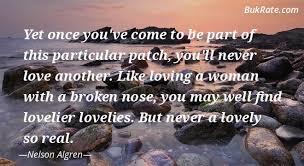
“Like loving a woman with a broken nose, you may well find lovelier lovelies. But never a lovely so real.”
In an odd sort of way, Nelson Algren's Chicago: City On The Make (written in 1961) looks inward at Chicago in the 1950s, while Jack Kerouac's On The Road (1957) glances outward from New York at about the same period, with both books standing as visceral, anarchic statements about life in America during the button-down framework of the Eisenhower presidency.
Algren, like many authors, never felt accepted or included in his home town, nor anywhere else he chose to call home and late in life he ended up semi-homeless, his fate made worse by what he felt was a betrayal by Simone de Beauvior, who had a lifelong relationship with philosopher Jean-Paul Sartre but a tempestuous, much briefer love affair with Algren.
That said, Algren identified with down & out types his entire life, that being how some described him, though he had once been in the literary limelight, especially after Man With The Golden Arm, about a drug addict, won the National Book Award & was turned into a gritty film starring Frank Sinatra.
Algren was called "the poet of the jail & the whorehouse" and even as a kid venerated a fellow Swede named Risberg, who just happened to be one of the the 8 White Sox players banned from baseball for life for their part in the infamous Black Sox Scandal of 1919 when players conspired to lose World Series games at the behest of gamblers.
Algren delighted in calling the city of Chicago, "good times & hard, the infidel's capital 6 days a week." And he suggested that while Chicago is officially described in Latin as Urbs in Horto or "City in a Garden", unofficially it's a place where "3 million bipeds clamor with a single cry, one step aside or a leg off, I'm gett'in mine".
I view Chicago: City On The Make as a prose-poem, as well as a kind of urban graffiti, with my particular version complete with some grungy black & white photos by Stephen Deutch. A later version bears a homage by Studs Terkel, who reserved a special place in his heart for Nelson Algren but who served as a free-spirited conscience of Chicago, being uplifted by its culture, its characters & its history, while Algren always appeared dispirited by those same things.
The book consists of a series of prose vignettes, often rambunctious & free-flowing, but it also resembles a kind a Jazz-riff, written to personify men & women devoid of alternatives, or as Algren phrased it, "a drafty hustler's junction in which to hustle for a time & then move out of the draft." For, as Nelson Algren sees it, "every day is D-Day under the El."
Who could not enjoy a crusty proletarian soul like Algren who declares:
Never eat at place called Mom's; Never play cards with a guy named Doc; Never sleep with a woman whose problems are greater than your own!
It is said by some that Algren's Chicago has vanished but I suspect that just beneath the surface, the characters have merely changed accents; substitute Hispanics & others for the Poles, Swedes & Lithuanians of Algren's day & you encounter the same chaotic, multi-ethnic jousting for position, now as always a quest for some facsimile of the American Dream.
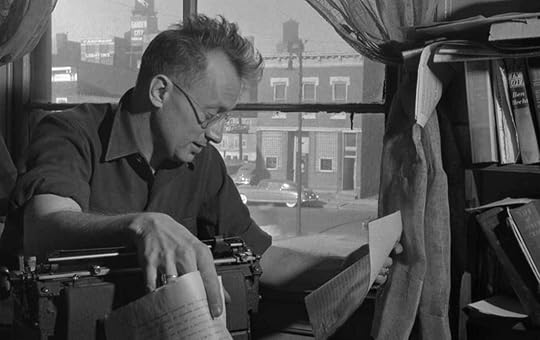
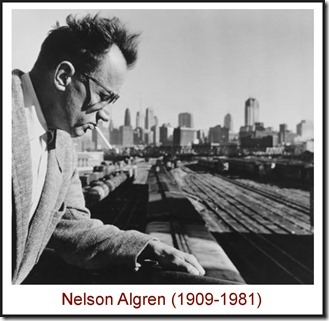
*Within my review are images of author Nelson Algren in various Chicago locations.
This is one of the best things I've ever happened upon--Algren's name is legendary, but I've mostly overlooked him. Too much of this book is too much good to comment on. I don't really know where to begin. As a knee-jerk lefty, there's a lot of Algren that's easy to agree with: the brokers and hustlers reward themselves of other's efforts; there's blood on the streets; you'll live your whole life in the shadows of towers; no one will remember your efforts unless you've stolen them of someone else's labor. On top of that, there's a soft spot for artists and poets run through the whole thing. With that sort of subject, written in a muscular, symbolist measure, I can't help but be a fan. Whether or not that's a book worth the reading, I couldn't say. For me, it's an exemplary American effort, over and beyond the facile complaints of the upper-middleclass so haunts our fiction--here the sweat and tears of Dreiser, Masters, Sandburg, find comment and expansion. Chicago's no sweet home, but the most terrible and American of places, scourged by power, reinvented, rootless--resting place of Haymarket and the ten thousand discouraged.
Sadly, reading this book only reinforced to me that, for better or worse, the old Chicago is a thing of the past...much like Vegas, it is an image to be sold to tourists but the reality is a sanitized version of something that hasn't existed for a long time. I guess that is the world we live in, in general...everything sanitized for our protection to the point where there is very little that is real anymore. What Chicago has gained in user-friendliness, it has lost in personality. Yes, if you know where to look, it's all still here and some things never change...but you have to look very hard these days to understand what made Chicago what it was. I don't think a lot of the people living here now can appreciate it either. I caught a glimpse of it when I lived here before from 98 - 02, but it was fading even then and has faded more now. A couple of points, though: Politics is still a very much a way of everyday life in Chicago and to be honest, Algren's romanticism of the "bad old Chicago" is tedious and corny to me at times. One thing that Algren does get right that I don't expect will ever change is that once you've lived here a while, you will love this old whore of a town more than she can ever love you (paraphrased/juxtaposed from several of the author's own words...although I don't think he ever calls her an old whore...that's all me. And, while I'm at it, loving her too much can be detrimental to your health.)
After completing Never Come Morning and Chicago: City on the Make, I may have to declare Nelson Algren as one of my top five favorite authors.
Sixty years after being penned, Chicago: City on the Make retains all of its poignancy; it remains an honest portrayal of the history of Chicago; it makes real the lives of the easily forgotten. This gritty piece of prose poetry, I think, is easily related to by any who have loved, hated, or hated to love Chicago. In about eighty pages, Algren poetically transcribes about 120 years of this city's history, chronicling the transition from untamed Pottawattomie prairie to a city, "That was to forge, out of steel and blood-red neon, its own peculiar wilderness" (11). He begins, in his sardonic prose, with a description of those who settled this land and their ruthless wagering with the Native people that called this place home. This place would be later known as Hustler City: They’d [the pioneering middle westerners] do anything under the sun except work for a living, and we remember them reverently, with Balban and Katz, under such titles as “Founding Fathers,” “Dauntless Pioneers,” or “Far-Visioned Conquerors.” Meaning merely they were out to make a fast buck off whoever was standing nearest. They never conquered as well as they hustled–their arithmetic was sharper than their hunting knives. (12)
He continues in this fashion, uttering line after line our city's hidden truths. He strips her bare (and to those that have loved her, she is tragically beautiful). Algren ignores the Louis Sullivans and the Stephen Douglases, and focuses his writing upon, "the nobodies from nowhere, the nobodies nobody knows, with faces cut from the same cloth as their caps, and the women whose eyes reflect nothing but the pavement" (67). He asserts that this is where you will find the heart of Chicago, not among the mirroresque windows of our tallest towers. They don't reflect anything of substance for him. No, a true reflection of this city is found in its fighters, its writers, its workers, its alley-dwellers, its tavern owners, its young toughs, and its working families. Algren uses many of his pages here to detail the horrors of city life, elevating Chicago to prime exemplar. However, he warns that, "Before you earn the right to rap any sort of joint, you have to have loved it a little while. You have to belong to Chicago like a crosstown transfer out of the Armitage Avenue barns first; and you can’t rap it then just because you’ve been crosstown" (42). These motions of admonishing urban life are as uniquely American, at this time, as Chicago herself. But Algren cannot simply disparage Chicago; he loves this city and he loves the people that populate it. In what are, perhaps, my favorite lines of the poem, Algren proclaims, "Yet once you’ve come to be part of this particular patch, you’ll never love another. Like loving a woman with a broken nose, you may well find lovelier lovelies. But never a lovely so real" (23). I think this holds true for many, especially for me, as I have tried to make my life in another city, but found myself wanting of the familiar, dusty alleyways; the street-side shops whose neon banners cry their wares in Spanish, Polish, Italian, Bohemian, Dutch, Hebrew, Ukrainian; the neighborhood talent striving to make their way by basketball, rhythmic poetry, and homemade CD's. And yes, I'm sure that many cities afford their residents these comforts, but reading Algren's words makes me think of mine. I highly recommend this work. If you have enjoyed any of the quotations in this review, I urge you to pick it up and give it a go. This essay is filled with them.
God, poor Nelson Algren. A man who had the deep, deep misfortune to be too sensitive a soul. Sure, he did all the masculine signifiers – a who’s who of lovers, an excess of investment in the fortunes of the White Sox – but at the end of the day he was a sadboi who just wanted to vibe with the rhythms of the city all around him, at a time when men were expected to behave in an utterly different fashion. I’d read bits and pieces of this for years, but the whole package is an absolute beauty.
Chicago has a tradition of romanticizing its hustlers, working girls and petty crooks. Mike Royko and Studs Terkel were award-winning writers and younger contemporaries of Algren who contributed to that tradition too. But CITY ON THE MAKE, written shortly after Algren received the National Book Award for THE MAN WITH THE GOLDEN ARM, took the romanticization of Chicago's street smart sharpsters and corrupt politicians to heights achieved by no one else. CITY ON THE MAKE is short (87 pages) and more poetry than essay. It depicts Chicago in a manner reflecting a hard-calloused sensibility that went out of fashion after Vietnam and Watergate. Although CITY ON THE MAKE was regarded favorably by the critics in New York City and was praised lavishly in France where it was first translated by Jean Paul Sartre, it fell flat in Chicago itself. The local gentry did not like the mirror that Algren held up to their city.
As a long time resident of Chicago, I did not love CITY ON THE MAKE either -- but, of course, I read it 60 years after the fact. To me, it coasts lazily on stereotypes resulting in a one dimensional depiction of a city that is far deeper and more complex than anything Algren even hints at in this short book.
There are four more thoughts that I want to share in this review. First, Algren assumes a lot from his readers. There are many references to obscure Chicago people and facts that are likely to be unfamiliar to most readers. Without the background, however, a reader may not fully enjoy Algren's sly side-swipes at Chicago's many hypocrites, past and present.
Second, in the edition that I read, an Afterword is included. The Afterword was written by Algren himself in 1961, for a 10 year anniversary edition of the book. Algren's Afterword is not gracious. He seems to have written it in part to settle the score with those who had panned CITY ON THE MAKE when it was first published in 1951. He makes little effort to disguise his anger or his motives. That failure does not reflect well on him.
Third, Algren is at his most entertaining when he reminisces about his childhood and the summer his family moved from the south side to the north side. He was a White Sox fan, and had to defend his honor and his favorite player, Swede Risberg, a chief conspirator in the then recent Black Sox scandal.
Finally, Algren is at his most interesting when he bemoans the quality of literature being created in Chicago in the period immediately after WWII. He remembers earlier times when Farrell, Ferber, Wright and others were writing the books that caused Mencken to call out Chicago as the city in America where the only books worth reading were being written. Yet, Algren himself and, a few years later, Saul Bellow were among the best of their generation.
Gorgeous prose poem to a city Algren loved and hated at the same time. Requires a bit of Chicago history knowledge to get anywhere reading it though. Make sure to get a copy with footnotes or endnotes for the same reason.
Tucson is my “city on the make,” that literal source of my life with memories, landscapes, traditions, and family that are the proudest parts of who I am. But it’s also a place that disappoints me in the way that only a hometown could. Where you grew up, is after all, by necessity, the place where you learned about human nature. Nelson Algren expresses some true crestfallen despondency toward Chicago in the way that only a person with a natal connection to a hometown could.
But Chicago is my chosen home, and this prose poem feels painful and insulting — and overly cynical — as Algren comes close to basically wishing Lake Michigan would wash the entire city away. It’s the power and beauty of his prose that makes it sting even more. The criticisms of Chicago’s graft and desperate hustling are universally acknowledged— and I’ve personally witnessed my share of the Chicago-style inferiority complex and dishonesty through my experiences in this city’s film industry. I know it’s racist and segregated, that it’s a neoliberal basin, that low-income fifth-generation citizens are getting priced out of their neighborhoods left and right, that the political machine is internationally associated with corruption, that all the talented artists keep leaving for the coasts once they’ve gotten a taste of success.
But I like this city. I have hope for it. I have to, because I choose to live here.
But again, I get it. Hometown resentment is a powerful force of nature. At the end of the day though I’ll take Sandburg’s “Chicago” over this — the sweatier, more vibrant, hopeless but proud Chicago.
“You’ll know it’s the place built out of Man’s ceaseless failure to overcome itself. Out of Man’s endless war against himself we build our successes as well as our failures. Making it the city of all cities most like Man himself—loneliest creation of all this very poor old earth.”
An epic prose poem about Chicago that celebrates all that is good and bad in our city. A slim book that makes the most out of every single word written. With a wonderful introduction by Studs Terkel and a brilliant afterword by Algren himself, I found that once I got started I had a hard time putting it down.
I loved Algren's use of colorful language and felt that he made many statements that still hold true today. Such as: "The hard necessity of bringing the judge on the bench down into the dock has been the particular responsibility of the writer in all ages of man. In Chicago, in our own curious span, we have seesawed between blind assault and blind counter-assault, hanging men in one decade for beliefs which, in another, we honor others."
Algren is a witty, smart man, and a wonderful writer. I hope to read his short stories and fiction next.
A must read for all Chicagoans as well as history and literature buffs.
Spectacular. Pure poetry, and truly a love story to his city -- which, Algren claims, must be loved the way you love 'a woman with a broken nose.' I read it in one sitting, and I want to read it again. Get THIS edition, though, and read Studs Terkel's intro. The footnoting is vital but not cumbersome. All in all, it made me want to simultaneously cry helplessly AND get another Chicago-themed tattoo. And I'm pretty sure that's precisely how Algren wants us to feel.
Algren feels so prescient because his concerns are so timeless: poverty, racial justice, the rights of sex workers, corruption, America's fucked relationship with its stolen land, etc... This work serves as a history of Chicago, of America, of the ways in which we fail our bravest artists and our most at risk citizens. Algren has a Baudelairian knack for making poetry out of the places and people most readers would rather not think about and I can't wait to read the rest of his work
"By days when the wind bangs alley gates ajar and the sun goes by on the wind. By nights when the moon is an only child above the measured thunder of the cars, you may know Chicago's heart at last."
Nelson Algren described a Chicago I do not recognize. He described a Chicago that was mostly struggling neighborhoods where wealth and prosperity are the exception in the downtown area and the Northshore suburbs. I know there are still struggling neighborhoods and downtown and the Northshore are still wealthy but there is much more in-between. Either way, I appreciate having Algren as an observer to report with clear and lively prose about a Chicago that has changed a lot since 1951 without apology.
Although Chicago may not still be quite the way he described it his themes still certainly apply to our lives. Algren was so class and justice conscious and his best observations timelessly cut the crap. "You can't make an arsenal of a nation and yet expect its great cities to produce artists. It's in the nature of the overbraided brass to build walls about the minds of men-as it is in the nature of the arts to tear those dark walls down." (p. 55) Something that still rings true as the US has the largest military budget in the world. And Algren continues with his observations of fine arts regarding the way wealth operates for its own benefit. "The city's arts are built upon the uneasy consciences that milked the city of millions... then bought conscience-ease with a multiple fraction of the profits. A museum for a traction system, and opera for a utilities empire." (p. 68-69) Algren was a writer who turned experiences, feelings, and references of the less fortunate into statements about society.
Algren also had a beat-poet's knack for flipping from discreet observation to revelatory musing. "For Chicago lives like a drunk El-rider who cannot remember where he got on nor at what station he wants to get off. The sound of wheels moving below satisfies him that he is making great progress." (page 86). Nelson Algren was a more cranky beat-poet but he seemed to have a deeper understanding of economic hardship which in Chicago: City on the Make he turned into great prose.
Dear Nelson Algren, long time fan of your tumultuous love with Simone de Beauvoir, first time reader. Can’t say I really understood most of this, the style is so steeped in early 20th century chicago myth-making that I didn’t recognize like 80% of the names and places listed, but you get the impression that who he was writing for were slowly disappearing even when it was written, much less 70 years later. was like hearing a eulogy for someone you didn’t know and feeling bad you came to the funeral but like no one else is really there so why not you. Liked that the base unit of his world is the rigged ball-game, already drunk barfly, local invincible boxer one shotted by the national champ, destitute gambler who’s more amused than anything else etc.. the impression of Bigger money is gonna take everything and everywhere will feel the same is weird from the perspective (mine) of that all already happened and I don’t know what you’re talking about But I liked it
I recently re-read this, which only reinforced my opinion that Chicago: City on the Make is one of the finest works of prose poetry in English, and really demonstrates Nelson Algren at the height of his powers, both in terms of his mastery of composition and, perhaps more importantly still, his moral and philosophical self-confidence. This last point is important: in 1951 Algren still thought that he could change Americans’ minds, or at least make a lasting and widely understood statement in a way that he felt was equivalent to that done by those he considered his peers, most notably Simone de Beauvoir, in a way that he had largely given up on by the later 60s and 70s.
Algren, especially in the late 40s and early 50s, was writing in a transitional period in American history between the interwar and Depression era that was his formative period and the setting for many of his major works, and the more affluent but alienated and culturally dead period of the early Cold War – between H-Bomb and A, if you will. Chicago: City on the Make, straddles this period, especially when one includes the excellent Afterward, written in 1961. At times, it can be hard to relate this America to ours – concerns about whether an increasingly affluent 1950s population would lose touch with its democratic and humanist values, or at least its more benign and down-to-earth form of hustle, can seem distant in an era when median family incomes have not grown in most readers’ lifetimes. But ultimately his grasp of the American psyche, his focus on the city’s more timeless personae, and his willingness to transcend any one era make this meditation on the soul of an American city and the American people more relevant than those of Steinbeck or Dos Pasos. Really only Hunter S Thompson came as close, and then only rarely.
Writing prior to Vietnam, and indeed prior to a long series of wars since Vietnam, the following passage really gets at the timelessness of what Chicago: City on the Make is getting at:
“You can see the boys who stopped caring in 1918 under the city arc-lamps yet. Under the tall lamps yet. An evening comes taxiing in and the jungle hiders come softly forth: geeks and gargoyles, old blown winoes, sour stewbums and grinning ginsoaks, young dingbats who went ashore on D Plus One or D Plus Two and have been trying to find some arc-lit shore ever since . . . Fresh from the gathering of snipes behind the nearest KEEP OFF warnings come the forward patrols of tomorrow. Every Day is D-Day under the El. By highway and byway, along old rag-tattered walls, surprised while coming up in the grass by the trolley’s green-fire flare, their faces reveal, in that ash-green flash, a guilt never their very own. Upon the backstreets of some postwar tomorrow, when the city is older yet, these too shall live by night.”
A love letter to the City of Chicago with precise prose that rocked my world. The most lasting metaphors about the city - one of vice and virtue, the hustler and the square. Algren’s textual version of Chicago warrants fear and fame, admiration and disdain. Love this complicated little book.
I was fascinated. I am a lifelong resident of Chicago. The City, not a suburb. The place is unique. The obvious flaws remain 70 years later. Mediocrity being a standard is an understatement.
"'Watch out for yourself' is still the word. 'What can I do for you?' still means 'What can you do for me?' around these parts–and that's supposed t omake this the most American of cities too. It's always been an artist's town and it's always been a torpedo's town, the most artistic characters in the strong-arm industry as well as the world's most muscular poets get that way just by growing up in Chicago–and that's an American sort of arrangement too they tell us.
"A town where the artist of class and the swifter-type thief approach their work with the same lofty hope of slipping a fast one over on everybody and making a fast buck to boot.'If he can get away with it I give the man credit,' is said here of both bad poets and good safe-blowers. Write, paint or steal the town blind–so long as you make your operation pay off you'll count nothing but dividends and hear nothing but cheers.
"Up, down and lurching sidewise–small wonder we're such a Johnson of a joint. Small wonder we've had trouble growing up.
"The very toughest sort of town, they'll tell you–that's what makes it so American.
"Yet it isn't any tougher at heart than the U.S.A. is tough at heart, for all her ships at sea. It just acts with the nervous violence of the two-timing bridegroom whose guilt is more than he can bear: the bird who tries to throw his bride off the scent by accusing her of infidelity loudly enough for the neighbors to hear. The guiltier he feels the louder he talks. That's the sort of little loud talker we have in Chicago today. He isn't a tough punk, he's just a scared one. Americans everywhere face gunfire better than guilt.
"Making this not only the home park of the big soap-chip and sausage-stuffing tycoons, the home cave of the juke-box giants and the mail-order dragons, the knot that binds the TV waves to the airlanes and the railroad ties to the sea, but also the psychological nerve center where the pang goes deepest when the whole country is grinding its teeth in a nightmare sleep.
"There, unheard by the millions who ride the waves above and sleep, and sleep and dream, night after night after night, loving and well-beloved, guarding and well guarded, beats the great city's troubled heart."
And on, and on. A beautiful and loving ode and indictment to this miserable city.
This is a short-ish collection of prose poems on Chicago in the early 20th century through to the edge of the Daley-era. This book is important if just for that moment it occupies: I think today it's hard to be in Chicago and imagine it pre-Daley, and I use the word imagine with all the etymological baggage: to literally create an image of the city.
Algren will give you some of that. Everything about his Chicago exists down, as in down alleys and down in the urban canyon created by rising buildings. There's Chicago's heart: amongst the useless nobodies and no names. “You can never truly love [Chicago] till you can love its alleys too." An eminently Chicago moment: talking about loving Chicago, and talking about alleys. Chicagoans love both of those things, and in the grand NYC - LA - CHI - Everyone Else debate, Chicago always sets up shop in the working class corner. Algren spends this book not just setting up shop, but digging out a foundation, laying brickwork, and throwing rocks at everyone that walks by: everywhere is done, and he calls Detroit a "a parking lot about a stadium" (mid-Century urban renewal burn!).
But at the root of it all is the engine that propels so much of Chicago love and Chicago discussion forward: the inferiority complex. Again and again, he drags in the names of Paris and San Francisco and New York and Rome and everywhere. Babylon, Troy, name it, its here. A city that cannot exist outside of the contexts of the Global City and how it compares. How spurned is Algren by the sense of abandonment by Wright, who fled to France? How lonely does he feel in a city he claims had a glorious output in the past but has sputtered into artistic malaise ca. 1961 now? How much does he try to transform the hulking metropolis into more than a boy amongst men? A lot.
It's an old hat thing now, or maybe not even old hat, but the thing. This quest for authenticity and prominence and bigness, but in the quest trying hard to not bruise it, ever mad at the always happeningness of change. 1961 Algren is sad that an old German beer garden was replaced by a cocktail lounge. And here I am, 2017, sad that that shabby cocktail lounge was replaced by a beer garden.
Algren’s infamous warts-and-all lyrical love letter to Chicago, in which he basically sums up the city’s crooked history as “a rigged ballgame” – an ongoing struggle between the hustlers and the squares, swindlers and victims, moral hypocrites and desperate low-lifes, capitalist barons and working-class slobs, where corruption is rewarded and sympathy for the losers generally absent. And yet for all that, Algren loves Chicago, but says you can’t really love it unless you embrace it for what it is, good and bad. There’s little doubt whose side Algren is on, so readers of a certain political persuasion are going to hate this book on principle. For myself, I happen to like both Algren and Chicago, so I really enjoyed it. Algren wears his passion on his sleeve, and it’s catching. I will say that the book, while short, takes some work thanks to Algren’s poetic references to historical figures and events, although the 60th Anniversary edition does come with helpful endnotes explaining everything. But it’s well worth the effort.
I was expecting this to be an informational book about Chicago's history up until the early 1950s (when it was published) and it was recommended all over the web as one of the best books about Chicago. But this is actually a prose-poem about Chicago written by one who grew up there. It reads a bit like Shakespeare in that Algren uses so much antiquated slang and he references so many people and places that only Chicagoans would recognize that I had to constantly flip to the helpful endnotes for explanations. Algren has a tough, punchy writing style that takes a bit of getting used to but ultimately gives the prose its poetic feel. I appreciated the writing but didn't really learn much about Chicago.
'It isn't hard to love a town for its greater and its lesser towers, its pleasant parks or its flashing ballet. Or for its broad and bending boulevards, where the continuous headlights follow, one dark driver after the next, one swift car after another, all night, all night and all night. But you never truly love it till you can love its alleys too. Where the bright and morning faces of old familiar friends now wear the anxious midnight eyes of strangers a long way from home.'
One of my favorite quotes. And a great encapsulation of a complex town.
I read the 60th anniversary edition which has notes on each chapter since some of the timely references have been a bit obscured by time. I still felt its edge though, and as I read more and realize when it was written, I realized how influential this must have been for the author career, not necessarily in a positive way. It's a work of art, now a classic, that was not so well received in it's time. It reads as prose poetry and some of the phrasings are truly beautiful.
Poetic, a must-read for Chicagoans. I found the annotations to be a little cumbersome; they're listed at the end of the book by page. Flipping back and forth disrupted the flow and effect of Algren's work.