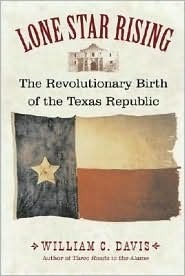
Focuses on the historical figures who played pivotal roles in the Alamo and the establishment of the Republic of Texas, describing the contributions of such individuals as Sam Houston, Stephen Austin, and Juan Seguin while noting the era's clash between three disparate revolutionary traditions. 40,000 first printing.
Currently professor of history at Virginia Tech, William C. Davis has written over fifty books, most about the American Civil War. He has won the Jefferson Davis Prize for southern history three times, the Jules F. Landry Award for Southern history once, and has been twice nominated for the Pulitzer Prize.
For several years, he was the editor of the magazine Civil War Times Illustrated. He has also served as a consultant on the A&E television series Civil War Journal.
Librarian Note: There is more than one author in the Goodreads database with this name.
A small community of Anglos, dominated by slave owning plantation owners who immigrated from the South, successfully revolted against a weak Mexican government. The Mexicans themselves, like many others in Latin America, had taken advantage of European turmoil and the weakness of Spain to gain independence. Mexicans were in the beginning of a long period defining their own institutions, which were quite different than those consonant with the Anglo culture.
The Texas of this Republic was much smaller than the Texas of today -- basically a coastal plane suited for growing cotton. The independence movement was financed from the USA, and many U.S. citizens came to help the Anglo settlers in their fight. Santa Anna was bringing forces from Mexico city, many conscripts picked up along the way, passing through states in revolt, to put down still another revolt in a far distant corner of the country. Perhaps it is not surprising that after massacring the Alamo command, he lost the war.
The book shows that, as one might expect, the people running the Texan rising were not very good at military nor political affairs, but they were good enough. The Mexican government and army at the time were not very good either. Compared to later events, there were only a few skirmishes in this rising. Kind of fun to discover that the Texans won the battle of San Jacinto by attacking at siesta time.
The book told me too much about people I had never heard of and do not now remember. I suspect it is better for people who have read a lot of Texas history. I also suspect that if that reading was done from school books approved by the state curriculum committee, the reader will get quite a different picture than he/she expected. The events here are bigger in myth than in reality. They are important because of what followed -- the Mexican-American War, the acquisition of the southwest by the USA, and the urgency that acquisition gave to the issue of slavery.
Here is a summary of the discussion of the book by a local History Book Club: http://j.mp/1Lfh1gL
This is detailed history of the events that led up to Texas declaring itself independent from Mexico. Very detailed on some fronts-- it opens with the geological formation of the area. Less detailed on others-- it skips the Indians that lived here aside from mentioning them as potential threats to various settlers and factions.
It covers Spanish rule, Mexican rule (no, they're not the same thing), the Anglo settlers coming in, the friction, and the probably inevitable fighting. The writer is pretty clearly pro-Texan (or Texian as they called themselves back then) but he doesn't gloss over things that made them look bad. While the war for Texas independence had many heroic moments, it had a lot less than that, too. The Anglo settlers came in under false pretenses and things went down hill from there.
The big historical figures are covered, with their merits and flaws both- Houston, Austin, Santa Anna, Travis. Crockett isn't covered much because realistically, he didn't have a lot to do with Texan independence, just the Alamo fight. Yes, there was more to the war than that one fight.
There's a lot of politics here, too. It can be not thrilling reading about politicians who can't make up their minds, supply problems for the army, and the like. So bear that in mind.
It was a good read. I've read a lot on this subject, and I learned a few things. Recommended for history fans, Texans, and those interested in the West.
First a disclaimer: I am a proud Texan and I really love my state. That being said... this is one of the best books on Texas history I have read. It is totally honest and portrays the history of the Texas Revolution, warts and all. Yes, it portrays the heroism of the Alamo, but it also notes the high rate of desertion among soldiers of the Texian army. Yes, it tells us of the high ideals of Texas leaders desiring an independent nation and later a state, but it also tells us that many were just seeking cheap land. This is an honest portrayal of Texas history that should be read by all serious students. Well written and accurate.
Excellent book about the settlement of Texas by immigrant Americans, Germans and Mexicans who lived in Texas under Mexican rule. A real good read for those interested in knowing more about the birth of the Texas Republic and an insight into the culture of Texans.
An excellent but at times dry history of the Texas revolution. Davis covers every detail, including the colonial development of Texas and divisions within the newly formed government after San Jacinto.
One of the aspects of this book that is particularly interesting is the context that this book provides to the Texan Revolution. In fact, this book can roughly be divided into two parts (although the author does not do so). The first half of the book provides the history of Texas going from the late 18th century and looking at the long-term issues of Texas' peripheral status within New Spain and the internal disorder present between centralist and federalist tendencies, and then, especially after 1803, the growing pressure from American elements. The second half of the book then contains an account of the Texan Revolution itself, which itself can be divided into three periods, an initial period of Texan success against the overmatched forces of Mexico within Texas, the massive and bloody retaliation of Mexico under Santa Anna, and then the sudden and shocking victory at San Jacinto that ends up securing Texas' brief independence. The author does a good job at examining not only Texas' uprising but also the complex and troubling aspects of the context of that revolution and what it meant for Texas' future. In doing so, the author places Texas in a context that not only includes Latin America and the United States but also in terms of Texas' on fragile identity in being American but not entirely so, seeking their own freedom but crushing the freedom of their slaves, seeking to set up a legal order but not being able or willing to be a part of Mexico's admittedly corrupt order.
This book is about 300 pages long and is divided into twelve chapters and various supplemental material. The book begins with a chronology as well as an introduction that points to Texas as an immigrant land. After that comes a look at the state of Texas at the end of the 1700's (1), which is followed by several chapters that detail the bad causes and bad men that tried to filibuster for Texas independence (2), or caused trouble and vexation for themselves and others (3). There is a discussion of the fate of Texas and how it was faring at the first part of the 19th century when there was a decisive change between internal revolt among the local Tejano population being the main issue to that of Americans, mostly Southerners, from the outside (4). this is followed by more confusion (5) and violence (6), as well as the dangerous imprisonment of Austin (7) and the dark schemes of Texan and Mexican leaders after the outbreak of the revolt (8). This is followed by the struggle for victory or death by outnumbered Texas (9), the dark atmosphere after the fall of the Alamo and the massacre of the Goliad (10), the question of whether Sam Houston would fight (11), and the success of San Jacinto (12) as well as the future of Texas, in an epilogue, after which the book closes with endnotes, a bibliography, acknowledgements, and an index.
The author writes about this subject matter with the approach of a Greek tragedy. The reader knows that Texas won its independence and later became an American state and likely knows something about Texas' complex identity within the United States. Yet the story of Texas' revolution is full of drama, drama that includes the long-term problems of Spanish imperialism that made Texas an empty buffer area inhabited mostly by Commanche and other tribes, until their own small population became intensely frustrated at the lack of development and Spain's class system and general incompetence, and invited in Americans. It was at that point, the author believes, that the Texas Revolution became inevitable for cultural and demographic reasons, something which I consider basically correct if not always pleasant as a view. The rest of the history, including the paranoia on all sides and the consequences of Mexico's lack of cohesion as a nation, flows along entirely naturally as one would expect, and the war itself is told with a dramatic flair that emphasizes the incompetence of the political leadership on both the Texas and Mexican side. Those who are fond of the Texan founding leaders, other than the Austins, are likely to be a bit irritated at this volume.
(Audiobook) (4.5 stars) This work looks at the history of the various protest/revolts that eventually lead to Texas' independence from Mexico. The narrative starts during the end of the Spanish colonial rule, as Mexico transitioned to its own independent nation. Yet, as it was trying to settle in as its own nation, it started down the path of the next revolution in its Texan holdings, as it was dealing with empresarios like Moses and Stephen F. Austin to try to accommodate American settlers into the relatively sparely populated areas of East Texas. From there, the tale starts to move into familiar territory of how the Mexican authorities clashed with American settlers on the boundaries of Mexican authority over Texas settlers. Also, various personality conflicts and small skirmishes started to build up. Soon, legendary figures such as Jim Bowie, William Travis and Davy Crockett enter the picture, as did Santa Anna. Much of the work looks at the setup to the fighting of 1835-36, but the final part of the book covers the conflict, as well as the political maneuvering of the Texan rebels. Sam Houston comes across a bit wishy-washy, and ultimately, lucky in the fight against Santa Anna. The work ends with Texas setting up its initial government, independent, but under the threat of further Mexican military action
Overall, a solid history of a key part of Texan/Mexican history. The details about key figures are most enlightening, especially with Houston and Santa Anna. Other works offer more details about Travis, Crockett, Bowie and Austin. Yet, the overall saga is the star of this work, and Davis does a solid job of portraying that in this history of Texas. He doesn't shy away from some of the less-ideal parts of this tale (Texan insistence on slavery, Mexican atrocities in conflict), which only add to a more complete picture of this time. If there is an issue with this work, it is with the narrator, who clearly has not lived in San Antonio or that area, as Bexar County is pronounced like "Bear" not Beh-har. Granted, the "proper" Spanish pronunciation might trend that way, but natives and long-time residence go with "Bear"
Everyone knows the story about The Alamo. Sacrifices of the almost mythical figures Davie Crockett, William Travis, and Jim Bowie inspire feelings of patriotism and resistance to oppression, even in the face of insurmountable odds and death. But the events leading up to and following The Alamo that inflamed and inspired the passion of these defenders, as well as the Mexican forces of Antonio Lopez de Santa Anna, are critical to appreciating the dynamics leading to the creation of the new Texian nation and creating the cornerstone of the epic Texian pride and national identity! I'm married to a native Texan, and believe me, the Spirit is still fervently alive and well... Read this book, and revel in the excellence of history recorded with heart and soul feelings, all blemishes and scars on display.
The history of Texas is fascinating. This book provides a great overview of how Texas got its independence form Mexico. The beginning was a bit hard to understand because there were so many people and events introduced. But as it developoed, everything became clear and it was fascinating to learn about many of the different events leading to Texas' independence. I remember saying "Rember the Alamo" as a child and watch many movies on the topic. But, it is only know that I am fully appreciating all that went into that event and the events before and after.
A thorough political and military history of the Texian Revolution. Davis provides solid analysis of the causes and course of the revolt, with good attention to racial factors often ignored. Especially valuable is his study of the tensions between the US on the one hand and Spain, later Mexico, on the other, that predated the 19830s tensions.
A must-read for anyone who wants to begin learning about Texas history. Very well sourced, incredibly detailed, and very accessible for the common reader.
Definitely an unbiased account that highlights both the good and the bad that came with the Texan revolution.
In "Lone Star Rising," William C. Davis has produced a comprehensive and thoroughly readable history of the Texas Revolution of 1836. Most history buffs will be familiar with Davis from his numerous appearances in cable television historical specials, including the A&E series "Civil War Journal." However, he should be equally well known from his vast body of work as a popular historian. This latest work is another strong demonstration of the prolific Davis's talent for producing readable, approachable works of insightful history.
The land-hungry dream of carving the Texan lands away from Mexico dated from the 1820s, but Davis begins even earlier, ably and entertainingly building up the setting for the 1830s. The attention paid to the preceding history yields significant dividends later in the book. For example, by the time Davis reaches the 1836 Revolution and the infamous massacres directed by Santa Ana, we already understand why such bloodshed was almost certain to occur. The narrative introduces us to the harsh Spanish tradition of how to deal with rebels. Also, when the narrative reaches 1836, the author has already painted decades of plotting Americans engaged in piratical-if-hapless invasions, aimed at seizing the province of Texas. To the Mexicans, the 1836 Revolution looked like just another frustrating, outrageous attempt by the gringos to steal their land.
The book's timing coincides with the summer release of Disney's "The Alamo," and it delivers on many of the points where the film fails. "The Alamo" promised us the Mexican side of the story of 1836; Davis's book actually delivers. In this, the book is superior to previous accounts. While he does not neglect the Texan pantheon: the stolid, conservative Stephen Austin; the unscrupulous Jim Bowie; Sam Houston, the scheming drunkard; and the fire-eating William Travis. Davis also calls attention to the often-neglected tejano (the Spanish-speaking Mexicans who had long lived in Texas) leader Juan Seguin. At last, the tejanos play a central role alongside with the American immigrants ("Texians"). Furthermore, the convoluted story of Mexican politics vis-à-vis the Revolution finally receive their due. Antonio Santa Anna, a fascinating character who is too often reduced to the role of a tin pot dictator and villain, also receives full attention.
Davis has penned a successful work, depicting how three very distinct groups of people struggled over both the land and the idea of what would become Texas, and how the Americans eventually triumphed. He avoids making an argument in favor of simply telling a story, and unlike his predecessors he tells a complete story. Consequently, the book reads as a new take on a very old story. It should become a major work among the popular histories of Texas.
I had originally given 4 stars for the detailed background of social and political thought in both Mexico and Texas. I am lowering my rating because the author seems to have taken the positions of Houston's detractors as fact. Ascribing very little credit to his leadership in winning the revolution. This "revisionism" is disturbing. If Houston was so inept, why did the army (and civilians) elect him president with nearly 90% of the vote?