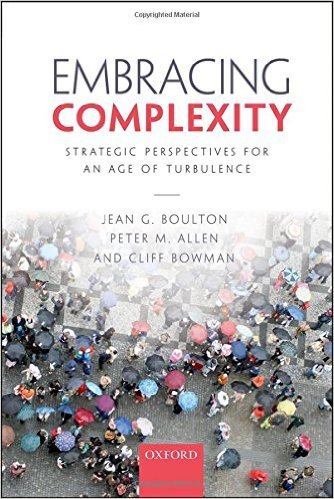
The book describes what it means to say the world is complex and explores what that means for managers, policy makers and individuals.
The first part of the book is about the theory and ideas of complexity. This is explained in a way that is thorough but not mathematical. It compares differing approaches, and also provides a historical perspective, showing how such thinking has been around since the beginning of civilisation. It emphasises the difference between a complexity worldview and the dominant mechanical worldview that underpins much of current management practice. It defines the complexity worldview as recognising the world is interconnected, shaped by history and the particularities of context. The comparison of the differing approaches to modelling complexity is unique in its depth and accessibility.
The second part of the book uses this lens of complexity to explore issues in the fields of management, strategy, economics, and international development. It also explores how to facilitate others to recognise the implications of adopting a complex rather than a mechanical worldview and suggests methods of research to explore systemic, path-dependent emergent aspects of situations.
The authors of this book span both science and management, academia and practice, thus the explanations of science are authoritative and yet the examples of changing how you live and work in the world are real and accessible. The aim of the book is to bring alive what complexity is all about and to illustrate the importance of loosening the grip of a modernist worldview with its hope for prediction, certainty and control.
So the edition in the possession of this reviewer has 269 printed pages.
On page one, 'the pervasiveness of machine thinking' is written in italics and it might be helpful if the authors could indicate the extent to which this is a good or bad phenomenon. Quoth the authors further: "There is no learning, variety, adaptation, innovation or surprise." The authors are professional academics and it would appear to be strange were there not to be an abundance of learning opportunities: to the extent that an absence of variety presents as our-friends-would-like-to-attend-a-variety-show-every-now-and-again, that sounds like a difficulty that should be possible to overcome. The concerns this reviewer has with the innovation enthusiasts, he would prefer to address elsewhere (similarly on p149). The reader is told: "A complexity worldview reminds us of the limits to certainty, it emphasizes that things are in a continual process of 'becoming' and that there is potential for startlingly new futures where what emerges can be unexpected and astonishing." which may indicate that if the reader is excited by this worldview, perhaps the reader might be interested in spending time at a hedge fund; those less excited by the prospect might be apt to remind those that are that they should not use that opportunity to facilitate the trafficking of their fellow citizens; a point that may need to be reinforced at the end of a bayonet; and, still on page one, 'Complexity thinking is not new, and has been part of our experience since the beginning of civilization' prompts this reviewer to anticipate an elaboration of the emergence of order from chaos later in the text. (Concerning pp95-6, what else appears to be generally relevant?-ty) Separately, it should be possible to protect the conversations about the nature, form and substance of original sin which are not gut-wrenchingly hypocritical and which are fit for the twenty-first century. The point: "In a mechanical worldview, managers or leaders are expected to control organizations and what happens in them." is well made and taken, and it may be worth re-visiting later.
Now the reader has made it to the end of page one, and this is the point where the reviewer finds himself taking on some of his post-graduate student habits. When presented with an academic disquisition, he might read a bit at the beginning, and then jump to the end for a quick look at the wrapping-up, so jumping now to page 220, the reader is offered:
"Peter's work since the 1970s has had modelling at its core, although this does not give a correct sense of the extent to which Peter reflects about the overarching implications of facing up to the complexities of the world."
Well, this one might not be too excited about that instance of the-thing-over-there-ification.
Things may start to breakdown after that.
On p228, the reader has: 'Peter mentioned that, if we can get to grips with what might happen locally, then it is easier for people to engage with possible future scenarios.' and it might be helpful if the authors could clarify (if they haven't done so earlier in the text what they mean by local in the context in which they use the word) and also which persons individually and people as groups they have in mind.
Things appear to go horribly awry on p230: 'Peter has talked about the role of modelling and the importance of complex models in terms of looking to the future and looking at the possible scenarios that might occur.' If the conclusion based on the activities of this one has been based on the evaluation of illegally intercepted communications, there would be a different set of difficulties that need to be addressed. Jean goes on: 'I don't disagree with that.' The point is acknowledged. "But for me a key answer to the question 'What would I like people to take away from this book?' is about mindset." That might beg the question as to which key answer the author has in mind.
On page 40, what else appears to be generally relevant? ty.
On page 47, what does: "Informing our judgements through embracing a complexity worldview forms the key message of this book" mean? How and why would that be significant?
On page 48, with respect to the title of Chapter four: "Have we thought like this before?", the reviewer wonders, if he may be excused a few words of management speak, what do the authors consider to be the key takeaways from the King James Bible and the Complete works of Shakespeare? Some form appears to be offered on pp51-2: the reviewer may prefer to develop some of these arguments elsewhere after finishing the book.
On page 49, what might: "But what does it mean to call something a science?" have to say about the authors' desire to take a thing, stick a label on it and put it over there? Why might that be significant? Similarly on p80.
There appear to be some significant features missing in 'The problem with assumptions of absolute space' on pp57-8 [at,in appropriate time/setting]. And the content of p98 needs to be raised and addressed elsewhere.
The arguments on p100 may be substantially defective. On p102: "As you will have gathered, we are in favour of the thinking behind evolutionary complexity and wary of overly abstracting generic learning from simpler models." is certainly one way of putting it. And on p103: "Evolutionary complexity accepts the fact that 'systems' can change their nature over time.' may be re-assuring.
So now the reviewer has reached Chapter six (p105) and is informed: "The focus of this book is not how to do modelling." which is fair comment, however: "This book is predominantly about 'embracing complexity' as a mindset." might beg the question as to what the inherent virtue or utility value of such a mindset might be, even once the headbanging in inverted commas is unpacked and ascribed an interpretation more substantial than abstract-activity-under-way-by-third-party-over-there. The arguments on p107 appear to consist largely of circular reasoning.
On page 116, looking from the present to the past, what else appears to be generally relevant?-ty.
On p123, what would be a decent rebuttal to an argument that considers complexity theory in terms of study to be a noisy branch of fuckwitology, and in terms of practice, unanchored obstructive gate-keeping? On p124, Jean's technique can be discussed at/in an appropriate time/setting. And on p126, how is: "If we believe life is essentially unpredictable, why do we continue to run organizations as if predictability were the norm?" framed, how appropriate would the frame of reference be, and what would be the assumptions that underpin the connection between the frame of reference and the question?
What else appears to be generally relevant in 'challenging what we regard as scientific and professional' on pp129-30?-ty.
On p132: "...whilst there is nothing to stop us refining change over many pilot experiments and determining what we feel is an appropriate approach, it is important to give some flexibility to implement change in a way that..." appears to present difficulties even taking into account differences in comportment tastes that need to be addressed at/in an appropriate time/setting.
On p135: to what extent is "There is a strong culture in many anglo-saxon organizations that taking time to understand what happened in the past is unhelpful or unnecessary." valid, and what could be done differently within and between the different types of settings to which this assessment is applied? To what extent is the regulatory and legal framework in this domain proper and fully functional?
So now the reviewer has reached chapter 8 (p138): section 8.1 asks the question 'what is strategy?' and on p141, to what extent is: "We also have to consider what we mean by strategy. Strategy is in part about what we as an organization intend to do...So if we were to define strategy as 'what we end up doing", rather than..." satisfactory? "Where to start in exploring strategy from a complexity perspective?" appears to beg the question. Similarly, on p161, to what extent would: "...strategy is an unfolding set of actions, initiatives, and experiments." be acceptable?
#donotfacilitatethetraffickingofUKcitizens - section 8.4 pp152-7; p161: "Strategy, ideally, is a set of evolving, co-ordinated change initiatives, and it responds to the success or otherwise of these initiatives and to emerging issues, as the changes are implemented. The intent is to design these initiatives to reduce uncertainty, to gather information, trial changes, conduct experiments..."; p165; p168; p205; p233
On p164, what does: "2. Foresight the future" mean?
This issues and arguments around the content of Chapter nine, to the extent they relate to the facilitation of cross-border organised crime are best addressed elsewhere.
A key message to central government appears on p213: "When we implement policy, we need to build in ways to challenge and review policy through working with a number of stakeholders to ensure a number of perspectives."
On p222: "A key focus in Peter's work has been to experiment with what new factors will invade current patterns, what will invade the status quo." does not relate to the activities of this one. And "Peter's approach to modelling is constantly to say 'we understand the current patterns of relationships, but what can change about those patterns from the outside?" is, from, the point of view of this one, totally unacceptable, as is: "I like the phrase Peter uses when he says complexity thinking is where science meets history-that is where events and actors can shift the instituted patterns and structures of relationships."
The community of social anthropologists may find the content of the reviews on the back cover especially prescient.
This is an extremely fascinating book that offers an interesting perspective on the world around us. I particularly enjoyed how the authors emphasised the complex nature of society. I think it's something that we intuitively know, but we sometimes reject complexity by relying on models. But we forget that models don't show the whole world. There was a chapter that went into statistics a bit and, suffering from maths and stats anxiety, I did breeze through this chapter a bit. Still, this book is well worth a read and is more than likely to get you re-thinking the world around you.
This might be the best book on the application of complexity science concepts to practical areas of human activity. The authors have done a brilliant job of making a wide span of activities within complexity science understandable. Too many books in this area are unreadable to all but the most committed scientist or made overly simplistic (and often wrong).
This is for serious readers looking to understand what complexity is and how it can be practically applied to organizations and social change. The authors have kept this as a work of scholarly literature, yet managed to write it in an engaging manner. Having read dozens of texts on complexity science and systems thinking with few I’ve liked, I would recommend this wholeheartedly to anyone looking to either be introduced to the topic or someone looking to advance their understanding.
Lemme start with a good note. The world is very complex indeed my people, and I think this was the perfect book to introduce complexity in a nutshell. It really displays the concepts in a very digestible way for people with no clue about complexity.
In contrast, the book might also get confusing at times due to the constant overlapping of concepts. When one comes to chapter 5 they have an emotional crisis
Am I gonna pass the complexity course? I have no idea But I have all my notes of this book in a nutshell for everybody interested in them https://luxurious-digestion-b99.notio...
Overall I’m happy that I read this book. Perhaps I’m a more aware person, and I’m definitely a more traumatized one. Lots of love, lovelies <3
This is a comprehensive walk through complexity science with many useful economies across disciplines. I found the Friday half more academics than the second and they're a great glossary at the end to help explain all of the new words I produced to a beginning student of complexity.
The content was great overall but did feel quite academic at times.
A very practical and insightful introduction to complex systems thinking. It also offers more in depth application of complex systems thinking so I think there is something in this book for everyone.
Incredible book on complexity theory that I can very well relate to. Don't let the title fool you, except for one (sub)chapter that elaborates on other historical (and more spiritual) manifestations of complexity theory, this book is very tangible, rational and well written. It's a rather complex story, but told in a comprehensible way. It argues that complexity as a worldview (as both ontology and epistemology) can offer other and relevant solutions for the problems of the 'real', interconnected, contextualised, historical and ever changing world. It offers an alternative perspective to the more mechanical ways of thinking (that focus more on predictability, control, intervention, measurements, etc.) which have dominated within recent social sciences. I think it is clever how the authors manage to offer this other worldview, without devaluating the value and use of models and measurements, more commonly used in more mechanical approaches/perspectives of the world. They point out, for instance, that models can be useful in predicting future scenarios or explaining certain events as they can shape knowledge and understanding of people involved. Yet these models are not reality: “Wishing the world was predictable an controllable does not make it so, and it might make us disregard what is actually happening” (p.232). Models might work in certain/particular situations, but always operate within the ‘real’ and complex world. The book offers new ways of thinking about and more importantly working which such a complexity world view, also giving new, useful perspectives on managing, strategising, etc.