“Reliance, Illinois has it all—mystery, politics, war; love, death, and art . . . Every page is a pleasure” (Karen Joy Fowler, author of We Are All Completely Beside Ourselves). Illinois, 1874: With a birthmark covering half her face, thirteen-year-old Madelyn Branch is accustomed to cold and awkward greetings, and expects no less in the struggling town of Reliance. After all, her mother, Rebecca, was careful not to mention a daughter in the Matrimonial Times ad that brought them there. When Rebecca weds, Madelyn poses as her mother’s younger sister and earns a grudging berth in her new house. But she is deeply wounded by her mother’s deceptions, and soon leaves to enter the service of Miss Rose Werner—prodigal daughter of the town’s founder, suffragette, and purveyor of black market birth control who sees in Madelyn a project and potential acolyte. Madelyn, though, simply wants to feel beautiful and loved—and for that she will pin her hopes on William Stark, a young photographer and haunted Civil War veteran, in this historical novel that offers “a compelling portrait of a small Midwestern town and its residents during a period of great change” (Library Journal).
I grew up ten miles outside of Grass Valley, California, a Sierra Nevada foothill town in the heart of Gold Country. Dad taught high school Special Ed. Mom was a librarian, a second grade and then a middle school English teacher, so most of my early memories feature blackboards, books, dusty, deserted playgrounds, and bigger kids who were mostly tolerant and kind, in a dismissive sort of way. I adored them all but idolized Jean, a freckled blond girl in my older brother’s class.
Jean was bigger than most of the boys, faster too, and her knees were branded with the most exquisite bruises I’d ever seen. Jean taught me how to dribble a basketball, how to elbow my way into games, how to play through bloody noses, how to go get the ball when the boys wouldn’t pass to me. I wanted to be Jean, but any playground respect I might have earned as her understudy was undercut by the fact I was a teacher’s kid, and a crier, and too eager to please for my own good. It also didn’t help that I loved to play make believe with another, distinctly uncool faction of kids who became my lasting friends.
Although I eventually grew to love reading, I never imagined I’d write books. At ten I dreamed of two things. Playing NBA basketball with Magic Johnson, and singing in Star Makers! a junior high song and dance troupe complete with sequined leotards and tap shoes. One of these dreams came true, but I have burned all video evidence. I did some success on the basketball court. At any rate I was good to earn a scholarship to play at Saint Mary’s, a small, division one college on the west coast. We won a lot, which was great, but I was undersized and rarely played, which wasn’t great. It also became clear in my wretched first year, that I was not cut out to be a pre-med student. (I thought athletes were competitive!) After fumbling around a few semesters I found a home with English majors, many of whom also wrote squalid little poems and stories in beat up notebooks, and what’s more, admitted to doing so.
After college I studied writing on a Rotary Scholarship at the University of Aberystwyth, Wales. Here, with the confidence of a novice, I decided to write a novel, and set about it with an athlete’s bullheaded determination, blocking out time and showing up each day whether I felt like it or not. In fiction, I found a medium appropriate for the outsized emotions that had always plagued me. The best thing about books—writing or reading them—is that you’re invited to feel and think deeply with, and for, other people. Even people who never existed, or lived hundreds of years before you. I also tried my hand at acting in Wales but my first role, as a mad lawyer in the Duchess of Malfi, was also my last. The whole venture felt too much like sports, with a coach or casting director determining whether I would get to play. Editors, those literary gate keepers, can say no, but they can never stop you from writing.
Probably my folks imagined I’d go away for a year and get this writing thing out my system. Instead I returned to attend my alma mater for an MFA. A year later my first novel, CROWN OF DUST, was published. Now after marriage, my first full time job, and a baby, and a few spectacular failures, my second novel—RELIANCE, ILLINOIS—has finally endured that treacherous sophomore road to existence. I’m working on a third.
“Woman must have her freedom, the fundamental freedom of choosing whether or not she will be a mother and how many children she will have. Regardless of what man’s attitude may be, that problem is hers — and before it can be his, it is hers alone. She goes through the vale of death alone, each time a babe is born. As it is the right neither of man nor the state to coerce her into this ordeal, so it is her right to decide whether she will endure it.”
----Margaret Sanger
Mary Volmer, an American author, pens a well crafted as well as an enthralling historical fiction, Reliance, Illinois that centers around the life of a young teenage girl and her young unwed mother, who shifted from Kentucky to Reliance in order to get married to a wealthy bachelor, all the while addressing the little daughter with a birthmark covering half of her face, as the woman's little sister, grief-stricken by her mother's actions and the coldness by her mother's new family, the little girl takes shelter in the mansion of the town founder's daughter, who teach her a great deal about life women's life in the post-Civil war period, but dark secrets threaten to destroy the safe coccoon of happiness that the little girl built around her.
Synopsis:
Reliance, Illinois tells the story of a young woman faced with choices that will alter the course of her own future, and offers a brilliant window into American life during a period of tumultuous change.
Illinois, 1874: With a birthmark covering half her face, thirteen-year-old Madelyn Branch is accustomed to cold and awkward greetings, and expects no less in the struggling town of Reliance. After all, her mother, Rebecca, was careful not to mention a daughter in the Matrimonial Times ad that brought them there. When Rebecca weds, Madelyn poses as her mother’s younger sister and earns a grudging berth in her new house. Deeply injured by her mother’s deceptions, Madelyn soon leaves to enter the service of Miss Rose Werner, prodigal daughter of the town’s founder. Miss Rose is a suffragette and purveyor of black market birth control who sees in Madelyn a project and potential acolyte. Madelyn, though, wants to feel beautiful and loved, and she pins her hopes on William Stark, a young photographer and haunted Civil War veteran.
Madelyn, a barely 13-years old girl, travels with her young unwed mother, Rebecca from Kentucky to an exciting little Mississippi River town, Reliance, where her mother is supposed to get married to one of the affluent businessman of the town. Upon arrival, without wasting a single moment, the man gets married to Rebecca, who addresses her little teenage daughter as her younger sister, and reluctantly the man allows Madelyn to live in their house. But the cold welcome and an equally hateful attitude from her mother's new family, forces Madelyn to take shelter in Miss Rose, the town founder's wealthiest daughter's mansion. Within few days, Madelyn also develops a crush on the local photographer and Civil war Veteran mysterious young man, William. Under Miss Rose's wings, Madelyn learns a lot about the women's rights for birth control and under another writer's eyes, she learns about world of classic literature, all the while befriending the staffs working in the mansion. Little did she knew that the murder of a servant girl would jeopardize the warmth she felt for William. Above all, will she get her mother's love, while struggling to survive with a birthmark and without any love in a strange town?
This book marks as a glory and honor to all the suffragettes who fought for the women's equal rights in a post-Civil war era. Many names have been forgotten, while some are given credit even to this day and the author has aptly evoked that sense into her readers' souls about the a women's fight for equal rights for not only education but also for sexual freedom. The book opens interestingly as the author strikingly captures the voice and mind of a 13-year old girl, who is not only educated by interprets things like a mature adult. The author also captures her fear of losing her mother to a different family and her fear of losing herself amongst the haughty and eccentric towns folks of Reliance. The moment I started reading, I felt myself drowning into this post Civil war Mississippi river town, layered perfectly with unraveling secrets and with dramatic folks.
The writing style of the author is remarkable, laced perfectly with evocative sentiments to make the readers' heart sync with the shifting emotions. The narrative captured by the author is engrossing, articulate and free flowing, that will make the readers easily comprehend with the dialogues shared among the characters. The pacing is moderate but it will feel a bit rushed near the end, as the author quickly manages to bring justice to the story line. Although, the author left no room for disappointment as there are plenty of twists and layers that the author peels away gradually one after another through the course of the story and so the readers will be easily swayed with the pace of this heart warming tale.
The timeline depicted by the author is fascinating and extremely visually graphic enough for the readers to feel like the scenes are unrolling right before their own eyes. The timeline is thought provocative, vividly drawn with its then political reforms and systems, the then society harboring narrow minded ideals, the then people who thought women are subjected to limited opportunities and freedom of their own, the then landscapes with its through detailing and layers. The time warp feeling will hit the readers right from the very first page itself and for that all the credit goes to the author whose research as well as imagination gave wings to this marvelous story.
The characters are well developed with enough realism, that harbors their flaws as well as inner souls, as a result, it will be easier for the readers to connect with them. Although, I failed to connect with either William or Rebecca or Mr. Dryfus, the only characters with whom I could strongly connect with are Madelyn and Miss Rose, rest felt like a portrayal from the point of view of Madelyn. The protagonist, Madelyn is an honest character, who sees and interprets things around her in a striking manner, unlike any immature child. Although she behaves like a erratic teenager at times, especially with her mother, and not to mention her heart's weakness towards handsome William. Her attitude is relatable and her journey, especially her ordeal with the people and the murder of the servant girl in Reliance is arresting enough to keep the readers stuck to this story till the very end.
In a nutshell, the story is emotional and deeply touching, also being thoroughly illuminating enough to leave a lasting impression in the minds of the readers.
Verdict: A promising tale of a struggling teenager in a post-Civil war American town.
Courtesy: Thanks to the author, Mary Volmer, for giving me an opportunity to read and review the book.
I could not wait to read Mary Volmer's second novel, and I was not disappointed. This is a big book-- full of larger than life characters and heart-breaking secrets (god I love a story about the secrets we keep and why). The book follows protagonist Madelyn's journey through self-deception as she struggles to find acceptance and to embrace her own identity, and yet Volmer also manages to depict the whole gamut of women's experiences in the post-Civil War era. The agitation for women's suffrage, the necessity of reproductive rights, the importance of education-- all of that is here too, and yet it's told in such a sparkling, sharp voice that the novel always feels intimate. For all their faults (and these are all spectacularly flawed characters), the people who populate this novel feel so real, so complex, that you can't help but sympathize with each and every one of them, which feels like a small miracle. This is a lovely, engaging, heart-wrenching, honest novel. It might be historical fiction, but the issues Volmer addresses are oh-so-relevant.
My gratitude to the author for sharing this novel with me.
I just don't get the point of this book. I don't understand what the storyline was really supposed to be? The writing was ok, though the style seemed to lend to confusion as to who was talking or where the hell people came from...there were also a significant amount of characters to keep track of and at least a handful of them seemed to be pointless to the overall story. I can't say I hated it but I can't figure out what the draw of this book could be? The coming of age of the main character, I suppose...but that wasn't even a compelling enough story to really pull me through the book....she basically seems to be largely just a narrator for the goings on of whomever happens to be around her...
Of course I love this book! I hope you, too, (whoever you are) enjoy living for a time in this tumultuous little Mississippi River town with Madelyn and company.
The premise for this book is admittedly interesting and it started well with the arrival of 13 year old Madelyn and her mother in the fictional small town of Reliance, Illinois in 1874 to start a new life, after the mother Rebecca has answered a lonely-hearts ad. These early chapters have a certain charm, as the two women adjust to life in a new place and with a new husband. But then Madelyn goes to work for the local suffragette and advocate for women’s rights, Rose Werner and after the that the novel loses focus and becomes tedious as too many sub-plots and minor characters are introduced – and Madelyn’s voice, as narrator, fails to convince. In fact Madelyn herself fails to convince and I actually found her mother a more engaging character. There are a few anachronisms but on the whole the author has done her research, but the introduction of Samuel Clemens (Mark Twain), presumably to add verisimilitude, is both unnecessary and irrelevant. All in all, not a book I particularly enjoyed.
Beautifully written novel about the life of women in a small mid-Western town in the late 1800's -- the aftermath of the Civil War, the struggle to be independent when money, power, professions and authority were tightly grasped in the hands of men, and grassroots attempts at suffrage, birth control and education. All seen through the eyes of engaging teenage Madelyn, who -- despite all obstacles, physical and familial -- can't resist her curiosity about the world. I kept rooting for this protagonist and all those who supported her, sometimes to no avail. Also includes a wonderful cameo appearance by Samuel Clemens -- in the unlikely role of teaching a tutor how to ride a bicycle!
This is a story of women's rights; of finding a place in the world; and of learning to accept life with all the challenges and difficulties. It's a lovely book that looks back on the life of Madelyn, a girl born with a large birthmark during an era where being different meant being an outcast. Author Mary Volmer successfully weaves together fascinating historical elements; 1800s small-town American, the expansion of travel, the election process, and the rights of women. While she tackles large topics, the story feels intimate with beautiful descriptions, elegant and interesting characters, and thoughtful insights.
"[I]f it were profitable to fight injustice, then injustice would become as scarce as gold."
Set in a small town during the Reconstruction Era, Mary Volmer's "Reliance, Illinois" is a novel of self-discovery and the assertion of feminine strength. Madelyn Branch and her mother Rebecca find themselves entering Reliance, Illinois in response to an advertisement placed in the "Matrimonial Times." Rebecca, a savvy woman who has done whatever necessary to survive since finding herself pregnant at the age of 13, hopes to marry Lyman Dryfus, a man she has yet to meet and whom she intends to dupe by claiming her daughter as her orphaned younger sister. Madelyn grudgingly goes along with this plan.
Maddy's relationship with her mother is relentlessly complicated. Jaded by the memory that her mother once abandoned her for several years after her birth, Maddy now justifiably feels betrayed once again, asked to participate in a deception which again strips her of her mother.
"Hate, that simple, stubbed toe of an emotion, which colors everything an explicable black and white, would have been so much easier than love. I loved her. Certainly not in the grateful, dependent manner I imagined girls were meant to love their mamas, but grudgingly, irrationally."
Maddy, like so many daughters, loves and fears her mother; and, again like so many before her, the more she turns away from her mother, the more she finds herself understanding and, ultimately, emulating her.
Despite her prominent birthmark, which covers her from head to thigh on one whole side of her body, Maddy's inner fire refuses to remain hidden. Unable to fade into the background as she sometimes wishes, her fighting spirit looms large and, incapable of biting her tongue, she tends to speak her mind no matter the consequences. How appropriate, then, that she is taken in by Miss Rose, daughter of the town's founder and its most infamous resident.
"[Rose] was a radical, a nuisance, a countess, a blessing, a madam, a suffragette. All of these things, and none of them."
Miss Rose seethes underneath her composed, "ladylike" facade. Rose schemes and plans for the betterment of women. Feeling that she and others like her were duped into delaying the fight for women's rights in order to fight against slavery, now that slavery has been abolished, she is adamant that the fight for women's rights be promptly and effectively resumed. Though her motives are frequently deceptive and often self-serving, she is, at heart, a true feminist unafraid to speak her mind.
"'What else but a slave would you call a man with no right to represent his own wishes, to develop his God-given abilities, or to support himself by his own merit? What do you call a man with no right to govern the functions of his own body? I have described...the American Woman."
Under Rose's and her companion Mrs. French's tutelage, Maddy is tumbled like a rough quarry stone, her sharp edges smoothed while her essence is polished until it shines through. She taps unsuspected depths of strength and knowledge, eventually embodying the feminism her mentors aspire to.
Despite its historical setting, "Reliance, Illinois" reads with a pace and sensibility that resonates for the modern reader. Though the mass of the story takes place between 1874 and 1876, it is an apt allegory for today, for the struggles women still face the world over for freedom and equality. Its messages are not subtle, but they are also not sanctimonious nor overbearing. Mary Volmer's novel is wrought with precision and grace. "Reliance, Illinois" is a shining example of the importance of women's voices and the beauty of their craft.
Thank you to Soho Press for the complimentary review copy.
Apparently, I didn't know how to hold a pen, to sit in a chair, to pronounce vowels; I had not known what a verb or a noun, much less what a participle was (though it sounded like someone religious in the Bible). I had been unable to pick out Illinois on a map, much less Reliance or Chicago or London or Rome. Dot had taught me to figure some, but I had never painted and never read a score; the only music I knew were bawdy songs backroom men taught me. I had seethed with humiliation, of course; my deficiencies had never been paraded before me so incisively. It bothered me, but not as much as it might have, because by the time Mrs. French finally declared the examination over (thank Jesus and all his many participles), I had had little intention of returning to the manor, William or no. I still didn't quite believe it when late the next morning Miss Rose's shiny hansom rattled to a stop before the print shop to collect me. What Mama thought of it? I don't know.
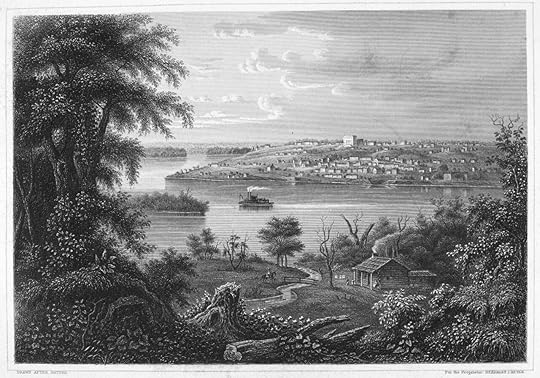
~~A steel engraving, from 1860, of a town on the Illinois banks of the Mississippi River. I imagine Reliance (year 1874) as looking somewhat like this, although the bluffs are described as much higher, with the houses set into them. Imagine (almost) 13 year old Madelyn looking out at expanse of the Mississippi, after living all her life in the rural hills of Eastern Kentucky.
First few sentences: I was three months from thirteen when Mama and I stepped off the carriage in the Mississippi River town of Reliance. We carried between us one tattered carpetbag and a hatbox of balding crushed velvet filled with lace-making and sewing notions. And we carried a marriage proposal from a Mr. Lyman Dryfus.
Madelyn's mother, Rebecca, was desperate when she answered an ad in the Matrimonial Times --the 1800's version of Match.com. She was quick to describe her age (much younger than the mother of a 13 year old should be), and beauty. But she omitted any mention of a daughter completely. So showing up to Mr. Dryfus's door with Madelyn in tow took some explaining. She is described as a younger sister, and Rebecca states that she couldn't possibly leave her behind. Mr. Dryful grudgingly admits Madelyn into his eccentric home, but Madelyn never feels at home there.
Increasingly hurt by her mother's lies, and holding a grudge as only a young teenager can do, Madelyn goes to work for Miss Rose--possibly the most notorious woman in the area. The opening quote shows her being interviewed by the tutor, Mrs. French, employed by Miss Rose. Madelyn expects to get an education in return for helping the nurse care for Miss Rose's elderly father. But she doesn't know just how extensive her education will be. Along with Maddy, we are submerged into highly provocative political topics facing women in the late 1870's--namely, the right to vote, and the increasing demand for control over their own bodies. Miss Rose is determined to give the women of the town access to a "uterine veil" aka diaphragm. How will the next few years unfold for our young protagonist? Read this interesting historical novel to find out!
My two cents: Many of the low reviews for Reliance on Goodreads come from complaints of a "bogged down plot" or "too much going on". I agree that Volmer tried to tackle a lot of heavy topics, and came close to going in over her head. But, in my opinion, she still managed a cohesive story arc. But all that aside, I loved Madelyn. Several reviewers found her unlikable, or thought that her voice wasn't strong enough. However, given her upbringing, and the adversity she faces, I think she did the best she could. I also identified a lot with Rebecca--talk about trying to do the best one can with a tough hand!! Volmer particularly shown as a writer by creating realistic tension between a mother and her teenage daughter, then developing them both (and their relationship) throughout the course of the book. 3 stars for the story, and 4 for the dialogue...averaged to 3.5 stars or "Very Good". Recommended as a library checkout!
~~Since the dawn of time, women have tried to prevent unwanted pregnancies. Diaphragms became popular in the 1800's, especially after cheaper rubber production was available. While "Uterine veil" isn't one of the nicknames listed, I very much like "Mother's friend". https://www.civilwarmed.org/birth-con...
Other favorite quotes: Hiram Cassidy Main, the traveling agent who brought us books, once placed in my hand a white-brown shell the size of a good throwing rack and bade me be still and silent even when something spiny began prickling. Soon I was staring at a sand-colored crab testing its legs against the warm planes of my palm. I used to think of Mama like that crab, hunkering down inside a shell, venturing out tentatively, and never for very long.
~~I think there should be a better word, a bigger word than gratitude --a word that stretches a full page of type and takes at least ten minutes and a lifetime of practice to properly say.
~~Live people can haunt, you see, as well or better than the dead, and in those first weeks, I measured everything I saw or did against what Mama might say or think about it--silly, given that Mama was never one to share what she thought or felt.
~~I followed Mrs. Hardrow into the room, staring at my feet, and still those mirrors caught pieces of me like blackberry thorns.
~~The war, the railroad, the panic. It was odd to hear talk of a time before these things, like hearing of a time before the moon and the sun and the stars.
~~"Only a fool insists on revealing what she knows the moment she learns it, Madelyn. She might as well expel a meal as soon as she consumes it. Let it nourish you first. Digest, Madelyn!"
~~She could not fathom that maybe I did not wish to be seen. Except, perhaps, by William.
~~I thought maybe I did. I thought maybe Mrs. French was as wrong about me as I had been about William. I wasn't like her, wasn't intelligent or kind, didn't have any promise. Ordinary, except ugly. Extraordinarily ugly. She just couldn't see it. This was my fear: that she'd made up someone better than I'd ever be, and when she learned the truth, I'd lose her, too.
I received an unsolicited copy of this book for review by the publisher. This does not affect my opinion of the book or the content of my review.
When I received a copy of this book in the mail, my curiosity was piqued - I hadn't heard anything about this book, and the subject matter (suffrage, reproductive rights) grabbed my attention immediately.
I will admit, some of my disappoint with the book was that I went in thinking it was Young Adult, and it's not. It took my brain some time to reorganize after realizing this!
+ / I did like the subject matter (when it was brought up), and the chemistry between Madelyn & William.
- / Madelyn was not a likeable character for me, nor was anyone really. I found a few of the characters to be indistinguishable from one another, which is a problem for me because I can handle a book that has little plot but GREAT characters (and vice versa) but sadly, it didn't feel like the plot was ever moving and the characters weren't pulling me in.
I wish I had liked this one, but flipping through the last third of the book confirmed that it wasn't going to get any better for me. So I read the last few pages and I'm calling it a day!
Bleh. I'm still trying to figure out what the point of this book was and why I bothered to finish it. While I can enjoy a book that is a "slice of life" story where nothing much happens (I loved "A Spool of Blue Thread"), this one was frustrating because it felt like something--lots of things--were supposed to happen, but nothing really did.
What a pleasure to be an early reader. Mary Volmer offers such lush language -- and this story about nineteenth-century women struggling to achieve the right to vote is so perfect for this election year!
Set in a fictional Mississippi River town in Illinois, just north of St. Louis, in the 1870s, this is a much more subtle feminist historical novel than Alice Hoffman’s Magic Lessons, which I read just prior to this. To me, it feels perceptively historically authentic without being didactic about it. (Magic Lessons was didactic about the history it conveyed but did not feel historically authentic overall.) And it’s told in a first-person narration that’s refreshingly straightforward chronologically. So many secrets our young narrator is asked to keep--and yet it doesn’t feel like one of THAT kind of books. (How many book jackets boast about the secrets the book's characters keep?) It’s mostly very well written--well above average--which makes the occasional clumsy sentence requiring rereading to navigate all the more puzzling. All in all, a very worthwhile read.
Like others, I was drawn to this book because it's set in the 1870s and features a woman fighting for suffrage and birth control. Like others, I wanted to like it more than I did. I also like that we have someone with a "disfiguring" birthmark as our protagonist, instead of someone who doesn't realized her own beauty, etc. (Oh, wait, we have the mom for that.)
But. I didn't like Miss Rose. I didn't feel like rooting for her. I know she's supposed to be complex and not necessarily likeable, but I wanted to believe in her/appreciate her, and I did not. I did really like Maddy's teacher, who wears trousers and does science things. Make the story about those two.
Too many subplots. I have a strong distaste for murder mystery/mysterious dead body stories, and unfortunately, that ended up being central here.
If we could have focused on Maddy's growth as a person and the women's rights theme, it would have been a much stronger story. I loved the lesson on birth control, and all the various women who show up for it.
Volmer offers both a tenderly aching coming-of-age drama and a compelling glimpse into the origin of women’s rights and the suffragist movement in the 1870s. The novel’s narrator and protagonist is Madelyn Branch, a vulnerable, plucky thirteen year old who struggles with the burden of a glaring birthmark that tints half her face. She yearns for self-worth and the hope that someone will see beyond her appearance and learn to love her. When Madelyn’s mother Rebecca accepts a marriage proposal through a newspaper advertisement, they head to the riverside town of Reliance in Illinois. Over the next few years, Madelyn and Rebecca find themselves entwined both in the town’s history and among the secrets of the town’s residents. Madelyn pines for William, an anguished Civil War veteran, and she finds herself privy to details surrounding the mystery of a deceased young girl. The novel’s most memorable sequence of events centers around Madelyn earning a caretaker’s job in the manor of the town’s ailing founder, where she also lands under the mentorship of the founder’s daughter, Miss Rose, a strong-willed and irascible feminist. Volmer’s sure-handed charting of Madelyn’s growth alongside her desires and heartaches allows for an intimate look into a young woman’s burgeoning identity and her struggle to find a place in the world. Volmer’s robust prose lends a poeticism to Madelyn’s voice, and each tightly focused chapter is a delightful experience in Madelyn’s journey to adulthood.
“Reliance, Illinois” is a stealth masterpiece. It starts with Maddy, a complicated teenage girl wrestling with tough circumstances that arise from the grossly unequal status of women in the 1870s. She’s also going through some more familiar struggles like those I went through at her age, wanting to be beautiful and loved, trying to reconcile romantic fiction with reality, and trying to forge her own path in life. As the story moves along, characters grow more layered, and everyone harbors tantalizing secrets. Maddy gets a front row seat to some radical women doing some radical politics. The novel becomes a juicy page-turner … except when an especially lovely line insists the reader linger and read it again. And then, as the story begins to wrap up, it takes a startling turn. Loose threads are tied together in a breathtakingly beautiful plot twist with consequences that push Maddy toward the wise woman she will become.
Favorite line: “Far below at the docks, the scream of the ten-o’clock steamer leaving Reliance; with it I felt the weight of false hope lifting, and the gasping ache rushing to fill its place was, frankly, a relief.”
My name-twin's done me proud once again :-) The characters that she has rolling around in her head are so interesting! They're dreamers; broken but strong and determined and temperamental and loving and faithful and believable! There's a bit of each of them in me. The book is written during the Civil War and hits many of the emotions of that time in the North. Towns were growing and people were moving, trying on new things and holding onto old traditions and values. Volmer hits on these with her thorough character development and plotlines revolving around each of the players, intertwining them when needed to balance the community life of this river town. The books holds to the truth that family doesn't necessarily need to be blood related, but simply joined by the heart.
Moving alongside Maddy* as she reluctantly settles in Reliance was a powerful glimpse into this girl's life. Secrets, small town life, and national issues weave throughout the novel. If you are looking for your next read, pick this one up!
*ps also, totally unrelated to the actual book review itself, but I ADORED Maddy's descriptions of Miss Rose's clothes.
"Through my study window, I can see ladies, two dozen of the hundreds who will march today, Mama there among them, gathering amid the fallen leaves on Harrison Street, adjusting their suffrage sashes, and hatpins, holding their banners strong in the breathless August heat. "Such enthusiasm saddens me some, yet as Rose--my dark eyed, demonstrative Rose--pitches into the room and tugs my arm, I feel also the haunting presence of two women in the host who came before me. Look around you. Look back. This is what I want to tell my daughters, the message I wish to leave behind. Be grateful, but not too grateful for the fragments of the rights due all persons. Remember, justice and change comes hard and slow. Remember that you will have many mothers in this life besides me, all of them flawed. Judge them, judge me, but not too harshly. Carry on, my girls, but guard yourself against the irrational defeats that may yet come."
The perfect ending to an imperfect book.
I picked this book up from the free bin at a book store in hopes to have a deep historical novel. Being an Illinois native, myself, I had high hopes for this book. However, those hopes were dashed when I read that the author is not only born and raised in California, but gave no indication to the fact that she has actually visited Illinois. I know this doesn't mean that the book is immediately trash, but the author did miss a few nuances that locals pick up on (like the fact that Cairo was only mentioned 1 time in passing, and that was the main hub of the area in the set era; that the main method of transportation seemed to be train, not steamship, etc). Looking past this, you will find a spoiled Maddy who seems determined to hold on to the bitterness of her past and infatuation with the mysterious William. And Miss Rose...well that's a whole other topic that I can't dig in to without giving away spoilers. Needless to say, I was annoyed often by these characters.
I will say that Volmer did a fantastic job setting the stage to draw her audience in. Despite myself, I did finish the book because I wanted to know what happened. And I did feel satisfied with the ending. However, it is not a book I would recommend. Especially toward teenagers or younger ages.
Although never explicit, Volmer does not hold back in setting the stage and mentioning basic anatomy. There was also the topic of contraception that appeared, almost unexpectedly out of nowhere, in one of the chapters.
I appreciate Volmer's attempt to write a historical novel about suffrage and freedom for all, but I would recommend that she do more research for her next novel (go visit where you are writing about...even if it is fictitious, get a feel for the area you imagine that town being).
Mary Volmer's Reliance, Illinois is a mostly forgettable novel. Thirteen-year-old Madelyn Branch (defining feature: a massive port wine stain covering half of her body), moves to Reliance with her mother, Rebecca, who for reasons of establishing a marriageable reputation, is transformed into Madelyn's elder sister. (I should add here that the novel is set in 1874.) Madelyn is permitted, just, to reside with the new Mr. and Mrs. Dryfus, but wounded by her mother's lies, Madelyn soon accepts a position with the mysterious Miss Rose, whose forays into women's suffrage are fodder for scandal.
I didn't care much about the characters or most of the plot. I found the storyline baffling at times - I never did fully understand the scandal around the mayoral election - and it felt like the story often flitted between characters and events without much continuity. Samuel Clemens made a guest appearance - the single memorable event in the book, which I'll get to in a moment - but then disappears as quickly and unexpectedly as he arrived. I've rarely disagreed more with the book jacket quote, in this case: "Reliance, Illinois has it all - mystery, politics, war, love, death, and art." The mystery and the politics both felt contrived, and the war was long over. All-in-all, it was pretty meh.
Except.
Except for the one memorable event, when Samuel Clemens expounded on voting rights, thusly: "Give men of education, merit, and property - give such men five, maybe ten votes to every one of your ignorant Joes. As of now, Joe can be made to vote for any cause by anyone who can persuade him through fear or profit to make his mark on the line, even if that cause does damage to him and his family."
Amen, brother.
Never have true - or scarier - words been spoken, further proof, if we needed it, that the more things change, the more they stay the same.
According to the author's notes, Clemens views on voting rights came from a variety of sources, including The Autobiography of Mark Twain. Whether he spoke these exact words, or Volmer crafted them, I cannot say, but, Mr. Clemens, I feel your pain.
I purchased this book at a reading by the author, Mary Volmer.
A fascinating story, set in 1874 on the Mississippi River. The protagonist is a teenage girl of thirteen, Madelyn Branch who pretends to be the younger sister of her beautiful mother, Rebecca, when they arrive in Reliance for her mother’s marriage to a never-met “business man” found in the “Matrimonial Times." Mr. Dryfus is unhappily surprised because he did not expect his new wife to come with a spirited teenager. Maddy has some unique challenges to confront as well as the usual teenage longing to be pretty and loved. Unwanted in her mother’s new relationship, Maddy takes advantage of an opportunity in the household of the eccentric, wealthy Miss Rose becoming both servant and student. As she searches for her own path, she gets involved in social justice issues, radical early “feminist” schemes and faces the realities of romantic love.
The character of Maddy is finely developed. Both she and the secondary characters are drawn with complexity. As the plot unfolds the author reveals yet another secret, keeping the reader fully engaged until the surprising end of the story. With beautiful writing, vivid description and complexity of character and plot, I highly recommend this book.
Facially-disfigured Madelyn, barely into her teens, travels with her mother to the fictional Reconstruction-era town of Reliance, Illinois where her mother will enter into an arranged, lonely-hearts type marriage, passing Maddy off as a sister. It is only the cornerstone deception in what Maddy finds to be a fortress of secrets and ruses constructed by the town’s women, beginning with her mother and encompassing the lowliest servants to the upper crust of society.
The story picks up steam subtly as Maddy, whose deformity it is assumed will limit her options in life, comes to be known for her ability to keep ugly secrets.
When I closed the book I couldn’t help but reflect upon how deception seemed to be almost a requirement for women to survive in society at any level. The men are not immune from lies, omissions, and silences of their own, but it’s the women whose lives hang in precarious balance should their deceptions be revealed. It tautens the theme of suffragism and women’s rights that runs through the book and underlies Maddy’s choices about when to speak out and when to hold her tongue as she navigates a rocky adolescence amid the burden of the secrets she keeps. And like much historical fiction, we’re left to ponder all that still hasn’t changed.
I read an ARC of this novel on my kindle, and I'm hoping that some things changed before going to press. On the kindle, I was always surprised when time jumped forward--there were no spaces or lines between paragraphs or an extra page.
Madelyn defines herself by her facial birthmark and as her mother's daughter so when the rich lady in town offers to educate and "better" her, she jumps at the chance. While keeping secrets about almost everyone in town, Maddie comes of age, falling in love, making friends, and learning more about her family and those around her. The atmosphere is pioneer era small town--Reliance is a fictional town on the Mississippi that missed its chance for a railroad. It's the Sin Society versus the suffragettes who sneak illegal birth control into town, which hits a little too close to home these days. There were bits of literary-ness, while other parts were jarring and crude, and the two didn't mesh together as well as I would have liked, resulting in the 3-star rating.
"Reliance, Illinois" is a wonderful book, and it draws its period, a time soon after the Civil War in fascinating, well-researched detail. And it's full of exciting drama, functioning as a mystery as well as a historical novel. It's set in a fictionalized town on the Mississippi River. The cast of characters includes men and women from all walks of life of that period, and the book evokes particularly well the various lives women led and the ways their choices were confined -- the ways they struggled to succeed and be safe. It follows its main character, a girl called Madelyn Branch, who has begun life with various strikes against her, as she moves through teenage years and into young womanhood, discovering family secrets, growing in knowledge and understanding, and exploring the ways in which women were struggling for parity in a very gender-defined society. The writing is beautiful, and, very much like Hilary Mantel in her historical novels, Volmer enters and depicts the inner life of her main character in deeply moving ways and arresting language.
Reliance, Illinois is just across the river from me just outside of Grafton. I know this place! I know these rivers, the confluence and the wide expanse of water called Alton Lake where sailing is good and enjoyed by many on the weekends. Being familiar with the local geography and history may have been what intrigued me by this book but it wasn't what kept me reading. While I never really like Madelyn the narrator as she was a spoiled, rude, child lacking a self awareness I did enjoy her growth as a character in this failing river town. Madelyn arrives from Kentucky with her mother Rebecca in Reliance in an effort to improve their lives and with a promise of marriage for Rebecca but first they must pass Madelyn off as her sister. This book was a great read for Women's History Month tacking women's rights as the story of the suffragist movement begins to shape the lives of everyone in the town of Reliance.
This book was decent, had good points but really was just kinda angsty and took too long to get to the good intriguing parts.
Basically it's this small southern Illinois town in the late 1800's when a woman and her daughter (who has a huge red birthmark on half her body) move to marry a stranger in town. To do this, the woman must tell everyone the daughter is actually her sister. Which starts it's own string of drama and lies. The move introduces some new characters, a charming but troubled William, who the daughter dramatically pines for, as well as very strong female characters pushing for the right to vote and secretly trying to introduce birth control to the town.
I would recommend it to some, but I think a faster pace or less angsty narrator/perspective would have helped.
Mary Volmer's Reliance, Illinois is an engrossing read. I love that this book is from the perspective of a young protagonist, Madelyn, but the book addresses not one, but several serious topics such as poverty, prostitution, loss, women's rights as they pertain to the getting the vote as well as contraception, and race relations. Mary Volmer does an amazing job at having many well rounded characters who the reader comes to genuinely care for and, in particular, she skillfully weaves in a beautiful story of longing and limitations between Madelyn and her mother. This book won't disappoint. It tugs at your heart and manages to make you think and laugh. I can't wait for Mary Volmer's next book!
I was attracted by the Illinois connection, to be perfectly honest.
The story was somewhat interesting (historical view of women's roles in society and all), but the balance seemed so far off for me. I mean, it was like 270 pages of build-up (establishing who was who, and how they had come into the life of the "main character"'s life)--and then BAM! Tons of revelations and movement for about 25 pages, before the wrap-up conclusion.
But I read the "ARC" version--so perhaps things changed a bit after that? (Long story about how I came across the ARC; as an English teacher, that was almost a bit distracting in itself.) ;-)