All our books are used but in good condition. All books checked carefully for damage before listing.EXCELLENT value for money and ready for dispatch using Amazons fufillment service.We believe you will be completely satisfied with our quick and reliable service. All orders are dispatched as swiftly as possible
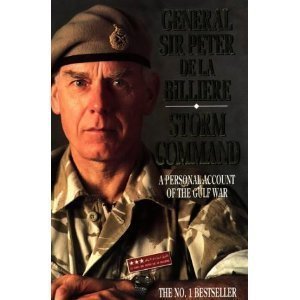
General Sir Peter Edgar de la Cour de la Billière, KCB, KBE, DSO, MC & Bar is a former British soldier, who was Director of the United Kingdom Special Forces during the Iranian Embassy Siege and Commander-in-Chief of the British forces in the 1990 Gulf War.
A few years ago there was something of a vogue for applying the theory of war to business management. Yet military high command is increasingly a matter of applying the theory of business management to war.
An American colonel in Afghanistan criticised his superiors for making war by 'Power Point,' and was promptly sent home for saying so, but no one contradicted him. Sir Peter’s commentary on the First Iraq War or Gulf War, over a decade before, suggests this trend has been developing for some time. His own conflicts in this book take the form of presentations rather than gunfights.
It is important to note that this is a commentary, a personal recollection, not an overall history of the war as a whole. So, while there was serious fighting going on elsewhere, it is not Sir Peter’s function to describe it here – even if he cannot resist including a few exciting second-hand anecdotes. Its value is as a record of what the Deputy Commander-in-Chief of the Coalition and Commander of the British Forces saw, heard, thought, said, and did himself. As such it is fascinating.
The most telling aspect is the contrast between this book, which focuses on a single campaign, and his swashbuckling memoirs, ‘Looking for Trouble,’ where the focus is more on the breath of his earlier career as a junior and field officer with the SAS. In this book, the action takes the form of briefings, formal and informal meetings, lobbying, and telephone conversations – it could be the biography of a high-level corporate executive, except that at the end of the decision-making process, men go into battle.
Such is the nature of modern generalship that Sir Peter’s greatest achievement in the campaign is lobbying successfully for an organisational change which transferred a British armoured brigade to a separate British divisional structure. This might not sound like much of a contribution but it almost certainly saved lives.
It is to his credit that in all the political and bureaucratic manoeuvring, he never loses sight on how the actions of the high command impact on the men in the front line. As one of the most experienced and decorated combat officers of his generation, he has nothing to prove, so he understands his role is to make sure his troops have every possible advantage before the fighting begins and then to keep out of their way.
It is hardly Napoleon at the Bridge of Lodi, but it is an excellent illustration of how modern should be fought. In one respect, Sir Peter and his colleagues were too successful: their campaign tends not be taken seriously by the media because the casualties were, in the end, unexpectedly light – which is, of course, precisely why it deserves to be admired and studied.
An account of the Gulf war from the commander British Forces point of view. Relying on letters sent home daily during the conflict to free Kuwait. These are the shoulders where the service & political requirements rest, add in the co-operation with 30 other countries & an American leader, you have the makings of a total disaster! Fortunately de la Billiere & Scharzkopf are like minded militarily, although one can be brusque whilst the other self demeaning together they work well. This means a mutual trust & respect of each other, allowing for thoroughness in planning & execution of the war. Total trust is expected & achieved. Here then is not the pelmel of each battle, but an overview of what's needed to succeed & the wherewithal to achieve it. I hope he is enjoying the farm life, happy retirement!!!
The author, Commander of the British forces durinng the Gulf War 1991, writes a personal account of the preparations and the operations of these forces. Interesting book to know the problems they had to overcome to put a Division in theatre and fight with the Americans.
This book is about, as the title says, a personal account of the Gulf War. This means that there is very little action and fighting, weather from his SAS days or from Gulf War action. It is also very not the official history of the Gulf War, his personal opinions are clearly laid out. However, he does resist talking to much about his political views. He does, however, spend a lot of time talking about the political effects on the War.
The book is very well written. Unlike other ex-SAS soldiers, his book has no grammatical errors, mistakes and other bad editing. Obviously, this book is not necessarily the same type as other ex-SAS books, but it will be read by the same base, as well as other bases as well, such as people generally interested in the Gulf War. The book has quotes, and is based off, letters he sent to his wife every night, which adds spice and shows how things where at the time.
The book starts with him arriving to the UK, after a trip, where he hears about what's happening in the Gulf. He thinks he is the best person for the job, and puts himself up for it. Getting accepted, he gets sent to the Gulf. In the book, it details how although he was allowed to make his own decisions on the ground - he loves the lazzire fare approach and promotes it throughout the book - he is annoyed how any decision that has a large cost, especially extra troops and motivation, tries to be prevented by cost cutters in the government. Throughout the book it changes from a focus in the beginning on to the political and high ups attitude, to personal accounts from soldiers action on the ground at the end.
In conclusion, it is simulating and interesting, though sometimes a bit long winded.
It was an interesting book and I enjoyed reading it. However, something in this book didn’t feel right. I couldn't put my finger on what it was. It just felt wrong. It's well written. Very interesting. Maybe for the first time ever, I didn't trust everything that was written. Strange, I know, right? Anyways I found it on ebooks on libby, and I have seen as well on borrowbox.
Read it in a horribly bad translation to Norwegian, if I ever shall read it again it will be in the original version. So the only advice from me is stay away from cheap translations. Have no idea about how well it is written in English.
I had the pleasure to work with Sir Peter in Aldershot whilst he was learning butchery of which I taught him. I feel very proud to have known such a great commander, thank you for all your service Sir
Very much a personal account that does not give much in the way of background to the war. It was refreshing to see a non-American viewpoint of this war.
I really enjoyed 'looking for trouble' and hoped this would be similar. Whilst it is an interesting perspective ce and account,ultimately I was left feeling slightly disappointed...his autobiography was really inspiring, but I felt this episode focuses a lot on politics and to be honest I feel it gets lost at times in the placatories of generous remarks various leaders are making about each other at certain times. This may be a have, but I still have a great deal of respect for the author and look forward to exploring his book on the VC..