What do you think?
Rate this book


522 pages, Kindle Edition
First published September 1, 2013
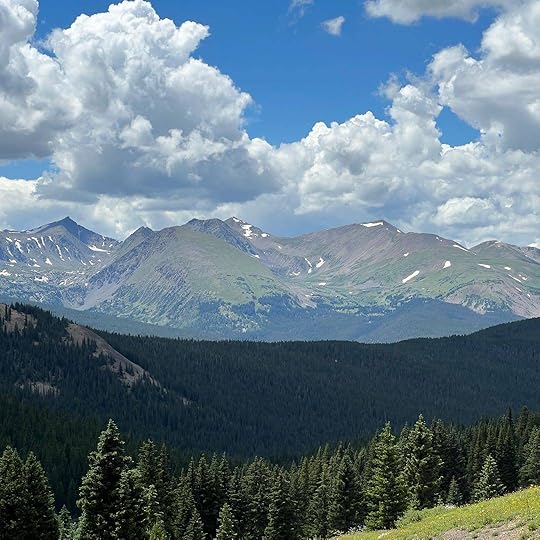
A lot happened in Colorado over a 400-million-year period, from 1.8 to 1.4 billion years ago. And then there is no record for 1 billion years. At the end of this lost record Colorado was flat, until around 300 million years ago (Pennsylvanian period) when the Ancestral Rockies formed. These brought deep ancient rocks to the surface, and then also weathered flat over the next 200 million years. 100 million years ago Colorado was under deep water, accumulating thick deep marine sediments. Then around 70 million years ago Laramide mountain building started working west to east across Wyoming and Colorado, bringing ancient deeply buried rocks up to the surface again, creating most of current assortment of mountain structure, but these mountains were lower than today... like 5000 ft lower. About 25 million years ago all of Colorado and the surrounding region rose up 5000 ft. Before that Colorado's many famous 14,000 ft peaks were 9000 ft peaks. At the same time a deep rift formed between most of the state of Colorado and an area called the Colorado Plateau. The Colorado Plateau is not a mountain range. Incorporating southern Utah, northern Arizona, all of the Grand Canyon, and the west edges of Colorado and New Mexico, it is largely undeformed, just high. The rift is the Rio Grande Rift. This was accompanied by a lot of volcanism (at least through 6 million years ago) that created the San Juan Mountains in western Colorado.
There is a degree of confidence in explaining the Ancestral Rocky and Laramide mountain building phases. But the late phase has no settled explanation. It's largely the kind of activity expected at the end of a tectonic plate, not in the middle.
The authors put it this way: Some geologists proposed that the volcanism was triggered as the North American plate overrode the Pacific plate and part of its midocean ridge by perhaps as much as 1200 miles. If so, friction would have melted great quantities of crustal rock, which then may have risen along old faults to build volcanoes ... Eventually, the subducted plate may have run up against the deep roots of the Rockies and been unable to push farther east, creating the huge forces that brought about regional uplift in Colorado and neighboring states. Development of the San Andreas fault in California may have relieved the pressures and brought on tension, stretching the domed-up area to the breaking point and creating the deep faults associated with the Rio Grande Rift. Those faults, reaching down to the mantle, would have allowed the escape of magma from the mantle--the basalt flows of the Late Phase of volcanism.
A far-fetched story? It may be. It fits the facts, but the facts are too few."