An unlikely friendship develops between Gabrielle Bissonette, who has returned home to wilderness Michigan to care for her father, and Valley, her sister-in-law, as they struggle to cope with the growing rage and violence of Gabrielle's brother, a troubled Vietnam veteran. A first novel. 25,000 first printing.
Screwnomics is now on Ms. Magazine's Blog! Here I am after seeing it LIVE for the first time. Follow my new Ms. Magazine series Women Unscrewing Screwnomics for good news for a change!
ººº
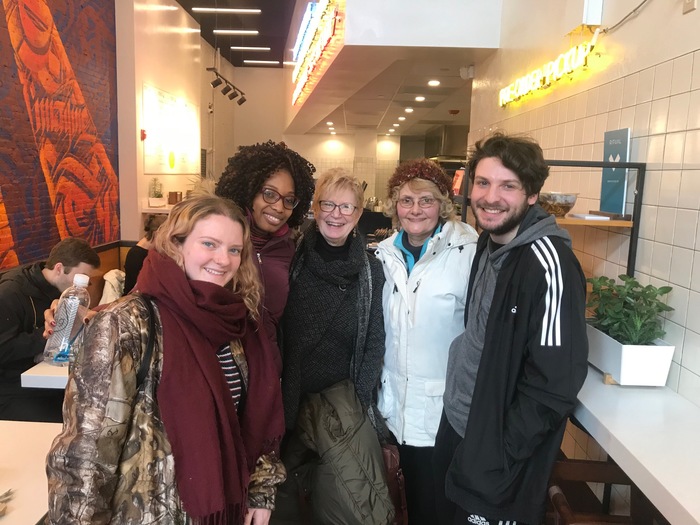
Here I am with a lovely group of attendees after our February 2, 2019 WILPF meet up at the Community Church of Boston.
Rickey Gard Diamond grew up and began writing in the Midwest, in the midst of big political changes and family differences. Pursuing a new life as a single mom, she moved her family to Vermont where she finished college and edited a statewide newspaper on issues of poverty. In 1985, she became founding editor of Vermont Woman, where she continues today as a contributing editor.
She taught writing and literature, feminist and media studies at Vermont College of Norwich University for over 20 years, while publishing articles and short fiction. In 1999, Calyx Books published her novel, Second Sight, which was republished by HarperCollins in 2000. Her short fiction, previously published in literary journals, was put out as a collection titled Whole Worlds Could Pass Away in 2017 by Rootstock Publishing.
She "followed the money" in her journalism, and saw systemic reasons for poverty. Teaching and writing about the uses of language in fiction and non-fiction, she became fascinated by economic "fictions," and presented at the NOW Economic Summit in Atlanta in early 2008, just months before the crash. In 2012, she won a Best Investigative Series from the National Newspaper Association for a five article series titled “An Economy of our Own.” The NNA cited her “atypical sources,” by which, she says, she supposes they meant women.
She was awarded a Hedgebrook fellowship in 2014 to create a book on economics that she envisioned would include cartoons and be readable and even enjoyable. “Economics does include a great deal of funny business,” she says about the subject, pointing out Andrea Dworkin’s famous statement: Money talks. But it talks in a male voice.
Diamond hopes her latest book Screwnomics, which deconstructs the economy’s long sexual history and Wall Street braggadocio, will help change that. Women are already making change
You’ll find many scheduled events on www.screwnomics.org, where you’ll also find a YouTube interview I did with Guy Rathbun, who is at KCBX in California. Screwnomics is fun, he says….which is exactly the point!
Interweaves the experience of a women hunter who is also an adult student trying to complete her degree with a powerful story about family dysfunction and family violence. Gabrielle lives in the Upper Peninsula of Michigan, beautifully rendered in Diamond's rich description, in her father's cabin, saving as much money as she can to finish her degree. The hunting scenes, written atypically from a woman's point of view, are honest and realistic -- Diamond obviously has gone hunting. Shortly before Robert, her brother, is due to get out of prison, his jailhouse bride, Valley, shows up on Gabrielle's doorstep. Gabrielle is utterly unprepared for this vegetarian, hippie girl coming into to her life, while also dreading the release of her brother from prison.
The story is told in two different time periods, one from the Vietnam War era of the early 1970s, and the second from ten years later, looking back. Several threads interweave through the story: Gabrielle's struggle with her final study which is about Ernest Hemingway, a man whose writing she both appreciates and abhors; the mystery of the disappearance years earlier of her mother; her brother's violent and menacing nature: and Gabrielle's unique experience as a woman hunter.
There is much to admire in this first novel as a page-turner, not the least of which is Diamond's rich storytelling language and voice. This book never got its deserved recognition.
Gabe is Gabrielle, a woman who is pursuing a masters in literature. She is recalling events of her past, particularly in 1973/74 when her brother Robert, just released from prison for manslaughter, and his wife Valley come to live with her in her father's cabin. Gabe is divorced, having married Dennis, and grown bored with him. Robert is a Viet Nam veteran, a violent person with a substantial charm. There is much local color here, of the personal and environmental sorts. Gabe describes her hunting outings with a poetic grace. There is a cast of family friends who form a backdrop for the events in question. Diamond shifts back and forth between the mid-80;s when she is studying and the 70's when the real action happens. There are forays to other periods. We learn that her mother abandoned the family and that her father is emotionally very cut off. She unravels thin layers at a time until we get to the core of the tale. There is much here about Hemingway, how she feels about his work, the women in his novels.
Interesting set up to the book, requiring a preview before diving into the story line. A woman attempting to "find herself" after a divorce and while pursuing a Literary Arts Degree. Written on a two-part timeline, one a retrospect and the other in the more recent present - each a ten year gap. I did not find the story line intriguing enough to hold my interest. Troubled family, destructive habits, protagonist spends too much time over thinking her choices. Finished the book in one week, rather than the two or three days more recent (and interesting) stories have taken.