The epic journey of Ogami Itto and Daigoro continues in this stunning volume! A female yakuza and her band are ordered to catch Lone Wolf and Cub, but the authorities aren't counting on a woman's heart. Meanwhile, the Yagyu have called in Japan's most deadly bounty hunters, and offer an even greater reward — can the Lone Wolf trust anyone around him, when the lure of wealth tempts even seemingly harmless peasant folk? And with Daigoro feverish and near death's door, can Lone Wolf and Cub make it through a winter gale to safety?
This volume contains the following To a Tomorrow That Never Comes Bounty Demons The Will of the Fang When the Wolf Comes Life in Death
Kazuo Koike (小池一夫, Koike Kazuo) was a prolific Japanese manga writer, novelist and entrepreneur.
Early in Koike's career, he studied under Golgo 13 creator Takao Saito and served as a writer on the series.
Koike, along with artist Goseki Kojima, made the manga Kozure Okami (Lone Wolf and Cub), and Koike also contributed to the scripts for the 1970s film adaptations of the series, which starred famous Japanese actor Tomisaburo Wakayama. Koike and Kojima became known as the "Golden Duo" because of the success of Lone Wolf and Cub.
Another series written by Koike, Crying Freeman, which was illustrated by Ryoichi Ikegami, was adapted into a 1995 live-action film by French director Christophe Gans.
Kazuo Koike started the Gekika Sonjuku, a college course meant to teach people how to be mangaka.
In addition to his more violent, action-oriented manga, Koike, an avid golfer, has also written golf manga.
The long and winding road [Meifumado] that leads to revenge offers no respite for the fugitive samurai Ogami Itto or for his three year old son, Daigoro. This road has recently turned a lot more crowded and a lot more vicious after their powerful adversary, the Yagyu clan, has decided to be done with secrecy and put a sizeable bounty on the heads of the Lone Wolf and his cub. Now every bounty hunter in the realm, every border garrison and every peasant who wants to escape poverty is ready to do anything in their power for the promised gold.
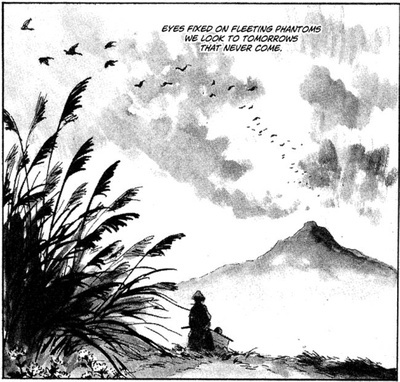
Though tears can be hidden All hearts break Starlight seeps into the bones Blood runs dry in frozen hearts And night descends On tangled fields. A homeless journey Beyond dark fate Lament of wildflowers Moan of wind Blooming in shadows Hell’s sweet blossoms. Eyes fixed on fleeting phantoms We look for tomorrows That never come.
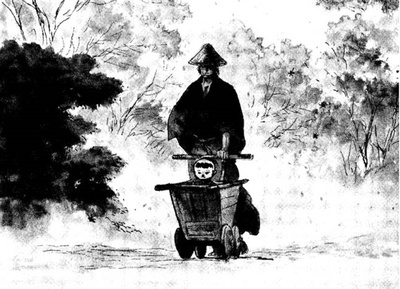
I have read these albums twice over: first time a little faster to get the story and the second time when I prepare to review, paying more attention to the artwork and to the cultural aspects. I find this very rewarding and often it convinces me to raise my rating from four stars to five, as in the present collection that starts with an amazing dialogue between image and text: a lonely road in autumn with the by now emblematic silhouettes of pensive warrior and cart with child black against the sky.
To a Tomorrow That Never Comes is a quote from the poem I quoted earlier about the endless journey of Ogami Itto across medieval Japan. By now, almost every place he visits is decorated with posters of him and of Daigoro, stating the sum of money to be paid for their capture or for information about their whereabouts. Fast couriers on horse spread the news of each and every sighting of the duo.
Still, Ogami Itto can find unexpected allies on his road, other outcasts who feel either threatened or inspired by his quest or by his dedication to bushido. More often than not, such helpful hands end up dead when the hunters catch up with their prey. Lone Wolf usually escapes from such confrontations, due to his skill with a battle sword and to his complete disregard for death. But the others are not under the dubious protection of the demons of Meifumado.
Bounty Demons presents the most famous hunters in the realm being invited to the Yagyu compound and offered an even bigger reward for catching Lone Wolf. The hunters gather at a lonely hut in the middle of winter, on the main road to Edo, because they know Ogami Itto will not try to hide from his pursuers.
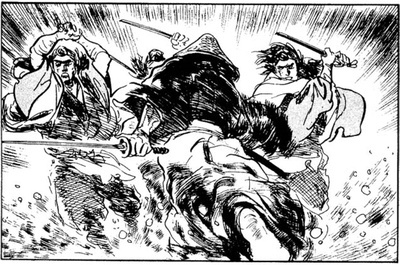
Each bounty hunter has a weapon-of-choice that he is proficient with, reminding me of earlier albums that showcased the Edo period armoury and how it is put to use against the Lone Wolf. I don’t think it is a major spoiler to say that the journey doesn’t end here, except for the over-confident bounty hunters.
The Will of the Fang is a more standard type of Lone Wolf story, as it basically describes a duel with another renowned samurai – this time a former student and friend of Ogami Itto from the period when he was the shogun’s executioner. This former friend now rides in full battle armour at the head of his clan when border signals announce the entrance of the fugitives on his territory.
Concerns of honour and of discipline still apply even when the odds are one man against an army in armour and on horseback. [And, honestly, these odds are becoming ridiculous and the main reason I considered only four stars in my review]
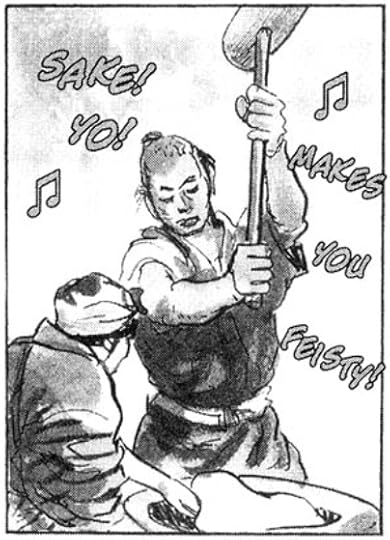
When the Wolf Comes has once again a winter setting, and for once it is a scene of laughter and companionship as some villagers sing and work preparing a traditional rice cake. Messengers bring to the village the news that Lone Wolf is in the area and that government troops are searching for him.
The villagers are tempted to win the money for themselves, a sum that will guarantee that they will survive a harsh winter. Knowing they are no match to the famous swordsman, they prepare a careful trap, hoping they can do with kindness and with a fake smile what many men with swords could not achieve. Letting the wolf come in among the sheep may have unexpected consequences, though.
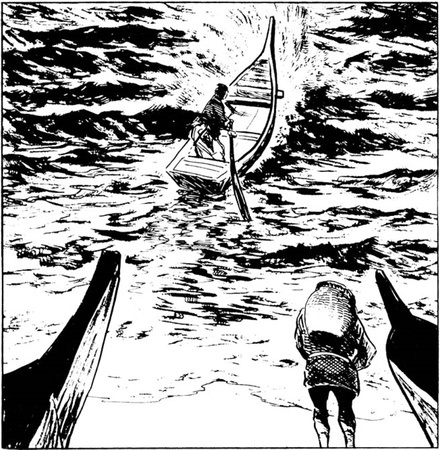
Life in Death Sickness may achieve what steel could not. Winter and exhaustion from the endless journey have put Daigoro to bed with pneumonia. Hiding in a cave in the mountains, Ogami Itto can do little but watch as his child wastes away, refusing food. He is still a loving father though, and when the child expresses a wish for oranges, he is ready to do anything to get them, even riding out to sea in the middle of a blizzard.
But will his efforts be enough to turn the odds? We will not find out until the next album.
I thought that I'll reserve this to the last volumes of the series, but The Will of the Fang is my most favorite volume of Lone Wolf and Cub yet. The eponymous chapter in this book is the best chapter that I have read so far. Here, Itto Ogami has shown a side of him that readers haven't seen and felt so far. I won't spoil it with you, but many will agree that they have been moved by both the action and the silent parts of this chapter.
Life in Death is a chapter for fathers. Damn, to think that Ogami went that far? The thought is almost inconceivable as it is impossible. Sad, impressive and truly a celebration of life in death.
With the other two equally engrossing chapters, volume 17 clearly shows that Itto and Daigoro takes a toll on the path they are walking, with everybody, the village, bounty hunters, soldiers alike, hunt him to the edge of Japan. The series as a whole is a truly remarkable manga, a literature that everybody must read.
Warmly delicate shading gives way to a ferocious intensity of energy that never seems to wane here in Vol. 17. Instead, a truly waxing current of electrifying violence sloughs off its typified hackneyed veneers with expertly applied human emotion and the connectives it entails. Amazingly derived from the human nature we all share, what is deeply imbedded within, is exposited in stories that are supremely enjoyable as they are warm to the touch.
Resonating at numerous levels, clearly well-done historical research imbues tales that seem just as fresh as yesteryears. Whether its yet another landscape crushing in its inherent latencies, or the bone and metal searing alike Dotanuki of Ogammi Itto’s deft sword-work, each and every page revels in the seminal.
Still roaring with the nigh perfection of Vol. 15, echoes of excellence here have lost little if any of that energy in its degenerative rotations henceforth. Another near flawless collection is the result.
Doğa olayları, yüz ifadeleri ve hikayeler her zamanki gibi muhteşem. Yani nasıl bir çizer karakalem, hiç renk olmadan yağmuru, karı, karanlığı bu kadar güzel betimler. Yüz ifadelerini bu kadar başarılı bir şekilde kağıda döker. Nasıl bir yazar bizi alır feodal Japonya'ya götürür. Sayısız ölüm görmüş biri ile üç yaşında masum yavrusunun hikayesine çeker. Her cilt beni ayrı kendine hayran bırakıyor.
Mesela "Aranıyor" ilanlarındakiler Ogami Itto ve Daigoro, ama aynı zamanda tasvire dayalı başarısız çizimler. Nasıl aynı iki kişi böyle hem başarılı hem başarısız çizilebilir.
Bu sefer "Dişlerin İradesi"nde Otami Itto ile Daigorocuğuma birşey olacak diye çok korktum. Lütfen 168. sayfada Daigoro'nun yüz ifadesine bakın. Babasının sırtında sayısız kez ölüme atılan 3 yaşında bir çocuğun ilk kez ölümle burun buruna geldiğinde takınacağı ifadeyi göreceksiniz.
Hikaye öyle "controversial" ki bir yandan Ogami'ye üç yaşında bir çocuk için o Meifumado'yu seçti deyip canını tehlikeye attı diye kızıyorum, diğer yandan ateşi çıkan Daigoro Mikan portakalı istedi diye dağları denizleri aşıp dondurucu soğukta okyanus ortasında küçük bir kayıkta geçen yabancı gemileri bekledi diye hayran kalıyorum.
Neyse, "Kurt Geldiğinde" hikayesinde köylünün her yerde aynı köylü olduğunu bir kez daha gördüm. 28 köyün birleşip Ogami Itto'yu ve Daigorocuğumu öldürmek için yaptıkları zavallı, acınası planlar, hareketler... Her yerde aynı köylü kaypaklığı, kurnazlığı, kendini akıllı sanması... Kolluk kuvvetlerini kandırrma çabası... Ve Daigorocuğumun içinde bulundukları kulübeyi ateşe vermek için fırlattıkları kozalakları alıp yaptığı kardan adama göz diye koyması. Tek kelimeyle olağanüstü bir hikaye detayı.
O kadar inanılmaz bir seri ki hala animesinin olmamasına inanamıyorum. Keşke Rurouni Kenshin, Samurai Champloo tadında renkli bir şekilde animesini izleseydik. Usta bir elde muhteşem bir iş çıkardı, eminim.
"Ölümün İçinde Yaşam" hikayesinde de yetersiz beslenme, hastalık, yorgunluk ve zatürre riski Daigorocuğumu bitap bırakıyor. Babası üç günlük ömrü kaldı diye düşünüyor ki bunu hissetmek bile bir babayı 30 yıl yaşlandırır. Bu hikayede de bir babanın oğlu için yapamayacağı hiçbirşeyin olmadığını görüyorsunuz. Daigoro da iyileşip babasına kalan portakaldan veriyor. Gözlerde yaş, pıt.
Bitmesin diye idareli okuyorum ama bir gün bitecek, biliyorum.
This may well be the most surprising volume of Lone Wolf and Cub to date. We have seen the devotion of Ogami Itto and his son Daigoro to the path of vengeance they have have undertaken, eschewing all that is human in order to follow the way of meifumado. Devoted only to his quest for vengeance, Itto seems to have forgotten all of the trappings of his former life and truly acts the role of a demon incarnate, a whirlwind of death and destruction. True, there have been quieter moments for both father and son, and times when they have interceded in the lives of others in benevolent ways, but underneath even their most seemingly altruistic actions has always lain the will of cold steel that drives them on. In this volume that facade begins to crack and even the taciturn Lone Wolf shows that a human heart still beats in his chest.
“To a Tomorrow that Never Comes”: The country is on fire with the news of the bounty on the heads of Lone Wolf and Cub. A travelling group of yakuza learns of the news and their beautiful young leader makes a surprising decision: they will help Lone Wolf and Cub to escape the dragnet that is being organized to pull them in. Not everyone in the group agrees with their leader’s plan, however, and when matters start to go south will she side with her clan or with Lone Wolf, and what connection does she have with the lone assassin?
“Bounty Demons”: The price for Ogami Itto and his son Daigoro has been raised a hundredfold and the most notorious bounty hunters in Tokugawa-era Japan are eager to claim the prize that could set them up for life. What will happen when three notorious groups of hunters each decide to follow the same plan of attack in their search for Lone Wolf and Cub? Will they be able to work together to take down the infamous assassin, or will they kill each other first? Or will one group be clever enough to play their opponents against each other and Itto in order to win? One thing is certain: none of them can succeed if they underestimate the assassin and even his seemingly helpless son.
“The Will of the Fang”: On his way to Edo, Itto passes through the Kamifusa Sanuki han, whose forces have been mobilized at the order of the Shogun to bring down the notorious assassin. Itto will not relent in the face of any opposition, even when it means that he must face his former pupil, now the daimyo of the han, in single combat if he wishes to proceed. This is a story that gives us another rare glimpse into the life Itto had before everything was taken from him and the result of the duel was, for me at least, a shocking example of the true price Itto has had to pay in the name of his quest, a price perhaps not as easily undertaken as his normally reserved demeanor would lead us to expect.
“When the Wolf Comes”: the king’s ransom being offered for Ogami Itto has even led the peasants of poor villages to stake all in the hopes of overcoming the relentless assassin through sheer numbers and surprise if not through skill of arms. Can the plan formed by one such group of peasants who hear that the assassin is nearing their village possibly defeat the assassin that has laid waste to armies and skilled fighters by the score? What if the local authorities swoop in to capture the prize just when the peasants are on the verge of success? Will the lowest of the low prevail, or will they once again be caught between the hammer and the anvil of forces outside their control?
“Life in Death”: The harsh circumstances of their fugitive life have taken their toll on Daigoro. Exhaustion, hunger, and privation have left their mark on the three-year-old boy, leaving him at death’s door. Itto offers his life to the demons of meifumado in exchange for his son’s life and, driven to distraction by his imminent loss, goes on a seemingly hopeless quest in order to try and save his boy’s life.
Sometimes it can seem that Ogami Itto is merely a superhuman tool of destruction. Single-minded in his search for vengeance, he even goes so far as to drag his infant son into a life of danger and hardship. And yet, for all that many of the stories in the saga of Lone Wolf and Cub can be seen as panoplies of violence, mere set pieces showing off Itto’s martial skill and unrelenting will, there are still many wonderful tales of humanity to be found in these volumes. Most often these glimpses come from Daigoro, a strange child used to violence, but not yet consumed by it; or in the secondary characters whose lives cross paths with the assassins and whose acts of kindness, venality, or pathos show us the wider range of human experience. Yet this volume shines in its ability to show us how even Ogami Itto, the infamous and seemingly unbeatable Lone Wolf, is himself still human after all. A man stretched to the limit, we see how much he relies on his son to maintain this tenuous connection to humanity and how deeply he cherishes the memories of his human life even as he has been forced to forsake them in order to achieve his hopeless quest.
Entiendo que la idea es hacer ver al Lobo Solitario como este Samurai imparable, pero digamos que hay un cierto punto en que más que sonar increíble, empieza a sonar ridículo. Aun así la historia avanza bien, y las secuencias del paso en la montaña, y los de la aldea que hace Sake/Mochi fascinantes.
La historia de la líder de los del sombrero, que en teoría es romántica, pero es también tiránica. Y la verdad esperaba más de los cazarecompensas.
Con la gran recompensa que Yagyu puso sobre la cabeza de lobo y su cachorro, es un todos contra todos y la gente está haciendo fila para tratar de matar a estos dos personajes. Es interesante y vemos más del trabajo en equipo de ambos personajes, es increíble como funciona el honor de un es samurái y lo que vivir en Meifumado significa tanto para Itto como para Daigoro. Igual tenemos el formato de historias cortas y se sienten distintas a lo que habíamos estado viendo porque ahora que todos quieren cazarlos los personajes tienen que ser más cuidadosos. La última historia nos muestra a Itto buscando unas mandarinas para Daigoro que está enfermo y muriendo, una historia muy emotiva que fue de mis favoritas de este tomo.
More Lone Wolf and Cub trekking towards Edo. Little plot movement but there are some interesting stories in the mix about various members of the underworld and peasantry helping or hindering them. To a Tomorrow That Never Comes focuses on the honor of the yakuza. Bounty Demons was a fun standout where three teams of bounty hunters decide to work together to take on Ogami. When the Wolf Comes shows the efforts of a group of villages to get Ogami's bounty and pay their taxes.
The Will of the Fang is an emotional maelstrom of violence when Ogami's former student comes out against him. It has one of the most striking scenes in the entire series, but is also a story where the truncated, episodic narrative with few recurring characters weakens it. I would've appreciated the student's introduction much earlier in the series.
Life in Death is the other story with character development. Daigoro is sick. Ogami struggles to take care of him while they're on the lam.
The Will of the Fang and Life in Death are worth reading again in the future, so 4/5 stars.
Ogami Itto e di suo figlio Daigoro, che non trovano tregua sulla tortuosa e pericolosa strada di Meifumado. Dopo che il clan Yagyu ha messo una taglia considerevole sulle loro teste, la strada è diventata più affollata e feroce, con ogni cacciatore di taglie, guarnigione di confine e contadino desideroso di ottenere la ricompensa in oro.
Ho letto questo albo due volte: la prima volta in modo più veloce per capire la storia e la seconda volta con maggior attenzione all'artwork e agli aspetti culturali. Questa seconda lettura mi ha convinto a dare una valutazione più alta al fumetto, passando da quattro a cinque stelle, come in questa raccolta. L'album si apre con un dialogo sorprendente tra immagine e testo: una strada solitaria in autunno con le sagome iconiche di guerrieri pensierosi e un carro con un bambino nero, il che ho trovato molto gratificante.
I'm hesitant, but for now I give this volume 5 stars as it definitely stands above the most recent volumes I've read. All the stories run together with no "filler," and the stakes seem real. Despite knowing there is so much story left, Ogami and Daigoro repeatedly seem vulnerable, as showcased by the willingness to accept the Yakuza's help, Ogami's emotions over his former student, and Ogami's prayers to demons in relation to Daigoro's waning health. A really well-done volume that pulls back the curtains and shines a light on all the characters' emotionality.
Another superb entry in the series that finds Lone Wolf & Cub making their journey to the Japanese capital, Edo, only to encounter many dangers along the way, especially since a giant bounty has been put on their heads. Koike crafts another brutal tale as Itto & Diagora make their journey, encountering help and harm along the way. He doesn't skimp on the drama, especially when Diagora gets sick. It is matched by Goseki Kojima's gorgeous art, crisply realistic yet brutal. One of the best manga series ever.
Yagyu has given up pursuing Ogami Itto in quote-unquote "honorable" ways and has put a bounty on his head. Now bounty hunters and even everyday people are coming after Itto. Despite being on the demon path, Itto finally begins to show remorse for what he has to do.
One of the best volumes, especially the last two chapters. The villagers making plans to kill Lone Wolf and Cub and we get to see how much Ogami cares for his cub Diagoro when he's sick. Great series.
Another great installment of Lone Wolf & Cub, this one very action packed. I keep cracking up reading these because I am also watching The Mandalorian and the influence is so clear.
Idk what it is, I just am more into tragedies these days, and there's plenty tragic about these stories. Still, I feel like there's a mystical element missing.
Die Jagd auf den einsamen Wolf wird nun intensiver. Die Belohnung, die die Yagyu nun bieten, kann niemand mehr ignorieren: Soviel Geld hat kaum einer bisher gesehen. Dies ruft die unterschiedlichsten Jäger auf den Plan.
Besonders interessant fand ich daher die Folge "Bounty Demons", die durch die interessanten Kopfgeldjäger sehr viel Atmosphäre trägt.
Auffallend: in zwei der Geschichten zeigt Ogami Itto Gefühle; einmal für einen ehemaligen Schüler und dann für seinen Sohn, den er dann doch lieber am Leben sieht als im Meifumado. Erstmals in der Reihe ist dies in dieser Form der Fall.
Ich hatte vorhergesagt, dass nach dem letzten atemberaubenden Band das Tempo nun wieder herausgenommen wird; und in Bezug auf die Kerngeschichte und den Yagyu-Brief ist das auch der Fall. Dafür wird man aber mit dermaßen viel Blut in den Kämpfen entschädigt, wie man es seit einigen Bänden nicht mehr gesehen hat.
I have the feeling that this is one of those series you have to had read almost the whole way through to have it make sense. Then again, I'm not sure - going off the volumes I've read - I could take seventeen closely packed (I'm serious, the books are SMALL, and considering how detailed the linework is that's not necessarily a good thing. Eyestrain ahoy!) volumes, which all presumably consist of "Guy and son travelling somewhere, their journey interrupted occasionally for a bloodbath." I have a feeling I might put up with it if I knew what was going on, but really - I approve of journeys+bloodbaths, but this feels repetitious and flat to me.
The hunt continues. It's interesting how the series heats up as the bounty increases. There are enough twists to make it interesting and things get more desperate.
Chapter 85 "The Will of the Fang" and chapter 87 "Life in Death" are possibly my favorite chapters in this series so far. Both works are very moving. Plus they serve as great depictions of Bushido.