There is much to discuss in Elizabeth Hay's novel His Whole Life. Where to begin is the first puzzle. How can a person who is only 15 years old be considered to have had his whole life? Perhaps the title suggests that the novel is only meant to trace Jim's life to date, his whole life up to the age of 15. Let's look at an early and obvious phrase that leaps from the page. A child named Jim, who turns out to be the protagonist of the novel, asks his parents "what is the worst thing you have ever done?" An interesting question for a young boy to ask. As we read through the novel we discover that Jim is a boy beyond his chronological age. In fact, at times he is more mature and grounded than either of his parents.
Nevertheless, I think the best place to begin this ramble is at the end of the novel. Its last sentence contains multitudes of possibilities and demands the reader to both reflect back on the novel and gaze forward into the novel's unwritten future to the life that Jim has yet to meet. To reflect on the title once again, to realize that as a 15 year old, Jim still has his whole life ahead of him.
The final words of the novel are:
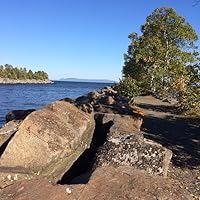
--- yet everything was changing. Jim put his hand around her, closing briefly the space that was opening between them. All morning the leaves kept falling on their lake of bays.
Here we find the essence of the novel. As a fifteen year old, Jim is at the stage of life where everything is indeed changing. Change is the central troupe of the novel. From one's health, to one's relationships with parents, relatives, and even friends, Jim experiences both the long drawn out march of change and change that occurs with lightning speed. These changes are mirrored within the context of historical events that occur within the time frame of this novel. The novel is set in the mid 1990's when the possibility of Quebec separating from Canada was headline news. As the referendum question lurched its way towards the vote that would determine the fate and future of Canada, so the lives of Jim and his parents stumble towards their collective and individual futures. The vote to remain in Canada was razor thin; the fate of the Jim is left unclear at the end of the novel.
It is instructive to pay closer attention to the ending in order to appreciate how creative and suggestive it is. When Hay writes that Jim's arm closed briefly "the space that was opening between them" we realize that love can be both enduring and fleeting. Jim will move away from his mother. Loss is a part of life and the amount of loss that the mother and son have endured has both brought them together and also made them aware that they will, at some time, necessarily move away from each other. This concept of bonds that exist and bonds that will be broken is consistently reinforced throughout the novel. For example, if we take a look at the dogs that are part of Jim's life we see how with each loss of a dog Jim not only mourns a loss but also gains an important insight into the world.for example, when Jim's dog Moon is found dead, Jim mourns its loss. In a wonderfully evocative metaphor, Hay has Jim look at the moon and come to the realization that the lunar moon is an object that is at some times full, then has chunks bitten from it until it is almost gone, only to add parts until the moon is again seen full and round in the night sky. What Hay has accomplished with this metaphor is to transform the fact that Jim's dog was partially eaten into an understanding of how the greater world works. Thus, for each loss Jim learns there will be a renewal and for each pain there will come a pleasure and for each step in his painful adolescent growth will come an understanding. This understanding may be raw and may even be incomplete, but we realize that just as the moon seems to magically heal itself, so can an individual.
I was surprised at the number of times the idea of loss and then renewal or understanding and insight was repeated. Everything from trees that are blown down, to crops and flowers, to relationships between individuals and families, to the French-English backdrop of history in this novel get repeated and repeated again. I think Hay could have used fewer examples coupled with a longer exploration of meaning and insight for better effect in the novel. There is, however, no question that Hay's prose, her ability to draw effective images in the reader's mind, and to please the reader with evocative style is consistent and impressive. One of my favourite sentences in the novel was the final one. Its rich denseness of image and purpose coupled with a subtle phrasing was remarkable. The last sentence "All morning the leaves kept falling on their lake of bays" can be unpacked in many ways. The lake has been the place where the family were headed when Jim first asked his question "what is the worst thing you have ever done?" Now, at the end of the novel, we find ourselves back again at the lake. In the interval we have experienced an entire novel of revelations of people's actions that are misplaced, wrong, hurtful, morally suspect and perhaps even evil at times. The "leaves kept falling." The leaves are suggestive of people's actions. The people in the novel all seemed to drop surprises, pain, and distress on one another. We are told that these leaves fall into "their lake of bays." For Nan and Jim, as they hold each other closer, even as they know that there is a space widening between them, they can watch their lives in the movement of the leaves. Life keep falling for them as well.
When I consider the phrase "lake of bays" I see the novel in its entirety. A lake is an expanse, and Jim's experiences on the lake have been exhilarating, informative and, at times, sad and frightening. Each of these experiences has, however, helped inform Jim of the world he lives in. A bay within the topography of a lake is an indent, an inlet, an imperfection within the space of a lake. All lakes have bays as all people have flaws. Everyone has a metaphorical lake of bays. As Jim and his mother hold each other and watch the leaves fall into the lake they are actually watching their past and their future lives. Nan and Jim both hold on to each other and, by necessity, are at the same time in the act of letting go.
Consider the title --His Whole Life -- this novel is not Jim's whole life as he is only fifteen at the end of the novel. On the other hand, it is Jim's whole life because within the short span of time that this novel encompasses he has experienced life and death, love and hate, compassion and revenge. The historical template of Canada's referendum shadows the events of this novel.
Could it be that Elizabeth Hay is asking her readers if Jim's life will be any more secure than Canada's?