A history of American popular taste in art, architecture, and interior decoration, with short sketches of the men and women responsible for the trends.
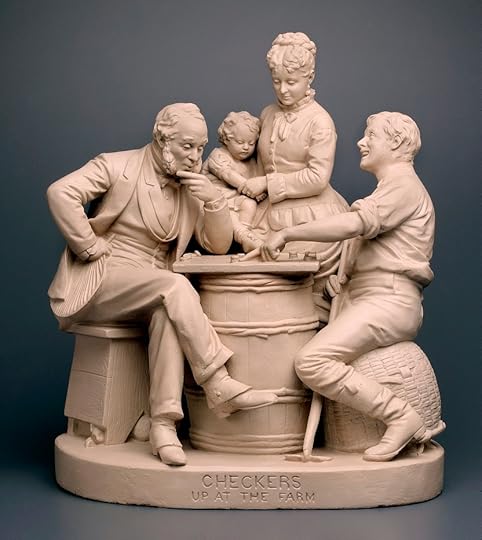
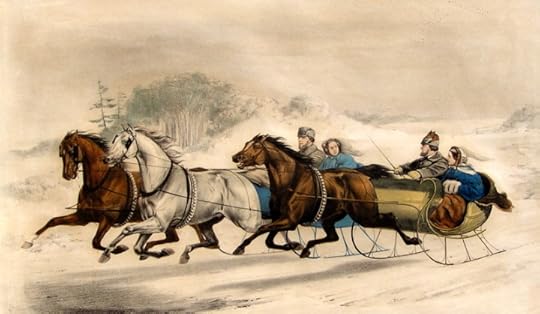
The Tastemakers is relevant now only as historical artifact, as it covers approximately the century from 1850 to 1950 in detailing American tastes for architecture, art, and design. Americans dallied with Greek revival style, the gingerbread-cutesy Gothic of Andrew Jackson Downing, and concrete modernist structures, each style claiming to be more authentic and honest than what preceded it (there is always an overtone of morality that comes with taste, Lynes instructs). As the 1940s closed, the ranch house and its variations reigned supreme. America was exceedingly slow to embrace high art, preferring the banality of John Rogers' sculpture and Currier & Ives prints, which were the Thomas Kinkades of their day - produced in a factory and hand-colored on the premises by employees.
John Rogers, "Checkers Up at the Farm"
Currier & Ives, "Oh Yeah We On, Bitch."
Marcel Duchamp's "Nude Descending a Staircase" at the New York Armory Show of 1913 shocked the massive crowds who thronged to see it and inspired countless cartoons and mockeries ("an explosion in a shingle factory," one wag called the Cubist painting). The exhibit was supposed to get Americans interested in American art, but the bulk of paintings bought were by Europeans, including Van Gogh, Gauguin, Cezanne, Picasso, and Matisse.
One of the chapters is Lynes's famous essay "Highbrow, Lowbrow, Middlebrow," which explains what men (and trust me, it's all about men in Lynes's telling) fit in these categories circa 1949. The highbrow man listens to Bach, late Beethoven, Schoenberg, Bartok, and jazz - thus if he has any cultural alliance with another brow it's with lowbrow, rather than middlebrow, which he detests. Instead of having an oenophile recommend the best French wine, he tries to find a good red table wine, which is more difficult. He buys an Eames chair and never washes his salad bowl. The middlebrow man goes to foreign films, reads Toynbee, and never calls curtains drapes. (For today's middlebrow person, I would revise that to: watches Ken Burns miniseries, reads David McCullough, and never calls a woman "a gal.")
Lynes concludes by telling the reader not to worry about taste. No one knows what good taste is, or what bad taste is. The point should be to please yourself.
Define a highbrow : A person who sees a sausage, we're told in jest, and instantly thinks of Picasso. Pub c 1950, this consideration of American taste is a dinosaur today; out-of-date. Its value is historic. The chapter on the 1913 Armory Show is a ripping report. The photos throughout are revealing. Best chapter, as GR says, is "Highbrow, Lowbrow, Middlebrow" -- perhaps, cos the author is so middlebrow himself. He describes movie producers and art dealers as upper middlebrows. Huhhh? Whoooo? - I assume he's being ironic when he bows to the pretentious wind chimes of art critic Clement Greenberg. Author is correct when he observes that a highbrow is devoid of humor : "He will not tolerate frivolity where the arts are concerned." Which is why the Greenbergians fainted when Pop Art exploded in the 60s.
Author neglects movies-tv as shapers of not only American, but also international taste. Maybe that's another book. The good stuff here is pre-1920s. He reminds us that Thomas Love Peacock wrote (1817) : "No gentleman would be so rash as to have a taste of his own."
This attempt to describe who creates fashions of taste in the American public, and how they do it, is interesting from a historical and sociological perspective, but completely outdated. First, the book was published in the 1950s (my copy, off my parents’ bookshelf, is a 1955 edition). Secondly, Lynes chooses to focus on the 1800s, when fashion and taste centered on completely different arenas than they do today. As a result, most of the discussion is about fine art and architecture, areas which are, at best, peripheral to any evaluation of taste today. The attention paid to the development of architectural styles in the 1800s is meaningless to pretty much anyone today except students of architecture. In the discussion of fine art, the modern reader will at least recognize a few names (Currier and Ives, for example), and some more when he gets to the early 1900s. Most interesting in this section (more than the first half of the book) is the fact that the concept of a public art gallery had to be forced on an uncomprehending public. Still, to the modern reader, there is clearly much missing. Because it is so focused on looking back, the book almost completely ignores the prime objects of taste today — movies and music. (The early 50s publication date excuses the ignoring of television.) Nonetheless, there is a primary theme which applies to today’s world of taste. Matters of taste are only relevant when fashion changes. And it is the “tastemakers” of the title who initiate those changes, and encourage the public to adopt them. This is the key to the discussion of architecture in the 1800s. Every new style had some proponent telling the public (through books and magazines) that the new style was superior to the previous one. Compare this to today’s movie and music scenes (not to mention clothes and cars), where there is always someone, whether in the business or the press, telling us that new is better, and you have to get the latest, the newest, the now hip. In conclusion, although there are interesting, and relevant aspects of this book, I can really only recommend it if you are interested in 1800s architecture and the changes in the art world from 1850 - 1920. Otherwise, much of it will only bore you.
80% of the value of this book is in the second-to-last chapter, "Highbrow, Middlebrow, Lowbrow." (Lynes did not invent the terms but he did popularize them.) And 80% of the value of that chapter is in the accompanying chart.
interesting nuggets, but boring and dull for the most part. I'd have been more interested if this history of American tastes in art and decor hadn't ended around WW2.