

What do you think?

Chaos Imagined: Literature, Art, Science
The stories we tell in our attempt to make sense of the world―our myths and religion, literature and philosophy, science and art―are the comforting vehicles we use to transmit ideas of order. But beneath the quest for order lies the uneasy dread of fundamental disorder. True chaos is hard to imagine and even harder to represent. In this book, Martin Meisel considers the long effort to conjure, depict, and rationalize extreme disorder, with all the passion, excitement, and compromises the act provokes.
Meisel builds a rough history from major social, psychological, and cosmological turning points in the imagining of chaos. He uses examples from literature, philosophy, painting, graphic art, science, linguistics, music, and film, particularly exploring the remarkable shift in the eighteenth and nineteenth centuries from conceiving of chaos as disruptive to celebrating its liberating and energizing potential. Discussions of Sophocles, Plato, Lucretius, Calderon, Milton, Haydn, Blake, Faraday, Chekhov, Faulkner, Wells, and Beckett, among others, are matched with incisive readings of art by Brueghel, Rubens, Goya, Turner, Dix, Dada, and the futurists. Meisel addresses the revolution in mapping energy and entropy and the manifold effect of thermodynamics. He then uses this chaotic frame to elaborate on purpose, mortality, meaning, and mind.
Meisel builds a rough history from major social, psychological, and cosmological turning points in the imagining of chaos. He uses examples from literature, philosophy, painting, graphic art, science, linguistics, music, and film, particularly exploring the remarkable shift in the eighteenth and nineteenth centuries from conceiving of chaos as disruptive to celebrating its liberating and energizing potential. Discussions of Sophocles, Plato, Lucretius, Calderon, Milton, Haydn, Blake, Faraday, Chekhov, Faulkner, Wells, and Beckett, among others, are matched with incisive readings of art by Brueghel, Rubens, Goya, Turner, Dix, Dada, and the futurists. Meisel addresses the revolution in mapping energy and entropy and the manifold effect of thermodynamics. He then uses this chaotic frame to elaborate on purpose, mortality, meaning, and mind.
608 pages, Hardcover
First published January 12, 2016
Ratings & Reviews
Friends & Following
Create a free account to discover what your friends think of this book!
Community Reviews
Displaying 1 - 2 of 2 reviews

November 14, 2015
This is an in depth look at chaos as portrayed in art, music, and literature over the centuries. It was an exhilarating synthesis for me as he spends a lot of time with artists and writers I love and points me toward visiting with ones I should love . Also, it’s a topic I have long been interested in from the science aspects, but never imagined it could encompass so broad a swath across areas of knowledge or that the constructions of chaos from the humanities could bear potency and truth beyond metaphor.
What is at stake for human beings in the imagination of chaos? Why its persistence in the face of so much ambivalence and recalcitrant mental equipment? There are clues in the opposing terms that regularly frame its representations: chance and necessity, formlessness and form, heterogeneity and homogeneity, randomness and predictability, the many and the one. What is at stake is the universe. But the local energies that drive the imagination of chaos come from more intimate levels, inhabited by feelings about action and constraint, desire and limitation, liberty and security, violence within and violence without, by the appetite for life and the fear of its inevitable undoing.
Reading this is like drinking from a firehose. Luckily, he has a gifted method of organizing his coverage of the output of Western civilization on his topic by following the historical evolution of concepts within special themes or spheres, such as chaos at the beginning and end of the universe, paradoxes of chaos as the epitomy of evil and as revolutionary wellspring, the chaos effectively personified in war, as bland void vs. messy excess; chaos as corrosive or enlivening energy; and finally chaos as captured in the science of entropy.
In Meisel’s first chapter, which he calls an untethered epilog, he acknowledges that in recent times the perspective of science has the dominant voice. The author is no scientist, but instead an emeritus professor of literature at Columbia University with an academic focus on theater. Still, I was blown away with his evident knowledge of all the implications and challenges posed by modern physics to the humanities over constructing an adequate model of reality. A difficult reading flight through a line of discoveries (Heisenberg Uncertainty Principle, wave-particle duality, special relativity, the Big Bang, black holes, quantum tunneling, vacuum that is not truly empty, fractals, non-linear thermodynamics, self-organizing processes, etc) leads to conclusions that are readily graspable by ordinary readers. Namely, that despite the humbling replacement of the comfortable, rational and deterministic Newtonian clockwork universe with a disturbing one destined for an ultimate heat death and riddled with fundamental incompleteness and uncertainty at its core, there is something refreshing and optimistic in how cosmos and chaos are no longer antipodes, but instead are bound up with each other. For the rest of the book he explores what art and literature have done to imagine chaos and in many ways to prefigure where we are now in our precarious understanding.
The earliest representations of chaos come from visions of God’s creation of the universe. In some versions, like in Genesis, it reflects the formation of order out of a formless void or nothingness, while in others forms are being separated from a hectic, random maelstrom. Either way, the metaphors of light and darkness and of good and evil are common associations. Meisel takes us on a good romp through versions by Hesiod, Ovid, and a host of painters. The figure-ground relations of order as good and disorder as bad begins to be assailed in a chapter called “Carnival”. All societies embrace occasions where the usual social proprieties are set aside and hierarchies of class are leveled or inverted. In Medieval fairs one can see a beggar assume the role of a king and the king a beggar. I appreciated the insights of the author’s tour of paintings by Bosch and Breugel, which typically have mystified me. The long analyses of Bunyan’s “Pilgrim’s Progress” and Pope’s “Dunciad”, were somewhat interesting under the chaos rubric, but otherwise dragged because I never read them. But boring old Milton with “Paradise Lost” he brings to life from the perspective of Satan as a king of a topsy-turvey world being a satiric carnival inversion. At one point where Satan describes chaos at the threshold of Hell is more than cool:
Illimitable Ocean without bound,
Without dimension, where length, breadth, and highth,
And time and place are lost; where eldest Night
And Chaos, ancestors of Nature, hold
Eternal Anarchy, amidst the noise
Of endless wars, and by confusion stand.
For hot, cold, moist, and dry, four Champions fierce
Strive here for Maistry, and to Battle bring
Their embryon Atoms …
Meisel puts the disturbing metamorphoses and inversion of dreams into the Carnival section. Steering clear of Freud and Jung, he mines Shakespeare’s “The Taming of the Shrew” and “Midsummer Night’s Dream” for insights. The biologist in me wants to reach for some adaptive function of such emotional and mental forays and their resolution which are common to all of the arts, taking you out of the ordinary, shaking up your preconceptions, and then returning you from the journey after you close the book, the curtain falls, or you walk out of the gallery. This conception, which impressed me a lot long ago in college, was argued as an aesthetic theory by Morse Peckham in his “Man’s Rage for Chaos,. which holds that the function of art is to create not order, but disorder. The payoff comes from the outcome of the disturbing encounter in the form of a cognitive and emotional sense of integration. Another iteration of this idea came into my possession from later reading Andrew Weil’s “The Natural Mind”, in which he makes a parallel argument to account of why all societies make use of psychogenic drugs and why children play and spin themselves dizzy. The altered states of consciousness that result and the progression from return to normal states is such a pervasive cycle he presumes to have a personal and potentially evolutionary adaptive value. Meisel shows respect for Peckham’s ideas but makes it clear he is not after the functions of chaos in art and life; instead he is more into the pursuit of truths revealed in representations of chaos. When I see Bruegel’s “Land of Cockaigne” I reach for the why people of all periods seek drugged states, but Meisel gives us broader angle on how the portrayal of altered states informs our construction of perceptual reality.
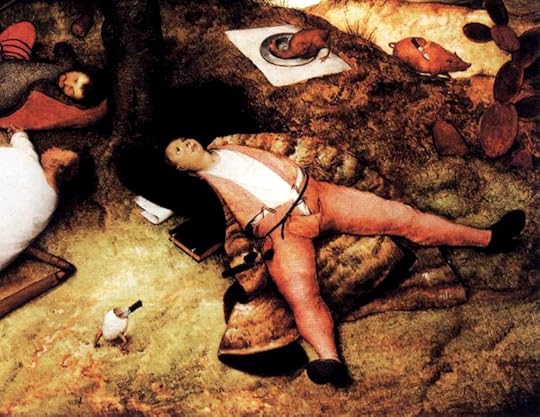
Detail from Breugel's Land of Cockaign (1567
I was most happy with the book’s long chapter on war, which presents the ultimate affront of violence and death as a chaos both against and in service of civilization. The literature examples (Ovid, Hobbes, Brecht, Fludd, Stendhal, Stephen Crane, Tolstoy) are interspersed with a more dominant coverage of visual representations. My horizons were greatly expanded by his detailed tour of the works of Callot from the French Revolution, Goya from the Napoleanic Wars, and Otto Dix from World War 1. We’re not talking about a couple of examples and a few generalizations. The narrative details dozens of themes present in no less than 7 works of Callot, 16 of Goya, and 15 of Dix (a good reason to try the print version of this book instead of the e-book like I did). War is an appropriate setting for portrayal of the chaos in its horrors, confusion, depersonalization, death, decay, machinations, and approximation of armageddon. Most people are familiar the portrait of terror in Picasso’s “Guernica”, with its Cubist image of a screaming of the horse and mother under a bombing of a village. Meisel covers that masterpiece in detail. New to me were many of the powerful and freakish etchings and paintings of Dix. The meanings the author pulls out of them are worth pursuing even if you read nothing else from this book.
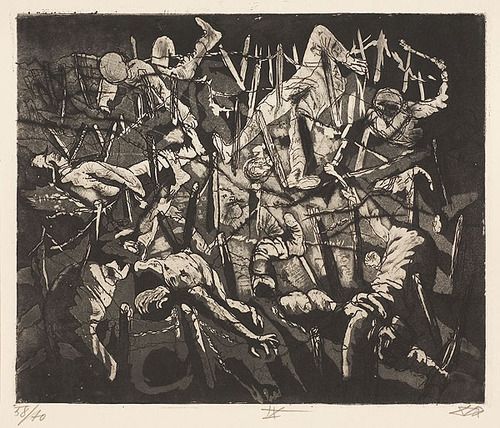
"Dance of Death 1917--Dead Man's Hill" (1924) by Otto Dix
In the chapter called “Energy”, Meisel makes his way into the clockwork universe of Newton, a model of reality which attempts to banish chaos. But scientific conceptions of the barriers posed by friction and inertia take flight against his “timeless and uncluttered geometry” in Sterne’s “Tristam Shandy” (1759-67), which Meisel explores in detail for its recognition that the energy of life lies in the erratic and unpredictable, in the very digressions his character thrives on. Definitly makes me want to read it. In this same period Haydn was demonstrating how music could emulate the emergence of beautiful forms out of an initial state of slowly swirling dissonance in his pieces “Creation” and “Representation of Chaos”. The marvel Meisel makes of this accomplishment is how he did so without resorting to the cacophony of random noise (now that I recall, it was more pleasant than the atonal experiments of Schoenberg much later). Leibnitz was inspired to write that “there are cases where some disorder in the part is necessary for producing the greatest order in the whole” and “even a dissonance in the right place gives relief to harmony”. Meisel summarizes: “Indeed, the dissonances are there to be resolved, integral to the system, governed by the same esthetics that governs the system of music”. That’s just the way I feel about the necessity of certain messy closets and drawers in my house for order elsewhere to rise above.
Meisel presumes Haydn was influenced by the nebular cosmology of Kant, who in taking a break from his day job as a philosopher envisioned a coalescence of stars and planets from a beginning state of totally disaggregated matter. For him “the chaotic principle was not simply as antecedent ground but as a constant, inherent in the play of forces and productive of endless, linear change” chaos is “what sustains a temporalized, endless creation though infinite extent. … is always a frontier of cosmos in the making, always a frontier of chaos to be structured.” I’ll have to take Meisel’s word for that. He builds further on the concept of an energizing role of chaos in the process of creation through a tour of the relevant works of the likes of Blake, Carlyle, Goethe, and Schiller and highlights how “pitiable” the hope is that they can conform to the Newtonian model. Again, except for Blake’s wild concoction of “The Marriage of Heaven and Hell”, I miss out on the thrills of such insights from not having read the works he taps.
Not so, for his wonderful deep diving into the outdoor paintings of the Brit J.W.M. Turner in the 18th century. A close look at a dozen works included in a section called “energy Unbound” reveals his fascinating experiments with an energetic form of formlessness. He finds in them an “exhaustless living energy with which the universe is filled”, representations that are “protean, transformative and transforming”, a primalness of “light and heat encountering dark and cold”, and reflections of Faraday’s conception of matter as centers of far reaching forces. My delight with this section was enhanced with a mind-bending introduction to the works of Italian futurists after the early 20th century.
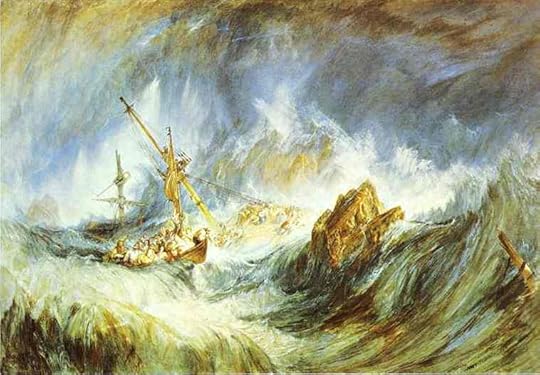
Play of forces and light at the boundaries of form in “A Storm (Shipwreck)”(1823) by Turner
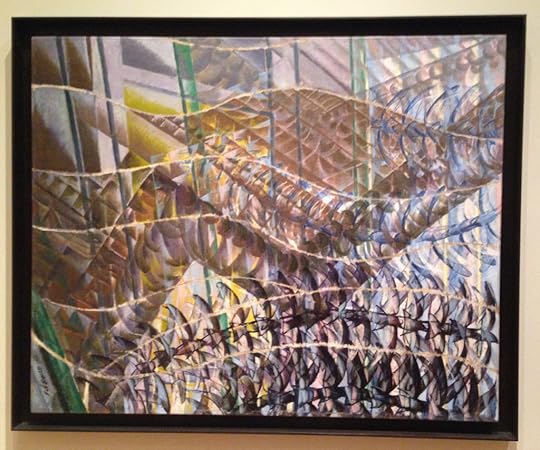
Blend of order and chaos in “Dynamic Sequences” (1911) by Italian Futurist Giacomo Bella.
Meisel journey reaches a climax with his chapter on entropy as the face of chaos. That’s where the rubber hits the road for me. All the work on machinery in the Industrial Revolution was associated with the harnessing of energy flow to do work and the discovery of the source of inefficiency that makes perpetual motion machines impossible. The Second Law of Thermodynamics, as formulated in the mid-19th century, began as a principle behind the irreversible flow of energy from warmer to colder bodies and ended up as a statement about the universe or other “closed” systems always progressing toward a state of increased net entropy. The latter is a measure of energy not available to do work, such as the “waste” heat or dissipated, homogenized energy of any operating machine.
The irreversibility of thermodynamic processes was soon recognized as the basis of time’s “arrow”. A further implications of the Second Law is the ultimate fate of the universe in a totally dispersed state of matter and energy at absolute zero temperature, often tagged as “heat death”. Such an end state of extreme homogeneity makes for a different angle on chaos as disorder. The converse is that it takes outside energy to bring about a decrease in entropy, leading to conceptions that equate negative entropy with order. Living organisms evolve and develop order in complex structures without violating the Second Law due to the outside energy put into the system at Earth surface by solar radiation captured through photosynthesis by plants. Schroedinger’s book “What is Life” (1944) in explaining this takes an almost a poetic turn in characterizing our biosphere as a little eddy of negentropy amidst the massive progression toward increasing entropy by all the sun’s energy output radiating into space (interestingly, Meisel cites the fact that Beckett made a gift of the book to his brother).
All these ideas and implications tied up with the Second Law took a long time for art and literature to digest in representations of chaos in relation to entropy, spanning the periods of romaticism, modernism, and post-modernism. Meisel starts with specific works of Checkhov, Melville, and Zola and ends with Beckett and Pynchon. It was a fun ride. For the most part he doesn’t delve much into the impact of quantum theory or modern advances in cosmology on the output of the humanities. Grappling with the Second Law predominates, perhaps because it a bit more accessible to meaning as a ravening substrate of reality compared to the wilder aspects of 20th century physics that deals with the very small or very large. The upshot is that we just don’t take the nature of the universe so personally any more. The exception is Schrodinger’s Cat and the integral role of the observer in collapsing probability waves to one alternative or other. We get that in Pynchon, such as in the uncertain reality state of the character at the end of his “Crying Lot of 49”. With Beckett in “Waiting for Godot” we get a stripped down parody of life in that indeterminate state of limbo, a play I was lucky to experience in the 70s’. Parallels and divergences are made with the chaos and nothingness in the music of John Cage (who was a prof at my college). In Beckett we get the potent image of a woman giving birth over a grave as a strike at the relativity of existence between nothing and nothing. His emulation of the last stages before the end of all has haunted my mind over the decades. From their post-apocalyptic bunker with a small window to the world, the life of the mind holds out:
Clov: There’s no more nature.
Hamm: No more nature? You exaggerate.
Clov: In the vicinity.
I found this book a masterful synthesis and exploration, but I don’t know who I could recommend it to. In many ways it is less challenging than "Goedel, Escher, and Bach", Hofstadter’s marvelous look at cross-fertilization of conceptions of reality from science, math, art, and music. But Meisel follows a path that can wallow a lot in details that smacks of academic self-indulgence. For books you have read, such details in the analysis can be rewarding, but less so otherwise. Luckily for the art tour he puts much before your eyes to help gather meaning from what he is after. I was gratified to get so much of human creation in a framework that helps me mentally organize so many threads of ideas which had begun to get chaotic in my mind.
The book was provided by the publisher in e-book form through the Netgalley program.
What is at stake for human beings in the imagination of chaos? Why its persistence in the face of so much ambivalence and recalcitrant mental equipment? There are clues in the opposing terms that regularly frame its representations: chance and necessity, formlessness and form, heterogeneity and homogeneity, randomness and predictability, the many and the one. What is at stake is the universe. But the local energies that drive the imagination of chaos come from more intimate levels, inhabited by feelings about action and constraint, desire and limitation, liberty and security, violence within and violence without, by the appetite for life and the fear of its inevitable undoing.
Reading this is like drinking from a firehose. Luckily, he has a gifted method of organizing his coverage of the output of Western civilization on his topic by following the historical evolution of concepts within special themes or spheres, such as chaos at the beginning and end of the universe, paradoxes of chaos as the epitomy of evil and as revolutionary wellspring, the chaos effectively personified in war, as bland void vs. messy excess; chaos as corrosive or enlivening energy; and finally chaos as captured in the science of entropy.
In Meisel’s first chapter, which he calls an untethered epilog, he acknowledges that in recent times the perspective of science has the dominant voice. The author is no scientist, but instead an emeritus professor of literature at Columbia University with an academic focus on theater. Still, I was blown away with his evident knowledge of all the implications and challenges posed by modern physics to the humanities over constructing an adequate model of reality. A difficult reading flight through a line of discoveries (Heisenberg Uncertainty Principle, wave-particle duality, special relativity, the Big Bang, black holes, quantum tunneling, vacuum that is not truly empty, fractals, non-linear thermodynamics, self-organizing processes, etc) leads to conclusions that are readily graspable by ordinary readers. Namely, that despite the humbling replacement of the comfortable, rational and deterministic Newtonian clockwork universe with a disturbing one destined for an ultimate heat death and riddled with fundamental incompleteness and uncertainty at its core, there is something refreshing and optimistic in how cosmos and chaos are no longer antipodes, but instead are bound up with each other. For the rest of the book he explores what art and literature have done to imagine chaos and in many ways to prefigure where we are now in our precarious understanding.
The earliest representations of chaos come from visions of God’s creation of the universe. In some versions, like in Genesis, it reflects the formation of order out of a formless void or nothingness, while in others forms are being separated from a hectic, random maelstrom. Either way, the metaphors of light and darkness and of good and evil are common associations. Meisel takes us on a good romp through versions by Hesiod, Ovid, and a host of painters. The figure-ground relations of order as good and disorder as bad begins to be assailed in a chapter called “Carnival”. All societies embrace occasions where the usual social proprieties are set aside and hierarchies of class are leveled or inverted. In Medieval fairs one can see a beggar assume the role of a king and the king a beggar. I appreciated the insights of the author’s tour of paintings by Bosch and Breugel, which typically have mystified me. The long analyses of Bunyan’s “Pilgrim’s Progress” and Pope’s “Dunciad”, were somewhat interesting under the chaos rubric, but otherwise dragged because I never read them. But boring old Milton with “Paradise Lost” he brings to life from the perspective of Satan as a king of a topsy-turvey world being a satiric carnival inversion. At one point where Satan describes chaos at the threshold of Hell is more than cool:
Illimitable Ocean without bound,
Without dimension, where length, breadth, and highth,
And time and place are lost; where eldest Night
And Chaos, ancestors of Nature, hold
Eternal Anarchy, amidst the noise
Of endless wars, and by confusion stand.
For hot, cold, moist, and dry, four Champions fierce
Strive here for Maistry, and to Battle bring
Their embryon Atoms …
Meisel puts the disturbing metamorphoses and inversion of dreams into the Carnival section. Steering clear of Freud and Jung, he mines Shakespeare’s “The Taming of the Shrew” and “Midsummer Night’s Dream” for insights. The biologist in me wants to reach for some adaptive function of such emotional and mental forays and their resolution which are common to all of the arts, taking you out of the ordinary, shaking up your preconceptions, and then returning you from the journey after you close the book, the curtain falls, or you walk out of the gallery. This conception, which impressed me a lot long ago in college, was argued as an aesthetic theory by Morse Peckham in his “Man’s Rage for Chaos,. which holds that the function of art is to create not order, but disorder. The payoff comes from the outcome of the disturbing encounter in the form of a cognitive and emotional sense of integration. Another iteration of this idea came into my possession from later reading Andrew Weil’s “The Natural Mind”, in which he makes a parallel argument to account of why all societies make use of psychogenic drugs and why children play and spin themselves dizzy. The altered states of consciousness that result and the progression from return to normal states is such a pervasive cycle he presumes to have a personal and potentially evolutionary adaptive value. Meisel shows respect for Peckham’s ideas but makes it clear he is not after the functions of chaos in art and life; instead he is more into the pursuit of truths revealed in representations of chaos. When I see Bruegel’s “Land of Cockaigne” I reach for the why people of all periods seek drugged states, but Meisel gives us broader angle on how the portrayal of altered states informs our construction of perceptual reality.
Detail from Breugel's Land of Cockaign (1567
I was most happy with the book’s long chapter on war, which presents the ultimate affront of violence and death as a chaos both against and in service of civilization. The literature examples (Ovid, Hobbes, Brecht, Fludd, Stendhal, Stephen Crane, Tolstoy) are interspersed with a more dominant coverage of visual representations. My horizons were greatly expanded by his detailed tour of the works of Callot from the French Revolution, Goya from the Napoleanic Wars, and Otto Dix from World War 1. We’re not talking about a couple of examples and a few generalizations. The narrative details dozens of themes present in no less than 7 works of Callot, 16 of Goya, and 15 of Dix (a good reason to try the print version of this book instead of the e-book like I did). War is an appropriate setting for portrayal of the chaos in its horrors, confusion, depersonalization, death, decay, machinations, and approximation of armageddon. Most people are familiar the portrait of terror in Picasso’s “Guernica”, with its Cubist image of a screaming of the horse and mother under a bombing of a village. Meisel covers that masterpiece in detail. New to me were many of the powerful and freakish etchings and paintings of Dix. The meanings the author pulls out of them are worth pursuing even if you read nothing else from this book.
"Dance of Death 1917--Dead Man's Hill" (1924) by Otto Dix
In the chapter called “Energy”, Meisel makes his way into the clockwork universe of Newton, a model of reality which attempts to banish chaos. But scientific conceptions of the barriers posed by friction and inertia take flight against his “timeless and uncluttered geometry” in Sterne’s “Tristam Shandy” (1759-67), which Meisel explores in detail for its recognition that the energy of life lies in the erratic and unpredictable, in the very digressions his character thrives on. Definitly makes me want to read it. In this same period Haydn was demonstrating how music could emulate the emergence of beautiful forms out of an initial state of slowly swirling dissonance in his pieces “Creation” and “Representation of Chaos”. The marvel Meisel makes of this accomplishment is how he did so without resorting to the cacophony of random noise (now that I recall, it was more pleasant than the atonal experiments of Schoenberg much later). Leibnitz was inspired to write that “there are cases where some disorder in the part is necessary for producing the greatest order in the whole” and “even a dissonance in the right place gives relief to harmony”. Meisel summarizes: “Indeed, the dissonances are there to be resolved, integral to the system, governed by the same esthetics that governs the system of music”. That’s just the way I feel about the necessity of certain messy closets and drawers in my house for order elsewhere to rise above.
Meisel presumes Haydn was influenced by the nebular cosmology of Kant, who in taking a break from his day job as a philosopher envisioned a coalescence of stars and planets from a beginning state of totally disaggregated matter. For him “the chaotic principle was not simply as antecedent ground but as a constant, inherent in the play of forces and productive of endless, linear change” chaos is “what sustains a temporalized, endless creation though infinite extent. … is always a frontier of cosmos in the making, always a frontier of chaos to be structured.” I’ll have to take Meisel’s word for that. He builds further on the concept of an energizing role of chaos in the process of creation through a tour of the relevant works of the likes of Blake, Carlyle, Goethe, and Schiller and highlights how “pitiable” the hope is that they can conform to the Newtonian model. Again, except for Blake’s wild concoction of “The Marriage of Heaven and Hell”, I miss out on the thrills of such insights from not having read the works he taps.
Not so, for his wonderful deep diving into the outdoor paintings of the Brit J.W.M. Turner in the 18th century. A close look at a dozen works included in a section called “energy Unbound” reveals his fascinating experiments with an energetic form of formlessness. He finds in them an “exhaustless living energy with which the universe is filled”, representations that are “protean, transformative and transforming”, a primalness of “light and heat encountering dark and cold”, and reflections of Faraday’s conception of matter as centers of far reaching forces. My delight with this section was enhanced with a mind-bending introduction to the works of Italian futurists after the early 20th century.
Play of forces and light at the boundaries of form in “A Storm (Shipwreck)”(1823) by Turner
Blend of order and chaos in “Dynamic Sequences” (1911) by Italian Futurist Giacomo Bella.
Meisel journey reaches a climax with his chapter on entropy as the face of chaos. That’s where the rubber hits the road for me. All the work on machinery in the Industrial Revolution was associated with the harnessing of energy flow to do work and the discovery of the source of inefficiency that makes perpetual motion machines impossible. The Second Law of Thermodynamics, as formulated in the mid-19th century, began as a principle behind the irreversible flow of energy from warmer to colder bodies and ended up as a statement about the universe or other “closed” systems always progressing toward a state of increased net entropy. The latter is a measure of energy not available to do work, such as the “waste” heat or dissipated, homogenized energy of any operating machine.
The irreversibility of thermodynamic processes was soon recognized as the basis of time’s “arrow”. A further implications of the Second Law is the ultimate fate of the universe in a totally dispersed state of matter and energy at absolute zero temperature, often tagged as “heat death”. Such an end state of extreme homogeneity makes for a different angle on chaos as disorder. The converse is that it takes outside energy to bring about a decrease in entropy, leading to conceptions that equate negative entropy with order. Living organisms evolve and develop order in complex structures without violating the Second Law due to the outside energy put into the system at Earth surface by solar radiation captured through photosynthesis by plants. Schroedinger’s book “What is Life” (1944) in explaining this takes an almost a poetic turn in characterizing our biosphere as a little eddy of negentropy amidst the massive progression toward increasing entropy by all the sun’s energy output radiating into space (interestingly, Meisel cites the fact that Beckett made a gift of the book to his brother).
All these ideas and implications tied up with the Second Law took a long time for art and literature to digest in representations of chaos in relation to entropy, spanning the periods of romaticism, modernism, and post-modernism. Meisel starts with specific works of Checkhov, Melville, and Zola and ends with Beckett and Pynchon. It was a fun ride. For the most part he doesn’t delve much into the impact of quantum theory or modern advances in cosmology on the output of the humanities. Grappling with the Second Law predominates, perhaps because it a bit more accessible to meaning as a ravening substrate of reality compared to the wilder aspects of 20th century physics that deals with the very small or very large. The upshot is that we just don’t take the nature of the universe so personally any more. The exception is Schrodinger’s Cat and the integral role of the observer in collapsing probability waves to one alternative or other. We get that in Pynchon, such as in the uncertain reality state of the character at the end of his “Crying Lot of 49”. With Beckett in “Waiting for Godot” we get a stripped down parody of life in that indeterminate state of limbo, a play I was lucky to experience in the 70s’. Parallels and divergences are made with the chaos and nothingness in the music of John Cage (who was a prof at my college). In Beckett we get the potent image of a woman giving birth over a grave as a strike at the relativity of existence between nothing and nothing. His emulation of the last stages before the end of all has haunted my mind over the decades. From their post-apocalyptic bunker with a small window to the world, the life of the mind holds out:
Clov: There’s no more nature.
Hamm: No more nature? You exaggerate.
Clov: In the vicinity.
I found this book a masterful synthesis and exploration, but I don’t know who I could recommend it to. In many ways it is less challenging than "Goedel, Escher, and Bach", Hofstadter’s marvelous look at cross-fertilization of conceptions of reality from science, math, art, and music. But Meisel follows a path that can wallow a lot in details that smacks of academic self-indulgence. For books you have read, such details in the analysis can be rewarding, but less so otherwise. Luckily for the art tour he puts much before your eyes to help gather meaning from what he is after. I was gratified to get so much of human creation in a framework that helps me mentally organize so many threads of ideas which had begun to get chaotic in my mind.
The book was provided by the publisher in e-book form through the Netgalley program.

June 10, 2016
Chaos Imagined: Literature, Art, Science by Martin Meisel is a masterful work that serves as both a history (of sorts) of the concept of chaos as well as detailed analyses of various texts to illustrate how perceptions were expressed and eventually changed.
This is not a simple read but it is quite accessible to anyone who likely is interested in an interdisciplinary volume about chaos. It is not so much a difficult read as it is a broad read which invites readers to ponder what they have just read and to possibly (re)read the texts under discussion. This is a wonderful book to work through slowly with a blank journal at hand.
The depth and breadth of Meisel's knowledge is impressive, providing excellent explanations of scientific material while also offering superb analyses of literary and philosophical texts. In doing so he manages to avoid excessive jargon (it cannot be completely avoided, some topics simply need their specialized vocabulary) but his explanations excel in the areas that require specialized terminology.
Chaos underwent a significant change in how it is perceived in the 18th and 19th centuries, as Meisel illustrates remarkably. It went from disruptive and associated with evil or bad while order was its opposite, perceived as good and desirable. Chaos then became more closely associated with the freedom of potential, in no small part due to understanding that the world is more chaotic than it is ordered.
I would hesitate to put this into the pop category of science-themed books that are so useful for the general public, but I do think it would be enjoyable to most who like those works. Because the author ranges over so many areas (literature, science, art, film, etc) there are many opportunities for a reader to find an interesting avenue into the topic, which makes this an ideal volume for those who like to think deeply as well as broadly.
Reviewed from a copy made available by the publisher via NetGalley.
This is not a simple read but it is quite accessible to anyone who likely is interested in an interdisciplinary volume about chaos. It is not so much a difficult read as it is a broad read which invites readers to ponder what they have just read and to possibly (re)read the texts under discussion. This is a wonderful book to work through slowly with a blank journal at hand.
The depth and breadth of Meisel's knowledge is impressive, providing excellent explanations of scientific material while also offering superb analyses of literary and philosophical texts. In doing so he manages to avoid excessive jargon (it cannot be completely avoided, some topics simply need their specialized vocabulary) but his explanations excel in the areas that require specialized terminology.
Chaos underwent a significant change in how it is perceived in the 18th and 19th centuries, as Meisel illustrates remarkably. It went from disruptive and associated with evil or bad while order was its opposite, perceived as good and desirable. Chaos then became more closely associated with the freedom of potential, in no small part due to understanding that the world is more chaotic than it is ordered.
I would hesitate to put this into the pop category of science-themed books that are so useful for the general public, but I do think it would be enjoyable to most who like those works. Because the author ranges over so many areas (literature, science, art, film, etc) there are many opportunities for a reader to find an interesting avenue into the topic, which makes this an ideal volume for those who like to think deeply as well as broadly.
Reviewed from a copy made available by the publisher via NetGalley.
Displaying 1 - 2 of 2 reviews