Jump to ratings and reviews
Rate this book

A History of Virility

Rate this book
In these original essays, an international group of scholars, including Arlette Farge, Jean-Paul Bertaud, Christelle Taraud, and Fabrice Virgili, follow the socio-historical evolution of virility, as opposed to masculinity, to unsettle popular accounts of politics and culture. The book begins with ancient conceptions of the male gender, which persisted, with significant alterations, for centuries. While virility was challenged during the Enlightenment, its preeminence was restored by social forms of male bonding in the nineteenth century. Models and codes of virility are chipped away by pacifist, feminist, and gay rights movements during the next hundred years; twentieth-century conceptions of maleness embody a "virility on edge," which adds a fascinating new dimension to our understanding of history.

A major contribution to the nascent field of masculinity studies, this history consults painting, sculpture, literature, philosophy, film, and cultural and sociological critique. It involves fascism, nationalism, liberalism, classicism, colonialism, and war. With the twentieth century delivering one blow after another to hegemonic virility, this book also explores where manliness might be headed next.

768 pages, Hardcover

First published October 13, 2011

6 people are currently reading
234 people want to read

About the author

Alain Corbin

132 books88 followers
Alain Corbin is a French historian, specialist of the 19th century in France.

Trained in the Annales School, Corbin's work has moved away from the large-scale collective structures studied by Fernand Braudel towards a history of sensibilities which is closer to Lucien Febvre's history of mentalités. His books have explored the histories of such subjects as male desire and prostitution, sensory experience of smell and sound, and the 1870 burning of a young nobleman in a Dordogne village.

Ratings & Reviews

What do you think?
Rate this book

Friends & Following

Create a free account to discover what your friends think of this book!

Community Reviews

5 stars
8 (42%)
4 stars
8 (42%)
3 stars
2 (10%)
2 stars
1 (5%)
1 star
0 (0%)
Displaying 1 - 8 of 8 reviews
Profile Image for Warwick.
Author 1 book15.4k followers
January 31, 2016

Rubens, Male torso (study of the Farnese Hercules), c. 1600-1608

I remember a girl I worked with at White City in my early twenties, let's call her Lisa (although her real name is Christine Mulholland), complaining to us all that she couldn't find anyone to date. And I said, hmm, I think I could probably set you up with someone – thinking mostly: like me, because she was quite cute. But she just snorted and looked at me and said: ‘Yeah, but they'd all be poetry-readers.’

Wow! This casual emasculation – doubtless nowadays I would be calling it a ‘microaggression’ – stayed with me over the years, so I guess it struck a nerve. Lisa's basic approach to gender relations – not a complicated or an uncommon one – was perhaps best summed up by the nineteen-year-old Amy Winehouse:

You should be stronger than me,
But instead you're longer than frozen turkey.
Why d'you always put me in control?
All I need is for my man to live up to his role.
You always want to talk it through – I'm okay!
I always have to comfort you every day.
But that's what I need you to do. Are you gay?
'Cause I've forgotten all of young love's joy,
I feel like a lady, and you're my ladyboy…

…only perhaps without Amy's patina of irony. That song came out at a time when the ‘New Man’ was a very prominent thing – guys who took care of their appearance, talked about their feelings, wept on a biweekly basis, ordered quiche and treated women with ostentatious respect, all in the hopes of sensitively taking one of them up the arse behind Davinci's on a Friday night. All I need is for my man to live up to his role. Men were not really sure what women wanted from them. Were we supposed to be touchy-feely and emotional now, like everyone claimed in my sister's copies of 19 and Marie Claire? Or were we supposed to be basically the exact opposite of that – like all the men in my sister's trashy novels, which invariably had two people snogging under a waterfall on the cover and a monosyllabic hero called Dirk or Rock and a heroine whose anatomy in the crucial scenes was described confusingly in terms of a ‘throbbing centre of femininity’?

Some women were a bit snippy about the general male confusion. ‘Newsflash: all women are different,’ they would point out, reasonably. ‘It's not like you can adopt some magic persona that makes you attractive to everyone. Why don't you just be who you are and stop trying to be adored.’ Which was perhaps a little disingenuous, not only because of the way it pretends not to understand a basic fact of human psychology, but also because it misses the whole point about how gender roles are constructed in the first place. What the opposite sex wants and expects has always – in what the cool kids like to call a ‘heteronormative’ society – been quite crucial to these things, whether you care about it yourself or not.

Men through history have defined themselves in opposition to three things: women, children and animals. To be a man is, fundamentally, not to be a woman, not to be a boy, and not to be a wild beast: this is how the Romans staked out virilitas and how the Greeks conceptualised ἀνδρεία. They were stronger, more active during sex, and hairier than women; but not as hairy, brutal or lustful as animals. Even now, growing up, these are the three common insults that get thrown at you at school: What are you, a girl? What are you, a baby? And, usually by teachers or parents: What are you, an animal? (The first of these is the one most freighted with disapprobation and mockery, for reasons I never understood. When I was laughed at in school, aged nine, for having a purple pencil-case – the colour was thought to be too feminine – I got my mum to buy me a pink one instead, because fuck you. That is, I'm afraid, what I was like from a young age. Bloody-minded and protective of my stationery.)


Loaded magazine, May 1997

In my formative teenage years, the UK was overtaken by a strange reaction against sensitive, moisturising masculinity. Suddenly it was all Liam Gallagher, lager lager lager, and Loaded magazine. And looking at this ‘lad culture’ from a distance now, it kind of looks like all the men collectively going, ‘Oh god just leave us alone would you, we just want to get drunk and laugh and talk about girls.’ There was quite a lot of criticism of it at the time, but I thought it was quite freeing and I liked the honesty of it, even though the general tone was not really me (I have zero interest, for example, in football or cars, which were and are de rigueur conversation-openers when two men meet each other for the first time).

But in a way, that disconnect was the whole fun of it – the entire phenomenon was a lot more ironic and self-mocking than its critics ever realised, I think. And a lot less sexist. To me at least it never felt remotely predicated on the idea that women were inferior to men, only on a kind of openness about sexual attraction that seemed fresh because of the prevailing feeling then that men were supposed to appear above that sort of thing. Women were never presented as alien beings – on the contrary, everyone assumed commonality; it was assumed that since men liked drinking and telling jokes and objectifying people they were attracted to, women probably felt the same way. (Loaded at its height was being read by more women than any of the top ten women's magazines.) And while I don't doubt that some women would have liked to approach the whole conversation differently, in my circles the general feeling was one of relief, social levelling and understanding. Indeed when I think of my late teens I remember (wrongly, no doubt) a kind of perfect idyllic gender equality, untouched by the internet outrages of a later generation – an equality, by the way, which was not understood by the media, who branded these incomprehensibly ‘unfeminine’ women ‘ladettes’ and splashed endless pictures of Zoe Ball and Sara Cox holding pint glasses over the front page of the Daily Mail.

Anyway, what is this – I Love 1997? The point is that masculinity is, as this book makes clear, an ‘acquired quality’ and I have been thinking about where I acquired mine. It is moreover something that exists in relation to a given society rather than in a vacuum. As Judith Butler would say, a man is not something you just are, it's something you have to continually ‘perform’ in a hundred conscious and unconscious ways, although obviously Judith Butler wouldn't actually say it as plainly as that without involving the phrase ‘profound alterity’. One has to pick which of these performances it's fun to go along with, and which it is pleasing or necessary to push back against.


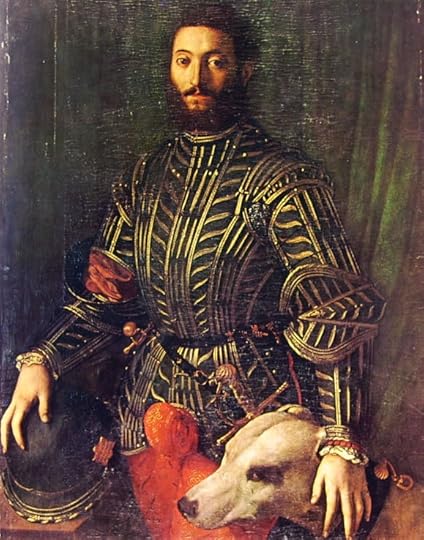
Codpieces: subtle. Il Bronzino, Portrait of Guidobaldo della Rovere, 1532

With essays on such topics as ‘The Great War and the History of Virility’, ‘The Necessary Manifestation of Sexual Energy’, ‘Working-Class Virility’, and ‘Virility through the Looking-Glass of Women’, this book is a bumper resource of historical context and po-mo theorising about what societies have considered that being a man should consist of, and why. I had never read a book of ‘masculinity studies’ before and I was a little cautious about what it would involve, half-expecting a 700-page diatribe against the machinations of modern feminism. Happily that does not feature. A History of Virility takes gender disparity as its starting-point and is concerned not with playing down or justifying subjects like violence or male domination, but with explaining them and looking for possible ways forward. It must be said that, despite the title, it's really only concerned with the West, and within that is determinedly Francocentric. This is perhaps one reason why ‘virility’ is preferred to ‘masculinity’, distinguishing the subject at hand from matters of pure biology or grammatical gender.

And the separation of ‘virile’ men from women, children and animals has been called on time and again to justify abuses of all kinds. When the New World was first colonised, for instance, American Indians were always compared to beasts – their strength was dismissed as ‘mere brutality’ and when they were friendly it was read as ‘possible submission’: if you're not considered a real man, it seems, then you ‘can only be fierce or submissive’. When Europe colonised Africa the same language was seen, and the interaction of gender roles and race filtered down into wider society. In postcolonial France, male prostitutes who catered to Arab ‘tops’ along the Boulevard Magenta were viciously suppressed, while female prostitutes from France's former colonies were broadly encouraged. For the Nazis, to take another example, ‘the correspondence of sex to gender is seen as the privilege of the superior race’. So the persecuted races are always seen in terms of gender disparity: ‘unfettered, masculinized Jewish women, effeminate Jewish men, and of course homosexuals of both sexes’.

Homosexuality has, in fact, offered surprisingly few challenges to idea of what virility means. Gay culture until very recently has generally been torn on whether to challenge gender roles (on the grounds that they generate systemic homophobia), or alternatively whether to go along with them wholeheartedly. Proust, for instance, put forward the idea that gay men were really ‘female’ souls in male bodies, searching for their traditional counterparts. (Among lesbians Radclyffe Hall is comparable: she was deeply conservative, called herself John, was not a feminist, adored Mussolini.) According to this view, ‘true’ homosexuality barely exists – the ‘underlying’ men and women are seeking each other out according to heteronormative tradition. The alternative idea was that you could hardly be more manly than a man who fucks men – gay men were the übermen, as André Raffalovich put it, ‘pure brutes, like Hercules, who hate women the most and who also seek out strong men’. It's not hard to see that this position also has its problems.


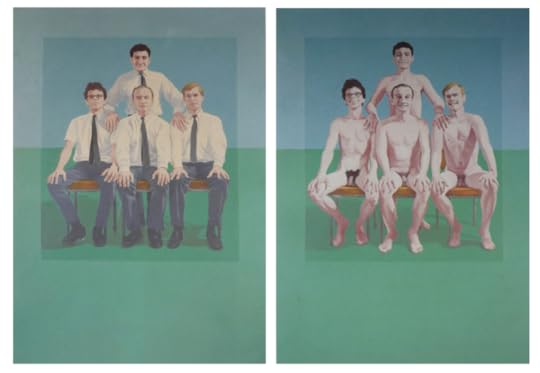
Wynn Chamberlain, Poets (Clothed) and Poets (Naked), 1964.

Sexuality has always been important to virility; ‘masculinity, like femininity, is a function of the sexual being’. It has been a commonplace of male thought forever that women do not understand the strength or the demands of the male libido – whether or not this is actually true is still angrily debated, but many women have been moved (or pressured) to accept the notion that men have some quasi-pathological ‘obsessive need’ for sex and have made allowances accordingly. Men themselves, meanwhile, have felt under pressure from their wives and female acquaintances to conceal this perma-horn, and under pressure from their peers to demonstrate it – a pressure that manifests itself in colleges, clubs, barracks and smoking-rooms throughout history. The first trip to the brothel is a rite of passage for apprentices in many industries as well as for army recruits – this kind of virility is, importantly, always extraconjugal.

French writers of the nineteenth century would send each other long, detailed reports on the best prostitutes to visit in a given country or district, building up a kind of composite global Rough Guide to rough trade. ‘I spent twenty-one days in Valencia without getting bored, but I got some thirty fucks. I had four girls in active service, all of them called Vicenta – St. Vincent is the patron saint of the town,’ reported Prosper Mérimée to his friends. ‘I've tried the women of Hesse, of Nassau and of Prussia. Those of Hesse get the laurels. […Women of London] have no ass, but fifty pounds of tits that slip through your fingers—they're as hard to hold on to as pancake butter.’ Many of them, compelled both to record and tally their sexual activities as well as to conceal them, kept extensive coded sex diaries. Alfred de Vigny noted on Tuesday 14 August 1838: ‘Maria—At the gymnasium, fucked in front of the statuettes.’ Wednesday 15th: ‘evening at the gymnasium.’ Thursday 16th: ‘Fucked Lydia [his wife]. Morning. Julia in the Batignolles.’ Saturday 18th: ‘Morning, in the Batignolles, at Julia's’ and so on in great detail, specifying positions, orgasms and so on.

In general this kind of ‘virile’ sexuality was considered utterly separate from the relationship one had with a spouse; it was divorced from all emotional attachments. ‘I despise gallantry,’ wrote Flaubert to his mistress: ‘that perpetual confusion between panties and heart makes me vomit. […] All I want from you as a woman is your body; leave the sentimentality to the old folks.’ Often this was felt to be an entirely male province – though when men believed that they had met a woman who understood and reciprocated this kind of desire, the heady mixture of acceptance, relief and excitement could be overwhelming. Vigny (again) got so excited writing to an encouraging mistress that he was moved to ejaculate all over his letter, and then describe, in shaky handwriting, the details of the postorgasmic spasms and loss of eyesight he was experiencing. One thinks also of Joyce's terrifying letters to Nora.


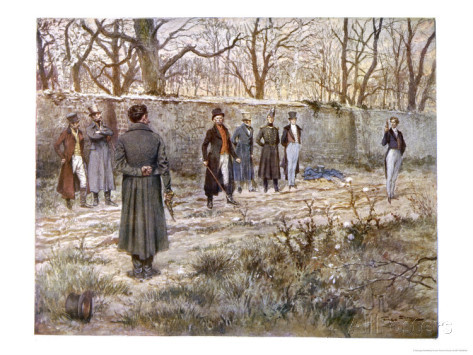
George Scott, A Duel with Pistols, 1815

Central to virility, always, is the use of violence, for which men are raised from a young age and which is often lauded and encouraged by society as a whole. Inter-state violence is of course a strongly gendered activity, though strangely this is rarely noted. When you read that 900,000 people were killed at Verdun, it has to be remembered that this means a holocaust of 900,000 boys, a fact so obvious that it is almost invisible. It is large matters such as this, as well as smaller issues of social interaction, that Pierre Bourdieu had in mind when he wrote that ‘male privilege is also a trap […] that obliges every man to affirm his virility in every circumstance […]. Everything works together to make of the ideal of impossible virility the principle of an immense vulnerability.’

However. Although it's important to note that men as well as women suffer from gender inequalities, and that women as well as men enforce them, it also must be recognised that men have been given much more power socially and politically than women, and women have suffered disproportionately at the hands of men. Some think that this is a natural consequence of the imbalance in power relations, and that when women are given power they act in the same way – this is one response to Christine Bard's conundrum:

How do we reconcile, on the one hand, the existence of Reichführerinen or female American soldiers torturing prisoners at Abu Ghraib with, on the other hand, the no less debatable reality of a historical experience of women that places them instead on the side of nonviolence?


But others, more pessimistic, believe that male violence is fundamental and biological. Modern feminist artists and activists have investigated this idea in various ways – Odette Thibault suggested men should take cyproterone (an antidote to testosterone) to diminish aggressiveness, while other women have dosed themselves with testosterone in order to ‘inhabit’ maleness, reporting huge libido increases and an ‘impression of strength’. This has interesting implications concerning the role of drugs and prosthetics in the modern construction of gender (Beatriz Preciado: ‘You think you're bio-women, but you take the pill; you think you're bio-men, but you take Viagra; you are normal and take Prozac’).

It is possible that in earlier times when bears were numerous, virility may have played a specific and irreplaceable role; but for several centuries men have no longer been visibly good for anything.
      —Philip Roth

I think it's important that this book shows how virility is constructed and enforced by the whole of society – it is not just something with which men endow themselves for their own benefit. Many women, of course, à la Winehouse, view traditional virility very positively, even when they're uneasy about its implications, and a playful, contextual exaggeration of gender differences is not necessarily a bad thing. It can be fun, it can be reassuring, it can be sexy. But there are bad things that can tag along with these ideas and they need to be thought about. This book reiterates the dangers inherent in gender imbalances that feminist writers have been talking about for some time, and in that sense it's a welcome broadening-out of those theories which may, perhaps, make them feel more inclusive. Many feminist writers have said that the lack of a history of male gender roles is ‘at the very core of the conditions for reproducing male domination’: well, this book is a start, and a very thoughtful and enjoyable one.

Most of all, by linking social concepts of virility with historical examples of where we have inherited these expectations from, it somehow makes it easier to look the problems of masculinity full in the face. This leaves you with a lot of provocative questions to ponder. As Jean-Jacques Courtine asks: ‘Do today's men intend to bear much longer this millenary burden, or do they wish to lighten their load—even if it means giving up its advantages?’
Profile Image for Gretel.
338 reviews62 followers
April 8, 2016
I received an ARC through the courtesy of NetGalley and the publishers.

Before I start my review, I have a few things to say.
First, a big thanks to Warwick! He started reading this first and it was thanks to his comments I knew this book existed.
Second, I wasn’t able to finish this mammoth of a book before the publication date, which was the 16th of February 2016. So I already passed the publication date. Not only does this book consist of 752 pages, I’m in the midst of writing my Master’s thesis, so I have very little time. Nonetheless, I wanted to give a feedback and encourage you to read this book, because I think it deserves a lot of attention.
Third, I try to talk about the book and mix it with my own thoughts on the topic. For now, I concentrate on Chapter 20, Homosexual Transformations.
I intend to add more material to this review the further I read! It will take a little more time, that’s all.


A History of Virility is thankfully a well-researched cultural, anthropological, philosophical, artistic, social, and political analysis of the image of men, maleness, masculinity, virility, and all the topics surrounding it, NOT some sort of glorification of masculinity/men! The articles cover different topics and times, beginning with Ancient Greece and ending in modern times. There’s even a chapter on the female view/gaze on virility. So with over 700 pages of science you have a lot to cover and discover!

I chose for this glimpse-review the chapter Homosexual Transformation because right now the Swiss are about to vote on an initiative about changes on tax rights for married couples. The thing is, the initiative might have some good points, but it’s championed by the CVP, a conservative right-winged Christian party so the initiative is not only crude, extremely one-sided, and questionable, it openly discriminates against non-heterosexual couples. (Don’t get me started on the other initiative, which is a nightmare…openly calling to legally treat foreigners as as second-class citizens and shitting on human rights. I better not go there or I won’t stop ranting.)

The chapter begins with a few simple explanation on terminologies (gay, homosexual, queer, etc.) and the inner and outer struggle of non-heterosexual identity. By inner and outer struggle I mean inside the community – how LGBQT define themselves and how they treat their own members – and outside of the community.
Virility plays an important role in the definition of gayness. Gays were typically thought of as effeminate and flamboyant, an ideal stamped by others on how gays are. For me, there is a strong connection between virility and “not being male but feminine”, femininity being weakness, softness, and emotional/not logical. It’s interesting, because when certain people want to belittle gays, they compare them to women. No, they put them down by lowering their social status to that of a woman.
On the other hand, lesbians are put down by comparing them to men. For them, lesbians want to be men but they can’t because the lack “natural” virility, a virility which is usually connected to genitalia and societal power. Lesbians are basically seen as bad impersonators of men, lacking true masculinity, while gays seem to offend virility by rejecting the default sexual orientation and liking what women like, also making them bad impersonators of women.
It boils down to the misconception of: “They just want to be a man/woman!”

Florence Tamagne mentions in her article the “gay clubs” during different times in history. I remember watching a documentary on these secret underground clubs in London, usually owned by a woman, who takes on the role of “Mother”. In that documentary, they explained how men met not only for sex, but also to perform a carnevalesque roleplay. They dressed up, often as women, re-enacted births with puppets or household utensils, and did a bunch of other crazy stuff. They shed all form of social and gender norms. Probably most of them weren’t transgender (although I’m sure some must have been). Putting on a dress and pretending to be a woman was less about wanting to be a woman, but about contrasting the harsh norms of Victorian England and the strict image of a true and proper English man. It was as much play as it was showing society the middle finger.
The question whether some of them thought that their homosexual desire meant they had to be women (in other words, you can have sex with men without wanting to be a woman), is something we can’t answer without personal accounts of that time. In the end, each individual must have perceived the scene and their sexuality differently.

An interesting point is brought up by the author, one I also thought about: MtF transgender are more talked about than FtM. The short answer Tamagne gives is sexualization of women in media and society.
I think I have to agree with this. Becoming a woman seems to be way more scandalous and I think a big part is, even though many probably don’t consciously get it, being a woman puts you in a huge disadvantage. It’s probably seen as men choosing to be the weaker sex, the sex that is inferior because we have less power, authority, etc. Becoming a woman makes you weak (although I have to point out transwomen don’t ‘become’ women, they are women; the body they were born with is just not the one fitting their gender, I’m talking from the POV of society here!) and vulnerable. In fact, all eyes are on the transwoman: does she look feminine enough? Is she convincingly female? How pretty is she?
I fear transmen, especially those who don’t fully transition or are about to, are still perceived as women, hence the disinterest in them. And probably it’s also not so interesting because they become the powerful sex.
I just thought how interesting it was when Caitlyn Jenner transitioned. The moment she presented herself on the cover of a magazine, dressed in a bodice, the world instantly talked about her in terms of beauty and her sexiness. It was about what a convincing SEXY woman she was. And convincing means to look and present oneself in a certain fashion.


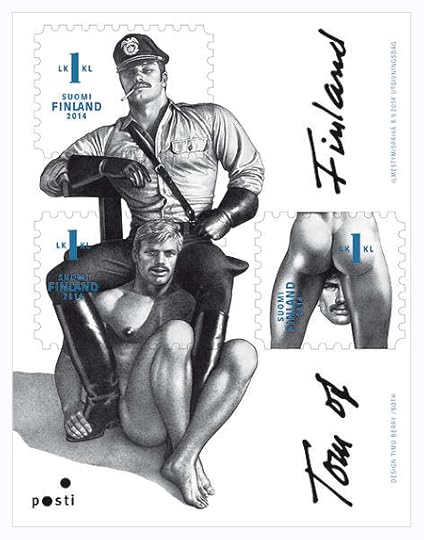
On to another topic: How gay culture re-appropriated the image of hypermasculinity. It’s really interesting how gays took that image and still showcased their sexuality. It was provocative and challenging. I’m really interested in this subculture because it has created some very interesting art. Think of Tom of Finland.

description

I encourage you to read into this subculture of the gay community, it’s fascinating. But be warned, some artists are very graphic. There is also a Japanese manga genre with this kind of style, called bara, which literally means rose. Funny how such a hypermasculine style carries such a delicate name, isn’t it?
Also, if you like yaoi/bara or are open to gay erotica (not much going on, anyway) and enjoy a bit of satire, I recommend Muscular Sailor Sexy Moon by Nobita. It's glorious!


“From the back we are all women; the anus knows no sexual difference.”

Guy Hocquenghem (this name, though…) perfectly captures what I’ve been talking about. He is neither the first, nor the last to talk of homosexuality as degrading because it puts men on the same level as women, and women are lower than men. Anal sex is emasculating. Until today heterosexuals may have sex with men/gays as the penetrating part or the one receiving oral sex from the other man without risking too much. It’s still the powerful, active part. The gay part is the one being anally penetrated or giving fellatio. Being penetrated is giving up power, a subordinate position held by women.
It’s no wonder people make fun of this idea by mocking “No homo”.

France used the image of the feminine, corrupt, two-faced gay to paint Germany as evil homosexuals. Homosexuals as shorthand for traitors and the political enemy.
Nazis calling communists and Jews “feminine”. Persecuting homosexuals.
Communists in Russia calling homosexuals a Nazi invention.
The list is infinite.

I could go on since the topic is very rich but I will stop with a little food for thought: being gay is being feminine, yet certain cliques are highly homoerotic and sometimes even enforce gay encounters as a form of community feeling or for punishment, like sports, sororities, or prison.
But doesn’t for example the homosexual tension in sports show how ridiculous it is to try to shoehorn gayness into an easily identifiable form with one and only one color?
Nothing is per se gay/homosexual. Things just are. It’s when people need arguments to demonize the Other that things are made to be gay/homosexual and therefore bad.
It would be so much easier if homophobes would mind their own fucking business instead of putting so much importance on who loves who and who touches which genitalia. Because I can tell you this, LGBQT people want one thing: their fucking peace. They want to live without having to fear for their lives and constantly being mistreated. They’re advocating the rights to exist in peace and being treated as human beings. I’ve talked with a lot of people belonging to the LGBQT community (me being part of it, too) and for them their gender or sexuality is just something that is part of them. It’s there like your nose or the hairs on your arms. Nothing you would constantly think about (apart probably from transpeople, they have it harder) if it wasn’t for others trying to convince you how abhorrent you are for existing.
If you then add race, gender, and social class to the mix, things get awful. Some people belong to several marginalized groups and the fact that I have to say ‘marginalized’ speaks for itself.
We are still not people. We are members of group X or community Y because we are not recognized as being part of the group “human being”.


Before I go further on a tangent I’ll stop the review with final thoughts on the article.

A few points I didn’t like about this specific chapter: the constant use of ‘transsexual’ instead of ‘transgender’, the lack of specific explanations or quotations at crucial points, and lack of further critical analysis. Especially the last two points are irritating. The superficiality with which some aspects are talked about, aspects that DEFINE and ENCOURAGE gender ideals and norms, is annoying at best. You are presented a delicious 5 star menu and then get served a tiny, half-bitten cold sausage. (Pun was not intended but…too late now.)

An example: the code language gays used to secretly identify each other in public, which is basically a gay slang. Tamagne does not mention one example. She merely mentions the fact and moves on. For me, this is impossible to bear. If you bring up points like these, at least give a few examples or explain a little further.

Final note: Apparently, some people don’t like Queer as Folk because it reinforces the stereotypes of gay community: virility, ripped bodies, large penis, etc.
I see where that comes from but most characters don’t fit the gay ideal. They are either too thin or too plain or too fat. The two prominent lesbians of the series are the critical voices in the testosterone filled gay community. There is as much representation of virile gayness as there is struggle with that virility. The age old problem of wanting to be part of Eden and never getting there. Maybe not the best series but at least honest for a few voices within the community. Still, I think it’s time for a new Queer as Folk for 2016! QaF 2.0 could use more colors, more women, more trans*, and more economic diversity!
Profile Image for Juli Rahel.
765 reviews20 followers
June 2, 2016
In my studies I have focused very explicitly on gender, whether it was in English literature over all or specifically in medieval English literature. I find the way gender is represented, advocated or repressed very interesting, and part of that is the way in which we have translated gender patterns from previous centuries to our own. Part of the fact I could follow my interest is because of the path early feminist scholars have built for me. Their early forays into what "feminity" means were incredibly important and have established Gender Studies as its own independent field. However, a similar focus on "masculinity" has only slowly developed so when I saw A History of Virility on Netgalley I knew I wanted and had to read it. Thanks to Columbia University Press and Netgalley for providing me with a copy of this book in exchange for an honest review.

To start with it has to be acknowledged that the contributors to this academic collection are absolutely stellar. Not only do they stretch across different disciplines, together they also manage to interrogate every moment of relevant human history. As such, the book does exactly what its title promises which is quite a feat for an academic book. A History of Virility actually does cover the history of the concepts of virility and masculinity, the way in which these ideas and concepts were represented in the arts and how they developed over time. What is also interesting is how this collection of chapters interacts with some of the academic theories who are dominant in the field of Gender Studies at the moment. One of the crucial ones, a theory taught to every English lit undergraduate, is Judith Butler's ideas about gender performativity. Basically this theory means that gender isn't something set and intrinsic, but rather that what we consider 'masculine' and 'feminine' are a set of behaviours which we perform. And this covers everything from clothes, to ways of walking and talking etc. Until now I've only really seen this theory applied to femininity, so it was interesting to see it applied to masculinity and virility for once.

Perhaps most interesting to readers who are not as interested in the Classical periods are the chapters on more recent history, such as 'Fascist Virility' by Johann Chapoutot. Masculinity and virility have been used, especially in Nazi Germany, as a way of incite a population. During the Second World War, Italian and German fascism were built upon the concept of virility, which went hand in hand with a complete devaluation of women apart from being mothers and wives. Virility, then, became everything femininity was not. To see recent history in such a different way is interesting, especially if you then look at the way in which we currently seems to be returning to some of the thought patterns from before. It is important to be aware not only of how gender plays a role in societal developments, but also how gender is only one of the many things playing in such major upheavals.

Reading A History of Virility was absolutely fascinating. Not only is it a great addition to the field of Gender Studies in general, but when it comes to Masculinity Studies it is also a fundamental contribution. Moving through the key phases of human life, A History of Virility does exactly what its title promises. I'd recommend this to fans of non-fiction and history.

For full review: http://universeinwords.blogspot.co.uk...
Profile Image for Roman Clodia.
2,915 reviews4,710 followers
June 22, 2016
This is a thoughtful collection of essays that explores the historicisation of virility from classical Greece and Rome to the twentieth century. The authors don't always add anything new to the extensive bibliography that exists on constructions of gender and/or masculinity but where they do add value is in the material, often French, that they use as the basis of their analysis.

So analyses of Renaissance beards and codpieces, for example, already exist, as does extensive work on Nazism and the anxious paradoxes of masculinity but both areas are developed here. It's productive, too, that visual images are discussed alongside texts with some surprising nuances teased out.

This is a scholarly text which speaks to the field, but is likely to be accessible to interested general readers as well. It's perhaps not quite as provocative or ground-breaking as the preface would like it to be, but is certainly a worthy addition to the literature investigating masculinity and the masculine body in historicised contexts.
Profile Image for noblethumos.
749 reviews77 followers
December 12, 2024
Alain Corbin’s The History of Virility is an intellectually rigorous and comprehensive exploration of the concept of virility, examining its historical evolution, societal implications, and role in shaping masculine identity from the early modern period to the present day. Corbin, a noted French historian with a focus on cultural and social history, approaches virility not as a static or biologically determined trait, but as a socially constructed concept, deeply embedded in cultural, political, and economic contexts. This historical analysis of virility provides fresh insights into the complex interplay between gender, power, and identity in Western societies, particularly within the framework of masculinity.


The book is divided into several sections, each focusing on different aspects of virility. Corbin traces how the understanding and portrayal of virility have changed over time, emphasizing that its meaning is not universal or timeless but contingent upon the historical, social, and political landscapes in which it is situated. He begins by addressing the early modern period, where virility was often linked to physical strength, military prowess, and the ability to dominate in both the public and private spheres. In these early periods, virility was constructed as a vital force associated with male reproductive capacity, physical endurance, and the moral qualities of leadership, courage, and honor.


One of Corbin’s central arguments is that virility was historically associated with specific roles and privileges that marked men’s status within society. This connection between virility and social status is explored through a variety of lenses, including the evolving roles of men in the military, the aristocracy, and the emerging bourgeoisie. As Western societies modernized, particularly through the rise of industrial capitalism and urbanization, the concept of virility underwent a transformation. Whereas early modern virility was deeply intertwined with physical labor, violence, and war, the industrial age saw virility begin to be linked with new forms of male performance—intellectual labor, financial success, and the ability to navigate complex social hierarchies. This shift is particularly evident in Corbin’s analysis of the changing representations of men in literature, art, and media during the 19th and 20th centuries.


Corbin also places significant emphasis on the ways in which medical, scientific, and psychological discourses have shaped understandings of virility. The rise of modern medicine and psychiatry in the 19th century, for example, played a pivotal role in defining virility in terms of biological and psychological health. Men’s virility was increasingly linked to their ability to perform sexually, to demonstrate strength and vitality, and to maintain a stable psychological equilibrium. Corbin examines how the medicalization of masculinity—through the development of treatments for erectile dysfunction, infertility, and mental health issues—helped to shape the public perception of virility, making it a central aspect of modern manhood.


However, The History of Virility is not solely a chronicle of how virility has been historically constructed. Corbin also investigates the ways in which the concept has been contested and subverted. Throughout the book, he highlights the challenges to hegemonic forms of virility, particularly during periods of social upheaval and political change. The feminist movements, labor movements, and other progressive political forces have, according to Corbin, played a significant role in deconstructing traditional ideals of virility. In particular, Corbin delves into how the 20th-century critiques of gender norms and the increasing acceptance of diverse expressions of masculinity have altered the public understanding of virility. He examines the cultural shifts that have challenged the once-unstoppable connection between virility and power, showing how alternative masculinities—such as those articulated in queer theory and non-conformist social movements—have redefined virility in ways that reject dominant, traditional ideals.


One of the strengths of Corbin’s analysis is his ability to ground the abstract concept of virility in concrete historical and social contexts. Through careful archival work, he draws on a variety of sources, including medical texts, literature, political speeches, and visual representations, to trace the ways in which virility has been constructed and manipulated in different epochs. Corbin does not simply rely on abstract theory but integrates a vast array of historical documents and cultural artifacts to substantiate his claims, providing a thorough and detailed examination of the subject matter.


Despite its many strengths, The History of Virility has certain limitations. Corbin’s emphasis on Western masculinity, while insightful, can appear overly Eurocentric, as it largely focuses on the evolution of virility in European and North American contexts. While these regions have played a pivotal role in shaping global discourses on gender and masculinity, the book could benefit from a more extensive consideration of non-Western cultures and how their constructions of virility might differ. Additionally, while Corbin acknowledges the shift toward more inclusive and diverse forms of masculinity in contemporary culture, the book could have delved deeper into the ongoing debates around gender identity, trans masculinity, and intersectionality in the 21st century, topics that are becoming increasingly important in the study of gender and sexuality.


Another potential critique is that Corbin sometimes adopts a somewhat deterministic view of history, in which the concept of virility appears to be inexorably shaped by larger societal forces such as capitalism, industrialization, and medicalization. Although these forces undoubtedly played significant roles in shaping virility, there are moments when Corbin seems to downplay the role of individual agency, alternative cultural movements, and grassroots political action in challenging the dominant norms surrounding masculinity.


In conclusion, The History of Virility is a major contribution to the study of gender history, offering a nuanced, interdisciplinary analysis of how virility has evolved in response to historical, cultural, and political forces. Corbin’s work provides a detailed and compelling account of how masculinity has been constructed, contested, and transformed across centuries, shedding light on the deep connections between gender, power, and society. Despite its limitations, particularly in its focus on Western masculinity and its occasional deterministic tone, The History of Virility remains an essential work for scholars of gender studies, history, and cultural theory, offering valuable insights into the complex and shifting nature of masculinity.

GPT
4 reviews
January 15, 2023
"WTF?" you say; "Ahhh", I say,
"Curious? Feminist? Read on..."
Virility t'is a manly book weighing in at 700 pages and 3.25 pounds. It does a magnificent job separating the masculine body from male behaviors; 'virility'.
Masculinity is in the as-delivered male body consisting of size, stature, height, muscle, strength and that testosterone-fueled "fight it or f* it" chemistry. In short, its not inherently good, evil or toxic; it simply is. Completely in harmony with environmental necessity, natural selection and the preferences of women.
The word 'virility' means both "man" and "virtue"; hence "the male virtues". As such, it consists of the words, actions and behaviors of the male. Two important points come out of this:
First, A History of Virility is the ultimate feminist read. You will gain a fabulous understanding of both the ground-state of the masculine and the virile behaviors that society tugs from the package: 2,500 years of shifting, conflicting and obsoleted standards on what it is to be a man; frequently quoted from the people alive at the time.
The second point is in discerning that 'the problem' becomes its own solution: the male virtues are defined by society, culture, male comradery and female acceptance of what "a good man" is. As such, "virtue" is in the societal acceptance and appreciation of male actions, efforts, words and behaviors; and men make great efforts competing for the honor & pride of having their personal actions and accomplishments admired and accepted.
This admiration of male action is termed "Glory", in the old-meaning of the word: the heroic warrior, the persuasive statesman, the defender of personal honor, the hard worker, the craftsman, the provider, the protector, the loyal friend, the good husband and the teaching father. In summary, all the kind words said at his funeral. These glories are cultivated from "the virtues" of confidence, honor, steadfastness, courage, courtesy, strength of effort, providing & protecting, moral backbone, truth, and fierceness & persuasion in debate.
Over the course of 2,500 years of Euro American history, "the virile man" could alternately massacre a village or protect the innocent, rape for fun & sport or protect in security and commitment, punch on being insulted, or distance himself from the "rough & tumble" bars and subcultures. The masculine package is powerful at its ground state, ready to achieve honor, pride and glory in proving himself to those surrounding him; however they define it.
What you want from men will be given; and therein lies the problem, the solution and the hope for the greater good. The masculine is not toxic; it simply "is". Toxicity is in the lowest level of virile behaviors that we wink & nod to, secretly admire, click, swipe, legislate and protect. Toxicity is the glorified fusion of bad behavior with male self-identity: when you can't be a man, a manly man, a virile man; unless you prove yourself in these bad behaviors and stand up to the scorn of those 'inferior' to you.
Virility offers men and woman a framework for navigating the seeming contradictions of modern relationships. Statistically, women don't need a male protector but select based on height; don't need a male income but won't marry an unemployed or lower income man; want a man of good partner, husband and father quality but swipe-right on studly shirtless gym-rats.
That testosterone-fueled body and mind get very confused. Which behaviors and when? There is a new balance between the masculine, the feminine... and the human. Therein is the solution in which the seeming contradictions dissolve. It is beautiful to be human and to dance with each other from time to time. The conversation continues, and so does our mutual embrace.
Profile Image for Ana-Catrina.
339 reviews
August 5, 2025
Reading this was a series of "Yeah, duh" moments for me. Other than the description of the Greek ceremony of becoming a man, which was new to me and very interesting, everything else felt already known.
This entire review has been hidden because of spoilers.
Displaying 1 - 8 of 8 reviews

Can't find what you're looking for?

Get help and learn more about the design.