Now in paperback, the fascinating story of America's vast natural ice trade which revolutionized the 19th century
On February 13, 1806, the brig Favorite left Boston harbor bound for the Caribbean island of Martinique with a cargo that few imagined would survive the month-long voyage. Packed in hay in the hold were large chunks of ice cut from a frozen Massachusetts lake. This was the first venture of a young Boston entrepreneur, Frederic Tudor, who believed he could make a fortune selling ice to people in the tropics.
Ridiculed at the outset, Tudor endured years of hardship before he was to fulfill his dream. Over the years, he and his rivals extended the frozen-water trade to Havana, Charleston, New Orleans, London, and finally to Calcutta, where in 1833 more than one hundred tons of ice survived a four-month journey of 16,000 miles with two crossings of the equator. The Frozen Water Trade is a fascinating account of the birth of an industry that ultimately revolutionized domestic life for millions of people.
This is what Gavin Weightman wants you to believe: in 1805, Frederick Tudor and his brother William had a brilliant idea: ice. Specifically, selling it--in the summer, in the South, in New Orleans, in Cuba and the Caribbean, in Britain and British India and all sorts of places where, before artificial refrigeration, ice was rare or difficult to make.
It was an absurd idea at the time, but Frederick tried it anyway--and, over the next several decades, he succeeded. Despite early hardships, poor planning, financial near-ruin, and occasional warm winters, the Tudor Ice Company came to dominate the "frozen-water trade," employing thousands of workers and exporting millions of tons annually from New England to all parts of the world, delivering ice in ships to places as far away as Calcutta, both regularly and to enormous profits. And despite competition, Frederick Tudor--at one time proclaimed "The Ice King"--ruled the business, and retired a successful and wealthy man. However, as important and popular as the ice business was in the 19th Century, it disappeared almost completely in the 20th as artificial refrigeration became cheap and available. Like its product, the industry simply melted away, and was forgotten.
At least, that’s the “official” history of the frozen-water trade. But I don’t buy it. Are we to believe, as the author says, that one man created an entire thriving industry solely for fame and fortune? That he was just in it for the money? That sound you hear is me snorting with incredulity. Thing is, if Seth Grahame-Smith has taught us anything recently, it's that the secret history of the world is full of monsters: Abraham Lincoln hunted vampires, Queen Victoria fought demons, Henry VIII was a werewolf, Shakespeare was immortal, etc. But it can't just be the important people. Plenty of other figures in history, less well-known (or, in Frederick's case, forgotten), were probably just as important in the never-ending war between the people of Earth and the forces of evil. So what was Frederick Tudor's part in the story? We can only guess.
One possibility: in 1805 or so, Frederick Tudor lost his mother or his sister or maybe a childhood sweetheart in a boating accident, or a flood, on Rockwood Pond near Boston. In a bout of sisyphean madness, he vowed to drain the pond and scatter its waters across the earth--until his brother (secretly a water elemental working for Thomas Jefferson), advised Frederick to harvest the water, in its frozen state, in defense of the United States, or something.
The young Republic at the turn of the 19th Century was weak, and the bodies of the men killed in the Revolution decades before had finally ripened and were rising from their graves as zombies. Worse, former President John Adams, still bitter from losing the election in 1800, had used his dark magicks to call up fire elementals to sabotage Jefferson's administration. There were local zombie uprisings in the West Indies, demons and hellhounds in New Orleans, and India--well, India was just hot. But ice would end these plagues, and if the Tudors could provide the ice, shipping it out to the regions of the world beseiged by the forces of darkness, perhaps humanity could gain the upper hand, or something.
Or so Frederick was led to believe. Little did he, or his brother, realize the dark truth: Jefferson wasn't just fighting the forces of hell. He was kdnapping them, storing them in ice, and hiding them away. He was building an army of his own. And John Adams was not his only target...
Or something.
Thing is, who are you going to believe: Gavin Weightman, with his extensive research on the subject, or me with an awesome alternate theory? I bet I could get a book deal out of it, too. Anyone have Seth Grahame-Smith’s number?
In this review, I use images and some descriptions from the ice trade entry in wikipedia https://en.wikipedia.org/wiki/Ice_trade The entry is interesting to read and there are nice images and even a video.
One of the most memorable scenes in one of the Laura Ingalls Wilder Little House on the Prairie Series books is the scene where she describes how the ice was cut, hauled and stored during the winter. The ice was kept in special ice houses and used in the summer.
I have always been fascinated by the methods, practices and systems that human beings used in order to improve their life and survive before modern technology made everything so easy and effortless.
This book tells the story of the ice trade industry, with special focus on the life and achievements of the pioneer of the industry, the New England businessman Frederic Tudor.
At its peak, at the end of the 19th century, the U.S. ice trade employed an estimated 90,000 people in an industry capitalized at $28 million ($660 million in 2010 terms),[a] using ice houses capable of storing up to 250,000 tons . In 1879 a report estimated that the industry harvested about 8 million tons annually (however this is an estimate, as there were few records on the subject at the time).
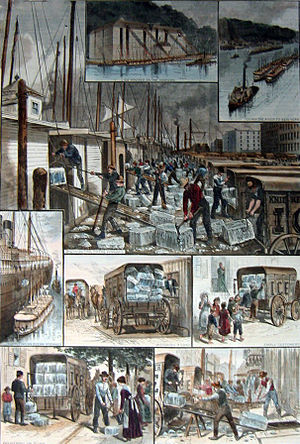
The ice trade around New York City; from top: ice houses on the Hudson River; ice barges being towed to New York; barges being unloaded; ocean steamship being supplied; ice being weighed; small customers being sold ice; the "uptown trade" to wealthier customers; an ice cellar being filled; by F. Ray, Harper's Weekly, 30 August 1884
While The ice was globally shipped by sea and rail reaching England, India, South America, China and Australia, the main bulk of the ice was used in the United States both for industry and private consumption.
The ice harvest, which lasted for a few weeks, usually between January and March, took place across that huge region of North America where the winters are hard enough to freeze lakes and rivers solid. Whether it was on the Hudson River, one of the New England ponds, the Kennebec River in Maine or in the mid-west, it presented the same extraordinary winter tableau, and in many places drew crowds of spectators.
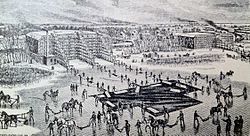
Harvesting ice at Wolf Lake, Indiana, in 1889, showing the conveyor belts used to lift the product into the ice house
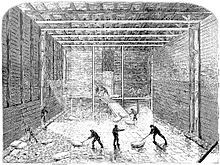
When the surface was marked out, horse-drawn ploughs with metal teeth cut far enough down into the first grooves to enable men with long-handled chisels to prise the blocks free. The giant ice cubes were then coaxed along channels of free water to a mechanism which hoisted them into the timber ice-house. Loading was from the top, the blocks sliding down a chute from which they were hauled into regular stacks, like huge building blocks. Sawdust was put between and around the blocks as insulation. Stacked like that awaiting shipment, the ice cubes were able to survive for several years, shrinking slowly through each summer and refreezing in winter.
Ice being stacked inside a warehouse at Barrytown on the Hudson River
In 1806, Fredrick Tudor , shipped ice to the Caribbean island of Martinique, hoping to sell it to wealthy members of the European elite there. In the following years he overcame many technical and financial issues and became known as the "Ice king of Boston".
Tudor and the people related to his business managed to improve the harvesting with special tools and methods, the storage with special designed Ice (storage) houses and the methods of distributing the ice.
This book is an excellent researched book on a fascinating subject. It exposed me to an industry that I was not aware of, and does not exist anymore. After reading it, I did some online reading and broadened my mind on the subject.
Personally, I would prefer more emphasize on the technology and industry, and less emphasize on the specific people and their hardships.
This is another history book that I read years ago. I was most impressed by the fact that an entire industry--with a specialized, seasonal work force that used specialized tools and techniques--was built around the harvest and transport of block ice to far-away temperate countries that did not have any natural ice of their own. The effort that the Tudor brothers put into this endeavor is astounding--and so, too, is the fact that few transactional records from the period exist, making it nigh impossible to get a fix on ice's economic stature in the import/export schemes of the day. What is known is that the two Tudor brothers harvested block ice and brought it to people who had never before enjoyed its benefits--making these people want this commodity even more.
Author Weightman does an excellent job expanding on events and people that would otherwise reside in a few footnotes, and the history that he pieces together is well worth reading.
This was a cool little book! I think I was turned on to it by an NPR story that sounded interesting, and in fact the book kept my interest almost the whole way. I had not realized how large an important the ice industry was in the US before the Civil War (I think most people don't think about it), and this guy Tudor was as much of a driven mogul as any of the inventors of the early 1800s. You can see the effect of various aspects of US history that affected him, from war of 1812 to Civil War. Once refrigeration was possible to manufacture, the harvesting of ice disappeared. We can also credit the rising pollution of water sources for ruining ice harvesting, which seemed to be a pretty green industry really. Anyway, I recommend the book. Well written. I like books written by former journalists. They kinda know how to keep the story succinct.
This is a fascinating book about a subject I knew little about, other than horse drawn wagons used to deliver ice to people's houses. I had no idea how large an industry ice was and the distances American ice was shipped. That an industry of this magnitude is today virtually forgotten is amazing to me. Then again, I can't ever remember( I'm 67) not having a refrigerator with cold drinks and ice. Recommended reading.
With the modern convenience of fridges (and indeed, I have to defrost my freezer soon) , we forget about the days before electricity and reliable forms of cooling food.
This books details the life and work of one man in particular who kept at it with getting ice cut from frozen American lakes each winter, and then shipping them to the Tropics.
I found this book to be interesting, well written but not absorbing. I guess that's because I like to know the historical figures more deeply than the restrictions of the book allowed.
I was really enjoying this book until I hit this: "... Melting ice releases its latent heat of fusion, and a sealed ice house will actually heat up as the ice melts. It is imperative the ice house be well ventilated to allow this heat to escape. " Ummmm... WHAT??? Clearly the author never set foot anywhere near a high school Chemistry or Physics class. I suspect the author simply copied this from some anecdotal sorce, without even thinking about it. This made me doubt everything else in the book. Hence the rating of 1.
He does state that "... the principles of thermodynamics, which underlie both the preservation of ice in warm climates and artificial refrigeration, would not be worked out until decades later. " The time frame for this book is the 19th century, but they had a better ubnderstanding than that.
For the record, latent heat is the energy absorbed or released by a substantance during a phase transition, e.g. solid to/from liquid, or liquid to/from vapor
when water freezes, it releases latent heat during the phase transition from liquid to solid, and it absorbs heat during the phase transition from solid to liquid i.e., melting. This is why ice makes your drinks cold.
I know you didn't ask, but the latent heat of Water is about 334 kilojoules per kilogram.
The greatest story never told. Something we use everyday and take for granted, ice. This book is so well written and full of fascinating information about life in America in the early-1800s. Being from the North East I cannot believe that I had never heard of this man or his contribution to not only commerce in America at that time but the creation of an industry that would truly change the world in which we live. An excellent and quick read - I would highly recommend for anyone but particularly for my fellow New Englanders.
One of the most amazing entrepreneurs in American history is a man named Frederic Tudor. He was a visionary of the first order, in the early years of the nineteenth century, he understood that a market could be created for one of nature’s products, ice. His vision was to harvest ice from frozen lakes and rivers during the New England winters, store it and then place it on ships to be transported to tropical climates as well as the cities on the eastern seaboard in the summer. Some of the ices was transported all the way to British India. Although his first attempts were failures and he spent some time in debtor’s prison, Tudor never lost faith in his vision, and he became a very wealthy man. His story is one of a person literally creating a market where none existed. After the initial success where people were able to enjoy ice cream and cold drinks in the heat of the summer, the demand grew dramatically. Even though it was a simple product, there were some significant technical difficulties. Finding a way to put ice on a ship and have it travel from New England all the way to India was a challenge. The ship had to cross the equator twice and spend significant time in the tropics. This was before the laws of heat transfer were fully understood, so it largely trial and error. This book was a pleasure to read, making you realize that there are some simple products and as yet untapped markets for those products yet to be exploited. In many ways, the development of the ice market helped drive the demise of the transport of ice. For it helped drive the development of the modern electric powered refrigerators and ice making machines that rendered the long-range transport of ice inefficient. This is one of the best business history books that I have ever read.
If we weren't doing this for a book discussion, I never would have picked this up. If we weren't doing this for a book discussion, I never would have finished this book. I'm giving it two stars because I did finish the book and I do know what I read.
This is the story of Frederic Tudor and his quest to harvest ice, mostly in Massachusetts, and ship it to ports in the southern United States and around the world. I learned a lot about this industry, the risks & pitfalls, successes, etc, but author Weightman did not present this information in a way that intrigued me to find out more about this topic.
Great book about ice harvesting to understand the opportunities provided by other technologies…Most interesting to me was the decline of the industry due not only to electricity & household refrigeration, but ALSO the warming temps back in the latter 1800’s!!! Tudor was an interesting man, driven by his beliefs. And being a Mainer and familiar with Maine ice harvesting (and the children’s book “Cocoa Ice” by Diana Applebaum that I read every year to my 4th graders as a piece of Maine history) I found Weightman’s account brought more insight and background to the part Maine played in the history of ice harvesting.
A fascinating look at an industry that sounded like a crazy idea when it was first conceived (storing ice in New England in winter, then shipping it to hot places in the summer) but eventually turned into an enormous industry. Enjoyable to read, especially as a Massachusetts native (it turns out that most of the industry began here).
The Frozen Water Trade tells the story of the ice-cutting and shipping industry, which has no real antecedent, with the possible exception of gas station ice machines. The book is also something of a Stealth Biography of "The Ice King Of Boston" Frederic Tudor, the man who pioneered the ice trade, was not without many complications, including multiple stints in debtors jail.
An unbelievably boring book about a fascinating subject. Much could have been done to describe the experiences of having a cold drink for the first time, other ways that hot places have dealt with heat and cooling, or even just more narrative detail instead of a linear tromp through the events of one man’s life.
Fascinating history of a trade I knew nothing about. Exporting natural ice by ship from Boston to India as well as the local trade in the era before artificial refrigeration. Clever stuff.
Yet another rather unbelievable piece of history, with a formidable pioneer and his unrelenting drive, creation of an addiction for ice and the capitalism that usually follows.
Well told accounting of the nearly forgotten ice trade. It was fascinating to realize just how massive this operation, which is not obsolete, truly was.
A well-written, solid book about a little known, but fascinating aspect of history - the almost unbelievable trade in ice. I was surprised about how much info and records the author appeared to have to work with, or was he just very good at spinning the sparse records into a good tale.
Although the concept of this obscure endeavor from the mid 1800s is both fascinating, hair-brained and inspiring, the day to day history itself isn't. No fault of the author, just a true story devoid of any sensationalist excitement, backstabbing, cutthroat competition, risk of death, etc.
This was a bit of a slow read for me at times, but a fascinating look into what life was like without refridgerators and how dependent American's were on the ice harvesting industry for their food, drinks and ice cream! I am glad I read it.
Modern life has so many luxuries that we tend to notice them by their absence not by their presence. Comfortable fabrics, ease of transportation, computer scheduling, mass communication and onwards have at times created the assumption that the masses demand a product, and the smart classes get together, solve the problem and within a few years industry and society are aided and life moves on. What is often given less attention is the creation of a new want, where it did not previously exist, nor was there any expectation that if the problem were not solved, no one particularly notice. Such is the case with consumer ice. Yes, ice in drinks, ice in environment cooling, ice in food preservation and comfort.
The story that Weightman, a British author and filmmaker, tells is even more remarkable considering that when ice was first sold as a commodity, the early 19th century, was in an age when technology did not yet exist to create man made ice in any location. In other words, it took entrepreneurs with ideas and skill, to cut, ship and sell ice from cold locations to warm locations, while preventing the obvious melting.
Anyone whose work requires of them anything more than non-linear, A to B thinking would find this book useful. For when Frederic Tudor, a frequently failed Massachusetts businessman, decided that he could perfect and manage the shipment of river and lake ice to the Caribbean in 1806, he began one of the first technological and marketing success stories of the early American Republic and the Industrial Revolution.
Of course the use of ice for consumer use was nothing new, but the scale of the enterprise that the Tudor created in early America far surpassed anything in world history before, and it was such a success that no one really remembers it today. The basics of creating and adapting new strategies for seemingly new problems, with rapid rates of success / failure observation are all told in their excruciating history for the Tudor saga.
Within a few decades, thousands were employed, lives were change and fortunes were made in ways that resemble the growth of the information technology industry. If someone today sees an image of an New England worker, hacking away at the ice; the thought is you are viewing a bucolic, quaint image. Instead, the viewer is seeing innovation and a diffused hierarchy of adaptation all with the expressed purpose of taking American winter ice to the tropics and even to Europe. Weightman even explains why some markets are closed with the failure to market commercial ice to the British Isles.
The eventual collapse of the ice trade came about as quickly as it sprang up, because of further innovation in creating artificial ice machines, perfected by later New Englanders. The reader can expect a fascinating story about seemingly mundane events over nearly a hundred years that involves business, marketing, adaptation, personal failure and commercial luxury of the most common natural element, water, in this case its frozen form.