"What do I like about writing for children? Everything," says Florence Parry Heide, the award-winning author of more than sixty children’s books, including the classic THE SHRINKING OF TREEHORN, illustrated by Edward Gorey. "I like the connection with children," the author says. "I like the connection with all kinds of book people. And I like the connection with my childhood self, which is the most of me. It is the most welcome and familiar of worlds. There miracles abound--indeed it is magical that something I might think of can be put into words, stories, ideas, and that those words end up in the heads of readers I will never meet."
Florence Parry Heide wrote SOME THINGS ARE SCARY, a humorous look at childhood bugaboos, more than thirty years ago. "I had finished another book and was in the mood to write something else," she says. "I decided to get some kindling from the garage, reached into the kindling box and--good grief!--grabbed something soft and mushy. I fled back to the house, scared to death." A brave return visit to the kindling box revealed the object of terror to be nothing more than a discarded wet sponge, but the thought remained: some things are scary. As she recalls, "What scared me as a child was that I’d never learn how to be a real grownup--and the fact is, I never did find out how it goes."
One thing Florence Parry Heide does have a good handle on is the concept of friendship, in all its humorous manifestations. THAT’S WHAT FRIENDS ARE FOR, a tongue-in-cheek tale cowritten with Sylvia Van Clief in 1967, pokes at the tendency of well-meaning friends to offer advice instead of help, and presents a valuable lesson about what true friendship means. "One of my many (true) sayings is ‘A new friend is around the corner of every single day,’ " the author declares. "Also true: Friendships last. And last."
Born and raised in Pennsylvania, Florence Parry Heide worked in advertising and public relations in New York City before returning to Pittsburgh during World War II. After the war, she and her husband moved to Wisconsin, where they raised five children, two of whom have cowritten critically acclaimed books with their mother. Florence Parry Heide now lives in Wisconsin.
Jay Temple and his sister, Cindy, and their friend Dexter Tate are the publishers of a local newspaper called the 'Random Review'. It is a small publication of local news. They also comprise the membership of the Spotlight Club: detectives of a sort that have solved a few mysteries. They are school age kids, living in a the small town of Kenoska. The feel is of the 1950s era.
When Jay is doing some clean-up work in Mr. Pruitt's yard, he finds an Egyptian mask, wrapped up and hidden in the yard. He shows it to Mr. Pruitt, who takes it and says he will handle it.
When he tells Cindy and Dexter about it, they do a short write-up and add it to the new edition of the 'Random Review'. Things turn strange when the printer's shop is broken into and their master copy is stolen. Nothing else is missing, just their paper.
Later, Jay has biked out towards the country and found an old abandoned house. When he enters it, he finds that somebody has been staying there, and there are some large crates that seem to contain stuff. He doesn't know what, but figures it must be valuable.
The mystery involves who are the people that have put the crates there, what is in them, who is this 'Lon's Lawn Service' that has suddenly shown up and where did Mr. Pruitt go with the mask.
It is geared towards elementary readers as it is a chapter book and it does have some illustrations. But it is a fun visit back to a simpler and slower time for grown-ups to enjoy.
My favorite thing about this 1979 children's mystery, which centers around three kids who both solve mysteries as the "Spotlight Club" and publish a weekly community newspaper, is that a subplot involves a boy trying to ride his bike 300 miles in one summer to win a t-shirt.
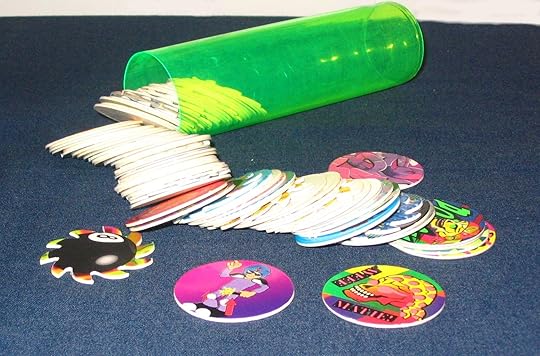
One summer, when I was about ten years old, my family went to visit my grandparents in another state. Their town was having a promotion where, if you collected twenty pogs from neighborhood businesses, you earned a free ice cream cone. Remember pogs?
Yes. Pogs. Cardboard discs that were manufactured for less than a penny and sold for a quarter, to the absurd delight of children in the U.S. for a brief time in the 1990s. I will never understand why my mother decided to humor my desire to chase down twenty pogs, rather than just buy me a two dollar ice cream cone. But I'm glad that she did. We spent the entire week driving around together, going into stores and restaurants we'd never heard of, seeing parts of the town we'd never had a reason to visit, and collecting pogs. In short: exploring and bonding. By the end of the week, I'd earned my ice cream cone, and I was thrilled. Maybe we were manipulated by the advertising powers of capitalism, but it's a sweet memory.
. . . Do kids do this stuff anymore? Would a child in his right mind, in the 2010s, ride 300 miles to earn a t-shirt? Or collect twenty pogs to earn an ice cream cone? I feel like most earning and redemption for kids today happens in video games. Do I sound like I'm a hundred years old?
Anyway, the thing that the mother-daughter writing team of Florence Parry Heide and Roxanne Heide understood (past tense, as Florence apparently passed away in 2011) was that humble, ordinary quests can put you in the way of adventure. If the kid in this story wasn't trying to ride his bike 300 miles, he never would have passed the mysterious abandoned house in the countryside. And then he never would have gone snooping, and then the Spotlight Club never would have figured out how a priceless Egyptian mummy mask wound up buried under the leaves of their neighbor's lawn. (Did I mention that this incredibly enterprising group of children also operates a lawn-mowing business? They're like miniature Donald Trumps.)
I also like that the Spotlight Club prepares its weekly newsletter with the 1970s technology of literal cut and paste before taking it to the printers to be photo-copied. Ah, the good old days!
To wrap this up: The mystery is pretty cute; there is a satisfying number of red herrings; and the decisions that the kids make which let the story build are not the result of the characters' complete idiocy (I'm looking at you, Clive Cussler), but rather their believable lack of life experience and adult judgment. It's also refreshing--or, I suppose, disappointing, depending on your point of view--that the Egyptian artifact at the center of the story derives its sense of mystery not from supernatural powers, but rather from its unexplained presence in the children's neighborhood.