Garrett Putman Serviss was an American astronomer, popularizer of astronomy, and early science fiction writer. He majored in science at Cornell and in 1876 joined the staff of the The New York Sun newspaper, working as a journalist until 1892. Serviss showed a talent for explaining scientific details in a way that made them clear to the ordinary reader, leading Andrew Carnegie to invite him to deliver The Urania Lectures in 1894 on astronomy, cosmology, geology, and related matters. Serviss toured the United States for over two years delivering these lectures. He also wrote a syndicated newspaper column devoted to astronomy and other sciences.
Eight of his books are devoted to astronomy. He also wrote six works of fiction in his lifetime, all of which would today be classified as science fiction.
It reads like a Jules Verne book; no wonder the book had been dedicated to the Verne's readers.
An eccentric 30-year-old man called Stonewall is about to get his 4 friends into an undreamt adventure.
He’s been working in his own lab on the power of the atom; he’s "eloquent” on radioactivity; he knows about the “power” residing in a single ”grain of radium”: the so-called “inter-atomic energy”. His peers at the club Olympus understand nothing about the issue.
One day, Stonewall manages to get his friends to visit his lab; soon they find they’re travelling through space.
Despite all initial reluctance, all thoughts like “this is kidnapping” …soon, as I said, they’re part of an “interesting expedition”…to Venus.
Only one friend was left on ground: to witness the ship departing skywards. It’s a “diabolical” car disappearing westwards. Venus shines like a "diamond" , up there, in New Jersey.
Inside the spaceship, Henry and Jack can smoke freely, because, as Edmund Stonewall explains, the smoke has been turned into atomic energy.
Stonewall thinks Venus is more important than money; while Henry had another angle: Stonewall should be making good money, with a patent of the engine. Jack and the genius are the only “romantic souls”.
According to the counts of the eccentric Stonewall they’ll reach Venus in 15 days; no, 16, to be more exact. They’ll be introduced to “the inhabitants of another world”.
In the past 5 days they had a rough time with meteors. Through the “peepholes” of the craft they had , at the start of their journey, a view of the Pacific west. Their speed is of 20 miles per second.
Stonewall thinks of himself as the Columbus of space; being Jack and Henry his lieutenants. The self-entitled Columbus thinks humanity has been wasting money on steam and electricity, when in fact there’s limitless energy in the atom.
They “know” of 14-feet giants of Mars; how about those of Venus?
-I’m very curious about,….too.
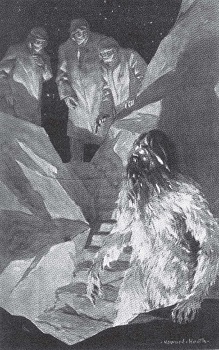
“Standing on the steps...was a creature shaped like a man, but more savage than a gorilla.”
...
“They’re mountains of crystal!”
“Mountains of crystal!” we echoed.
“Nothing else in the world, and I am ashamed not to have foreseen the thing. It’s plain enough when you come to think about it. Remember that Venus being a world lying half in the daylight and half in the night, is necessarily as hot on one side as it is cold on the other. All of the clouds and floating vapors are on the day side, where the sunbeams act. The heated air charged with moisture rises over the sunward hemisphere, and flows off above, on all sides, toward the night side, while from the latter cold air flows in beneath to take its place. Along the junction of the two hemispheres the clouds and moisture are condensed by the intense cold, and fall in ceaseless snowstorms. This snow descending for ages has piled up in mountainous masses whose height may be increased in some places by real mountain ranges buried beneath. The atmospheric moisture cannot pass very far into the night hemisphere without being condensed, and so it is all arrested within a ring, or band, extending completely around the planet, and marking the division between perpetual day and perpetual night. The appearance of gigantic flames is produced by the sunbeams striking these mountains of ice and snow from behind and breaking into prismatic fire.”
This is an interesting piece that seems to have been written before Edgar Rice Burroughs and Otis Adebert Kline wrote their famous Venus series. This is a trip to Venus on a craft that can travel a tremendous speed and is powered by something that sounds possibly nuclear. Another interesting thing, since this is written after H. Rider Haggard's She, is that the main female character is described as having a presence that reminds me of Ayesha from She. And though she is not quite as dangerous as Ayesha, Edmunds fixation on Ala and the wonders of Venus might lead the expedition into danger.
Edmund has come up with a process that taps what he calls inter-atomic energy and he applies it to a special car shaped like a boiler, that he has created to take him into space. In a fit of anger at their remarks about his work he takes his friends with him without their consent. It takes about two weeks to get to Venus and there's some neat calculations behind it all though the ship itself has some potential design flaws.
Because of the peculiar rotational aspects of Venus Edmund chooses to land on the darker side where he figures there should be no one living, since it would be too cold. But they find a race of somewhat intelligent ape like hominids whom Edmund is able to communicate with through Telepathy. Because of dense atmosphere speech on the planet is amplified and though the beings do speak, they only do so on rare occasions. Learning about these creatures or people, creates some tension; but the real adventure comes when they traverse to the warmer sunny side of Venus.
On the warmer side there are more human-like hominids who also communicate through telepathy much the same as the apelike beings, though Edmund theorizes these people have tapped some other aspects of the difference in atmospheric pressure and possibly have a strange sensitivity to color and sound that is pretty interesting. Eventually he creates a device that helps them hear as the Venusian's do and they explore the wonderful strange way the Venusian's commune with nature. Here they meet the friendly, intelligent and beautiful Ala; and Ingra, Ala's jealous and dangerous fiance.
Edmund knows that they are in constant danger and they should leave soon, but he puts it off both because of his desire to explore Venus and that he enjoys teaching Ala; who seems to have an insatiable curiosity.
But there is some other portending catastrophe ahead that he ignores.
If I have any qualms about the story it's that of the other characters traveling with Edmund, only Jack and the narrator, Peter, seem to really get involved while Henry seems to mostly be going along for the ride, though every so often he votes they should go home or at least try doing some less dangerous things.
As it turns out this is another Dying World novel and this fact could get our heroes killed. But beyond that there are plenty of other dangers from the inhabitants and our heroes own miss-understanding of customs.
This is once again an interesting Classic in SFF and though the author has credentials that would support his knowledge of the science, there are still some things that might have been questionable back when he wrote this and certainly have a rough time surviving even the most rigorous of suspension of disbelief. Still for those who like to examine the roots of the craft of writing SFF, this is one more steppingstone to add to the genre.
Though I didn't quite get as much enjoyment from this as I have from Edgar Rice Burroughs and Otis Adelbert Kline. there's still enough excitement to get me straight through to the end; and now I wonder if those other authors read any of Garrett Putman Serviss's work before they ventured onto Venus.
This is one of those classic science fiction stories, and in fact when I got my copy through inter-library loan, it had a slip on it that showed it had been put in a library annex, stuck away in some vault of off-site storage because it never gets checked out. Well, more is the shame. The basic story is set in the nineteenth century, where a man asks his friends if they want to see something he has been working on and they all end up taking a trip to Venus, where there are different societies depending on if you live on the sun side or the no-sun side of the planet, where all you need as a human to survive is a fur coat and a pistol, and the people have tapped into the higher powers of the brain for communication. I loved the descriptions of speech, color, light, and music - music that is "unheard."
This 1909 planetary tale is not quite a romance, not altogether an adventure, and has no swords in it.
Our narrator is at his club in New York with his friend Edmund and their pals, and everybody sort of pokes fun at Edmund being some kind of scientific genius. Edmund builds a “car” (it's a spaceship) powered by “inter-atomic energy”, tricks them into getting into it, and flies them off to Venus.
Edmund explains to his friends that Venus only ever shows one side to the sun, so there is a day side and a night side of the planet, with a wall of ice mountains in between. They land on the frozen night side and meet some primitive hairy types who live in caves and have big glowing eyes. They adventure their way over to the day side (which is shielded from the sun by layers of clouds) and meet people who are basically human, but talk psychically with their eyes.
As you might expect, the pretty human people are scientifically advanced and largely pacifist. They've also got a beautiful princess/queen named Ala for Edmund to obsess over, but she is betrothed to this royal jerk named Ingra who generally disapproves of our heroes and schemes against them.
There are intentional shades of Jules Verne here, and I found bits similar to Wells' “The Time Machine”. The heroes also try to gain leverage by passing themselves off as gods to the Venusians, which may just be general purpose colonial fiction, but it reminded me most of H. Rider Haggard's stuff.
So! Inventory: some Victorian/Edwardian rich guys who frequent clubs (think stuffy England type stuff, not Studio 54), we have a planet with one language and two races, we have some sweet pseudo-scientific touches like ice mountains and lands of night, we have a freaky local religion with power-hungry priests and backward responses to blasphemy, we have a spaceship fueled by exhaled carbon, we have a semi-futuristic society with flying towers and monarchy, we have swampy jungles full of giant monsters, psychic head stuff and hidden human abilities, foreshadowed tragedy, wrap-around-fu, an implied more-perfect world which the heroes still wish to leave, and an overdoes of camaraderie.
What went wrong?
The recipe for “A Columbus of Space” has many of the same escapist and colonial science-fiction adventure ingredients that went into making truly classic planet stories from that time, like “Gulliver of Mars” and, especially, “A Princess of Mars”. What essentially made those work, however, was a formula in which one man goes alone to a fantastical place he hadn't really expected to go (in both of those books the hero basically wishes himself there without really realizing what he is doing) and falls in love and realizes he wants to stay. In “A Columbus of Space”, the actual hero, Edmund, our genius, goes because he planned it and took along friends. Edmund is never alone, never gets a chance to really fall in love with Queen Ala, or to truly challenge Ingra for her hand, or even to genuinely prove himself as worthy. This is a story of some humans who go to a weird world and show off some magic tricks to the locals and then have mixed feelings about their visit.
The other major sin is that only Edmund learns to talk psychically to the native populace, and so the others (including the narrator) must hear from Edmund what was said or just guess. Almost all of the dialogue is between these four men from Earth, and their gripes and wisecracks get tiresome pretty quick.
I am probably too narrow-minded a reader when it comes to planet stories since, to me, everything about a human shooting off to strange world written between 1880 and 1930 must be compared with either the Edgar Rice Burroughs or Edwin L. Arnold book. Objectively, I understand that the flavor of the romantic science-fantasy is not always going to be the author's aim. The reason I bring up those books again and again is not necessarily their more dreamlike escapist qualities, but the fact that they leveraged drama to bolster the adventure.
Had the heroes not simply been able to take care of problems with guns, and if they had been caught alone more often, this would probably be a big winner of a book for me.
One of the reasons I even read this book was that Lupoff mentioned it as a precursor to “A Princess of Mars” in his book “Edgar Rice Burroughs: Master of Adventure”. Lupoff made fun of the ending, which I will not reveal here, but people who have read both books (and Arnold's) will understand the comparison and where one may come up slightly shorter than the other.
This is an early work of planetary science fiction, so I forgive many of the shortcoming here. Much of the winning formula hadn't really been worked out at this time. I had a lot of fun with aspects of this. At the end of the day, I do recommend “A Columbus of Space” for the parts it got right, especially to people who read the kind of stuff that I do.
It is always more interesting to witness the flights of fancy of an author speculating on scientific matters than to read some hard-edged math-based thing which puts drama in a backseat to facts.
Due to eye issues Alexa reads to me, a very entertaining will written fantasy Sci-Fi space adventure thriller novella to Venus. The characters are interesting and will developed. The story line is complicated, fast moving, relationships, friendship and trust racing to the conclusion. I would recommend this novella to readers of fantasy and Science Fiction. Enjoy reading 🔰2021 😅
It was good, but not as good as contemporaries such as H G Wells. It moves fast and plenty happens (and I love, as always, the old ideas of space travel and other planets in our Solar System) but something was lacking, perhaps real tension or care for the characters. Nevertheless a good enough read when you're in the mood for old-fashioned pulp fantasy, just not up there with the best.
One of the often unsung pioneers of SF, American astronomer and author Garrett P. Serviss occupied a space somewhere between H.G. Wells and Edgar Rice Burroughs, springing out of the scientific romances of Jules Verne. While Burroughs is often quoted as the instigator of the interplanetary pulp adventures, there were several now seldom remembered precursors. One of the best was Serviss, and "A Columbus of Space", in my opinion, his best SF book, and without doubt an inspiration for the Barsoom series.
Dedicated to the readers of Jules Verne, the novel starts out very much in the style of the French pioneer, with a haughty, somewhat prickly universal genius inventor. Pricked by his friends' skepticism, he kidnaps three drinking buddies in his "inter-atomic powered" spacecraft and heads off to Venus. Here the influence of Wells takes over, as the party encounter two different intelligent species dominating the icy, dark side of the planet and the sunlit opposite. They first meet the yeti-like (think Chewbacca) dark-siders, who despite first appearences turn out to be hospitable and intelligent, but somewhat primitive. They take one of them along to visit the highly advanced light-siders who view the other race as inferior and exploit them for labour. Here they meet a princess of Venus and her evil betrothed. Drama and intrigue ensue.
Occasionally somewhat overly pulpy, the book nevertheless possesses a sophistication often lacking in later novels of similar types, and indeed in most of the works of the celebrated Burroughs. Its imagination is quite unique for the time it was written, going far beyond the scope of other early space adventure writers. Sadly it is now often dismissed as "another Burroughs clone", although it goes the other way round.
A Columbus of Space is a golden story of adventure on Venus. Scientist Edmond takes a group of friends on a trip through space in an "inter-atomic" powered "car" which is much like a Winnebago in size. They go to Venus meeting strange inhabitants on the dark and light sides and making friends an enemies as they travel. The tale is fast-paced, but the characters are rather boring. The science in the story is very dated but this is not a story for those who are into modern technology. Much like Jules Verne and Edgar Rice Burroughs this is a tale of human courage and ingenuity. While not the fastest or most thrilling tale, it is a nice picture of imagination from the early 20th century.
Mark Nelson does a credible job in narrating the LibriVox release of the story.
This is a delightful little golden age of sci-fi book, published the year my father was born, about a man who taps the secret of nuclear energy to power a ship to sail to Venus. He "kidnaps" his circle of fellow bachelors, and when they have discovered that he means to carry them away from the Earth, they are angry. He placates them by offering to return them to Earth, but they have by this time conceived an interest in appeasing their curiosity, and agree to the expedition. They visit the dark side first, and some crazy adventures await them there, but none so amazing as the ones they will experience when they travel to the light side. Serviss' imagination is in full flight as he entertains his readers with a space fairy tale.
Some rather interesting ideas in this tale (especially planetary weather), which keeps all but the most astute readers guessing as to the next plot twist. Also a few classic assumptions about future science -- like antigravity drive -- are merely plot devices (like Star Trek's transporters) and not well thought out.
When you stop and think about how the author came up with certain scientific ideas so long ago that rang true, or near true, this book could be a 4 or more. But through a modern lens, I was distracted by the inherent white man superiority I felt came through.
Bunch of White men travel through space, go to Venus, enslave natives, find more natives who are superior and White like them. Then there are some monsters, some intrigue, and that's all. Can be fun if you like to read things ironically. Otherwise, skip.
The Good: It was amazing to read this "old" sci-fi book. The imagination of the time was fantastic! The story moved along at a good pace. I've never heard of this author previously.
The Bad: The author killed off too many of the characters. What a shame.