

What do you think?

Quantum Night
Experimental psychologist Jim Marchuk has developed a flawless technique for identifying the previously undetected psychopaths lurking everywhere in society. But while being cross-examined about his breakthrough in court, Jim is shocked to discover that he has lost his memories of six months of his life from twenty years previously--a dark time during which he himself committed heinous acts.
Jim is reunited with Kayla Huron, his forgotten girlfriend from his lost period and now a quantum physicist who has made a stunning discovery about the nature of human consciousness. As a rising tide of violence and hate sweeps across the globe, the psychologist and the physicist combine forces in a race against time to see if they can do the impossible--change human nature--before the entire world descends into darkness.
Jim is reunited with Kayla Huron, his forgotten girlfriend from his lost period and now a quantum physicist who has made a stunning discovery about the nature of human consciousness. As a rising tide of violence and hate sweeps across the globe, the psychologist and the physicist combine forces in a race against time to see if they can do the impossible--change human nature--before the entire world descends into darkness.
368 pages, Kindle Edition
First published March 1, 2016
About the author
Robert J. Sawyer
224 books2,551 followersRobert J. Sawyer is one of Canada's best known and most successful science fiction writers. He is the only Canadian (and one of only 7 writers in the world) to have won all three of the top international awards for science fiction: the 1995 Nebula Award for The Terminal Experiment, the 2003 Hugo Award for Hominids, and the 2006 John W. Campbell Memorial Award for Mindscan.
Robert Sawyer grew up in Toronto, the son of two university professors. He credits two of his favourite shows from the late 1960s and early 1970s, Search and Star Trek, with teaching him some of the fundamentals of the science-fiction craft. Sawyer was obsessed with outer space from a young age, and he vividly remembers watching the televised Apollo missions. He claims to have watched the 1968 classic film 2001: A Space Odyssey 25 times. He began writing science fiction in a high school club, which he co-founded, NASFA (Northview Academy Association of Science Fiction Addicts). Sawyer graduated in 1982 from the Radio and Television Arts Program at Ryerson University, where he later worked as an instructor.
Sawyer's first published book, Golden Fleece (1989), is an adaptation of short stories that had previously appeared in the science-fiction magazine Amazing Stories. This book won the Aurora Award for the best Canadian science-fiction novel in English. In the early 1990s Sawyer went on to publish his inventive Quintaglio Ascension trilogy, about a world of intelligent dinosaurs. His 1995 award winning The Terminal Experiment confirmed his place as a major international science-fiction writer.
A prolific writer, Sawyer has published more than 10 novels, plus two trilogies. Reviewers praise Sawyer for his concise prose, which has been compared to that of the science-fiction master Isaac Asimov. Like many science fiction-writers, Sawyer welcomes the opportunities his chosen genre provides for exploring ideas. The first book of his Neanderthal Parallax trilogy, Hominids (2002), is set in a near-future society, in which a quantum computing experiment brings a Neanderthal scientist from a parallel Earth to ours. His 2006 Mindscan explores the possibility of transferring human consciousness into a mechanical body, and the ensuing ethical, legal, and societal ramifications.
A passionate advocate for science fiction, Sawyer teaches creative writing and appears frequently in the media to discuss his genre. He prefers the label "philosophical fiction," and in no way sees himself as a predictor of the future. His mission statement for his writing is "To combine the intimately human with the grandly cosmic."
http://us.macmillan.com/author/robert...
Robert Sawyer grew up in Toronto, the son of two university professors. He credits two of his favourite shows from the late 1960s and early 1970s, Search and Star Trek, with teaching him some of the fundamentals of the science-fiction craft. Sawyer was obsessed with outer space from a young age, and he vividly remembers watching the televised Apollo missions. He claims to have watched the 1968 classic film 2001: A Space Odyssey 25 times. He began writing science fiction in a high school club, which he co-founded, NASFA (Northview Academy Association of Science Fiction Addicts). Sawyer graduated in 1982 from the Radio and Television Arts Program at Ryerson University, where he later worked as an instructor.
Sawyer's first published book, Golden Fleece (1989), is an adaptation of short stories that had previously appeared in the science-fiction magazine Amazing Stories. This book won the Aurora Award for the best Canadian science-fiction novel in English. In the early 1990s Sawyer went on to publish his inventive Quintaglio Ascension trilogy, about a world of intelligent dinosaurs. His 1995 award winning The Terminal Experiment confirmed his place as a major international science-fiction writer.
A prolific writer, Sawyer has published more than 10 novels, plus two trilogies. Reviewers praise Sawyer for his concise prose, which has been compared to that of the science-fiction master Isaac Asimov. Like many science fiction-writers, Sawyer welcomes the opportunities his chosen genre provides for exploring ideas. The first book of his Neanderthal Parallax trilogy, Hominids (2002), is set in a near-future society, in which a quantum computing experiment brings a Neanderthal scientist from a parallel Earth to ours. His 2006 Mindscan explores the possibility of transferring human consciousness into a mechanical body, and the ensuing ethical, legal, and societal ramifications.
A passionate advocate for science fiction, Sawyer teaches creative writing and appears frequently in the media to discuss his genre. He prefers the label "philosophical fiction," and in no way sees himself as a predictor of the future. His mission statement for his writing is "To combine the intimately human with the grandly cosmic."
http://us.macmillan.com/author/robert...
Ratings & Reviews
Friends & Following
Create a free account to discover what your friends think of this book!
Community Reviews
Displaying 1 - 30 of 512 reviews

May 16, 2024
"The world would be a better place if everyone thought like him... The world would be a better place if everyone thought, period."
With this novel, entangling (😉 to my fellow nerds) quantum physics, philosophy, biology of consciousness, and morality, Robert J. Sawyer has more than redeemed himself for the train wreck that was Humans. This is every bit as brilliant as Hominids and Sawyer is now one of my favorite authors. I love his ideas, his imagination, and the way he writes.
The main characters in this book expound on the (real life) Penrose-Hameroff model of consciousness as they search for the reasons some people are psychopaths, others unthinking "sheep", and fewest of all, thinkers with a conscience.
Is there free will? Are people just at the mercy of their brains? Is capital punishment moral? Is it possible that people's conscious state can be changed? What happens when people go under anaesthesia?
These and so many more questions were explored and it made my brain very happy as we zip from one question or idea to the next.
There is not a lot of action, other than the firing of neurons, so it won't appeal to everyone. Those who have read and enjoyed other books by Sawyer will probably enjoy this one too.
I absolutely loved it. If you like SF that gives your brain a workout, I highly recommend this one.
With this novel, entangling (😉 to my fellow nerds) quantum physics, philosophy, biology of consciousness, and morality, Robert J. Sawyer has more than redeemed himself for the train wreck that was Humans. This is every bit as brilliant as Hominids and Sawyer is now one of my favorite authors. I love his ideas, his imagination, and the way he writes.
The main characters in this book expound on the (real life) Penrose-Hameroff model of consciousness as they search for the reasons some people are psychopaths, others unthinking "sheep", and fewest of all, thinkers with a conscience.
Is there free will? Are people just at the mercy of their brains? Is capital punishment moral? Is it possible that people's conscious state can be changed? What happens when people go under anaesthesia?
These and so many more questions were explored and it made my brain very happy as we zip from one question or idea to the next.
There is not a lot of action, other than the firing of neurons, so it won't appeal to everyone. Those who have read and enjoyed other books by Sawyer will probably enjoy this one too.
I absolutely loved it. If you like SF that gives your brain a workout, I highly recommend this one.

April 16, 2016
Full review on my podcast, SFBRP episode #302.
0.1 stars. If only Goodreads would let me.
This book isn't just the worst book I've finished in years, it's also utterly monstrous. I'm actually sickened that someone could write a book and their editor didn't say "Hold on, you're not going to put your name on this in public, right?"
Then there are these quotes from other reviewers here on Goodreads:
"And now I am really paranoid about who might be the psychopaths around me.... thank you Robert J. Sawyer.....thank you....."
"A flawless technique for detecting psychopaths... I hope I'm not the only one constantly looking over my shoulder after reading Quantum Night."
"You'll be talking about this with your family and friends -- or at least some of them -- for years."
"It is excellent reading and (dare I say it?) it might even be life changing."
"Interesting idea, like always from R.Sawyer, and will definitely use it."
"I can't help but find that I now label people as p-zeds, psychos, and quicks."
"Once you're done reading this, you'll spend a fair amount of time studying the people around you."
Congratulations, Sawyer, you've invented a new form of racism that your readers are now using to judge other people. Well done.
0.1 stars. If only Goodreads would let me.
This book isn't just the worst book I've finished in years, it's also utterly monstrous. I'm actually sickened that someone could write a book and their editor didn't say "Hold on, you're not going to put your name on this in public, right?"
Then there are these quotes from other reviewers here on Goodreads:
"And now I am really paranoid about who might be the psychopaths around me.... thank you Robert J. Sawyer.....thank you....."
"A flawless technique for detecting psychopaths... I hope I'm not the only one constantly looking over my shoulder after reading Quantum Night."
"You'll be talking about this with your family and friends -- or at least some of them -- for years."
"It is excellent reading and (dare I say it?) it might even be life changing."
"Interesting idea, like always from R.Sawyer, and will definitely use it."
"I can't help but find that I now label people as p-zeds, psychos, and quicks."
"Once you're done reading this, you'll spend a fair amount of time studying the people around you."
Congratulations, Sawyer, you've invented a new form of racism that your readers are now using to judge other people. Well done.

August 30, 2016
Those who are familiar with him know that Robert J Sawyer has grown into a vaguely conservative, late-middle-aged, sci-fi writer living in a famously soulless suburb west of Toronto. As he gets older, his work is coming more and more to reflect his circumstances. I can report that Quantum Night (2016) is definitely not among his best.
Quantum Night takes a smattering of fairly interesting speculative fiction ideas, and then proceeds to waste them in a story that is so childish as to be not credible.
The notion that the absence of small involuntary eye movements could be as a kind of "psychopath detector"? An intriguing premise! RJS then burns this concept with clumsily executed chapters written from the POV of a psychopath - which, as it turns out, mostly just consists of wanting to commit sexual assault and a swear-y internal monologue.
There is a further hook, arguably much more interesting (which I won't spoil here). Unfortunately, rather than incorporating science into our reality and drawing a narrative from that ( as I would argue the best spec fic does) RJS engages in a wholesale replacement of our world. The version of reality left in its place is not a looking glass world, so much as it is a shoddily built soundstage. There are no backs to the buildings, there is a matte painting where the sky should be, and the empathy that we are supposed to feel for characters has been replaced with a sound effect.
The ending is both so shoddy and so broadly telegraphed that I assumed a wicked twist had to be coming. Sadly, such was not to be. The resolution of the book appears to have been lifted with minor edits from the writing assignment of an elementary school student. Readers may wonder whether they are supposed to feel insulted.
And none of this even begins to engage with the deeply, deeply elitist and paternalistic ideas that lie at the heart of this book. While I cannot argue against their inclusion on artistic grounds (they are, after all, the consequences of the speculative premises established), I find the way that the characters - and RJS himself by extension - respond to these are highly questionable from a moral standpoint.
This is the first book by Sawyer that I've read in a few years, and I'm sad to see the rather sharp turn his style has taken. I think I'll be rereading much earlier works before I try a new one again.
Quantum Night takes a smattering of fairly interesting speculative fiction ideas, and then proceeds to waste them in a story that is so childish as to be not credible.
The notion that the absence of small involuntary eye movements could be as a kind of "psychopath detector"? An intriguing premise! RJS then burns this concept with clumsily executed chapters written from the POV of a psychopath - which, as it turns out, mostly just consists of wanting to commit sexual assault and a swear-y internal monologue.
There is a further hook, arguably much more interesting (which I won't spoil here). Unfortunately, rather than incorporating science into our reality and drawing a narrative from that ( as I would argue the best spec fic does) RJS engages in a wholesale replacement of our world. The version of reality left in its place is not a looking glass world, so much as it is a shoddily built soundstage. There are no backs to the buildings, there is a matte painting where the sky should be, and the empathy that we are supposed to feel for characters has been replaced with a sound effect.
The ending is both so shoddy and so broadly telegraphed that I assumed a wicked twist had to be coming. Sadly, such was not to be. The resolution of the book appears to have been lifted with minor edits from the writing assignment of an elementary school student. Readers may wonder whether they are supposed to feel insulted.
And none of this even begins to engage with the deeply, deeply elitist and paternalistic ideas that lie at the heart of this book. While I cannot argue against their inclusion on artistic grounds (they are, after all, the consequences of the speculative premises established), I find the way that the characters - and RJS himself by extension - respond to these are highly questionable from a moral standpoint.
This is the first book by Sawyer that I've read in a few years, and I'm sad to see the rather sharp turn his style has taken. I think I'll be rereading much earlier works before I try a new one again.

March 2, 2023
3.5 Stars
This is such an enjoyable sci fi thriller. I particularly enjoyed the Canadian references, many of which were personal to my experience. However some of the political references felt very niche and I worried those sections might lose American readers.
As for the story, it was generally a compelling story. I love science fiction as well as psychopathic stories so this was a great intersection of my interests. The science isn't the story didn't feel particularly sound so I'd more so recommend this one to readers who share my love for thrillers, rather than hard science fiction.
Overall I would recommend this one to readers who enjoy a good pageturner.
Disclaimer I received a copy of this book from the publisher.
This is such an enjoyable sci fi thriller. I particularly enjoyed the Canadian references, many of which were personal to my experience. However some of the political references felt very niche and I worried those sections might lose American readers.
As for the story, it was generally a compelling story. I love science fiction as well as psychopathic stories so this was a great intersection of my interests. The science isn't the story didn't feel particularly sound so I'd more so recommend this one to readers who share my love for thrillers, rather than hard science fiction.
Overall I would recommend this one to readers who enjoy a good pageturner.
Disclaimer I received a copy of this book from the publisher.

February 23, 2017
I am at a loss to explain how this atrocious novel was published, let alone how it found itself on the Canada Reads long list this year.
Before I get into its significant ethical and scientific flaws, I'll take a moment to point out that as a story, it also sucked. The characters were flat and gender stereotyped. The plot was nonsensical. All of the relationships in the book conveniently fit the needs of the plot; the dialogue was 95% info-dump; the main character was, besides an awful person (that below), a total bore. I couldn't put the novel down, not because I was enjoying it, but because I kept waiting for the plot twist that would make this piece of crap into something other than a piece of crap, which, needless to say, never came. I haven't hated a book this much since maybe Tathea, or even Race Against Time.
Scientifically, this novel is like someone reading a think piece about a butterfly's wings causing hurricanes on the other side of the world, and writing a novel in which global warming is caused by masses of undiscovered butterflies in the Amazon, which the protagonist vanquishes in order to save us all. You have to be so willfully ignorant to write it that it can't in any way claim to be science fiction.
Fair warning: spoilers galore. Since I can't in good conscience recommend anyone read this, I'd say go ahead and read the spoilers.
Quantum Night is the story of a middle-aged self-righteous bore with an inflexible obsession with utilitarian philosophy as expressed, and only as expressed, by Peter Singer. The hidden results of a freak accident caused by a psychological experiment gone awry twenty years ago reveal to him the shocking truth: 4/7 human beings do not have consciousness, have no feelings, and aren't really people (referred to as p-zeds, for "philosophical zombies"). 2/7 human beings are psychopaths. Only 1/7 humans on this planet have both consciousness and a conscience. It goes without saying that Our Hero is one of these latter.
Further freak accidents--exclusively involving friends, loved ones, and friends and loved ones of friends and loved ones--make it plain that it is possible to switch someone between states from lower to higher using either a good blow to the head or a highly specialized piece of quantum equipment called a "tuning fork." Imagine that. Hundreds of years of psychologists and psychiatrists diligently working to understand psychopathy and how to change it, and all they needed was a 2x4 or a large hadron collider. Who knew? These states loop, so that zombies become psychopaths and psychopaths become empaths and empaths become zombies. Moreover, as our mental states are quantum-ly entangled, you can switch lots of people between states at the same time.
Meanwhile, global violence against minorities of various kinds is spinning out of control, set off by a hockey riot in Winnipeg. Yes indeed. Having newly discovered that it is possible to turn all 4 billion "zombies" into empaths and disable all 1 billion global "psychopaths" by turning them into zombies (i.e. forcing them all to switch up twice) by use of a collider in Saskatoon, and this being the only way Our Hero can think of to stop imminent nuclear war, he bravely charges off to do just that. Does it matter to him that his theoretical construct has not undergone any kind of experimental scrutiny? That all they have is a couple of suggestive anecdotes and a mathematical model? That he is engaging 7.7 billion human beings in a psychological experiment without their consent that could have disastrous consequences for their lives?
Nope. Off he goes. He and he alone, you understand, has a proper ethical understanding of the greatest good for the greatest number as expressed by Peter Singer's utilitarian philosophy, so even if his horrified girlfriend is doing everything she can to stop him because she doesn't want his experiment to turn her beautiful daughter into a psychopath, he must soldier on. After all, this is just irrational maternal feelings. So he successfully switches the states of everyone's consciousness, and nuclear war is avoided. Huzzah! Girlfriend, of course, is now a psychopath and disposes of her daughter with Our Hero, who is now going to be a fantastic father, because who wouldn't want to grow up in a household with a man who knows exactly what to do in every situation based on his detailed understanding of the utilitarian philosophy of Peter Singer? No one, obviously. The End.
You may have thought this was long already, Dear Readers, but I have a lot more to say, so get yourself a cup of tea or coffee and settle in for the long haul as I describe the ethical and scientific flaws, to put it politely, of this horrendous book:
1. The Utilitarian Philosophy of Peter Singer
In the Does This Really Need to be Said category: Oh my god are you fucking kidding me our protagonist the uber-philosopher never questions Peter Singer? Peter Singer is infallibly right about everything, always? Lots of people like Peter Singer, I get it; he's an influential guy; and he's got a ton of critics even within utilitarian philosophy. Surely someone as passionately married to this general philosophy would know something about someone other than Peter Singer and not just be his mindless disciple--besides which, the irony of the book's hero due to his very-conscious-consciousness being unable to question or debate the ethics of ONE utilitarian philosopher!
Hey, here's ONE utilitarian critic of Peter Singer. He makes some good points. And yet Our Hero is a total slave to Singer's every dictate.
Even I, armchair philosopher that I am, can poke holes in the "ethics" displayed by Our Hero's choices. Example: Our Hero begins a long-distance relationship with a woman in Saskatoon. He can't justify the money spent on airfare to see her, as he currently donates $20k/year for starving children in Africa and doesn't want to cut back, so resigns himself to driving there. Oh yeah. OK. Yup in an era of global warming, which Our Hero references regularly throughout the book, driving every weekend from Winnipeg to Saskatoon to have sex with your girlfriend is a morally blameless choice. It has no harm for any human or animal or any living thing. That is 100% consistent with his 'philosophy.'
2. 4/7 human beings are "zombies" and not really people
Ethically: this shouldn't need to be said, but we hardly need another book, whether fiction or not, positing that a majority of the world's population can be safely dehumanized. Putting this in a science fiction book with a bunch of pseudo-scientific gobblydegook pretending to give this abhorrent claim some veneer of scientific plausibility is so unethical it completely, utterly undoes any claim he has to an interest in ethics through his main character. You might think he doesn't really mean it, but I suspect he does. At the end of the book, he lists a bunch of books he claims support the science in the novel. Nowhere in the acknowledgements or in the further-reading section or *anywhere* does Sawyer say, hey, in case you were wondering, I don't think 4/7 people in the world are zombies without thought or real feelings.
Scientifically: There is substantial evidence that this is not the case. It's not like consciousness hasn't been scientifically examined, for god's sake; there are a bunch of theories for what it is and where in the brain it's produced and how it works, but there are NO scientific theories that claim that A MAJORITY OF HUMAN BEINGS ARE NOT CONSCIOUS. This is like writing a science fiction novel about gravity not existing 3/7 of the time: if it flatly contradicts science it is fucking not science fiction.
3. 2/7 of human beings are psychopaths and 1/7 people are conscious and have a conscience
Ethically: Sawyer claims here that good people are outnumbered by assholes 2:1. The judgement and arrogance of that claim is breathtaking.
Scientifically: a) If there are twice as many psychopaths as people with conscience, then how can one justify the claim that psychopathy is the disorder and that having a conscience is healthy?
b) It is not true that estimates of the prevalence of psychopathy in the population come solely from prison studies, as he claims. These are studies of the general population and the results indicate that the prevalence is very low, about 1%. One can dispute it but to jump from 1% to 30% is ... bizarre, to put it mildly. How in the world has society cooperatively functioned for millennia if only 1/7 human beings are functionally capable of or interested in cooperations?
4. People "switch" between being zombies, psychopaths and good people whenever they lose consciousness. Umm ... even though 4/7 people don't have consciousness to begin with.
This is so unbelievably stupid it doesn't even merit a takedown.
5. It is ethically in line with Peter Singer's utilitarian philosophy to switch people between mental states en masse without their prior knowledge or consent.
I mean ....
There are a number of classroom scenes in which Our Hero lays out actual and thought experiments on moral philosophy as barely-disguised info dumps in which the reader is encouraged to take particular stances on determining "the greatest good for the greatest number," including the Trolley Problem. Go ahead and click through: I won't make this any longer by describing it.
Beside the substantial ethical problems posited by a situation in which one self-righteous asshole is entitled to make decisions for all of humanity based on a brainstorming session he had with his girlfriend (really), the internal ethics of the novel aren't even consistent. He comes right out and says in a classroom scene that in the Fat Man version of the Trolley Dilemma, people feel morally hesitant to push him on to the tracks for good reason: do I know this will work? What if it doesn't? Am I sure that it wouldn't work if I volunteered to jump in front of the tracks? etc.
OK, so: How the hell does Our Hero know, surely enough to justify this course of action, that what he is doing is going to work? He doesn't. There is no experimental data. Everything that has occured to that point in the novel is a fluke accident. None of it has been investigated or replicated. He is operating on wish fulfillment, guesswork and hubris.
6. His horrified girlfriend is operating only on maternal feelings rather than a solid understanding of Peter Singer's utilitarian ethics, and thus can be safely ignored
Ethically: This is sexist bullshit, pure "women are so emotional and irrational" nonsense. Not a surprise, coming in a novel where we are treated to a typical middle-aged man engaging in a relationship with a super-hot middle-aged mom who shows no physical evidence of childbirth and whose pubic hair grooming habits, for the benefit of whom isn't made clear because she doesn't date prior to Our Hero, is described for the reader for no reason I can fathom.
Scientifically: Every. Single. Time. Society. Intervenes. In Childrearing practics. On the assumption that maternal instincts are flawed and "science knows better." Absolute disaster ensues.
This has been demonstrated so many times for so long that there is no longer any question.
It has been examined and proven scientifically recently so many times that no actual scientist believes differently any longer.
Not all mothers are functional, and that is a problem; but maternal instincts as expressed by functional mothers evolved over a very long time to enhance the survival and fitness of offspring. They can generally be trusted.
Children do not need parents who are paragons of utilitarian philosophy as described by Peter Singer. They need parents who love them and act like it.
Our Hero took that away from his girlfriend's beautiful daughter, but the novel posits that this is ok because the "greater number" received the "greater good" through his heroic actions preventing nuclear war, which surely could not have happened any other way.
7. His description of society is so clueless and tone deaf it deserves its own savaging.
Says Sawyer, racism is only a problem for black people in the US.
And anti-semitism is only a problem for Jewish people in Europe.
And anti-native racism is only a problem for indigenous people in Canada.
Each society has one, and only one, racialized scapegoat out-group, and therefore other minorities are by default treated well there.
In Canada, non-native minorities are treated like white people, per the unnecessary input of the book's single, transitory black character. Yeah. I mean, this is clearly what we've seen with the spotless record of Canadian police departments and their utter lack of brutality towards black Canadians, and the 100% unanimous fully open-hearted embrace of Syrian refugees, and the total absence of any terrorist attacks against Muslims in, say, a mosque in Quebec ....
8. THE ETHICS OF THE MAIN CHARACTERS ARE FUCKING AWFUL
It did deserve the caps-lock treatment, per:
a) Middle-aged mom reuniting with previously-psychopathic boyfriend immediately introduces him to her daughter and has him stay the night. Speaking as a middle-aged single mom .... Hell No.
b) Said boyfriend immediately steps into the father-figure role without any qualms on the part of him, his girlfriend, or girlfriend's mom. Like on the first date. Apparently there are no negative impacts to be considered to the young girl if the relationship does not continue.
c) The entire cast is so psychotically secretive about everything it is ridiculous. The professors running the decades-ago experiment, in particular, will not alert the authorities or the police no matter how many awful things happen for no apparent reason except that the plot would not otherwise hold up. Someone kills your colleague and gouges out your eyeballs? No biggie. Just hide the body and pretend you were in a car accident. Why would you want this person in jail? Just because he's shown an ability to kill people brutally for no good reason and you have no idea when he's going to switch states and stop--and also, what if you lose your project funding? I just can't.
Keep in mind that these characters are all the 1/7 good guys with a conscience who are apparently capable of independent reasoning and interested in morals, ethics and philosophy. And then look at those actions and wonder where the hell their concern was for the wellbeing of that little girl, or the safety of society, or any good thing for any person other than themselves at all.
~~~~~
This book is like the Da Vince Code set in a psychological research institution, in which all 7.7 billion people engage unwillingly in an experimental treatment that fundamentally changes who they are because one middle-aged asshole thought it was the only way to avoid nuclear war, and it was totally ok anyway because 4/7 people aren't really people.
And then it was published and put on the Canada Reads long list.
WTAF
Before I get into its significant ethical and scientific flaws, I'll take a moment to point out that as a story, it also sucked. The characters were flat and gender stereotyped. The plot was nonsensical. All of the relationships in the book conveniently fit the needs of the plot; the dialogue was 95% info-dump; the main character was, besides an awful person (that below), a total bore. I couldn't put the novel down, not because I was enjoying it, but because I kept waiting for the plot twist that would make this piece of crap into something other than a piece of crap, which, needless to say, never came. I haven't hated a book this much since maybe Tathea, or even Race Against Time.
Scientifically, this novel is like someone reading a think piece about a butterfly's wings causing hurricanes on the other side of the world, and writing a novel in which global warming is caused by masses of undiscovered butterflies in the Amazon, which the protagonist vanquishes in order to save us all. You have to be so willfully ignorant to write it that it can't in any way claim to be science fiction.
Fair warning: spoilers galore. Since I can't in good conscience recommend anyone read this, I'd say go ahead and read the spoilers.
Quantum Night is the story of a middle-aged self-righteous bore with an inflexible obsession with utilitarian philosophy as expressed, and only as expressed, by Peter Singer. The hidden results of a freak accident caused by a psychological experiment gone awry twenty years ago reveal to him the shocking truth: 4/7 human beings do not have consciousness, have no feelings, and aren't really people (referred to as p-zeds, for "philosophical zombies"). 2/7 human beings are psychopaths. Only 1/7 humans on this planet have both consciousness and a conscience. It goes without saying that Our Hero is one of these latter.
Further freak accidents--exclusively involving friends, loved ones, and friends and loved ones of friends and loved ones--make it plain that it is possible to switch someone between states from lower to higher using either a good blow to the head or a highly specialized piece of quantum equipment called a "tuning fork." Imagine that. Hundreds of years of psychologists and psychiatrists diligently working to understand psychopathy and how to change it, and all they needed was a 2x4 or a large hadron collider. Who knew? These states loop, so that zombies become psychopaths and psychopaths become empaths and empaths become zombies. Moreover, as our mental states are quantum-ly entangled, you can switch lots of people between states at the same time.
Meanwhile, global violence against minorities of various kinds is spinning out of control, set off by a hockey riot in Winnipeg. Yes indeed. Having newly discovered that it is possible to turn all 4 billion "zombies" into empaths and disable all 1 billion global "psychopaths" by turning them into zombies (i.e. forcing them all to switch up twice) by use of a collider in Saskatoon, and this being the only way Our Hero can think of to stop imminent nuclear war, he bravely charges off to do just that. Does it matter to him that his theoretical construct has not undergone any kind of experimental scrutiny? That all they have is a couple of suggestive anecdotes and a mathematical model? That he is engaging 7.7 billion human beings in a psychological experiment without their consent that could have disastrous consequences for their lives?
Nope. Off he goes. He and he alone, you understand, has a proper ethical understanding of the greatest good for the greatest number as expressed by Peter Singer's utilitarian philosophy, so even if his horrified girlfriend is doing everything she can to stop him because she doesn't want his experiment to turn her beautiful daughter into a psychopath, he must soldier on. After all, this is just irrational maternal feelings. So he successfully switches the states of everyone's consciousness, and nuclear war is avoided. Huzzah! Girlfriend, of course, is now a psychopath and disposes of her daughter with Our Hero, who is now going to be a fantastic father, because who wouldn't want to grow up in a household with a man who knows exactly what to do in every situation based on his detailed understanding of the utilitarian philosophy of Peter Singer? No one, obviously. The End.
You may have thought this was long already, Dear Readers, but I have a lot more to say, so get yourself a cup of tea or coffee and settle in for the long haul as I describe the ethical and scientific flaws, to put it politely, of this horrendous book:
1. The Utilitarian Philosophy of Peter Singer
In the Does This Really Need to be Said category: Oh my god are you fucking kidding me our protagonist the uber-philosopher never questions Peter Singer? Peter Singer is infallibly right about everything, always? Lots of people like Peter Singer, I get it; he's an influential guy; and he's got a ton of critics even within utilitarian philosophy. Surely someone as passionately married to this general philosophy would know something about someone other than Peter Singer and not just be his mindless disciple--besides which, the irony of the book's hero due to his very-conscious-consciousness being unable to question or debate the ethics of ONE utilitarian philosopher!
Hey, here's ONE utilitarian critic of Peter Singer. He makes some good points. And yet Our Hero is a total slave to Singer's every dictate.
Even I, armchair philosopher that I am, can poke holes in the "ethics" displayed by Our Hero's choices. Example: Our Hero begins a long-distance relationship with a woman in Saskatoon. He can't justify the money spent on airfare to see her, as he currently donates $20k/year for starving children in Africa and doesn't want to cut back, so resigns himself to driving there. Oh yeah. OK. Yup in an era of global warming, which Our Hero references regularly throughout the book, driving every weekend from Winnipeg to Saskatoon to have sex with your girlfriend is a morally blameless choice. It has no harm for any human or animal or any living thing. That is 100% consistent with his 'philosophy.'
2. 4/7 human beings are "zombies" and not really people
Ethically: this shouldn't need to be said, but we hardly need another book, whether fiction or not, positing that a majority of the world's population can be safely dehumanized. Putting this in a science fiction book with a bunch of pseudo-scientific gobblydegook pretending to give this abhorrent claim some veneer of scientific plausibility is so unethical it completely, utterly undoes any claim he has to an interest in ethics through his main character. You might think he doesn't really mean it, but I suspect he does. At the end of the book, he lists a bunch of books he claims support the science in the novel. Nowhere in the acknowledgements or in the further-reading section or *anywhere* does Sawyer say, hey, in case you were wondering, I don't think 4/7 people in the world are zombies without thought or real feelings.
Scientifically: There is substantial evidence that this is not the case. It's not like consciousness hasn't been scientifically examined, for god's sake; there are a bunch of theories for what it is and where in the brain it's produced and how it works, but there are NO scientific theories that claim that A MAJORITY OF HUMAN BEINGS ARE NOT CONSCIOUS. This is like writing a science fiction novel about gravity not existing 3/7 of the time: if it flatly contradicts science it is fucking not science fiction.
3. 2/7 of human beings are psychopaths and 1/7 people are conscious and have a conscience
Ethically: Sawyer claims here that good people are outnumbered by assholes 2:1. The judgement and arrogance of that claim is breathtaking.
Scientifically: a) If there are twice as many psychopaths as people with conscience, then how can one justify the claim that psychopathy is the disorder and that having a conscience is healthy?
b) It is not true that estimates of the prevalence of psychopathy in the population come solely from prison studies, as he claims. These are studies of the general population and the results indicate that the prevalence is very low, about 1%. One can dispute it but to jump from 1% to 30% is ... bizarre, to put it mildly. How in the world has society cooperatively functioned for millennia if only 1/7 human beings are functionally capable of or interested in cooperations?
4. People "switch" between being zombies, psychopaths and good people whenever they lose consciousness. Umm ... even though 4/7 people don't have consciousness to begin with.
This is so unbelievably stupid it doesn't even merit a takedown.
5. It is ethically in line with Peter Singer's utilitarian philosophy to switch people between mental states en masse without their prior knowledge or consent.
I mean ....
There are a number of classroom scenes in which Our Hero lays out actual and thought experiments on moral philosophy as barely-disguised info dumps in which the reader is encouraged to take particular stances on determining "the greatest good for the greatest number," including the Trolley Problem. Go ahead and click through: I won't make this any longer by describing it.
Beside the substantial ethical problems posited by a situation in which one self-righteous asshole is entitled to make decisions for all of humanity based on a brainstorming session he had with his girlfriend (really), the internal ethics of the novel aren't even consistent. He comes right out and says in a classroom scene that in the Fat Man version of the Trolley Dilemma, people feel morally hesitant to push him on to the tracks for good reason: do I know this will work? What if it doesn't? Am I sure that it wouldn't work if I volunteered to jump in front of the tracks? etc.
OK, so: How the hell does Our Hero know, surely enough to justify this course of action, that what he is doing is going to work? He doesn't. There is no experimental data. Everything that has occured to that point in the novel is a fluke accident. None of it has been investigated or replicated. He is operating on wish fulfillment, guesswork and hubris.
6. His horrified girlfriend is operating only on maternal feelings rather than a solid understanding of Peter Singer's utilitarian ethics, and thus can be safely ignored
Ethically: This is sexist bullshit, pure "women are so emotional and irrational" nonsense. Not a surprise, coming in a novel where we are treated to a typical middle-aged man engaging in a relationship with a super-hot middle-aged mom who shows no physical evidence of childbirth and whose pubic hair grooming habits, for the benefit of whom isn't made clear because she doesn't date prior to Our Hero, is described for the reader for no reason I can fathom.
Scientifically: Every. Single. Time. Society. Intervenes. In Childrearing practics. On the assumption that maternal instincts are flawed and "science knows better." Absolute disaster ensues.
This has been demonstrated so many times for so long that there is no longer any question.
It has been examined and proven scientifically recently so many times that no actual scientist believes differently any longer.
Not all mothers are functional, and that is a problem; but maternal instincts as expressed by functional mothers evolved over a very long time to enhance the survival and fitness of offspring. They can generally be trusted.
Children do not need parents who are paragons of utilitarian philosophy as described by Peter Singer. They need parents who love them and act like it.
Our Hero took that away from his girlfriend's beautiful daughter, but the novel posits that this is ok because the "greater number" received the "greater good" through his heroic actions preventing nuclear war, which surely could not have happened any other way.
7. His description of society is so clueless and tone deaf it deserves its own savaging.
Says Sawyer, racism is only a problem for black people in the US.
And anti-semitism is only a problem for Jewish people in Europe.
And anti-native racism is only a problem for indigenous people in Canada.
Each society has one, and only one, racialized scapegoat out-group, and therefore other minorities are by default treated well there.
In Canada, non-native minorities are treated like white people, per the unnecessary input of the book's single, transitory black character. Yeah. I mean, this is clearly what we've seen with the spotless record of Canadian police departments and their utter lack of brutality towards black Canadians, and the 100% unanimous fully open-hearted embrace of Syrian refugees, and the total absence of any terrorist attacks against Muslims in, say, a mosque in Quebec ....
8. THE ETHICS OF THE MAIN CHARACTERS ARE FUCKING AWFUL
It did deserve the caps-lock treatment, per:
a) Middle-aged mom reuniting with previously-psychopathic boyfriend immediately introduces him to her daughter and has him stay the night. Speaking as a middle-aged single mom .... Hell No.
b) Said boyfriend immediately steps into the father-figure role without any qualms on the part of him, his girlfriend, or girlfriend's mom. Like on the first date. Apparently there are no negative impacts to be considered to the young girl if the relationship does not continue.
c) The entire cast is so psychotically secretive about everything it is ridiculous. The professors running the decades-ago experiment, in particular, will not alert the authorities or the police no matter how many awful things happen for no apparent reason except that the plot would not otherwise hold up. Someone kills your colleague and gouges out your eyeballs? No biggie. Just hide the body and pretend you were in a car accident. Why would you want this person in jail? Just because he's shown an ability to kill people brutally for no good reason and you have no idea when he's going to switch states and stop--and also, what if you lose your project funding? I just can't.
Keep in mind that these characters are all the 1/7 good guys with a conscience who are apparently capable of independent reasoning and interested in morals, ethics and philosophy. And then look at those actions and wonder where the hell their concern was for the wellbeing of that little girl, or the safety of society, or any good thing for any person other than themselves at all.
~~~~~
This book is like the Da Vince Code set in a psychological research institution, in which all 7.7 billion people engage unwillingly in an experimental treatment that fundamentally changes who they are because one middle-aged asshole thought it was the only way to avoid nuclear war, and it was totally ok anyway because 4/7 people aren't really people.
And then it was published and put on the Canada Reads long list.
WTAF

June 18, 2016
I have mixed feelings about this book. On one hand, there is a good, tense plot. On the other hand, there is an awful lot of philosophizing. Now, I’m the girl who sat through two lectures in a university philosophy class and then dropped that thing like a hot potato. It seemed to me like a bunch of pointless wrangling over things that a person should be sensible enough to know to do or not do without some complex philosophical position. I’ve since learned that not everyone is that sensible and that some people really do require being told to do the right thing.
So if you are interested in Utilitarian philosophy and in exploring questions about how many people have a conscience & how many psychopaths wander through our world, and you also have an abiding love of quantum physics, this will be a 5 star novel for you.
Me, I appreciated some of the details outside the main plot points. I live in Calgary and we currently have the first Muslim mayor in Canada, Naheed Nenshi. He’s a pretty popular mayor (and his religion was never an issue during elections). Sawyer is writing about the near future (2020) and has Nenshi becoming Prime Minister of Canada, something that I could truly see coming true. Heck, I’d vote for him. And Nenshi is an avowed nerd, so I would imagine that he has read this book.
The political background to the action was fun—how many books do you read where the United States invades Canada? And then Russia’s Putin and the American president (tactfully not named after any current figures) get into a power struggle, with Putin being willing to “liberate” Canada? Pretty ironic, after Crimea, yeah?
I often feel like I’m being held at emotional arms-length by Sawyer’s writing. Rob Sawyer is an intellectual guy and I completely appreciate the amount of research he did (how many novels have a bibliography at the end?) and the complex issues being dealt with, but I never really found myself caring a great deal. Finishing the book was driven by the mechanics of the story, not by an emotional need to see how things ended.
So if you are interested in Utilitarian philosophy and in exploring questions about how many people have a conscience & how many psychopaths wander through our world, and you also have an abiding love of quantum physics, this will be a 5 star novel for you.
Me, I appreciated some of the details outside the main plot points. I live in Calgary and we currently have the first Muslim mayor in Canada, Naheed Nenshi. He’s a pretty popular mayor (and his religion was never an issue during elections). Sawyer is writing about the near future (2020) and has Nenshi becoming Prime Minister of Canada, something that I could truly see coming true. Heck, I’d vote for him. And Nenshi is an avowed nerd, so I would imagine that he has read this book.
The political background to the action was fun—how many books do you read where the United States invades Canada? And then Russia’s Putin and the American president (tactfully not named after any current figures) get into a power struggle, with Putin being willing to “liberate” Canada? Pretty ironic, after Crimea, yeah?
I often feel like I’m being held at emotional arms-length by Sawyer’s writing. Rob Sawyer is an intellectual guy and I completely appreciate the amount of research he did (how many novels have a bibliography at the end?) and the complex issues being dealt with, but I never really found myself caring a great deal. Finishing the book was driven by the mechanics of the story, not by an emotional need to see how things ended.

December 16, 2015
I will read anything by Robert J. Sawyer. And I say that even though I consider a lot of his work uneven, and many of his characters and settings repetitive. But the ideas that run through his stories and the relentless examination of how those ideas might affect the world keep me thinking long after I've put the book down. "Quantum Night," which I received from NetGalley and devoured in a day, is no different, and it is chillingly relevant.
The recap of the plot is above and I don't want to give any spoilers. The general idea is that years ago Jim Marchuk participated in a psychology experiment that caused him to somehow lose six months of his life. Discovering what he did during that period and what ramifications those discoveries mean for the rest of humanity is the plot, but that's not the most interesting part.
What Sawyer does is find a topic he's interested in and research it thoroughly, extrapolate real-world meanings to their logical extremes to create a situation, and then toss some Canadian, Star-Trek-quoting academics at it to see what happens.
In this case, it's what makes someone psychopathic and how many psychopaths there are in the world. Turns out, a lot. There are even more people who basically spend their lives on autopilot, reacting to input in predictable manners proscribed by family, community, school and peers. The people who are aware and have consciences are the distinct minority. Anyone who's watched mobs tear up towns on the news, followed the 2016 presidential race, or even read a day's worth of their friends' Facebook posts will find this book unnerving as hell. And those mental states can be changed...
Sawyer writes about science and ethics, and he does so in a way that makes esoteric subjects perfectly understandable. The characters were interesting, the plot is good even if there are a few too many contrivances moving it along, and while the book certainly doesn't need a sequel I'd love to read about what happens next.
Highly recommended. You'll be talking about this with your family and friends -- or at least some of them -- for years.
The recap of the plot is above and I don't want to give any spoilers. The general idea is that years ago Jim Marchuk participated in a psychology experiment that caused him to somehow lose six months of his life. Discovering what he did during that period and what ramifications those discoveries mean for the rest of humanity is the plot, but that's not the most interesting part.
What Sawyer does is find a topic he's interested in and research it thoroughly, extrapolate real-world meanings to their logical extremes to create a situation, and then toss some Canadian, Star-Trek-quoting academics at it to see what happens.
In this case, it's what makes someone psychopathic and how many psychopaths there are in the world. Turns out, a lot. There are even more people who basically spend their lives on autopilot, reacting to input in predictable manners proscribed by family, community, school and peers. The people who are aware and have consciences are the distinct minority. Anyone who's watched mobs tear up towns on the news, followed the 2016 presidential race, or even read a day's worth of their friends' Facebook posts will find this book unnerving as hell. And those mental states can be changed...
Sawyer writes about science and ethics, and he does so in a way that makes esoteric subjects perfectly understandable. The characters were interesting, the plot is good even if there are a few too many contrivances moving it along, and while the book certainly doesn't need a sequel I'd love to read about what happens next.
Highly recommended. You'll be talking about this with your family and friends -- or at least some of them -- for years.

May 1, 2026
“Bingo … there’s no doubt about it: the president of the United States is a psychopath.”
Using entanglement and the myriad mysteries of quantum mechanics, QUANTUM NIGHT posits an intriguing and thought provoking scientific explanation for psychopathy, consciousness, and the heretofore inexplicable mob behaviour of large numbers that would willingly and eagerly follow a psychopath – in particular, the demands of the psychopath-in-chief, the president of the USA!
I looked forward to the possibility of reading a novel that seemed to offer me the opportunity for a high speed ride on my particular hobby horse – denigrating Republican politics, MAGA, and the lunatic in the White House who, for reasons that totally escape me, was elected not once, but TWICE, for God’s sake! To mix a metaphor, Sawyer has never been one for pulling his punches when it comes to poking a stick into the USA and its Republican (now fascist) politics!
“It should have come as no particular surprise … that [the president] was a psychopath. Such people were ideally suited to politics, each one a heaping plateful of traits selected from a smorgasbord that included pathological lying, charisma, glibness, skillful manipulation, and promiscuity – literally and figuratively getting into bed with whoever served the needs of the moment."
QUANTUM NIGHT also offered up a number of rather compelling and evocative side-bars on the ethics of psychological testing and experimentation that were seriously intriguing and eyebrow-raising.
But, after all was said and done (sadly), QUANTUM NIGHT offered characters that were not particularly compelling, interesting, likeable, or credible and dropped them into a plot that was just a little too Hollywood, too Byzantine and tortuous, and entirely over-the-top. QUANTUM NIGHT simply failed to live up to my literary hopes and dreams!
A rather disappointing effort from Canada’s most well-noted sci-fi author in residence.
Paul Weiss
Using entanglement and the myriad mysteries of quantum mechanics, QUANTUM NIGHT posits an intriguing and thought provoking scientific explanation for psychopathy, consciousness, and the heretofore inexplicable mob behaviour of large numbers that would willingly and eagerly follow a psychopath – in particular, the demands of the psychopath-in-chief, the president of the USA!
I looked forward to the possibility of reading a novel that seemed to offer me the opportunity for a high speed ride on my particular hobby horse – denigrating Republican politics, MAGA, and the lunatic in the White House who, for reasons that totally escape me, was elected not once, but TWICE, for God’s sake! To mix a metaphor, Sawyer has never been one for pulling his punches when it comes to poking a stick into the USA and its Republican (now fascist) politics!
“It should have come as no particular surprise … that [the president] was a psychopath. Such people were ideally suited to politics, each one a heaping plateful of traits selected from a smorgasbord that included pathological lying, charisma, glibness, skillful manipulation, and promiscuity – literally and figuratively getting into bed with whoever served the needs of the moment."
QUANTUM NIGHT also offered up a number of rather compelling and evocative side-bars on the ethics of psychological testing and experimentation that were seriously intriguing and eyebrow-raising.
But, after all was said and done (sadly), QUANTUM NIGHT offered characters that were not particularly compelling, interesting, likeable, or credible and dropped them into a plot that was just a little too Hollywood, too Byzantine and tortuous, and entirely over-the-top. QUANTUM NIGHT simply failed to live up to my literary hopes and dreams!
A rather disappointing effort from Canada’s most well-noted sci-fi author in residence.
Paul Weiss

February 12, 2016
HA! Finally, the Trump-Followers phenomenon explained!
I didn’t love this book as much as I love just about everything Robert J Sawyer writes, but given the current political climate in March 2016 it was very entertaining… and enlightening… and frightening!!
I didn’t love this book as much as I love just about everything Robert J Sawyer writes, but given the current political climate in March 2016 it was very entertaining… and enlightening… and frightening!!

February 4, 2016
Robert J. Sawyer's newest book tackles an enormous number of dense subjects -- including consciousness, ethics, morality, philosophy, and quantum physics -- but my favourite part was seeing all the action take place on the Canadian prairies. The plot mostly revolves around Winnipeg and Saskatoon, places deeply familiar to me. I loved the hyper-local name-dropping in Saskatoon, like when the main character orders TJs Pizza or goes to the Konga Cafe. Aside from my local pride (which Sawyer managed not to bruise!), the story itself is fantastic: Part psychological thriller, part mystery, and all science fiction, this book is the definition of a page-turner. The plot takes place in 2020, and the whole book is very much about our world right now; the novel's current events are chilling and eerily believable because they hit so close to home (literally, for me in Saskatoon). Decades from now, this book will be a time capsule, but the sooner you read it, the more it will feel like a future that might happen tomorrow.

August 15, 2016
*Nerd Alert* - sort of like a spoiler alert to let you know that if you don’t want to read nerd stuff, please stop reading now.
I thought I’d try something new. I’ve been having a hard time being moved by anything I’ve been reading lately. As a result, I have not been writing any reviews. So, I thought I would try to apply a rating to the book as I move through it at 10% intervals. I already track how many pages I’ve read and my progress through the book and therefore, I thought this should not be hard to do. Yeah, yeah, I’m a data geek, but playing around in Excel with my Goodreads database actually translates into creative ways to view data in my job. Alright, and it’s fun too.
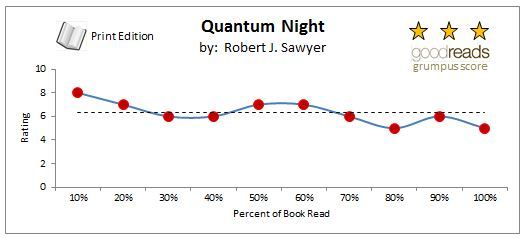
From the chart, you can easily see that this was the print edition and although I was rating on a 10-point scale to pick up nuances as to how I felt at that point in the book. I then converted the score back to a Goodreads scale by dividing the average by 2. I know, I know, nerd stuff.
The chart shows that the book started out with so much promise with a great concept about being able to identify psychopaths in the population and started heading downhill from there with temporary lift about halfway through the book with a less than stellar finish.
One of the things that really annoyed me throughout the book was the continual unnecessary negative references to U.S. Presidents, which really impacted my impression at the 80% mark.
On the positive side, I got to learn about such exotic places as Saskatoon Canada (seriously, I don’t think I’ve ever read a story with that as one of the featured places) and the possibilities of what could happen if we could really identify psychopaths so easily. Would it be a new way to discriminate or would it help us identify prevent future tragedies?
In the end, a 3-star rating – which means “I liked it” on the Goodreads scale, but just barely as the overall average translated to 3.15.
I thought I’d try something new. I’ve been having a hard time being moved by anything I’ve been reading lately. As a result, I have not been writing any reviews. So, I thought I would try to apply a rating to the book as I move through it at 10% intervals. I already track how many pages I’ve read and my progress through the book and therefore, I thought this should not be hard to do. Yeah, yeah, I’m a data geek, but playing around in Excel with my Goodreads database actually translates into creative ways to view data in my job. Alright, and it’s fun too.
From the chart, you can easily see that this was the print edition and although I was rating on a 10-point scale to pick up nuances as to how I felt at that point in the book. I then converted the score back to a Goodreads scale by dividing the average by 2. I know, I know, nerd stuff.
The chart shows that the book started out with so much promise with a great concept about being able to identify psychopaths in the population and started heading downhill from there with temporary lift about halfway through the book with a less than stellar finish.
One of the things that really annoyed me throughout the book was the continual unnecessary negative references to U.S. Presidents, which really impacted my impression at the 80% mark.
On the positive side, I got to learn about such exotic places as Saskatoon Canada (seriously, I don’t think I’ve ever read a story with that as one of the featured places) and the possibilities of what could happen if we could really identify psychopaths so easily. Would it be a new way to discriminate or would it help us identify prevent future tragedies?
In the end, a 3-star rating – which means “I liked it” on the Goodreads scale, but just barely as the overall average translated to 3.15.

August 13, 2016
QUANTUM NIGHT is Robert J. Sawyer's 23rd science fiction novel. Throughout all those novels and all those years, Sawyer has explored any number of far ranging ideas, sometimes a good number of them in one book (some of his novels have so many different ideas in play it's sometimes tough to keep up with them all, let alone figure out how they all play into the particular story he is telling). One of his favorite topics to explore is the nature of consciousness, and Sawyer returns to that
subject in a novel that reminds the reader of some of those earlier idea filled novels. From the idea a person can't be convicted of a crime because that may just be his (or her) nature, to the saying that a person's "lights are on, but no one is home" being a central theme to the book, Sawyer has the reader's head spinning from the opening pages. And it takes the thought that "you can't change human nature" and turns it completely on its ear.
Jim Marchuk has developed a technique for identifying the psychopaths in our midst. There are other techniques, but his appears to not only support the others but is 100% objective and accurate. Marchuk is called to appear as an expert witness in a murder trial; the defense claims that because the accused was "made that way" - that is, a psychopath - he cannot be found guilty of the crime (this is an idea that is not new, and appears here as a result of the mammoth amount of research that Sawyer has done for this novel. His method has determined that the defendant is indeed a psychopath; that is not in question. What started out as a cross-examination of the method turns into a cross-examination of Marchuk, the end result being that he has not only lost 6 months out of his life, but during that 6 months (he finds out later) he has done some pretty gruesome acts.
Not long after his day in court, Marchuk is contacted by an old girlfriend he had during that dark six month interval. Kayla is a quantum physicist. She and a colleague have discovered that the consciousness is quantum in nature, and that there are three states of consciousness: the philosopher's zombie or p-zed (the state where the lightsare on and no one is home), the psychopath, and what the novel ends up calling the cwcs (quicks) - conscious with conscience. Each of the three is a actually a quantum state that is an indicator of a quantum entanglement in the brain (it's at this point that I think I'd better stop trying to explain the science here and let you read the novel for yourself, and after you do that take a good hard look at all the non-fiction reading that Sawyer has laid out at the end of the book, and although it might not be a bad
idea to explain what a p-zed is, I don't want to take up half the review doing an info dump) and it turns out that an outside force can induce the brain to change quantum states.
However, there are several questions that are central to the story: why did Marchuk lose those 6 months, why is Kayla's brother in a coma, and why is there an increasing amount of violence occuring all over the world that appears to be somewhat unstoppable? The answers to the first two questions are handled relatively easily and in a straigtforward fashion. The third one is a tad more difficult to come to grips with, and the solution is one that will change the makeup of the entirety of humanity.
QUANTUM NIGHT is certainly a story of ideas, but it is more than that. It's a story of how those ideas influence the people in the story, and how it makes them think of their own as well as all of humanity's morality. These are real people, and although they are facing very earth shattering concepts and ideas that will change the way they think of each other and the rest of the human race, they react in what I feel are very realistic ways to a crisis that threatens to take down a good portion of civilization.
It's probably reasonable to talk about how the science is presented in QUANTUM NIGHT. This is the third book I've read in the last several months which contains a great deal of complex science to make the story work. The first was Kim Stanley Robinson's AURORA, and the second was Neal Stephenson's SEVENEVES. The first two novels have long stretches of infodumps - pages upon pages upon pages of infodumps. Robinson goes into gory detail telling the reader exactly why a generational starship will not work. Stephenson loves teaching his readers about orbital mechanics. Sawyer, on the other hand, weaves the science into the story so that while you're vaguely aware that you're getting a lecture in quantum mechanics (for example), it's not boring and tedious. It's part of the natural conversation of the story, and the characters react to it in
realistic ways. As much as I love a good infodump, I really got tired of the orbital mechanics in SEVENEVES; my eyes were rolling so much I felt they would spin out of my head. And while it could be argued that Sawyer treads dangerously close to the "As you know, Bob" method of the infodump, I don't think he ever crosses that line. The conversations between the characters in which the science is explained to the reader is believable and interesting.
Oh, one more thing. If you start walking down the street or sitting in your car at a stop light looking at people and wondering if they're psychopaths, p-zeds, or quicks, Sawyer has done his job. He's making you think about the world around you in different ways. And that's what good science fiction - like QUANTUM NIGHT - does.
subject in a novel that reminds the reader of some of those earlier idea filled novels. From the idea a person can't be convicted of a crime because that may just be his (or her) nature, to the saying that a person's "lights are on, but no one is home" being a central theme to the book, Sawyer has the reader's head spinning from the opening pages. And it takes the thought that "you can't change human nature" and turns it completely on its ear.
Jim Marchuk has developed a technique for identifying the psychopaths in our midst. There are other techniques, but his appears to not only support the others but is 100% objective and accurate. Marchuk is called to appear as an expert witness in a murder trial; the defense claims that because the accused was "made that way" - that is, a psychopath - he cannot be found guilty of the crime (this is an idea that is not new, and appears here as a result of the mammoth amount of research that Sawyer has done for this novel. His method has determined that the defendant is indeed a psychopath; that is not in question. What started out as a cross-examination of the method turns into a cross-examination of Marchuk, the end result being that he has not only lost 6 months out of his life, but during that 6 months (he finds out later) he has done some pretty gruesome acts.
Not long after his day in court, Marchuk is contacted by an old girlfriend he had during that dark six month interval. Kayla is a quantum physicist. She and a colleague have discovered that the consciousness is quantum in nature, and that there are three states of consciousness: the philosopher's zombie or p-zed (the state where the lightsare on and no one is home), the psychopath, and what the novel ends up calling the cwcs (quicks) - conscious with conscience. Each of the three is a actually a quantum state that is an indicator of a quantum entanglement in the brain (it's at this point that I think I'd better stop trying to explain the science here and let you read the novel for yourself, and after you do that take a good hard look at all the non-fiction reading that Sawyer has laid out at the end of the book, and although it might not be a bad
idea to explain what a p-zed is, I don't want to take up half the review doing an info dump) and it turns out that an outside force can induce the brain to change quantum states.
However, there are several questions that are central to the story: why did Marchuk lose those 6 months, why is Kayla's brother in a coma, and why is there an increasing amount of violence occuring all over the world that appears to be somewhat unstoppable? The answers to the first two questions are handled relatively easily and in a straigtforward fashion. The third one is a tad more difficult to come to grips with, and the solution is one that will change the makeup of the entirety of humanity.
QUANTUM NIGHT is certainly a story of ideas, but it is more than that. It's a story of how those ideas influence the people in the story, and how it makes them think of their own as well as all of humanity's morality. These are real people, and although they are facing very earth shattering concepts and ideas that will change the way they think of each other and the rest of the human race, they react in what I feel are very realistic ways to a crisis that threatens to take down a good portion of civilization.
It's probably reasonable to talk about how the science is presented in QUANTUM NIGHT. This is the third book I've read in the last several months which contains a great deal of complex science to make the story work. The first was Kim Stanley Robinson's AURORA, and the second was Neal Stephenson's SEVENEVES. The first two novels have long stretches of infodumps - pages upon pages upon pages of infodumps. Robinson goes into gory detail telling the reader exactly why a generational starship will not work. Stephenson loves teaching his readers about orbital mechanics. Sawyer, on the other hand, weaves the science into the story so that while you're vaguely aware that you're getting a lecture in quantum mechanics (for example), it's not boring and tedious. It's part of the natural conversation of the story, and the characters react to it in
realistic ways. As much as I love a good infodump, I really got tired of the orbital mechanics in SEVENEVES; my eyes were rolling so much I felt they would spin out of my head. And while it could be argued that Sawyer treads dangerously close to the "As you know, Bob" method of the infodump, I don't think he ever crosses that line. The conversations between the characters in which the science is explained to the reader is believable and interesting.
Oh, one more thing. If you start walking down the street or sitting in your car at a stop light looking at people and wondering if they're psychopaths, p-zeds, or quicks, Sawyer has done his job. He's making you think about the world around you in different ways. And that's what good science fiction - like QUANTUM NIGHT - does.

July 23, 2016
This is the 22nd Sawyer novel I have read, and I rated most of them A in my records. This one's a B-minus or C-plus.
There's a HEAP of interesting research behind this, and I don't blame Sawyer for thinking "there's a novel in this!" But I am left with the feeling that he bogged down several times, struggled, and eventually just forced it to be a novel against the flow of narrativium. It just isn't credible.
There are many individual pieces that are not in themselves incredible. They have research behind them, and Sawyer makes sure we know it. But they are stitched together into a plot that makes me think of a bunch of square plates, each stacked overlapping so far that it NEARLY falls off. By the end the tower is 200 feet tall, and don't sneeze!
Menno's reactions throughout are just not credible. Each one is explained, but I just don't buy it, unless he was on heavy drugs the whole time. Kayla and Victoria and several others are just too convenient: just the right person in the right place at the right time.
There's one key event - - that is very dramatic but seems to slide right into "OK, while I'm being stitched up and thinking about what just happened, I'm going to consider the consequences of Maranov's seminal 2004 paper on the psychosocial implications of soundproofed interview rooms."
The wider social, er, events that bring us to the final crisis are a BIG stretch, but not entirely implausible. I'd have liked a better explanation of why THIS was the time the situation inevitably had to spin out of control.
Our protagonist is a jerk ,as many have noted - but I had no problem with that. Makes the story more interesting, and as we see it allows more range in plot development.
I'm Canadian, and up to a point I like references that remind us the author is One Of Us too, whether the Us is Canadians, musicians, geeks or whatever. But too many authors overdo it, and Sawyer has done that this time, say I as I sit here overlooking the Fraser River, not far from that bridge across Brunette Creek, you know, the one city councillor Jxxx Kxxx got so upset about when its closure made her late for that softball tournament but as a result she met the mayor having an ice cream cone at Anny's, and as they walked and talked he tripped over that wonky piece of sidewalk, you know the one, right by the nail salon, eh?
So many interesting ideas. So much "say what? A TUNING FORK?" even before the big payoff, when the world falls apart, the centre cannot hold, and they did WHAT? with What? The whole WORLD, all at once? Give me a BREAK!
This ending falls just short of Superman reversing time by spinning Earth backwards.
It's carefully worked out, using details from all over the book and neatly knitting them together. But for me, it's codswallop.
But then, as a Q3 like you, I'd think that, wouldn't I?
There's a HEAP of interesting research behind this, and I don't blame Sawyer for thinking "there's a novel in this!" But I am left with the feeling that he bogged down several times, struggled, and eventually just forced it to be a novel against the flow of narrativium. It just isn't credible.
There are many individual pieces that are not in themselves incredible. They have research behind them, and Sawyer makes sure we know it. But they are stitched together into a plot that makes me think of a bunch of square plates, each stacked overlapping so far that it NEARLY falls off. By the end the tower is 200 feet tall, and don't sneeze!
Menno's reactions throughout are just not credible. Each one is explained, but I just don't buy it, unless he was on heavy drugs the whole time. Kayla and Victoria and several others are just too convenient: just the right person in the right place at the right time.
There's one key event - - that is very dramatic but seems to slide right into "OK, while I'm being stitched up and thinking about what just happened, I'm going to consider the consequences of Maranov's seminal 2004 paper on the psychosocial implications of soundproofed interview rooms."
The wider social, er, events that bring us to the final crisis are a BIG stretch, but not entirely implausible. I'd have liked a better explanation of why THIS was the time the situation inevitably had to spin out of control.
Our protagonist is a jerk ,as many have noted - but I had no problem with that. Makes the story more interesting, and as we see it allows more range in plot development.
I'm Canadian, and up to a point I like references that remind us the author is One Of Us too, whether the Us is Canadians, musicians, geeks or whatever. But too many authors overdo it, and Sawyer has done that this time, say I as I sit here overlooking the Fraser River, not far from that bridge across Brunette Creek, you know, the one city councillor Jxxx Kxxx got so upset about when its closure made her late for that softball tournament but as a result she met the mayor having an ice cream cone at Anny's, and as they walked and talked he tripped over that wonky piece of sidewalk, you know the one, right by the nail salon, eh?
So many interesting ideas. So much "say what? A TUNING FORK?" even before the big payoff, when the world falls apart, the centre cannot hold, and they did WHAT? with What? The whole WORLD, all at once? Give me a BREAK!
This ending falls just short of Superman reversing time by spinning Earth backwards.
It's carefully worked out, using details from all over the book and neatly knitting them together. But for me, it's codswallop.
But then, as a Q3 like you, I'd think that, wouldn't I?

March 23, 2016
I read this book a while ago and enjoyed it while reading it. However, looking back at it, I can see quite a bit that's problematic.
The main character is a psychologist whose research area is psychopathy. The long and the short of it is that he and his mentor discover that there is a way to "switch" people from "normal" to psychopath to empathic. He posits that most ("normal") people do not actually have self-awareness, and uses this theory to explain mob mentality and trends. People don't examine what they do; they just exhibit herd behavior and do not actually have consciousness. They just exist in the way that animals animals do, responding to stimuli. Psychopaths have gained consciousness and self-awareness, but not empathy. "Normal" people are about 60% of the population, psychopaths about 30%, and empaths about 10%.
I bet you think, "well, luckily I'm in the 10% of empaths", just like I did. And that's what Sawyer wants his readers to think. He wants all of us to believe that we are the special, most enlightened part of humanity. But mathematically we can't all be, can we?
Sawyer also has a very unreliable narrator in Jim Marchuk, his viewpoint character. Jim believes that he is an enlightened philosopher. But he practices utilitarian philosophy, which, if I'm to believe the author, is rather chilling when you get down to it. The utilitarian approach is to maximize happiness for the most people. Jim's interpretation of this is to push for an abortion when he finds that he and his wife are going to have a Down's baby. When his wife refuses, he is repulsed by his child. In response to this reaction, his wife divorces him.
Jim is also not afraid to play God and change the entire world because he judges that it will maximize happiness for most people, even if it will change everyone fundamentally. I can't say much more without giving away most of the plot, but Jim acted more like an antisocial (in the psychological sense) person than an empath. He also had a cruddy sense of humor and expected everyone to enjoy his jokes- not very empathic if you ask me!
So, Sawyer really talks simplistically about psychology and ends up with a protagonist who acts more like a supervillain. Maybe Sawyer also knows this and wants his audience to see through his protagonist, but I have the uneasy suspicion that he truly thinks this guy is a hero. I'm not sure i want to read anything else by this author if that is indeed the case.
I received a copy of this book from Netgalley in exchange for an honest review.
The main character is a psychologist whose research area is psychopathy. The long and the short of it is that he and his mentor discover that there is a way to "switch" people from "normal" to psychopath to empathic. He posits that most ("normal") people do not actually have self-awareness, and uses this theory to explain mob mentality and trends. People don't examine what they do; they just exhibit herd behavior and do not actually have consciousness. They just exist in the way that animals animals do, responding to stimuli. Psychopaths have gained consciousness and self-awareness, but not empathy. "Normal" people are about 60% of the population, psychopaths about 30%, and empaths about 10%.
I bet you think, "well, luckily I'm in the 10% of empaths", just like I did. And that's what Sawyer wants his readers to think. He wants all of us to believe that we are the special, most enlightened part of humanity. But mathematically we can't all be, can we?
Sawyer also has a very unreliable narrator in Jim Marchuk, his viewpoint character. Jim believes that he is an enlightened philosopher. But he practices utilitarian philosophy, which, if I'm to believe the author, is rather chilling when you get down to it. The utilitarian approach is to maximize happiness for the most people. Jim's interpretation of this is to push for an abortion when he finds that he and his wife are going to have a Down's baby. When his wife refuses, he is repulsed by his child. In response to this reaction, his wife divorces him.
Jim is also not afraid to play God and change the entire world because he judges that it will maximize happiness for most people, even if it will change everyone fundamentally. I can't say much more without giving away most of the plot, but Jim acted more like an antisocial (in the psychological sense) person than an empath. He also had a cruddy sense of humor and expected everyone to enjoy his jokes- not very empathic if you ask me!
So, Sawyer really talks simplistically about psychology and ends up with a protagonist who acts more like a supervillain. Maybe Sawyer also knows this and wants his audience to see through his protagonist, but I have the uneasy suspicion that he truly thinks this guy is a hero. I'm not sure i want to read anything else by this author if that is indeed the case.
I received a copy of this book from Netgalley in exchange for an honest review.

May 8, 2022
I'm a huge Robert Sawyer fan. I've read all of his books. This one was loaned to my sister before I had a chance to read it, but I finally got it back and read it last month.
This story is denser in science detail than most of Sawyer's books. I have always thought of his work as more accessible to non-SF folks, but this book is an exception. It has lots of detail. I found it fascinating, both Jim Marchuk's technique for detecting psychopathy and the quantum state method as well. The discovery of Jim's loss of memories of six months of his life from twenty years previously—that's the clue that gets the whole story going. Some of the twists in the personal side of the story and the socio-political race against time kept the story fascinating until the end.
I love having a word for all of those mindless followers: p-zeds. :)
From Publisher's Weekly: Hugo and Nebula Award–winning author Sawyer’s latest work is a fast-moving, mind-stretching exploration of the nature of personality and consciousness; it balances esoteric speculation with action and character. James Marchuk, a psychology professor at the University of Manitoba, is dismayed to realize that he’s missing half a year of memories from his college days. It turns out that he was the subject of an experiment that converted him from a passive nebbish to an active psychopath, until he eventually was shifted into a higher state of mind and acquired a conscience. Through painful discovery of his own vicious past, he confirms that conscience-driven humans are a minority, menaced by a large number of psychopaths who control zombie-like mobs. Now, looking at escalating military tension among Canada, the U.S., and Russia, Marchuk fears that psychopathic world leaders may be about to destroy humanity. Sawyer (Red Planet Blues) is very good at grounding the technical speculation in personal conflict, as Marchuk’s utilitarian principles struggle with his emotional impulses and the political/media references keep the story uncomfortably close to present-day fears.
This story is denser in science detail than most of Sawyer's books. I have always thought of his work as more accessible to non-SF folks, but this book is an exception. It has lots of detail. I found it fascinating, both Jim Marchuk's technique for detecting psychopathy and the quantum state method as well. The discovery of Jim's loss of memories of six months of his life from twenty years previously—that's the clue that gets the whole story going. Some of the twists in the personal side of the story and the socio-political race against time kept the story fascinating until the end.
I love having a word for all of those mindless followers: p-zeds. :)
From Publisher's Weekly: Hugo and Nebula Award–winning author Sawyer’s latest work is a fast-moving, mind-stretching exploration of the nature of personality and consciousness; it balances esoteric speculation with action and character. James Marchuk, a psychology professor at the University of Manitoba, is dismayed to realize that he’s missing half a year of memories from his college days. It turns out that he was the subject of an experiment that converted him from a passive nebbish to an active psychopath, until he eventually was shifted into a higher state of mind and acquired a conscience. Through painful discovery of his own vicious past, he confirms that conscience-driven humans are a minority, menaced by a large number of psychopaths who control zombie-like mobs. Now, looking at escalating military tension among Canada, the U.S., and Russia, Marchuk fears that psychopathic world leaders may be about to destroy humanity. Sawyer (Red Planet Blues) is very good at grounding the technical speculation in personal conflict, as Marchuk’s utilitarian principles struggle with his emotional impulses and the political/media references keep the story uncomfortably close to present-day fears.

March 9, 2016
A lot of interesting ideas, but unfortunately the narrative presentation wasn't my cup of tea. The narrator's tendency to constantly provide factoids (in addition to teaching classes, which we get snippets of) and, in my opinion, unnecessary amounts of descriptive specificity, put me at a remove from the story. As much as the novel concerns itself with the nature of conscience, consciousness and memory, I didn't feel particularly moved by or interested in any of the characters, which was problematic. I found the prose mostly polished and serviceable (with some repetitions), but a constant barrage of pop culture references, puns and allusions may have also kept me a little at bay. This is a conceptually ambitious novel with a clever plot, but the "stop-and-pontificate" nature of the narrative wasn't aesthetically pleasing.

November 13, 2016
Loved it! Yes, it's a thought experiment, and a simplistic one at that. But that doesn't mean you can't make a great novel out of it.
The idea that there might be three states of consciousness: Normal (people without actual self-consciousness), empathic and pyscopathic, is pretty much what we all think. So, never mind the current state of the science, it's a theory that basically fits the facts. But I'm sure nobody thinks it explains everything. It's just a place to start a story that doesn't contradict anything that's scientifically proven. Actually having those states changed by merely losing consciousness was a bit much to swallow, but as a writer I know recently said, every story can contain one big lie.

February 2, 2016
I received an ARC of Quantum Night through my work and was quite happy about it! I took it home and basically read it in two sittings. Without summarizing the book, I will say that I was happy with the character development throughout the story and that the book read more like a psychological thriller than science fiction. It was thought provoking and kept me turning the pages.
And now I am really paranoid about who might be the psychopaths around me.... thank you Robert J. Sawyer.....thank you.....
And now I am really paranoid about who might be the psychopaths around me.... thank you Robert J. Sawyer.....thank you.....

May 14, 2016
I read Robert J. Sawyer’s newest book in kindle format. I've previously read at least a dozen of his novels, and enjoyed most of them. In particular, I enjoy that he usually emphasizes topics in philosophy, and sometimes topics in science. In Quantum Night, that would be utilitarian ethics, and cognitive psychology.
This is hard-sf, so I’ll start with the speculative concepts. His primary concept comes from the effects of the hypothetically homogeneous quantum state of free electrons in neuron microtubules of the human brain. Just why all those free electrons should collapse into the same state is not clearly justified, nor is why the same does not apply to other mammal brains, but never mind, Sawyer is off and running. Fortunately, from there he extrapolates more as a psychologist than a physicist. There are some fairly amazing consequences of this; there are three categories of human personalities - Q1 (or P-zed) philosophical zombies, Q2 psychopaths, and Q3 conscious-with-a-conscience. All living human beings fall into one of these exaggerated categories, although identification of them has until recently been anecdotal rather than scientifically based. In order to explore this concept, Sawyer uses characters that are themselves psychologists and physicists, and pauses the action long enough for them to explain to each other.
Robert J. Sawyer is a proud Canadian, and the setting is a very near future Canada. So near future, in fact, that various national leaders are names recognizable from the contemporary news – although in the case of the US, it is a fictional stand-in for Donald Trump, I think. I suspect that a few of the negative reviews of the novel I have seen are motivated by disagreement with political or ethical positions in the book.
Quantum Night is plotted as a thriller. That is, not only are the main characters threatened, but the stakes are continuously enlarged. Utilitarian ethics are both explained, and called into play as characters are faced with decisions that balance the greater good against personal sacrifice. These are the elements of the book which lead to plot tension and difficulty in putting it down. This is a continuously thrilling read, and the weaknesses in concept and/or plot events are only apparent in deeper retrospect. A strong addition to Sawyer’s overall body of work.
This is hard-sf, so I’ll start with the speculative concepts. His primary concept comes from the effects of the hypothetically homogeneous quantum state of free electrons in neuron microtubules of the human brain. Just why all those free electrons should collapse into the same state is not clearly justified, nor is why the same does not apply to other mammal brains, but never mind, Sawyer is off and running. Fortunately, from there he extrapolates more as a psychologist than a physicist. There are some fairly amazing consequences of this; there are three categories of human personalities - Q1 (or P-zed) philosophical zombies, Q2 psychopaths, and Q3 conscious-with-a-conscience. All living human beings fall into one of these exaggerated categories, although identification of them has until recently been anecdotal rather than scientifically based. In order to explore this concept, Sawyer uses characters that are themselves psychologists and physicists, and pauses the action long enough for them to explain to each other.
Robert J. Sawyer is a proud Canadian, and the setting is a very near future Canada. So near future, in fact, that various national leaders are names recognizable from the contemporary news – although in the case of the US, it is a fictional stand-in for Donald Trump, I think. I suspect that a few of the negative reviews of the novel I have seen are motivated by disagreement with political or ethical positions in the book.
Quantum Night is plotted as a thriller. That is, not only are the main characters threatened, but the stakes are continuously enlarged. Utilitarian ethics are both explained, and called into play as characters are faced with decisions that balance the greater good against personal sacrifice. These are the elements of the book which lead to plot tension and difficulty in putting it down. This is a continuously thrilling read, and the weaknesses in concept and/or plot events are only apparent in deeper retrospect. A strong addition to Sawyer’s overall body of work.

March 23, 2016
As always, Sawyer tackles a relevant, intriguing and compelling subject matter and provides a smorgasbord of food for thought throughout the the entire course of the novel. The interweaving elements of plot, dialogue and introspection provide for a satisfying and quickly paced read that becomes fuel for interesting conversation upon putting the book down.
While I was intrigued with the concept of dividing the human race into three groups (Conscious/Conscientious Thinkers; Psychopaths and Philosopher Zombies) based on a predisposition in their mental state, it also startled and frightened me in it's simplicity. The way Sawyer ties those three possible states in to a quantum entanglement of human consciousness provides for a fascinating thought experiment, not just throughout the course of the novel, but for comparisons to the real world. After all, could the three possible states as suggested in this fiction explain the odd behaviours of riot mobs, of good/kind people behaving like heartless monsters at a Trump rally or hundreds of other bizarre and seemingly inexplicable patterns of human behaviour? I studied the Hare Psychopathy Checklist in University during a Criminal Behaviour course (my professor was an ex-RCMP profiler with in depth experience in the field), and I quite enjoyed reading Sawyer's brilliant merger of scientific research and speculation in that area.
The story is well-written, compelling, and, as you can often expect in a novel by Sawyer, insightful and intriguing debates on morality, science, and nature. It has been a while since Sawyer released a new novel, so it was great to be able to return to the thrill and joy of digging in to one of his books.
This was technically a 4.5 for me, as there were some points in the book that left me with questions - not just things I wanted to ask about some of the extrapolations from science that were made, but a couple of actual plot-points that left me confused (although, admittedly that might be more related to the thickness of my skull than anything the author left out) -- and in any case, those questions that left me hanging could be seen as a good thing. I mean, who DOESN'T want a novel to linger after having read it?
While I was intrigued with the concept of dividing the human race into three groups (Conscious/Conscientious Thinkers; Psychopaths and Philosopher Zombies) based on a predisposition in their mental state, it also startled and frightened me in it's simplicity. The way Sawyer ties those three possible states in to a quantum entanglement of human consciousness provides for a fascinating thought experiment, not just throughout the course of the novel, but for comparisons to the real world. After all, could the three possible states as suggested in this fiction explain the odd behaviours of riot mobs, of good/kind people behaving like heartless monsters at a Trump rally or hundreds of other bizarre and seemingly inexplicable patterns of human behaviour? I studied the Hare Psychopathy Checklist in University during a Criminal Behaviour course (my professor was an ex-RCMP profiler with in depth experience in the field), and I quite enjoyed reading Sawyer's brilliant merger of scientific research and speculation in that area.
The story is well-written, compelling, and, as you can often expect in a novel by Sawyer, insightful and intriguing debates on morality, science, and nature. It has been a while since Sawyer released a new novel, so it was great to be able to return to the thrill and joy of digging in to one of his books.
This was technically a 4.5 for me, as there were some points in the book that left me with questions - not just things I wanted to ask about some of the extrapolations from science that were made, but a couple of actual plot-points that left me confused (although, admittedly that might be more related to the thickness of my skull than anything the author left out) -- and in any case, those questions that left me hanging could be seen as a good thing. I mean, who DOESN'T want a novel to linger after having read it?

March 21, 2016
 is a disruptive sci-fi writer of such great caliber I am honored even to write a review of his latest book, Quantum Night. Quantum Night> is beyond disturbing to the point of being scary-real, so intriguingly current that I had to keep reminding myself this was fiction, set in an almost present/future, not actually happening now.
No spoilers, here, but the concepts Sawyer brings in (via extensive research and conversations with great scientists, psychologists and political analysts, all listed in his great bibliography at the end) are so fascinating that I find myself going around looking into people's eyes and analyzing everyone to see if they are Q1s, Q2s or Q3s. This book raises some important questions, some of which I list below, within a rekindled romance, some mysteries/whodunnit, some political and international chaos and other interpersonal relationships (parent-child, spouses, friends, mentor/mentee, collegial) interspersed with scenes in which the protagonist is teaching his undergraduate classes and having discussions on particularly relevant topics (lessons I thoroughly enjoyed, BTW).
Are YOU: a philosopher's zombie (Q1) following along without an "inner voice" or many thoughts surrounding your choices and experiences; a functioning psychopath (Q2), which (unsurprisingly) many of our political and social leaders are; or, a thinking, morally and ethically questioning, conscious human with a conscience (Q3) (unfortunately, not the majority...)?
What ethical rules do you try to (or claim to) live by and how well do you stick to them in actual daily life? How far would you go and what/whom are "acceptable sacrifices" and/or "collateral damage" to be permitted to accomplish doing "the greatest good for the greatest number"?
During this horrifying election season here in the USA, this book is especially troubling, timely and inspiring. Highly recommended, but bring along some tissues and some Xanax.

July 24, 2019
Canadian techno-thriller connecting quantum mechanics and consciousness while waxing philosophically on the ethics of changing the world.
A PhD. Psychologist and his PhD. Physicist girlfriend discover that that all human beings are quantumly entangled at a low-level of consciousness. In addition, that certain mental disorders can be triggered or cured based on the “brain’s” quantum state . Utilitarianism was used to resolve the ethics of saving the world from a nuclear holocaust by altering all of human consciousness.
My dead-tree copy was a moderate 370-pages. Original US copyright for the story was 2016. Reading pace was both fast and slow.
Robert J. Sawyer is a Canadian author with more than ten novels written. I’ve read a few of his books. They combine ‘soft’ social sciences like: sociology, anthropology and psychology with hard sciences like mathematics or physics. In addition, he likes to include popular culture references in his work.
Writing was good. Dialog was better than descriptive prose. The author oddly switched between first and third person, which was unnerving to read, but well handled. He also jumped backwards and back in time, which was also handled well. There were three POVs in the story. The protagonist was Jim Marchuk. His was the main POV. Menno Warkentin a supporting character was the secondary POV. Kayla Huron also provided a secondary POV.
The story contains sex, drugs and violence. The sex was modest and unimaginative. I can never understand, what perfect breasts (female) might look like, when they’re so different? All the sex was heteronormative and resolved with a fade to black. Soft core drug usage was mentioned. Alcohol was used both socially and to self-medicate. Violence was more graphic. It was physical and firearms. Physical trauma and wounding was moderately graphic. The story might qualify as racy YA.
There were only a few characters; Marchuk and Huron being the main characters. Marchuk was a PhD. university psychologist who has developed a new objective test for confirming if a person was a psychopath. He’s hip and humorous and makes many popular culture references. He’s the living embodiment of Utilitarianism. I couldn’t help liking the Marchuk character. Huron was his ex-girlfriend from their uni-days who was a quantum physicist. They rather too serendipitously get together when Marchuk realizes he has amnesia spanning the period of their relationship while at uni. Theirs was a geek-on-geek romance. Warkentin was Marchuk’s intellectual and professional mentor. He's got a secret, although I had a problem with him playing the long game like he did. Interestingly, he was blind. That was a clever move be the author character-wise. Pax was his seeing eye dog. I liked her as a character, although she didn’t bite anyone.
Plot was an interesting variation of the They Walk Among Us trope. Marchuk arrived at the realization through the use of theTrauma-Induced Amnesia trope. The very serendipitous reuniting of Marchuk and Huron completely exposes the Awful Truth. All humans are classifiable psycho-quantumly to be one of three basic phenotypic types with distinct traits. Psychopaths were one of the types. Psychopaths make great politicians. Humans are also all quantum entangled into a Superorganism. Also serendipitously, The End of the World as We Know It occurs right after this discovery. It’s spurred by psychopathic politicians. The-End-of-the-World was ridiculously unlikely. Given the recent results of American's conflict between its Executive and other branches of government, a President couldn't act so unilaterally so quickly. The ethics of a forced Trans Nature transformation brings the story boringly to an end. The author completely overreached with setting-up the ending. Either solving a murder or quantumly converting one or a smaller number of folks would have been a more fitting ending.
Note there is a strong edu-tainment component to the story. Mostly they were science info-dumps. Some of them were3 thinly disguised as Marchuk’s uni class lectures. They include: quantum physics, philosophy, ethics and deviant psychology. I found the philosophy and ethics devoted ones to be the least interesting.
World building was very Canadian. The greatest part of the story takes place in Saskatchewan and Manitoba. They're both understated, prairie gardens of polite paradise.
This was a well written story-- prose wise. I liked the characters. (Everyone likes Canadians.) I liked the initial discovery section, even with its many: infodumps. The corny amnesia trope was OK, but knocked the story down to "light reading". The quantumly conscious superorganism revelation was credible. I tolerated all the serendipitous events that moved the story along. (Can anyone be so lucky as Marchuk was?) However, the story was too heavily a platform for the author to air philosophic and ethical beliefs. That was frankly too heavy handed and boring. The death knell of the story was the End-of-the-World section. It was stupidly weak and rushed. While I could suspend my belief to include quantum entangled humanity, the author’s quick slide of the world into Armageddon couldn’t be managed. This book needed a better ending.
A PhD. Psychologist and his PhD. Physicist girlfriend discover that that all human beings are quantumly entangled at a low-level of consciousness. In addition, that certain mental disorders can be triggered or cured based on the “brain’s” quantum state . Utilitarianism was used to resolve the ethics of saving the world from a nuclear holocaust by altering all of human consciousness.
My dead-tree copy was a moderate 370-pages. Original US copyright for the story was 2016. Reading pace was both fast and slow.
Robert J. Sawyer is a Canadian author with more than ten novels written. I’ve read a few of his books. They combine ‘soft’ social sciences like: sociology, anthropology and psychology with hard sciences like mathematics or physics. In addition, he likes to include popular culture references in his work.
Writing was good. Dialog was better than descriptive prose. The author oddly switched between first and third person, which was unnerving to read, but well handled. He also jumped backwards and back in time, which was also handled well. There were three POVs in the story. The protagonist was Jim Marchuk. His was the main POV. Menno Warkentin a supporting character was the secondary POV. Kayla Huron also provided a secondary POV.
The story contains sex, drugs and violence. The sex was modest and unimaginative. I can never understand, what perfect breasts (female) might look like, when they’re so different? All the sex was heteronormative and resolved with a fade to black. Soft core drug usage was mentioned. Alcohol was used both socially and to self-medicate. Violence was more graphic. It was physical and firearms. Physical trauma and wounding was moderately graphic. The story might qualify as racy YA.
There were only a few characters; Marchuk and Huron being the main characters. Marchuk was a PhD. university psychologist who has developed a new objective test for confirming if a person was a psychopath. He’s hip and humorous and makes many popular culture references. He’s the living embodiment of Utilitarianism. I couldn’t help liking the Marchuk character. Huron was his ex-girlfriend from their uni-days who was a quantum physicist. They rather too serendipitously get together when Marchuk realizes he has amnesia spanning the period of their relationship while at uni. Theirs was a geek-on-geek romance. Warkentin was Marchuk’s intellectual and professional mentor. He's got a secret, although I had a problem with him playing the long game like he did. Interestingly, he was blind. That was a clever move be the author character-wise. Pax was his seeing eye dog. I liked her as a character, although she didn’t bite anyone.
Plot was an interesting variation of the They Walk Among Us trope. Marchuk arrived at the realization through the use of theTrauma-Induced Amnesia trope. The very serendipitous reuniting of Marchuk and Huron completely exposes the Awful Truth. All humans are classifiable psycho-quantumly to be one of three basic phenotypic types with distinct traits. Psychopaths were one of the types. Psychopaths make great politicians. Humans are also all quantum entangled into a Superorganism. Also serendipitously, The End of the World as We Know It occurs right after this discovery. It’s spurred by psychopathic politicians. The-End-of-the-World was ridiculously unlikely. Given the recent results of American's conflict between its Executive and other branches of government, a President couldn't act so unilaterally so quickly. The ethics of a forced Trans Nature transformation brings the story boringly to an end. The author completely overreached with setting-up the ending. Either solving a murder or quantumly converting one or a smaller number of folks would have been a more fitting ending.
Note there is a strong edu-tainment component to the story. Mostly they were science info-dumps. Some of them were3 thinly disguised as Marchuk’s uni class lectures. They include: quantum physics, philosophy, ethics and deviant psychology. I found the philosophy and ethics devoted ones to be the least interesting.
World building was very Canadian. The greatest part of the story takes place in Saskatchewan and Manitoba. They're both understated, prairie gardens of polite paradise.
This was a well written story-- prose wise. I liked the characters. (Everyone likes Canadians.) I liked the initial discovery section, even with its many: infodumps. The corny amnesia trope was OK, but knocked the story down to "light reading". The quantumly conscious superorganism revelation was credible. I tolerated all the serendipitous events that moved the story along. (Can anyone be so lucky as Marchuk was?) However, the story was too heavily a platform for the author to air philosophic and ethical beliefs. That was frankly too heavy handed and boring. The death knell of the story was the End-of-the-World section. It was stupidly weak and rushed. While I could suspend my belief to include quantum entangled humanity, the author’s quick slide of the world into Armageddon couldn’t be managed. This book needed a better ending.

March 9, 2016
http://www.themaineedge.com/buzz/syna...
Any book reviewer will tell you that one of the greatest joys of the job is discovering a writer that had yet to be experienced. The opportunity to find an author whose work resonates with and entertains you is a precious thing.
One of the first such writers I encountered in my capacity as a reviewer was Robert J. Sawyer. The book was “WWW: Wake,” the first in a thoughtful and narratively engaging trilogy. From there, the Canadian sci-fi author had me hooked. Every work of his that I’ve read offers the combination of innovative ideas and imaginative storytelling that, to me, is the epitome of what science fiction can be.
Sawyer’s latest is “Quantum Night”; once again, he is striking the perfect balance between big ideas and quality tale-spinning.
Set just a few years into the future, “Quantum Night” follows experimental psychologist Jim Marchuk, who has developed a seemingly flawless method for the detection of psychopaths. However, while being cross-examined during the first exploration of his breakthrough in court, he is shocked to discover an inexplicable six month gap in his memory from two decades prior – a gap in which he apparently engaged in some particularly unpleasant (and uncharacteristic) actions.
A reunion with Kayla Huron – the girlfriend who left him during the darkest of his dark times – leads him to her work with the Canadian Light Source synchrotron. She’s a quantum physicist who has made some earth-shattering discoveries about the quantum nature of human consciousness. These discoveries – in tandem with some highly classified experiments in which Jim was a participant – begin to lead the two of them down a path where they not only discover the basis behind Jim’s lost time, but that indicates an unfathomable reality behind what consciousness truly is.
Jim and Kayla are left with a truly daunting decision; it’s possible that they can create a paradigm-shifting global alteration of consciousness – one that could potentially head off a rapidly escalating wave of violence that has led to a United States where killing undocumented immigrants is no longer murder and that has put boots on the ground in an invasion of Canada while Russia prepares to retaliate to the fullest nuclear extent. But humanity has no choice in the matter – do the ends justify the means?
One of the things that is remarkable about Sawyer’s work in general – and this book in particular – is his ability to address complex and esoteric concepts in such a way as to make them accessible without ever once condescending to the reader. He simplifies, but never dumbs down, indicating a degree of respect for his audience that all writers, sci-fi or otherwise, would do well to emulate.
That said, his understanding and rendering of those ideas wouldn’t amount to much without a quality story in which to deposit them. On that front, “Quantum Night” is some of his best work – the relationship dynamics and depth of character here are top-notch. No matter how smart a story might be, without relatable, engaging characters, it simply won’t work. In that respect, this book is firing on all cylinders.
Sawyer’s work probably fits easiest under the umbrella of “hard sci-fi,” but there might not be another author bearing that label whose work is more readable. He consistently produces thrilling, compelling and – forgive the cliché – page-turning work.
No one uses science fiction to ask the big questions quite like Sawyer. “Quantum Night” is another exceptional addition to his already-considerable canon, combining his passion for scientific inquiry and a deep curiosity about humanity’s potential with a meticulous attitude toward research and – of course – a mastery of narrative and world building. It’s another first-rate effort from the current king of Canadian science fiction.
Any book reviewer will tell you that one of the greatest joys of the job is discovering a writer that had yet to be experienced. The opportunity to find an author whose work resonates with and entertains you is a precious thing.
One of the first such writers I encountered in my capacity as a reviewer was Robert J. Sawyer. The book was “WWW: Wake,” the first in a thoughtful and narratively engaging trilogy. From there, the Canadian sci-fi author had me hooked. Every work of his that I’ve read offers the combination of innovative ideas and imaginative storytelling that, to me, is the epitome of what science fiction can be.
Sawyer’s latest is “Quantum Night”; once again, he is striking the perfect balance between big ideas and quality tale-spinning.
Set just a few years into the future, “Quantum Night” follows experimental psychologist Jim Marchuk, who has developed a seemingly flawless method for the detection of psychopaths. However, while being cross-examined during the first exploration of his breakthrough in court, he is shocked to discover an inexplicable six month gap in his memory from two decades prior – a gap in which he apparently engaged in some particularly unpleasant (and uncharacteristic) actions.
A reunion with Kayla Huron – the girlfriend who left him during the darkest of his dark times – leads him to her work with the Canadian Light Source synchrotron. She’s a quantum physicist who has made some earth-shattering discoveries about the quantum nature of human consciousness. These discoveries – in tandem with some highly classified experiments in which Jim was a participant – begin to lead the two of them down a path where they not only discover the basis behind Jim’s lost time, but that indicates an unfathomable reality behind what consciousness truly is.
Jim and Kayla are left with a truly daunting decision; it’s possible that they can create a paradigm-shifting global alteration of consciousness – one that could potentially head off a rapidly escalating wave of violence that has led to a United States where killing undocumented immigrants is no longer murder and that has put boots on the ground in an invasion of Canada while Russia prepares to retaliate to the fullest nuclear extent. But humanity has no choice in the matter – do the ends justify the means?
One of the things that is remarkable about Sawyer’s work in general – and this book in particular – is his ability to address complex and esoteric concepts in such a way as to make them accessible without ever once condescending to the reader. He simplifies, but never dumbs down, indicating a degree of respect for his audience that all writers, sci-fi or otherwise, would do well to emulate.
That said, his understanding and rendering of those ideas wouldn’t amount to much without a quality story in which to deposit them. On that front, “Quantum Night” is some of his best work – the relationship dynamics and depth of character here are top-notch. No matter how smart a story might be, without relatable, engaging characters, it simply won’t work. In that respect, this book is firing on all cylinders.
Sawyer’s work probably fits easiest under the umbrella of “hard sci-fi,” but there might not be another author bearing that label whose work is more readable. He consistently produces thrilling, compelling and – forgive the cliché – page-turning work.
No one uses science fiction to ask the big questions quite like Sawyer. “Quantum Night” is another exceptional addition to his already-considerable canon, combining his passion for scientific inquiry and a deep curiosity about humanity’s potential with a meticulous attitude toward research and – of course – a mastery of narrative and world building. It’s another first-rate effort from the current king of Canadian science fiction.
April 19, 2016
A swing and a miss...
I've read or listened to quite a few of Robert J. Sawyer's novels over the years (Calculating God is a particular favorite) and I've rarely been disappointed but Quantum Night just didn't work for me. Sawyer's novels are always thought-provoking and this is no exception. Unfortunately, it proceeds from an interesting premise and then reduces humans to a ridiculously simple 3 types of consciousness. Once the characters settle on that worldview, it shapes their actions making the whole story somewhat difficult to swallow. The utilitarian protagonist's moral center, even when supposedly correct, seems more than a bit askew. The book is peppered with pop culture references to the point of distraction and it's heavy-handed politics came across as both preachy and simplistic. As I understand it, the science has a basis in contemporary scientific theory but it's application in Quantum Night felt more like the stuff of B-movies than what I'd expect from this author.
I listened to the audiobook and the reading, by Scott Aiello, is quite good. It helps keep the book humming along, despite it's flaws. Sawyer's style makes easy reading and he's always had a good sense of pacing so this isn't a difficult, or even unenjoyable listen, just a book that doesn't quite deliver on it's promise.
I've read or listened to quite a few of Robert J. Sawyer's novels over the years (Calculating God is a particular favorite) and I've rarely been disappointed but Quantum Night just didn't work for me. Sawyer's novels are always thought-provoking and this is no exception. Unfortunately, it proceeds from an interesting premise and then reduces humans to a ridiculously simple 3 types of consciousness. Once the characters settle on that worldview, it shapes their actions making the whole story somewhat difficult to swallow. The utilitarian protagonist's moral center, even when supposedly correct, seems more than a bit askew. The book is peppered with pop culture references to the point of distraction and it's heavy-handed politics came across as both preachy and simplistic. As I understand it, the science has a basis in contemporary scientific theory but it's application in Quantum Night felt more like the stuff of B-movies than what I'd expect from this author.
I listened to the audiobook and the reading, by Scott Aiello, is quite good. It helps keep the book humming along, despite it's flaws. Sawyer's style makes easy reading and he's always had a good sense of pacing so this isn't a difficult, or even unenjoyable listen, just a book that doesn't quite deliver on it's promise.

September 8, 2016
Lately, I've been reading as much Robert J. Sawyer as I can get a hold of if not for any other reason than to keep up with more current authors of the genre, as I tend to concentrate mostly on "Golden Age" period authors - I also plan to check out P. F. Hamilton, A. Reynolds, more Scalzy... and so many other.
My first impression of Sawyer's latest novel was mixed. I kept thinking I was reading Dean Koontz or something... Sawyer's usual optimistic Clarke-like hard scifi that I usually expect was not there. However, the constant mention of "Utilitarianism" reminded me of van Vogt's "Nexilism", which I liked.
I found this to be his strangest and most implausible story thus far, yet I think of it often and now tend to noticed people's characters and even find myself characterizing them in that Q1, Q2, Q3 levels - which is somewhat disturbing.
However, in the end this was a rather good read. Sawyer is attempting something different here and maybe even being innovative.
Not my favourite by far, but very interesting just the same.
My first impression of Sawyer's latest novel was mixed. I kept thinking I was reading Dean Koontz or something... Sawyer's usual optimistic Clarke-like hard scifi that I usually expect was not there. However, the constant mention of "Utilitarianism" reminded me of van Vogt's "Nexilism", which I liked.
I found this to be his strangest and most implausible story thus far, yet I think of it often and now tend to noticed people's characters and even find myself characterizing them in that Q1, Q2, Q3 levels - which is somewhat disturbing.
However, in the end this was a rather good read. Sawyer is attempting something different here and maybe even being innovative.
Not my favourite by far, but very interesting just the same.

May 22, 2017
Wow, just wow.
In general I like Robert J Sawyer's brand of sci-fi writing where there is a basis of science that doesn't get in the way of an entertaining read. Books like Calculating God, FlashForward, etc but this book I did not like.
A good chunk of the book comes off incredibly preachy as the main character discovers the world is made up of 4/7 zombies, 2/7 psychopaths and 1/7 woke intellectuals. The lead character is one of the woke and seems like a stand in for RJS himself. The books seems to be a reaction to the growing populist movement gripping the world. The lead believes that the world would be so much a better place if the intellectuals were in charge of everything which I'm not necessarily saying is wrong but ignoring the masses is kinda what has gotten us into this state to begin with. Anyway, the crux of the book seems to be coming from an angry place.
The resolution to the entire story was also easily deduced very early on in the book. I may not have finished this book at all if it wasn't for the myriad of short flights I took this month.
In general I like Robert J Sawyer's brand of sci-fi writing where there is a basis of science that doesn't get in the way of an entertaining read. Books like Calculating God, FlashForward, etc but this book I did not like.
A good chunk of the book comes off incredibly preachy as the main character discovers the world is made up of 4/7 zombies, 2/7 psychopaths and 1/7 woke intellectuals. The lead character is one of the woke and seems like a stand in for RJS himself. The books seems to be a reaction to the growing populist movement gripping the world. The lead believes that the world would be so much a better place if the intellectuals were in charge of everything which I'm not necessarily saying is wrong but ignoring the masses is kinda what has gotten us into this state to begin with. Anyway, the crux of the book seems to be coming from an angry place.
The resolution to the entire story was also easily deduced very early on in the book. I may not have finished this book at all if it wasn't for the myriad of short flights I took this month.

September 18, 2016
Very interesting concepts. I'll be imagining I'm surrounded by psychopaths and hope I'm one of the truly conscious! Sawyer's writing is typically straightforward. Hard to suspend disbelief when main character finds he's a murderer and kinda says 'oh dear!' But a solid 3 star read.

April 16, 2019
3.5 stars.
This is a very difficult book to review because there were a lot of things I loved, and a lot more that I did not.
To start off, the concept the book is based on is quite intriguing, exploring consciousness, conscience, and morality all in one. Really enjoyed that aspect of the book.
It did take a bit to get through the first 70 pages and get used to the writing and the technical terms, but I feel the author did a good job of explaining things in simple terms, or at least as simple as quantum physics can be, even if it felt a bit info-dumpy at points.
However, the characters were bland. I did not feel anything for them, and the ending did not help. In fact, it was disappointing. The synopsis set me up for a huge reveal, which was very anti-climactic when it eventually came. From the book description, I kind of expected more. But just to give credit where it’s due, I was surprised by some of the minor plot twists.
The book was also very politics-heavy - not my jam to be honest. Although it was interesting at times.
And on a related note, I loved that it mostly took place in Canada and that I was able to recognise some of the Canadian things that were mentioned.
Overall, Quantum Night was mostly an enjoyable read but at times as boring as this review. I would still recommend this book if you’re starting out in the science fiction genre (and have previously read at least five sci-fi novels or so) in spite of its being about Quantum Physics 🙈
This is a very difficult book to review because there were a lot of things I loved, and a lot more that I did not.
To start off, the concept the book is based on is quite intriguing, exploring consciousness, conscience, and morality all in one. Really enjoyed that aspect of the book.
It did take a bit to get through the first 70 pages and get used to the writing and the technical terms, but I feel the author did a good job of explaining things in simple terms, or at least as simple as quantum physics can be, even if it felt a bit info-dumpy at points.
However, the characters were bland. I did not feel anything for them, and the ending did not help. In fact, it was disappointing. The synopsis set me up for a huge reveal, which was very anti-climactic when it eventually came. From the book description, I kind of expected more. But just to give credit where it’s due, I was surprised by some of the minor plot twists.
The book was also very politics-heavy - not my jam to be honest. Although it was interesting at times.
And on a related note, I loved that it mostly took place in Canada and that I was able to recognise some of the Canadian things that were mentioned.
Overall, Quantum Night was mostly an enjoyable read but at times as boring as this review. I would still recommend this book if you’re starting out in the science fiction genre (and have previously read at least five sci-fi novels or so) in spite of its being about Quantum Physics 🙈
September 6, 2016
A Sawyer book always has a fascinating idea, and often bobbles the execution. This one doesn’t screw up the dismount, exactly, but the idea is so frustrating that I couldn’t put this on my list of Sawyer novels worth reading even if it weren’t for the more-extensive-than-I-remember-others-being infodumps. (FWIW, the lead characters are all professors, and we totally do talk that way, so there was decent justification for the infodumps.) Basically, the book posits that about 60% of humanity are just stimulus-response machines, emulating consciousness without having any internal monologue—so-called philosopher’s zombies, or what I thought of as John Searle’s Chinese room. Two-thirds of the rest are psychopaths, and the remainder are conscious and have a conscience. Plot: When a psychologist discovers that he’s lost a year’s worth of memories, he embarks on a journey that puts him at the center of this research—because he was shifted from one state to the next. As the world descends into ever more violence at the local and international levels, he has to decide whether to try to shift everyone. Sawyer often tends to strong biological determinism, and this is pretty much the strongest I can recall. His leads all conclude that the emptiness of the majority of people has to be kept a secret or it will justify slavery, genocide, etc., and of course a conscious person can’t really love a zombie. I didn’t get it: if your measurements suggest that 60% of humans lack consciousness (setting aside debates about what that might mean), doesn’t Occam’s Razor suggest that you are measuring the wrong thing and might need to look elsewhere? The supportive description of humans mostly flocking to follow whatever the nearest people to them do was also unconvincing: the protagonist suddenly starts noticing his sister going along with whatever’s nearest, including nearly getting them swept up in a riot.
And this leads into the creepy gender politics—though the two key scientists who work with the protagonist are women, he’s a utilitarian and literally muses near the climax about how sad it is that his girlfriend (one of the scientists) is so focused on her own kid and not on the universal good, like he is. Then, at the end, when she’s been converted to a psychopath and he’s still got a conscience due to convenient plot reasons, she immediately hands over her kid to him because she doesn’t want to deal with neediness, thus providing him a replacement kid for the son he never sees because he wanted his then-wife to get an abortion when the son was diagnosed with Downs syndrome in utero. Which, not for nothing, contradicts what they’ve posited before about newly minted psychopaths remembering that they had consciences and thus behaving accordingly. Ugh. So that’s it for me for a while; as I recall, Sawyer’s trilogy on hominids had different, but also creepy, gender stuff/biological determinism.
And this leads into the creepy gender politics—though the two key scientists who work with the protagonist are women, he’s a utilitarian and literally muses near the climax about how sad it is that his girlfriend (one of the scientists) is so focused on her own kid and not on the universal good, like he is. Then, at the end, when she’s been converted to a psychopath and he’s still got a conscience due to convenient plot reasons, she immediately hands over her kid to him because she doesn’t want to deal with neediness, thus providing him a replacement kid for the son he never sees because he wanted his then-wife to get an abortion when the son was diagnosed with Downs syndrome in utero. Which, not for nothing, contradicts what they’ve posited before about newly minted psychopaths remembering that they had consciences and thus behaving accordingly. Ugh. So that’s it for me for a while; as I recall, Sawyer’s trilogy on hominids had different, but also creepy, gender stuff/biological determinism.

January 27, 2020
Seeing as I feel that Sawyer did his best work years ago, and there is so much new fiction to read, I wouldn't have picked up this novel had not my book group wanted to read something by the man, since he's going to be guest of honor at our local SF convention [Capclave 2019]. In the end I wound up feeling rather annoyed since there is a lot going on here that now feels just wrong headed.
Keeping in mind that Sawyer has a reputation for writing about ideas first and characters second the moment that said characters invoked Stanley Milgram and Philip Zimbardo the alarms went off for me, as the notorious social-psychology experiments run by these men have been demonstrated to my satisfaction as being incompetently conducted at best and perhaps out and out fraudulent at worst. To be fair to Sawyer this book was published at just about the last moment where you could take Zimbardo's "Stanford Prison" Experiment and Milgram's "Obedience to Authority" work seriously. I am currently contemplating how confrontational about this point I want to be when I have the chance to meet the man [I decided to let the moment pass].
Probably more serious are Sawyer's speculations on the sociopathic personality which seem rather half-baked to me, as satisfying as they might be to wallow in when contemplating the people that one finds annoying. I have a professional degree as a mediator and any system of analysis that doesn't take seriously the values and loyalties that people actually have and how they respond under stress isn't worth talking about. At a certain point what Sawyer seems to have here is a gentler, kinder version of Cyril Kornbluth's "The Marching Morons." Though again, to be fair, Sawyer probably thought that he was writing a new take on Poul Anderson's "Brain Wave." To put it another way, how much would you care to be under judgement in a society where "normal" mental health is mandated by the authorities? It certainly doesn't seem very appealing to me.
As for the notion that there could be a quantum aspect to the functioning of conscious thought; sure, why not. It certainly makes as much sense as assuming that Humans are simply meat versions of computers, which looks less and less likely.
Apart from that I'll credit Sawyer with having written a competent piece of commercial fiction but I tend to want more than that from my entertainment reading.
Originally written: August 18, 2019.
P.S. Why didn't I go after Sawyer back in 2019? Because I decided that it would really not be relevant to the proceedings. (August 18, 2019).
Actual rating: 2.5.
Keeping in mind that Sawyer has a reputation for writing about ideas first and characters second the moment that said characters invoked Stanley Milgram and Philip Zimbardo the alarms went off for me, as the notorious social-psychology experiments run by these men have been demonstrated to my satisfaction as being incompetently conducted at best and perhaps out and out fraudulent at worst. To be fair to Sawyer this book was published at just about the last moment where you could take Zimbardo's "Stanford Prison" Experiment and Milgram's "Obedience to Authority" work seriously. I am currently contemplating how confrontational about this point I want to be when I have the chance to meet the man [I decided to let the moment pass].
Probably more serious are Sawyer's speculations on the sociopathic personality which seem rather half-baked to me, as satisfying as they might be to wallow in when contemplating the people that one finds annoying. I have a professional degree as a mediator and any system of analysis that doesn't take seriously the values and loyalties that people actually have and how they respond under stress isn't worth talking about. At a certain point what Sawyer seems to have here is a gentler, kinder version of Cyril Kornbluth's "The Marching Morons." Though again, to be fair, Sawyer probably thought that he was writing a new take on Poul Anderson's "Brain Wave." To put it another way, how much would you care to be under judgement in a society where "normal" mental health is mandated by the authorities? It certainly doesn't seem very appealing to me.
As for the notion that there could be a quantum aspect to the functioning of conscious thought; sure, why not. It certainly makes as much sense as assuming that Humans are simply meat versions of computers, which looks less and less likely.
Apart from that I'll credit Sawyer with having written a competent piece of commercial fiction but I tend to want more than that from my entertainment reading.
Originally written: August 18, 2019.
P.S. Why didn't I go after Sawyer back in 2019? Because I decided that it would really not be relevant to the proceedings. (August 18, 2019).
Actual rating: 2.5.
Displaying 1 - 30 of 512 reviews