Hitler, I’m sure, never saw himself as a villain. In his heart, he probably saw himself as the hero of his own life and the savior of Germany. He truly believed that what he was doing was the right thing to do. Likewise, his goose-stepping Nazi soldiers imagined themselves, I'm sure, doing God’s work, helping to rid the world of something that they considered an evil. They weren’t killing humans---innocent men, women, and children. They were eradicating a Jewish plague upon the Earth.
One never thinks that what one is doing is evil. Rationalizations and justifications are always made to help assuage any semblance of guilt or doubt. Questioning yourself, questioning your actions: these only lead to feelings of confusion and self-doubt and the dangerous sense that, maybe, what one is doing is actually evil.
This is the beauty of nationalistic extremism: Blind patriotism and committing one’s self to a policy of unquestioning loyalty to an ideal, a country, a flag, a nation, a ruler. When one can’t---or won’t---ever admit to being wrong, it’s easy to vilify and demonize those who disagree with you, those who criticize you, those who question your core beliefs. How can you be wrong when you have God on your side?
In every totalitarian society that isn’t a theocracy, the dictator or the small body of rulers takes the place of the religion. The Supreme Leader, in essence, becomes a God. Questioning the dictator becomes a crime of the state. Protesting becomes a mortal sin. Mockery or criticism of the dictator is a subversive act, punishable by death. This is across the board. It’s the way it’s always been throughout history, and it will be this way for all eternity, until the very last oppressed human breathes his or her last breath.
The brilliant thing about Claudia Gray’s fantastic novel “Lost Stars” isn’t that it can be read and enjoyed simply as a love story set in the “Star Wars” universe. It’s not that it is targeted at a young adult audience. It isn’t because it is extremely unsettling in its parallels with the current state of the U.S. All of that is true.
The brilliant thing is that it makes us understand what life is like in a totalitarian society. It is brilliant because the reader easily sympathizes with, and cares about, characters who most “Star Wars” fans would simply write off as evil.
The protagonists in Gray’s novel are Imperial officers. They are children of the Empire. They have grown up within a system that is designed to glorify the Emperor, who has promised wealth and security and peace throughout the galaxy.
They are children who have learned to justify the fact that their wealth comes at the expense of the subjugation and slavery of others, namely non-humans, because they have been brainwashed with the racist belief that humans are the only superior race in the galaxy.
They are children who have learned to justify the fact that security has been achieved through the destruction of individualism and privacy. All thought and action is done for the sake of the Emperor. No thought or action is made against the Emperor without being reported to authorities for correction. All art and literature and music is created for the glory of the Emperor.
They are children who have learned to justify that peace can only be achieved through war against those that rebel against the Empire. Only until every rebel is eradicated will true law and order be achieved.
“Lost Stars” follows the lives of Ciena and Thane, two children from the Outer Rim planet of Jelucan. From a very young age, they both wanted to be a part of the Empire. They enrolled in and graduated from the Imperial Academy, both quickly rising in the ranks of the Imperial Fleet: Ciena as a technician on a Star Destroyer and Thane as a Tie-fighter pilot.
Despite the Imperial codes of conduct which forbade platonic and sexual relationships among officers, Ciena and Thane fell in love. Therein lies the tragedy...
Thane begins to question Imperial policies and practices. Ciena remains faithful to the Empire. Thane begins to understand the type of freedom and sense of individual value for which the Rebellion is fighting. Ciena refuses to even entertain the possibility that the Rebel Alliance is anything more than a terrorist organization.
Then, one day, Thane has a revelation when he sees a young boy screaming obscenities at a slave and then receiving a pat on the head by a stormtrooper: “That was how evil magnified itself: it took root in the young and grew along with them. Each generation provided the next level of abuse. We’re teaching children to approve of slavery. We’re teaching them cruelty is a virtue. " (p. 210)
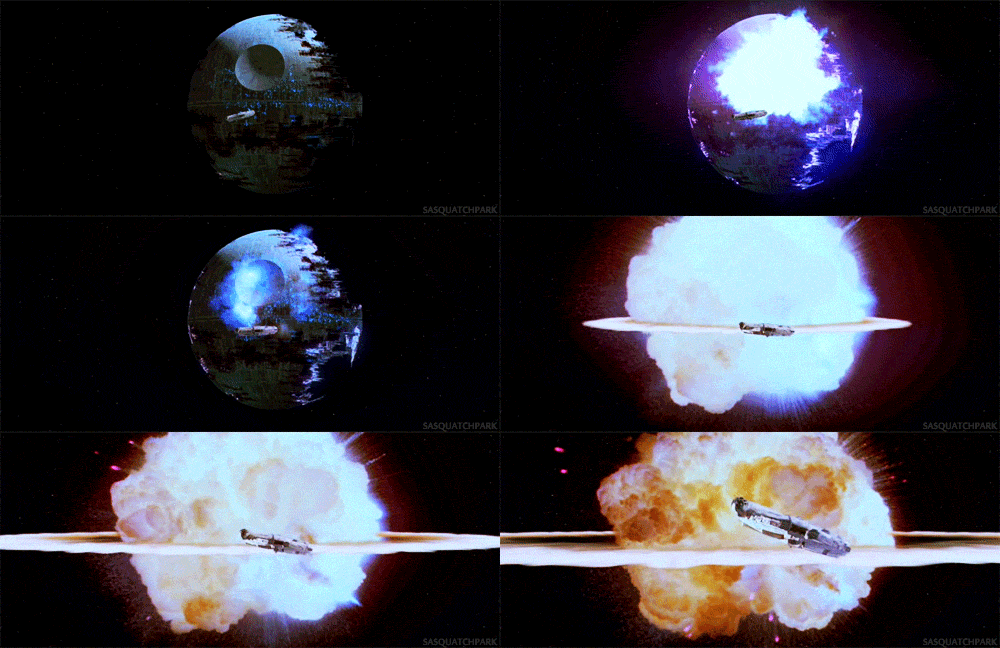
Thane and Ciena’s love story follows the narrative arc of the original series, starting with the destruction of the first Death Star (“A New Hope”), to the Battle of Hoth (“The Empire Strikes Back”), to the Battle of Endor (“Return of the Jedi”), to the Battle of Jakku (events that foreshadow and lead into “The Force Awakens”).
It is cleverly and masterfully done, and Gray does a stellar job of tying her characters’ stories into the stories that fans already know and love.
Some reviews have called this the “Romeo and Juliet” of Star Wars stories, and the comparisons are, of course, inevitable. Like Shakespeare’s famous star-crossed couple, Gray’s lovebirds are doomed from the start, but their journey toward their eventual fate is a beautiful one. It is also a tragic, disturbing journey through nationalism and totalitarianism taken to the galactic extreme.