Jump to ratings and reviews
Rate this book

Иван Федорович Шпонька и его тетушка

Rate this book
Любимец учителей благонравнейший школьник Ванюша, вырос и превратился в застенчивого доверчивого подпоручика в отставке Ивана Федоровича Шпоньку. В провинциальном имении вместе с тетушкой он ведет свое ленивое существование. И только одно происшествие смогло внести беспокойство в неизменный уклад его растительно-пустoпорожней жизни - желание тетушки женить Ивана Федоровича. И тут ему снится сон, где он все же выполняет желание тетушки.

ebook

First published January 1, 1832

2 people are currently reading
60 people want to read

About the author

Nikolai Gogol

2,001 books5,670 followers
People consider that Russian writer Nikolai Vasilievich Gogol (Николай Васильевич Гоголь) founded realism in Russian literature. His works include The Overcoat (1842) and Dead Souls (1842).

Ukrainian birth, heritage, and upbringing of Gogol influenced many of his written works among the most beloved in the tradition of Russian-language literature. Most critics see Gogol as the first Russian realist. His biting satire, comic realism, and descriptions of Russian provincials and petty bureaucrats influenced later Russian masters Leo Tolstoy, Ivan Turgenev, and especially Fyodor Dostoyevsky. Gogol wittily said many later Russian maxims.

Gogol first used the techniques of surrealism and the grotesque in his works The Nose , Viy , The Overcoat , and Nevsky Prospekt . Ukrainian upbringing, culture, and folklore influenced his early works, such as Evenings on a Farm near Dikanka .
His later writing satirized political corruption in the Russian empire in Dead Souls .

Ratings & Reviews

What do you think?
Rate this book

Friends & Following

Create a free account to discover what your friends think of this book!

Community Reviews

5 stars
37 (18%)
4 stars
52 (25%)
3 stars
74 (36%)
2 stars
31 (15%)
1 star
10 (4%)
Displaying 1 - 24 of 24 reviews
Profile Image for Glenn Russell.
1,519 reviews13.3k followers
Read
March 26, 2023


Ivan Fyodorovich Sponka and His Auntie - Nicolai Gogol's extraordinary tale of humor and imagination, not nearly as famous as The Overcoat or The Diary of a Madman or The Nose but a tale containing the most spectacular nightmare in all of Russian literature.

Nicolai Gogol is all about writing style; his humor and satire are bound up with word choice, offbeat shifting of tone, a sense of play and timing, timing, timing. As a way of capturing at least a small sense of the author’s actual language, I’ve linked my comments to nine quotes taken from the story’s introductory paragraph and five chapters.

“I put it in the drawer of a small table; I think you know it well: it stands in the corner just where you come in the door . . . But I forget, you’ve never visited me there.”

So relates the tale’s narrator in the brief, playful introduction, setting the frame for how his house servant used the last part of this story written down by Stepan Ivanovich Kurochka for baking pies, thus the tale is incomplete. But, please don’t be fooled: this Gogol story possess a unsurpassed completeness - it is a matter of a reader understanding the depth and beauty of Sponka’s dream in the final chapter.

I. IVAN FYODOROVICH SPONKA
“Ivan Fyodorovich, although he usually behaved properly, on this occasion was hungry and unable to resist temptation; he took the pancake, placed a book in front of him, and began eating it.”

In all his years in school, Sponka was a well-behaved and diligent model student. But there was that one time when Sponka was overcome by hunger and love of pancakes. And predictably in a society condoning beating and abusing children, Sponka received a canning resulting in a lifelong psychological scar. Gogol employed satire and understatement to portray men and women as violent pigheaded brutes.

“Perhaps that very incident was the reason he never had the desire to enter government service, having learned by experience that one is not always successful in concealing one’s crimes.”

Gogol’s subtle dig at government service employees – officials using their position within the government to swindle and cheat.

“To demonstrate further the cultural level of the P. regiment, we’ll add that two officers were terrible gamblers and lost their uniforms, caps, overcoats, sword knots, and even their underwear, which is more than you can say about many other regiments.”

Gogol’s satire on what passes for culture in the army: dancing the mazurka and playing cards.

"He drilled his men so well that the company commander always held him up as an example. As a result, in a short time, only eleven years after becoming an ensign, he was promoted to second lieutenant."

Only eleven years to receive a promotion! Then again we must acknowledge the Russian army has such high standards. What a scream.

II. THE TRIP
“You should know, kind sir, that I have the custom of plugging my ears at night since that awful time when a cockroach crawled into my left ear in one Russian inn. Those damned Russians, as I found out later, will even eat their cabbage soup with cockroaches in it. It’s impossible to describe what was going on: it tickled my ear, it really did . . . it nearly drove me mad!”

So speaks fat Grigory Grigorevich, a complete self-centered lout and buffoon. Gogol pokes fun at this fatso at every opportunity. This chapter highlights Sponka's return to his farm and how he is a goodhearted, honest man in a world of dishonest gluttons and slobs.

III. AUNTIE
"However, he was always out in the fields with the reapers and the mowers, and this afforded his gentle soul inexpressible enjoyment. The uniform sweep of a dozen or more shining scythes; the sound of the sheaves of grass falling in straight rows; the songs of the reapers pouring forth from time to time, now cheerful, as if greeting guests, then mournful, as if parting from them; and the peaceful clear evening, and what an evening it was! The air was so fresh and pure! How full of life everything was then: the steppe was turning red and blue and was aflame with flowers; quails, bustards, gulls, grasshoppers, and thousands of insects, and from them, whistling, buzzing, droning, and crackling at once merging into a harmonious choir; nothing was silent, even for a moment. The sun was setting and going into hiding. Oh! How fresh and fine!"

Pure, simple, kindhearted Sponka is keenly aware of the beauty in nature. In this sense, the high point in life for Sponka the farmer is aesthetic experience. If only people would leave him along to enjoy the natural world and take pleasure in the bountiful life surrounding him.

IV. DINNER
“My aunt had the honor of . . . she told me that a deed of gift left by the late Stepan Kuzmich . . .”
It’s difficult to depict the unpleasant expression that appeared on Storchenko’s face as soon as these words were uttered.
“So help me God, I can’t hear a thing! I must tell you that I had a cockroach in my left ear."

This exchange between Sponka and Grigory Grigorevich underscores that author Nicolai Gogol agrees with philosopher Arthur Schopenhauer when he said: “In cannibal societies, men eat one another; in civilized societies, men deceive one another.”

V. AUNTE'S NEW SCHEME
“His wife was sitting on a chair. He felt strange; he didn’t know how to approach her, what to say; and then he noticed that his wife had the face of a goose. Inadvertently turning to one side, he saw another wife, also with the face of a goose.”

This is a mere snippet from Sponka’s nightmare the night following his Auntie telling him he should get married. Auntie can even see her grandchildren running about in her kitchen. Auntie so wants to be a grandma! No matter that Sponka is not the marrying type – Auntie wants what she wants. So human but also so mulish – and so perfect for the satire and humor of Nicolai Gogol.


Russian author Nicolai Gogol, 1809-1852
Profile Image for Mark  Porton.
610 reviews822 followers
April 30, 2022
After reading the Overcoat a while back, I just had to gobble up more Gogol. In the last couple of days, I’ve had the pleasure of reading two of his short stories – the first of which was Ivan Fyodorovich Shponka and his Aunty. Isn’t that a title to wet one’s whistle?

Ivan Fyodorovich is a young man who was a well-behaved little boy at school, he was even a class monitor – (do you remember monitors at school?). He was diligent, nice enough, not brilliant. He served in the military and not long after ending his service he received a letter from his Aunty who was managing some land for him in a small Eastern Ukrainian Town called Gadyach, as both his parents were no longer alive.


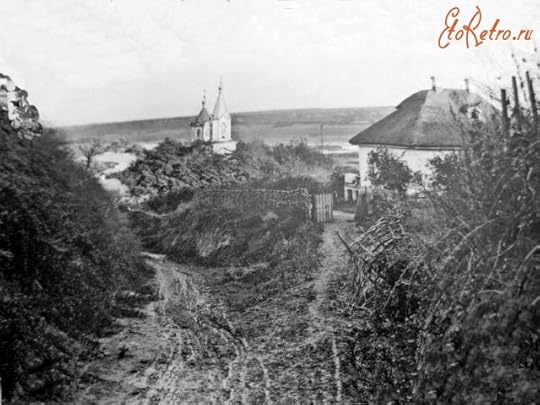
A terrific old photo of Gadyach - you can imagine sloshing through the mud, the earthy smell of pig dung and the whiff of woodfires as you toddle along to the Inn for a Mushroom-Cocktail and Beetroot Sandwiches

Aunt’s letter asked him to come home to manage his estate, as she is getting old. On the way he meets a bossy neighbour of his estate called Grigory Grigoriviech, this boorish man had to squeeze into the Inn Ivan was staying. Note: Many of Gogol’s more farcical characters have a high BMI, probably in the clinically obese range. This seems to be a theme. Grigory insists Ivan MUST visit him when he arrives – he insists!

Gogol’s descriptions of landscape and character is wonderful. He is mainly describing the ordinary, but he always exaggerates depictions of farcical characters, many of his descriptions border on the grotesque and are HILARIOUS.

Anyway, when Ivan arrives ‘home’ in Gadyach – he learns from his Auntie that Grigory Grigoriviech sits on a parcel of land that actually belongs to Ivan. Ivan eventually challenges Grigory about this at a dinner – and conflict and intrigue follows.

Gogal at this best, introducing some drama into an otherwise ordinary situation.

This wasn’t as good as The Overcoat, but good enough to be enjoyable and a bit funny. I’d give it 3.5 stars, but I’d raise it to 4.5 due to a trick I've never encountered before, at the conclusion of this story. It kind of blew me away. I felt I had been “had”. Clever stuff Comrade Gogol,

4 Stars
Profile Image for Bill Kerwin.
Author 2 books84.4k followers
April 17, 2019

This realistic story of Ukrainian landowners, included in Evenings on a Farm in Dikanka, Vol. 2 (1832), is really only half a tale. Gogol, in the persona of narrator Rudy Panko, gives us a “dog ate my homework” excuse for the omission: he says his illiterate wife used up the last chapter of the story to line the pan when she baked her pirozhkis. I think Gogol just got tired of the writing it, but didn’t want throw away the fragment because of the superb surreal dream he was inspired to include near the end of the single completed chapter.

Gogol was right to be bored: It includes a few vivid scenes of Ukrainian local color, and presents us with a few amusing characters, but what looks like it may develop into a real plot—that the Shponka’s next door neighbor Grigory Grigoriviech may have arrogated to himself sixty acres that properly belong to young Ivan—never goes anywhere at all. Instead, his aunt starts to put pressure on him to marry Grigoriviech’s daughter, and Ivan—disturbed at the prospect of marriage—has a very disturbing dream, which ends in the following manner:
then he suddenly dreamed that his wife was not a person at all but some sort of woolen fabric; that he was in Mogilev, going into a shop. “What kind of fabric would you like? Says the shopkeeper. “Take some wife, it’s the most fashionable fabric! Very good quality! everybody makes frock coats from it now.” The shopkeeper measures and cuts the wife. Ivan Fuodorovich takes it under his arm and goes to a tailor, a Jew. No,” says the Jew, “this is poor fabric! Nobody makes frock coats from it . . .”
Profile Image for Pinko Palest.
961 reviews48 followers
November 14, 2017
This is one of the very best pieces that Gogol ever wrote: the reader can't help laughing aloud, not just with the hilarious jokes, but also with the way the author stands every narrative tradition known to humankind on its head. As fresh and original today as it was when it was written
Profile Image for Fatima .
23 reviews
December 16, 2023
Bro is literally me when it comes to love ( incapable )
Profile Image for Hussein.
18 reviews47 followers
September 15, 2024
Diary of a Madman is a haunting journey into the unraveling mind of a minor government clerk, Poprishchin. As his diary entries spiral into madness, Gogol masterfully captures the isolation, obsession, and delusions that consume his protagonist. Starting off with petty frustrations and eventually escalating to the belief that he is the King of Spain, Poprishchin's decline is both tragic and darkly comic. This was my first Gogol read, though I've long been curious about Dead Souls and The Overcoat, and it certainly did not disappoint. His sharp commentary on societal pressures and mental health, wrapped in a mix of absurdity, humour and melancholy, has definitely made me eager to dive deeper into his works.
21 reviews1 follower
February 5, 2025
I bet you’re a lot of fun at parties!
Profile Image for Anton Segers.
1,320 reviews20 followers
November 5, 2023
Een aantal geestige situaties uit het komisch contrast tussen de doodbrave en -saaie Shpanko en de bazige mensen rond hem. Geconfronteerd met een vrouw die hoopt op romantiek praat Shpanko enkel over zijn passie voor rotsen en gesteente.
Maar het verhaal gaat nergens naartoe en werd door Gogol onafgewerkt…
Profile Image for Tabuyo.
485 reviews48 followers
December 14, 2016
Este relato me ha gustado mucho. Al contrario que otros relatos de tintes fantásticos aquí prima el realismo. El único problema es que Gógol lo dejó inacabado a propósito y me dejó con ganas de saber como terminaba la historia. No es un spoiler ¿eh? Lo avisa antes de empezar.

Mi reseña: http://contandoteunlibro.blogspot.com...
Profile Image for TarasProkopyuk.
686 reviews110 followers
March 1, 2015
Что-что, а изыскано высмеивать человеческие негативные качества, или даже просто подшучивать над своими персонажами Николай Васильевич Гоголь умеет превосходно. )

"Иван Фёдорович Шпонька и его тётушка" весьма красивое и весёлое произведение.
Profile Image for Dorothy Himberc.
96 reviews4 followers
May 7, 2022
Quirky, very Gogol-ish. A tribute to the little 19th century everyman who - while not especially clever, and not especially well equipped for dealing with the influence and opinions of the women around him - maintains a dignity.
Profile Image for Guilherme Neves.
26 reviews
September 3, 2022
3.5
I liked the funny way this story is told and the way it ends making the reader imagine how the story really ends
Profile Image for Alexandr Kuznetsov.
213 reviews2 followers
December 24, 2024
Не оконченная, неожиданно реалистичная, в которой автор нащупывал образы для будущих больших текстов
Profile Image for Kae.
5 reviews
January 1, 2025
Ivan Fyodorovich is unbelievably autistic coded.
Profile Image for D.
61 reviews
September 13, 2023
The awkward scene between Ivan and his love interest stood out for me, relatable, painful and funny!
Profile Image for Javier Muñoz .
350 reviews11 followers
February 23, 2017
3.5 stars

Parece que a Gogol le encanta combinar historias para un final determinado (Aquí es solo para indicar que la historia se deja abierta (quizás hasta tiene otros fines)) El artilugio de narrar y las descripciones del campo son totales!!
Profile Image for Maie Elfayoumy.
94 reviews48 followers
January 8, 2017
I really wish it had an end. It would've been funnier than imagining one.
Displaying 1 - 24 of 24 reviews

Can't find what you're looking for?

Get help and learn more about the design.