What do you think?
Rate this book


124 pages, Paperback
First published January 1, 1969
Oh, that morning burned in the heart! Oh, the illusory nature of calamity. Oh, the irretrievable! What’s worse about this burden which no one has yet called by any name, what’s worse – paralysis, or nausea? Nervous exhaustion or mortal sorrow somewhere in the region of the heart? But, if that all equal, then all the same what’s worse about it – tetanus, or fever?
The other passengers looked at me almost indifferently with their round, vacant eyes.
I like that. I like that my country’s people have such empty, bulging eyes. This instills in me a feeling of legitimate pride. You can imagine what the eyes are like where everything is bought and sold – deeply hidden, secretive, predatory and frightened. Devaluation, unemployment, pauperism… People look at you distrustfully, with restless anxiety and torment. That’s the kind of eyes they have in the world of Filthy Lucre.
If I should ever have any children, I’ll hang on their wall a portrait of the Procurator of Judaea, Pontius Pilate, so that they will grow up neat and clean. Procurator Pontius Pilate standing there washing his hands – that’s the right kind of portrait.


Îmi place că poporul țării mele are ochii atît de goi și de bulbucați. Asta îmi imprimă un sentiment de legitimă mîndrie. Ne putem imagina ce fel de ochi sînt acolo. Unde totul se vinde și totul se cumpără: ...ochi bine ascunși, pitiți, rapaci și înspăimîntați... Inflație, șomaj, pauperism... Se uită pe sub sprîncene, cu îngrijorare perpetuă și suferință – iată ce fel de ochi sînt în lumea banilor peșin...
În schimb, ce ochi are poporul meu! Sînt mereu holbați, dar n-au în ei nici un fel de tensiune. Deplină absență a oricărui sens, în schimb – ce vigoare (ce vigoare spirituală!); ochii ăștia n-au să te vîndă. N-au să vîndă nimic și n-au să cumpere nimic. Orice s-ar întîmpla cu țara mea, în zile de îndoială, în zile de împovărătoare meditații, în vremuri de încercări și amaruri felurite – ochii ăștia n-au să clipească.
De-o viață întreagă mă apasă acest coșmar, coșmarul că ești înțeles anapoda, nu, nu „anapoda“, ci strict pe dos, adică de-a dreptul porcește, adică antinomic.”
Mai era și Hegel. Asta mi-o aduc aminte foarte bine: era și Hegel. Spunea: „Nu există deosebiri, în afara deosebirii de grad între gradele diferite și absența deosebirii“. Adică, dacă-i să traducem asta într-un limbaj ca lumea: „Cine nu bea acum?"...
Sufletul meu e precum burdihanul calului troian, încap multe în el.
Ziua noastră de mîine e mai luminoasă decît cea de ieri și cea de astăzi. Dar cine garantează că ziua noastră de poimîine nu va fi mai rea decît cea de alaltăieri?
Trebuie să respectăm, repet, străfundurile sufletului altuia. Trebuie să ne uităm în ele, chiar dacă acolo nu-i nimic, chiar dacă acolo nu-s decît aiureli e tot una: uită-te și respectă, uită-te și nu scuipa...
”За сметка на това какви очи има моят народ! Те са постоянно опулени, но в тях няма никакво напрежение. Пълна липса на всякакъв смисъл, но затова пък каква мощ! (Каква духовна мощ!) Тези очи няма да те продадат. Нищо няма да продадат и нищо няма да купят. Каквото и да стане със страната ми. В дни на съмнения, в дни на тягостни размисли, в усилните времена на всякакви изпитания и бедствия - тези очи няма да премигнат. Все им е едно”...
”О, ако целият свят, ако всеки на тоя свят беше като мен сега- тих и боязлив, и освен това беше също такьв неуверен в нищо: нито в себе си, нито в сериозността на мястото си под небето - колко хубаво щеше да е! Никакви ентусиасти, никакви подвизи, никакьв фанатизъм! Всеобщо малодушие!”
“От третия райх, четвьртия прешлен, петата република и седемнайсетия конгрес - можеш ли да прекрачиш заедно с мен в света на мечтаното от всички юдеи пето царство, седмо небе и второ пришествие?...”
“А съм длъжен да ви кажа, че хомосексуализмът в нашата страна е изкоренен макар и окончателно, но не изцяло. По-точно казано, изцяло, но не напьлно. А още по-точно дори така: изцяло и напълно, но не окончателно. Защото за какво си мислят сега хората? Единствено за хомосексуализма. Е, и за арабите си мислят, за Израел, за Голанските взвишения, за Моше Даян. Но ако изгоним Моше Даян от Голанските вьзвишения и накараме арабите и юдеите да се сдобрят? Какво ще остане тогава в главите на хората? Едничък само чист хомосексуализъм.”
“От място се провикваха: „А къде се намира тая Норвегия?... И кой знае къде!" - отговаряха от друго място. „На майната си, в гори тилилейски!" „А бе където и да е - надвиквах аз глъчката, - без интервенция няма да минем. За да възстановим разрушеното от войната стопанство, трябва първо да го разрушим, а затова ни е нужна гражданска или каквато и да е война, нужни са ни най-малко дванайсет фронта.."”
“Защото не е ли човешкият живот моментно натаралянкване на душата? А също и помрачаване на душата? Всички сме един вид пияни, само че всеки по своему, един є изпил повече, друг - по- малко. И зависи на кого как му действува: един се смее в очите на този свят, а друг плаче на гърдите на този свят. Един вече се е издрайфил и му е хубаво, а друг сега започва да драйфа. А аз - какво аз? Много съм вкусил, а изобщо не ме хваща, дори нито веднъж не съм се размял както трябва и нито ведныж не сьм се издрайфил. Аз, вкусилият от този свят толкова, че губя чет и последователност - съм най-трезвият на този свят; просто трудно ме хваща...”

”On the other hand, what eyes my people have! They are constantly wide open, yet there is no tension in them whatsoever. A total absence of any sense, but oh, what power! (What spiritual power!) Those eyes will never betray you. They will sell nothing and buy nothing. No matter what happens to my country. In days of doubt, in days of burdensome reflection, in the strenuous times of all kinds of trials and disasters—those eyes will not blink. They just don't care”...
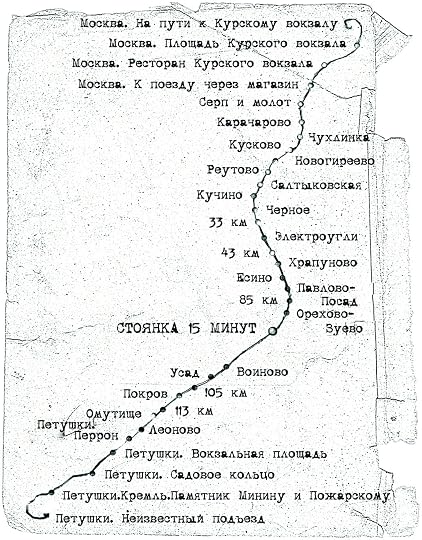
The journey from Moscow to Petushki is about 140 km by train. For the drunk Venichka, however, it turns into a labyrinth of smoke and hallucinations, periodically clouded and cleared by the alcoholic fumes of quite a few bottles of vodka combined with beer, wine, methylated spirits, shaving lotion, wood varnish, and two salami sandwiches. All in the company of fellow travelers who are no less detached from reality.
Amidst diverse recipes for moonshine, conversations with guardian angels and drunk conductors, and dreams of more vodka, revelations are shared and countless philosophical justifications of (non-)being are defined—but most of all, a ticking time bomb is planted under the Soviet mentality.
The book is often classified as a satire. I disagree. Given Erofeev's own biography, this is actually a painfully frank confession—uncovered by any self-delusions—of a deliberate and implacable self-destruction within an unbearable reality. In this reality, only drunks and madmen, who are often one and the same, choose freedom. Yet in a crushing totalitarian reality, the only possible freedom is the freedom of self-destruction. Much like the Moscow–Petushki train, it moves back and forth, never reaching its final destination.
This is not satire; it is a stripping bare and a cry of pain for which there is no cure, only an anesthetic.
Erofeev was broken early in childhood. Born beyond the Arctic Circle in 1938, he was the son of a father declared a “wrecker” and sent to the Gulag for many years. His impoverished mother sent Venedikt to a boarding school, where he began drinking at age 16 and graduated with a gold medal, which gave him a ticket to a university in Moscow. But the northerner never fit into the established tracks—drunkenness and insubordination cast him into a vagrant life without permanent registration.
Erofeev’s own life was not that of a dissident, but of a desperately alienated and broken man who never accepted the Soviet reality of fake collectivism and “prosperity.” An internal alcoholic emigration. The terrifying thing is that, after so many years, he is still right.

Не смейтесь. У меня богатый опыт в создании коктейлей. От Москвы и до Петушков пьют эти коктейли до сих пор, не зная имени автора; пьют «Ханаанский бальзам», пьют «Слезу комсомолки», и правильно делают, что пьют. Мы не можем ждать милостей от природы. А чтобы взять их у нее, надо, разумеется, знать их точные рецепты; я, если хотите, дам вам эти рецепты. Слушайте.
Я в их годы делал так: вечером в четверг выпивал одним махом три с половиной литра ерша — выпивал и ложился спать, не раздеваясь, с одной только мыслью: проснусь я утром в пятницу или не проснусь? И все-таки утром в пятницу я не просыпался. А просыпался утром в субботу, и уже не в Москве, а под насыпью железной дороги, в районе Наро-Фоминска. А потом — потом я с усилием припоминал и накапливал факты, а, накопив, сопоставлял. А сопоставив, начинал опять восстанавливать напряжением памяти и со всепроникающим анализом. А потом переходил от созерцания к абстракции, другими словами, вдумчиво опохмелялся, и, наконец, узнавал, куда же все-таки девалась эта пятница.
— Нет, вы меня не так поняли, ребята… просто я…
— Нет, мы тебя правильно поняли…
— Да нет же, не поняли. Не могу же я, как вы: встать с постели, сказать во всеуслышание: «Ну, ребята, я …ать пошел!» или «Ну, ребята, я …ать пошел!» Не могу же я так…