Duchlan Castle is a gloomy, forbidding place in the Scottish Highlands. Late one night the body of Mary Gregor, sister of the laird of Duchlan, is found in the castle. She has been stabbed to death in her bedroom but the room is locked from within and the windows are barred. The only tiny clue to the culprit is a silver fish s scale, left on the floor next to Mary s body. Inspector Dundas is dispatched to Duchlan to investigate the case. The Gregor family and their servants are quick perhaps too quick to explain that Mary was a kind and charitable woman. Dundas uncovers a more complex truth, and the cruel character of the dead woman continues to pervade the house after her death. Soon further deaths, equally impossible, occur, and the atmosphere grows ever darker. Superstitious locals believe that fish creatures from the nearby waters are responsible; but luckily for Inspector Dundas, the gifted amateur sleuth Eustace Hailey is on the scene, and unravels a more logical solution to this most fiendish of plots. Anthony Wynne wrote some of the best locked-room mysteries from the golden age of British crime fiction. This cunningly plotted novel one of Wynne s finest has never been reprinted since 1931, and is long overdue for rediscovery."
Anthony Wynne is a pseudonym of Robert McNair Wilson, an English physician, who developed a specialism in cardiology after working as an assistant to Sir James Mackenzie, whose biography he subsequently wrote in 1926.
He was born in Glasgow, the son of William and Helen Wilson, (née Turner),
He was educated at Glasgow Academy and Glasgow University and became House Surgeon at Glasgow Western Infirmary. He was Medical Correspondent of The Times from 1914–1942.
He twice stood, unsuccessfully, for Parliament, as Liberal candidate for the Saffron Walden district of Essex in 1922 and 1923.
He wrote biographies and historical works under his own name and a single novel under the pseudonym Harry Colindale. Under Anthony Wynne, he created Eustace Hailey, a doctor in mental diseases and amateur sleuth, who featured in many of his 45 mystery novels, beginning with The Mystery of the Evil Eye (1925) and ending with Death of a Shadow (1950).
As Anthony Wynne he also wrote short stories for a variety of magazines and newspapers.
He married Winifred Paynter on 7th December 1905 in Alnwick, Northumberland, and the couple had three sons. In the September quarter of 1928 he married again, Doris May Fischel, at Hampstead and they had two sons.
He died in the New Forest, Hampshire, on 29 November 1963.
I finished this a few days ago. I didn't take notes, so I apologise that this tale isn't completely fresh in my mind.
This doom & gloom laden tale reminded me a lot of Edgar Allan Poe & Sir Arthur Conan Doyle's works. Who murdered the Laird's sister? Of course she turned out to not be as saintly as she first appeared - in fact, Mary Gregor was evil to an implausible degree. There was great scene setting at the start, but then the story dragged. & dragged.
The only thing that saved this novel from a 2★ was the murder method & that I didn't guess the murderer, but if you are a fan of locked room mysteries, you might enjoy this one.
I have not read any books by Golden Age author Anthony Wynne before, but this is number twelve in a series he wrote featuring amateur sleuth Dr Eustace Hailey. Normally, I dislike reading books out of series order, but this was actually far more about the plot than the characters and so I did not find it difficult that I not read any previous mysteries by the author.
First published in 1931, this novel is set in the Scottish Highlands where Dr Hailey is staying with his friend, Colonel John MacCallien. One evening they receive a visitor to inform them that Mary Gregor, sister of the laird, has been murdered at Duchlan Castle. This is a locked room mystery – the body is found in a locked room, where there is a sheer drop outside the windows, and there is no obvious way the crime could have been committed. When a fish scale is found on the body, it leads to talk of local lore and superstitions, but Dr Hailey is convinced there is a far more human reason for the murder…
Although the laird is insistent that his sister, Mary Gregor, was universally loved and respected, it soon emerges that many did not share his opinions. Mary Gregor ruled the house the way she wanted and clashed with anyone who tried to usurp her position. Before long, there are more deaths and it will need Dr Hailey to discover the murderer and solve the crimes. This was a fairly dark mystery with a good setting. I found it much more an old fashioned ‘puzzle’ and, on re-reading, found it a little repetitive, but still enjoyable.
The thing I enjoy most about locked-room mysteries is, of course, waiting for the solution to materialize. Up until that point, I am mentally watching for anything that might be a clue as to how a locked-room murder was pulled off. This time, there was nothing to give it away, and I had to wait until the last few pages for the answer. Clever it was, indeed; I never would have guessed. Yet not all action takes place within the confines of a single locked room -- two other equally puzzling murders happen right under everyone's noses with no suspect in sight. So here you've got a bonus: a locked-room mystery and an impossible-crime story.
While the locked-room/impossible-crime components will probably be enough to please any vintage-mystery reader, I always go right to the human element in crime novels, and the dynamics at work in this household are perfect for examining what's in the minds of the people who live there. As the quotation with which I started my journal entry for this book states, "there's something wrong with this house," and Wynne gets to the dark heart of exactly what that something is. It takes a while to get there, but it is definitely worth the read time.
Si andas llorando por las esquinas porque ya te has leído todos los libros de Agatha Christie, amigui, guarda los clínex, ¡que traigo la solución!
Anthony Wynne es el pseudónimo de Robert McNair Wilson (1882-1963), un médico, periodista y escritor escocés. Honestamente, yo no había oído hablar de él hasta que este libro cayó en mis manos, y ahora solo espero que nos lleguen más de las 27 novelas que protagoniza el doctor Hayley, médico y detective aficionado en sus ratos libres. En concreto, ‘El asesinato de Lady Gregor’ (1931) es la número doce, pero puede leerse perfectamente de forma independiente.
¿Qué encontraremos en esta novela?
📚Un castillo en las Highlands escocesas 📚Un crimen de habitación cerrada 📚Todos tenían motivos para matar a Lady Gregor 📚Todos mienten u ocultan algo 📚Detective aficionado majísimo 📚Folclore local 📚Secretos familiares
Qué mejor para reencontrarme con un crimen de habituación cerrada que una novela de época. ¡Nada! En un caluroso verano escocés, Lady Gregor aparece asesinada en su dormitorio, puerta cerrada por dentro, ventanas atrancadas y una herida que no da opción a pensar que fuera autoinfringida. ¿El arma? Desaparecida. El asesinato remueve a la familia y la comunidad local pero cuánto más se investiga, más queda claro que la imagen de beata de la fallecida, escondía en realidad un montón de enemigos… ¿Necesitas más alicientes? No será el único crimen. Ideas y venidas, varias investigaciones paralelas y muchas mentiras te harán sospechar de todo y de todos, para al final, quedar todo perfectamente resuelto.
Como decía al inicio, ha sido inevitable para mi que me viniera a la cabeza la gran dama del misterio leyendo este libro, con la ventaja de que he podido adentrarme en la trama completamente en blanco, lo cual con las de Agatha, ya archiconocidas y mil veces adaptadas, no siempre es posible. No es una novela de tensión, ni un thriller al estilo actual, está llena de conversaciones y búsqueda de pruebas, a fuego lento.
Un descubrimiento fantástico y deseando adentrarme en el resto de los clásicos de la novela negra de la British Library para ver si mantienen este nivel. También diré que @duomoeditorial se está marcando unas ediciones preciosas en esta colección, ¡los quiero todos!
A locked room mystery set on the shores of Loch Fyne. This is apparently the twelfth in a series featuring this detective but he comes across as a pretty bland character. I think the main mystery here is why nobody had murdered the victim before! Although the solution is ingenious I felt the story dragged on for too long . There are some very old-fashioned views on women in this which annoyed me immensely although I do accept this is a 'golden age' novel.
A Scottish Locked Room Review of the Poisoned Pen Press eBook edition (February 2, 2016) of the British Library Crime Classics (BLCC) paperback (January 1, 2015) of the Hutchinson hardcover original (1931).
Murder of a Lady was yet another Kindle Deal of the Day which I took a chance on. The author Anthony Wynne (penname of Robert McNair Wilson 1882-1963) was previously unknown to me, as was the 28 book series of his amateur sleuth Dr. Eustace Hailey (1925-1950). I did check the list at The Book of Forgotten Authors, but even there he appears to be doubly forgotten, as he didn't make the cut.
Still, the editor Martin Edwards of the British Library Crime Classics series did select this book #12 of Hailey series to reprint. It is in the 'locked room' aka 'impossible crime' sub-genre of mysteries where a murder has been committed in a room where no one beyond the victim appears to have entered or exited and all the windows and doors are shut and locked when the crime is discovered.
In this case, Lady Gregor, the sister of the laird, has been apparently stabbed to death in her locked room. The weapon has disappeared. The brother, the nephew and his wife, a local doctor, various housemaids and servants (Note: the family piper Angus is not considered to be a servant) are suspects for various reasons. The misdirection carries on at length and the actual solution seems to come out of nowhere at the very end with little apparent investigation to provide earlier clues towards it.
There is a further misdirection that after each murder (there are more than one) a splash can be heard in the waters below the manor house and an apparent swimmer or fish is seen to drift away downstream. This introduces a possible supernatural / horror explanation of a sea creature taking vengeance for a past slight (It did make me think of Lovecraft's The Shadow over Innsmouth, coincidentally also from 1931).
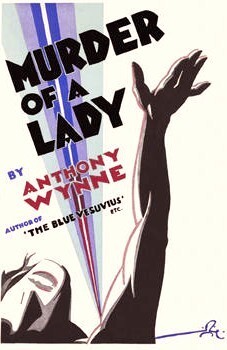
Really the only good clue for the early reader would have been the cover image in the original edition. Cover image of the 1931 Hutchinson original hardcover. Image sourced from Goodreads.
Dr. Hailey figures it out in the end, but it ends very abruptly and doesn't provide a reader the satisfaction of having followed his thinking along the way. This doesn't earn an Unsatisfactory Ending Alert tag, but the resolution was just too out of the blue to be entirely enjoyable. A 3-star "Like" is fairly generous.
Trivia and Links The British Library Crime Classics series are reprints of forgotten titles from the 1860's through to the 1950's. You can see a list at the British Library Crime Classics Shop (for North America they are reprinted by the publisher Poisoned Pen Press). There is also a Goodreads Listopia for the series which you can see here.
This is a Golden Age mystery set in Scotland. published in 1931. I think the author must have published other books with the protagonist, Dr. Hailey, an amateur detective.. He was visiting a friend when a woman was murdered in the local castle.
This is a classical locked door mystery. Mary Gregor had been found crouching at her bed, covered in blood with all the doors and windows locked. How was it done? I remember an Agatha Christie book where it was the flowers on the wallpaper that killed the victim. This one is not as clever.
Still it creates the atmosphere of the times and the Scottish Higlands. It was interesting to read the customs. Not so interesting was the attitude towards women. They thought a wife would be happy with a dress budget. Sigh. Of course, that was a sign of the times. I was shocked to read the attitude about the Irish. Apparently they thought Irish people were feckless and up to no good. That was a surprise.
Still, it's a pleasant Golden Age mystery just not one of the best.
Dr. Eustace Hailey, amateur, but very experienced detective, is called to assist in the investigation of the murder of Mary Gregor, the elderly sister of the laird of Duchlan. It was a brutal murder made even worse by the fact Miss Gregor had a reputation for charity and good works. Who would want to kill her? To further complicate matters, Miss Gregor was found in a locked room, a room that no one could have gained access to from outside. The windows to the room were locked as well. So how did the killer get to her?
Dr. Hailey also becomes suspicious of the constant praises regarding Mary Gregor. She sounds too good to be true. In fact, the more he hears about her, the more he comes to realize that any number of people would had been glad to see her dead. She was selfish, controlling, cruel, and manipulative, but her family seems incapable of admitting it. Why? Then there is the long scar on her chest, the mark of another deadly attack long ago. This is something else the household claims to be totally ignorant of.
Hailey does not get very far into his investigation when Inspector Dundas, the official investigator shows up and three things quickly become clear about Dundas -
1. He is completely and utterly tactless and has a knack for offending everyone around him.
2. He does not want Dr. Hailey anywhere near the investigation.
3. He has no idea what he is doing.
Disappointed, Dr. Hailey leaves, but he cannot stay out of the investigation no matter how hard he tries. Finally, it becomes very obvious even to Dundas that he needs help and Hailey returns to take things over - and then there is another murder, this one just as inexplicable as the first. Hailey believes the murders are linked to that long ago incident that left the awful scar on Mary Gregor's chest - he just has to prove it.
Murder of a Lady is set in 1930 Scotland. Wynne depicts a world that has not entirely moved out of the 19th or even the 18th century ways. Duchlan still lives like a Scottish lord in the days of Mary Queen of Scots. He considers his servants his family and even refers to them as his "helpers." He shares his late sister's obsession with the past. One gets the feeling that he would have preferred to live in the Scotland of two or three hundred years earlier.
The sense of tradition and history pervades the story. I kept thinking of Walter Scott. Of course, the problem for Duchlan and Mary Gregor is this is not feudal Scotland, but a 20th century one. Their attempts to turn back the clock have simply made things worse for everyone else. Tradition and history are fine, but they should not dominate one's existence.
The puzzle is a good one. The method of killing was ingenious and one I had never thought of before. I certainly never suspected the killer or the motive. You literally don't learn the identity of the killer until the very, very end, which keeps up the suspense.
This is easily the best of the British Library Crime Classics that I have read so far. It's a shame that Anthony Wynne is not better known for he wrote very good mysteries. I would definitely read more by this author.
Mary Gregor was murdered in her own bedroom, at Duchlan castle in the Highlands of Scotland. She died from a shoulder wound and was found huddled by her bed with a wound to her shoulder. The bedroom door had been locked from the inside – a complex lock created by a former laird had to be removed when the alarm was raised – the closed windows were equally secure. There was almost no bleeding from the wound, there was no weapon to be found and, maybe the most puzzling thing of all, there was a single herring scale in the wound ….
The Procurator Fiscal sent for the police; and he also sent for Doctor Eustace Hailey, who he knew was visiting friends who lived not far from the castle.
The household was stunned, and nobody could offer a single reason why someone would want Mary dead. There was her widowed brother, Duchlan; there was his son, Eoghan, Duchlan’s son who had come home on the night of Mary’s death; there was his wife, Oonagh; there was his son, Hamish; and there was a small band of loyal and long-serving family retainers.
Mary Gregor had been a pillar of the community; but it soon became clear that, behind her glossy public image, she had been a hard and controlling woman who had bent all of her family to her own will for years and year.
Watching the characters and the relationships being brought into the light, watching relationships under great strain as family members suspect each other and try to divert suspicion, was fascinating; and that made this book quite unlike and other Golden Age mystery I can remember.
There was a great deal of incident; there were more seemingly impossible murderers; there was a strong suggestion that supernatural forces had been at work; and there some interesting references to art and culture dropped in.
Thing got a little too melodramatic at times, but the plot, the characters are very well done and that always kept the story on track.
I was sorry that the story was a little over-stuffed with diverse elements; some of them were interesting but some of them had me wishing that the author would get on with solving the mystery.
The solution is very clever – the practicalities were highly improbable, but the logic and the psychology worked – and, though I didn’t see it coming, when I looked back I realised that there had been a few little clues.
Anthony Wynne wrote well, the story was always engaging, and he caught the atmosphere, as unfolding events generated fear and hysteria, very well indeed. That was what held things together, and that was what kept me turning the pages.
I can’t say that this is the greatest Golden Age crime novel; but it is different and it is entertaining.
I found this book to be delightful and the ending made me laugh out loud with glee. The solution to the "impossible crime" was absurd and contrived - as these impossible crime solutions often are - but not such that I was annoyed.
I didn't guess whodunnit. I was pretty sure throughout the entire thing whodidntdunit, and I was right about that, but I focused on the wrong character.
The victim, Mary Gregor was an odious woman. She reminded me a lot of Mrs. Boynton, from Appointment With Death, which remains one of my favorite Christie mysteries. Some people go unmourned for good reason. The second inspector sent to investigate, Barley, was a blooming idiot with a bad case of confirmation bias - he decided who did it, and then try to squash the evidence into agreeing with him.
The book did drag a bit - this I cannot deny, and I agree with Tigus that the talky-mc-talkerson grew tiresome. I was totally astonished by the THIRD murder, and by the fourth, I was dying to get to the end! Overall, this ended up being one of my favorite of the BLCC reissues.
Anthony Wynne (real name Robert McNair-Wilson) was recognised as the master of the locked room mystery in the so-called Golden Age of Murder and here he provides another example featuring the gifted amateur sleuth Dr Eustace Hailey.
The lady found dead in the locked room of the castle in which they resided was Mary Gregor, sister of the laird of Duchlan. She had been stabbed to death but the windows and doors of the room are all locked so it would seem that no-one could get in or out. However, there was a very small clue left behind but it seemed to make no sense whatsoever.
Inspector Dundas is called in to investigate and initially he learns from family and staff that Miss Gregor was a kind and charitable woman. But further investigation leads him to believe that there was another side to her character and he spends half the book trying to discover exactly what that was.
Dundas felt early on that he had discovered the murderer but before he could make any arrest, he too is killed, again in seemingly impossible circumstances and again with a similar small clue left behind. Fortunately by then Dr Hailey was on the scene and he continued the investigation along with another officer called to the castle in Inspector Barley.
A further death occurs, which mystifies everyone, and Hailey and Barley repeatedly interview the host of characters that populated the castle. But they got nowhere and were even more confused when locals claimed that fish creatures from the nearby waters were responsible for the crimes. Fortunately Hailey subsequently outlined a more logical, solution that satisfies everyone.
'Murder of a Lady' has potential but fails to fulfil it as it meanders along with some fanciful detective work among some not very exciting or interesting characters. But once again in these British Library Crime Classics, the cover is delightful!
This was too melodramatic for my taste, and I found the writing style sloppy. It was occasionally difficult to determine who was in action, because there were two doctors that were frequently together, and yet it would say only "the doctor."
Dr. Hailey spent a lot of time discussing particulars of the case with the various suspects. He gave them more information than he should have, as well as revealing confidences that were given to him. I don't consider this sound detective work. Both police detectives were absurd (albeit in different ways), and how the second one got warrants was pretty ridiculous. He came up with a theory, acted as though it was fact, accused his suspects, and said he was being logical. Yet Dr. Hailey admired him?
The entire family was unlikable, particularly the father and aunt. The son was all over the place, wanting to kill himself several times either as a sacrifice for his wife or to set her free. Yet he also flew into a rage and nearly strangled her to death when his aunt wouldn't speak to him. Let's not even talk about how his mother died.
In the end, I suspected the murderer's identity but could not guess the method....probably because it was also absurd and unbelievable. Then the book ends abruptly.
I know it was written a long time ago, but the stereotypes, sexism, classism, and racism were a little obnoxious. I've read from this period before and never found it so obvious, so perhaps it was just this author. This is the first I've read in the series, and probably the last.
It was a complete mystery. Right up until that very obvious piece of backstory was revealed so perfectly. Still, the method was quite a surprise, so that redeemed it a little bit. Maybe I shouldn't have jumped into this series at number 12, or maybe Wynne's style just isn't for me. Either way, it didn't work for me. The first thing that annoyed me was that no one in the whole book was likeable. The detective is almost a non-entity (that might have been fixed if I'd known him before this book), so maybe he is nice. Everyone else is a miserable human being. I just couldn't root for any of them. It is clean.
A strong woman of independent mind is most definitely have to be an evil and cruel one. The pleasure it gives men to soothe their egos by depicting women such!! Also what a dragggg!!!!
Amateur detective, Dr Eustace Hailey, is visiting a friend in Mid-Argyll in the Scottish Highlands, when a murder is committed in nearby Duchlan Castle, home of the laird, Hamish Gregor. The victim is the laird's sister, Mary, a woman to all outward appearances of a saintly nature, the last person one would expect to be brutally slain. Her body is found in her bedroom, with the door and windows locked from the inside, and no obvious way for the murderer to have got in or out. The local Procurator Fiscal has heard of Dr Hailey's reputation and begs him to come and look at the scene, fearing it may be some time before a police detective arrives in this remote spot. It's not long before Dr Hailey discovers that Mary Gregor had another, darker side to her nature, harsh and judgemental, manipulating and controlling the people around her to get her own way in all things, no matter the cost to others...
These British Library re-issues of vintage crime novels have been a bit hit or miss for me, so I'm delighted to say this one is most definitely a hit! I was simultaneously attracted to and apprehensive about it because of its Scottish setting – so often at that period Scottish characters were annoyingly stereotyped as either figures of fun or drunken, belligerent half-savages by the rather snobbish English writers of the time. However I needn't have worried – it turns out Wynne was Scottish himself, and the picture he paints of this Highland society gives a real feeling of authenticity, even though it does, as with most Golden Age crime, concern itself primarily with the aristocratic and professional classes. There is an interesting, short introduction from Martin Edwards, giving a little background information on the author, and setting the book into its place in the history of crime fiction.
Although the focus is largely on the locked-room puzzle of how the crime could have been done, there's some pretty good characterisation along the way. Not so much of the detective, Dr Hailey – I believe this was quite far along in the series so Wynne may have presumed his readers already knew about him. But the victim's personality is key to the motive, and, though she's dead before we meet her, we get an increasingly clear picture of her in all her malevolence through the eyes of the various people who knew her. Her brother Hamish, the laird, is another fine creation – his snobbery and sense of self-importance, his pride in his family and lineage, his weakness to stand up to his sister, his insistence on the maintenance of tradition. I particularly liked the way Wynne portrayed the women, showing them as subordinate within this society, but strong within themselves; victims sometimes, but not hysterical ones; and intelligent, worthy partners for the men they loved.
Of course, there is more than one murder, and I have to admit that the second one took me totally by surprise and actually made me gasp a little. There's no real horror aspect in the book, but it nevertheless builds a great atmosphere of rather creepy tension, aided by the superstitions of the Highland folk. It does veer into melodrama at points, but that works well with the rather gothic setting of the old house filled with secrets from times gone by. I wouldn't call it fair-play – I think it would be pretty impossible to work out the who, why and how of the crimes. And yes, it does stretch credibility when all is revealed – the method, at least, though the motivations of all the characters were credible enough to carry me over any other weaknesses.
I enjoyed this one very much – another author the British Library has managed to add to my list!
NB This book was provided for review by the publisher, Poisoned Pen Press.
This is a pretty interesting book. Written in the 1930s (so yes there were comments about a woman's way of thinking that made me a bit angry) by a Glasgow-born physician who was prolific in writing, not only mysteries of which locked rooms were a speciality, but biographies and other books on science, medicine, history and politics. Anthony Wynne was the pseudonym of Robert McNair Wilson (1882-1963), whose works fell out of print but are seeing the light of day again, thanks to Poison Pen Press.
"Murder of a Lady" is indeed a locked room mystery with lots of twists and turns. In reality, there are four murders but only one is in a locked room — that of an old woman who everyone believed to be a saint but in her gentle supposed kind words, she had a way of twisting everything to her own wishes. And by talking to those who knew her, you find out that in reality she was hated.
So what happened the night that she was found crouched by the side of her bed with a terrible wound? There are no lack of suspects from the village doctor, to her brother, her nephew and his wife. All had cause to dislike the woman but ultimately, how was she killed in a room that had bolted windows and a locked door? While the police focus on the how, Dr. Eustace Hailey, an amateur sleuth and psychologist digs into the woman's background and those of her victims. It is only through the filter of finding out the why, that the how is possible. It will keep you guessing to the end.
A very good read — not amazing but very good. It is a bit dated and a couple of the characters are really annoying but still ...
An atomospheric seat of the edge read with strong victorian characters. It truly kept me towards the edge eager to find out out the who-dunnit mystery. Alas ! It left me a little dissapointed with the unfurling of the murderer toward the end. It could have tied the loose ends more carefully with the plot beginning to thicken brilliantly throughtout the narrative. I loved the book for the lucid free flowing narrative and a faulty yet a maverick detective. The book held my interest up till the end and definately had some interesting take on the methods of detection.
Right at the outset we have a grisly murder in a classic locked room--no way in, no way out--and no murder weapon in evidence. In the course of the novel there are two more murders; not in a locked room, but still very puzzling. Of course, all is revealed and explained (somewhat absurdly) in the end. Taking up the space in between is a dreadfully dull tale of the Scottish family involved in these events. Very little of it pertains to the explaining the actual murders. My advice? Read the first chapter, possibly the second, and then the last.
Ein sehr cleveres Buch um mehrere quasi unmögliche Morde. Am Anfang steht der Mord an einer alten Dame, die in einem verschlossenen Zimmer zu Tode kommt (locked room mystery). Es gibt keinerlei Anhaltspunkte, wie sie ermordet werden konnte, Dr. Hailey und der Inspektor stehen vor einem scheinbar unlösbaren Rätsel. Auch die weiteren Morde und Ermittlungen sind unergiebig. Von der handvoll in Frage kommenden Verdächtigen kann es niemand gewesen sein und trotzdem muss es jemand gewesen sein. Die Befragungen ziehen etwas zäh dahin und erst auf den letzten Seiten findet sich eine (durchaus zufriedenstellende) Antwort.
Lectura simple , se da muchas vueltas a un misterio que finalmente se soluciona muy rápido, en pocas páginas, te quedan 4 páginas y piensas: Como. Va a acabar todo¿? Y acaba…. Estaba en una lista de novela de intriga inglesas, por lo que no dudaba su lectura, pero va a ser que la lista No me sirve de guía, porque este es el segundo chasco que me leo.
I hadn't read anything by this author before, but I'm glad some of his work is being reprinted. This one kept me guessing until the end (and I still find the solution...improbable at best, but that's OK).
Great characterizations, but does include some dated assumptions about men/ women and their motivations. Rather more descriptive than some mystery authors (maybe this author loved sunsets as much as Anne Shirley did).
Se me ha quedado algo floja en cuanto a historia y me hubiera gustado algo más de profundidad en los personajes. Además el final aunque está cerrado me ha parecido demasiado precipitado.
When Ms Mary Gregor of Duchlan Castle is murdered, the whole village is shocked. Who could have killed such a wonderful and kind old woman? Dr. Hailey is consulted immediately, so that he is on the spot from the beginning. There appears to be no clue except a fish scale on the wound. A very typical locked room mystery and the plot was rather intriguing.
The story was written in a rather rambling manner. Though it started off crisply with the murder, the family dynamics just went on and on for pages. I usually actually love family dynamics in a murder mystery but only if it is done right. Here, it pretty much became a melodrama with an old woman trying to hold on to her family position at any cost to the wives of the men in the family. Take any old Indian joint family and you'll pretty much see this shit. Then there are love angles and husband-wife fights. It just went on for too many pages.
I did enjoy the actual investigation scenes, especially with the local inspectors. And the stakes are upped when more bodies begin to fall. I actually began to enjoy the show when that happened. But it also became clearer who committed the murders a while before the resolving. The clue was pretty clear to me.
Nevertheless, I am glad to have read Anthony Wynne, one of the golden age authors. Maybe his other stories would be less melodramatic. I definitely intend to check them out.
Murder mystery set in the Scottish Highlands. Features an amateur detective, dr Hailey, who is (of course) cleverer than all the police. the plot is extremely melodramatic, and the characters quite unbelievable. One of the policemen in particular is such an absurd caricature I thought he was going to turn out to be an imposter. The identity of the murderer is not difficult to guess. This one apparently has never until now been reprinted, and it is not hard to see why.
This book includes two murders (classic), two murders (detective-inspector flavor), four prevented or aborted suicides, two completed suicides, a dozen incidents of rapid aging (He aged overnight! He aged in the last hour! He aged in moments!), and one husband choking a wife who looks like and is constantly compared to his mother (but one is enough!!). That being said it is very very dull.
Duchlan Castle. Sister to the Laird Mary Gregor is found dead, windows and door locked. Inspector Dundas starts the investigation and when that comes to a halt asks the help of amateur detective Dr Eustace Hailey. What secrets will be revealed. But there will be another death. An entertaining historical mystery Originally published in 1931
A rip-roaring good story! This was my first ever "locked room" mystery and it kept me guessing right up till the very end. The murderer was a complete surprise to me and I'm still scratching my head over the murder weapon, but I enjoyed every minute of this novel.