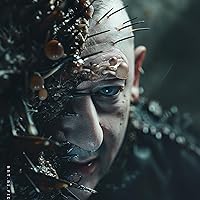
A soul's journey through the night, a missing time and narrative bend and interlock across a play of poetic forms and voices to make one story of love and loss. In And She Was Corbett combines the fictional spell-making of Haruki Murakami, with the filmic neo-noir of Atom Egoyan ( Exotica ) and David Lynch ( Lost Highway , Mulholland Drive ), to push the boundaries of poetic genre, asking us to renegotiate the way we encounter and reconfigure ourselves through trauma, in desire, or as we seek to reassemble ourselves and our past.
November, 3am, and two young lovers are about to meet on the Heathrow Express. A side street in an unknown Felix Morning wakes with no memory. In his pocket is a membership card for a nightclub, The Bunker. With the help of the beautiful Flick, he must recover what he has lost.
Deep into a dangerous love affair, Esther and Iain believe the other can replace what they each have lost - a heart, a gift - but is Esther's price too high for Iain to pay, and can their love survive?
Who is Esther, where has she come from, and what has she got to do with the woman in the labyrinth? Does Flick belong to the past or to the future? What is memory, and what remains of us without it?
And She Was demands our attention, its startling and dazzling writing asking us to be carried away as we read, but returning us by its end to a place both resolved and transformed.
“I owe a debt. / I am still not initiate. Can I / Kill what love has touched?” Sarah Corbett’s And She Was, an original and inspired verse- novel, is concerned with love and desire, how they intersect with trauma and loss, and what it takes to come to peace with one’s lot. Much of the work is concerned directly with Esther and Iain, drawn into a passionate relationship unsuspectingly — sex and longing, attachment and confusion, dependence, pulling away. “A hand pulls him / out of his throat, hangs him on the light above.” Love is as restorative as it is terrifying and uninhibited: “And they were awake in the midnight of here / drunk as seals in the wave of their first year.” But much of the narrative follows Felix, an amnesiac Runner at the nightclub The Bunker, and Flick, a woman who recognises him, with whom he shares an uncertain connection; together, they stand to recover that which they lost, a theme that is echoed and built upon in the second, closing sequence of poems about Esther and Iain. Although the Felix + Flick sequence is strange and oblique, its ramifications for Esther + Iain become increasingly palpable, a parable in resonances, of “what kicks in when memory’s blind”. The way Corbett composes her work, both on an overall structural level, and when it comes to the individual words, the precision of expression, is consistently outstanding to me: “He is like // Looking at a lamp / Through skin // He is all the wants / Come home.”
I picked up this book out of curiosity of how a novel works in poetry form and it was an interesting read. Not my favourite book by this author but still enjoyable.