

What do you think?

The Fuse #1
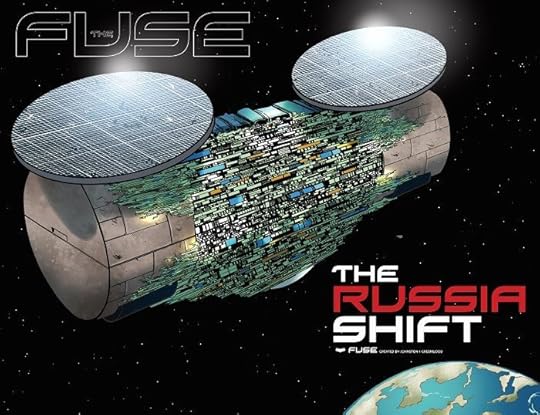
The Russia Shift
22,000 MILES UP, THERE IS NO BACKUP. Working homicide on an orbiting energy platform, in a five mile long jury-rigged steel city stuffed with a half million people, and no help from your so-called colleagues back on earth, is more than tough...it's murder. Cynical, foul-mouthed veteran ANTONY JOHNSTON (UMBRAL, Wasteland) gets partnered with fresh-faced idealist JUSTIN GREENWOOD (Wasteland, Resurrection) for a new crime series with serious attitude! Collects THE FUSE #1-6.
160 pages, ebook
First published August 27, 2014
About the author
Antony Johnston
351 books428 followers** Sign up for Antony's newsletter at http://ajwriter.substack.com **
Antony Johnston is a multi-award-winning author, a New York Times bestseller, and one of the most versatile writers of the modern era.
The Charlize Theron movie Atomic Blonde was based on his graphic novel. His murder mystery series The Dog Sitter Detective won the Barker Book Award. His crime puzzle novel Can You Solve the Murder? reinvented choose-your-own-story books for a mainstream audience and was a Waterstones Paperback of the Year. And his productivity guide The Organised Writer has helped authors all over the world take control of their workload.
Antony is a celebrated videogames writer, with genre-defining titles including Dead Space, Shadow of Mordor, and Resident Evil Village to his credit. His work on Silent Hill Ascension made him the only writer in the world to have contributed to all of gaming’s ‘big three’ horror franchises.
His immense body of work also includes Marvel superheroes such as Daredevil and Shang-Chi, the award-winning Alex Rider graphic novels, the post-apocalypse epic Wasteland, and more. He wrote and directed the film Crossover Point, made entirely in quarantine during the coronavirus pandemic.
An experienced podcaster and public speaker, he also frequently writes articles on the life of an author, and is a prolific musician.
Antony is a former vice chair of the Crime Writers’ Association, a member of International Thriller Writers and the Society of Authors, a Shore Scripts screenwriting judge, and sits on the Writers’ Guild of Great Britain’s videogames committee. He lives and works in England.
Antony Johnston is a multi-award-winning author, a New York Times bestseller, and one of the most versatile writers of the modern era.
The Charlize Theron movie Atomic Blonde was based on his graphic novel. His murder mystery series The Dog Sitter Detective won the Barker Book Award. His crime puzzle novel Can You Solve the Murder? reinvented choose-your-own-story books for a mainstream audience and was a Waterstones Paperback of the Year. And his productivity guide The Organised Writer has helped authors all over the world take control of their workload.
Antony is a celebrated videogames writer, with genre-defining titles including Dead Space, Shadow of Mordor, and Resident Evil Village to his credit. His work on Silent Hill Ascension made him the only writer in the world to have contributed to all of gaming’s ‘big three’ horror franchises.
His immense body of work also includes Marvel superheroes such as Daredevil and Shang-Chi, the award-winning Alex Rider graphic novels, the post-apocalypse epic Wasteland, and more. He wrote and directed the film Crossover Point, made entirely in quarantine during the coronavirus pandemic.
An experienced podcaster and public speaker, he also frequently writes articles on the life of an author, and is a prolific musician.
Antony is a former vice chair of the Crime Writers’ Association, a member of International Thriller Writers and the Society of Authors, a Shore Scripts screenwriting judge, and sits on the Writers’ Guild of Great Britain’s videogames committee. He lives and works in England.
Ratings & Reviews
Friends & Following
Create a free account to discover what your friends think of this book!
Community Reviews
Displaying 1 - 30 of 97 reviews

July 19, 2015
Middle of the road police drama...set in space.
The story itself wasn't all that special, but it was functional.
The art, however, was absolutely hideous. I've been trying to get over my hatred of ugly art this year. In fact, I've made it a personal goal to try and overlook styles that don't fit into the mold I have in my mind. Branch out, if you will.
But this?
I'm sorry, but it was everything I personally loathe. Distorted faces with gross features, and characters that are indistinguishable from one another.
Don't believe me? Check this panel out...
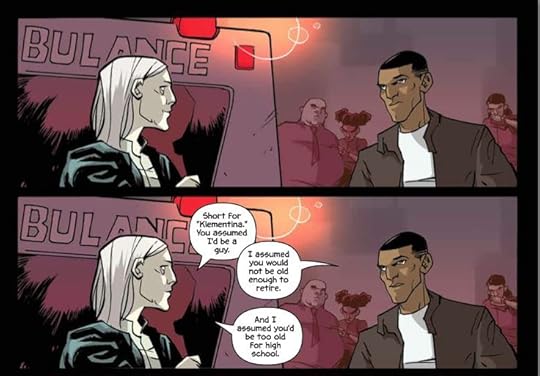
In case you can't read the text, she makes a crack about his name being feminine & assuming he was going to be a woman, and he says "I assumed you would not be old enough to retire.". To which she replies, "And I'd assumed you'd be too old for high school.".
Ok. Can you tell any difference in their ages by looking at them?
I'm going to go ahead and answer for you. No.
No, you cannot tell that she is an older woman, any more than you can tell that he is supposed to be a fresh-faced young man.
The both look like recovering stroke victims!

Alrighty, enough bitching.
The gist is that this young cop volunteers (for reasons yet unknown) to come work homicide on this shithole of a space station. He's partnered up with the crusty old chick who knows how to do her job, and doesn't want to take on the young pup. They do the cutsie cop thing where they bump heads, and grumble about being assigned to each other. As police officers do...
For example, his last name is Dietrich so she calls him Marlene.
If you get that joke you're probably at least as old as I am, or you're one of those youngweirdo drama geeks.
Put your cardboard pitchfork down, nerd. My son is taking a theater class next year in high school, so I just need to get a few shots in. You know, before I have to start supporting his acting career.
You don't think joining drama is going to gay him up, do you?*
Shit! You liberals are awful touchy today!
Where was I? Oh, right.
So they do the meet-cute, work their case, and eventually come to respect each other.
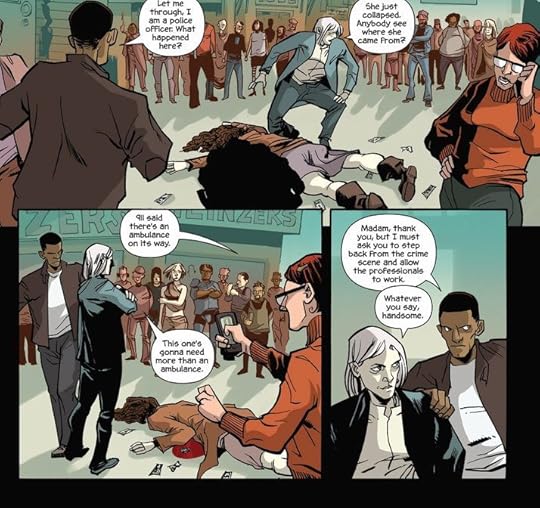
The case starts out with the rather unsurprising discovery of a dead homeless person (or the space station equivalent of a homeless person), but they quickly begin to uncover secrets that lead them to believe the death is connected to a high-level politician.
Who has apparently had a stroke, as well.
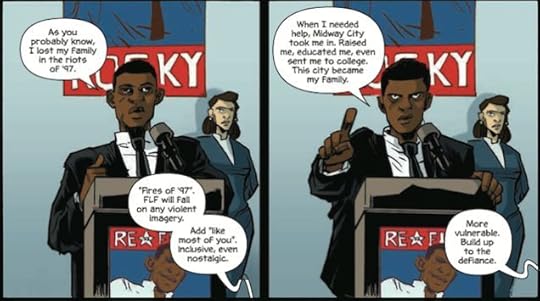
The mystery isn't all that bad or all that good. It just is. I don't have any real complaints about anything (other than the art), so if you're a fan of police procedurals, you might really like this one.
This was gifted to me by my Shallow Reading buddy, Mike. Thank you!
*That was written in sarcasm font, in case you'rean IDIOT upset.
No need send the PC Squad after me.
The story itself wasn't all that special, but it was functional.
The art, however, was absolutely hideous. I've been trying to get over my hatred of ugly art this year. In fact, I've made it a personal goal to try and overlook styles that don't fit into the mold I have in my mind. Branch out, if you will.
But this?
I'm sorry, but it was everything I personally loathe. Distorted faces with gross features, and characters that are indistinguishable from one another.
Don't believe me? Check this panel out...
In case you can't read the text, she makes a crack about his name being feminine & assuming he was going to be a woman, and he says "I assumed you would not be old enough to retire.". To which she replies, "And I'd assumed you'd be too old for high school.".
Ok. Can you tell any difference in their ages by looking at them?
I'm going to go ahead and answer for you. No.
No, you cannot tell that she is an older woman, any more than you can tell that he is supposed to be a fresh-faced young man.
The both look like recovering stroke victims!
Alrighty, enough bitching.
The gist is that this young cop volunteers (for reasons yet unknown) to come work homicide on this shithole of a space station. He's partnered up with the crusty old chick who knows how to do her job, and doesn't want to take on the young pup. They do the cutsie cop thing where they bump heads, and grumble about being assigned to each other. As police officers do...
For example, his last name is Dietrich so she calls him Marlene.
If you get that joke you're probably at least as old as I am, or you're one of those young
Put your cardboard pitchfork down, nerd. My son is taking a theater class next year in high school, so I just need to get a few shots in. You know, before I have to start supporting his acting career.
You don't think joining drama is going to gay him up, do you?*
Shit! You liberals are awful touchy today!
Where was I? Oh, right.
So they do the meet-cute, work their case, and eventually come to respect each other.
The case starts out with the rather unsurprising discovery of a dead homeless person (or the space station equivalent of a homeless person), but they quickly begin to uncover secrets that lead them to believe the death is connected to a high-level politician.
The mystery isn't all that bad or all that good. It just is. I don't have any real complaints about anything (other than the art), so if you're a fan of police procedurals, you might really like this one.
This was gifted to me by my Shallow Reading buddy, Mike. Thank you!
*That was written in sarcasm font, in case you're
No need send the PC Squad after me.

January 28, 2015
Sci-fi police procedural set aboard a massive space station: sounds like fun to me, especially when one of the two cop protagonists is a cynical, foul-mouthed, frequently offensive old lady. Like many other Image titles I have come across in recent months, however, The Fuse fails to deliver. First of all, the artwork is barely functional. In some cases one and the same character miraculously changes appearance from one panel to the next, in others two different characters would be indistinguishable if it wasn't for their clothes. Secondly, the case our heroes investigate is generic at best – apart from sub-par storytelling, there is virtually nothing to distinguish it from your typical procedural drama. Which brings me to my third point - isn't this supposed to be a futuristic space station? How come people still use cash, corded telephones, books, and folders? I mean, the story might as well be set in 1970s Hoboken, not that there would be anything wrong with that...

November 6, 2014
I can't resist a good police story, which is what this is, but set in an orbital space station. We have the new partner that just came to space, the old partners who thinks the other is too green, which is nothing new, but I liked the dynamic between the two. The case had a bunch of twists going around, it definitely keep me interested. There's nothing particularly newfangled about this comic (the space setting could be used more, I hope they will do that in future issues) but I really liked it.
Re-read: 5/10/2015
Re-read: 17/03/2020
Re-read: 5/10/2015
Re-read: 17/03/2020

May 7, 2016
A solid police procedural graphic novel series, set in space, with a touch of larger conspiracy to make my heart sing. Ralph Dietrich, a 28 year old black homicide detective from Germany, transfers to the orbiting space station known as The Fuse. His partner, a cranky older Russian white woman named Klem Ristovych, isn't about to give this new kid any unearned credit. Especially when he starts by assuming she's a civilian. Awkward!
I've always liked Greenwood's art. His people are angular, dynamic, and interesting, especially when they're grumpy. The cast here is diverse, better reflecting what our future in space will actually look like than much sci-fi does. If you enjoy following detectives around as they patch together clues and solve a case, this series may be worth checking out.
HOWEVER, a bit of a warning, I didn't much care for the opening of the first volume, because I was not in the mood for a black man to die first and his overall portrayal did not do a lot for me. So you may need to wait out that bit.
ALSO NOTE, there is a major queer character here but it's a spoiler.
I've always liked Greenwood's art. His people are angular, dynamic, and interesting, especially when they're grumpy. The cast here is diverse, better reflecting what our future in space will actually look like than much sci-fi does. If you enjoy following detectives around as they patch together clues and solve a case, this series may be worth checking out.
HOWEVER, a bit of a warning, I didn't much care for the opening of the first volume, because I was not in the mood for a black man to die first and his overall portrayal did not do a lot for me. So you may need to wait out that bit.
ALSO NOTE, there is a major queer character here but it's a spoiler.

January 6, 2017
The first volume in The Fuse series is a great introduction to the science fiction story. This is an off Earth tale told in a space station/living environment called The Fuse. We get a solid understanding of the socio-economic environment as Deectives Ristoyivich and Dietrich investigate two murders of lower class, homeless citizens know as "cablers."
This is a great read and Ib look forward to subsequent volumes in the series.
This is a great read and Ib look forward to subsequent volumes in the series.

January 12, 2016
A police procedural set on a space station. The art can be iffy, but the space noir is solid stuff.

May 25, 2015

0-2 today...think I'll stop reading.
This had potential, a gigantic space station, inhabited by tons of people, and the Homicide Detectives (one's a foul mouthed old Russian lady, the other is a brand new arrival, young Black German.) This part would be cool, but then the writer decides to just throw every cliché into this BORING Police Procedural...I've seen more exciting episodes of As the Paint Dries.
In the future, there are still homeless people, everyone still uses cash, guns, dress the same, and have telephones that are identical to today. This is supposed to be years in the future...but nothing has progressed.
The mayor is an Obama figure, and when one of the homeless murder victims turns out to be his long-thought-dead brother, things unravel from there, and everyone just is predictable and does exactly what we think until the reveal at the end which isn't much of a surprise at all.
And of course the fish out of water cop turns out to be all jacked up to help his grizzled veteran partner even though they did nothing bond-worthy the whole time except fight off some hobos, who were actually old friends of the grizzled cop.
Politicians are bad, hiding secrets, the media is scum, and cops will do whatever it takes to solve the case.
This might as well have been a really shitty 70s cop movie, they totally ignored all the potential for what the Space Station (The Fuse) could be...just such wasted potential.
Part of the Image Humble Bundle pack from Christmas? Ya. It's just such a shame that this could have been something...oh and to boot? The art is sub-generic at best. NO imagination, nothing cool, the colours aren't very popping, there's no hues of focus, there's nothing dynamic or memorable.
In short? This is about the most boring Space Cops Comic Book you could ever read. So don't.


October 28, 2014
The standard police procedural can be transplanted to so many mediums and genres. The Fuse is an example of transplanting the police procedural into the near future, and writer Johnston makes a good go of it. Overall this is close to four stars, but a last page cliffhanger, despite the crime being solved, detracts a little from the story. The characterization is adequate, and if there are more volumes I expect the characters will develop more overtime.
Dietrich has done the unusual. He has left Munich to join the homicide division on The Fuse an energy platform 22,000 miles above the Earth. Dietrich is our outsiders point of view as customs and events have enabled The Fuse to form its own society that is different from Earth (see cablers).
Klem is Russian, and on purpose I'm leaving out some parts of her background. Not only is Klem from Russia, this is one of the few science fiction comics with a strong female lead. Oh, Klem isn't particularly good at making friends, as she has moments where she will bull her way through the politics to solve the crime.
Here the crime is the murder of two cabelrs. In the course of solving the crime we meet the department's CSI crew, and get a taste of makes their personalities unique, and the mayor and government of the station.
Definitely for those who are fans of CBS Television's procedurals (NCIS, Elementary) Stuart Kaminsky's Rostinkov novels and possibly Ed McBain's 87th precinct books.
Dietrich has done the unusual. He has left Munich to join the homicide division on The Fuse an energy platform 22,000 miles above the Earth. Dietrich is our outsiders point of view as customs and events have enabled The Fuse to form its own society that is different from Earth (see cablers).
Klem is Russian, and on purpose I'm leaving out some parts of her background. Not only is Klem from Russia, this is one of the few science fiction comics with a strong female lead. Oh, Klem isn't particularly good at making friends, as she has moments where she will bull her way through the politics to solve the crime.
Here the crime is the murder of two cabelrs. In the course of solving the crime we meet the department's CSI crew, and get a taste of makes their personalities unique, and the mayor and government of the station.
Definitely for those who are fans of CBS Television's procedurals (NCIS, Elementary) Stuart Kaminsky's Rostinkov novels and possibly Ed McBain's 87th precinct books.

April 11, 2018
Leído a principios de año, una gran decepción. Esperaba muchísimo más. Sólo el nombre y la portada eran lo que atraía...

October 10, 2014
Not bad for a first outing, though there's a lot more that could be done with the futuristic setting (a giant orbital space station) and characters. We follow a brand new police detective, Dietrich, as he arrives from Earth and is immediately thrust into a mystery involving a pair of dead "cablers" (the space station's version of the homeless, people who live in the crawl spaces and vents, where the "cables" are). Dietrich and his partner Klem Ristovych, one of the original settlers on the station, follow the mystery right to the front door of the mayor and his wife. This is a pretty run-of-the-mill mystery, but it introduces us to the characters and the places. The artwork by Justin Greenwood is reminiscent of his work on Wasteland, where it wasn't always possible to tell characters apart from each other or even to know what exactly was happening in each panel. It helps that this art is colored rather than in black and white, but it still suffers from some slapdash efforts. Being touted as Homicide crossed with Battlestar Galactica, or CSI in space, this series has a lot to live up to and hopefully future volumes will build on this very workmanlike start.

June 6, 2017
The Fuse: The Russia Shift is Volume One in the collection of this comics science fiction police procedural series, set on a space station orbiting earth. The Russia Shift introduces us to our two cops; Ralph Dietrich, just arrived from Earth, and his more experienced partner Klem Ristovych. This book was released in 2014 by Image Comics.
The Fuse: The Russia Shift is written by Antony Johnston and drawn by Justin Greenwood, with color done by Shari Chankhamma and lettering by Ed Brisson. Word and image meld to create a believable city on a space-station, a city with a homeless population it doesn’t acknowledge, festering wounds from decades of racial tension that have been papered over rather than addressed, and an under-staffed police force. Read more: http://www.fantasyliterature.com/revi...
The Fuse: The Russia Shift is written by Antony Johnston and drawn by Justin Greenwood, with color done by Shari Chankhamma and lettering by Ed Brisson. Word and image meld to create a believable city on a space-station, a city with a homeless population it doesn’t acknowledge, festering wounds from decades of racial tension that have been papered over rather than addressed, and an under-staffed police force. Read more: http://www.fantasyliterature.com/revi...

Did Not Finish
April 8, 2015DNF not even half way through..
I've been trying to pick this up month after month with no luck, nothing was motivating me, not the story nor the characters. I don't want to waste anymore time on something I'm not enjoying. I'll probably end up giving this to my brother or a local second hand book shop. That'll teach me to blindly buy a comic book without reading any ratings or reviews beforehand.
I've been trying to pick this up month after month with no luck, nothing was motivating me, not the story nor the characters. I don't want to waste anymore time on something I'm not enjoying. I'll probably end up giving this to my brother or a local second hand book shop. That'll teach me to blindly buy a comic book without reading any ratings or reviews beforehand.

June 19, 2016
A perfectly OK cops-in-space book. The mystery is quite well done: carefully built up, then well explained in the end. The science-fiction aspect is a nice overlay, but it's not used to particularly strong effect, though there is some good imagination in thinking about the underclass of a space station. Overall, this was an interesting book, but not a phenomenal one.
January 24, 2015
I hate to give one star reviews but these kinds of stories just annoy me to no end. The basics: this is a police procedural set on a space station, the titular Fuse, about a century in the future.
Sadly, this is terrible Science Fiction and a terrible Mystery story. Hashtag rant mode commence.
It starts off as a new detective ships up from Munich and is immediately embroiled in a murder case. Seriously, as soon as he steps off the shuttle a person drops dead right in front of him. Boom! We're off to the races.
Ugh. I hate stupid-ass coincidences like that.
This is compounded by two things: the dying person is not just hemorrhaging the red go-juice of life, but also cash. WHY IS THERE PAPER MONEY ON A SPACE STATION?! Back in the 1950s, even up to the early 1970s, I can see someone making this mistake, because everything was paper back then. It was even how we programmed computers. But this book was written sometime in 2013. Come on.
I just watched Aliens again last night, and it's embarrassing that a movie from 1986 is more futuristic than a book published in 2014.
This is underscored by the fact that our new guy, Ralph Dietrich, calls his superiors from a pay phone. Seriously, did Johnston write this in 1989 and then simply cross out "New York City" and write in "New Space City" when it came time to make it?
Everywhere they go the place looks like any standard Earth city. Small houses, green lawns, white picket fences, run-down tenements with graffiti... oh fer cry. The doors in the police precinct look like wood. I'll cut them some slack and pretend they're painted to look like wood, but who are we kidding? They're fucking wood.
There are books on the shelves. Calendars on the walls, sticky notes and folders. Why? Paper is HEAVY. If transport to high Earth orbit is so cheap that they can waste fuel and space on something so heavy, why is that not reflected in the general economy everywhere else?
See, someone who had actually thought about the world they were creating -- or perhaps had read any science fiction at all -- would have thought of that.
You know how you show that someone is super rich on a space station? Put real books on their shelves. Make it an actual private library. Seriously, that's how unbelievably expensive and wasteful it would be to take a bunch of books into orbit. Paper is also a fire hazard, and fire can turn into a literal Extinction Level Event aboard a space station, unless it's so gigantic that humans barely take up a tenth of it. We see the Fuse from the outside. It ain't that big.
Plus, if you simply spin out current trends towards digital everything, why would someone 100 years from now even use paper? Not just on a space station, but anywhere? The past few years Hollywood has been collectively pissing its pants because people under 30 simply aren't buying hard copies of movies any more. The music industry is in freefall because kids aren't even buying digital versions of songs any more, they're streaming everything.
Science fiction is about extrapolation -- extrapolate three generations of people whose mindset is that they can stream anything any time. Those people 100 years from now would look at paper books and video discs the same way we look at papyrus scrolls and anvils: not-very-interesting relics of a bygone era.
I could go on but let's rant about the police procedural portion of this book. It's no better.
This reads like one of the less-interesting episodes of Law & Order, the kind of episode that they throw together based on some newspaper headline and because it's season 19 and they're pretty much out of ideas due to having cranked out more than 400 of these already, so they just plug standard characters into the formula and give them boilerplate dialogue.
The problem with doing a procedural, any kind of procedural, is that this is the single most popular form of story type in our culture, and has been for decades. Fully 50% of all TV shows are procedurals. The other 50% are everything else: sitcoms, reality shows, dramas, news magazines and competitions like The Voice and American Idol.
Since procedurals are so common, why stick to the formula? At the very least, show us something new based on your milieu. It's a space station, so do something with that. That's how you push it into new territory.
But if you're going to do that, then at the very least read the other SF procedurals that are out there. Niven, Varley, Walter Jon Williams -- they all have excellent versions. Ed Naha wrote two terrific books called The Paradise Plot and The Suicide Plague, and The Paradise Plot takes place on a space station. In fact, it's one incredibly similar to the Fuse.
Now that I think on it, The Fuse is actually a lame version of The Paradise Plot. You should read that book instead, it's good.
As I also ponder it, the opening of The Fuse tries to mash up the flying-to-orbit scene from 2001: A Space Odyssey and the pre-credits sequence in Die Hard. The difference here is that in 2001 we got to see that Dr. Floyd is a VIP because he's on an otherwise empty shuttle. A lot of people miss that aspect of the film. In Die Hard, McClane has an interaction with his seatmate who tells him the best way to calm down after a flight is to take off your shoes and make fists with your toes. Then it's revealed that McClane has a gun, which shocks the other guy. McClane tells him to relax because he's a cop. In The Fuse there's a similar exchange where a woman confesses that she's running away from something and then Dietrich reveals that he's a cop, much to her dismay.
The problem is The Fuse never does anything with the information we're given in the shuttle ride. When McClane tries the "make fists with your toes" thing, he discovers that it works and it's a funny moment. But then the bad guys show up and he's caught barefoot in the middle of a hostage situation. He's caught literally flat-footed. Get it? A slang word for a cop is "flatfoot." This is why Die Hard is so good: it's working on all these other levels besides the main story. And if you've seen the movie, you know that being barefoot in this situation plays into 1) the character arc, 2) the plot and 3) the action scenes. A seemingly throw-away line perpetuates itself throughout the movie.
The Fuse has none of that, yet borrows from its betters.
Dietrich even has a real gun, just like John McClane. On a space station. "Oh, don't worry," he assures his boss, "I know better than to discharge a gun in a pressurized cylinder." Then why do you have it? Why was he allowed to keep it? You better be a pretty damn good shot if you're going to start blasting away, potentially poking holes in the hull and killing everyone.
Here's an idea: try a goddamn taser instead.
See? This is what I mean by not taking the unique setting into account. There are limitations and issues that one can't get around inside a space station, yet not a single one of those are addressed. they might as well be in Detroit or Hamburg.
The last issue/chapter was such a cliche, with the cop and bad guy holed up together and they put all the pieces together for the reader. It's the worst kind of infodump in a procedural, just absolutely lazy. Let us figure it out, at least.
Remember that coincidence in the opening I talked about? Yeah, there are a few more throughout the story. They're dumb, though, and not worth lengthening this already ridiculously long review for.
The art is okay. The problem is that characters look too much alike.
Dietrich is a black cop and the mayor is likewise black. They look almost exactly the same. And I don't mean that in a racist way, I mean they're drawn to be nearly identical. The only way to tell them apart is that one wears a tie (on a space station) and the other wears a jacket. They are the same height, shape, haircut, everything.
Maybe this will come into play in later installments, but I don't care. I won't be reading them. All it does here is cause confusion.
The primary way the characters are differentiated is by color. These people literally never change clothes. The only way you tell them apart is by the color of their shirts. That's another indicator we're playing for the cheap seats here, when everything is like a cartoon.
I just read the superb Manifest Destiny, Vol. 1: Flora & Fauna, where the characters have to wear similar clothing because some of them are soldiers and the rest are given only a limited palette and materials to work with, yet you can immediately tell who's who at a glance.
I started The Fuse before I started Manifest Destiny... or Saga Volume 4, or The Flash or Ms. Marvel or Captain Marvel and I kept putting it off because it was just so clunky and annoying. The book seemed like it was getting heavier each time I went to read it, and I couldn't get through an entire chapter/issue, which is only 22 pages or something. Of a comic book. I finished all of those other books before finishing this one.
The Fuse is a Science Fiction Police Procedural and it's bad at both.
Sadly, this is terrible Science Fiction and a terrible Mystery story. Hashtag rant mode commence.
It starts off as a new detective ships up from Munich and is immediately embroiled in a murder case. Seriously, as soon as he steps off the shuttle a person drops dead right in front of him. Boom! We're off to the races.
Ugh. I hate stupid-ass coincidences like that.
This is compounded by two things: the dying person is not just hemorrhaging the red go-juice of life, but also cash. WHY IS THERE PAPER MONEY ON A SPACE STATION?! Back in the 1950s, even up to the early 1970s, I can see someone making this mistake, because everything was paper back then. It was even how we programmed computers. But this book was written sometime in 2013. Come on.
I just watched Aliens again last night, and it's embarrassing that a movie from 1986 is more futuristic than a book published in 2014.
This is underscored by the fact that our new guy, Ralph Dietrich, calls his superiors from a pay phone. Seriously, did Johnston write this in 1989 and then simply cross out "New York City" and write in "New Space City" when it came time to make it?
Everywhere they go the place looks like any standard Earth city. Small houses, green lawns, white picket fences, run-down tenements with graffiti... oh fer cry. The doors in the police precinct look like wood. I'll cut them some slack and pretend they're painted to look like wood, but who are we kidding? They're fucking wood.
There are books on the shelves. Calendars on the walls, sticky notes and folders. Why? Paper is HEAVY. If transport to high Earth orbit is so cheap that they can waste fuel and space on something so heavy, why is that not reflected in the general economy everywhere else?
See, someone who had actually thought about the world they were creating -- or perhaps had read any science fiction at all -- would have thought of that.
You know how you show that someone is super rich on a space station? Put real books on their shelves. Make it an actual private library. Seriously, that's how unbelievably expensive and wasteful it would be to take a bunch of books into orbit. Paper is also a fire hazard, and fire can turn into a literal Extinction Level Event aboard a space station, unless it's so gigantic that humans barely take up a tenth of it. We see the Fuse from the outside. It ain't that big.
Plus, if you simply spin out current trends towards digital everything, why would someone 100 years from now even use paper? Not just on a space station, but anywhere? The past few years Hollywood has been collectively pissing its pants because people under 30 simply aren't buying hard copies of movies any more. The music industry is in freefall because kids aren't even buying digital versions of songs any more, they're streaming everything.
Science fiction is about extrapolation -- extrapolate three generations of people whose mindset is that they can stream anything any time. Those people 100 years from now would look at paper books and video discs the same way we look at papyrus scrolls and anvils: not-very-interesting relics of a bygone era.
I could go on but let's rant about the police procedural portion of this book. It's no better.
This reads like one of the less-interesting episodes of Law & Order, the kind of episode that they throw together based on some newspaper headline and because it's season 19 and they're pretty much out of ideas due to having cranked out more than 400 of these already, so they just plug standard characters into the formula and give them boilerplate dialogue.
The problem with doing a procedural, any kind of procedural, is that this is the single most popular form of story type in our culture, and has been for decades. Fully 50% of all TV shows are procedurals. The other 50% are everything else: sitcoms, reality shows, dramas, news magazines and competitions like The Voice and American Idol.
Since procedurals are so common, why stick to the formula? At the very least, show us something new based on your milieu. It's a space station, so do something with that. That's how you push it into new territory.
But if you're going to do that, then at the very least read the other SF procedurals that are out there. Niven, Varley, Walter Jon Williams -- they all have excellent versions. Ed Naha wrote two terrific books called The Paradise Plot and The Suicide Plague, and The Paradise Plot takes place on a space station. In fact, it's one incredibly similar to the Fuse.
Now that I think on it, The Fuse is actually a lame version of The Paradise Plot. You should read that book instead, it's good.
As I also ponder it, the opening of The Fuse tries to mash up the flying-to-orbit scene from 2001: A Space Odyssey and the pre-credits sequence in Die Hard. The difference here is that in 2001 we got to see that Dr. Floyd is a VIP because he's on an otherwise empty shuttle. A lot of people miss that aspect of the film. In Die Hard, McClane has an interaction with his seatmate who tells him the best way to calm down after a flight is to take off your shoes and make fists with your toes. Then it's revealed that McClane has a gun, which shocks the other guy. McClane tells him to relax because he's a cop. In The Fuse there's a similar exchange where a woman confesses that she's running away from something and then Dietrich reveals that he's a cop, much to her dismay.
The problem is The Fuse never does anything with the information we're given in the shuttle ride. When McClane tries the "make fists with your toes" thing, he discovers that it works and it's a funny moment. But then the bad guys show up and he's caught barefoot in the middle of a hostage situation. He's caught literally flat-footed. Get it? A slang word for a cop is "flatfoot." This is why Die Hard is so good: it's working on all these other levels besides the main story. And if you've seen the movie, you know that being barefoot in this situation plays into 1) the character arc, 2) the plot and 3) the action scenes. A seemingly throw-away line perpetuates itself throughout the movie.
The Fuse has none of that, yet borrows from its betters.
Dietrich even has a real gun, just like John McClane. On a space station. "Oh, don't worry," he assures his boss, "I know better than to discharge a gun in a pressurized cylinder." Then why do you have it? Why was he allowed to keep it? You better be a pretty damn good shot if you're going to start blasting away, potentially poking holes in the hull and killing everyone.
Here's an idea: try a goddamn taser instead.
See? This is what I mean by not taking the unique setting into account. There are limitations and issues that one can't get around inside a space station, yet not a single one of those are addressed. they might as well be in Detroit or Hamburg.
The last issue/chapter was such a cliche, with the cop and bad guy holed up together and they put all the pieces together for the reader. It's the worst kind of infodump in a procedural, just absolutely lazy. Let us figure it out, at least.
Remember that coincidence in the opening I talked about? Yeah, there are a few more throughout the story. They're dumb, though, and not worth lengthening this already ridiculously long review for.
The art is okay. The problem is that characters look too much alike.
Dietrich is a black cop and the mayor is likewise black. They look almost exactly the same. And I don't mean that in a racist way, I mean they're drawn to be nearly identical. The only way to tell them apart is that one wears a tie (on a space station) and the other wears a jacket. They are the same height, shape, haircut, everything.
Maybe this will come into play in later installments, but I don't care. I won't be reading them. All it does here is cause confusion.
The primary way the characters are differentiated is by color. These people literally never change clothes. The only way you tell them apart is by the color of their shirts. That's another indicator we're playing for the cheap seats here, when everything is like a cartoon.
I just read the superb Manifest Destiny, Vol. 1: Flora & Fauna, where the characters have to wear similar clothing because some of them are soldiers and the rest are given only a limited palette and materials to work with, yet you can immediately tell who's who at a glance.
I started The Fuse before I started Manifest Destiny... or Saga Volume 4, or The Flash or Ms. Marvel or Captain Marvel and I kept putting it off because it was just so clunky and annoying. The book seemed like it was getting heavier each time I went to read it, and I couldn't get through an entire chapter/issue, which is only 22 pages or something. Of a comic book. I finished all of those other books before finishing this one.
The Fuse is a Science Fiction Police Procedural and it's bad at both.

September 24, 2014
'The Fuse Volume 1: The Russia Shift' is a police procedural set on an orbiting space station. That was pretty much all I needed to know to dive right in.
When a homicide detective from Earth gets assigned the Russia Shift on the space station, then gets assigned a hardened old veteran detective, he might be in for more than he bargained for. He's from Germany, she's been on board the station since it was being built. She's ill-tempered, foul-mouthed and one tough cop. His name's Dietrich, she calls him Marlene. I won't spoil why it's called the Russia Shift.
A murder happens on his first day, that sets things in motion, but the cops are not too concerned with solving it since the victim is one of the station's undesirables. When a second victim shows up dead, and it's tied in to a local politician, then it seems to be something that people want hidden.
It's a pretty good mystery. The space station stuff adds unique elements to the story. I wasn't as crazy about the young cop, but I liked the older foul-mouthed partner. Maybe future issues will have more character development for Dietrich. There's definitely a hint of something that he's hiding. This is a complete story arc, so I'm curious to know what they'll do in future issues. I liked it quite a lot.
I received a review copy of this graphic novel from Diamond Book Distributors, Image Comics and NetGalley in exchange for an honest review. Thank you for allowing me to review this graphic novel.
When a homicide detective from Earth gets assigned the Russia Shift on the space station, then gets assigned a hardened old veteran detective, he might be in for more than he bargained for. He's from Germany, she's been on board the station since it was being built. She's ill-tempered, foul-mouthed and one tough cop. His name's Dietrich, she calls him Marlene. I won't spoil why it's called the Russia Shift.
A murder happens on his first day, that sets things in motion, but the cops are not too concerned with solving it since the victim is one of the station's undesirables. When a second victim shows up dead, and it's tied in to a local politician, then it seems to be something that people want hidden.
It's a pretty good mystery. The space station stuff adds unique elements to the story. I wasn't as crazy about the young cop, but I liked the older foul-mouthed partner. Maybe future issues will have more character development for Dietrich. There's definitely a hint of something that he's hiding. This is a complete story arc, so I'm curious to know what they'll do in future issues. I liked it quite a lot.
I received a review copy of this graphic novel from Diamond Book Distributors, Image Comics and NetGalley in exchange for an honest review. Thank you for allowing me to review this graphic novel.

October 25, 2016
I liked this a bit more than Codename Baboushka, which is the other book by Antony Johnston I've read. The Fuse has sci-fi elements, it takes place on a space station orbiting Earth, and combines those with a police drama, the protagonist, Dietrich, is a homicide detective.
It kicks off with a bang when a woman is found dead outside a dock on the station shortly after his shuttle arrives. The nice thing about this book is that the reader and the protagonist get to experience the space station for the first time together. So the implications of her death and people's reactions to it come about naturally within the story. This lets the creators explore the setting in a way that I found engrossing.
Yet, the story does unfold slowly at times. I felt like the pacing was good, but there were things that could have been tightened up a little bit. The way it is written actually works well for foreshadowing events and developing the characters. And the art sucked me in. It may not be the prettiest, but it has a grittiness that complements the story perfectly. Part of what made the characters work so well for me is the illustrations.
Fans of police procedurals will definitely want to check this out. I say bring on more.
It kicks off with a bang when a woman is found dead outside a dock on the station shortly after his shuttle arrives. The nice thing about this book is that the reader and the protagonist get to experience the space station for the first time together. So the implications of her death and people's reactions to it come about naturally within the story. This lets the creators explore the setting in a way that I found engrossing.
Yet, the story does unfold slowly at times. I felt like the pacing was good, but there were things that could have been tightened up a little bit. The way it is written actually works well for foreshadowing events and developing the characters. And the art sucked me in. It may not be the prettiest, but it has a grittiness that complements the story perfectly. Part of what made the characters work so well for me is the illustrations.
Fans of police procedurals will definitely want to check this out. I say bring on more.

July 30, 2016
This was one of my favorite reads of the past few weeks. When two murders expose a deep conspiracy on an isolated space station/energy platform, new detective Dietrich and his grizzled partner Klem sift through the clues to discover (after numerous false leads) the reasons behind it. This is basically a police procedural, with the environment of the Fuse having a small but crucial part in events. But this book crackles with energy - the dialog is bristling, the characters memorable, and the plot circuitous but logical. The art is simple but perfect for servicing the story without getting in the way. Everything here just works really well to make an entertaining read. There are enough pieces left in play that I hope we get future volumes to explore them, but even if we don't, this volume does a very good job of standing on its own too. It's basically the epitome of a good first volume of a graphic novel, and highly recommended for anyone who likes mysteries, especially in science fiction environments.
February 1, 2016
This is more a police procedural than a science fiction comic. As that it is actually good. Interesting plot, fast pace and wonderful drawings. The SF here is rather light (a still working clam shell mobile phone in a 100 years? Really?), but I still liked the book enough to continue.
I should add that I really like the art. Edgy, and reminds me of Lemire's minimal and scrawny humans.
I should add that I really like the art. Edgy, and reminds me of Lemire's minimal and scrawny humans.

April 8, 2015
Really liked this. Okay I said crime is not exactly my thing. But crime with a sci-fi setting? Working homicide on an orbiting energy platform? I'm up for it! Lol. Yeah, funny how things work out like that. Would definitely line up Vol. 2 of this...
October 5, 2015
This was a really great read !

June 11, 2020
I tried to enjoy the stupidness of this book, but in the end it was just to stupid to enjoy. Didn't finish.
September 8, 2019
The opening issue about murders aboard a space station introduces two police detective protagonists: Klem Ristovych, an elderly-but-tough-as nails female cop who knows the ropes around Midway City and newly arrived Ralph Dietrich, a man with a past (though in this introductory issue we aren't yet certain exactly what events haunt him). They investigate two murders, and Johnston and Greenwood, quickly give us the lay of the land, enough flashes of characterization and a building mystery to whet our appetites for future issue. A strong start to a promising series. I'll be reading more.

February 27, 2018
A police procedural set in space? You can bet that got my attention!
I had some difficulties with this book—sometimes I had trouble keeping track of characters, the pace was problematic and I floundered a bit trying to get my bearings in the world—but I enjoyed it enough that I’ll pick up the next one. I hope that one will give me a better grasp on the world (the various factions in particular) and I look forward to learning more about the two main characters.
I had some difficulties with this book—sometimes I had trouble keeping track of characters, the pace was problematic and I floundered a bit trying to get my bearings in the world—but I enjoyed it enough that I’ll pick up the next one. I hope that one will give me a better grasp on the world (the various factions in particular) and I look forward to learning more about the two main characters.

January 18, 2019
Decididamente un cómic negro/ciencia ficción bastante flojo. El arte es interesante pero los personajes demasiado estereotípicos y la trama no aporta nada nuevo. Divertimento ligero bien hecho.
February 24, 2019
La scurrile detective Klementine "Klem" non è molto amata dai politici che governano la colonia orbitale "Fuse", noi invece non possiamo fare a meno di amarla.

October 6, 2014

More reviews (and no fluff) on the blog http://surrealtalvi.wordpress.com/
The Fuse Volume 1 collects a full story arc in an ongoing story set in a space station orbiting Earth. The book is a snappy, mature, and nuanced murder mystery with enough intriguing clues to keep readers interested but not give too much away.
Story: Young detective Dietrich arrives on The Fuse - an orbital station with a bad reputation. Immediately, he becomes embroiled in Fuse politics when a homeless 'cabler' ends up dead at his feet. Paired with a mature native detective, he's about to learn all he needs to know about The Fuse as they scramble to solve the case. But this one random murder goes much deeper than either could have imagined.
Most of the components of the murder mystery in this story are rote - double crosses and obfuscations popular since noir became big in the 1940s. Where The Fuse really excels isn't the story so much as the backstory, worldbuilding, and especially dialogue. The world set up is intriguing and not your typical sci fi story in space. The dialogue is brisk, nuanced, and very much a part of the setting. We don't have 2014 dialogue in a futuristic story, fortunately.
As the plot began to devolve and motivations uncovered or discovered, I admittedly wasn't all that impressed with a 'seen this before' murder case. But this complete story arc in this first volume is clearly an opening gambit for much more to come. Tantalizing hints at the end of the volume suggest there is much more to our upstanding protagonist Dietrich - and that he has a vested interest in coming to the down and out station. I look forward to seeing where the authors will take this now that the first mystery is solved.
Reviewed from an ARC.

November 2, 2014
Ohhhhh, the problems with this... I'll get the easy one out of the way, and that's the art. Greenwood's clearly paid a lot of attention to Guy Davis, and that's helpful, because he's got that body language down. Unfortunately, everything else is missing. One character changes physiques 3 times in the course of the story. And he's only in 2 issues.
But the real problem is the writing. For one, it's a cop procedural set on a space station...that does absolutely nothing with it being set on a space station. And the two concepts that are space station-centric...are easily translatable to a planet side story. You could set this in Detroit and have pretty much the same comic.
On top of that, the procedural story isn't even that original. I've seen this on at least 3 different Law & Order eps, among others.
And all of this would be fine, I guess, or at least less problematic, if I thought The Fuse was trying to say something. Anything. Instead, I feel like Johnston doesn't have a grasp on either of the genres he's trying to mash up here, and therefore fails miserably at both.
*sigh* And I was really hoping I'd finally find a comic by Antony Johnston that I like...but it wasn't to be. Again.
But the real problem is the writing. For one, it's a cop procedural set on a space station...that does absolutely nothing with it being set on a space station. And the two concepts that are space station-centric...are easily translatable to a planet side story. You could set this in Detroit and have pretty much the same comic.
On top of that, the procedural story isn't even that original. I've seen this on at least 3 different Law & Order eps, among others.
And all of this would be fine, I guess, or at least less problematic, if I thought The Fuse was trying to say something. Anything. Instead, I feel like Johnston doesn't have a grasp on either of the genres he's trying to mash up here, and therefore fails miserably at both.
*sigh* And I was really hoping I'd finally find a comic by Antony Johnston that I like...but it wasn't to be. Again.
October 26, 2014
In a very strong story, two ill-matched cops face the task of solving the murder of two homeless drop-outs, but on a huge orbiting space station. They don't allow each other to get off on the right foot, but when their suspicions point towards the incumbent mayor and his office, they just have to get along and cooperate. The six issues give the space for both sides of the story, and the relationship between the two is nicely handled, if predictable. The ghost-white female one has a fine line of cussing at her boss, too, while the new, black German one is just as competent at his job in a very different way. And the plot is fine at panning that job out over all six issues – I guess a lot of the last one is the big reveal where we find out who and what, how and why, at the expense of some of the action, but on the whole the story is superbly sustained, and the hint at further arcs on this space station are to be much thought-of, for any repeat of the success of this book will be well worth applauding.

February 11, 2015
"Police procedural in space" is the hook, and a lot of the time The Fuse gets by on the obvious fun and love Antony Johnston is having simply doing a buddy cop book. I read very few procedurals, and quite a lot about space, so perhaps I should have been put off by the fact that the "space" element doesn't exactly impose itself on the storyline. But the cop genre tropes were fresh enough for me, and Johnston's glee in them clear enough, that I kept reading anyhow.
The Fuse is - despite a fairly high body count - a benign book by the standards of recent Image launches. Klem and Dietrich - our inevitably mismatched leads - never truly feel in danger, even when they notionally are. Despite Justin Greenwood's pacy, gritty art, it gives The Fuse the feeling of a cosier comic than it's perhaps meant as - an English detective story rather than a gritty cop yarn. But again, that was a positive for me: I enjoyed spending time with these people and watching trust develop between them.
The Fuse is - despite a fairly high body count - a benign book by the standards of recent Image launches. Klem and Dietrich - our inevitably mismatched leads - never truly feel in danger, even when they notionally are. Despite Justin Greenwood's pacy, gritty art, it gives The Fuse the feeling of a cosier comic than it's perhaps meant as - an English detective story rather than a gritty cop yarn. But again, that was a positive for me: I enjoyed spending time with these people and watching trust develop between them.

May 18, 2015
I loved this except for the art... I loved the style but the faces were super awkward. If Klem weren't the only person to wear the black sypuit jacket with ghost white skin, you wouldn't know her from one panel to the next. Same goes for all the characters. It takes some deducing the figure out who's doing what.
But the story's fun, and I like the writing. Clever detective story writing. Also having one of the main characters be new to the station was a great way to get Fuse's history without going into obvious exposition or flashbacks.
But the story's fun, and I like the writing. Clever detective story writing. Also having one of the main characters be new to the station was a great way to get Fuse's history without going into obvious exposition or flashbacks.
Displaying 1 - 30 of 97 reviews