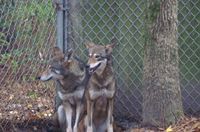
Red wolves are shy, elusive, and misunderstood predators. Until the 1800s, they were common in the longleaf pine savannas and deciduous forests of the southeastern United States. However, habitat degradation, persecution, and interbreeding with the coyote nearly annihilated them. Today, reintroduced red wolves are found only in peninsular northeastern North Carolina within less than 1 percent of their former range. In The Secret World of Red Wolves, nature writer T. DeLene Beeland shadows the U.S. Fish and Wildlife Service’s pioneering recovery program over the course of a year to craft an intimate portrait of the red wolf, its history, and its restoration. Her engaging exploration of this top-level predator traces the intense effort of conservation personnel to save a species that has slipped to the verge of extinction. Beeland weaves together the voices of scientists, conservationists, and local landowners while posing larger questions about human coexistence with red wolves, our understanding of what defines this animal as a distinct species, and how climate change may swamp its current habitat.
I had a conservation biology professor during my masters program teach me that red wolves were hybrids and thus not worthy of conserving, which was something I believed without further research.
One month ago I was hired by Reflection Riding Arboretum and Nature Center, one of the 44 facilities across the country participating in the Red Wolf Species Survival Plan, and my outdated knowledge was very swiftly corrected. The issue of the red wolves is so incredibly complex, and I regret initially writing them off.
Beeland’s narrative is depressing but realistic, and definitely an important read for conservation biologists and nature lovers alike.
So so good! This has been on my TBR for 4 years - since the first day I volunteered at St. Vincent’s Wildlife Refuge in Florida, the only active red wolf island propagation site! It’s been almost 2 years since I worked for the red wolf program and thought it time to finally read this. This is such an incredible, in-depth history and explanation of red wolves - their management, their cultural perceptions, their taxonomy, all of it. It was informative and brought up a few issues I hadn’t even considered, such as climate change and saltwater intrusion. It also gave me a much stronger insight into the history of the program, and an admiration for those early biologist that fought to conserve them! It also made me feel somewhat nostalgic of my time on the program, even though that was only 2 years ago. It’s interesting reading a book that frequently mentions someone you know (shoutout to Ryan)! If you couldn’t tell from this book, I’ll tell you now from my own personal experience: red wolves are resilient. Their strength is inspiring. They deserve our help, and with it, they have the potential to thrive. Excellent read!
Thoroughly and wonderfully researched, this book is a fantastic look of the red wolf and its past, present, and future plight. Frankly, there is not a detail that Beeland does not cover. I do not think any other book exists that covers the topic of red wolves so well, and I think it is particularly special to hear such a detailed report of the day in the life of red wolf management. This book simply helped me so much to better understand the red wolf.
The most up-to-date and essential overview of the Red Wolf I've seen yet, both as a scientific summary and for popular audiences. Though this is a fairly slim book, there is much to learn within.
It's so cool that this was published at the UNC in Chapel Hill. It's always cool to read a book from my state.
The Fisheries and Wildlife Service's Red Wolf Recovery Program is in 5 counties in NC: Dare, Tyrrell, Hyde, Beaufort, and Washington. The largest pieces of public land are the Alligator National Wildlife Refuge, Pocosin Lakes National Wildlife Refuge, and the Mattamuskeet National Wildlife Refuge.
"Pocosin" is an Algonquian word meaning "swamp on a hill."
Today's red wolves in the Albemarle Peninsula came from the captive breeding program. The only population of wild red wolves is in NC.
It's cool she said before this the only live red wolves she had seen were at the Museum of Life and Science and the NC Zoo.
In 2002 the first wolves from the NC Zoo were taken to Alligator River.
I thought the wolf howling sessions for $7 was really cool. I would love to do that.
It was upsetting learning that the hybrid (red wolf and coyote) pups have to be killed because they'll jeopardize the genetics of the red wolves.
It was cute that they could tell the puppy out from the rest of the wolves. The staff woman had to howl 4 times to get them to start, and then she had the kids howl, and the adults, and they howled again. I would love to be a part of that.
It was nice to hear how the team operated with searching for dens, setting and checking traps, and imbedding chips and putting on radio collars. Every time the wolves would be submissive and not show one sign of aggression. Once they were caught they’d roll over, barely look at them, and let them do whatever they wanted. They would be so afraid of humans that they’d pee and crap themselves. The staff would work like 10 straight days, wake up early, and check their traps to make sure the animals hadn't been trapped for too long. They would get so upset if the animals were hurt in the traps, like when 2 of the female's toes froze overnight and she bit them off, and when they had to put the hybrid puppies down.
It's insane that only such a small portion of the population there supports the red wolf program, and that some are neutral or secretly supportive but not vocal about it so they won't have to deal with the ones who are opposed to it.
I didn't want to hear from the opposed party at all. I couldn't stand reading their views on wolves. One man said people are still opposed but they don't talk about it anymore, like they're okay with it. But I liked that she was sure to point out that silence doesn't mean tolerance and wolves are showing up shot, poisoned, or disappear and that could be people's way of showing how they really feel.
Some are opposed because they don't believe red wolves are really wolves and that they're not native. I saw right through that. They don't give a crap about wolf DNA, they're just trying to come up with up with a reason to hide how much they don't like them for ignorant reasons. One man claimed they were never there because there's no folklore on them. A folklorist, hah. What a joke. Who does he think he's fooling? These jerks are grasping at straws.
I loved that she said that records exist from the diaries of early European explorers who saw them and heard them howling. There are court documents from Tyrrell County for wolf-scalp bounties in 1768-1789.
I was upset to learn of fox pens where foxes are held so dogs can train to hunt them. They can be injured or killed. It's legal in NC where trapping has a strong history, and they've started using coyotes. It's a terrible practice like dogfighting and I'm ashamed my state is letting it happen for these loser hunters who use foxes as sport.
It was fascinating learning the process that biologists went through in working with the trappers. They worried that in the quest to trap coyotes, trappers were confusing them with young red wolves. They wanted to look at the animals first and paid trappers for their trouble.
The worst part of dealing with animals is death and it was no exception here. I couldn't stand to read about the trapper who was strangling foxes as they pulled up to his house. She described the blood and saliva and the body jerking and spasming. Like wow. That's a lot. The red wolf staffer was casually asking the trapper about not working in the live market anymore and the man's new fur business of killing animals for their fur. Fur markets pay about $10 more per animal than live markets where they have to keep the animal and feed them until they have enough for the buyer. "It heartens me that he doesn't like selling to the fox-pen operators." I'm sorry, did you just say you were heartened that he prefers killing animals outright for their fur over putting them in a hunting pen??
I had been thinking that this could use some pictures so I was so glad when I came to them. It would have been so lacking if we couldn't see what she was talking about. It was cool that most of them were taken by Ryan.
She said the program might be unique because the collars are used to guard against hybridization. Most of the wolves and a lot of coyotes are collared so they can monitor if wolves are with coyotes and sterilize or kill coyotes to keep the wolves pure.
It's amazing that she got to meet Ronald Nowak, the man responsible for suggesting one of the three origin theories of red wolves. He saw an article about them and researched and sent his findings to the FWS. They had an endangered species section in the laboratory in the now Smithsonian. He was eventually hired by the FWS in the Office of Endangered Species.
It went into DNA and I had a bad flashback to genetics class. It went way deeper than I wanted to go or could understand, but the analysis of red wolf DNA by Wayne and Jenks showed red wolves to have DNA from gray wolves and coyotes. There was no uniqueness to red wolves, though the study was from a small sample. It was a big deal to the conservation world because it brought up their worthiness for conservation. A woman wrote an article saying the FWS may have spent 20 years and hundreds of thousands of dollars to preserve a mutt. The Department of the Interior didn't want the Endangered Species Act to protect hybrids but they went back on it before the findings came out. Wayne and Jenks said their findings didn't go against the continued need to protect them.
Some thought hybridization occurred because of habitat degradation, with gray wolves coming into contact with coyotes. Some researchers thought that if humans had created this wolf then it's less important than if Mother Nature had. But Jenks said if the animal adapted to environmental changes by hybridizing then it is natural.
The big question was whether interbreeding was the red wolf's beginning or end, if that was what created the red wolf or if it caused the red wolf's near extinction.
Just to confuse us, another study was done with so much genetics terms that contradicted the previous ones. It showed little or no gray wolf DNA in eastern or red wolves, meaning they evolved independently of the gray wolf. Eastern and red are more related to each other than gray wolves or than they are to coyotes. Hybridization with coyotes occurs because wolves would be more likely to breed with their common relative rather than with gray wolves who are less related.
You started off agreeing with the first findings only to have another theory make you abandon the previous, over and over with each theory, until you didn't know what to believe. No one agreed with anyone; everyone had a different idea. It is sad that Nowak's idea from decades of research has lost support.
In 1700 John Lawson was hired by the Lords Proprietors to do surveys. The party saw Native Americans near Bulls Island, SC setting the swamp canes on fire, maybe to maintain habitat for preferred species or to flush out prey. At night they heard howls and their Indian pilot said it was common. When he visited the Waxhaw tribe he thought a man had wolves tamed by starving and beatings.
It was mostly the English who settled NC.
It was upsetting learning that settlers hated wolves so much that they formed hunts, men shot them on sight, set pit traps, leg-hold traps, and neck snares. Bounties were set on dead wolves the equivalent of a month's wages. Forty shillings were offered for wolves killed by dogs versus 10 shillings for those killed by traps, favoring the more brutal death.
They also could have been seen as a religious threat, a symbol of evil and trickery. Wolves were seen as making a pact with the devil to their capabilities and being able to kill a person's soul.
Some Native Americans tattooed wolves, along with moose, deer, bears, and birds, on their cheeks and arms.
They were taken out by traps, carcasses laced with poison, and dynamite in dens.
In 1973 the FWS looked for someone to run a field station in Texas to manage the last red wolves. Curtis Carley, a coyote ecologist, was chosen for his skills and knowledge and field biology. In 1973 he determined that preserving the species in the wild wasn't possible but that it might be in captivity. As his team found more hybrids, he had the idea to take them all out of the wild for captive breeding. It meant making them go extinct in the wild. He had strict criteria for the wolves he captured, requiring them to meet every characteristic he defined as belonging to a red wolf. It's debated whether or not he caused red wolves to have a more wolf-like appearance today.
They had to have a certain howl profile, skull length, weight, height, hind foot length, ear length and brain volume to skull ratio. He realized that some hybrids could have the size of their ancestors and that they could make it into the breeding program instead of the true red wolves.
Carley made an announcement through the AZA to examine zoo wolves and determine if they were red wolves. Only one was a red wolf; the rest were hybrids or coyotes. Zoos unknowingly bred their hybrids and sent the pups to other zoos. He knew that keeping hybrids or coyotes would ruin captive breeding. He wrote that if they didn't want to destroy the hybrids or change the signs to hybrid, they could send them to him to euthanize. Carley decided that one institution had to be in charge of red wolves and choose competent organizations to be included.
Everyone worried that they wouldn't be able to survive in the wild so Carley had the idea to make them wild island wolves. He knew to set up test releases and tracking methods. He was taken with the SE coastal islands under state or federal wildlife agencies because they were geographically confined, with low densities of people which minimized conflict with livestock, had healthy ecosystems, enough prey to live off, and they isolated red wolves from coyotes. He sought the right size with dense cover in public lands for wildlife refuges, parks and forests.
It's sad that Carley doesn't get the recognition he deserved for his work and it goes to the FWS. He argued with his supervisors over the need to manage invasive coyotes and his hybridization warnings were ignored.
Warren Parker was the first wolf reintroduction project leader in the nation. The Nature Conservancy offered land in the Albemarle Peninsula at Alligator River as a wildlife refuge for the release of the wolves in 1984.
They released expendable ones on land that people could log and hunt on and kill them if they were a danger.
The recovery team wanted the Dare County Bombing Range land, the training site for the U.S. Navy and Air Force, if the wolves could tolerate the jet and plane engines.
The wolves were flown to Raleigh but a storm would have delayed their arrival and held up the press. It's so cool that the Coast Guard heard of it and sent a helicopter to fly below the storm.
Mated pairs were put in pens to acclimate to the area. Chris Lucash lived on a houseboat to watch them. I felt bad for the female who one day walked up to him and wagged her tail, and he snarled at her and threw the food down so she’d be afraid of him.
When the team released the wolves, it took them days to come out of their pen and leave the area and when they did they stuck to paved and unpaved roads. It was funny that they said it was like they didn't want to go through briars any more than people did. They'd run down the road and when a car came they'd get off on the shoulder and wait for it to pass like pedestrians.
It was tragic about all the wolves that died early on, and the female who went back to her acclimation pen, put her head halfway in her dog house and died. Parker saw that the program needed wilder wolves and not zoo wolves that couldn't survive in the wild. He wanted 2nd and 3rd generations born.
It's cool that they released wolves in the Great Smoky Mountains National Park in NC even though it didn't work.
It was terrible that they went around killing wolves that were thought to be hybrids when a test revealed that they were true red wolves. It was unbelievable that the genes were changing as people did more research.
They realized they could slowly breed the coyote out. In the 1990s Lisette Waits believed them to be 96% red wolf and 4% coyote and it would decrease in time.
Another problem is inbreeding depression where wolves mate with relatives which causes a loss in genetic diversity.
She went to Point Defiance Zoo and the woman said the wolf would recognize Will Waddell, and it became active and aggressive when he smelled Will, who's trapped him.
I didn't like that someone feels that hybridization are the fittest because they can live in areas wolves can't and they're still carrying wolf genes. The Algonquian wolves might not be true wolves anymore, but they're performing the same function. He wants to preserve the new one instead of the genes of the old.
Humans causing wolf deaths it the biggest cause of hybridization, when a wolf's mate is killed they're more likely to mate with a coyote. They need to change the law that hunters can claim they thought wolves were coyotes and get off Scot free! But it was encouraging that Waits thinks they can eliminate hybridization.
I was surprised that she said the FWS will need to hand over the program to the state of NC even tho the WRC hasn't been involved. I was upset to learn that the manager of the wildlife management division in the WRC doesn't want to continue the program, doesn't think red wolves are a real species, and there's no use for red wolves since coyotes exist.
It was so tragic about the male who sought shelter in his dog house during the hurricane, peeked out and he was crushed by a falling tree.
The last chapter had the book ending on such a depressing note. It was all about climate change and sea levels are rising and habitat changing as saltwater replaces freshwater. She knows they're so challenged that they'll never fill their past ranges. They'll never be able to be unmanaged and will need funding.
This entire review has been hidden because of spoilers.
Happily finished in a tent in the Sierras, by headlamp. DeLene is a friend, but I would recommend this book highly to anyone interested in wolves, wildlife conservation techniques, human-wildlife relationships, or the complexity of defining species and what that means. This is not an easy read—expect to learn a lot of serious science—but it is clear, has an impeccable fluidity, and is punctuated by astute and writerly observations of the fieldwork DeLene spent a year shadowing. Good stuff.
A glimpse into the efforts to save the red wolf from extinction. Beeland presents the history of the red wolf in the American Southeast, its destruction, and the heroic efforts undertaken to pull the species back from the brink of extinction in well-written prose. A must-read for anyone interested in wolves, wildlife conservation, or the politics of endangered species.
The Secret World of Red Wolves: The Fight to Save North America's Other Wolf is a thorough, well-researched, and absolutely depressing look into the decline of red wolves.
While scientists can't agree upon the origin of the species, the book describes how European settlers exterminated nearly every wild red wolf from North America. Any surviving red wolves began interbreeding with coyotes. A few decades ago, humans captured all the wild red wolves and hybrids, killed any canid they deemed a hybrid, bred the pure red wolves, and released some back into the wild under intense management, considering this the species' only chance of survival. Currently, the only wild red wolves live in the Albemarle Peninsula of North Carolina. At the time the book was written, 200 red wolves lived in captivity and 100-120 were wild. (Today, according to a google search, there are about 257 in captivity and 18-20 in the wild.) The Secret World of Red Wolves concludes that even if the reintroduction program was more successful, climate change will eventually drive the Albemarle Peninsula's red wolves back into coyote country, where they will continue to hybridize until no red wolves are left.
It brings up a lot of questions. Is the life of each individual animal precious? Is each species precious? How should man interact with animals? The book made me wonder why Curtis J. Carley and others thought it was more valuable to preserve pure red wolves than hybrids and coyotes. What's the reason to bring a species back from the edge of extinction, the big general philosophical reason, that justifies euthanizing so many individual canids who are hybrids and coyotes? (Not to mention euthanizing red wolves without breeding potential!) The book also made me question, would I actually want to live near wild wolves?
The book contains many descriptions of deaths of canids, including graphic descriptions of the sounds, sights, and smells associated with their deaths. For this reason, I don't recommend the book to animal lovers.
TL;DR: Despite the middle of the road rating, this book has a special place in my heart because the red wolves have a special place in my heart.
Part of me wants to rate this higher than three stars. Red wolves have a special place in my heart because I've visited the Nature Station at Land Between the Lakes quite frequently, and in recent years, LBL has become one of the conservation partners for red wolves.
One of the things I learned in this book is that LBL wasn't always on board for being a part of the conservation project. Which kind of surprised me because, again, it's become a partner in recent years. And here a few years ago, there was a litter of red wolves born at the Nature Station. And I'm quite proud of that.
I think a large part of why I'm giving this book a three star rating is because of how scientifically it's written. I understand that there's space for scientifically leaning books, but they're not always my favorite.
This entire review has been hidden because of spoilers.
Excellent overview of the red wolf and the efforts surrounding their conservation. I read this book for a paper on red wolves and it really helped me to understand the wolf and its unique characteristics and habits. Very well written, informative, and engaging.
Very interesting and informative. Some would say that red wolves aren't a species and that discussion further complicates preservation efforts. I'd never heard of them. They are native to the SE of the USA and only through extraordinary human intervention in the 1980's have they been saved from extinction. This book is like Field and Stream meets Scientific American. The first third of the book talks not only about the wolves but the dedicated field biologists who have devoted their lives to managing and studying these canids. The middle third gets a little dry as it goes into the various theories on the origin of the wolves as well as lots of genetics. The last third is about the future of the species and it's not optimistic. Right now the wolves are in the Albemarle Peninsula( just west of Nags Head) of coastal North Carolina(relocated there from Texas and Louisiana) where they have been thriving only with very active human management. The wolves are managed by the federal government's Fish and Wildlife Service. The state of North Carolina's wildlife agency doesn't see the red wolf as deserving of any protection and wouldn't want to take over from the federal government. The state has even taken actions that put the red wolf at risk by increasing opportunities to hunt coyotes. Coyotes and red wolves can easily be mistaken. Also red wolves unlike grey wolves mate with coyotes and produce hybrid offspring. Part of the problem with keeping the red wolf gene pool stable has been this predilection for red wolves to breed with coyotes. That's a full time job for field biologists-preserving the purity of the red wolf gene pool. The other danger to the wolves is the rising ocean level which will inevitably decrease their habitat range in North Carolina. They will have to be relocated and that's not going to be easy finding a place with small game for them to hunt and also accommodating humans in the neighborhood. The Great Smoky Mountains(tried in the 1990's) which would seem a perfect place for them failed in that regard as there was not enough population of small mammals for the wolves to hunt. Finally something I want to see in North Carolina other than Asheville.
I love wolves, so picked this book up at the library knowing nothing about the red wolf. The author did a lot of research and spent a lot of time in the field with biologists and the people working with the wolves. I cringe at the mistreatment of these and all animals by humans. The story of the conservation effort was engaging and informative. Her conclusions at the end were not optimistic for the red wolf's survival on its own unless they are found another location to live outside the Albemarle Peninsula. Surprising to me was the fact that it is not just their difficulty to survive in a limited area under those conditions, but also the devastating effects that climate change is having, and will have, on their habitat. I felt sad for the red wolf and also for the potential loss of my beloved outer banks. Time will tell, but it doesn't sound promising.
The Secret World of Red Wolves is the most authoritative book written on red wolves to date. T. DeLene Beeland has done a thorough job of educating the reader on red wolf history from the distant past up until the present day. You learn how and why they became extinct in the wild-and how thanks to the hard work of the Red Wolf Recovery program they live in the wild once again! You learn about the threats to their survival, both past and present. Sometimes I smiled when reading the book, and sometimes I cried. Beeland pulls no punches. I have read the book twice so far, and thanks to the information in it I have become the red wolf “specialist” for a non-profit organization. This is a must read for anyone interested in red wolves, wolves in general, or how an endangered species can be brought back from the brink of extinction.
It probably helped that I have a family connection to one of the Fish & Wildlife service biologists who was featured in this book, but this was an interesting and well written account of the highly endangered red wolf. I was surprised by how much I *didn't* know about the red wolf program, even though I live in NC and know one of the red wolf biologists. Three stars because I liked it but nonfiction just isn't my thing.
Very enjoyable and informative read. I'm not well versed in the sciences, so I was delighted that the technical discussions were easy for a lay person to understand. Covering the wolves recovery and history from multiple perspectives gives makes for a very balanced and easily understood dialogue. Definitely recommend to anyone interested not only in wolves but also in ecology and environmental concerns.
I enjoyed the objective writing and the introduction of questions that weren't necessarily answered in the text. A good piece of nonfiction should introduce more questions for the reader than answers about the topic discussed.
Accidentally took this back to the library before I finished the last couple of chapters, so I guess I missed the parts about how rising water levels are threatening the red wolves' habitat. What I did read was interesting and well written.
This is a very interesting book. I enjoyed reading it. In most part I totally disagree with what the scientists do there, but subject is definitely fascinating.