Jump to ratings and reviews
Rate this book

A History of the Osage People

Rate this book
Traces 400 years of Osage culture from prehistoric times to the group's current status as an officially recognized tribe.
Osage traditional lands are located in mid-continental America encompassed by the present-day states of Arkansas, Missouri, Kansas, and Oklahoma. Major waterways through these lands and the defensible terrain of the Ozark range provided the tribe a distinct advantage in prehistoric and early historic times. A warlike people, the Osage long encroached on neighboring tribal lands, especially those of the Caddo to the southwest. Yet good natural boundaries and centuries of success in warfare afforded the tribe little advantage in attempts to forestall Euro-American westward expansion. Three major routes to the West—the Missouri and Arkansas Rivers and the Continental Trail—crossed Osage land, so conflict with the newcomers was inevitable.
Louis Burns draws on ancestral oral traditions and research in a broad body of literature to tell the story of the Osage people. He writes clearly and concisely, from the Osage perspective. First published in 1989 and for many years out of print, this revised edition is augmented by a new preface and maps. Because of its masterful compilation and synthesis of the known data, A History of the Osage People continues to be the best reference for information on an important American Indian people.
Louis F. Burns , of Osage-French-Scottish heritage, is a member of the Mottled Eagle Clan and author of six books, including Symbolic and Decorative Art of the Osage People.

632 pages, Hardcover

First published November 1, 1989

9 people are currently reading
121 people want to read

About the author

Louis F. Burns

5 books4 followers

Ratings & Reviews

What do you think?
Rate this book

Friends & Following

Create a free account to discover what your friends think of this book!

Community Reviews

5 stars
9 (40%)
4 stars
6 (27%)
3 stars
5 (22%)
2 stars
2 (9%)
1 star
0 (0%)
Displaying 1 - 6 of 6 reviews
Profile Image for Clif Hostetler.
1,285 reviews1,041 followers
October 26, 2022
The Osage are a Native North American tribe that at the time of first European contact dominated portions of modern day Missouri. Later they also dominated portions of areas now known as Kansas, Arkansas, and Oklahoma. The tribe is linguistically related to the Kansas, Ponca, Omaha, and Quapaw tribes, and much of their ritual and mythology can be traced back to their Midwestern origins evolved from the Mississippian culture.

The Osage were fortunate to be able to take advantage of their strategic position which controlled the west bank of the Mississippi River to create something of a trading empire from 1678 to 1803. First they allied themselves with the French, and then dominated trade with the Spanish when they occupied New Orleans. Under both the French and Spanish rule the Osage restricted use of trails through their area which limited trade and development by the Europeans. The author credits the Osage control of the area for making France willing to sell it and of lowering its purchase price.
One very important contribution of the Osages was of special value to the United States. Desiring to keep the Southern portion of the Central Plains trade for themselves and to prevent their enemies to the southwest from securing fire arms, the Osages blockaded the area. Thus, the French and then the Spanish were denied any real access to the three routes to the interior of North America west of the Mississippi. These routes were the Missouri and Arkansas River routes and the Overland Route across the Central Plains, which later became the road to Santa Fe. This factor was a consideration in the decision to sell Louisiana to the United States.
After the Louisiana purchase by United States it was recognized that development of good relations with the Osage was important. A group of Osage leaders were transported to east coast cities to meet the then President Jefferson. The following are some of the comments Thomas Jefferson made about his meeting with the Osage Chiefs.
Jefferson wrote of the meeting the next day in a letter to Robert Smith, Secretary of the Navy. He describes the Osages as, "the most gigantic. men we have ever seen." Jefferson also wrote, "They are the finest men we have ever seen." Being aware of the importance of these Osage visitors, the President wanted to impress them with American justice, liberality, and power. With this in mind, he encouraged them to sightsee in the Washington area.

Jefferson's statement about the Osage importance to the United States deserves repeating: "Jefferson then summed up the American attitude toward the stronger western tribes, revealing in a few words the justification for the expense; the anxiety; and the elaborate detail with which he and Dearborn had arranged for Lewis to send back these delegations. 'The truth is,' he said, 'they are the great nation South of the Missouri, their possession extending from thence to the Red river, as the Sioux are great North of that river. With these two powerful nations we must stand well, because in their quarter we are miserably weak.'"
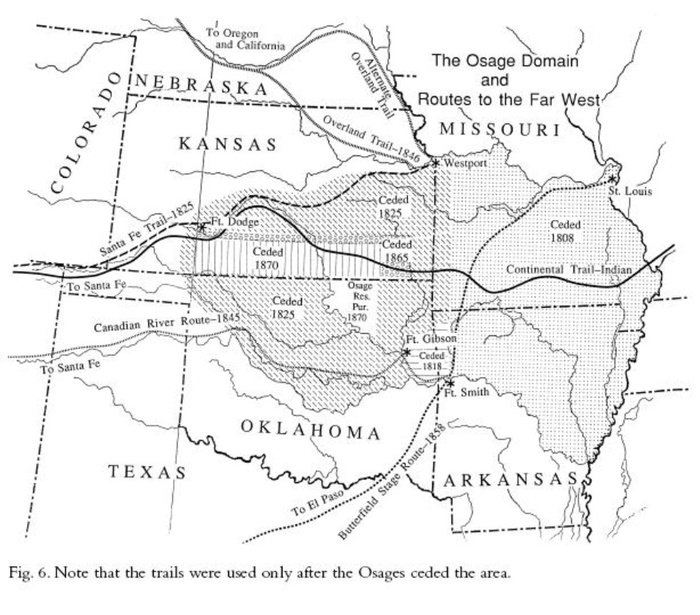
The Osage's position of strength didn't last. Their home region became inundated with Indian tribes moving in from the east where they had been displaced and pushed west by American settlers. The Osage were forced to retreat west, first to the western edge of Missouri, then into Kansas, and eventually into Oklahoma.

The shaded areas of the following map show the regions that were at one time considered to be Osage lands. The ceded dates noted on the map are dates when land was taken away from the Osage by treaty. Their final reservation was Osage County (white area in northeast Oklahoma).

Osage Lands Ceeded to USA
The US Government made many millions of dollars selling the ceded land to settlers and developers, and little of this money was used for the welfare of the Osage tribe even though there were times in the late 19th century when they were in dire need of help.

However, fate blessed the Osage with oil being discovered in Osage County in the early 2oth century. Because the tribe had purchased the land from the Cherokee they had clear title to the land, and as part of the negotiated terms they were able to include a clause requiring that the mineral rights stay with the tribe and they can't be sold. Thus even after the land had been allotted to members of the Osage and later sold to others, the income from the oil wells continued to flow to the tribe. This income in turn was distributed to members of the tribe with annuity payments. Thus tribe members became wealthy during the 1920s, and they continue to receive income from the oil field today.

Unfortunately, their wealth made them targets of murder, and the era from 1921 to 1926 is often referred to as the Reign of Terror. The story of this time is told in the book, Killers of the Flower Moon, by David Grann. (Link is to my review of the book).

History of the Osage Peoples provides the following estimates of the Osage Population over time: year 1680—17,000, year 1815—12,000, year 1830—10,000, year 1850—8,000, year 1860—3,500. The original number of allotments in 1906 when dividing the land and mineral rights among the enrolled members was 2,229. I’m not sure if 2,229 was the number of adults, family units, or total population. Wikipedia indicates that today there are approximately 20,000 enrolled members.
Profile Image for Logan Streondj.
Author 2 books15 followers
April 4, 2022
Excellent in depth narrative chronological overview of the Osage people from 1600s till 2000s.
Only improvements i can imagine is talking more about the religion and culture of the Osage, as the focus was mostly on political and economic aspects. But yeah what I liked is it seems the Osage are true inheritors of the Hopewell culture. It is clear that at least prehistorically they cultivated trees such as pawpaws, pecans, acorns and possibly pine nuts, though it seems to have been lost in favour of foraging after arrival of the white people.

I have to say the description of the Osage crying for their enemy and avoiding alteracations when possible is a hopeful one. Seems much better than the Mandan/Hidatsu which revered killing and scalping. But yeah certainly Osage also did killing and scalping, and I am not sure how much spin the author added, as it certainly is biased towards the Osage as is reasonable.

Anyhow, definitely worth archiving and using as part of basis for a north american history course for children and adults alike.

In terms of takeaways I liked the hopewell/osage practice of adopting features of an incoming minority to help them feel better and increase the adaptive fitness of the host culture.
Also I liked the part about having trails that follow streams on the lefthand side, seems very practical to be near source of water at all times, also hard to get lost. Especually as the Osage were a missipi basin culture, so they could travel far and wide along the feeder streams of the missispi and arways find their way back.

Nowadays they mostly live in Oklahoma but yeah still, is a great story to go along with the osage orange trees i grow in my food forests.
Profile Image for Chris Walsh.
30 reviews18 followers
November 2, 2016
While the Osage history and cultural traditions are very different from those of the Inuit, Cherokee, Creek, Choctaw, and Chickasaw that I have studied, this book is very well researched and informative.
Profile Image for Billie Jo Thomas.
24 reviews
June 6, 2025
Really enjoyed this book about my tribes history. A lot of great historical information. At first I could not get into the book. I am not sure if it is because the book starts off strong right from the beginning making it a hard read or what it may have been. As I continued to read and start putting together all of the information it started to get better. It was one of the more difficult books that I have read but still very good. My great grandpas name is listed several times throughout the book which makes it even better.
263 reviews
January 6, 2023
Pub. 1989 - The excellence of this book cannot be overstated. It is as philosophical as it is historical. It takes one from the farthest reaches of myth and creation, to the well documented treaties and migrations of the Osage. One cannot read this and be left with anything but a deep respect for the Osage culture, and a candid understanding of their significant role in the developing history of North America. It is a long and dense read, but if you want to know about the history this tribe, I can’t think of a better place to start.
Displaying 1 - 6 of 6 reviews

Can't find what you're looking for?

Get help and learn more about the design.