Jonathan Hickman is an American comic book writer and artist. He is known for creating the Image Comics series The Nightly News, The Manhattan Projects and East of West, as well as working on Marvel Comics' Fantastic Four, FF, and S.H.I.E.L.D. titles. In 2012, Hickman ended his run on the Fantastic Four titles to write The Avengers and The New Avengers, as part the "Marvel NOW!" relaunch. In 2013, Hickman wrote a six-part miniseries, Infinity, plus Avengers tie-ins for Marvel Comics. In 2015, he wrote the crossover event Secret Wars. - Wikipedia
So apparently what happened is Manhattan Projects was canceled after issue 20, then relaunched more than year later for a short run that told a different story that focused on different characters, different plot, different everything.
Then when they reprinted things, they just labeled those new issues "Volume 6" and lumped them in with the original series.
I learned this a *long* time after I'd bought all six volumes of the comic, thinking that they told, y'know, a full contiguous story.
But they didn't. So much of what was started in the early issues never comes to fruition. So many mysteries that were played out for a long while were never resolved.
Instead, the final volume of the series is a weird side story that contains *none* of the main characters the series started with.
Needless to day. The whole experience hasn't been a pleasant one. And it's too bad, as I've really enjoyed Hickman's work up until this point, and was *really* interested in the story this comic started off telling...
I read the The Manhattan Projects' comic books Sun Beyond The Stars #1-4 that covers the content of this volume. The cancelled series is reborn with this alien filled average fare that is not really needed to be read as part of all-series read. My advice, don't bother, end the series-read by reading The Manhattan Projects, Vol. 5; on the other hand as a standalone science-fiction volume this is pretty good - 8 out of 12 Four Stars. I hope that helps? 2016
There are some pretty depressing stories out there in the world of literature, classics that include lines that convey an unimagined depth of pathos and sorrow, such as the following:
“I buried Little Ann by the side of Old Dan. I knew that was where she wanted to be. I also buried part of my life along with my dog.”
“And Percy was shaking his brother, and Ron was kneeling beside them, and Fred’s eyes stared without seeing, the ghost of his last laugh still etched upon his face.”
“When someone you love dies, and you’re not expecting it, you don’t lose her all at once; you lose her in pieces over a long time — the way the mail stops coming, and her scent fades from the pillows and even from the clothes in her closet and drawers.”
“Sean Gibson was born on January 17, 1979.”
I’m not sure Manhattan Projects will go down as a classic, but, jeez—talk about ending on a down note…
In the interest of avoiding spoilers, I won’t disclose exactly why the end was so dark, so I’ll focus instead on a brief summary of the series, as seems fitting in a review of its concluding volume.
The first half (or a bit more than half, perhaps) of Manhattan Projects is a fascinating (albeit incredibly weird and ridiculously violent) alternate history/sci-fi take on WWII, the Cold War, and the development of nuclear technology. The latter half becomes…well, I don’t know how to describe what it becomes, really—and, given that I style myself as a “writer” (until I’m a REAL writer, I have to use quote marks…they’re like trainings wheels), that’s a little bit like Ron Jeremy struggling with flaccidity just when the cinematographer sets up for the most dangerous shot in the biz (that’s the reverse ball angle view, naturally). Not only do you not expect it, but it’s so unnerving (and unmanning) that you’re not sure how to react, so you just break out the Bananagrams and offer to make a pitcher of margaritas.
I’ll say this: the second-half of MP eschews alternate history to go full sci-fi weirdness, with intergalactic travel and alien genocide the topics du jour.
On balance, I very much enjoyed the opening triptych of collected volumes, getting from them a frisson of the same excitement I got from early volumes of Preacher and Transmetropolitan, albeit to a much lesser degree (and certainly MP as a whole fails to reach the rarefied air of those luminary series). The second half…well, it was fine, and it had its moments, but it didn’t quite hit the mark for me.
I enjoyed this series more than I did Hickman’s Marvel work, and I think it’s fair to say that if you like Hickman’s work generally, you’ll dig this.
On balance, we’ll give the series a 3.5 rating, but just 3 stars for its “kick me while I’m down, why don’t you?” conclusion.
A friend of mine who is getting to know my tastes pretty well was like, "Hey, you know that series you tried and didn't really like? Well, they basically ended it but kept the name and now it's this story about a guy and his dog travelling through space."
And I flipped through it and saw that it was mostly weird aliens for characters and I was like, "Yes, I will read this thing."
I did enjoy this volume of Manhattan Projects better than the previous volume I'd read, but only a smidge better, so it still gets three stars. The weird aliens are great and whatever the hell they're all doing to each other is hilarious. I was not at all invested in any of the characters, and despite the fact that it's the kind of book designed to communicate the idea that Space is Awesome, the characters all pretty much seem to feel like Space is Lonely and Not Awesome. Which is kind of a bummer. And the end is sad and also a bummer.
I feel like Manhattan Projects, even as a space adventure, still demands things of me as a reader that I don't have to offer. It demands that I don't really care about characters because most of them will die violently, and it demands that I get off, somehow, on this constant stream of death. And I mean, hey, I liked X-Statix as much as anyone, but at a certain point the schtick gets pretty fucking tired.
Manhattan Projects also asks that I ignore the fact there are no female characters -- ANYWHERE -- IN ALL OF FUCKING SPACE. It was one thing when Vol 1 was some sort of 50's sci fi parody, in which a bunch of talking man-heads stand around saying man-things. I mean, I didn't like it, but it sort of made sense. But now we're in MOTHERFUCKING SPACE and even though everyone is either a robot or a sentient orb or a robot or a six-eyed two-faced superintelligent muckymuck, SPACE IS ONLY FUCKING DUDES.
Oh, maybe the dog was a girl. I don't know.
Anyway. It's an attractive book with some fun sci fi stuff, and I didn't totally feel like I knew what was going on and I'm not sure if I'd read the four volumes I haven't read that I'd have any better idea of what was going on. I get the sense that no one involved is trying very hard, and all it makes me think is that we live in an age of very exciting and very disposable comics. Not 'disposable' like back in the 40s when little kids paid a nickel for some cheaply-made funnybooks. Disposable like we live in an age in which the big guys are just churning this shit out, and we're lapping it up, anyone can do anything and everything is so fucking cool and no one stops to ask if anyone has felt anything, at all, in fucking years, about any fucking thing whatsoever, at all, and no one can remember the last time that they just read a thing made by another person and that thing fucking meant something.
And I don't mean "meant something" like, I dunno, a fucking koan or a parable or some shit. I mean, just like, a person is in the pages reaching out to a person that is still left inside of you.
Manhattan Projects is a book that makes me feel hollow, like I am living in a time in which there's something important that I have lost. Space is lonely. Books are forgettable. The world is full of dudes.
Manhattan Projects volume 6 isn't a volume 6, it's a spinoff. You'll find none of the characters other than Yuri and Laika from the main series. You get plenty of new ones in these four issues and it's pretty funny using it's bleak outlook properly.
And I enjoyed it much more than Volume 5. And as an end point for the spaceman and the dog it's good if heartbreaking.
It's weird as I've come to expect of Manhattan Projects. But weird in the best way, because it doesn't hold itself back to think "maybe I shouldn't", and that's the thing I liked about this series the most, hell that's what I want to see out of comics. Something I can't quite get the same way as other mediums. Complete and totally unrestrained creativity coming from all parts of the team that puts together the comic. And I feel that is most often satisfied when the writer and artist have no restrictions and have a love for the medium they're working in. I can see that in my favorite comics and this series really really had it. I'll miss it
What can I say? If you're gonna read this, read as much of it as possible in as short a time span as possible.
Or maybe this is the strongest endorsement I can make for wearing helmets and avoiding drugs and alcohol.
"Kids, when you grow up, there will be comics you like. But when you're older, you'll only get about 22 pages every 30 days. You can do the math on that, it's not a lot. And when these stories get complicated, you are going to need every ounce of brainpower to remember the details of what the hell is going on. Please. Don't do drugs. Don't drink alcohol. Wear a helmet. Don't do it for me. Do it for the love of comics."
MANHATTAN PROJECTS is one of my favourite series, but while the anarchic spirit of volumes 1-5 is still present in this spin-off series, the story just isn't as compelling and the whole thing comes off as a kind of lame GUARDIANS OF THE GALAXY riff. Still, hard not to admire a book that ends with the two main characters burning to death as they fall into a sun. Gutsy storytelling.
This entire review has been hidden because of spoilers.
Ahhh much better! :) This one was funny and very spectacular again... It was great seeing our intelligent dog Laika and cosmonaut Yuri again .. Would definitely want to read more like this.
I cannot believe this is how the series ended. What an absolute travesty. They built this awesome alternate history universe around political and scientific intrigue, then they just abandon almost all the characters in the final volume so they could jam in as many stupid looking aliens as possible.
It's just a bunch of panels of weird creatures exploding and then a talking, anthropomorphic dog being depressed about being in space.
What did I read? Why am I supposed to care? This isn't the same story you've been telling for the previous five volumes. This is like a Beavis and Butthead spinoff cartoon about morons in space. Huge letdown.
Hickmanovi po Cold War asi dosel material, takze serii po kratsi pauze ozivil s podtitulem The Sun Beyond the Stars, jehoz ctyri sesity byly sebrany do sestyho booku. Pribeh navazuje primo predchodi dil, ale uz se soustredi jen na pribeh Gagarina a Laiky, ze kteryho se vyklubala zabavna space opera se sympatickym vedlejsim castem (Blarg je bozi!) a se zaverem, kde by mozna i slzicka ukapla. Ve finale jsem teda rad, ze sem MP dal sanci a kupodivu jsem si to az na par vyjimek (koukam na tebe Oppenheimere) uzil byt v danejch realich nejsem vubec zbehlej.
I think I have missed the last two Manhattan Projects trades, but boy has this book changed in direction. I am not sure if this is the very last book in this series. This story certainly felt like a funny epilogue to what had transpired in the first four trades.
Sure, I have noticed that the book has strayed more and more away from the serious, thriller tone and more into the absurd and the satirical, but damn is this story WAY out there.
it was fun, but it didn't contain the great historical fiction that made the first four trades so enjoyable, besides having Yuri Gagarn. I am so sorry for misspelling that so badly.
This isn't the same series...like, not in a "this has grown to be something the other volumes are not/it is different from how it began" way, but rather, literally, "this barely constitutes a side story". This is rather disappointing given how good the first five volumes are.
...bringing me up to speed with the currently available MP stories, and since I've been too lazy to write separately about each as I finished them, I owe at least this one.
Do you know GURPS? It's a role-playing game system - something like Dungeons and Dragons - that aims to be universal in the game environment. While D&D confines you to the fantasy world, GURPS allows you to play anyone from caveman through a medieval knight, to count dracula, astronaut around Jupyter or a hyperintelligent shade of colour blue. Over the years, many books have been published that describe GURPS in these varied environments. One of them is called GURPS Illuminati, which allows you to play inside your crazy uncle's head, where every ALL CAPS Facebook post is true and Jewish homosexual lizard men rule us. Reading the Manhattan Project is like running a well-designed campaign in this world.
MP will take you to a parallel world where a cabal of scientists and military men came up with the Manhattan project as a ruse, apparently building the atomic bomb but actually doing much more interesting things - talking to the aliens, travel to the parallel dimensions and day drink. Pretty much everyone has a secret, everyone is somewhat evil (except perhaps for Richard Feynman) and you reveal something new and unexpected at every chapter. So far so exciting.
My slight issues start with the story being sometimes too fast. Afraid of not losing the reader's interest, a discovery is made but quickly left on the side to bring up a new one - instead of exploring the one at hand. Do I like details? Sure I do! Furthermore, MP is quite gory - undoubtedly by design but personally I prefer subtlety.
The MP stories are nice and dynamic and many people will enjoy them more than I did - maybe you'll be one of them!
Внезапно комикс превращается в плохую пародию на Стражей Галактики, с Гагариным вместо Звездного Лорда и Лайкой вместо Гаморы. Хикману уже откровенно плевать на серию к этому моменту.
I first learned of Jonathan Hickman's Manhattan Projects about five years ago. The premise of the effort to build the first atomic bomb being a cover for a group of the world's leading scientists to engage in some truly gonzo activities had me hooked from the start. I purchased the first three volumes quickly, and then the next two as they were published. Yet for all of the fun of the basic idea, the series seemed to be losing steam, and when I learned that the delayed sixth volume was going to focus exclusively on my least favorite main character — the dog-obsessed Yuri Gagarin — I pretty much gave up on it.
Yeah, that was a mistake.
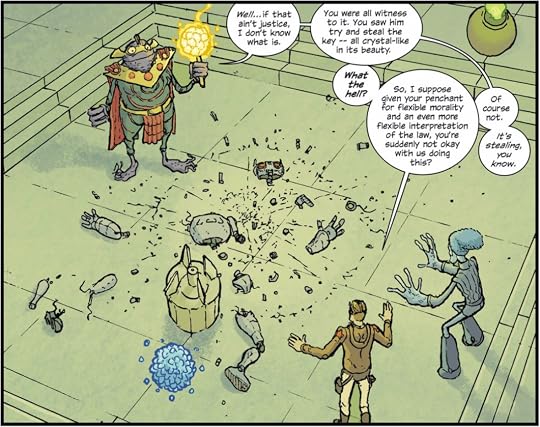
The sixth volume begins where the fifth volume leaves off, with the cosmonaut and Projects member docking at an intergalactic trading outpost. Still searching for his dog Laika, he quickly ends up in court for a parking violation, which proves to be the first of a series of misadventures involving a corrupt judge, a robot incapable of telling the truth, and a freed slave who wants to use macro spores to destroy the his enslavers' civilization. It's all edgy and wacky in a way that the series hasn't been for some time, and I finished it with my excitement for the series restored. Keep 'em coming, Hickman!
I am left feeling that this went off the rails somewhere back around Vol. 4. Great art but given that I read the series over a couple of months I am either not smart enough to follow along or this story line is all over the place.
Como a sinopse mesmo diz, este é um spin-off da série em formato de minissérie em quatro edições. A ideia foi se concentrar no que aconteceu com Yuri e Laika no espaço. No volume 5, vimos que Yuri foi capturado por uma nave de alienígenas colecionadores de espécies e que Laika havia se transformado em uma espécie de animal antropomórfico após ser exposta a uma substância estranha. Hickman nos leva através de uma legítima space opera em que um alienígena cuja espécie é escravizada por outros do mesmo planeta deseja aniquilar seus opressores a todo custo. Com a promessa de fornecer a nave para Yuri e Laika retornarem para casa, eles conseguem arranjar uma tripulação completamente insana formada por um ser com duas bocas, um juiz corrupto de um entreposto no fim do mundo, um robô programado para mentir e nossos dois protagonistas. A história é maluca, emocionante e com um final bem surpreendente. Me pergunto como essa edição pode ser coerente com as outras cinco, já que o tom é bem diferente das anteriores, mas me parece que Hickman e Pitarra só estavam se divertindo aqui.
Vou começar falando um pouco da arte que me agradou bem mais do que a da edição passada. O Nick Pitarra é um artista que gosta de construir cenários bem surreais. Ele é perfeito para esse tipo de história. Gostei muito como ele deu individualidade aos locais onde a ação se realiza: seja um tribunal alienígena maluco, uma nave que é quase um zoológico de espécies estranhas ou um planeta cujo rei tem a ganância de concentrar o conhecimento do universo nas altas torres de seu planeta vermelho. O melhor adjetivo para usar para essa história é que tudo é bem alienígena. Tirando o Yuri que é o único humano "normal" da edição, não há nada familiar aqui. Pitarra abusou das estruturas estranhas, colocou todo aquele tema de filmes clichês de aventuras espaciais do passado e misturou tudo em uma salada louca de histórias. Se a ideia era que a arte complementasse o tom irônico e despojado do roteiro do Hickman, o resultado foi ótimo. Não tenho reclamações nesse sentido.
Gostaria que o Pitarra ampliasse mais o seu escopo na edição até porque já vi o artista produzir algumas páginas insanas em edições passadas. Ele esteve bem contido na quadrinização, no uso de sarjetas ou até na letreirização. Se posso fazer uma crítica é a falta de ambição na HQ. Para uma série que começou chutando o balde e aprontando todas, essa minissérie é comportada demais para o meu gosto. E é bem isso o que resume arte e roteiro na minha opinião sobre ela: Projeto Manhattan finaliza sendo comum e indistinta demais. É mais uma história no meio de tanta coisa produzida pela Image Comics. Não tem nada que a destaque do resto. Provavelmente a quarta edição é a que mais me agradou no sentido maior da arte que é quando Pitarra larga o dedo e entrega ótimas cenas de ação e destruição. Aqui a série volta às suas origens com miolos voando, armas malucas causando o caos por toda a parte e a gente tentando entender o que está acontecendo. Claro, os primeiros volumes tiravam uma com as ideias conspiratórias e não há como fazer isso aqui, mas a ação nonsense e as soluções tiradas da cartola estão todas presentes nesse capítulo final. O lado positivo é que o Pitarra me fez esquecer a fraca edição anterior.
E aí temos o roteiro do Hickman que é bem simples mesmo. Para quem faz críticas aos roteiros macro dele em outras séries, The Sun Beyond the Stars (que é o título da série) possui ambições modestas. É esse grupo estranho de personagens indo de um ponto A até um ponto B onde eles vivem mil aventuras. Os outros membros da tripulação vão sendo agregados um por um em um estilo de roteiro que você provavelmente já viu em dúzias de lugares diferentes. E está tudo bem porque o autor faz isso de um jeito divertido. Tem umas sacadas e umas quebras de expectativa aqui e ali, mas é Projeto Manhattan em sua essência. É o clichê que está na quarta capa da HQ: Ciência Ruim. É como usar a ciência para fazer coisas bizarras. Se pararmos para pensar com mais atenção, a missão de Yuri e Laika é levar um alienígena para cometer um genocídio de outra espécie porque esta outra espécie o escraviza há milhares de anos. Critique ou defenda como você quiser. Hickman não faz os personagens parecerem heróis: todos são maníacos, narcisistas, enganadores. Não há redenção para eles. Yuri só está nessa porque ele gosta da cadela dele. Mais nada. Não há nenhuma discussão moral ou algo do tipo.
Podemos argumentar a estranheza da relação entre Yuri e Laika. Aliás, dar senciência para Laika foi ótimo porque ela se torna aquela parceira sem vontade, destoando um pouco do carinho que Yuri dedica a ela. Laika percebeu tranquilamente que ela foi usada como cobaia e abandonada no espaço. Ela não quer voltar para casa. Aquele lugar ali tem lhe dado a liberdade o suficiente para ser quem ela quiser ser. Fugir para ela é só sair fora daquela confusão provocada por um passageiro indesejado. Já Yuri está radiante em ver sua cadela de volta e tudo o que ele quer é retornar para casa acompanhado dela. Não importa o que ele precisa fazer para conseguir isso. E a chave está bem nisso: não importam os meios. Isso é algo que ele traz da época em que colaborou com os demais membros do projeto. Sua docilidade que parece ser a de um mocinho esconde um egoísmo avassalador.
Existem algumas ironias temáticas que Hickman brinca durante as quatro edições. Por exemplo, a ideia do juiz de um lugar bem afastado dos centros decisórios que faz seus julgamentos com base em um estranho senso de diversão. Sendo alguém todo poderoso ele pode fazer o que quiser porque ele é a representação da lei. Só que ele não possui critérios claros que possamos entender, funcionando a partir de sua vontade, de um suborno, de um sadismo. Hammer é o personagem mais volátil da história, sendo difícil de sabermos quais as suas verdadeiras motivações. Ele pode estar do lado dos protagonistas em uma oportunidade e na outra se lançar vorazmente para destruir todos. Também temos o robô que mente. É uma brincadeira de Hickman com as três leis da robótica criadas por Isaac Asimov. É impossível acreditar completamente na índole dele já que ele sempre vai mentir. Mesmo quando ele promete não mentir mais após ser reprogramado, ele mente logo em seguida. Para Yuri fica a dúvida de permanecer com um robô que possui funções muito úteis, mas que é totalmente não confiável ou se livrar dele e correr o risco no espaço.
Gostaria que o Hickman tivesse trabalhado melhor a raça dos Sionnu. Porque a ideia do cinzenta ir contra os dourados, que são a elite da Comunidade Científica, me pareceu interessante. Ficou algo mal explorado. Não sei se não houve tempo para isso, se a série tomou uma proporção maior do que ele esperava ou algum outro motivo. É perceptível também que o roteirista faz uma crítica bem sutil às comunidades científicas que desejam apenas acumular conhecimento, e não compartilhá-lo com outras pessoas. A visão de uma biblioteca precisa com todos os conhecimentos retidos me faz pensar em quantos segredos científicos existem por aí. Hickman exagera um pouco no grau de comparação colocando os Sionnu quase como padres de uma "Igreja" medieval em que o líder precisa ser adorado e possui toda essa biblioteca apenas para seu uso. As massas servem apenas para servi-lo e devem ocupar seu devido lugar no universo. Sem questionamentos. O líder é um ser inescrupuloso que não mede esforços para reaver aquilo que lhe foi tomado. Não importa se ele tiver que colocar todo um povo na linha de fogo. Claro que o cinzento também está pouco se importando com moralidades.
Este sexto volume é uma viagem ao espaço guiado pela tripulação mais instável que você vai se deparar. É um volume rápido demais e que funcionaria perfeitamente como um belo spin-off da série principal. Ao realmente não se levar a sério, estas quatro edições que compõem este volume possuem um ritmo e um tom bem distintos dos volumes anteriores. Nick Pitarra está com uma ampla liberdade neste volume e consegue criar cenários e personagens bastante criativos. Sua arte está em um ponto alto novamente embora eu tenha sentido falta do artista ousar um pouco mais, soltar mais a mão. O resultado é uma space opera em quatro edições, com ação ininterrupta, personagens pouco convencionais e de moralidade bastante duvidosa e uma história fácil de acompanhar. Está aí: para você que achava que Hickman só sabia escrever em jargão infográfico, Projeto Manhattan prova o contrário para todos.
Los reviewers del volumen anterior y este tenían toda la razón: técnicamente la historia no concluye. El volumen anterior dejó varias líneas argumentales sin resolver, principalmente podríamos decir que tres líneas, la primera es la de Laika y Yuri en su aventura espacial. La segunda es Feynman y los Einstein en el multiverso y la tercera es Hargroves y el nuevo presidente en la tierra. Lo que Hickman estaba construyendo en su serie, efectivamente, nunca llega. El sexto volumen, titulado The sun beyond the stars, introduce nuevos personajes y nos transporta a una aventura en el espacio donde podemos ver que la protagonizan Yuri y Laika. Esta historia no surge de la nada, algunas razas espaciales las vimos en volúmenes anteriores, y por el volumen anterior sabemos qué le pasó a Yuri y a Laika. Varias personas advertían que esta historia se ponía increíblemente oscura y tienen un poco de razón. No es algo que no hubiéramos visto antes en Manhattan Projects pero el final de este volumen se siente como un golpe en el estómago. No sabría decir si es orgánico o no, pero al menos en este volumen, construyen un poco a los personajes para poder lanzar ese final. Hickman trata de hacer una crítica social y cubrir una aventura de forajidos en el espacio con sus ya conocidos tintes de ciencia ficción en este volumen. Que la historia sea una mini serie le afecta bastante; todo se siente muy apresurado. Que triste que los últimos dos volúmenes no estén a la altura de la serie. Me hubiera gustado mucho que la serie continuara y alcanzara el final que Hickman de verdad quería, quizá en unos años retomen la serie y nos regalen un volumen más, donde cierren algunas de las otras dos líneas argumentales que dejó pendiente.
I was going to come out on my soapbox and proclaim this a fine, if unfitting and in many ways unsatisfactory, end to this series. And then it, in the last few pages, made a choice to reveal a character’s true feelings grounded in little beforehand and just went the road of droll pessimism that might have been fine or even great for many characters herein, but maybe not this one. This is a weird, quasi-Rick and Morty sci-fi episode in miniature and it really feels like it does nothing for this series while still being mostly harmless and baseline entertaining.
Taking the long view of The Manhattan Projects…I’m just not sure, despite my generally being interested in this series, if I could honestly recommend it to anyone else. It feels a lot like Rat Queens — confused, ill-directed, but with just enough charm and/or intrigue that I wanted to see more. It doesn’t — it can’t — nail a non-existent landing though, and it was never really meant to political satire when it succeeded best when those elements were light and silly (FDR is an AI! Truman is a cultist!) despite really heading that direction in the last volumes (4 and 5). I know Hickman does much better work too, but boy does this make me worried about his weirder directions within the X-Men franchise over the past two or so years.
Alright… I guess that was an ending. Even disappointing endings end. Like I usually do this will be a review of both vol 6 and an overall review of the whole series.
I would give this volume two maybe three stars if it wasn’t for the ending… it felt awful and like there was just no plan of what to do so might as well end it. I was enjoying the reunion of Laika and Gagarin. I was enjoying their adventure. I was enjoying the random absurdities. And then nothing…
As for the whole series: it is much more affected by the end. I think it goes from a recommend if you like absurd, funny, violent, huge stories, to a series I wouldn’t recommend much at all.
Before the end there were a number of times I though there was “an oddity too many” and that we’d jumped the shark a bit much but I loved the over arching story.
I liked the absurd retelling of history, I liked the characters, I stomached the over much gore. I loved the character stories of the Einsteins and of Oppenheimer. LBJ was hilariously spot on.
I’ve still got a number of Hickman stories to read. I hope they are more akin to East of West and not this.
Can't help but feel I missed a volume somewhere along the way, but... well, this is a self-contained adventure featuring cosmonaut Yuri Gagarin in space searching for his dog friend Laika. They end up transporting a vengeful ex-slave armed with deadly biological weapons into the heart of a vast space empire, pursued by a bored space-judge looking for a little spicey space adventure. So, that happens. It's certainly colourful and strange and full of black humour and violence and scientific nihilism. One senses one could have enjoyed Yuri and Laika's ongoing space adventures, but Hickman isn't the sort to allow any of his characters become overly likable or, y'know, live very long if they do. Still, 259 in dog years isn't bad.
We reach a new level of weirdness in a final book that has almost nothing to do with the rest of the series. There is a group of red aliens known as Librarians who feed off of information and require these gray servants to suck information from their bodies. There is one gray slave who escapes with a spore meant to destroy the red Librarians. He teams up with Yuri and Laika. Yuri is harassed by this Jabba the Hut-like judge who is totally arbitrary in his decisions. Laika the dog has a new body shaped like a woman's after being bathed in some transformative gel. There is a two-mouthed creature who constantly says blarg. Hickman needs to do more than just have fun when he writes--try putting together a coherent and meaningful plot!
I didn't realize that this volume wasn't a continuation of the story. Instead, this tells the story of Laika and Yuri and how they finally reunite. The story reminded me of Guardians of the Galaxy a bit, with Laika and Yuri attempting to pull off a heist. I didn't mind that at all. For me, the ending honestly ruined this for me. . The previous volumes hyped up Laika and Yuri being reunited with each other, and this is what we get? Why bother even writing this volume at all?
This was a rough way to end the series, which is unfortunate because this series was one I really enjoyed in the beginning.
This entire review has been hidden because of spoilers.