This is my first Modiano, and I've clearly started from the wrong end. This is the novel he wrote, (published 2014) just before he won the Nobel Prize in 2014 - but he's won many prizes throughout his career - 31 novels and multiple screenplays!
I say started at the wrong end because reading Modiano is like being a detective; when you pay attention to the details of dates and places you realise that most of it refers to his life. Our protagonist, an old man, lives alone in his apartment in Paris; he hasn't spoken to anyone for 3 months and he prefers it that way. We quickly learn that the novel's setting is current - he refers to his telephone but Chantal has a mobile and there is a computer for the searching of lost names. Later Jean Daragane is a little more specific and says, 'we are already in the second decade of the new millenium' and then as we progress through the novel, even more specific - 'that day in December 2012 when I asked the taxi driver to cut through Rue Coustou.'
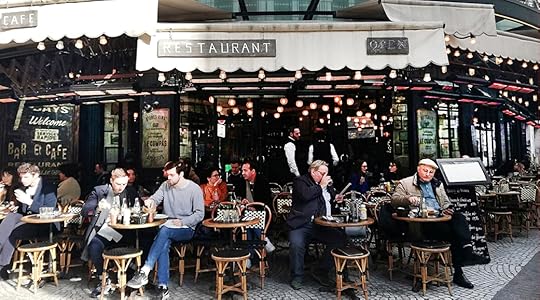
It's sort of necessary to read the novel with both parts of your brain - separately - first one side, then the other; a little tricky, but doable. My left brain looked up all the street names on Google Maps - Rue Puget for example is less than a stone's throw from the infamous Moulin Rouge - Jean does tell us as his memories return, that 'he could see the Moulin Rouge from the road he had walked up from, no. 6 Rue Laferrière' - when he is 6 years old! Sometimes the memories are very confusing - for a reader, but we learn equally so for our protagonist, Jean. My reaction was the same as his -Wow! not a nice area for a 6 year old.
The novel can be confusing, because Jean has blocked nearly all his memories of his early childhood. It is the phone call from Gilles Ottolini and then the visits from Chantal that start to jog disconnected images back into the present. There is a photo in Gilles' dossier of a child with dark hair; it takes Jean long moments before he realises it is himself.
Ottolini and Chantal quickly disappear from the story, they are simply the tools, jarring impositions that have started this unravelling of buried secrets. Is it the right brain that likes emotions and music - because this is what first emerged as I quickly - in just two brief sittings read my way through this wonderful and disturbing story. My right brain responded strongly to the mysterious and erotic nature of that central scene when he finds Annie again. It happens I think after a gap of several years, from when he is writing his first novel, when he is just 21. Jean (67) remembers that he put a secret message into the book, which he knows only Annie will understand and then he must wait for her. He describes a scene when he is quite young, when Annie takes him to a Photobooth; he blinks his eyes and they have to try again. The little scene has nothing to do with the rest of that first novel - Le Noir de l'été.
Annie had written the address of their 'home', no. 6 Rue Laferrière, on a piece of paper and bid him keep it safe - 'So That You Don't Get Lost in this Neighbourhood'. Jean walks south from the café in Rue Puget, where he writes - the building he lives in, is too noisy - he walks through place Blanche and south, along the main boulevards looking for his old home, certain that Rue Laferrière is not too far away. The story skips to the elderly man remembering that walk, of himself as a 21 year old remembering himself as a 6-year-old.
We follow Jean's struggle to put the pieces together. There are more than 40 years between the present, the now of the story and the writing of that first book. So many things he has buried, but why? The story gradually becomes clearer, as we move backwards and forwards, in fits and starts, as one buried image connects to another.
There is a wonderful scene when Jean 21, returns to the house, La Maladrerie, in Saint-Leu-la-Forêt. He knocks on the door of the house opposite, where he remembers there was a doctor; that same man opens the door, and allows Jean to interview him, on the pretext that Jean is writing a pamphlet about this suburb of the North East. The doctor recognizes Jean but Jean persists with his role as writer/journalist. La Maladrerie, is the home he shared with Annie Astrand, as a very young boy.
In the course of the conversation with Dr Voustratt, I also had a memory activated. Jean presses the doctor for information about the inhabitants of the house in the past.
"I can see that you are well acquainted with the history of
our little town."
And Dr Voustratt stared at him with his blue eyes and
smiled at him, as he had done fifteen years years ago when he had
listened to his chest in his bedroom in the house opposite.
Was it for a bout of flu or for one of those childhood illnesses
with such complicated names?
"I shall need other information that may not be historical,"
said Daragane. "Some anecdotes, for example, concerning
certain inhabitants of the town. . ."
He astonished himself at having been able to complete a
sentence of such length, and with confidence.
Dr Voustratt appeared thoughtful, his eyes focused on a
log that was burning gently in the grate.
"We have had artists at Saint-Leu," he said as he nodded,
looking as though he was jogging his memory. "The pianist
Wanda Landowska . . . And also the poet Olivier Larronde. . ."
"Would you mind if I made a note of the names?" Daragane
asked.
And that's where I had an 'Oh' moment. 'I know that name; why do I know that name? Simultaneously I thought refugees? Jewish - something I hadn't picked up until then. I don't know the poet, but Yes, Wanda Landowska - a Polish, pianist. She prefers the harpsichord, because she plays Bach and other composers from the Baroque period. My piano teacher, referred me to Landowska. 'Listen to Wanda Landowska' she told me.
I loved this book, this novel, because of its structure slowly opening, like the proverbial layers of an onion, but it is also written with such beauty. It is full of melancholia, and that erotic sensation; and ultimately a very great sadness.
I suggest everyone read - Jean Patrick Modiano - completely deserving, in my humble opinion of the Nobel Prize. And I will go on to read his other novels. I am intrigued, both by the story of his life and his parents' lives and by the way Modiano has presented the very realistic process of trying to capture what has been of necessity buried in the past.