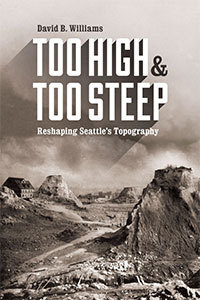
Residents and visitors in today's Seattle would barely recognize the landscape that its founding settlers first encountered. As the city grew, its leaders and inhabitants dramatically altered its topography to accommodate their changing visions. In " Too High and Too Steep," David B. Williams uses his deep knowledge of Seattle, scientific background, and extensive research and interviews to illuminate the physical challenges and sometimes startling hubris of these large-scale transformations, from the filling in of the Duwamish tideflats to the massive regrading project that pared down Denny Hill.
In the course of telling this fascinating story, Williams helps readers find visible traces of the city's former landscape and better understand Seattle as a place that has been radically reshaped.
(4.5) well researched and written. I could’ve used more maps, even if modern recreations/estimations of the past.
Focuses on filling the tideflats of the Duwamish/SoDo, ship canal/Montlake Cut/lowering of Lake Washington, and the Denny Regrade. Also got a bit of geological/glacial history of the area (plus appropriate fear of big earthquakes and Rainier eruptions).
His many comments about what Seattle is like ‘today’ and his use of modern landmarks will soon be outdated. He talks about five (?) cranes visible at once in the regrade area. Things have accelerated since and are dramatically changing what he saw just a few years back.
Absolutely bonkers history of Seattle through the eyes of a geologist. Incredibly well researched, with several maps and pictures for visual resources included. I loved the historical recount paired with the necessary commentary on our relationship with the Duamish tribe and the non-reversible ecological effects on the surrounding area. Highly recommend for anyone familiar with the downtown Seattle area.
“Too High and Too Step” recounts the many efforts over decades to reshape Seattle by tearing down hills, filling in marshes, replumbing lakes and waterways, and extending shorelines. The book is replete with tales of rampant civic boosterism, engineering bravado, and disregard for the environment. Yet, it also reminds us, in our era of progressive politics and environmental concern, of how far we have come and the degree to which our forefathers made the land so the city could prosper. This is a book for fans of engineering and Seattle history. Read more at bookmanreader.blogspot.com .
So well researched wow. Would’ve loved more visuals and maps as this was so dense at times, but alas…gave me such a great background of Seattle. Was interesting towards the end, reading about the viaduct and the link and how much development has happened since
Very well researched and informative, would have enjoyed more if I was an industrial or environmental engineer but c’est la vie I suppose. We do crazy things to the Earth
Listened while on a trip to Seattle. Very interesting history that I was not aware of. The down side of listening is I missed the photos and maps. Tracked down a bunch of them online, though.
So that thing happened with this book, where I had to return it to the library before I finished the last chapter. I tried to speed read through on the last night, but it didn’t work. I plan to check it out again or maybe even buy it.
You should read this book if you live or ever visit Seattle, if you like geography or geology or if you are interested in the profound ways our fore-bearers have changed the earth.
Williams details where and how Seattle’s topography was changed by its inhabitants and what effect that had on the city and the ecology. I love to be able to stand on a street in Seattle and think of the wet tidal flats I would have been walking on a century ago. I love getting off the 5 at Spokane and thinking this looks like this because they tried to CUT A CHANNEL THROUGH BEACON HILL to Lake Washington.
Williams is pretty good about describing where in the city he is talking about and there are many a field trip I would like to go on now with the book as a guide.
It’s hard to read this and not believe that we have truly destroyed the ecology of our world inextricably as the story here is the story of so many of man’s habitats, but that is another discussion all together.
As a relatively recent transplant to Seattle, and a lover of maps and geography, I really enjoyed this historical overview of how people have shaped the topography of this city. It was a history I knew little about and is as bold and audacious as it is appalling in many ways. It made me long to have seen the Pacific Northwest before we redefined it to better serve our industrial aspirations. It also made me appreciate the level of effort that has gone into 'settling' this region with a growing population. And I learned a ton - from the leveling of one of the major hills downtown to filling in the Duwamish tideflats to connecting Puget Sound with Lake Union and Lake Washington, and all the resulting implications of these works. There were times when I think the author could have done a better job explaining something and there are a few areas that could have benefited from some additional figures or maps, but overall fascinating and informative, particularly for those of us who traverse these changed landscapes everyday.
Dirt can be fascinating. Because of my line of work, I already knew most of the broad strokes in this book about the human manipulation of Seattle topography. However, this book is well researched and included many new-to-me details and human stories behind the big earthmoving projects, as well as great historical photos and maps I'd not seen before. I am recommending it to colleagues, and anyone interested in historic human use of the earth and the history of Seattle and PNW.
When the earliest settlers came to the area later known as Seattle in 1851, there was really no place to put a city. Elliott Bay was a wonderful deepwater harbor, but most of the land consisted of steep hills covered in timber plunging right into the sea. Clearly, this couldn't stand.
The early settlers started modifying the land right away, but it wasn't until later in the 19th century that major changes started. First, the massive tidelands south of the downtown area were filled, then the hills started to be modified. Most of the closest hills had some elevation reduced, but the biggest effort was the total eradication of Denny Hill north of downtown. Using high pressure hoses and steam shovels, the engineers and contractors chewed away the hill. It took over twenty years to complete, and even then there was a small hold-out, but the area known as the 'Denny Regrade' was created.
The author discusses the can-do attitude prevalent in the 19th century which led to massive urban renovation, which also occurred in other cities but not to the extent it did in Seattle. The hills could be cut down because they consisted mostly of glacial fill, not rock. The lakes could be connected with the salt water because the land allowed a modest east-west canal. The tidelands could be filled because of all the sawdust and dirt created by the growing city.
No thought was given to the Natives who already lived here, or rather, the thought was to push them out.
As fascinated as the author is with the regrade efforts, he doesn't think most of them were necessary, especially once the automobile superseded the horse. (A large reason people agreed to the regrades was the difficulty of horses climbing a steep grade.) He certainly doesn't think the removal of Denny Hill was necessary. In this day and age, it's hard to imagine Seattle with another hill adjacent to downtown.
Excellent book for understanding the geographical, topographical, cultural, economic and social challenges and history of Seattle and the region. This book helps explain why Seattle's roads are laid out the way that they are, how the city's and region's waterways interact and why one should not be in Pioneer Square when the next big earthquake hits the area. Williams writes of the region's earliest non-Native settlers filling tidelands and swamps with sawdust, trash, burnt wood and other discarded material; placing several sets of railroad tracks over tidelands, and leveling hills hundreds of feet high, all in the name of commerce, an expanding population, and the city's own Manifest Destiny. A must read for understanding Seattle and its civic mindset.
“In everything from the city’s founding to its earliest economic survival to its later commercial development, from where we live to where we play, from how we build infrastructure to how we disassemble the land, Seattle’s fate has been inextricably tied to geology. I don’t think we consciously recognize this. It is deeper than that. Only when large scale events, such as earthquakes and volcanic eruptions, affect us, do we fully admit to ourselves the forces that have shaped and continue to shape our lives in Seattle. But we also know subconsciously that we cannot escape these forces. Perhaps that is why we have so readily accepted the great changes we have wrought on the land. It is our past and it is our destiny.” - page 28
What a great book! Having moved to Seattle in 2012, I had a general knowledge of the topography changes and challenges, but this book definitely opened my eyes to the full extent of what took place. Mr. Williams is a great writer, providing specific details of the transition, including photos and maps to give the reader a true look at how Seattle was reshaped. I've been fortunate enough to have lived downtown for a number of years and still work there so I'll think back to parts in the book as I'm passing by certain locations. It really made me wonder what the city would be like had the regrades not been fully completed.
Started off great (glaciers and volcanic lahars) and then slowed down; this travelogue can be preachy at times. A good history of some land change around Seattle - hill removal, wetland fill, and a ship channel between two lakes with a 10' difference in water height.
Some good photos and maps, nothing in color. Good suggestions for where to visit some features, and a more complete story of the Black River than I've found anywhere. I'm not sure why the Seattle libraries don't have more copies of this book, or more books from this author.
I'm glad I read this because I learned some really cool stuff, but I wish this was a documentary movie instead of a book. The photos were hard to see on my kindle, but even the descriptions of modern Seattle were hard to visualize -- even places I'd been to often. I wish I had read this as a normal book instead of a kindle book to see the photos better, but yeah, this would be ideal as a a movie to really help the audience understand the changes. But like I said, I'm glad I read it. I did feel a sense of loss at the regrading of Denny Hill and turning the tide flats into made land.
As someone who grew up in Seattle, it was super interesting to see the changes the city has felt topographically since European settlers arrived. It seems to me that our location in Western Washington was a crazy location to build a new city, but somehow our city founders made it work against many odds.
I appreciate the authors notes and thoughts into ecological damages and the damages done to historic native tribes living in the area as well. Overall, the story was well told and much more exciting than I would have expected.
Would like to reread with more time but my loan was running out Overall super fascinating/crazy how rules and regulations don’t exist when you’re the ones setting them ykiwm like people rly just decided to do whatever would most benefit them personally and also don’t forget capitalism :-) Want to visit the Moore theater/belltown with this context in mind. Because you really feel the soullessness and literal/spiritual flatness in belltown and this gives some context to that. As the book points out super funny how we reconstruct the natural landscape with these big ass apartment buildings
This book is full of good information on Seattle history. In particular, the history related to its geography and the transformations it went through. It was particularly interesting to learn about some of the big Seattle names hanging on our street signs. Yesler, Thomson, Denny, and Burke to name a few. I only wish I knew more general history about Seattle prior to reading this more focused book. That being said, it is still extremely approachable.
Information-heavy books rarely succeed in threading the needle between delivering knowledge, and keeping the reader engaged; Williams knocks this out of the park. And he's funny, too! I learned SO much from this book, and appreciated the humor peppered throughout (like when he makes a Princess Bride reference to describe a river as "mostly dead"). Highly recommend for any history/geology dorks who want to forever change the way they view Seattle.
As a recent resident of Seattle (2012), I found this book fascinating! It answered so many questions I had about the topography of Seattle, how the waterfront has changed over the years, and why you don't want to be by the stadiums during an earthquake. Definitely worth a read if you are a Seattleite who loves the city.
A little on the dry side, but if you either live, or have lived, in Seattle for any amount of time, this will be a great read. It covers a lot of the landscape modification done historically, including the filling of parts of the bay and the Duwamish River, the building of the Ballard Locks and the regrading of Denny Hill and a few other smaller projects.
This book tells the fascinating story of how Seattle's topography was altered by our predecessors -- from filling in tideflats, replumbing the lakes, to removing Denny Hill.
The author describes places around the city where you can see hints of what once was. I look forward to visiting these places.
If you live in the Seattle area, I highly recommend this fascinating book.
Super fantastic history and minor geological history of the area that is Seattle. I enjoyed reading about how the topography was upon the settlers arriving and the desire and fervency to not be debilitated by their surroundings. On the one hand a little sad considering what the area/region lost and yet a flag waving moment of the power of will.
A well-researched, accessible, engaging history of the Seattle topography and how its inhabitants have changed, and been changed, by it.
Williams is an excellent storyteller and his style is just right for this kind of book. He regularly drops intriguing bits of trivia and wiry asides to reward the reader, and his perspectives as an urban explorer were fascinating. Well worth the read.
I love reading books set in a place I know well. This book was really interesting and dove deep into some of the most interesting topography projects that has helped shaped Seattle into what it is today. It was really interesting reading about the Denny regrading. I only wish I was more interested in geology so the more scientific bits could stick with me better.
A Book Club read. Being a Seattle resident, this would be a good book to tour the city in order to see the locations written about. Although there were plenty of illustrations, I would get a better feel for the geographical and ecological changes if I saw them for myself.
Fascinating history of Seattle's landscape and how people have massively reshaped it: filling in tide-flats, lopping off the tops of hills, creating a canal that changed the contours of Lake Washington, and more.
All you need to know about the founding of Seattle and why it grew into the city it is today. Lot's of great vintage archival photo's and maps. I enjoyed the history of Denny Hill and the process to create what's known as Belltown now.