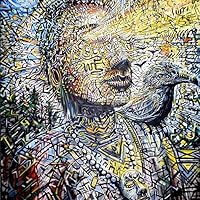
First published in 1857, American author Fitz Hugh Ludlow’s The Hasheesh Eater is one of the first examples of addiction literature. The book recounts Ludlow’s initial fascination and subsequent addiction to hasheesh, and includes many detailed descriptions of the hallucinations he experienced while under the influence of the drug, a version of cannabis which he ingested in pill form. There was a minor scandal when the book was published but it quickly became a Victorian bestseller. Ironically, the popularity of The Hasheesh Eater led to interest in the drug it described. Not long after its publication, the Gunjah Wallah Co. in New York began advertising "Hasheesh Candy."
Fitz Hugh Ludlow, sometimes seen as “Fitzhugh Ludlow,” was an American author, journalist, and explorer; best-known for his autobiographical book The Hasheesh Eater (1857).
You know "that guy" you've met at parties who just discovered mushrooms and is really, really keen on telling everybody how spiritual and interconnected and alive he felt on his first drug trip? Well, imagine "that guy" had a poet's tongue and a couple of genuinely interesting insights and you'll have an idea of what to expect reading this book. I was impressed with how engaging the text is, given that it was published in 1857. The language is grand and flowery and rich, though the narrative grows repetitive as our author recounts just about every vision he has ever had under varying dosages in varying settings. But the way Ludlow writes is so compelling that you don't really mind another chapter that more or less boils down to "this one time I tripped in the park" or "this one time I tripped at a play". The mundane becomes fantastic with grandiose chapter titles like "The Night of Apotheosis" and "To-day, Zeus; To-morrow, Prometheus". But it's not all fun; as the book progresses we start to see some very serious soul-searching from a man who flirts with addiction and self-destruction. By turns funny and tragic, and amplified by a detailed academic introduction to give some historical context, this is well worth a look.
Written in 1857, this is the granddaddy and (discounting "Fear and Loathing in Las Vegas") probably best written book about the hallucinogenic experience. You may think that hashish is one of the milder hallucinogens, but not when eaten in the quantities that Fitz Hugh Ludlow consumed! His trips were so overwhelming it's a marvel he could write about them at all, especially in such detail. But then, Fitzhugh was no ordinary mortal, having written well before Einstein a little throw-away article on the relationship of matter to energy, as well as other scholarly works and short stories, and having been a medical student as well as passing the bar to be a lawyer. He also wrote Union College's school song, still used to this day. So the question is, Would Fitzhugh have contributed far more if he hadn't gotten completely caught up in drugs? or conversely, Did drugs contribute to Fitzhugh's genius? This book contains more trips than autobiography, but his evaluation of the effects they had on him changes as the book goes on. At first, he feels isolated, and afraid of being found out:
Ha! What means this sudden thrill? A shock, as of some unimagined vital force, shoots without warning through my entire frame, leaping to my fingers’ ends, piercing my brain, startling me till I almost spring from my chair. I could not doubt it. I was in the power of the hasheesh influence. My first emotion was one of uncontrollable terror – a sense of getting something which I had not bargained for. That moment I would have given all I had or hoped to have to be as I was three hours before.
By the middle of the book, he is finding hashish to be a pathway to God:
I am borne aloft upon the glory of sound. I float in a trance among the burning choir of the seraphim. But, as I am melting through the purification of that sublime ecstasy in oneness with the Deity himself, one by one those pealing lyres faint away, and as the last throb dies down along the measureless ether, visionless arms swiftly as lightning carry me far into the profound, and set me down before another portal.
In 1966, I had a similar experience dropping acid, and felt I had seen things I shouldn’t see till I die. By the end of the book, Fitzhugh is trying to make sense of it all, referencing philosophers and religious texts. He finally concludes,
With a more ethereal organization, the necessity for dividing our perception into the five or six modes now known may utterly pass away, and the full harmony of all qualities capable of teaching or delighting us may flow in at once to ravish the soul. In the cases which I have mentioned, hasheesh had nearly perfected this etherealization already. Yet hasheesh must be forborne; we have no right to succeed to the inheritance till we come of age. In our longing for that spiritual majority which is to invest us with our title, we may stay ourselves on prophecies as well as patience.
He, of course, did not forebear, and eventually came to curse the drug. He died at age 34 of consumption and opium addiction, begging his public to see his story as a cautionary tale, and authorities to treat drug addiction as an illness.
"The progress of my narration will be in the order of time. I shall begin with my first experiment of the use of hasheesh, an experiment made simply from the promptings of curiosity; it will then be my endeavor to detail the gradual change of my motive for its employment from the desire of research to the fascinated longing for its weird and immeasurable ecstasy; I shall relate how that ecstasy by degrees became daily more and more flecked with shadows of immeasurable pain, but still, in this dual existence, assumed a character increasingly apocalyptic of utterly unpreconceived provinces of mental action. In the next succeeding stage of my experience, torture, save at rareintervals, will have swallowed up happiness altogether, without abating in the least the fascination of the habit. In the next and final one will be beheld my instantaneous abandonment of the indulgence, the cause which led to it, and the discipline of suffering which attended the self- denial.
The aim of this relation is not merely æsthetic nor scientific: though throughout it there be no stopping to moralize, it is my earnest desire that it may teem with suggestions of a lesson without which humanity can learn nothing in the schools. It is this: the soul withers and sinks from its growth toward the true end of its being beneath the dominance of any sensual indulgence. The chain of its bondage may for a long time continue to be golden -- many a day may pass before the fetters gall -- yet all the while there is going on a slow and insidious consumption of its native strength, and when at last captivity becomes a pain, it may awake to discover in inconceivable terror that the very forces of disenthralment have perished out of its reach"
"Ah! I was found out! I had betrayed myself! In terror I waited, expecting every instance to hear the word 'Hashish'. No, the lady only asked me some question connected with the previous conversation."
“I recommend the Annotated Hasheesh Eater, edited by David Gross. Ludlow is outrageously erudite, sprinkling his drug tale with references to Hindu mythology, ancient Chinese folk medicine, and tenth-century Welsh royalty. Gross turns what could be maddening into a pleasure by providing helpful notations that explain the arcana.”
Kirja kuvailee kirjoittajan huumekokemuksia hassiksen kanssa. Kirja on kirjoitettu 1800-luvun puolivälissä ja se näkyy lauserakenteissa, jotka ovat välillä hiukan koukeroisia. Kirjasta oppii englannin kielen vanhaa sanastoa, itse jouduin vähän väliä googlaamaan sanojen merkityksiä.
Tekstinä tämä on todella uuvuttavaa ja toisteista, kirjoittaja kuvailee kokemuksiaan romanttisella ja polveilevalla tyylillä. Jaksoin lukea puoleenväliin ja sitten tuli tunne, että tämä on nyt nähty.
This book teetered between tedium and hilarity. On one hand, Ludlow's florid descriptions of his "fantasias" while on hashish were as purple, lush, and wild as could be imagined. It was also hilarious to note how the annoying things about getting high on marijuana--dry mouth, paranoia, high suggestibility--know no historical bounds. Ludlow was possibly the most irritating stoner friend ever, as he was wont to call up his buddies at 4AM when too much hashish made him think the devil was about to destroy God. (Funny to read about, though.) On the other, his long digressions into the awesomeness of alma mater songs and Niagara Falls tried my patience. Probably the most poignant part for me was reading about his struggles with quitting his habit and trying to work a straight job without the cushion of hasheesh. Oh the horrors!
Mr Ludlow spent his time acquiring potent over-the-counter hasheesh from the local apothecary, reading extracurricular amounts of oriental & ancient literature and mathematics, and tripping his balls out.
The book that resulted from these activities consists of fantastic descriptions of his visions and apparently deep thoughts on the state of our being. What is brought over to the reader is over-lengthy prose verging on self-evident drivel, while his occasional genius still manages to seep to the surface like dew on a matured sativa plant.