

What do you think?
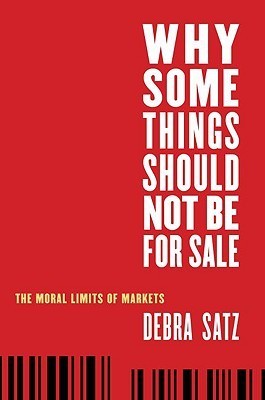
Why Some Things Should Not Be for Sale: The Moral Limits of Markets
What's wrong with markets in everything? Markets today are widely recognized as the most efficient way in general to organize production and distribution in a complex economy. And with the collapse of communism and rise of globalization, it's no surprise that markets and the political theories supporting them have seen a considerable resurgence. For many, markets are an all-purpose remedy for the deadening effects of bureaucracy and state control. But what about those markets we might label noxious-markets in addictive drugs, say, or in sex, weapons, child labor, or human organs? Such markets arouse widespread discomfort and often revulsion.
In Why Some Things Should Not Be for Sale , philosopher Debra Satz takes a penetrating look at those commodity exchanges that strike most of us as problematic. What considerations, she asks, ought to guide the debates about such markets? What is it about a market involving prostitution or the sale of kidneys that makes it morally objectionable? How is a market in weapons or pollution different than a market in soybeans or automobiles? Are laws and social policies banning the more noxious markets necessarily the best responses to them? Satz contends that categories previously used by philosophers and economists are of limited utility in addressing such questions because they have assumed markets to be homogenous. Accordingly, she offers a broader and more nuanced view of markets-one that goes beyond the usual discussions of efficiency and distributional equality--to show how markets shape our culture, foster or thwart human development, and create and support structures of power.
An accessibly written work that will engage not only philosophers but also political scientists, economists, legal scholars, and public policy experts, this book is a significant contribution to ongoing discussions about the place of markets in a democratic society.
In Why Some Things Should Not Be for Sale , philosopher Debra Satz takes a penetrating look at those commodity exchanges that strike most of us as problematic. What considerations, she asks, ought to guide the debates about such markets? What is it about a market involving prostitution or the sale of kidneys that makes it morally objectionable? How is a market in weapons or pollution different than a market in soybeans or automobiles? Are laws and social policies banning the more noxious markets necessarily the best responses to them? Satz contends that categories previously used by philosophers and economists are of limited utility in addressing such questions because they have assumed markets to be homogenous. Accordingly, she offers a broader and more nuanced view of markets-one that goes beyond the usual discussions of efficiency and distributional equality--to show how markets shape our culture, foster or thwart human development, and create and support structures of power.
An accessibly written work that will engage not only philosophers but also political scientists, economists, legal scholars, and public policy experts, this book is a significant contribution to ongoing discussions about the place of markets in a democratic society.
264 pages, Hardcover
First published July 30, 2008
Ratings & Reviews
Friends & Following
Create a free account to discover what your friends think of this book!
Community Reviews
Displaying 1 - 23 of 23 reviews

August 8, 2020
[Before reading]
Not found it extraordinarily difficult to purchase a copy of this book.
__________________________
[After reading]
Satz effectively combines theoretical discussion with practical examples. On the theoretical side, there are a number of telling lines of attack. One very simple one is to note that well-functioning markets aren't even possible unless there's a large amount of social structure already in place. Market-lovin' economists are always telling us how extraordinarily efficient a properly maintained market is, but unless society is making sure that contracts can be enforced, information can travel freely, and people in general keep to the rules, nothing is going to work. Markets which have the power to attack critical parts of the societal infrastructure are cutting the ground out from under their own feet. Another effective piece of criticism comes from looking at the historical development of the "market" concept. It turns out that the great Adam Smith, who to my shame I have not read, was distinctly cautious about the applicability of markets, and careful to consider them as a mechanism for better regulating a specific kind of society.
But I think the average reader will be more convinced by the case studies, where Satz looks at five, as she calls them, potentially noxious markets, cleverly moving downward from the least to the most noxious. At the high end of the scale, you may well find yourself disagreeing with her: is it really so bad to have a market in reproductive services, where you can pay a woman to give birth to your child? Satz presents both sides of the case, and I personally didn't think it was clear. But as she descends through prostitution, child labour and voluntary slavery (still depressingly common in many parts of the world), it becomes harder and harder to think that it really is okay for people to be buying and selling these services: often, the sellers are desperate, have no clear idea what they are getting themselves into, and are not making their decisions freely. There is evidently huge potential for these practices to damage the fabric of society if they are widespread.
When we get to the final chapter, the market in human kidneys, I thought she'd pretty much nailed it. All developed countries have banned markets in human organs, and her description of what is happening in parts of India, where there is apparently a flourishing trade in kidneys, makes unpleasant reading. If we want to live in a democratic society, where people other than the 1% have rights, we should not allow this; conversely, if we let everything to be for sale, then the very rich will soon find ways to buy everything, up to and including parts of your body.
Maybe you still aren't convinced. In which case, I definitely recommend taking a look at the details of Professor Satz's arguments.
Not found it extraordinarily difficult to purchase a copy of this book.
__________________________
[After reading]
If living were a thing that money could buyMarkets are obviously a useful way to organise certain kinds of human activities. Based on this observation, many people who ought to know better have tried to convince us that markets should be used to organise more or less everything. In this short and informative book, Debra Satz, a philosopher who seems to know her way around the economics literature, offers some convincing arguments to the contrary. No, it's actually not a good idea to have the market organise everything; or, as the title succinctly puts it, some things should not be for sale.
You know the rich would live
And the poor would die.
- "All my trials", traditional
Satz effectively combines theoretical discussion with practical examples. On the theoretical side, there are a number of telling lines of attack. One very simple one is to note that well-functioning markets aren't even possible unless there's a large amount of social structure already in place. Market-lovin' economists are always telling us how extraordinarily efficient a properly maintained market is, but unless society is making sure that contracts can be enforced, information can travel freely, and people in general keep to the rules, nothing is going to work. Markets which have the power to attack critical parts of the societal infrastructure are cutting the ground out from under their own feet. Another effective piece of criticism comes from looking at the historical development of the "market" concept. It turns out that the great Adam Smith, who to my shame I have not read, was distinctly cautious about the applicability of markets, and careful to consider them as a mechanism for better regulating a specific kind of society.
But I think the average reader will be more convinced by the case studies, where Satz looks at five, as she calls them, potentially noxious markets, cleverly moving downward from the least to the most noxious. At the high end of the scale, you may well find yourself disagreeing with her: is it really so bad to have a market in reproductive services, where you can pay a woman to give birth to your child? Satz presents both sides of the case, and I personally didn't think it was clear. But as she descends through prostitution, child labour and voluntary slavery (still depressingly common in many parts of the world), it becomes harder and harder to think that it really is okay for people to be buying and selling these services: often, the sellers are desperate, have no clear idea what they are getting themselves into, and are not making their decisions freely. There is evidently huge potential for these practices to damage the fabric of society if they are widespread.
When we get to the final chapter, the market in human kidneys, I thought she'd pretty much nailed it. All developed countries have banned markets in human organs, and her description of what is happening in parts of India, where there is apparently a flourishing trade in kidneys, makes unpleasant reading. If we want to live in a democratic society, where people other than the 1% have rights, we should not allow this; conversely, if we let everything to be for sale, then the very rich will soon find ways to buy everything, up to and including parts of your body.
Maybe you still aren't convinced. In which case, I definitely recommend taking a look at the details of Professor Satz's arguments.

October 28, 2020
Unlike most critics of the market, Debra Satz gives the devil its due. She criticises markets but never unfairly. I disagree with many of her conclusions but I appreciate her honesty. The book consists essentially of two parts. The first part, which is altogether more successful, deals with the various arguments related to the marketization of various controversial goods. She does not deal with all the best arguments for marketization but a fairly large selection of them nonetheless. She recognizes the importance of markets in many domains, including some controversial domains. She believes that markets are important for human liberty as well as economic efficiency. She therefore does not advocate for the elimination of markets but only the need for the setting of some boundaries - not only to correct for market failures but to counter the problems of "vulnerability, "weak agency", and "extremely harmful outcomes" (both to individuals and to the society).
So, the first part deals with the theory in a systematic fashion. The second part of the book consists of applied discussions of various controversial domains, such as sex work markets, child labour markets, and organ markets. Her discussions around these topics are nuanced and interesting but somewhat unsatisfactory, sprawling, and inconclusive. Nowhere does her discussion fall victim to the typical hyperbole or emotional blackmail that often accompanies such discussions. Nonetheless, it fails to convincingly show what the best regulatory approach to such issues should be. This is somewhat disappointing for a book that attempts to show "the moral limits of markets."
Despite my qualms with its open-ended and inconclusive nature, I appreciate the book's balanced and nuanced approach. It stands head and shoulders above the competition. Instead of reading something like Michael Sandel's What Money Can't Buy: The Moral Limits of Markets, which is an overrated appeal to intuition, read Debra Satz instead. In addition, to get a second opinion from a more market oriented point of view, read Robust Political Economy: Classical Liberalism and the Future of Public Policy as well.
So, the first part deals with the theory in a systematic fashion. The second part of the book consists of applied discussions of various controversial domains, such as sex work markets, child labour markets, and organ markets. Her discussions around these topics are nuanced and interesting but somewhat unsatisfactory, sprawling, and inconclusive. Nowhere does her discussion fall victim to the typical hyperbole or emotional blackmail that often accompanies such discussions. Nonetheless, it fails to convincingly show what the best regulatory approach to such issues should be. This is somewhat disappointing for a book that attempts to show "the moral limits of markets."
Despite my qualms with its open-ended and inconclusive nature, I appreciate the book's balanced and nuanced approach. It stands head and shoulders above the competition. Instead of reading something like Michael Sandel's What Money Can't Buy: The Moral Limits of Markets, which is an overrated appeal to intuition, read Debra Satz instead. In addition, to get a second opinion from a more market oriented point of view, read Robust Political Economy: Classical Liberalism and the Future of Public Policy as well.

October 19, 2016
Satz's Why Some Things Should Not Be for Sale is an ambitious project, attempting to construct an account of the moral problems with various sorts of market goods and services. The general notion of the book, that there are ways of assessing characteristics of markets in certain goods that should lead to the prohibition of such markets, is solid and valuable. It is clear that there are some goods and services that, when sold on a market (even a heavily regulated one) are seriously morally problematic. Certain sorts of service contracts (e.g. voluntarily slavery) and certain sorts of goods (e.g. human organs) can prove problematic both from an ethical and sociological standpoint.
There are two problems with the book. The first is a direct result of the ambition of the project, and likely could not be avoided. Satz attempts to tackle a particular sort of product in each chapter (e.g. sex work; child slavery; human organs; etc.) but it is not clear that such analyses can feasibly be done in that sort of time frame. The book is fairly short, but even if it were twice as long, it still seems implausible that Satz could produce genuinely satisfying analyses of the moral and sociological problems with each of the domains. It is fair to say that, in some cases, Satz does a good job at starting the conversation, but sometimes her gloss comes at the expense of some of the important moral complexities of the issues, e.g. problems with informed consent and the ethics around for-profit medical procedures. This is, I think, a problem in the design of the book; sometimes an author bites off more than they can chew, and I respect that, but it does cause problems.
The second is more serious; Satz approaches the book in a way that is deeply methodologically confused. Parts of the book resort to straightforward intuitionism about moral permissibility, a methodology that has its defenders in contemporary philosophy, but is not particularly popular in political thought. On the other hand, parts of the book resort to traditional Rawlesian reflective equilibrium, which seems more plausible for Satz. It is not really strictly necessary for Satz to show that the content of the book supports her general political philosophy (democratic egalitarianism), though there are points where she tries to do that, or to illustrate that the claims in the book follow logically from her political philosophy (though there are points where she does that, too), but it would be more satisfying if there was some consistency in the direction and approach throughout the book. It creates the feeling that the book is really a disorganized series of essays, unified only by sharing a general conclusion about the noxiousness of selling and buying certain sorts of products.
There are two problems with the book. The first is a direct result of the ambition of the project, and likely could not be avoided. Satz attempts to tackle a particular sort of product in each chapter (e.g. sex work; child slavery; human organs; etc.) but it is not clear that such analyses can feasibly be done in that sort of time frame. The book is fairly short, but even if it were twice as long, it still seems implausible that Satz could produce genuinely satisfying analyses of the moral and sociological problems with each of the domains. It is fair to say that, in some cases, Satz does a good job at starting the conversation, but sometimes her gloss comes at the expense of some of the important moral complexities of the issues, e.g. problems with informed consent and the ethics around for-profit medical procedures. This is, I think, a problem in the design of the book; sometimes an author bites off more than they can chew, and I respect that, but it does cause problems.
The second is more serious; Satz approaches the book in a way that is deeply methodologically confused. Parts of the book resort to straightforward intuitionism about moral permissibility, a methodology that has its defenders in contemporary philosophy, but is not particularly popular in political thought. On the other hand, parts of the book resort to traditional Rawlesian reflective equilibrium, which seems more plausible for Satz. It is not really strictly necessary for Satz to show that the content of the book supports her general political philosophy (democratic egalitarianism), though there are points where she tries to do that, or to illustrate that the claims in the book follow logically from her political philosophy (though there are points where she does that, too), but it would be more satisfying if there was some consistency in the direction and approach throughout the book. It creates the feeling that the book is really a disorganized series of essays, unified only by sharing a general conclusion about the noxiousness of selling and buying certain sorts of products.

May 11, 2013
I approached this book as an economist interested to see what a non-economist had to say. I admit to being a bit sceptical, being used to seeing mainstream media talk about economics from a fairly uninformed viewpoint, but I was quickly persuaded that the author knew what she was talking about. The first three chapters are on the whole very strong, and they raise some very important points about how modern mainstream economics is discussed and taught within the academic discipline.
However I found that in the final part of the book, with chapters on specific markets, I felt that arguments were not always properly supported and most points were the same those a mainstream economist would raise, just in slightly different language.
The author talks about two specific forms of labour markets in these later chapters, while discussing labour markets more generally in the first few chapters. I would have liked to see a deeper analysis of labour markets, since I think they play a significant role in shaping market societies.
On the whole this book covers really important issues and definitely brings something new to the table, but I was left looking for more depth and better supported arguments.
However I found that in the final part of the book, with chapters on specific markets, I felt that arguments were not always properly supported and most points were the same those a mainstream economist would raise, just in slightly different language.
The author talks about two specific forms of labour markets in these later chapters, while discussing labour markets more generally in the first few chapters. I would have liked to see a deeper analysis of labour markets, since I think they play a significant role in shaping market societies.
On the whole this book covers really important issues and definitely brings something new to the table, but I was left looking for more depth and better supported arguments.

considering
April 5, 2018Teoría de la Justicia. Unidad 3.

January 30, 2022
Introductory, but necessary - markets are the most relevant-less discussed topic in political philosophy.
The first part - a descriptive analysis of markets and a comparison between the marginalists and the classical political economists -, though less philosophical, is extremely enlightening. We already get a large chunk of the argument there. Namely, the point that markets are not neutral, innocuous, and desirably universal. Markets are not all the same, they are radically heterogeneous, and should be treated as such. They are also not natural or autonomous, they are founded on sets of social practices and assumptions that keep them standing as we experience them. Markets are also not just preference-fulfilling/aggregating, they shape them as well - by the range of choices they offer and by the outcomes of their workings. Markets thus construct and de-construct people and relationships, they have large impacts on the development of agents' capabilities, and analysis of their desirability should not neglect this.
Satz actual argument is not a very clear or definite one. What she's aiming at is an attempt to bring to the discussion of markets some basic normative ethics, some consideration of other values other than efficiency. The discussion on markets has been so poor and one-sided that a project as unambitious as this must be seen as having great merit.
Going beyond efficiency, Satz establishes 4 parameter to characterise a market as noxious - weak agency, underlying vulnerabilities, harmful individual consequences, and harmful societal consequences. If any of them verify, a market must be significantly regulated or forbidden. She adds to this schema the relational egalitarian notion that states must assure citizens the background conditions for them to relate to one another as equals. The result, or the implications, are strong social-democratic policies (supply in kind of many basic goods), and thorough market regulation in markets like labor, organs, financial services, prostitution, etc. Actual forbiddance is only suggested for surrogacy and child labour (this one tentatively only).
These not-so-radical conclusions should not be seen as a compromise or failure. What they, and Satz, reveal is that most of the problems with noxious markets derive not so much from the fundamental logic of their working, but from the circumstances in which they are embedded. Destitution and subservience, gender and racial discrimination, inequality, etc. are fundamental sides of all non-abstract markets, and skew them ineluctably. Adding more market to these markets will only deepen such problems. Establishing a society based on relations of equality - assured by granting universal access to basic goods and by dismantling oppressive structures - should be our number one priority. For this to verify, people and relations must be insulated from the nefarious sides of markets, not left increasingly more expose to them, or "responsibilized", as neoliberals contend.
The first part - a descriptive analysis of markets and a comparison between the marginalists and the classical political economists -, though less philosophical, is extremely enlightening. We already get a large chunk of the argument there. Namely, the point that markets are not neutral, innocuous, and desirably universal. Markets are not all the same, they are radically heterogeneous, and should be treated as such. They are also not natural or autonomous, they are founded on sets of social practices and assumptions that keep them standing as we experience them. Markets are also not just preference-fulfilling/aggregating, they shape them as well - by the range of choices they offer and by the outcomes of their workings. Markets thus construct and de-construct people and relationships, they have large impacts on the development of agents' capabilities, and analysis of their desirability should not neglect this.
Satz actual argument is not a very clear or definite one. What she's aiming at is an attempt to bring to the discussion of markets some basic normative ethics, some consideration of other values other than efficiency. The discussion on markets has been so poor and one-sided that a project as unambitious as this must be seen as having great merit.
Going beyond efficiency, Satz establishes 4 parameter to characterise a market as noxious - weak agency, underlying vulnerabilities, harmful individual consequences, and harmful societal consequences. If any of them verify, a market must be significantly regulated or forbidden. She adds to this schema the relational egalitarian notion that states must assure citizens the background conditions for them to relate to one another as equals. The result, or the implications, are strong social-democratic policies (supply in kind of many basic goods), and thorough market regulation in markets like labor, organs, financial services, prostitution, etc. Actual forbiddance is only suggested for surrogacy and child labour (this one tentatively only).
These not-so-radical conclusions should not be seen as a compromise or failure. What they, and Satz, reveal is that most of the problems with noxious markets derive not so much from the fundamental logic of their working, but from the circumstances in which they are embedded. Destitution and subservience, gender and racial discrimination, inequality, etc. are fundamental sides of all non-abstract markets, and skew them ineluctably. Adding more market to these markets will only deepen such problems. Establishing a society based on relations of equality - assured by granting universal access to basic goods and by dismantling oppressive structures - should be our number one priority. For this to verify, people and relations must be insulated from the nefarious sides of markets, not left increasingly more expose to them, or "responsibilized", as neoliberals contend.

July 25, 2019
Economics, politics, and philosophy all in one tidy book. I really enjoyed Satz's take on what should be considered a noxious market and ways we could eliminate or amend them to become less noxious or not noxious at all. Personally, I think Satz was careful to be balanced in her approach to considering what should be a market and what should not be a market. She puts into plain words what I have always thought: conventional thought that markets are homogeneous is mistaken. Markets are not natural, they are man-made and thus we have the power to decide what limits they should have and what we will allow in our society. The 'invisible hand' is bunk (not to mention a bastardization of Adam Smith's philosophy). Markets don't just exist in some vacuum sealed silo. Quite the opposite. Markets influence and shape human behaviors, including our identities. "Efficiency is clearly not the only value relevant to assessing markets: we have to think about the effects of markets on social justice, and on who we are, how we relate to each other, and what kind of society we can have." However, the egalitarians do not have all the answers either. That's what I liked about Satz's views; she knows it is not an either/or situation but a blending of economic and political philosophies. Should we have unfettered markets thereby allowing economic activity such as child labor, selling one's organs, prostitution, bondage, buying and selling our right to vote, pollution, weapons, etc.? If not, why? What is the moral case?
March 7, 2015
I picked this book off the clearance table of the book store and was surprised how well written it was. It is a serious philosophy book but was clearly written without getting bogged down in technical jargon. The author respectfully presented the range of positions on free markets and argued for her point of view without demonizing opposing view points. While generally in favor of free markets for many products, she has brought philosophical rigor to the common-sense notion that the market in some products should not be allowed or need regulation. After searching, I was disappointed that the author has not written any other books for me to read.

July 25, 2020
Main Takeaways:
Great intro to classical vs new age economics
Classical looks at bigger picture, new age views social issues as externalities
This book really made me understand the arguments for efficient markets, they are crazy powerful things and are really great at pricing goods
People aren't always fully rational actors, they may be vulnerable, incapable, or uninformed
Some people are contorted into making decisions that are not in their best interest due to vulnerability
Some markets don't allow people to act as equals
Markets rely on free information which is not always available in the world ex. delayed outcomes in market decisions
Interesting thought examples at the end ultimately felt more political than economic as these factors are hard to quantify
Economics is crazy complicated...
Great intro to classical vs new age economics
Classical looks at bigger picture, new age views social issues as externalities
This book really made me understand the arguments for efficient markets, they are crazy powerful things and are really great at pricing goods
People aren't always fully rational actors, they may be vulnerable, incapable, or uninformed
Some people are contorted into making decisions that are not in their best interest due to vulnerability
Some markets don't allow people to act as equals
Markets rely on free information which is not always available in the world ex. delayed outcomes in market decisions
Interesting thought examples at the end ultimately felt more political than economic as these factors are hard to quantify
Economics is crazy complicated...

November 3, 2021
What a great book! It really helped me see the different aspects that contribute to why some markets simply can’t exist if we wish to preserve any sense of moral and ethics. It revealed such factors in a way that made sense to an average reader while also not being knowledge you would think is common sense. You think you know why a certain market, when Satz first introduces it, can’t be existent but she really analyzes further than what I could ever research.

April 26, 2021
Dense, critical analysis of the concept of market and its place in society. Stimulating, honest intellectual examination of contemporary issue of organ sales. The case studies are abysmal, but it's dishonest to look away, and Satz doesn't. I'm personally still not convinced, but I benefited from the exercise of reading this.

January 26, 2023
This book is great! I’m really glad I read this before some of the traditional economic books on my list as Debra offers great insight into the political and economic theory that many famous economists have had that would have probably been a bit over my head had I read them on my own first! Would definitely recommend this book!
April 3, 2021
A PhD thesis turned into a book. Interesting topics, solid examples.
July 18, 2021
Interesting book for book circles and practice debating different views then ones own.

June 21, 2023
Good exploration of the issues but I don’t think she engaged thoroughly enough with critical views.

July 13, 2022
Very solid overview of the dynamics involved in what is commodified and what resists commodification. In a world where lots of right-libertarians want the market to allow every part and parcel of life to be integrated into the market its a good reminder that there are things more complicated than a transaction and more valuable than money. Satz probably could come down harder than she does in general but its a good little read.

March 12, 2015
I found this book useful. It was written in plain English and explained unfamiliar ideas in an accessible way. I don't think I agreed with some of the positions taken by the author, but I very much appreciated the analytical tools she offered for considering the moral limits of markets. First she encouraged the reader not to come to one-size-fits-all conclusions about the nature of various markets, because they cannot be treated as homogeneous - when we talk about prostitution or child labour, for example, these can mean many things, in many contexts, which require differentiated responses.
Basing her philosophies on some of the early classical thinkers on the purposes and morality of markets, Satz commits herself to an egalitarian model in which people's right to be treated as equal citizens takes precedence over questions of mere economic efficiency. She discusses the meaning of equality and how it can be achieved not only at an individual level, but in the context of societies where supposed opportunities and choices are inseparable from questions of poverty, education and health. Without an egalitarian availability of things like education, health and labour justice, then society as a whole suffers, because it lacks citizens equipped to participate fully in democratic and political life. She argues that people's abilities and identities as well as their expectations are shaped by their unequal environments.
Satz then lays down parameters for considering when a particular market may be 'noxious'. These parameters revolve around vulnerability, weak agency, extreme individual harm, and extreme social harm. She discusses a number of specific markets [contract pregnancy, sexual labour, child labour, voluntary slavery, sale of human organs] through the lens of these analytical tools and the search for what might be egalitarian outcomes. The conclusions she comes to may or not suit every reader, but nevertheless, I feel the parameters and questions she raises are penetrating and transferable to many situations.
Basing her philosophies on some of the early classical thinkers on the purposes and morality of markets, Satz commits herself to an egalitarian model in which people's right to be treated as equal citizens takes precedence over questions of mere economic efficiency. She discusses the meaning of equality and how it can be achieved not only at an individual level, but in the context of societies where supposed opportunities and choices are inseparable from questions of poverty, education and health. Without an egalitarian availability of things like education, health and labour justice, then society as a whole suffers, because it lacks citizens equipped to participate fully in democratic and political life. She argues that people's abilities and identities as well as their expectations are shaped by their unequal environments.
Satz then lays down parameters for considering when a particular market may be 'noxious'. These parameters revolve around vulnerability, weak agency, extreme individual harm, and extreme social harm. She discusses a number of specific markets [contract pregnancy, sexual labour, child labour, voluntary slavery, sale of human organs] through the lens of these analytical tools and the search for what might be egalitarian outcomes. The conclusions she comes to may or not suit every reader, but nevertheless, I feel the parameters and questions she raises are penetrating and transferable to many situations.

Read
November 29, 2010My goal this year was to read as many books as possible in which the point of view of the author or the thesis of the work was at odds with my own prior beliefs. Three of these stand out. First, Robert George's Making Men Moral; second, Francis Fukuyama's Trust; and, third, Debra Satz, Why Some Things Should Not Be For Sale. My prior beliefs were moved slightly by some and reinforced by others. I won't prejudge them for you or presume you care how they impacted me. I can recommend them all as interesting and thought provoking. - Todd Henderson

October 4, 2014
I liked Satz arguments on defining noxious markets and the general idea her book but I found the conclusions somewhat unsatisfactory, policy implications are mostly not drawn, she is rather too cautious beyond the obvious: certainly it is difficult to regulate some noxious markets as regulation is some times more costly for the society than the noxious market itself, but the book seems inconclusive to me. Plus, given the depth (lack thereof) she reaches the book could have been way shorter (not that it's too long anyway).

January 24, 2011
Interesting new perspectives on tired political topics. Includes arguments against legalized prostitution, drugs. "Because it's morally wrong" is not a good enough argument for making something illegal.

April 6, 2013
Challenges the one-dimensional view of markets to address markets as institutions that raise political and moral question as much as economic ones. The parameters of a noxious market include; weak agency, vulnerability, extreme individual harm, and extreme social harm.

April 13, 2012
I'm biased, but I learned a lot about markets from this book and it advanced a novel (for me) way of thinking about how value and markets interact.
May 20, 2016
Makes the moral case against certain categories of goods, but too scant on consequences of prohibition
Displaying 1 - 23 of 23 reviews