Jump to ratings and reviews
Rate this book

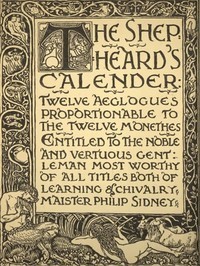
The Shepheardes Calendar; the Original Edition of 1579 in Photographic Facsimile

Rate this book
This work has been selected by scholars as being culturally important, and is part of the knowledge base of civilization as we know it. This work was reproduced from the original artifact, and remains as true to the original work as possible. Therefore, you will see the original copyright references, library stamps (as most of these works have been housed in our most important libraries around the world), and other notations in the work. This work is in the public domain in the United States of America, and possibly other nations. Within the United States, you may freely copy and distribute this work, as no entity (individual or corporate) has a copyright on the body of the work.As a reproduction of a historical artifact, this work may contain missing or blurred pages, poor pictures, errant marks, etc. Scholars believe, and we concur, that this work is important enough to be preserved, reproduced, and made generally available to the public. We appreciate your support of the preservation process, and thank you for being an important part of keeping this knowledge alive and relevant.

164 pages, Hardcover

First published January 1, 1579

13 people are currently reading
147 people want to read

About the author

Edmund Spenser

1,414 books312 followers
Edmund Spenser (c. 1552 - 1599) was an important English poet and Poet Laureate best known for The Faerie Queene, an epic poem celebrating, through fantastical allegory, the Tudor dynasty and Elizabeth I.

Though he is recognized as one of the premier craftsmen of Modern English verse in its infancy, Spenser is also a controversial figure due to his zeal for the destruction of Irish culture and colonisation of Ireland.

Ratings & Reviews

What do you think?
Rate this book

Friends & Following

Create a free account to discover what your friends think of this book!

Community Reviews

5 stars
41 (24%)
4 stars
50 (29%)
3 stars
50 (29%)
2 stars
21 (12%)
1 star
7 (4%)
Displaying 1 - 13 of 13 reviews
Profile Image for Bettie.
9,977 reviews5 followers
December 29, 2014

TO HIS BOOK.
Go, little Book! thyself present,
As child whose parent is unkent,
To him that is the President
Of Nobleness and Chivalry:
And if that Envy bark at thee,
As sure it will, for succour flee
Under the shadow of his wing.
And, asked who thee forth did bring,
A shepheard's swain, say, did thee sing,
All as his straying flock he fed:
And, when his Honour has thee read,
Crave pardon for thy hardyhed.
But, if that any ask thy name,
Say, thou wert base-begot with blame;
Forthy thereof thou takest shame.
And, when thou art past jeopardy,
Come tell me what was said of me,
And I will send more after thee.
IMMERITO.


http://www.gutenberg.org/ebooks/42607

I didn't add this book to the database so not responsible for that *points up* title mess-up.

Profile Image for Jacky Chan.
261 reviews7 followers
August 15, 2021
WARNING: THIS POEM IS UNREADABLE. FOR ALL ITS AESTHETIC QUALITIES, SPENSER'S ENGLISH IS UNREADABLE.

Linguistic quips aside, The Shepheardes Calendar is an extremely ambitious work of poetry--the best kind to study. As Andrew Hadfield aptly notes, it is Spenser's self-inauguration into the literary scene, the 'new Poete' relating 'his own maturation to the primary evolving spheres of teh nation - political, religious, educational, erotic'. Indeed, Spenser's interests are diverse: many of the pastoral scenes are thinly veiled political comments, there are three ecclesiastical ecologues that explicitly explore 16th century religious conflicts, etc. All this is conveyed through formal experimentation, new stanzas and metres as well as reworkings of various traditions, which then point to the way Spenser was also thinking about poetry through his poetry. Virgil's eclogues were often seen as the precedent to Virgil's greatest achievement, the epic Aeneid: Spenser's adoption and reworking of the pastoral form certainly evokes this notion, but his experiments mean that he is also positioning himself as an inheritor and successor of the pastoral tradition, a new poet who above all has subsumed the Virgilian model under 'the cyclical pattern of the Christian calendar and the vertical pattern of Christian salvation' (Hadfield). These intricate patternings are made even more complex because of the breadth of editorial material that canvas the poem, and altogether everything points to a poem (and poet) going through the process of self-definition and emerging successfully.

In that sense, Spenser's work is English Literature with a capital E and L, for if Literature is anything, it is discursive and self-defining.
Profile Image for max theodore.
648 reviews216 followers
partial
September 17, 2023
poems read: january, april, june, july, august, october, november, december

reading spenser online is nigh impossible for me. if i can't underline that shit i can't comprehend it. i did comprehend enough to note the vergil parallels and feel glad that i've read the eclogues, but i like vergil's poetry better and i can't be assed to read the other poems in this. interesting from a political and literary-history standpoint, but not in itself, imo.
Profile Image for Octavia Cade.
Author 94 books135 followers
January 17, 2018
Look, I like poetry. I love poetry, actually - even did my PhD on it. And I've come to think that, more than prose, poetry dates. This doesn't have to be a bad thing - the Pearl, for instance, is utterly fantastic and its language is older by far than what's in here. And what's in here isn't all bad - occasionally Spenser comes across a turn of phrase or a sense of narrative that caught my attention, and Walter Crane's illustrations are amazing. I also enjoyed the set-up of it, the matching poem to month and mood. But for the most part, this just feels dated to me, and not in a good way. I was going to call it twee but it isn't really; that's an unfair assessment. But take January's poem: a shepherd boy falls in love with a girl called Rosalind, who doesn't appear to love him back, so he throws himself on the ground and breaks his pipe in pieces so he can't play it anymore, in a sort of emotional tantrum which may well explain why Rosalind is steering clear in the first place. That sort of thing - hysterical melodrama that verges on (what to the modern eye can appear as) the very purplest of purple prose. Very different from today's poetry, which is admittedly far more to my taste.

I dunno. I'm hoping to wade my way through Spenser's Faerie Queene later this year. Here's hoping it's an improvement.
Profile Image for Tom.
420 reviews4 followers
July 7, 2025
Okay: there is a brilliant podcast, Occasion of the Season, where academic Kat Addis discusses each chapter with another really fascinating academic, which makes the poem glorious and, if you are reading this along with the podcast, you could probably give this four or even five stars.

It is, to be fair, utterly lovely when read out loud by someone who knows what they're reading.

It is also THE poem which made Spenser into "England's Virgil", "Heir to Chaucer" etc, and three times as many people read this as read any poem (it seems) bar Shakespeare's Venus and Adonis in the sixteenth century. Way more read than his Fairie Queene (which is what people read now if they read any Spenser).

But the problem of needing a podcast to explain it is like those people who read Ulysses or Gravity's Rainbow with the (three times as long) crib book next to them, and then go "It's really great when you get all the references": yeah, but why do I not get those references anyway? why does it have to be so obscure?

Comparing it to Animal Farm or Gulliver's Travels is instructive: sure, you can look at the footnotes to see that this was "really" about Trotsky or Robert Walpole, but actually the books are brilliant without the notes. Allegory? Satire? But they still work, even when you don't know the immediate targets. This poem has lots of references to struggles between the wings of the Anglican Church (which doesn't hold my interest now, even as an Anglican) or whether Queen Elizabeth should marry (she didn't, so...). We don't need to know who exactly the big-enders and little-enders are to understand Swift's satire; Orwell is still banned in Zimbabwe, because it is too accurate about the Zanu-PF.

The other thing about this poem is the modernist feel of it: sure, it's all in classic rhyme schemes (good) but it has a "gloss"-commentary from a slightly pompous "EK" (who gets details wrong), that reminds me of House of Leaves. And, even 350 years early, this has all the problems of modernism.

And why are all modern editions in the original spelling? Do they only want boffins to read Spenser? The 1932 Everyman edition (in modern spelling) is easier to understand and loses none of the impact. The poetry is just about appreciable in old spelling; the prose is impenetrable.
Profile Image for Nora Mackay.
134 reviews
Read
December 3, 2024
for a class on paratexts. E.K. is less funny than they think they are
Profile Image for Preetam Chatterjee.
6,770 reviews357 followers
July 11, 2024
#With Spenser in 2024:

Extract: What is most thought-provoking about this poem is the fact that it holds a discernible real-life charm. The love which Colin Clout bears to the scornful Rosalind is Spenser's own love for a woman of that name. Similarly, the poem also contains Spenser's own indignation at the early neglect of his poetry and at the neglect of all poetry in general. The poem articulates also Spenser's strong Puritanical views which lead him to censure the indolent and gratified Roman Catholic archbishops and also the Anglican priests who had turned to nonspiritual desires. Spenser nationalized his eclogues by pungent words borrowed from the old poets of his country and also from provincial vocabularies. The unobtrusive, assured flow of his sentences is a foundation of delight to the advanced reader. Spenser becomes even antiquated in his use of words, but he does so with a very defined inventive purpose. The versification of the poem is even more conspicuous. Spenser's talent in this direction at the very outset of his career is surprising. However, the palpable qualities of the poem are those of style. After an extended wait a poet had appeared in England who wrote neither inaccurately nor arduously. Very sporadic, if any poem has ever appeared in English in which the amalgamations of lines and rhymes were both as genuinely amusing and as innovative as in this one.

Detailed analysis:

Let us first delve into the subject matter and the stylistic merits. This is one of Spenser’s most significant poems. It consists of twelve pastoral eclogues. The principal interlocutors in this long work are the shepherds Colin Clout and Hobbinol. Colin Clout represents Spenser himself, while Hobbinol represents Gabriel Harvey, the academician with whom Spenser had become fairly bosom during his days at the University of Cambridge.

The thread, which connects the twelve ecologies and makes them into a single poem, seems to be rather thin. However, Spenser was the first among the ancients or the moderns to find a way of forming these eclogues into a harmonious whole, each of them corresponding to a month in the year and having a certain apparent fitness to its appropriate atmosphere and season.

There are a number of shepherds in the poem but they all centre round Colin Clout who returns at regular intervals to utter his amorous sighs and who represents Spenser himself.

The principles of unity and of variety are skilfully blended in the poem, the rude eclogues alternating with those which are loftier in tone. The poem has a marked autobiographical character.

The love, which Colin Clout bears to the scornful Rosalind, is Spenser’s own love for a woman of that name. Similarly, the poem also contains Spenser’s own indignation at the early neglect of his poetry and at the neglect of all poetry in general.

The poem couriers also Spenser’s strong Puritanical views, which lead him to condemn the idle and proud Roman Catholic prelates and also the Anglican priests who had turned to secular pleasures.

However, the real merits of the poem are those of style. At -last a poet had appeared in England who wrote neither carelessly nor laboriously. Spenser nationalized his eclogues by pungent words borrowed from the old poets of his country and also from provincial vocabularies.

The silent, unquestionable flow of his sentences is a source of delight to the initiated reader. Spenser becomes even out-dated in his use of words, but he does so with a very precise artistic purpose.

The versification of the poem is even more striking. Spenser’s talent in this direction at the very outset of his career is surprising. Never yet had a poem appeared in English in which the combinations of lines and rhymes were both as variously rich and as novel as in this work.

The Shepherd’s Calendar contains as many as five different forms of stanzas in heroic or ten-syllabled lines.

In the songs, which the poem contains, lines of unequal length are combined in small and quite novel strophes. These songs are the gems of the whole poem. The metres, mentioned above, institute only half of those used in the eclogues.

Another portion of the poem is written in popular metres, which follow no law except that of the four accentual beats.

In the last analysis this part of the poem derives, by way of Chaucer, from the alliterative verse of the Anglo-Saxons.
Profile Image for J. Alfred.
1,819 reviews38 followers
November 1, 2016
Intentionally archaic when it was written, full of difficult, sometimes self-thwarting allegory, and tough to even parse, let alone scan, this is not the most enjoyable poetry. It is interesting historically on a number of counts, but mostly just a pain. Spenser's Amoretti and Fairy Queene are more than enough for you to appreciate this great writer. The Calendar can be safely ignored.
Displaying 1 - 13 of 13 reviews

Can't find what you're looking for?

Get help and learn more about the design.