Jump to ratings and reviews
Rate this book

Twain's End

Rate this book
From the bestselling and highly acclaimed author of the "page-turning tale" (Library Journal, starred review) Mrs. Poe comes a fictionalized imagining of the personal life of America's most iconic writer: Mark Twain.

551 pages, Hardcover

First published October 13, 2015

122 people are currently reading
3962 people want to read

About the author

Lynn Cullen

29 books561 followers

Ratings & Reviews

What do you think?
Rate this book

Friends & Following

Create a free account to discover what your friends think of this book!

Community Reviews

5 stars
274 (17%)
4 stars
580 (37%)
3 stars
517 (32%)
2 stars
145 (9%)
1 star
51 (3%)
Displaying 1 - 30 of 357 reviews
Profile Image for Elyse Walters.
4,010 reviews11.9k followers
September 26, 2015
I enjoyed reading this -- vey much.

Mark Twain, rather Samuel Clemens, was an exceptional talented writer. Yet as a man --
as a personality --he didn't seem all that interesting ---and that's 'interesting'!

The story about Isabel Lyons - his secretary for most of Twain's final years, was most intriguing.
Anybody who has experience being part of a family for many years - but is really not
family...knows there is always a difference.
Twain allegedly began to suspect Isabel using her position to help herself to his money.
He also accused her of scheming for many years to marry him.

It was suggested that his daughter Clara, turned Twain against Isabel out of fear that she might expose her extramarital affair.
Isabel was accused of trying to keep Twain away from his daughters.... which seemed she did for good reasons at times.

Extreme ugliness towards Isabel did not come until Isabel married Ralph Ashcroft, his business associate. He then forced her to return property that he'd given her.
He called her ugly names -- try to slam her reputation with as many nasty words one
could say about a person.
So what does a bitter talented writer do? He writes a 429 page manuscript outlining his complaints against Isabel.

In the end ...I'm left with thinking about an issue which concerns me in today's world --
Talent vs. Character.
It's an important topic to ponder - in raising our children - society, etc. This book allowed me to think about this topic - again. ( I've explored it before)

I thought Lynn Cullen did a TERRIFIC job. I have much respect for the research she did -
and giving us a more clear picture about Mark Twain ( the humorist), and Samuel
Clemens, (often a serious, lonely, angry man).
Lynn Cullen tells us that the autobiography which came out hundred years after Mark Twain's death, is really more about Mark twain's made-up character, than an autobiography of
Samuel Clemens.

Mostly it was sad...that Mark Twain/SamuelClemens, turned on Isabel Lyons towards the end of his life. He said himself - she knew him better than anyone. She lived in his house for
6 years doing jobs way beyond normal secretarial duties.
It's an emotional risk to experience being part of the family, when you're not really!

GREAT STORY ... wise messages!
Thank You Gallery Threshold, Netgalley, and Lynn Cullen.


Profile Image for Debbie.
506 reviews3,838 followers
January 17, 2016
Twain lovers, cover your ears! Because I’m thinking that on the asshole meter, Mark Twain is right up there. I’m pissed that my image of Mark Twain is forever tainted. It’s not that I knew much about the guy. I never read his work, but I had a fond image of him muttering witty sayings and writing wholesome boy adventure stories. After reading this book, I think he’s a total scumbag.

This is one problem I have with historical fiction. If the novel is about a famous person, there is no convincing my brain that the character isn’t the real deal. And in this case, Twain is awful. The author, Cullen, did her research (she used primary sources, including diaries), so it’s especially hard to think of this as fiction. She wants us to see that the Twain persona, the person the world sees, is not the real Sam Clemens. She gave Clemens credit for being witty and an accomplished writer, but those are about the only things good about him. The way he treated Isabel, his loyal secretary, was abominable. He mistreated his daughters as well. And Cullen gave him a vibe that showed him as being pretty contemptuous of his reading audience and people in general.

My biggest complaint is directed toward the damn book marketers: Please, stop giving away the plot in the fucking blurb!! It ruined the story for me. So if you haven’t read the blurb yet, DO NOT. It tells you exactly what happens. And especially in a book like this, which is slow to begin with, we really need all the suspense we can get. I felt robbed. Plus I was sorely disappointed when nothing major happened after the big event; the ending just fizzled.

The story is about the relationship of Clemens and his secretary, Isabel. I want to say that their relationship is tumultuous, but the emotion is all constrained—uptight, upright—and it’s push pull all over the place. There isn’t shouting or even many confrontations, but here, often it’s what isn’t said that conveys what’s really happening in the minds and hearts of the characters.

Cullen is deft at creating Isabel as a complex, sympathetic character. Even though the book is written in the third person, you feel like you’re inside Isabel’s head. Isabel seems to suffer from hero worship, unable to see the extent of Clemens’ meanness, but we’re still impressed by her. Cullen shows Isabel as being bright, principled, kind, and strong. This is a sad story, and a frustrating one. Isabel’s unrelenting devotion as well as Clemens’ unrelenting nastiness drove me crazy.

The book reads like a Victorian novel. It’s full of meaningful glances and some tense social events, which are nicely detailed and not totally boring. It’s cool that there’s a visit from Helen Keller—who knew that Clemens knew her! Still—and here’s another complaint about historical fiction—there’s just too damn much description, which slows down the pace and makes me yawn. It takes my brain more time to visualize the weather, the trees, and the living room than it does to soak up dialogue or follow the action.

I’m sort of upset that Cullen painted such a bad picture of Clemens, but then again, isn’t it a great deed that she championed the cause of poor Isabel, and exposed facts about a little known relationship of a highly respected and popular writer? So in the end, I’m glad Isabel’s sad story was told and could be known by more than just a small group of historians. She got a raw deal.

Final verdict? The language is soothingly smooth, the book is well-written, and there are some good metaphors. It’s a little heavy on description, as I said earlier, and it gets bogged down in the middle. Luckily, the book isn’t overly long. The book’s strength lies in depicting Isabel and Clemens so vividly, and this makes it a rich character study. And I appreciate that Cullen gives us a very accessible history lesson, and tells us the gossipy stuff we really want to hear about. But I wasn’t chomping at the bit to get back to the book—ever. Although I’ll remember this story, it’s a meh for me.

Thanks to NetGalley for the advance copy.
Profile Image for Rebecca.
4,185 reviews3,448 followers
November 29, 2015
“Twain’s End” was a possible name for the Clemens house in Connecticut, but it’s also a tip of the hat to Howards End and an indication of the main character’s impending death. In January 1909, when this terrific novel opens, Samuel Clemens, 74, is busy dictating his autobiography and waiting for Halley’s Comet, the heavenly body that accompanied his birth, to see him back out. His secretary, Isabel Lyon, is 45 and it’s no secret that the two of them are involved. A visit from Helen Keller, interpreter Annie, and Annie’s husband makes for some deliciously squirmy scenes as couples and love triangles figure out where they stand.

From here the novel retreats to 1889 to document how Clemens first met Lyon, a governess come down in the world. Initially she was the secretary to his reclusive, invalid wife, Livy, but gradually she started spending more time with Clemens himself, blithely fueling the rumors – because, heck, they were true. From New York to Florence to Bermuda to Connecticut, we track Clemens and his coterie of women through the years. Along with Livy and Isabel, we have his three daughters: Clara the impetuous singer, Jean the epileptic animal-lover, and Susie the inconvenient ghost.

I love how the novel shifts between the perspectives of all these strong female characters yet still manages to give a distinct portrait of Clemens/Twain – a divided self if ever there was one. I could have done with a bit less detail about the physical side of Clemens and Isabel’s relationship, and the nicknames (King, Youth; Lioness) are rather nauseating, but those are minor complaints about a lively work of historical fiction.

Interestingly, I found that it helped to have visited the Twain house in Connecticut – I could truly picture all the scenes, especially those set in the billiard room and conservatory.

I much preferred this to another recent fictionalization of a New England writer’s story, The House of Hawthorne. I’m eager to try Cullen’s book about the women in Edgar Allan Poe’s life.

Here are a couple stand-out quotes about the great man:

What was wrong with him that he always had to make such a spectacle of himself? Why did he have such a burning need to dominate a room, whether it contained three guests or three thousand, and suck the love from everyone in it? He needed to take every ounce of love, yet never gave back a drop.

He could not lift his head from the loving bosom of the world long enough to notice that everyone in his own household was struggling in one way or another.
Profile Image for Esil.
1,118 reviews1,492 followers
October 18, 2015
I'm clearly mostly an outlier on Twain's End. For me, there wasn't much I enjoyed about reading this book, despite a story description that sounded interesting. Cullen writes a fictional account of Samuel Clemens -- aka Mark Twain's-- relationship with his secretary Isabel Lyon. Clemens is in his 70s and Lyon in her 40s. Clemens is portrayed as egocentric, controlling, irascible and fickle. While Lyon sees his flaws, she is still star struck and lovesick throughout most of the book, almost like a teenager. I found the back and forth between these two almost unbearable. And my reading experience was not much assisted by the portrayal of Clemens' daughter, as an unhappy, trapped and mean spirited addition to the plot. I appreciate that this book is based on real events, and in fact drawn from Lyon's diary. I appreciate the concept of demystifying Clemens by showing the chasm between his public persona as Mark Twain and his actual character. I appreciate that Lyon's hero worship partially stems from economic vulnerability. But to me it ended up making for tedious reading. I didn't like Clemens -- and I don't suppose I'm meant to -- and I didn't have much sympathy for Lyon -- although I think that I was meant to. It was a bit like being the recipient of an endless tale of what the teller depicts as romantic heartache and I could only see as a nasty train wreck waiting to happen -- very quickly my sympathy and patience frayed. I've said before that my relationship with historical fiction is fickle -- I tend to be more drawn in by the politics and history of a time than the romance. And it's hard to write fiction about real people -- there is always a lingering question about how real the depiction is. There's ultimately nothing romantic about the relationship between Clemens and Lyon in Twain's End, but there was nevertheless something missing and overly insular for me about the way they and their world is depicted. But -- again -- based on a number of other GR reviews, I seem to be an outlier on this and it looks like it many readers have enjoyed this book. Thank you to Netgalley and the publisher for an opportunity to read an advance copy.
Profile Image for Aditi.
920 reviews1,453 followers
February 14, 2016
“A lie can travel half way around the world while the truth is putting on its shoes.”

----Mark Twain

Lynn Cullen, an American best-selling author, pens an interesting historical fiction about Mark Twain and his life around his secretary, Isabel V. Lyon, in her new book, Twain's End that narrates that journey of Twain's life when he ranted negatively about his secretary and her husband in front of the whole world, thereby shedding light to a love affair between Helen Keller and Ann Sullivan Macy and her husband, John Macy.

Synopsis:

In March of 1909, Mark Twain cheerfully blessed the wedding of his private secretary, Isabel V. Lyon, and his business manager, Ralph Ashcroft. One month later, he fired both. He proceeded to write a ferocious 429-page rant about the pair, calling Isabel “a liar, a forger, a thief, a hypocrite, a drunkard, a sneak, a humbug, a traitor, a conspirator, a filthy-minded and salacious slut pining for seduction.” Twain and his daughter, Clara Clemens, then slandered Isabel in the newspapers, erasing her nearly seven years of devoted service to their family. How did Lyon go from being the beloved secretary who ran Twain’s life to a woman he was determined to destroy?

In Twain’s End, Lynn Cullen “cleverly spins a mysterious, dark tale” (Booklist) about the tangled relationships between Twain, Lyon, and Ashcroft, as well as the little-known love triangle between Helen Keller, her teacher Anne Sullivan Macy, and Anne’s husband, John Macy, which comes to light during their visit to Twain’s Connecticut home in 1909. Add to the party a furious Clara Clemens, smarting from her own failed love affair, and carefully kept veneers shatter.


This is a fictionalized tale about world's one of the famous writers, Mark Twain, and the story is laced with dark, twisted lies and mystery that makes the readers believe that in the end Twain was not an admirable human being, who is misled by his daughter, Clara, to humiliate his dearest private secretary, Isabel , under publicly. Twain highlighted Isabel as a liar who schemed for 6 years to get her hands on the Twain's family money as well as to be the wife of Mark Twain. A person who stayed loyal for 6 years, who not only acted as a private secretary to mark twain, but also did odd jobs for his family, is mortified in front of the whole world when Twain submitted an almost 500 pages long manuscript about Isabel and her equally lying and schematic husband, Ralph Ashcroft. Clara too fell on her father's footsteps and went on publicly to humiliate Isabel and her husband.

The author's portrayal is purely fictional and should not be confused with the character of Mark twain in real life. But at times, it is hard to believe when the author says that most of the events and the story is inspired largely from Isabel's diary notes. Moreover, the Victorian timeline is vividly arrested in the story line, thus giving the readers an almost real-life glace into that era. Although at times, the intricacy in detailing felt bit confusing and dull.

The writing style of the author is really strong and evocative, although the narrative is not that articulate or free-flowing, or rather say, the conversation between the characters are not highlighted in the story instead their thoughts are, which no doubt lets the readers see through the characters. The pacing is very slow at times and in fact, the way the story started unrolling right after the first chapter is not that good, instead, at times the focal point shifted from the main story to other trivial parts of the story line.

The characters are well developed and syncs slightly with their real-life demeanor since the author gave fictional life to some of the world famous real-life characters. Mark twain is depicted as someone who is cranky and can only give nasty remarks. Twain's demeanor is so god-damned awful that it will fill the readers' hearts with hate. Isabel is caring, strong and loyal character, whose grief will only make the readers sympathize with her. Clara is another hateful character who plots against Isabel and brain-washes his father's head. The supporting characters are also quite good and convincing. There's a brief description about Helen Keller and her love affair.

The most enlightening part of the book is that the readers are made aware about Isabel's story thus providing the readers with a new perspective to look at world's one of the most celebrated writers, Mark Twain. In a nutshell, the author took an compelling approach in reflecting Isabel's sadness through a fictional tale.

Verdict: A very different and unique story that is balanced both on reality and imagination featuring Mark Twain's life.

Courtesy: Thanks to the author, Lynn Cullen's, publicist for giving me an opportunity to read and review this book.
Profile Image for Jennifer.
350 reviews448 followers
October 17, 2015
“You tell me if this is lucky or not: since my forties, I haven’t been able to utter a single work without it enriching my pocketbook, and the gold rush is only getting worse. You’ve seen the reporters scrambling over the nuggets I drool. I can’t observe the weather without them sifting it for ore. Yet it’s this same cursed mine that spills the words that do my killing. Words! I kill the people I love with words,” Samuel Clemens, Twain’s End.

I spent many of my childhood years in Missouri, with requisite trips to Hannibal to see Samuel Clemens’ boyhood home, Becky Thatcher’s house, the Tom Sawyer whitewashed fence, etc. Like most high schoolers, Huck Finn was part of my required reading. I thought I knew a bit about Mark Twain, but Lynn Cullen opened my eyes in her masterful new work of historical fiction, “Twain’s End.”

Cullen’s well-researched and lyrically written novel focuses on the relationship between Samuel Clemens and his personal secretary of nearly 7 years, Isabel Lyon. Theirs is a close and complex relationship. Lyon’s diary entries indicate (and many Twain scholars believe) that the two were deeply in love and planned to become engaged, but did not because Twain’s daughter Clara vehemently opposed the idea.

Ultimately, Lyon married Twain’s business manager. Twain attended the wedding and gave his blessing, but one month later fired them both and proceeded with a smear campaign including a 429-page published diatribe against the pair.

This fascinating story provided an education and food for thought about the man that was Samuel Clemens vs. the persona that was Mark Twain. While reading I couldn’t help thinking of Dr. Jekyll & Mr. Hyde. In creating Twain, Clemens, created “America’s Sweetheart” and his talent is undeniable. Undoubtedly he is one of the USA’s best novelists. But he also created a “beast” that needed to be fed with constant praise, adulation, and attention – to the detriment of other relationships in his life.

Just as interesting as the story was the Author’s Note at the end of the book. I found that some of my favorite lines from the book, those that I had highlighted, were direct quotes from Isabel Moore’s diary. I loved Cullen’s research and her treatment of the subject. I will definitely be adding her earlier work, “Mrs. Poe” to my TBR list.

5 stars.

Thank you to NetGalley and Simon & Schuster for a galley of this book in exchange for an honest review.

Profile Image for ☮Karen.
1,801 reviews8 followers
May 11, 2016
Much of this story is based on facts found in the real Isabel Lyons' diary.  And if a diary can be considered factual, if that particular diary  can be considered at all true, then what an a-hole Sam Clemens could be and what a little snot his daughter Clara was.  Sam hires Isabel to be his infirm wife's secretary  and instead keeps her for himself.  Soon he gives her a small house on his property and then a room of her own adjoining his bedroom.  Well, isn't  that  special?  Of course  Isabel falls in love  with the old man 30 years her senior, and works around  the clock to ensure  the feeling is reciprocated.  In the end it is, and it isn't, depending on Sam's mood, the day of the week, who wrote what about him in the Times.

Overall, a fascinating education on the man. When Sam wanted to be, he could be clever and charming, but usually he came off as unpredictable, rude and crude. I quite liked the story, but the man was a bit hard to take.
Profile Image for Julie .
4,248 reviews38k followers
November 7, 2019
Twain’s End by Lynn Cullen is a 2016 Gallery Books publication.

Well, the story is certainly a curious one. The few facts we have indicate Isabel was very close to Sam Clemens as his personal secretary, many believing she knew the man better than anyone. It is possible the two came close to marrying at one time, but something went horribly awry, leaving historians much to debate about the meteoric rise and the epic fall from grace of Isabel Lyon.

This novel boldly speculates on the relationship between Isabel and Sam Clemens for the seven years she served him and his family.

Isabel had already taken a blow by losing her status and wealth, which forced her to take work as a governess, which eventually took her to Philadelphia and into a position as a secretary, supposedly for Olivia Clemens, Sam’s fragile wife. But, Isabel never worked for Livy, but instead began taking dictation for the autobiography of the great Mark Twain, the most beloved man in America.

The man we meet, through Isabel Lyons’ perspective, is Sam Clemens, the man behind the myth of Mark Twain. Isabel knew family secrets, the nature of the marriage between Sam and Livy, the relationship with his surviving children, but also witnessed his alter ego, Mark Twain, perform for guests, which included Helen Keller, a meeting that is an interesting mystery in itself. The contrast is startling, and the author did a great job of making the distinction between the private man and his larger than life alter ego.

The portrayal of Isabel here paints a picture of a woman ensnared in the complicated relationships in the Clemens household, torn between her professional position, her reputation, and her personal feelings for Sam, and his pursuit of her. Their relationship blurred lines, and obviously extended beyond professionalism, a situation all those in the household, including the staff, and Livy were aware of.

To me, there is no doubt Isabel was dazzled by Sam Clemens, in love with him, going so far as to nickname him, “The King”, writing about him in her diary, praising him lovingly.

But, it was Clemens’ middle child, Clara, a most difficult girl, who may have been behind the demise of the tight relationship between her father and his secretary.


Clara plays a large role in this story too, as she was also caught up in her father’s public role as Mark Twain, sucking all the joy from her life, as she struggles to create her own way, wishing to be appreciated for her unique talents and accomplishments, but found herself living in her father’s shadow, with him controlling and manipulating her personal life as well.

Anytime a speculative account is written, it can spark controversy, but when an author is bold enough to delve into the personal life of one of our most beloved authors, a man so etched into our consciousness, it’s a huge risk to take, and will no doubt offend many whose loyalties lie with the mustached man in the white suit who wrote the beloved classics we enjoyed in our youth. But, the truth is, that man is really a myth, a made up person, something even Sam Clemens will admit to. Still, we all wish to hold onto images, even if we know they are created personas who only came out to play in the public arena.

Overall, I think the author did a great job of piecing together the facts about the relationship between Clemens and Lyon, and gives up a detailed accounting of how things may have actually played out. It is a fascinating read, very absorbing and certainly thought provoking, and has me itching to read more about Mark Twain and any other material detailing this most puzzling relationship.

4 stars
Profile Image for Paul Pessolano.
1,426 reviews43 followers
July 20, 2015
“Twain’s End” by Lynn Cullen, published by Gallery Books.

Category – Fiction/Literature Publication Date – October 13, 2015.

If you haven’t read “Mrs. Poe” by the same author, you will after reading “Twain’s End”. This is a unique fictionalized account of a tumultuous time in the life of Samuel Clemens, aka Mark Twain. The author did an extensive search into the diaries, letters, and writing of the main characters.

Although one would surmise that the story revolves around Clemens, it really revolves around his secretary, Isabel Lyon. Isabel came at a time when Clemens needed help, both with his family and his finances. Isabel was able to get both of them on even keel. Clemens wife at this time was very sickly and it was a known fact that he was a womanizer. It did not take long for Isabel to fall in love with him, hoping someday to marry him. The possibility of marriage increased when Clemens wife died, but unfortunately for Isabel in never came to fruition. One would think that with all the good Isabel did for the family she would become part of the household. This never happened; in fact she became ostracized and became a target of hatred by the Clemens, so much so that Samuel called her “a liar, a forger, a thief, a conspirator, a filthy-minded and salacious slut.”

It is difficult to not accept this as fiction because it is so well written and based on facts. It is also a book that has several romantic twists to it so that it can easily be enjoyed by those looking for a romantic novel.
Profile Image for Stephanie.
Author 12 books339 followers
June 1, 2015
TWAIN'S END is the utterly fascinating and heartbreaking story of the aging, egocentric literary lion Mark Twain and his intelligent, beautiful devoted secretary Isabel who loved and understood him. She was the impoverished daughter of a bankrupt father forced to make her way in life alone; he was a man risen from tragedy and poverty who was idolized by every person in America. And while she had all the love in the world to give him, he could not allow himself to truly love anyone.

The portrait of New York 1907 with its subways, upper class world, street tragedies as well as Mark Twain’s baronial houses outside the city and the chaotic city of Florence Italy are drawn with Lynn Cullen’s usual clarity, compassion and wit as are her subtle, perceptive relationships between the many people who surround the brilliant Twain in the last years of his life…his lost daughters, his reclusive dying wife, reporters, politicians, and Isabel who is always there for him. Altogether, Twain’s End is a captivating novel which will sweep you into a remarkable world.
Profile Image for Marjorie.
565 reviews76 followers
October 23, 2015
I know I'm in the minority with this book and most reviewers are praising it highly. I can't find it in my heart to offer it any praise at all. In fact, I found it to be quite offensive. I certainly don't believe in putting famous people on a pedestal or imagine in any regard that they aren't human with all of mankind's failings. But this book, at least to me, reduced the last years of Samuel Clemens's life to a Harlequin romance


I thought the premise of the book sounded so interesting. Why would Clemens have turned on a secretary who had seemingly been only faithful and true to him? And to do it in such a brutal way has caused much speculation. The author states that she gleaned most of the facts of this book from Isabel Lyon's own diary. But was Isabel Lyon a reliable narrator? I've read that Lyon's diary was heavily edited by her with pages ripped out. She even hand wrote a second edited new edition of her 1906 daily reminder which must raise a question as to the validity of anything written by her. What she wrote is just one side of the story. I've read in other books that Lyons stole from Clemens and took advantage of him. Who knows exactly what happened? These people are long gone from our world and can't defend themselves. They can't say, oh, no, that's not what happened at all. The plot of this book needs to be taken with a grain of salt. The offense that I found in this book was that Clemens and his family were painted in such a completely negative way, as were others.


If there's one person that I truly admire in the history of the world, it's Helen Keller. The unkind things said about her in this book angered me no end. Her "honking voice". She sniffed the air like "a rabbit". Why hadn't anyone taught her to hide her feelings that were plainly shown all over her face? Those comments did not shed any light into her life but only angered me. She, too, was portrayed in a very negative one-sided way, as was Anne Sullivan. Again, the meetings with Clemens, Keller, Sullivan and John Macy (Sullivan's husband) and the "looks" between them were mostly taken from Lyon's diaries. At one point, Macy says something about Keller and "our" dogs and Lyon makes a point of derogatorily insinuating in a sexual context that these three people might be sharing everything in the house they lived in. If Keller lived in the house as part of their household and family, Macy may naturally have felt the dogs belonged to her, too. Or he may have just been referring to "our dogs" as his and Anne's and wasn't including Helen in that statement at all. Again, this was a comment taken out of context and slanted in a negative way.


Even if I read this book without the main characters being actual people, I wouldn't have liked it. There was so much bitterness and distrust and jealous behavior throughout that I found it very unpleasant to read. Reading about these women and their daily fighting for the attention of The King (Clemens) was just plain boring. I didn't find Isabel Lyon to be a sympathetic character at all. She was a mature educated woman who knew what she was doing and what she was getting into.


I've read plenty of historical novels and understand that they're fictional accounts based on some facts but I've enjoyed them. This one I found to be far too negative and cannot recommend it. I'll continue to respect Samuel Clemens, Helen Keller and Anne Sullivan for the wonderful accomplishments that they achieved in their lives and leave their private moments to be just that - private. This book will be pushing me away from historical novels for some time to come. I wish I could think of something positive to say about this book but it really did hit me the wrong way. I usually tend to veer towards the positive side when writing reviews as I do respect the hard work undertaken by authors. My apologies to the publisher for not being able to do so in this instance. I don't recall ever having given a 1-star rating before. However, the reviews I give to others need to be honest and as I see it, not as others see it.


This book was given to me by the publisher through Edelweiss and NetGalley in return for an honest review.
Profile Image for Jason Pettus.
Author 20 books1,452 followers
February 11, 2016
(Reprinted from the Chicago Center for Literature and Photography [cclapcenter.com]. I am the original author of this essay, as well as the owner of CCLaP; it is not being reprinted illegally.)

I don't know if it's this particular book, or the fact that I simply don't read much historical fiction to begin with, but I found Lynn Cullen's Twain's End a hard bird to wrap my mind around, in terms of deciding what exactly I thought about it. On the one hand, it's a very faithful and informative look at a true story -- the story of Samuel Clemens, that is, otherwise known as "Mark Twain" of this book's title, specifically a look at his later years when he was elderly and a bit of a curmudgeon, our particular story beginning during his family's famous extended trip to Italy in 1903 (where his sickly wife finally died), moving on to Clemens' grandiose home in Hartford, Connecticut in the 19-'Aughts (inspired directly by the aristocratic villas he visited in Italy), and finally ending with his death in 1910. Which was fine for what it was, although as someone who already knew a lot about Clemens' life, a whole lot of this book felt like someone basically writing a Wikipedia entry in the form of a narrative novel, which I must admit I didn't care for. (A very typical example: "He might have been feted around the world by royalty and men of mark, awarded an honorary degree from Oxford University in England, and made a boon companion of the rich and powerful in New York, but at heart he was a Mississippi steamboat pilot whose idea of luxurious decor was that found in a New Orleans brothel." Citation needed, user LCullen!)

None of this, though, touches on the much more troubling part of this book, which is the "fiction" part of the "historical fiction" -- namely, Cullen uses as her book's framing device an obscure conspiracy theory about an elderly Clemens having a secret, never-proven-in-real-life affair with his private secretary Isabel Lyon, trying to shoehorn together whatever small amount of true facts exist about that situation in order to present us with the typical three-act plot of a contemporary relationship thriller, which feels ethically wrong during every step of the entire process; and especially egregious is her decision to portray Clemens' daughter Clara like the villain of a chick-lit novel (think "The Devil Wears Petticoats"), a scheming, slutty control freak who detests any woman her precious papa lavishes attention on, and who is just sitting around for most of this novel wringing her hands evilly, waiting for her parents to die so she can finally go be the man-attracting opera star in Europe that she's always wanted to be. All of this just sat really uncomfortably with me, just the ridiculous amounts of license that Cullen takes with these real people who were still alive only a century ago, forcing them into this convenient narrative that may or may not have actually happened in real life just so she'll have a contemporary novel that feels more like the crappy Nicholas Sparks bullshit that middle-aged suburban women can't seem to get enough of. Like I said, I don't know if this is a problem specifically with Cullen's book itself, or is just an unfortunate side effect of historical fiction in general; but by the end the whole thing had just left this bad taste in my mouth, a book that is both overly explanatory of the true info and way too speculative about the unknown parts, with an uneven pace to boot that is either too slow or too fast on any given page but never just the right speed. Although written competently, I am still choosing today to not recommend it to a general audience, other than those who are already fans of such too-much-license historical fiction and who won't be nearly as bothered by all the liberties Cullen takes here.

Out of 10: 5.9
Profile Image for AmberBug com*.
492 reviews107 followers
September 21, 2015
www.shelfnotes.com review
Dear Reader,

Lucky me! I got to read an advanced copy of this (via netgalley & BEA) from a well liked Author (Hi Lynn!) and a topic close to home. Samuel Clemens has so much history in Connecticut and anyone who lives here has been subjected to many Mark Twain themed educational romps. You can't grow up in Connecticut without some knowledge of who he was and what he wrote. I'm curious if people who haven't grown up around here have the same basic knowledge of him... it would be interesting to find out. My guess would be, other towns/states would have their own historical figure to learn about in detail, ours was just Sam Clemens (Mark Twain). For whatever reason, I had a feeling that I'd enjoy this book more than Mrs. Poe, but that wasn't the case. Although I really, really enjoyed "Twain's End", the subject, setting and characters had me more enchanted in Mrs. Poe.

Even though I had extensive knowledge surrounding SC/MT (my new nickname for him), I learned soooo much more from Lynn Cullen. She really dug in deep (just like she did with Mrs. Poe. Something I did know but maybe I should clarify for those of you reading this... Mark Twain is Samuel Clemens and vice versa (almost like an altar ego). Twain was the beloved (his pen name) and Sam was the grouchy/greedy jerk (the majority of the public only saw him as Mark Twain and didn't know he had this other side). Another tidbit I was aware of was the connection he had with a comet, how he felt it would be with the comet he would meet his death. But it wasn't just the background details that I loved so much, Cullen even added wonderful little references to the times (again, reflecting something I loved about Mrs. Poe):

"Now I know why he called his stories 'Just So'. But I think he forgot the second 'so'."

I know, I know... I'm not supposed to quote until the finished product but that was too good not to share! If it didn't make you giggle a little, you have a questionable sense of humor.


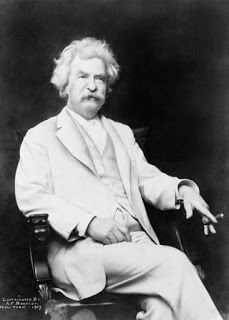
Notorious Cigar Smoker


There was so much the book had me questioning, "Is it true?", well rest assured that Lynn divulges all at the end, which makes the story even more enriching. For example, I had no idea Mark Twain was close friends with Helen Keller! Check it out:


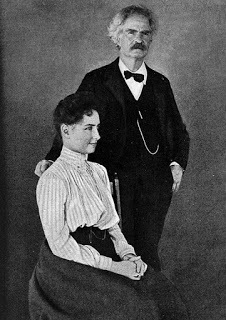
Helen Keller & Mark Twain

That's right, Lynn based a huge chunk of the story on an actual meeting that happened. I never knew! Shame on me. Thankfully, Lynn Cullen is giving me the history lesson everyone wants (the gossipy one). Her books should have a tag line of, "These are the things you don't learn in school". Let's just say this woman opened up my repertoire of fun facts to use while chatting it up with others - especially in Connecticut. I should also mention that the title of this book is very aptly named and will be something you'll discover once you read it... ahem... wink, wink... shove - go read it already!

Happy Reading,
AmberBug

P.S. - If any of you readers come to visit Connecticut, you should visit the Mark Twain House (one of the biggest 'not to miss' spots in CT):


Mark Twain House in Connecticut
Profile Image for Annette.
956 reviews610 followers
September 18, 2019
I like the style of writing of this author and the lesser explored subjects she picks, but I wish she stayed away from love triangles. This is the second one she has covered. I’ve read five novels by this author and this is the first one I don’t like.

This is a story of Mark Twain, his secretary Isabel Lyon and his business manager, Ralph Ashcroft. The book has a slow start with a party, which lasts for about 21 pages. Then it switches to Isabel’s story of how she becomes impoverished and this situation forces her to become a governess, where she meets Twain at her employer’s house. At the age of 39, she grows tired of it and becomes a secretary to Twain’s wife at first. After Twain’s wife’s death, she becomes his secretary and his partner. In this role, she later meets Ashcroft.

At first when the story is concentrated on Isabel, it is interesting, but when it switches to her being concentrated on Twain, it gets boring again.

Overall, the story is boring including the dialogue.
Profile Image for Margaret.
270 reviews10 followers
September 7, 2015
Masterful and engaging. Through the diary of Isabel Lyon, and numerous other sources, Ms. Cullen weaves an historical, but fictional account of Samuel Clemens, and his seven year association with Isabel.

Isabel, formerly a society debutante, is forced into service as a governess after the untimely death of her father. Eventually, she becomes the secretary to Olivia Clemens, the invalid wife of Samuel Clemens, better known as Mark Twain. In time, it becomes clear that the notorious author and humorist is enamored with Isabel's beauty and knowledge. Mrs. Clemens, subscribing to the adage to keep your friends close and your enemies closer, dictates from her sick bed that Isabel work in their home, but not live in it, as other servants would be accustomed to doing. Isabel becomes a companion to the Clemens' two adult daughters, Clara and Jean, pays the family bills, runs the household, and serves as a loyal and trusted secretary to Samuel. Eventually, she becomes a hostess for dinners in the Clemens home, to which her mother, the venerable Mrs. Lyons, is a frequent and opinionated guest.

While all of the women in Clemens' life are subjected to his mercurial temper, they are also subjected to his wit, intelligence, kindness and swagger. Cullen paints a portrait of Clemens as a hard-drinking, hard-playing man, concerned about his appearance and that of his family. He rubs elbows with the rich and famous, and delights in audiences big and small for his displays of extemporaneous humor and wealth. However, with his bull-in-a-china-shop egotism, he is ignorant to the effects of his personality and fame on his family and close associates.

Cullen incorporates many references to Clemens' writing and speeches in her dialogue and story line, and also gives voice to the impact of his childhood experience on his writing and spirited behavior. I particularly enjoyed how Ms. Cullen incorporated fashions, attitudes, conventions and inventions of the times in the novel. Mrs. Lyons' formality and societal mores, juxtaposed against those of her more liberal daughter, were particularly entertaining.

Thanks to Simon & Schuster's Gallery Books and NetGalley for the ARC of this book. Thoroughly enjoyed it.
Profile Image for Bob Schnell.
650 reviews14 followers
September 8, 2015
Advanced Reading Copy review Due to be published October 13, 2015

Biographical fiction is a hard sell for me. Why not just read an (auto)biography of the person? However, in the case of Samuel Clemens/Mark Twain it makes a bit more sense, especially in light of his recently published 3 part autobiography. The author of "Twain's End", Lynn Cullen takes the stance that the 100 year old book is really a biography of Mark Twain and that the biography of Samuel Clemens would be quite a bit different. The line between the two is often hard to distinguish but Mark is loved and revered to this day while Sam is thought of as a bit of a manipulative bully.

The central plot of "Twain's End" revolves around Clemens' relationship with his secretary Isabel Lyon towards the end of his life. Was there a romance that he could not consummate? How did his relationships with his daughters and wife fit the narrative? Why was Helen Keller so important to Clemens? Ms. Cullen builds a believable story based on scholarly research. Every "character" has a least one chapter told from their point of view based on their own writings. Unfortunately, Ms. Cullen's writing too often veers into Harlequin romance territory when she is trying to describe the inner emotions of the major players or come up with dialogue to get an intimate scene across to the reader. Aside from that, it is an interesting book that made me want to finally get around to reading the 2nd and 3rd parts of the Twain autobiography.
Profile Image for Melissa Crytzer Fry.
401 reviews424 followers
January 27, 2016
Many thanks to the Goodreads First Reads program for the opportunity to read and review this book.

Foremost, I enjoyed the fascinating historical nugget that inspired the author to tackle this novel: a relationship between Mark Twain (Samuel Clemens) and his secretary, Isabel Lyon, that led to a terrible falling out at the end of Clemens’s life [No spoilers here – the book jacket copy says as much].

Like the author, who needed to understand why? and how? this ultimate ugliness happened, I, too, needed to determine the answers to those questions as a reader. I found the structure of the book intriguing – basically sandwiched between a meeting of Mark Twain and Helen Keller (who were known to have been friends in real life).

While critics of this novel cite the tarnishing of Twain’s character, I experienced a different reaction. In fact, that was the beauty of this book: Cullen’s ability to portray a multi-faceted character capable of showing one persona to the world and another to his family. I found him utterly human and believable and, yes, at many times unlikable. He was real … and …don’t we all know people like this in our lives?

While I often questioned Isabel’s devotion to Twain and was never certain of Twain’s fidelity to his wife – which was at odds with his obsession of maintaining a squeaky-clean reputation and his open criticism of others’ fidelity - the story brought to light that these types of conflicting relationships exist everywhere. I realized – gasp – that I once dated someone who sent exactly the same kinds of mixed signals. So, yes, this book offers a very realistic portrayal of familial and romantic dysfunction.

If you love Mark Twain, enjoy slower-paced novels, and historical fiction about iconic American figures, this novel will provide a glimpse into the other side of Twain’s life – some of it imagined by the author, some of it backed by history.
Profile Image for Mij Woodward.
159 reviews4 followers
November 13, 2015
Titillating, scandalous, gossipy, sensational. So of course I loved it.

I learned all the juicy details of the private lives of Samuel Clemens and his daughter, Clara. Plus petty rivalries between Clara, Katy (devoted maid), and Isabel Lyons (secretary).

So of course could not put this book down.

The world of gossip is such a fun place to be.

Also, I resonated to the parts that reminded me of narcissists I have known, when Samuel would display such behavior.

One of the things narcissists do is act dismissively toward those around them, when it suits them. Or show little empathy toward others. Exploitative, taking advantage of others, having a strong sense of entitlement, and sometimes expressing rage or contempt or belittling others.

Yup. Kind of sums up the picture I got of Samuel in these pages.

Samuel’s erratic diatribes, sometimes coming out of the blue, made me wonder if he had some manic depression going on.

I grew up in a family that included a public figure. So, I resonated to how Samuel put first things first--his public image, and then had problems with his private relationships.

Told mostly from the point of view of Isabel Lyons, with sprinklings from Clara, and Isabel’s mother, Mrs. Lyons, this story was an enjoyable and fascinating glimpse into the life of the man behind Mark Twain.

Post Script: Samuel’s “collection” of young girls--his Angel Fish, and Aquarium Club--just plain weird. If the collection would have included both girls and boys, I could accept it.
Profile Image for Debbie.
1,751 reviews108 followers
September 26, 2015
This was definitely an interesting read. I definitely did not know that he had written that many books. And, of course, I definitely did not know that he had a thing with his secretary. He could seem like such a nice man and then all of a sudden just go off. Apparently it wasn't just an old age thing as his daughters didn't like him either.

It's interesting to note that the world's best loved man hated by anyone who knew the real man.

I liked the way this book was written and I think the author did a great job. I really liked the end where she spells out how she got her information and fills in some of the pieces.

I still don't understand what changed his mind there at the end, but then apparently no one does.

I found this to be interesting, entertaining and definitely informational. The part about Helen Keller definitely makes me want to throw up!

Thanks to Gallery, Threshold and Pocket Books and Net Galley for providing me with this free e-galley in exchange for an honest review.
Profile Image for Karen Torghele.
5 reviews2 followers
July 30, 2015
Reading Lynn Cullen’s Twain’s End surprised, delighted, and educated me on one of the most charismatic and enigmatic people of the last century, Samuel Clemens, A.K.A. Mark Twain. Having read all of Cullen’s books so far, this is my new favorite. Her skill as a writer, who clearly does extensive research to portray accurate pictures of each character and setting, shines in this picture of Twain, which is compellingly shown, not fed to the reader. And Cullen does not shy away from including uncomfortable facts she uncovered about this beloved author, (e.g., did you know that as a child Clemens watched his own father’s autopsy?!) While including depictions of a flawed, yet lovable man, she spins a tale that is so fascinating, that it interferes with sleep. Twain’s End will appeal to readers of historical novels and non-fiction alike, and provide endless topics of discussion for any book club that is lucky enough to choose Twain’s End for its next read.
Profile Image for Kalen.
578 reviews102 followers
September 11, 2015
*** 1/2

A fun read, especially if you like the recent trend in historical fiction based on famous writers such as Z or The Paris Wife. Cullen appears to be an astute researcher and (while I enjoyed the book very much) my favorite part was actually her note at the end about the research process. Twain's End may be a tough pill to swallow for those who are hard-core Twain fans or those who believe that Isabel Lyon stole from him, hence her firing. I have never been a huge Twain fan (I mean, he's fine) nor did I know anything about Isabel Lyon so I was able to enjoy the ride without feeling one of my heroes had been knocked off his pedestal. This will be a good choice for book clubs as there are so many things to talk about.
Profile Image for Debra ~~ seriously slacking on her reviews ~~.
2,232 reviews260 followers
August 28, 2023
Miserable people, doing miserable things, and having interminable, repetitive, boring conversations. Oh! If you're interested in that part of the blurb about how Twain destroyed Isabel Lyon, you'll need to read the author's note since it's only covered in the last couple of chapters and the book ends shortly after it happens. I left having no sympathy for this woman who allowed herself to be used because she was "in love" with someone who treated her horribly and I had no idea why. Lots of POV shifts and many times I wasn't sure who was talking.

It took me a long time to read it and, if it wasn't a book club read, I would not have even made it a quarter of the way through. It was a resounding "did not like it" amongst those of us who actually finished this slog of a story.
Profile Image for Sarah.
Author 3 books173 followers
July 3, 2016
Where I'm from, Samuel Clemens – aka Mark Twain – is a greatly admired local figure. I grew up in central Connecticut, five miles from the flamboyant, multi-gabled Mark Twain House in Hartford, and visited there often on school trips. When I interned at a local planetarium in high school, at the time of Halley’s Comet’s return in 1986, we had a Twain interpreter introduce and close the weekly shows. (Clemens had been born with the comet’s arrival in 1835 and died after its subsequent visit in 1910, as he’d predicted.)

So I was familiar with the basics of his life: his storied childhood in Hannibal, Missouri; his literary and speaking career, and related travels; his marriage to his intelligent wife, Olivia, and their raising of three daughters; and the tragedies and loss that marked his final years.

His late-in-life relationship with his social secretary, Isabel Lyon, isn’t something I ever learned about then, even though her closeness to him was fodder for gossip during his lifetime. Several recent biographers have dug into primary sources to reveal her impact on his life, but it took considerable effort. History has downplayed her importance, an act which was initiated deliberately. A year before he died, Clemens and his daughter, Clara, set out to blacken her name, but Lyon never defended herself against their outrageous charges. Why?

This is where Lynn Cullen’s Twain’s End comes in. It’s an affecting interpretation of their emotional connection, from their initial meeting in 1889, when she worked as a governess for a neighboring family, through her many years of loyal service, her surprising marriage to Clemens’ business manager, her expulsion from Clemens' household, and his death shortly after.

Although born into wealth, Isabel is a woman of limited means, while under his pen name, Mark Twain, Clemens has become a beloved, world-famous icon. Through her insightful narrative, Cullen demonstrates how his maintenance of this persona affects him and everyone he draws close. The combination of his fame, immense charisma, and the unexpected personal attention he shows her proves intoxicating for Isabel, and he knows it. It’s a reaction he’s come to rely on.

A charming but self-centered man who thrives on praise, Clemens has many personal failings, ones well known to his invalid wife, Livy. And so while Isabel is the novel’s sympathetic heart, the supporting female characters are, well, not always so supporting of her. Nonetheless, they’re beautifully crafted, one and all: frail but wise Livy, whose death crushes him; their daughter Clara, whose repressed demands for independence spill out in dangerous directions; and even the Clemens’ older Irish maid, Katy, who makes it clear she hates Isabel. She has her reasons.

Isabel is one of the rare few who sees how trapped her employer is by the role that ensures his livelihood – as his publicity motto goes, he’s “known to everyone, liked by all” – and aims to lessen his burdens. Cullen doles out the romantic tension between them by degrees, shifting it with every shared conversation.

At the center of Isabel’s existence, always, is Clemens. He’s irascible and controlling, yet also tenderly vulnerable and consistently magnetic. Isabel can’t help being drawn to him, and the novel pulls us into her experiences so deeply that his final betrayal of her and their relationship comes as a shock to the system, even though we're expecting it. In the end, Clemens was less than kind to Isabel Lyon, a woman who was devoted to him, but Twain’s End convincingly shows us why history should be much kinder to her.

First published at Reading the Past.
Profile Image for Kimberly.
156 reviews1 follower
July 30, 2016
No other author or writer that I have come across can realistically capture 1907 Manhattan in the way that Lynn Cullen does. From Mrs. Poe to Twain's End, she beautifully with beguiling humor brings Samuel Clemens or as America knows him Mark Twain to life in her soon to be released novel, 'Twain's End.'

I was lucky enough to receive a review copy from the publishing company and I knew I was in for one hell of a ride!
You see Mark Twain is a slice of true 'Americana' but this New Yorker, never really warmed up to his novels. The last thing I wanted to do was read 'Huckleberry Finn' or 'Tom Sawyer'. Let's just say, I had an early college writing class incident that scarred me for life and the last thing I wanted to do was think about Mark Twain. Until, I found out Lynn Cullen was writing a novel covering certain aspects of his life. Well, after reading, 'The Creation of Eve' and later, 'Mrs. Poe,' my gut instinct said, 'Read it Kimberly' and I am grateful that I did.

Author, Lynn Cullen, introduced me to Samuel Clemens and his two daughters Clara and Jean. Sure they were an overly protective family which was easily relatable from the page into the reader's psyche. Then, came Samuel Clemen's wife, a fragile, sickly figure who was his love, Olivia Langdon Clemens. They had an interesting relationship and her presence is a much needed thread weaving its way throughout, 'Twain's End;' especially, when you meet Mark Twain's secretary and true confidante, Isabel Lyon. In due course, the working relationship between Mark Twain/Samuel Clemens and Isabel Lyon becomes one of complete trust. Twain keeps her by his side both professionally and personally capturing her attention with his raucous humour and wit. His temper flares when she opposes him and shows her own sense of self. Hidden underneath her professional sullen faced façade is a lonely ordinary looking woman bubbling over with simmering sensuality and attraction for the aged adored author. Isabel Lyon is such a cherished right-hand assistant to Twain, that her mother, Mrs. Lyon is quite often part of the inner circle; visiting numerous times. Isabel also works for and in close proximity to Twain’s two grown daughters, Clara and Jean Clemens. The Clemens women do not take to her right away and they have a tortured professional relationship as her years with The Clemens Family progresses.

As if this is not enough, Lynn Cullen includes friends who are a part of MarkTwain's circle, Helen Keller, her teacher Anne Sullivan Macy, and Anne’s husband, John Macy which leads to an interesting love triangle storyline. Trust me, the humor, debauchery, and wit is ever present thanks to Lynn Cullen's delicious writing style.

I don't want to give anything else away but one thing I never thought I would ever say, 'Thank you Lynn Cullen for making me like Mark Twain and Samuel Clemens!' I highly recommend, 'Twain's End' to anyone who would like to get to know the man behind the myth!
Profile Image for Anna Patterson.
Author 147 books43 followers
October 10, 2015
BOOK REVIEW:

Posted by Anna Patterson. Writer, Journalist, Book Reviewer

TWAIN’S END – Literature/ Fiction Adult by Lynn Cullen.
Publishing Date is October 13, 2015, published by Gallery, Threshold, Pocket Books, and Gallery Books. 308 pages.

I am a blogger and reviewer. I was privileged to read this book as a professional reviewer on Net Galley. I received a copy to read through the Net galley program in exchange for an honest and unbiased review which I am happy to share now.

Books by this author include:
Mrs. Poe
Reign of Madness
The Creation of Eve
I Am Rembrandt’s Daughter
This book brings to life a fascinating woman whose life was very much involved with that of the famous man she worked for, Mark Twain. As his private secretary, she became such a part of his life, that their sharp abrupt end of this relationship was noteworthy. She was his private secretary, and also married his business manager, Ralph Ashcroft.
What type of woman does it take to strike the perfect balance to work for a famous and gifted man, Samuel Clemens? In this book, the woman, Isabel, handles this very well, and also becomes involved intensely in his life. This meeting will forever change her destiny and life.
This book tells vividly the story of Isabel whose father taught her Aristides, Solon, and Themistocles. But it was his death when the girl was nineteen that changed everything. One of the results was the horrifying truth which Isabel’s mother saw, but hated to accept, her daughter was forced to seek employment.
I would give this book Five Stars because this is a difficult subject, but brought together with beautiful care and dialogue. I enjoyed seeing the life of Mark Twain in this way. It added depth to my own experience as a reader of the writer of classics, Mark Twain.
As the book explains the Author Lynn Cullen reimagines the tangled relationships of very famous people and the people who became a part of their everyday lives.
In a description of the book, the publisher states that this book is by the bestselling and highly acclaimed author of the book the Library Journal calls the “page-turning tale” Mrs. Poe. The book Twain’s End is a fictionalized imagining of the personal life of America’s most iconic writer, Mark Twain. “Based on Isabel Lyon’s extant diary, Twain’s writings and letters, and events in Twain’s boyhood that may have altered his ability to love, Twain’s End explores this real-life tale of doomed love.”

The author lives in Atlanta with her family and shares with Mark Twain a love of cats.
Her work Mrs. Poe is a national best seller, named a Target Book Club Pick, an NPR 2013 Great Read, as well as an Indie Next List Selection.


Profile Image for Donna Morin.
Author 18 books486 followers
February 11, 2016
There are hundreds of biographies written about the man, and equally as many historical novels breathing life back into the deceased author. Twain’s End by Lynn Cullen (author of Mrs. Poe) stands out, not only for her masterful writing, but for the particular facet of Twain’s life she captures, its end. From the first words, Cullen, a lyrical writer, sets the tone, one reminiscent of the iconic Jane Austen. Twain’s End is the story of Twain and Isabel, their struggles with their growing feelings, and the odd culmination of them. But it is also—and perhaps more enlightening—the story of Clemens journey into old age and the steps of his life before taking his final step, the final chapter of his life. It is a Twain little known but highly worth knowing. Superbly written!
Profile Image for Renee Ross.
Author 12 books49 followers
August 9, 2016
If a book doesn't grab me in the first chapter, I'll usually abandon it. Or, I'll keep slogging along - constantly checking my progress - and feeling dismayed that there is so much of the story left. That's not to suggest that these books are of poor quality, only that I have very particular taste and not a lot of free time to devote to reading. This book had the opposite effect. Ms. Cullen brought the story to life so vividly, it felt more like a time machine than a novel. The intimate portrayals made me reluctant to leave such interesting characters behind. But the good news is, I can now move on to the next of Lynn Cullen's books. I'm so delighted to have discovered this very talented author!
372 reviews12 followers
July 1, 2015
This book is certainly an eye-opener. When thinking of Samuel Clemens aka Mark Twain, I had always pictured a rather ornery, gentle and kind man who would be fun to be around. According to the research done by Lynn Cullen, nothing could be further from the truth. He was a crochety, mean old curmudgeon who made life miserable for some of those around him. Twain's End is primarily an accounting of his secretary's life. Isabel Lyon devoted a good part of her life to Twain and in return received slander and hate from him. An interesting outlook on Twain's life. I received this book from Simon and Schuster and thank them for sending it to me. I enjoyed it though it was quite a surprise.
1 review
September 7, 2015
Lynn Cullen's newest gem of historical fiction gives us all a deep look into a side of the real Samuel Clemens that many of us may not care to know.
However , with Cullen's bright and polished prose, I was drawn into a delightful yet somber story of the truly conflicted and perhaps sad aspect of Twain's life that only truth can reveal. A more than likely real account of his secretary, and yes , lover, shows us a man dealing with his own demons of fame, family intrigue, lust and love that all men fight with internally and eternally.
An enjoyable and smooth read,it is a novel all Twain lovers should immediately devour.
Displaying 1 - 30 of 357 reviews

Can't find what you're looking for?

Get help and learn more about the design.