At the turn of the century, Leonid Andreyev was regarded at home and around the world as one of the greatest living Russian writers. Passionate, provocative, flamboyant, controversial, he was lionized by Maxim Gorki and hailed alongside Leo Tolstoy. Master of the dramatic, Andreyev's dark, horrifying, sensual visions prefigured absurdist theater and existentialist fiction. Almost a century later, they still strike to the heart.
In this splendid volume, Andreyev's granddaughter, Olga Andreyev Carlisle--an accomplished writer herself--offers vibrant new translations of eight of his best stories. Here is Andreyev's famous "The Seven Who Were Hanged." Here, too, are the richly crafted tales "Abyss" and "Darkness." "The Red Laugh," his powerful delineation of apocalypse, is all the more remarkable for its prophecy of the threat of nuclear war. When first conceived, these stories rocked the political and literary camps of all Europe. Reading them today is haunting: the themes have grown in significance.
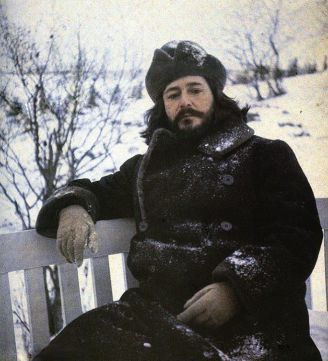
Accompanied by Olga Carlisle's intimate introduction and complemented with Andreyev's own extraordinarily beautiful self portrait photography, this is truly a work of visions.
Leonid Nikolayevich Andreyev (Russian: Леонид Николаевич Андреев; 1871-1919) was a Russian playwright and short-story writer who led the Expressionist movement in the national literature. He was active between the revolution of 1905 and the Communist revolution which finally overthrew the Tsarist government. His first story published was About a Poor Student, a narrative based upon his own experiences. It was not, however, until Gorky discovered him by stories appearing in the Moscow Courier and elsewhere that Andreyevs literary career really began. His first collection of stories appeared in 1901, and sold a quarter-million copies in short time. He was hailed as a new star in Russia, where his name soon became a byword. He published his short story, In the Fog in 1902. Although he started out in the Russian vein he soon startled his readers by his eccentricities, which grew even faster than his fame. His two best known stories may be The Red Laugh (1904) and The Seven Who Were Hanged (1908). His dramas include the Symbolist plays The Life of Man (1906), Tsar Hunger (1907), Black Masks (1908), Anathema (1909) and He Who Gets Slapped (1915).
I've been in love with the idea of Leonid Andreyev since I was a teenager. My love for Russian history predates that by several years, but I was about 15 or so when I read an article about Russian literature of the early 20th century, my historical period of choice.
I've always been embarrassingly deficient in Russian literature, and I was hoping to remedy that by finding some authors to read. (This project remains neglected.) In any event, the article listed some of the better known Russian writers of the time, but there was also a brief, cryptic reference to Andreyev and his stories about "murder and insanity." My immediate reaction was "Screw those more famous authors! Why have I never heard of this guy?!"
It prompted a dozen-year-long odyssey of trying and failing to find his work in every bookstore I went to. I occasionally would stumble across mentions of him on the internet, like in a great Weird Fiction article about him a few years ago. I'd also find intriguing mentions of his stories and how his work became so bizarre that he eventually isolated his readers and fell from his position as one of the most popular writers in pre-WWI Russia. But the work itself was hard to find. I found some dubious public domain examples of his work, but I never would read them because I was afraid they'd be terrible.
I finally found this collection, edited and translated by his granddaughter. And I'm relieved to say that it not only lived up to my expectations but also surpassed them. His granddaughter is a superb writer in her own right who writes eloquently and movingly in the introduction about the grandfather she never met whose presence still loomed large over her family and Russian literary tradition years after his death.
I have seen Andreyev referred to as the "Russian Poe." I love Poe, but I feel like that comparison somehow manages to undersell how very strange Andreyev's work is. This collection includes several stories, all of them wonderful but undeniably odd. What struck me the most, though, was how very modern his work was. Most of these stories were written before 1910, but if I hadn't known that, I would have assumed they were contemporary. At first, I wondered if it was simply because the translations were fairly modern themselves, but there is one from another translator, and it displays the same quality.
Part of the reason they seem so modern is the subject matter, which would have been taboo for most writers of the time. Andreyev writes directly and without euphemisms about insanity, murder, and rape, among other things, but it never comes off as salacious. His characters are almost unanimously criminals, lunatics, revolutionaries, and prostitutes, but he writes with a great deal of psychological insight and empathy for them, without ever seeming like he is shying away from their darker sides. The result is hilarious, disturbing, touching, and thought-provoking.
Andreyev's writing style is as imaginative and unique as the subject matter. That surprised me because I feel like a writer's personality is often lost in translation. I was trying to think of an appropriate adjective to describe his work, and the best one I can think of is "fervent." There is a palpable energy to his writing, especially when he writes in first person, that took me surprise. In addition, he employs some of the most unusually vivid metaphors and imagery that I have ever read. He also has a knack for describing body language, gestures, and facial expressions that I recognized immediately but have never seen another writer describe.
This is one of the stronger short story collections I have read in that I thought all of the stories were good. The most famous is perhaps "The Seven That Were Hanged," a novella, really, about revolutionaries and criminals on death row. But my two favorites were "The Thought" and "The Red Laugh." The former is a first person account of a murderer recounting his crimes and desperately trying to argue that he is perfectly sane. It's chilling and weirdly funny and hauntingly believable.
"The Red Laugh" has been referred to as foreshadowing nuclear warfare. At first, I thought that was a stretch, but it really is shockingly modern, and the last few pages easily could have been a harrowing description of the aftermath of atomic warfare. It was written in 1904 as a response to the Russo-Japanese War, but it also captures the horrors of modern mechanized warfare some ten years before the rest of the world started writing about that during WWI. It's probably the most surreal description of warfare I've ever read. It managed to beat Gustav Hasford's The Short-timers, which I had thought was impossible to top for sheer insanity.
In addition to Andreyev's short stories, the collection also includes several of his photographs. He was an avid amateur photographer who loved experimenting with color photography. They're pretty interesting in their own right. My favorite is a self-portrait that is the most quintessentially Russian-looking picture I've ever seen:
Andreyev's "The Red Laugh" is one of the best, most horrific psychological war/macabre stories I have ever read. Insanely, highly recommended.
Every story in here is a gem-just don't purchase this edition for the photographs- they are criminally small, grainy, and poorly reproduced. A real shame, considering that Andreyev was an early adopter of color photography, and his work in this realm deserves a glossy, coffee-table publication.
This is an excellent compilation translated in English by Andreyev's granddaughter Olga Andreyev Carlisle, with an extensive introduction and beautiful photos. The book includes the stories The Thought (1902), At the Station (1904), The Thief (1904), The Abyss (1902); and his best known two short novels The Red Laugh (1904) and The Seven Who Were Hanged (1905). His fiction which can be seen as an early pioneer of existentialism, with an expressionistic style and themes. It seems that Andreyev has an obession with darker side of human soul, in the chaotic background of historical and social events leading early 20th century. He walks in the footsteps of Dostoevsky, but has a unique path.
'The Thought' really makes me want to reread Nabokov's 'Despair' because Nabokov was obviously parodying it. There are an incredible number of obvious references to it in Despair! The appeals to the reader, the relationship with his father, the reference to his handwriting, his environment's ever increasing encroachment on his thought processes, the mirror, the small dog, the children... I wonder if it's part of the comedy that Hermann, instead of copying Dostoesvky, was in fact copying a 'lesser' author. Probably. I feel my Nabokov prof should have pointed this out but I suppose there's just so much to talk about in 'Despair'...
Re: the others, I liked 'The Seven Who Were Hanged' much more than 'The Red Laugh' (which was just ridiculous) but really, these stories seem to suffer from the same amateurishness. They're repetitive and completely lacking in subtlety. Andreyev does have some really wonderful sentences though... his imagery is original & great. ...I think he could have really benefited from a good editor.
I don't have many more stories to read but I think I'll leave it unless I am forced to write an essay on him.