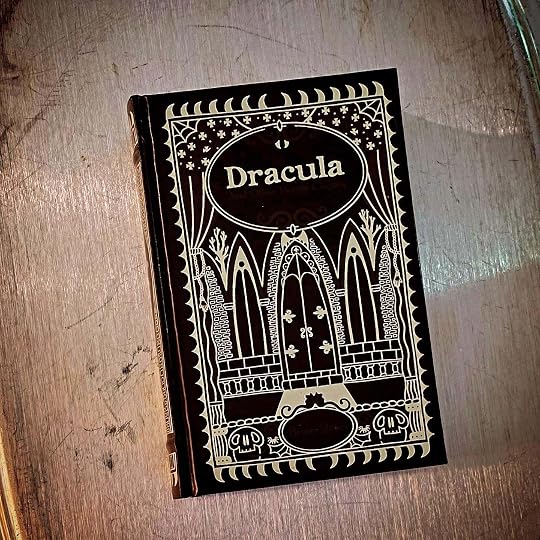
Dracula is still a real and living presence in modern Romania, and there is nothing like reading Bram Stoker’s 1897 novel Dracula in Romania during the month of October. During the day, the landscape of the Transylvanian plains seems tranquil, almost pastoral. One sees a shepherd and his dog guiding the sheep to their grazing place, or notices the red tassels that adorn the horses pulling the carts of Romany farmers; and the chief danger seems to be from the aggressive drivers that one sometimes encounters on Romanian roadways.
As night begins to fall, one feels a chill that seems to go deeper than anything that the autumn air alone could cause. One remembers the travel-book warnings that one should not drive in rural Romania after dark. When one finally reaches Sibiu or Brasov, just as the sun is setting, one’s eyes are drawn to the stern, austere beauty of the town’s churches. And just what was that little creature winging its unsteady way among the lighted steeples?...
So, I felt impelled to read Dracula in Romania. But then, I had also felt the need to read Dracula on my first visit to Ireland. Yes, I read Joyce and Yeats during my time in Ireland; but when I arrived in Stoker's hometown of Dublin, I found myself wanting to read Dracula first. And, more recently, when I was on a drive up and down the island of Great Britain, and found myself in Whitby in northeastern England, I recalled that one of this great novel's most terrifying episodes takes place at Whitby Harbour, and therefore I found myself turning once again to Dracula. The old bloodsucker won't leave me alone!
Bram Stoker no doubt knew that he had a good story idea in mind. He conducted diligent research regarding the historical Dracula, who died in 1477. The bloody-minded Vlad Țepeș or “Vlad the Impaler,” who as voivode of Wallachia committed unspeakable cruelties on a regular basis, more than earned his nickname as a Drăculești or Dracula, Romanian for “son of the dragon.” So outrageous were the atrocities committed by Vlad Dracula that he became linked with the abundant vampire folklore of Eastern Europe; and 400 years later, Bram Stoker gave Dracula to the world.
The power of Dracula starts with characterization generally, and with the title character in particular. Please allow Stoker to introduce him, as he is first seen by Jonathan Harker, a young English solicitor whose business it is to help facilitate Dracula’s plans to move from Transylvania to England:
Within stood a tall old man, clean-shaven save for a long white moustache, and clad in black from head to foot, without a single speck of color about him anywhere. His face was a strong – a very strong – aquiline, with high bridge of the thin nose and peculiarly arched nostrils, with lofty domed forehead, and hair growing scantily round the temples but profusely elsewhere. His eyebrows were very massive, almost meeting over the nose, and with bushy hair that seemed to curl in its own profusion. The mouth, so far as I could see it under the heavy moustache, was fixed and rather cruel-looking, with peculiarly sharp white teeth; these protruded over the lips, whose remarkable ruddiness showed astonishing vitality in a man of his years. For the rest, his ears were pale, and at the tops extremely pointed; the chin was broad and strong, and the cheeks firm though thin. The general effect was one of extraordinary pallor.
It is a chilling detail to note that, once Dracula has relocated from Transylvania to England, he grows younger -- black hair rather than white or grey, with more youthful features. Makes sense, I suppose: in Transylvania, the local peasants know what measures to take to keep the vampire at bay, and only the unwary will be ensnared. But in the rationalist late-19th-century of Queen Victoria's England, where remedies like crucifixes and garlic would be seen as "superstitious" -- well, the table is fairly set for a vampire to slake his thirst endlessly.
From his initial conversations with Harker, Dracula shows his pride in his aristocratic heritage, his disdain for the common people (he would not want even to sleep in the same earth with commoners). It is as if Stoker is suggesting, mischievously, that the move from titled lord to vampire is not a terribly long leap. Jonathan Harker, meanwhile, emerges as a smart and likeable young man; imprisoned in Dracula’s castle, he cannot pit his power against Dracula’s, and therefore he must make good use of his wits if he is to survive his fearful captivity.
Dracula's plans to relocate from Transylvania to England are of course successful; and, as mentioned above, one of the novel's most chilling episodes occurs when the Russian ship Demeter races into Whitby Harbour in the midst of a strangely heavy fog. A correspondent for the Dailygraph newspaper recounts what happened next.
[B]etween the piers, leaping from wave to wave as it rushed at headlong speed, swept the strange schooner before the blast, with all sail set, and gained the safety of the harbour. The searchlight followed her, and a shudder ran through all who saw her, for lashed to the helm was a corpse, with drooping head, which swung horribly to and from at each motion of the ship. No other form could be seen on deck at all. A great awe came on all as they realised that the ship, as if by a miracle, had found the harbour, unsteered by the hand of a dead man! (p. 103)
It is a horrifying archetype -- a ship of the dead -- and the Dailygraph correspondent records how "The man was simply fastened by his hands, tied one over the other, to a spoke of the wheel. Between the inner hand and the wood was a crucifix, the set of beads on which it was fastened being around both wrists and wheel" (pp. 104-05). Situational irony abounds; the reader knows what these details mean, but the characters witnessing these horrors do not.
Once Dracula has successfully arranged to be transported from his Transylvanian homeland to England, the reader sees that a struggle for the future of humanity itself has begun. Fortunately for humankind, Abraham Van Helsing is on the scene. Van Helsing, a great scientist whose areas of expertise extend beyond the natural to the supernatural, draws the reader’s interest and admiration (though Stoker’s attempts at rendering the character’s Dutch-inflected English sometimes seem forced).
Two young women who are dear friends -- Lucy Westenra and Mina Murray -- eventually become the most prominent targets of Dracula's vampiric depredations. Mina is Jonathan's fiancee, and she is desperately worried about Jonathan when his letters from Transylvania stop coming. Lucy, meanwhile, is so popular that she receives proposals of marriage, on the same day, from three highly eligible bachelors -- Arthur Holmwood, an aristocrat who will someday become Lord Godalming; Dr. John Seward, the director of an asylum just outside London; and Quincey Morris, a wealthy young American from Texas.
Lucy is Dracula's first target, and she becomes paler and weaker day by day; and it is heartbreaking to watch the long struggle for her life and soul, between Van Helsing and Lucy’s three suitors on the one hand (all of whom, at one point or another, donate their blood in an effort to stop Lucy’s long, slow decline toward death) and the implacable Dracula on the other. His vampiric effect upon Lucy becomes ever more evident throughout her decline; Dr. John Seward records at one point that "Whilst asleep [Lucy] looked stronger, although more haggard, and her breathing was softer; her open mouth showed the pale gums drawn back from the teeth, which thus looked positively longer and sharper than usual" (p. 202). The novel is filled with just this kind of forehadowing.
Van Helsing asks his new friends if they are prepared to fight the vampire, knowing the danger they all face. Mina, who is now married to Jonathan, records in her journal the commitment they all made together to do battle against the evil of Dracula:
When the Professor had done speaking, my husband looked in my eyes, and I in his; there was no need for speaking between us.
"I answer for Mina and myself," he said.
"Count me in, Professor," said Mr. Quincey Morris, laconically as usual.
"I am with you," said Lord Godalming, "for Lucy's sake, if for no other reason."
Dr. Seward simply nodded. The Professor stood up and, after laying his golden crucifix on the table, held out his hand on either side. I took his right hand, and Lord Godalming his left; Jonathan held my right hand with his left, and stretched across to Mr. Morris. So as we all joined hands, our solemn compact was made. I felt my heart turn icy cold, but it did not even occur to me to draw back. (p. 309)
A couple of unfortunate twists of fate make the outcome of Lucy’s struggle all the more tragic. And then one senses all the more strongly what is at stake as the vampire turns his diabolical attentions toward Mina. Throughout this part of the novel, it is exceedingly painful to witness the suffering of both Mina and Jonathan -- one growing ever weaker, ever more attuned to the mentality of the vampire who wants to make her one of his brides; the other aging before his time, as his fear for Mina makes his hair turn grey and then white (a reversal of the way we see Dracula growing unnaturally younger with all that blood he's been drinking).
Van Helsing is knowledgeable and courageous; Arthur, John, Jonathan, and Quincey do not know the realm of the supernatural as Van Helsing does, but they are all just as brave as he is. The five of them confront Dracula at a house that Dracula has rented in London; the confrontation does not go as Dracula would have liked, and the vampire makes a hasty disappearance. Van Helsing knows what that means:
He, our enemy, have gone away; he have gone back to his Castle in Transylvania. I know it so well, as if a great hand of fire wrote it on the wall....For this he took the money; for this he hurry at the last, lest we catch him before the sun go down....He is clever -- oh, so clever! He know that his game here was finish; and so he decide he go back home. He find ship going by the route he came, and he go in it. We go off now to find what ship.... (p. 406)
And with that, the novel Dracula returns to where it began, as Van Helsing, John, Arthur, Jonathan, and Mina travel overland to Transylvania, hoping to anticipate Dracula's sea-borne return and end the vampire's reign of terror once and for all. I liked that circular aspect of the novel's structure.
I also like how Stoker unfolds the grim story of Dracula through journals, newspaper clippings, letters, diaries, phonograph recordings, and the like. This epistolary, documentary quality contributes to the novel’s power, and somehow makes the novel’s bizarre events seem more plausible.
There are good reasons why this is one of the best-loved and most influential novels in all of literary history. If you have never read this novel, read it; if you have read it, read it again. Dracula will wait for you. He has all the time in the world.