The conquest of the North Pole was an elusive, almost impossible goal at the beginning of the last century. But a son of patrician parents, Robert E. Peary, and a son of sharecroppers, Matthew Henson, shared a dream of conquering the unconquered North Pole and were brave enough to risk their lives numerous times before they finally succeeded. Henson’s great physical stamina and his ability to speak Inuit and develop warm relationships with the peoples of the Arctic were indispensable to the quest. He mastered the complexities of the dog sled and led the team across the layers of ice that covered the frigid, threatening Arctic Ocean. Henson and Peary’s jubilation at finally reaching the Pole was later dashed when controversy swirled around their achievement. Even after their deed was recognized, African American Henson’s contribution was largely overlooked. It took the world many years to hail him as a hero of exploration.
Dolores Johnson is a journalist who has worked on newspapers in Oregon, California, Wyoming and Colorado, but she always wanted to write and sell a murder mystery. She tried writing books about an investigative reporter and a newspaper editor, but it wasn't until she wrote a book about a dry cleaner, using her background as a free-lance writer and field reporter for American Drycleaner, that she met with success.
(NOT A NEW REVIEW; JUST SHELVED ON NEW "NAT GEO" BOOKSHELF)
MEA CUPLA: Having spent so much of my adult life overseas, I realize that I have been inexcusably ill-informed about certain issues here in my own country, particularly our fraught history of race relations and the Black Lives Matter movement. So anyway, as just an initial small step to correct this appalling lack of awareness, I’m adding a “Black History” bookshelf here on GR, beginning this excellent if slim biography of Matthew Henson, disputably the first man of any color to reach the North Pole.
Arctic or Antarctic, polar exploration is always brutal; but it’s particularly difficult in the north where there is literally no ground to stand on – there’s just ice above and water below, and that’s it. Still, the history of Robert Peary’s and Matthew Henson’s eight – eight! – attempts to reach the Pole were particularly painful. During their final successful attempt in 1909, Henson literally hauled Peary across the ice for well over a a week, as Peary had lost eight toes to frostbite some eleven years earlier and could barely walk. Also, while scouting ahead just 15 miles south of the pole, Henson and his dog team fell through the ice and were only barely rescued from the frigid water by one of the party’s Inuit members.*
Not having read much about either Peary or Henson before, I was surprised to discover that upon their return, Peary’s party learned that a competing (and more media-friendly) expedition lead by one Dr. Cook claimed to have reached the Pole a full year earlier; it then took a six-month investigation for Cook to be exposed as a fraud and Peary’s claim to be unanimously recognized. But by that time, Peary had ceased all contact with Henson; and so when the accolades and awards came in – a Hubbard Medal (the National Geographi Society’s highest honor), full Navy pension, Congressional recognition, etc. – it all went straight to Peary, with no mention of Henson. So while Peary went on to a comfortable retirement and international acclaim, Henson found a job parking cars in Brooklyn, (although black politicians some of Henson’s friends finally persuaded President Taft to award Henson the job of “messenger boy” at the U.S. Customs House in New York City).
Why this sudden rift, after some 22 years of shared exploration? Certainly, Peary deserves credit for sticking with Henson in the first place – he was smart enough to recognize that Henson was simply the best man for the job, regardless of his race. And yet...this was still just 40 years after the Civil War. As one source puts it:
‘But Peary, who author Fergus Fleming called “the most unpleasant man in the annals of polar exploration,” had no interest in sharing the glory of the accomplishment with any other man, especially a black man. Years before his quest for the Pole commenced, Peary had written to his mother, “I must be the peer or superior of those about me to be comfortable.”
‘And Henson made Peary very uncomfortable indeed. While Peary viewed him as an inferior, it was Henson who was essentially the de facto leader of the Polar expeditions – Henson who took care of the other men, dogs, and supplies; Henson who spoke the Eskimo language; Henson who fixed the sledges (tough sleds) and used those sledges to pull Peary, who’s walking ability was hampered by the loss of 8 of his toes to frostbite on a previous expedition, to and from the Pole. Without the skills of Matthew Henson, the American flag would not likely have been the first atop the world.
‘Yet during the 1909 expedition, Peary had secretly planned to leave Henson behind once they got close to the Pole, so that he could claim farthest north all for himself. But the expedition made better time than he realized (it’s hard to keep track when you’re laying in a sled), and the team landed at the Pole before he had a chance to ditch the others.
‘Crestfallen that he had to share the glory of the moment with 4 Eskimos and a black man, Peary immediately ceased to speak to Henson, the man who had saved his life on a previous expedition and had remained absolutely loyal to him for 22 years when every other member of the expeditions had left because of Peary’s insufferable personality and demands. Unwilling to share the resulting fame, Peary forbade Henson to write, lecture, or grant interviews about the expedition. Henson had used his own camera to take 100 pictures on the trip and used his own money to develop them. Peary asked to borrow these pictures and then never gave them back.’
Thankfully – if belatedly – Henson did at least get a portion of the recognition he deserved. In 1944, Congress issued a medal honoring all members of the Peary expedition; and in 1954, President Eisenhower held a White House reception for Henson and his wife. And finally, in 2000, the National Geographic Society posthumously awarded Henson its Hubbard Medal – the same award given to Peary 91 years earlier. Today, the bodies of Henson and his wife Lucy lie in Arlington Cemetery next to that of Peary, beneath a tombstone that reads: “The lure of the Arctic is tugging at my heart. To me the trail is calling. The old trail. The trail that is always new.”
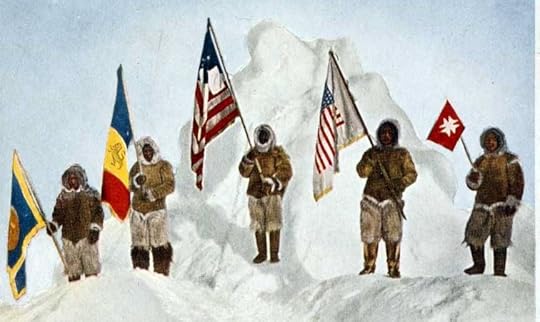
* Just as Henson deserves full recognition for his feats, so too do the Inuit members of the expedition – Seegloo, Egingwah, Ooquesh and Ootah, (seen below; Henson is holding the U.S. flag). Interestingly, humorously and oh-so-tellingly, the Inuit were amazed to finally reach the Pole after so many years and realize it was just another expanse of ice; “but there's nothing here,” said a disappointed Ootah, who had earlier saved Henson from the black water and then again saved Henson's frozen feet by warming them on his bare stomach).
By the side of Admiral Robert Peary was the African American, Mathew Henson. But few know that a black man was also first to arrive at the North Pole.
This book is a fast read and gives interesting insight into the 16+ year relationship of these two man. Sadly Henson received no credit or rewards like Peary.
There is so much history out in the world. I wish I could adsorb the knowledge like a sponge.
Excellent introduction to more details about Matthew Henson's incredible strengths as an explorer and dedication so one can know a bit more than that he was the first known person to be at the North Pole!
The historical images and facts are presented well. There's a lot to unpack in terms of what's problematic or complicated as well as awesome and impressive about the story and the past. I think it is a great book for discussion or for older audiences to use as a starting point. I definitely want to read his autobiography, now!
It's published by National Geographic, who were horribly dismissive of Matthew Henson and his achievements at the time, and that is somewhat dealt with ~ the bulk of the story is pretty factual, based on pictures and accounts, so it's only in the more editorial moments (like the conclusion) that it feels awkward and very minimizing of the reality of Mr. Henson's story.
A spellbinding account, with well-curated photographs giving credence to the tale. Henson was a great man, known for his kindness, intelligence, and resourcefulness, who deserved better than he got from his fellow explorer, Peary (not a likeable person, as monomaniacal about reaching the North Pole as Captain Ahab in conquering Moby Dick); I gave this book 4 stars mainly because Peary's attitude towards Henson is so maddeningly utilitarian. All of Henson's descendants and relatives should wear his name proudly!
This is a great photobiography of Matthew Henson - the first African American to make it to the North Pole with Robert Peary on April 6th, 1909. This is a fascinating story about how Peary saw beyond Henson's skin color and chose him to assist on the multiple attempts to make it to the North Pole. Henson was definitely the man for the job. The Inuit people loved him and Peary trusted him. I found it interesting to learn about the meteorites too!
I enjoyed learning about Matthew A. Henson and Peary making it to the North Pole. It is sad that it took so long for Henson to get his recognition, but he finally did.
The simple and powerful story of Matthew Henson, the African American self-made explorer who traveled to the North Pole as his life's mission and a natural outdoorsman. The photographs tell the story as much as the words of what Henson went through in order to make it, especially in the midst of African American oppression, failed personal relationships, a love for the Inuits, and a resounding need to complete the mission that took him mutliple tries.
The story is as much about the other man, Robert Peary who was interested in getting to the North Pole and Henson who was originally brought along as Peary's manservant, but then led the sledges, planned the trips and essentially made it to the North Pole an hour before Peary and his small crew (of the same expeditiary unit) made it but also how it was spoiled by the false claims of a Dr. Cook who "made it to the North Pole" about a year before Henson and Peary.
I appreciated that the National Geographic book by Dolores Johnson also shared personal issues, the fundraising that had to take place to get them there, but also the hardships Henson endured in having to take on menial jobs in between his expeditions. And also it didn't leave out (though it was somewhat of an aside) that both Peary and Henson fathered children by the Inuit's who helped them survive so far north. Theme in history? I think so.
Overall it was a great jaunt into a piece of history that I will never experience, per se. The writing is captivating in it's easiness and straightforwardness.
How would you like to be part of the first successful expedition to the North Pole – indeed, be the first (with assistance from Inuit guides) to set foot on the North Pole – but then get none of the credit? This is exactly what happened to Polar Explorer Matthew Henson, and the reason was because he was African American. Fortunately, Dolores Johnson’s appealing biography sets forth in great detail Henson’s greatest accomplishment. Henson and adventurer Robert Peary teamed up six times before reaching the North Pole in 1909. Henson’s abilities were imperative to their eventual success: Henson befriended the Inuit people, learned to speak their language, learned how to drive a sled dog team, and became an expert in surviving in the Arctic. When Peary and Henson finally returned from their final, successful trip to the North Pole, they learned someone else had falsely claimed to have reached it first. Although the record was finally set straight for Peary, it was not until decades later that Henson’s contributions were recognized. Johnson’s excellent biography of Henson was made a Selector’s Choice on the Outstanding Science Trade Books list of recommended titles, with good reason. As School Library Journal notes, “Fascinating archival photographs document the conditions at Arctic Circle and help tell the explorer’s inspiring story.” Onward brings this intrepid African-American adventurer’s life to middle-school readers, and gives Henson the recognition he truly deserved.
(64 pgs) A quick read. This National Geographic book does not meet the high standard of other NG books I have read. Many of the photographs are out of focus. The writing is very dry. I found the mention of Peary and Henson leaving their eskimo wives and children behind to be troubling. Although the book is probably written for young people it should really have mentioned that before contact with the outside world the Inuit shared their possessions and women with visitors. This was standard and a courtesy and in Inuit tradition was not considered wrong; and in fact was considered a generous thing to do. And to bring the children back into the white world would have created untold hardship because of prejudice and because it would have robbed them of their culture. I don't think the author was aware of this aspect of Inuit behavior. It is obvious (at least to me) that she judged behavior based upon white, American cultural values at the time. I would not recommend this book.
After several failed attempts with his partner Robert Peary, African-American explorer Matthew Henson was one of the first men to set foot on the North Pole. Although Henson's warm relationship with the Inuit people (he learned their language and taught other men on the expeditions about their culture) and his skill with dog sledging were integral to their success, Henson was not recognized for his achievements until some time later. Henson was posthumously awarded the National Geographic Society's Hubbard Medal (their highest honor) nearly 100 years after Peary was given the same award for the same expedition.
This biography is detailed enough to be useful for school work and its awesome photographs and exciting story will appeal as recreational reading for young explorers.
Wow, did this guy get rooked! They story is both inspiring and depressing - he was an incredible person and explorer, and he got so many bad breaks because he was African American. I think Peary took him and the Inuit with him on purpose so he could claim all the glory without anyone along who would demand that it would be a shared victory. Too bad he couldn't have gotten the recognition he deserved while still living.
Grades 7-9. Not at all what I expected. Did not leave me with a good impression of Matthew Henson and an even less of a good impression of his partner Naval Officer Robert Perry. Despicable treatment of the Inuit people. The book is published by National Geographic, who originally sponsored the two explorers. Therefore, there is not a great deal of depth to the inappropriate actions of Henson and Perry. Sad.
A fantastic book about a lesser known explorer who has made amazing contributions in exploration and science. Matthew Henson was the first man to actually make it to the North Pole but because of the color of his skin, the credit was given to another explorer. This is a really interesting account of his life and contributions. Intended for children who are a little bit older (4th grade and up).
Interesting read although a bit disconcerting to find a typo in the introduction. Important story, well told. Good to see Henson get full credit for his work. Peary was infuriated that Cook stole his thunder and took credit for discovering the pole, when it was Henson who truly got there first.