

What do you think?
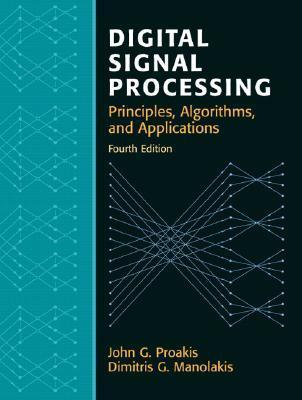
Digital Signal Processing: Principles, Algorithms, and Applications
A significant revision of a best-selling text for the introductory digital signal processing course. This book presents the fundamentals of discrete-time signals, systems, and modern digital processing and applications for students in electrical engineering, computer engineering, and computer science.The book is suitable for either a one-semester or a two-semester undergraduate level course in discrete systems and digital signal processing. It is also intended for use in a one-semester first-year graduate-level course in digital signal processing.
1104 pages, Hardcover
First published January 16, 1992
Ratings & Reviews
Friends & Following
Create a free account to discover what your friends think of this book!
Community Reviews
Displaying 1 - 22 of 22 reviews

January 17, 2022
Perfect book. But not for reading. Every single thing is described in maximum detail by the authors; therefore, it is boring to read but great to find solutions.
I consider this book being equivalent to stackoverflow.com for engineers.
I consider this book being equivalent to stackoverflow.com for engineers.
February 18, 2010
The essential textbook on DSP. 4th year EE coursebook
March 2, 2013
I just wish I had more time to read this book! This is THE best book for Signal Processing. Lucid and Comprehensive.

May 14, 2013
its a gud book to be reffered for the exams.
Want to Read
November 24, 2014It's a wonderful book for me to read about Digital Signal Processing.
February 15, 2025
Pros: This is the textbook for a DSP course at my university.
Cons: I find that the book contains numerous errors in mathematical notation, making it both confusing and time-consuming to interpret and understand.
For example, in the discrete-time system, the author denotes y(n) = T(x(n)), which is incorrect in function notation. From my perspective, the correct notation should be y(n) = [T(x)](n). Here, T(x) represents a mapping that operates on a sequence (either finite or infinite) and produces another sequence, y, with n serving as the index of the new sequence.
In addition, in the chapter Discrete-time signal and system, the author wrote the Convolution formula as y(n) = h(n) * x(n). This is a completely incorrect mathematical formulation. Even though the Convolution formulas on Wikipedia are defined more precisely (https://en.wikipedia.org/wiki/Convolu...).
There are numerous other mathematical errors.
If the author adhered more strictly to mathematical notation, I would be able to read and understand this book and its principles more quickly
Cons: I find that the book contains numerous errors in mathematical notation, making it both confusing and time-consuming to interpret and understand.
For example, in the discrete-time system, the author denotes y(n) = T(x(n)), which is incorrect in function notation. From my perspective, the correct notation should be y(n) = [T(x)](n). Here, T(x) represents a mapping that operates on a sequence (either finite or infinite) and produces another sequence, y, with n serving as the index of the new sequence.
In addition, in the chapter Discrete-time signal and system, the author wrote the Convolution formula as y(n) = h(n) * x(n). This is a completely incorrect mathematical formulation. Even though the Convolution formulas on Wikipedia are defined more precisely (https://en.wikipedia.org/wiki/Convolu...).
There are numerous other mathematical errors.
If the author adhered more strictly to mathematical notation, I would be able to read and understand this book and its principles more quickly

December 5, 2025
sucks. Just really sucks. Many a painful hour has been spent on this flaming pile of garbage. Maybe the book was just written for people vastly more intelligent than I, but I found it very challenging to understand. You MUST be very very very good at math to understand this completely. Would not recommend for those who are looking for a gentle introduction. The ratio of words to math is like 1/2. Literally incomprehensible unless you're some kind of wizard. Oh, yeah, and also there's like a bunch of mistakes in the book and solutions manual. So have fun wasting an entire day trying to figure out why you messed up a problem, when it was actually just a mistake in the book :))

October 8, 2017
Though not clear and intuitive in the first go, you see the beauty as you read and re-read. This is not an introductory text in Digital Signal Processing, some intuitions, or rather the required maturity, has to be formed before considering reading this book.
Read
July 6, 2019Lpi

Read
June 22, 2022l;kjn

July 14, 2023
I hate you even more
May 17, 2025
It's helpful in electrical engineering works
This entire review has been hidden because of spoilers.

December 8, 2016
For a complete newbie to Digital Signal Processing, this was a clear and fun read. Notation was very clear, lots of examples, and good amount of topics covered. I used this alongside a Masters level SSP course with no prior signal theory experience and didn't get too lost - so the book did it's job as a student text!

May 30, 2009
Although it takes some getting used to, once you get comfortable with it, this is a great DSP text. Good explanations about the underlying math, and also some helpful practical examples of application. My first point of reference for DSP math.

September 2, 2007
Buku ini adalah buku teks mata kuliah, Pengolahan Sinyal Digital. Dan, mau tahu aku dapat nilai apa? A! Yippie....

October 29, 2008
Textbook for ECE 437, Digital Signal Processing I.

February 19, 2011
لا تقررررب !!
Want to Read
August 24, 2011i am happy ,i get this book.
Read
October 10, 2013i thnks its a good book for digital process
May 11, 2014
Undoubtedly this is the best book for digital signal processing.
Displaying 1 - 22 of 22 reviews