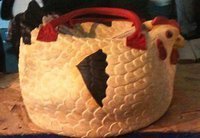
"The gift of a traditional Bride Box leads Mamur Zapt into a complex and intriuging investigation" Cairo, 1912. The Pasha receives an unexpected gift: a traditional Bride Box. When opened, however, the box contains an unwelcome jolt from the past . . . At the same time, a little girl is discovered riding under a train from Luxor - and the Mamur Zapt, Head of the Khedive's Secret Police, is called in to investigate. He soon finds himself confronting a political storm as the end of British rule approaches and his investigations uncover a tangled web of family loyalties and betrayals, with its roots in a slave trade long supposed to have been stamped out in Egypt.
Michael Pearce grew up in the (then) Anglo-Egyptian Sudan. He returned there later to teach, and retains a human rights interest in the area. He retired from his academic post to write full time.
In our age of instant everything, it is hard to remember what life used to be like—back when travel by train was the fastest option and considered so much faster than travel by donkey, when letter post was the ultimate in communication and when life proceeded at a much slower pace, albeit with sudden surges in action. This novel catches that pacing really well. It is still a modern novel in that there are none of the flowery descriptions and diversions that one encounters in 19th century literature (I always have to find a slowed down, more patient head-space before I tackle older fiction). Pearce’s investigators know that they have to do things at the proper pace (i.e. the rural Egyptian pace) or they will jeopardize their results.
I had two reasons for choosing this novel—it was recommended as summer reading on CBC radio and it was set in Egypt, a country which fascinates me (and which I kick myself regularly for neglecting to visit before the current upheaval). I have consumed a certain amount of Ancient Egyptian fiction, but this was my first foray into early 20th century Egypt. Jumping in at the 17th book in the series, I found I was still able to sort everybody out—I would probably be fonder of some of them if I had been reading from the beginning, but I liked them well enough on short acquaintance.
If you like things tied up in neat and tidy bows, this may not be your book. Pearce acknowledges the messiness of life and the dissatisfaction of having the best outcome not being necessarily the most just outcome. Reality, in other words.
It seems that the slower pace of life just 50 years ago has really been brought to my attention recently—just this morning, I was chatting with a student assistant about the differences between using typewriters and computers. We still have an electric typewriter in the library’s labelling department for use on one specific type of label—and our students universally find the technology difficult. If I confess that I learned to type on an ancient manual typewriter, I immediately become a little old lady in their eyes. (Additionally, I had to fight to take typing in high school—the thinking back then was that I wanted to end up as a boss, rather than a secretary, so I shouldn’t learn how to type because that was a secretarial skill. Since I now make my living by typing, I’m very glad I didn’t listen to that argument). In addition to the typing issue, I’ve been working on a writer’s archival papers the last several weeks and I find modern correspondence by email much more confusing to sort through than the stately letters of the past, which may refer to former letters, but don’t just attach copies of them to the body of the current communication! Content of archives is certainly shifting!
Not that I’m unhappy about using computers vs. typewriters or email vs. snail mail—just an observation about how much life has changed during my lifetime. It makes me wonder how my grandfather felt, going from plowing with a mule to farm mechanization to seeing a man land on the moon. He never did get the hang of reversing a car (my father, as a boy, had to back the car out of the garage always and as a result could drive in reverse at high speed for quite a distance—I’m somewhere in between, reversing slowly, carefully and not always accurately.)
It also makes me wonder if we can maintain the speed of change into the future—what will our society be doing by the end of my life? If I’m falling behind now, how will I feel at 90? Eek!
I was so thrilled to see this return of the Mamur Zapt (Gareth Owen), his fiery lady love Zeinab, serious, hard-working lawyer Mahmoud and my second-favorite character after Owen, Georgiades ("the Greek"). This is one of my favorite historical mystery series and I've collected them all and try to push them on all of my mystery-loving acquaintances; I love the dry British humor, the warmth and humanity of the characters, and author Michael Pearce's brilliant dialogue.
This mystery opens with two terrible discoveries - a little girl has been found clinging to the undercarriage of a Cairo-bound train, and among the cargo on the train is a traditional bride box which should contain a trousseau - but instead holds the decomposing body of the girl's older sister. Owen soon suspects slavers might be operating in the south, where the child and the bride box hail from, despite wide-held optimistic belief that the British had abolished the shameful practice. He and Mahmoud investigate only to find large quantities of guns being moved as well...
My favorite part of this wonderful mystery was wandering Cairo alongside shambling, unkempt Georgiades as he chats up witnesses, cajoles confidences out of them and eats his way through the bazaars, gathering information unobtrusively - he puts a smile on my face every time, and the dialogue is priceless! I hope we don't have to wait so long for the next book. Highly recommended.
I was looking for a light mystery and this one was on my Kindle, probably a leftover from last year's trip to Egypt. But I found the book dull and wearing (although short), even if it is rather atmospheric. I'm not sure if the first 16 in the series are fresher, but I fear that I am unlikely to find out.
Another entry in Michael Pearce's ongoing love letter to Colonial Egypt. This series is endearing and wonderful in the same ways that the "No. 1 Ladies Detective Agency" series is -- mixing the provincial with the wise to great effect. As long as Pearce keeps writing them, I'll keep reading them!
Leila, a 9 year old who escaped from slavers, is brought to the Mamur Zapt. Britain has recently abolished its Egyptian anti-slavery office, and is considering disbanding the Sudan office, in the mistaken belief that it has successfully eradicated slavery.
At the same time, the Parquet becomes involved when a child's body is found in a bride box.
The two cases converge when Leila recognizes the box as her sister's. With Owen and Mamoud each working their piece of the puzzle, it becomes clear that much is at stake as Egypt struggles, in 1913, to define a national identity.
The chronology of the series has broken down with this 17th book predating WWI, while the 16th book is set in post-war Egypt.
1912 Egypt -- a woman and her bride box; a little girl escaped by crouching under a train; guns in secret boxes; Egypt-Sudan age-old tensions; Egyptian-British tension; marriage skirmishes; learning-impaired disability; being killed for being kind; all tied up in a police procedural strung with native-colonial tension -- I could not put it down.
Egypt 1912 and the Sudan issue is large--those wanting unity and those liking the power of division. The slave trade underlies the plot, that and gun-running. Sudan, Egypt's slave market, had been part of Egypt seventy years ago. It was where they used to go to get slaves.
Solving the murder moves slowly as the Egyptians and the British work parallel. Egyptian police procedural is so different from American; same diligent search for villains and clues but much slower, more roundabout, more massaging information rather than questioning for answers. For a while, the slavery issue stays in the story but slips down the agenda. The bride box was even further down. Then it all comes together. Even as it does I wondered just how many bad guys there were.
The disabled son of the Pasha seems to have Down syndrome and a mother who loves him and a woman who is kind to him and pays for it. A woman with a bride box.
Finding out the murderer and the motive was a shock--taking myself into Egypt of 1912, I could see how the "it had to be" of it could happen but it was very sad, I thought.
I didn't mean to start this series with book 17, but it was the first one available. (I'm not sure why the library would have some books in a series, but not the first ones.) Perhaps because this was book 17, it took me a long while to sort out all the characters. The pace of this book is certainly much more leisurely than other books I've read recently, but maybe this is intentional on the part of the author, to indicate the pace in Egypt during this time period. It's a tragic story of young lives which are not valued, but an interesting one. The book ends on an ambiguous note, again perhaps to indicate the political climate of those times. (At least I think it ended - that's the trouble with eBooks, you don't know when you're near the end. It wouldn't turn the page, so I assume that I was done.)
This book resets the series timeline: it is now 1912 (the previous story ended after WWI), and events in the characters’ lives happened at different times than in previous stories. For instance, several characters have been married longer than the previous book established. It’s a little confusing if you have been following the series but I guess the author wanted a reboot. It’s also a little grimmer than previous stories.
What Alexander McCall Smith has done for Botswana, Michael Pearce doors for turn of the century Egypt. The characters are complex, the motivations Eastern. The clash of bureaucracies, Egyptian and British, yields to human interaction and cultural motivation. Every story is a treasure and this meanders into surprising nooks and crannies of Egyptian society.
Delighted to find a new Mamur Zapt. It took a little longer than usual to get into stride with the plot but things picked up later. Actually why I would give the story 3.7. Enjoy the accurate rendering of life in turn of the century Egypt. Some issues never seem to change.
Egypt and Sudan are the setting for a mystery with the Mamur Zapt in charge. The story is slow and a little hard to follow being written in the Middle Eastern style. Owen works for the Mamur Zapt and is tasked with who killed girl and put her into the Bride Box. Interesting.
Although the story is set in a difficult period (Egypt before the First World War), the manner of telling it and its depictions of life at that time make it a quick read.
In 1913, while Egypt’s nominal head is a Khedive, the country is actually controlled by the British High Commissioner. Captain Owen is the Mamur Zapt—head of the secret police—in Cairo. A young girl, Leila, is discovered hiding under a train from Luxor. She informs the authorities that she was sold by her father to a group of Sudanese but escaped before being put on a slave ship. Owen is asked to probe into the matter, for such activity is thought to have been eliminated.
Owen’s colleague Mahmoud works for the Parquet—Department of Prosecutions—which, although staffed by lawyers, investigates crimes. An odious shipment addressed to a Cairo Pasha is also unloaded from a Luxor train. The item is a Bride Box thought to contain the ‘bottom-drawer’ objects of a bride, but instead a young woman’s corpse is found inside. Mahmoud is assigned to the case.
Leila happens to spot the Bride Box and exclaims that it belongs to her elder sister, Soraya. Leila also identifies Soraya’s clothing from the box, confirming the identity of the deceased, so Mahmoud and Owen head to Soraya’s village. There they question a lineup of possible suspects and, in their investigations, uncover much more than slave trading and murder.
While the mystery aspects in this novel are light, the period details of life in the cities and villages, including the poverty and descriptions of the landscape, are extensive. Egypt in 1913 was undergoing tumultuous times, and Pearce brings out the conflict between the various ethnic groups admirably. He presents a balanced approach, with musings such as: “The Egyptian population is struggling under the oppression of the Pashas. Egypt is struggling under the rule of the foreigners. Who were the British to rule his country?”
While this is the seventeenth novel in the Mamur Zapt series, it can be enjoyed as a standalone. Recommended.
This review first appeared in the print magazine, Historical Novel Review Issue 65 (Aug 2013)
This is listed as the 17th in the Mamur Zapt series about Egypt under British rule from about 1905 to the 1st World War and I've read every one. They are always delightful, always fascinating. The Mamur Zapt, head of the secret police is Owen and the give and take between him, his colleagues and the Parquet, the Egyptian police, is wonderful as are the passages where Owen confronts the local population. However, because Pearce has written so many of these he can now drop description, whether of people or places and only now and then does he allow himself to write of Cairo itself, with the Nile in the background, the people going about their daily chores, the heat, the noise, the smells and that's too bad; it's what made this series so special.
Gareth is Mamur Zapt, the British head of the Egyptian secret police. A runaway little girl unwittingly gives him the information that slavers, though outlawed in both Egypt and Sudan, are operating nevertheless. He and his friend Mahmoud, who is looking for a murderer, travel to Upper Egypt, which they think is primitive and uncivilized. They eventually untangle several crimes, though not to their entire satisfaction. While this is usually an interesting series, this particular book seemed a bit flat.
This is the seventeenth in the continuing story of Gareth Cadwallader Owen, The Mamur Zapt, Head of the Khedive’s Secret Police in Cairo. We've now advanced to 1913 and the political climate remains volatile as the body of a young girl turns up dead in her own bride box. This is entertaining and thought-provoking.
I finished this book only to fairly give it my negative review. I barely got to know the first 4 characters before another 4 were shoved down my throat....new characters jump in from nowhere...constantly. I am not accustomed to Pearce's storytelling; not a fan of how it was written or the language between characters. Disappointed!
Smart,enjoyable mystery. The author is a retired academic who knows a lot about this culture from an Anglo's perspective. He does a good job of showing how the European character who had lived in Egypt for a long time sometimes still didn't really understand the nuances of the place. I enjoyed the characters even more than the plot.
I found this novel difficult to read and understand mainly because of the writing style. The plot had too many threads to it and the characters were flat and uninteresting.